Cosmology

Posted in Jazz, The Universe and Stuff with tags , , , , , on August 24, 2011 by telescoper

I don’t know why it’s taken me so long to get around the posting this piece, but I suppose it’s better late than never. It’s by the brilliant trio led by Paul Motian (drums) and featuring Joe Lovano on tenor sax with Bill Frisell on guitar. The album it’s taken from is called Trioism,  which was recorded in 1993. I’ve picked this particular track to put up as a taster because it’s entitled Cosmology, which just happens to be my day job…

JWST: Over and Out?

Posted in Science Politics, The Universe and Stuff with tags , , , , on August 23, 2011 by telescoper

News filtered through recently that the cost of the James Webb Space Telescope, which is already  threatened with cancellation owing to cuts in NASA’s budget, is now estimated to be around $8.7 billion dollars, about $2.2 billion higher than previous figures. In fact about a decade ago, when I was a lad, and chair of the old PPARC Astronomy Advisory Panel, the price tag of  the NGST (Next Generation Space Telescope), as it was then called, was put at significantly less than one billion dollars.

The implications of cancelling JWST are profound on both sides of the Atlantic. As Mark McCaughrean explains in detail over on the e-astronomer, the European Space Agency has already made a substantial investment in JWST and planned future contributions include the launch and substantial operating costs. The instrument development is nearly finished, but whether there will actually be a telescope to put instruments on remains to be seen. It’s clear that this, together with previous unilateral decisions by NASA, is putting some strain on the relationship with ESA.

There were many who reacted to the initial suggestion that JWST should be cancelled by arguing that it was mere political posturing by Republicans in the House of Representatives and that it could and would be reversed if appropriate campaigning took place. To this end there has been, e.g.,  a letter to the White House Science Advisor (here for non-US astronomers and there for US ones). There’s also been a letter of support from the President of the Royal Astronomical Society. NASA’s administrators have also apparently come up with a plan to divert funds from other projects to support it. These efforts notwithstanding I get the distinct feeling that cancellation of JWST is a very real prospect and it goes without saying that the chances of avoiding it are not helped by  the increased estimated expense.

I’ve talked about this to a number of astronomers and cosmologists over the summer and found very mixed views not only about  (a) whether JWST will be cancelled or not but also about (b) whether it should be cancelled or not. Even astronomers have expressed exasperation with the spiralling cost of JWST and pointed out that if we had known a decade ago that it would take so long and involve such an outlay then it would never have gone ahead in the first place.

So let me try a straw poll:

Testing Times

Posted in Cricket with tags , , , on August 22, 2011 by telescoper

Ugh. I seem to have come down with a nasty bug, which started as the sorest of sore throats but has since broadened its ambitions. Not very nice, particularly since I’ve got a lot on my plate this week.

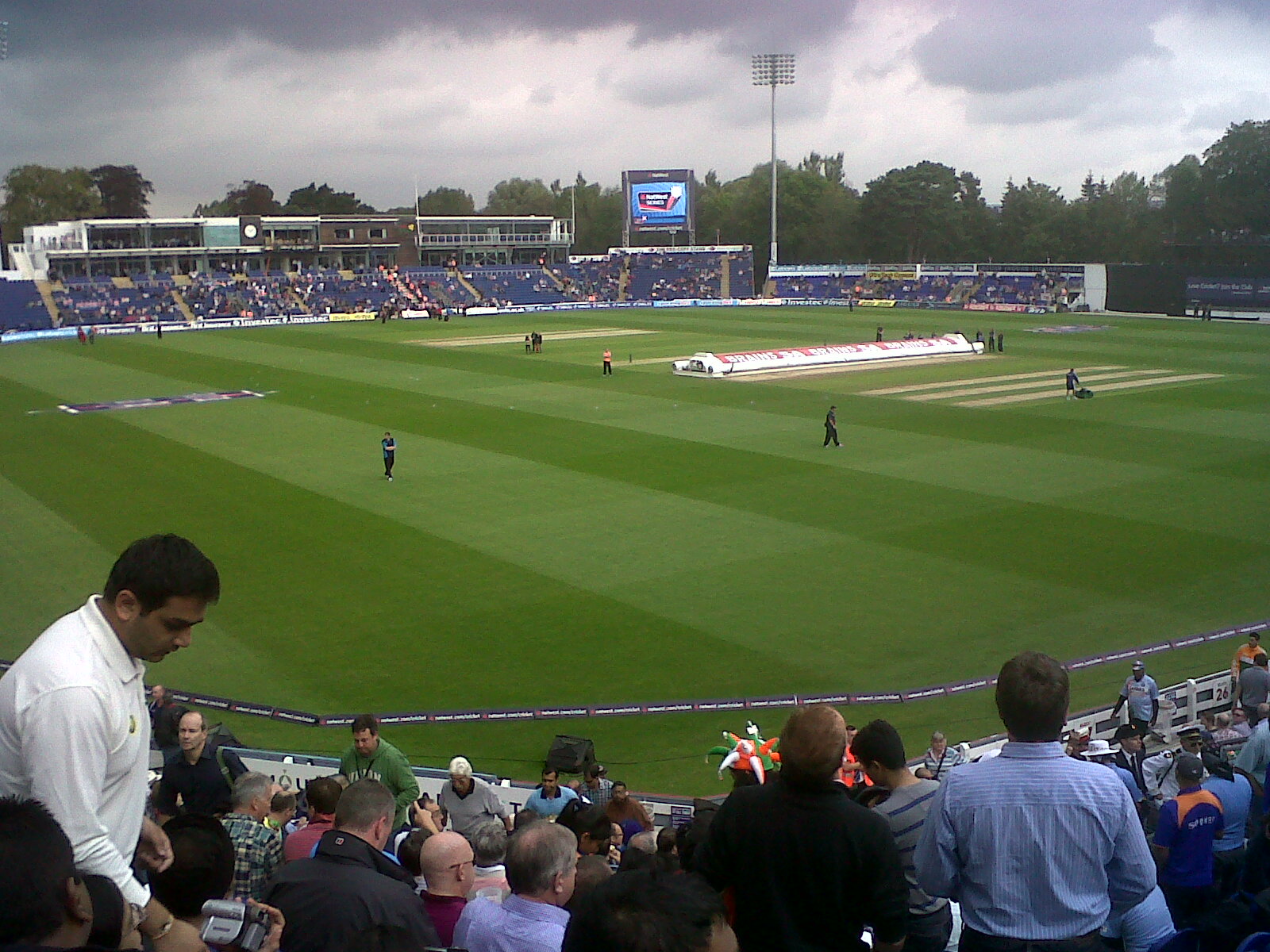
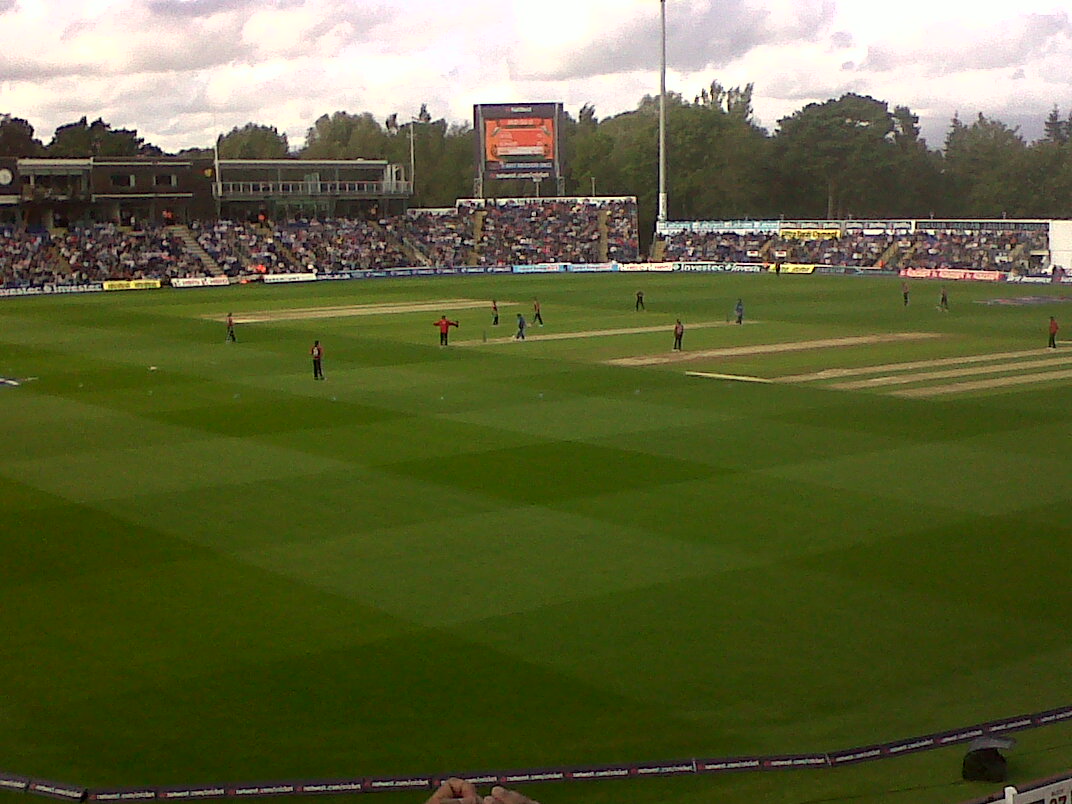
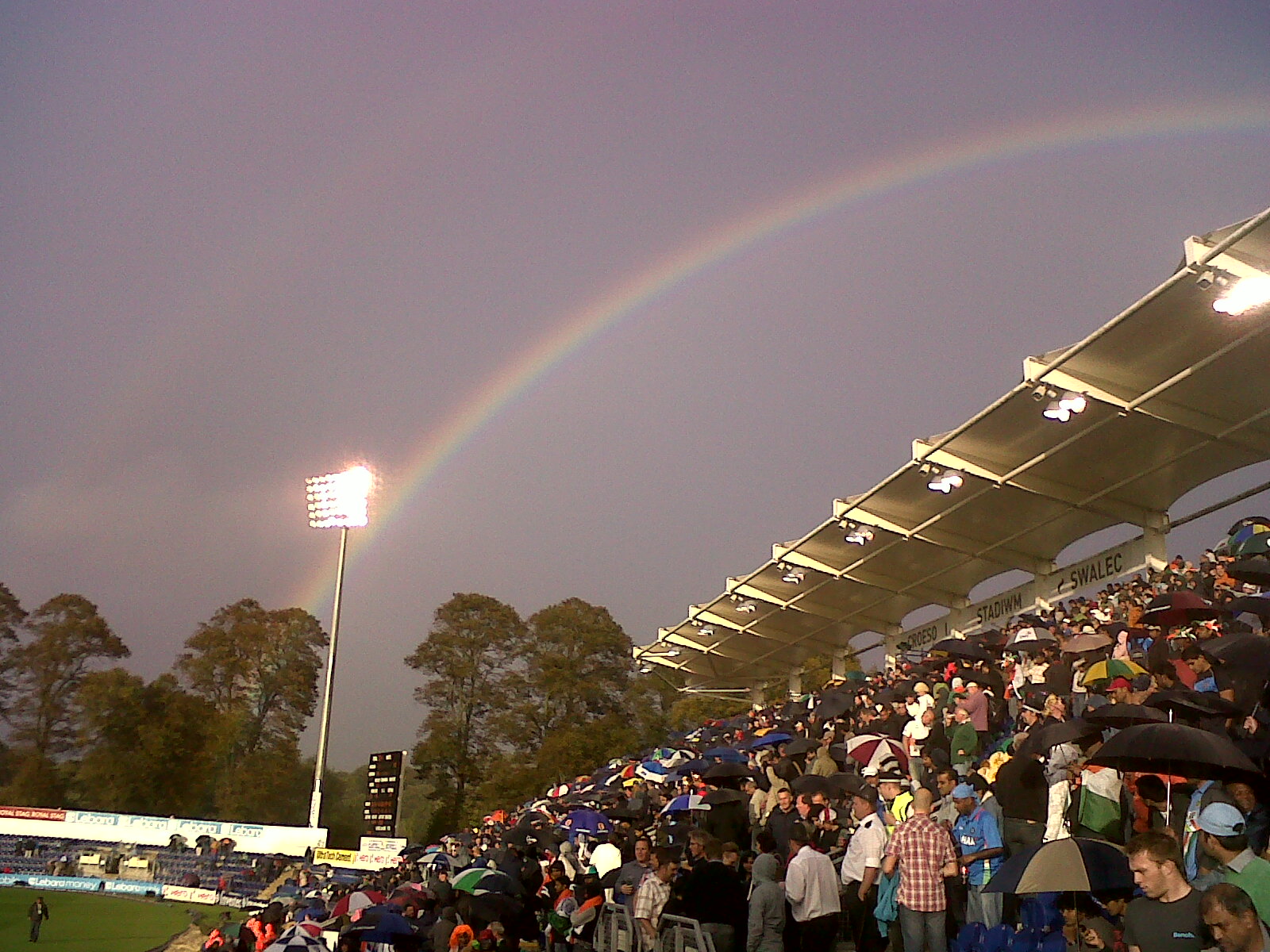
I have a feeling this may be a consequence of sitting in the rain for several hours on Saturday. The trip I mentioned in yesterday’s post was, in fact, to London SE11 in order to catch the Third Day’s play in the Fourth (and final) Test between England and India at The Oval. It’s been a long time since I was last there – about twenty years, in fact – and I’d almost forgotten the contrast between Kennington and St John’s Wood. Cricket at Lord’s is an altogether posher affair than at The Oval, you see. It’s also rather harder to get to from Paddington.

Anyway, I left Cardiff early and managed to meet up with an old pal (who still lives in South London and who got the tickets) in good time to get into the ground for the 11am start. It was quite sunny when proceedings opened with England resuming their first innings on 457-3 and looking to push on quickly. Within half an hour they lost the nightwatchman, James Anderson, quickly followed by Eoin Morgan. Bell and Bopara then put together a fine partnership until Ian Bell’s magnificent innings of 235 came to a close with England on 548-6. Matt Prior chipped in with 18 to take the score to 591-6 at lunch.

I reckoned England would probably want to score around 650 before declaring, but unfortunately the weather intervened and made this calculation irrelevant. It starting raining during the interval and didn’t really clear until about half past four. Play eventually resumed at 16.50, with time added on to make up for the disruption. Meanwhile, England declared – a wise decision, taken to ensure England would have enought time to bowl India out twice – so it was the tourists who came out to bat when play resumed.

In the first over, Sehwag hit two fours off Anderson and  was then out lbw, with India 8-1, which soon became 13-2 as Laxman departed, caught behind the wicket.  Tendulkar then arrived to the customary standing ovation and together with Dravid kept England’s fast bowlers at bay for a time.

But then, with the shadows lengthening, there followed one of the most fascinating hours of Test cricket I’ve ever seen. Graham Swann was introduced into the attack and immediately generated exceptional bounce and turn. He troubled both batsman until, with the score on 68, Tendulkar played a rash sweep shot which caught the top edge and dollied up a simple catch to James Anderson. In came the hapless Raina who looked all at sea. In fact he faced 29 balls without scoring a single run; he fell stumped, both literally and metaphorically. At 93-4 and with about 15 minutes to play, India sent in Sharma to play the role of nightwatchman.

At this stage England were smelling blood and had fielders around the bat like vultures waiting for the kill. I haven’t seen such attacking fields for an offspinner since watching old films of Jim Laker bowling at the Australians. Every ball looked dangerous.  Sharma didn’t survive long under the pressure. When he departed, for 1, that brought in the Indian captain Dhoni to partner the imperturbable Raul Dravid to the close at 103-5. India looked demoralised, England jubilant.

And with that I legged it back to Paddington and thence back home to Cardiff. A long day, good at both ends but with a damp patch in the middle.

POSTSCRIPT. India recovered well to score 300 all out  in their first innings, but that wasn’t enough to avoid the follow-on. They got a better start in the 2nd innings, but once again Tendulkar failed to get his 100th international century – just, this time; he was out for 91. Thereafter India collapsed hideously to 283 all out. England won by an innings and 8 runs, and completed a clean sweep. I wouldn’t have dared predict a 4-0 victory at the start of the series, but as it turned out England completely overwhelmed India.

And that’s the last Test cricket of this fascinating summer….

The Salutation

Posted in Poetry with tags , , on August 22, 2011 by telescoper

It’s been far too long since I posted a poem by my favourite of the metaphysical poets, Thomas Traherne (who lived from c. 1636 to 1674), so here’s another of his remarkable works, called The Salutation, in which he ponders the deepest questions of existence complete with authentic 17th century spelling…

These little Limbs,
These Eys and Hands which here I find,
This panting Heart wherwith my Life begins;
Where have ye been? Behind
What Curtain were ye from me hid so long!
Where was, in what Abyss, my new-made Tongue?

When silent I
So many thousand thousand Years
Beneath the Dust did in a Chaos ly,
How could I Smiles, or Tears,
Or Lips, or Hands, or Eys, or Ears perceiv?
Welcom ye Treasures which I now receiv.

I that so long
Was Nothing from Eternity,
Did little think such Joys as Ear and Tongue
To celebrat or see:
Such Sounds to hear, such Hands to feel, such Feet,
Beneath the Skies, on such a Ground to meet.

New burnisht Joys!
Which finest Gold and Pearl excell!
Such sacred Treasures are the Limbs of Boys
In which a Soul doth dwell:
Their organized Joints and azure Veins
More Wealth include than all the World contains.

From Dust I rise
And out of Nothing now awake;
These brighter Regions which salute mine Eys
A Gift from God I take:
The Earth, the Seas, the Light, the lofty Skies,
The Sun and Stars are mine; if these I prize.

A Stranger here,
Strange things doth meet, strange Glory see,
Strange Treasures lodg’d in this fair World appear,
Strange all and New to me:
But that they mine should be who Nothing was,
That Strangest is of all; yet brought to pass.

Cross Words

Posted in Crosswords with tags , , on August 21, 2011 by telescoper

I was out all day yesterday – of which more, perhaps, anon – but, as I usually do when I get an early train, I bought copy of the Saturday Guardian so that I could do the Prize Crossword during the journey.
When I settled into my seat and opened the paper I found quite a nice Araucaria puzzle which I completed in about 30 minutes. However, I noticed that the usual name and address bit for prize entries was missing and then it dawned on me that the number (25405) didn’t tally. Then the true enormity of the situation dawned on me – The Grauniad had erroneously printed Friday’s puzzle again in the Saturday newspaper. That’s the second time in as many weeks that the Guardian has messed up the crossword. After the last debacle you’d think they would have been a bit more careful.

Curiously the state of the Guardian’s crosswords preyed on my mind all day and developed into a full-blown mid-life crisis worthy of Reggie Perrin. I had a dawning realisation that so many of the things I do every day I do not because I enjoy them particularly but because they have become habits. The Guardian crossword is just one example. I started doing it over 20 years ago, and have won the prize seven or eight times over the years, but actually there have been very few in recent years that I enjoyed very much.

Part of the reason for this is that I started doing the excellent Azed puzzle in the Observer set by Jonathan Crowther. The Azed clues are not only extremely clever but also unfailingly sound in both grammar and syntax. The chance to submit your own clues to the monthly competition makes you realise how difficult it is to be both artful and rigorous. It’s a bit like how playing snooker on a full size table – which is impossibly difficult – leads you to appreciate even more the immense skill of the professional player. The other side of this is, of course, that it tends to raise your awareness of defects in other puzzles.

The Guardian’s puzzles have never been as strict as Azed, or others who follow in the steps of the great Ximenes, which is fair enough because they simply offer a different challenge. Araucaria, for example, remains popular because of his wonderful sense of humour – he’s one of the few setters who can make me laugh out loud – but the liberties he takes in some of his clues are enough to make me cringe. Unfortunately, the latest generation of setters include many who offer poorly constructed clues without the entertainment value to compensate. Frankly, I find most of them tedious. What I’m saying is that I’ve become a crossword snob.

Anyway, to cut a long story short, after realising the Guardian’s error yesterday I decided to experiment by (for the first time in my life) buying the Independent. Lo and behold, not just a very nice crossword indeed by Nestor but also a slightly trickier one in the supplement called Inquisitor.

So I’ve decided it’s time to stop buying the Saturday Guardian and switch to the Independent. The actual Guardian newspaper is a mess on Saturday’s anyway, lots of tedious supplements I never read, and there’s a big overlap in content with the Sunday Observer, not surprisingly given that they’re produced by the same people. The Independent is a neat tabloid format and I found the content refreshingly different from the Guardian. It’s quite a lot cheaper too. I may still have a go at the Guardian crossword occasionally – they’re all available free on the web – but I’m not going to buy the paper any more.

“Out with the old, in with the new” is the idea. There are a few other things I could apply that to, come to think of it…

Making shit up..

Posted in Uncategorized with tags , on August 21, 2011 by telescoper

People often accuse us cosmologists of making shit up, but at least we’re not as bad as cosmetologists (with whom we’re sometimes confused, at least in America)…

Now’s The Time

Posted in Jazz with tags , , on August 20, 2011 by telescoper

I’m up early and going to be out of here for the day, so here’s a bit of music to keep you going. It’s another of Charlie Parker‘s variations on the blues in F, this time called Now’s the Time.  It’s definitely one of the bluesiest of Bird’s blues, and indeed it’s quite close to the usual 12-bar chord progression:

| F7| F7| F7 |F7 | B♭7| B♭7| F7| F 7| C7| B♭7| F7| F7|

In fact this goes – if I’ve heard it right –

| F7| F7 | F7| F7| B♭7| B♭7|F7| D7| Gmi| C7| F7| C7|

No doubt people will correct* me for having cloth ears if I’m wrong but in any case it’s an all-time classic, so enjoy!

*Indeed so, and a more accurate set of changes that has been suggested to me is

F7|Bb7|F7|Cmi7 F7| Bb7|Bb7|F7|D7#9| Gmi7|C7|F7 D7|Gmi7 F7|

Is Space Expanding?

Posted in The Universe and Stuff with tags , , , , , , , , , on August 19, 2011 by telescoper

I think I’ve just got time for a quick post this lunchtime, so I’ll pick up on a topic that rose from a series of interchanges on Twitter this morning. As is the case with any interesting exchange of views, this conversation ended up quite some distance from its starting point, and I won’t have time to go all the way back to the beginning, but it was all to do with the “expansion of space“, a phrase one finds all over the place in books articles and web pages about cosmology at both popular and advanced levels.

What kicked the discussion off was an off-the-cuff humorous remark about the rate at which the Moon is receding from the Earth according to Hubble’s Law; the answer to which is “very slowly indeed”. Hubble’s law is v=H_0 d where v is the apparent recession velocity and d the distance, so for very small distance the speed of expansion is tiny. Strictly speaking, however, the velocity isn’t really observable – what we measure is the redshift, which we then interpret as being due to a velocity.

I chipped in with a comment to the effect that Hubble’s law didn’t apply to the Earth-Moon system (or to the whole Solar System, or for that matter to the Milky Way Galaxy or to the Local Group either) as these are held together by local gravitational effects and do not participate in the cosmic expansion.

To that came the rejoinder that surely these structures are expanding, just very slowly because they are small and that effect is counteracted by motions associated with local structures which “fight against” the “underlying expansion” of space.

But this also makes me uncomfortable, hence this post. It’s not that I think this is necessarily a misconception. The “expansion of space” can be a useful thing to discuss in a pedagogical context. However, as someone once said, teaching physics involves ever-decreasing circles of deception, and the more you think about the language of expanding space the less comfortable you should feel about it, and the more careful you should be in using it as anything other than a metaphor. I’d say it probably belongs to the category of things that Wolfgang Pauli would have described as “not even wrong”, in the sense that it’s more meaningless than incorrect.

Let me briefly try to explain why. In cosmology we assume that the Universe is homogeneous and isotropic and consequently that the space-time is described by the Friedmann-Lemaître-Robertson-Walker metric, which can be written

ds^{2} = c^{2} dt^{2}-a^{2}(t) d\sigma^{2}

in which d\sigma^2 describes the (fixed) geometry of a three-dimensional homogeneous space; this spatial part does not depend on time. The imposition of spatial homogeneity selects a preferred time coordinate t, defined such that observers can synchronize watches according to the local density of matter – points in space-time at which the matter density is the same are defined to be at the same time.

The presence of the scale factor a(t) in front of the spatial 3-metric allows the overall 4-metric to change with time, but only in such a way that preserves the spatial geometry, in other words the spatial sections can have different scales at different times, but always have the same shape. It’s a consequence of Einstein’s equations of General Relativity that a Universe described by the FLRW metric must evolve with time (at least in the absence of a cosmological constant). In an expanding universe a(t) increases with t and this increase naturally accounts for Hubble’s law, with  H(t)=\dot{a}/a but only if you define velocities and distances in the particular way suggested by the coordinates used.

So how do we interpret this?

Well, there are (at least) two different interpretations depending on your choice of coordinates.  One way to do it is to pick spatial coordinates such that the positions of galaxies change with time; in this choice the redshift of galaxy observed from another is due to their relative motion. Another way to do it is to use coordinates in which the galaxy positions are  fixed; these are called comoving coordinates.  In general relativity we can switch between one view and the other and the observable effect (i.e. the redshift) is the same in either.

Most cosmologists use comoving coordinates (because it’s generally a lot easier that way), and it’s this second interpretation that encourages one to think not about things moving but about space itself expanding. The danger with that is that it sometimes leads one to endow “space” (whatever that means) with physical attributes that it doesn’t really possess. This is most often seen in the analogy of galaxies being the raisins in a pudding, with “space” being the dough that expands as the pudding cooks taking the raisins away from each other. This analogy conveys some idea of the effect of homogeneous expansion, but isn’t really right. Raisins and dough are both made of, you know, stuff. Space isn’t.

In support of my criticism I quote:

 Many semi-popular accounts of cosmology contain statements to the effect that “space itself is swelling up” in causing the galaxies to separate. This seems to imply that all objects are being stretched by some mysterious force: are we to infer that humans who survived for a Hubble time [the age of the universe] would find themselves to be roughly four metres tall? Certainly not….In the common elementary demonstration of the expansion by means of inflating a balloon, galaxies should be represented by glued-on coins, not ink drawings (which will spuriously expand with the universe).

(John Peacock, Cosmological Physics, p. 87-8). A lengthier discussion of this point, which echoes some of the points I make below, can be found here.

To get back to the original point of the question let me add another quote:

A real galaxy is held together by its own gravity and is not free to expand with the universe. Similarly, if [we talk about] the Solar System, Earth, [an] atom, or almost anything, the result would be misleading because most systems are held together by various forces in some sort of equilibrium and cannot partake in cosmic expansion. If we [talk about] clusters of galaxies…most clusters are bound together and cannot expand. Superclusters are vast sprawling systems of numerous clusters that are weakly bound and can expand almost freely with the universe.

(Edward Harrison, Cosmology, p. 278).

I’d put this a different way. The “Hubble expansion” describes the motion of test particles in a the coordinate system I described above, i.e one  which applies to a perfectly homogeneous and isotropic universe. This metric simply doesn’t apply on the scale of the solar system, our own galaxy and even up to the scale of groups or clusters of galaxies. The Andromeda Galaxy (M31),  for example, is not receding from the Milky Way at all – it has a blueshift.  I’d argue that the space-time geometry in such systems is simply nothing like the FLRW form, so one can’t expect to make physical sense trying to to interpret particle motions within them in terms of the usual cosmological coordinate system. Losing the symmetry of the FLRW case  makes the choice of appropriate coordinates much more challenging.

There is cosmic inhomogeneity on even larger scales, of course, but in such cases the “peculiar velocities” generated by the lumpiness can be treated as a (linear) correction to the pure Hubble flow associated with the background cosmology.  In my view, however, in highly concentrated objects that decomposition into an “underlying expansion” and a “local effect” isn’t useful. I’d prefer simply to say that there is no Hubble flow in such objects. To take this to an extreme, what about a black hole? Do you think there’s a Hubble flow inside one of those, struggling to blow it up?

In fact the mathematical task of embedding inhomogeneous structures in an asymptotically FLRW background is not at all straightforward to do exactly, but it is worth mentioning that, by virtue of Birkhoff’s theorem,  the interior of an exactly spherical cavity (i.e. void)  must be described by the (flat) Minkowski metric. In this case the external cosmic expansion has absolutely no effect on the motion of particles in the interior.

I’ll end with this quote from the Fount of All Wisdom, Ned Wright,in response to the question Why doesn’t the Solar System expand if the whole Universe is expanding?

This question is best answered in the coordinate system where the galaxies change their positions. The galaxies are receding from us because they started out receding from us, and the force of gravity just causes an acceleration that causes them to slow down, or speed up in the case of an accelerating expansion. Planets are going around the Sun in fixed size orbits because they are bound to the Sun. Everything is just moving under the influence of Newton’s laws (with very slight modifications due to relativity). [Illustration] For the technically minded, Cooperstock et al. computes that the influence of the cosmological expansion on the Earth’s orbit around the Sun amounts to a growth by only one part in a septillion over the age of the Solar System.

The paper cited in this passage is well worth reading because it demonstrates the importance of the point I was trying to make above about using an appropriate coordinate system:

In the non–spherical case, it is generally recognized that the expansion of the universe does not have observable effects on local physics, but few discussions of this problem in the literature have gone beyond qualitative statements. A serious problem is that these studies were carried out in coordinate systems that are not easily comparable with the frames used for astronomical observations and thus obscure the physical meaning of the computations.

Now I’ve waffled on far too long so  I’ll just finally  recommend this paper entitled Expanding Space: The Root of All Evil and get back to work…

Astronomy Look-alikes, No. 62

Posted in Astronomy Lookalikes with tags , on August 19, 2011 by telescoper

I’d say that Professor Subir Sarkar of Oxford University bears more than a passing resemblance to cricketing legend Sir Vivian “Viv” Richards, although I couldn’t comment on whether that extends to his batting ability…

Subir Sarkar

Viv Richards

Artikulation

Posted in Art, Music with tags , , on August 18, 2011 by telescoper

I just spent an amusing evening watching a football match with the sound turned off on the TV and some experimental compositions by George Ligeti playing on my sound system. I thoroughly recommend playing music instead of listening to the commentators, by the way; it’s much more fun! Anyway, a piece that worked particularly well was the pioneering electronic composition Artikulation (1958). Having a look on Youtube I found this wonderful video which adds an even more appropriate visual to Ligeti’s extraordinary sound world than a football match, in the form of a graphical score (created by Rainer Wehinger) which you can follow along as the music plays.

To quote from an explanatory article I found on the web:

In order to capture the dynamics of the performance Rainer abandoned the conventions of standard notation, concluding it was ineffective in dealing with compositions devoid of regular meter and harmonic scale. The alternative system he developed relied on color, shape, width and position to capture Ligeti’s work. Color in the score was used to denote pitch or timbre, combs represented noise, dots marked impulses and the width of the elements indicated their duration. The video below maps Ligeti’s compostion on to Rainer’s graphical score to demonstrate how effectively it describes the performance.

I imagine many readers of this blog won’t agree with me, but I find the result absolutely fascinating. The visual score has an abstract beauty on its own, but together with the music it creates a particularly interesting effect; each page of the score had me trying to imagine in my mind’s ear what was going to happen next….