Here I am, up at the crack of dawn for a day trip to the Home of Cricket. The plan is to see the Third Day of the 1st Test between England and India at Lord’s, which just happens to be the 2000th Test Match and the 100th between these two countries. England seem to have the upper hand after Day 2, in which Kevin Pietersen scored a double century and England declared on 474 for 8. India survived without losing a wicket to end on 17-0 at stumps. With some time lost to rain, and India a very strong batting side, it looks like a draw is the most likely outcome but I’m really looking forward to Day 3, during which I hope to have the privilege of seeing the great Sachin Tendulkar bat. This is the 100th Test Match between England and India, and Tendulkar might score his 100th Test International century in it. If he does I will be the first to congratulate him, but I won’t mind if he’s out for a duck either! Anyway, the weather forecast is pretty good and however the match goes I’m looking forward to my day out. Not sure it will be the best I’ve ever had, but then..
A Day Out
Posted in Cricket with tags cricket, England vs India, Kevin Pietersen, Lord's, Sachin Tendulkar on July 23, 2011 by telescoperAstronomy Look-alikes, No. 60
Posted in Astronomy Lookalikes with tags James Murdoch, Will Percival on July 22, 2011 by telescoperI’m struck by the remarkable similarity between cosmologist Will Percival of Portsmouth University and James Murdoch, heir apparent to the disintegrating empire of News International. I wonder if, by any chance, they might be related (to Rupert Murdoch)?

Will Percival

James Murdoch
Please Fire Me
Posted in Poetry with tags Deborah Garrison, Please Fire Me, Poetry on July 22, 2011 by telescoperHere comes another alpha male,
and all the other alphas
are snorting and pawing,
kicking up puffs of acrid dust
while the silly little hens
clatter back and forth
on quivering claws and raise
a titter about the fuss.
Here comes another alpha male–
a man’s man, a dealmaker,
holds tanks of liquor,
charms them pantsless at lunch:
I’ve never been sicker.
Do I have to stare into his eyes
and sympathize? If I want my job
I do. Well I think I’m through
with the working world,
through with warming eggs
and being Zenlike in my detachment
from all things Ego.
I’d like to go
somewhere else entirely,
and I don’t mean
Europe.
The Curious Case of the Twisted Ring
Posted in The Universe and Stuff with tags astronomy, bar, Cardiff University, European Space Agency, Herschel Space Observatory, Milky Way, School of Physics & Astronomy, twisted ring on July 21, 2011 by telescoperJust time for a quickie this morning, prompted by the appearance of our own Professor Matt Griffin on the Today programme on BBC Radio 4 earlier on talking about newly published results from the Herschel Space Observatory. I didn’t hear it live as I’m strictly a Radio 3 person, but it must have made a pleasant change from stories about the imminent collapse of the euro and continuing extraordinay revelations about widespread corruption involving the British media, police force and political establishment. Among all this doom and gloom it’s nice to hear news of something that’s actually successful.
Anyway, the news from Herschel is that it has unveiled a ring structure in the centre of our Milky Way galaxy. The ribbon of gas and dust is more than 600 light years across and appears to be twisted, for reasons which have yet to be explained. The origin of the ring could yield important clues about the history of the Milky Way.
Warmer gas and dust from the Centre of our Galaxy is shown in blue in the image below, while the colder material appears red. The ring, in yellow, is made of gas and dust at a temperature of just 15 degrees above absolute zero. The bright regions are denser, and include some of the most massive and active sites of star formation in our Galaxy.

and here it is with the curious ring drawn on with crayons:

The central region of our Galaxy is dominated by an elongated structure, rather like a bar, which stirs up the material in the outer galaxy as it rotates over millions of years and is probably connected with the spiral structure seen in the disk of the Milky Way. The ring seen by Herschel lies right in the middle of this bar, encircling the region which harbours a super-massive black hole at the centre of our galaxy. The ring of gas is twisted, so we see two loops which appear to meet in the middle. These are seen in yellow in the image above, tilted slightly such that they run from top-left to bottom-right. Secondly, it seems to be slightly offset from the very centre of our Galaxy. The reason for the ring’s twist and offset are unknown, but understanding their origin may help explain the origin of the ring itself. Computer simulations indicate that bars and rings such as those we see in the centre of our Galaxy can be formed by gravitational interactions, either within the Milky Way itself or between it and the nearby Andromeda galaxy, M31.
For the experts, and others interested, the scientific paper containing these results can be found here.
Follow @telescoperHaloes, Hosts and Quasars
Posted in The Universe and Stuff with tags black hole, Cosmology, dark matter, galaxy, galaxy formation, halo, Press-Schechter theory, quasar, redshift on July 20, 2011 by telescoperNot long ago I posted an item about the exciting discovery of a quasar at redshift 7.085. I thought I’d return briefly to that topic in order (a) to draw your attention to a nice guest post by Daniel Mortlock on Andrew Jaffe’s blog giving more background to the discovery, and (b) to say something about the theoretical interpretation of the results.
The reason for turning the second theme is to explain a little bit about what difficulties this observation might pose for the standard “Big Bang” cosmological model. Our general understanding of galaxies form is that gravity gathers cold non-baryonic matter into clumps into which “ordinary” baryonic material subsequently falls, eventually forming a luminous galaxy forms surrounded by a “halo” of (invisible) dark matter. Quasars are galaxies in which enough baryonic matter has collected in the centre of the halo to build a supermassive black hole, which powers a short-lived phase of extremely high luminosity.
The key idea behind this picture is that the haloes form by hierarchical clustering: the first to form are small but merge rapidly into objects of increasing mass as time goes on. We have a fairly well-established theory of what happens with these haloes – called the Press-Schechter formalism – which allows us to calculate the number-density 


Anyway, courtesy of my estimable PhD student Jo Short, this is how the mass function of haloes is predicted to evolve in the standard cosmological model (the different lines show the distribution as a function of redshift for redshifts from 0 to 9):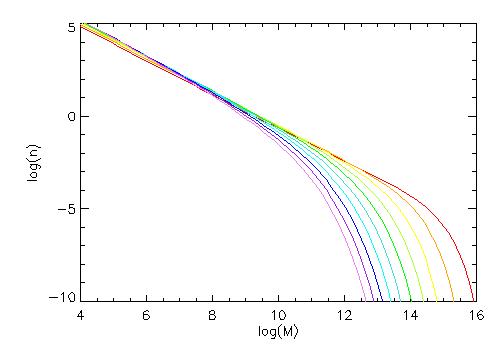
It might be easier to see what’s going on looking instead at this figure which shows 


You can see that the typical size of a halo increases with decreasing redshift, but it’s only at really high masses where you see a really dramatic effect.
The mass of the black hole responsible for the recently-detected high-redshift quasar is estimated to be about 
This question is very difficult to answer, as it depends on how luminous the quasar is, how long it lives, what fraction of the baryons in the halo fall into the centre, what efficiency is involved in generating the quasar luminosity, etc. Efstathiou and Rees argued that to power a quasar with luminosity of order 


The abundance of such haloes is down by quite a factor at redshift 7 compared to redshift 0 (the present epoch), but the fall-off is even more precipitous for haloes of larger mass than this. We really need to know how abundant such objects are before drawing definitive conclusions, and one object isn’t enough to put a reliable estimate on the general abundance, but with the discovery of this object it’s certainly getting interesting. Haloes the size of a galaxy cluster, i.e. 
Another thing worth mentioning is that, although there might be a sufficient number of potential haloes to serve as hosts for a quasar, there remains the difficult issue of understanding how precisely the black hole forms and especially how long that takes. This aspect of the process of quasar formation is much more complicated than the halo distribution, so it’s probably on detailed models of black-hole growth that this discovery will have the greatest impact in the short term.
Follow @telescoperClass of ’11
Posted in Biographical, Education with tags Cardiff University, graduation ceremony, School of Physics & Astronomy on July 19, 2011 by telescoperJust a quick note to mark today’s graduation ceremony for students in the School of Physics & Astronomy at Cardiff University, which took place at 10 o’clock this morning in St David’s Hall. I took part in the staff procession this year – as I have done on several previous occasions – so was there bright and early, all togged up in academic drag, ready for the kick-off. You can see a replay of the whole thing here so I don’t need to describe it in detail; I’m seated towards the left hand side of the stage so am fortunately out of shot for most of the video.
I admit to having had a bit of a hangover this morning because yesterday evening I attended a posh (black tie) graduation dinner at the invitation of the Vice-Chancellor. The splendid dinner was preceded by a drinks reception that lasted a full hour – at which much champagne was quaffed – and then followed by some lengthy and rather uninspiring speeches, during which I sought solace in the form of port. When proceedings were over, a few of us decanted ourselves into a local bar for a bit more to drink. I only realised how much I must have drunk when Columbo woke me up by jumping on my bed at 5am at which point I felt distinctly sub-optimal.
After the graduation ceremony there was a reception for graduates, parents, partners and assorted hangers-on back at the School of Physics & Astronomy followed by the obligatory pictures with the Head of School, Walter Gear, and Director of Undergraduate Studies, Bernard Richardson, including several attempts at the old “mortar-boards-in-the-air” shot…
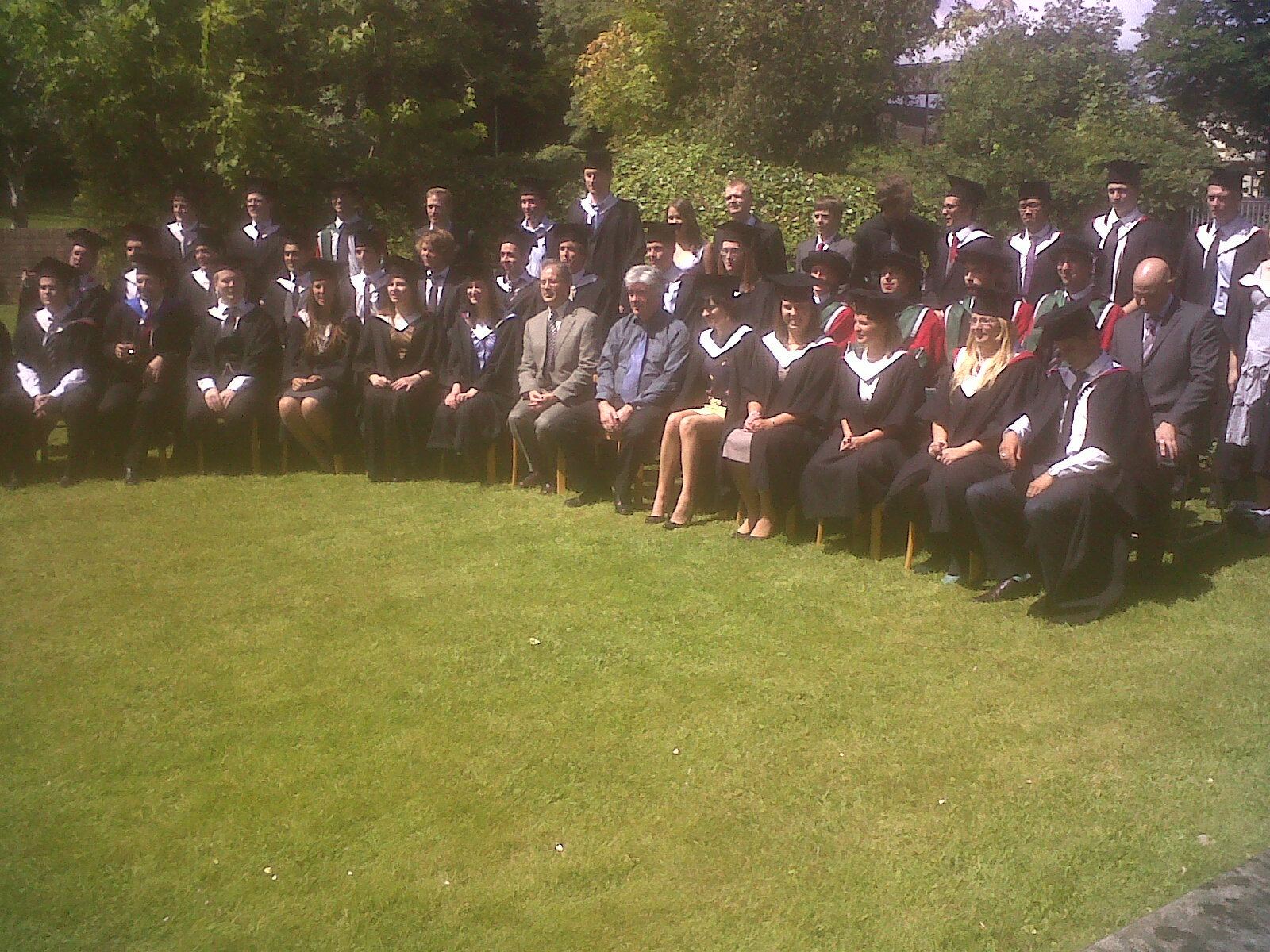
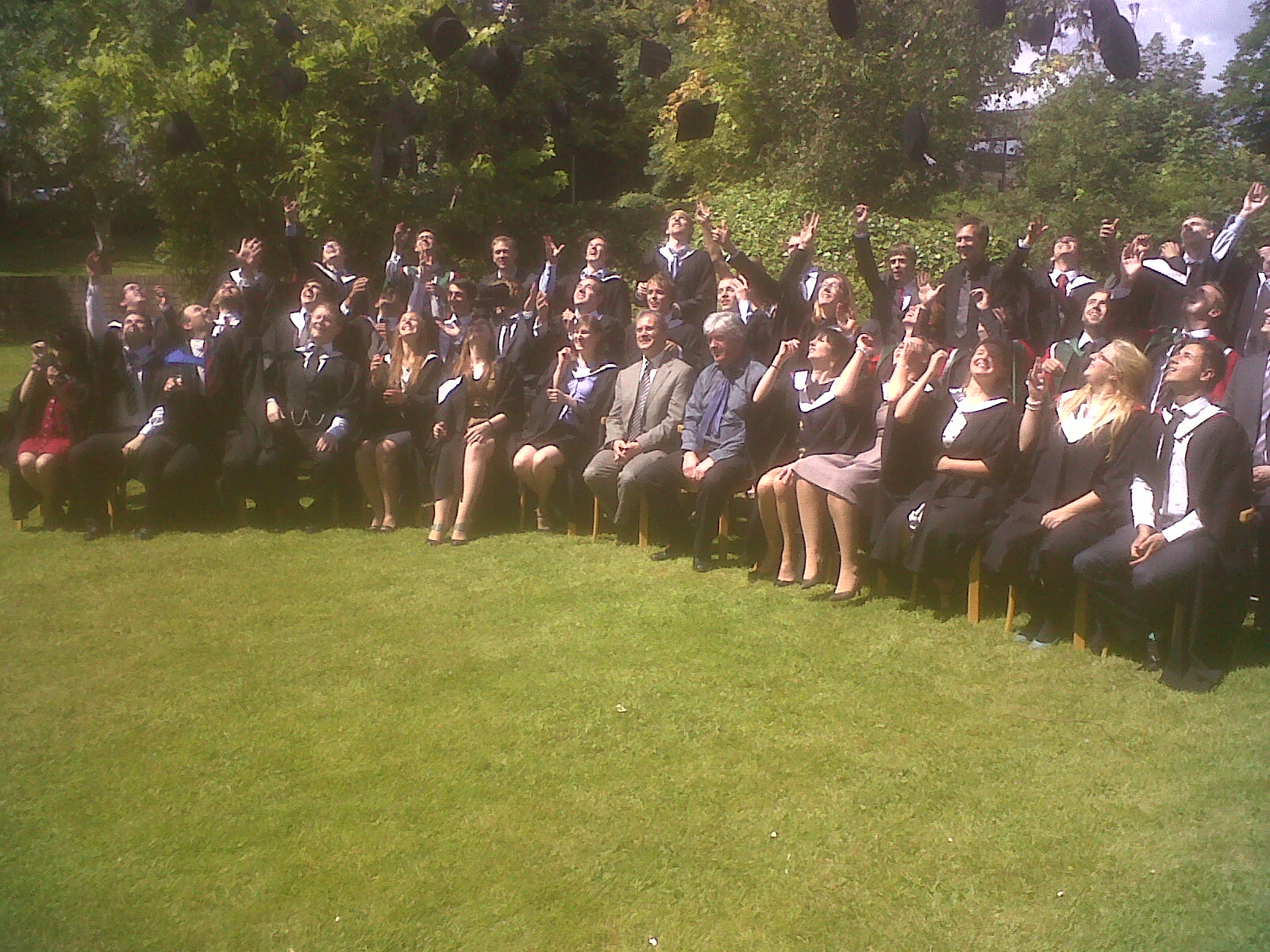
..of which my attempt with a phone camera came out surprisingly well!
The MPhys students graduating this year are the first such group that I’ve seen go all the way from first year to graduation, as I moved to Cardiff University in 2007. Graduation is always a bittersweet occasion, with joy at the students’ success, but also sadness that we have to say goodbye. Some will be staying to do PhDs and some will remain in Cardiff for a host of other reasons, but there’s a number of students in this group that I will miss a lot.
Follow @telescoper
People vs projects in science funding (via Responsible Innovation)
Posted in Finance, Science Politics with tags funding, Science Policy on July 19, 2011 by telescoperInteresting article about whether funding should go to scientists with reputations, or to excellent projects…
The force that through the green fuse drives the flower
Posted in Poetry with tags Dylan Thomas on July 19, 2011 by telescoperThe force that through the green fuse drives the flower
Drives my green age; that blasts the roots of trees
Is my destroyer.
And I am dumb to tell the crooked rose
My youth is bent by the same wintry fever.
The force that drives the water through the rocks
Drives my red blood; that dries the mouthing streams
Turns mine to wax.
And I am dumb to mouth unto my veins
How at the mountain spring the same mouth sucks.
The hand that whirls the water in the pool
Stirs the quicksand; that ropes the blowing wind
Hauls my shroud sail.
And I am dumb to tell the hanging man
How of my clay is made the hangman’s lime.
The lips of time leech to the fountain head;
Love drips and gathers, but the fallen blood
Shall calm her sores.
And I am dumb to tell a weather’s wind
How time has ticked a heaven round the stars.
And I am dumb to tell the lover’s tomb
How at my sheet goes the same crooked worm.
by Dylan Thomas (1914-1953)
P.S. This has been among my list of poems to post for some time now, and only today I find that cosmic variance have beaten me to it!
Follow @telescoper
Top Tips
Posted in Uncategorized with tags Top Tips, Viz Comic on July 18, 2011 by telescoperNot a lot of people know that one of my first publications was a contribution to the Top Tips section of the esteemed Viz Comic, which originates from my home town of Newcastle upon Tyne. The aforementioned Top Tips offer absurd, impractical or ludicrous suggestions to parody those in “lifestytle” magazines proposing handy hints to make domestic and everyday life easier.
I’ve been tweeting a few of my favourites over the last few days, including a couple of (very) vaguely astronomical ones, so I thought I’d collect some of them here. The first is relevant to this week’s festivities:
- Avoid feeling uncomfortably hot during your graduation ceremony by wearing only underwear underneath your gown
- A ‘guide bat’ tethered to your finger with a short piece of string is the perfect way to avoid trees and horses in the dark.
- Prevent your shoes from giving you blisters by lining their insides with sticking plasters
- Astronomers avoid total blindness when viewing the sun by using a telescope rather than binoculars
- Reduce the risk of night-time fires by soaking all your furniture with a hosepipe before going to bed
- Make your own inexpensive mints by leaving blobs of toothpaste to dry on a window sill
- A used condom filled with water and left on a radiator makes an attractive yet inexpensive lava lamp
- Avoid the need for expensive binoculars by simply standing cl0ser to the object that you wish to view
- Avoid hiring unlucky people by immediately tossing half the CVs into the bin
- Sausage rolls sewn together side by side make an excellent emergency wig for judges
- Dabs of silver model aircraft paint can transform repulsive facial warts into fashionable piercings
Feel free to add your own contributions- preferably original and, even better, with a physics or astronomy theme – through the medium of the comments box…
Follow @telescoperFrom Major to Minor
Posted in Music with tags Annie Lennox, backdoor progression, cadence, chords, Cole Porter, Ev'ry time we say goodbye, Red Hot and Blue on July 17, 2011 by telescoperI was looking around for something to post next week in honour of our graduation ceremony (which is coming up on Tuesday) and came across this, which brought back a flood of memories. It’s the wonderful Annie Lennox singing the classic Cole Porter song Ev’ry Time We Say Goodbye as performed as part of the AIDS fund-raiser Red Hot and Blue way back in 1990. Was it really that long ago?
Cole Porter has to be one of the cleverest songwriters of all time. His ability to produce tune after lovely tune was matched by his supreme skill in crafting the lyrics, often managing to produce rhymes in the middle of lines as well as at the end. He often used this superb craftsmanship to comic effect, but produced his share of beautiful ballads too, though none more beautiful than this. I’ve always loved the Ella Fitzgerald version of this song so much that I didn’t believe anyone could outdo it, but this track (and the video) moved me to tears when I first saw it, and it’s never lost its impact on me, especially when heard with the poignant video. The little boy shown in the home movies is a young Derek Jarman, who died of an AIDS-related illness in 1994.
This song exemplifies Cole Porter’s art as both composer and wordsmith. The trademark clever rhymes are there, but in this case there’s a wonderful juxtaposition of the words “how strange the change from major to minor” and an interesting chord progression, which is a minor scale variation of the plagal cadence (sometimes called the “Amen cadence”, because it’s how the word A-men is often sung in hymns). The plagal cadence involves a IV-I step back to the tonic chord (I), via a major 4th (IV) but in Ev’ry Time We Say Goodbye, the progression goes via IV-iv-I with the interpolation of a minor 4th chord (iv), which in the original key of E♭is an A♭m chord. It’s a lovely touch, no less lovely for being so clever.
This progression – or a variation of it involving a dominant 7th chord (i.e. IV-iv-♭VII-I) – can be found in many jazz standards, as a kind of “bluesy” alternative to the more usual V-I “authentic” cadence, and many pop songs use it too, including several by The Beatles. However, I doubt if even Cole Porter could have come up with a rhyme for “dominant seventh”!
Follow @telescoper
 In the Dark