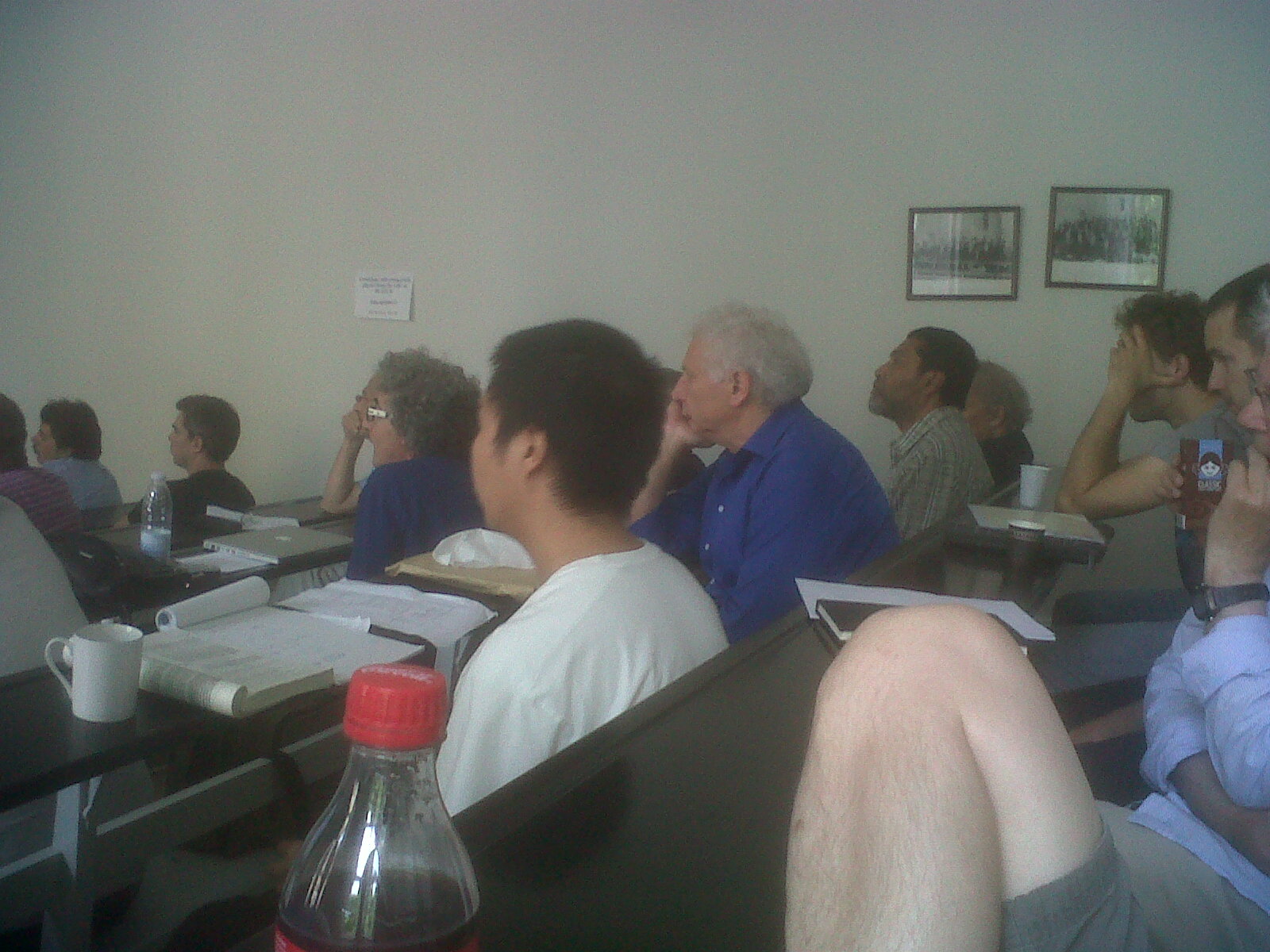
Auditorium A

Posted in Biographical, Books, Talks and Reviews with tags , , , , , on June 8, 2011 by telescoper

Just back from a splendidly wine-laden workshop dinner, I thought I’d do a quick post. My talk was moved to this morning, instead of the scheduled slot in the afternoon I think it went OK considering that, in the spirit of a small informal workshop, I talked mainly about work in progess…

That’s the whiteboard in my office in Cardiff, by the way, not my talk this morning. Auditorium A has good old-fashioned blackboards.

An advantage of speaking in the morning was that after it was over I was able to relax with a beer at lunchtime, but in the warm weather that made it rather difficult to stay on the ball afterwards. I’ve lost track of the amount of time I’ve spent sitting (or even speaking) in the famous Auditorium A of the Niels Bohr Institute over the years, actually, but I don’t think I’ve ever taken a picture there, so here’s one.

On the extreme left you can see our genial host Pavel Naselsky; in the centre left with blue shirt and grey hair, pretending not to be asleep, is Leonid Grishchuk; beside him to the right is Subir Sarkar and next to him,  more-or-less hidden from view, is Holger Bech Nielsen who travelled backwards in time especially to attend the workshop. The knee in the foreground remains unattributed.

Here is an “official” workshop photograph, taken while the participants were looking a bit more awake, but before quite a few had made it back from lunch..

Hello everyone! (via Astronomy Journal Club)

Posted in Uncategorized with tags on June 8, 2011 by telescoper

I thought I’d interrupt the preparation of my talk, which has been brought forward to 10.15 this morning, to reblog this interesting experiment. I guess most people likely to be interested will have heard about it on twitter, but for those who haven’t please have a look.

I’m not sure how successful it will be – that 140 character limit looks like a challenge when discussing a technical paper – but you never know!

Welcome all and thanks for your interest in the twitter astronomy journal club! The general idea is that we meet up on twitter at a prearranged day and time and discuss an interesting piece of astronomy research. This will generally take the form of an academic paper, but we could also include some articles too. Everyone's welcome to participate, whether you know anything about the topic or not. This is all inspired by the original Twitter Journa … Read More

via Astronomy Journal Club

The Happiest Place on Earth

Posted in Biographical with tags , on June 7, 2011 by telescoper

Here I am in wonderful Copenhagen. I arrived yesterday afternoon in lovely sunny weather, found my hotel, and then went for an evening stroll. It was so hot, in fact, that I was forced to sit outside drinking cold beer instead of preparing my talk, but then I’m not on until Thursday so there’s still time. Later on, the weather broke in spectacular fashion with a huge thunderstorm brewing up over the city. I sat and watched the son et lumière show out of the hotel window into the early hours, savouring the gorgeous earthy smell that comes with summer rain.

As I’ve mentioned before, Copenhagen is one of my favourite places. I was first invited here while I was a PhD student twenty-odd years ago and have been back at least once a year ever since. Of course, in the summer, especially in June when the days are longest, the city is particularly fine, but I actually like it here all year round. Of course it’s a bit dark and a bit cold in the winter months, but snow doesn’t make things fall apart here like it does in Britain, and Copenhagen takes on an austere beauty at that time of year which endows it with a unique sense of place. And, best of all, the harsh winter seems to make people embrace the summer even more joyfully. It was lovely to see people out enjoying themselves last night in the sunshine without a hint of the violence that blights Britain’s town centres after a day like this. Above all, though, Denmark is just such a civilised place. It’s a very egalitarian society, with excellent public services, virtually no poverty, a strong sense of its own identity, and a robust democracy.

After an early breakfast in my hotel (the slightly odd but very comfortable Hotel 9 Små Hjem where I’ve stayed a number of times in the past), I found this clip on Youtube.

I find it very amusing for a number of reasons. One is the supposition that happiness goes with sunny weather, which I find laughably superficial. I’d hate to live anywhere where the weather was the same every day, even if it were warm. The reporter also seems bemused that Canada appears higher in the table than the USA. It’s no surprise to me: given the choice, I’d much rather live in Canada than America!
Above all, the snide incredulity about “cold, dreary, unspectacular” Denmark is a truly excellent self-parody. It may be cold – sometimes – but, as Billy Connolly once said, “there’s no such thing as bad weather, just the wrong clothes”. But there’s certainly nothing dreary about Denmark – it has a vibrant culture and a long and fascinating history. It may be “unspectacular”, if by that you mean that it’s not gaudy or pompous or ostentatious. Modesty is a sadly underrated virtue.

I’m not a fan of league tables – and I dread to think what bizarre methodology produced the one referred to in the clip – but as a seasoned visitor it actually comes as no suprise to me that the Danes are in the Premier division for happiness. The point is that happiness isn’t about external things such as the weather. Nor is it about showing off. It’s a frame of mind. The Danes seem to understand that better than most.

P.S. I love Victor Borge! And what’s wrong with herring sandwiches?

Time Present and Time Past

Posted in Poetry with tags , , on June 6, 2011 by telescoper

Up early this morning to set off for the airport. No time for a proper post until I get to Copenhagen so I thought I’d just put this up, as it popped into my mind after I’d written yesterday’s item. I’m a bit reluctant to post a bit of a poem, rather than a whole one, but here goes.  This is the opening passage from Burnt Norton, the first of the Four Quartets by T.S. Eliot. If you haven’t read the whole thing, you should.

Time present and time past
Are both perhaps present in time future,
And time future contained in time past.
If all time is eternally present
All time is unredeemable.
What might have been is an abstraction
Remaining a perpetual possibility
Only in a world of speculation.
What might have been and what has been
Point to one end, which is always present.
Footfalls echo in the memory
Down the passage which we did not take
Towards the door we never opened
Into the rose-garden.

From Time to Time

Posted in Biographical, The Universe and Stuff with tags , , on June 5, 2011 by telescoper

It having been my birthday yesterday, and very nice it was too, thank you for asking, I’m filled this morning with thoughts about the passage of time. It’s strange how working in education imposes a cycle on your life: admissions, teaching, exams, graduation ceremonies, summer recess, and so on. The main thing that breaks this pattern of recurrence is when students finish their finals and leave for the big wide world. Since I moved to Cardiff in 2007, the 4th year students who have just finished their examinations are the first cohort that I’ve seen through their whole degree programme at Cardiff University, and it will be great to see them all get their degrees next month in St David’s Hall, but it will be yet another reminder of the passage of the years.

Not that I’m one to get depressed about such things. I’ve taken surprisingly well to middle age and gracefully (?) surrendered the things of youth some time ago. However, time is such a mysterious thing it’s hard not to think about its passing every now and then.

This time last year I was in Copenhagen for a small cosmology workshop. There’ll be a repeat performance next week too, so I’ll be off to Denmark for a few days. In fact I bought my ticket some time ago, but realised only on Friday that it was next week, and not the week after, so have had to rearrange a few things rather hastily. The advancing years have obviously addled my brain.

Anyway, all this talk about time and cycles gives me some sort of excuse to post the following video from the ESO Very Large Telescope in Chile. The photography is wonderful. Pity about the music, though. Spoils it a bit if you ask me…

June

Posted in Poetry with tags , on June 4, 2011 by telescoper

Now summer is in flower and natures hum
Is never silent round her sultry bloom
Insects as small as dust are never done
Wi’ glittering dance and reeling in the sun
And green wood fly and blossom haunting bee
Are never weary of their melody
Round field hedge now flowers in full glory twine
Large bindweed bells wild hop and streakd woodbine
That lift athirst their slender throated flowers
Agape for dew falls and for honey showers
These round each bush in sweet disorder run
And spread their wild hues to the sultry sun.

by John Clare (1793-1864).

Whippin’ that Jelly

Posted in Jazz with tags , , on June 3, 2011 by telescoper

Summer has most definitely arrived. It’s a gorgeous day and most of the students have finished most of their examinations, so I’m sure will be taking a well-deserved break and enjoying the sunshine. It’s also Friday, and time, I think, for a little frivolity.

I’m indebted to young Miss Liggins for drawing my attention to this old record via Facebook. It’s by a relatively obscure swing band called the State Street Swingers, which was based in Chicago during the mid-1930s. From a technical point of view the musicians weren’t anything like as proficient as the leading bands of the Swing Era, especially in the horn section, so they usually tried to make up for their relatively limited abilities by playing for laughs behind various vocalists. It doesn’t say who it is on Youtube, but the singer sounds to me like Washboard Sam. He made a lot of records with other bands for the Vocalion label, which is what this one came out on, so that’s at least consistent with my hypothesis.

The State Street Swingers only ever recorded 14 tracks, most of them involving euphemistically raunchy titles, like this one, Whippin’ that Jelly. It may not be the most sophisticated music, but I hope it at least brings a smile to your face, as it does to mine every time I listen to it!

D+E+F+W=$500000

Posted in The Universe and Stuff with tags , , , , , , , on June 2, 2011 by telescoper

Just a quickie this fine summer morning to pass on the news – for those of you who haven’t heard yet – that this year’s Gruber Prize for Cosmology has been awarded to Marc Davis (Berkeley, USA), George Efstathiou (Cambridge, UK), Carlos Frenk (Durham, UK) and Simon White (Garching, Germany). This prestigious award is given for their pioneering work on the Cold Dark Matter model of structure formation, which included some of the first large-scale N-body computer simulations. The “Gang of Four” produced a number of papers during the 1980s that established the idea that galaxies form by hierarchical clustering from small initial fluctuations in a matter distribution dominated by massive collisionless non-baryonic particles, the most famous of their papers being pretty universally referred to as DEFW.

In fact, if you’ll forgive me going on a trip down memory lane, that paper, published in 1985, was one of the first papers I read when I started my research degree the same year at Sussex. It was back in the days when everyone seemed to use a VAX for big computing jobs and the simulations presented in that paper involved a mere 323 = 32768 particles. You could probably run that kind of simulation on a mobile phone these days!

This early work on Cold Dark Matter wasn’t the final word, of course. Subsequent observational evidence for an accelerating Universe resulting in our standard cosmological model being modifiel to include an additional (large) component of dark energy in addition to dark matter. Nevertheless, the core ideas presented by DEFW established the basic foundations of structure formation upon which the current standard model is built.

Incidentally, you can read an interesting account of the discovery of the accelerating universe here; a cosmologist by the name of “George F. Stathew” plays a prominent role in that piece and it’s curious I’ve never heard of him before now.

Each of the four winners gets a share of the $500000 Gruber Prize, i.e. in “normalized” terms, they get $125000 each. Why is it so controversial to suggest dividing citation counts the same way? The DEFW paper has about 1500 citations according to ADS, so I think it’s quite reasonable to award the authors 370-odd each towards their respective h-indices. That’s still a pretty good result by any bibliometric standard!

The four also get a Gold Medal each to wear at parties, although by my previous logic they should have to share one between them. Perhaps George might consider donating his to Arsenal Football Club, as their trophy cabinet is looking rather empty these days?

None of the winners are Australian undergraduates, so this award probably won’t be considered newsworthy by the mass media. Believe it or not, however, the Gruber Prize is held in even higher regard by cosmologists than the Templeton Prize, so I’d like to take this opportunity to congratulate them myself for their thoroughly well-deserved honour!

A Paradox of Galileo

Posted in Cute Problems with tags , , , on June 1, 2011 by telescoper

Going by the popularity of the little physics problem I posted last week, I thought some of you might be interested in this little conundrum which dates back to the 17th Century (to Galileo Galilei, in fact). It’s not a problem to which there’s a snappy answer, so no poll this time, but I think it’s quite a good one to think about – and please try to resist the temptation to google it!

The above figure shows a large circular wheel, which rolls from left to right, without slipping, on a flat surface, along a straight line from P to Q, making exactly one revolution as it does so. The distance PQ is thus equal to the circumference of the wheel.

Now, consider the small circle, firmly fixed to the larger circle with the two centres coincident. The small circle also makes one complete revolution as the wheel rolls, and  it travels from R to S. Similarly, therefore, the distance RS must be the circumference of the small circle.

Since RS is clearly equal to PQ it follows that the circumferences of the large wheel and the small circle must be equal!

Since the radii of the large and  small circles are different,  this conclusion is clearly false so what’s wrong with the argument?

Turandot

Posted in Opera with tags , , on May 31, 2011 by telescoper

On the way to the Wales Millennium Centre in Cardiff Bay this evening it struck me that it was quite fitting to be going to see Welsh National Opera‘s production of Turandot so soon after Friday’s concert. After all this was Giacomo Puccini‘s last Opera and it was incomplete at the time of the composer’s death in 1924. It’s a work most famous for the rousing tenor aria Nessun Dorma from Act III , which was made even more famous when, sung by the great Pavarotti, it became the theme tune for the Italia 90 World Cup. But there’s also the gorgeous Signore Ascolta in Act I and, even better, the dramatic fulcrum of the Opera, and one of the greatest Puccini’s arias of all, the climactic In Questia Reggia. Puccini undoubtedly had a great gift for writing memorable songs but there’s much more to him than that, as this opera proves. Turandot is a particularly dark and troubling story, with music to match the drama at every stage, and it contains some extremely interesting “modern” ideas alongside the classic showpiece numbers.

The story is set in China (“in legendary times”). Princess Turandot (definitely pronounced “-dot” rather than “-doh”) is a tyrannical ruler who challenges potential suitors to solve three riddles. The penalty for failure is death; no resits allowed. The Opera begins with the Prince of Persia being led to his doom. You know the sort of thing – girl meets boy, boy falls in love with girl, girl beheads boy, etc. Calaf, Prince of the Tartars, arrives with his elderly father Timur and faithful servant Liu. Crazy fool that he is, he decides to have a go at the riddles. Three sinister ministers, Ping Pang and Pong, prepare the trial, letting on as they do so just how many others have died in the attempt to woo Turandot. Calaf, of course, succeeds, but Turandot doesn’t want to go along with her side of the bargain. Calaf sets his own riddle – Turandot simply has to guess his name by dawn and he’ll give up his suit and let Turandot execute him too. She tries everything she can think of to identify the mystery contestant, including keeping the entire population of Peking up all night and torturing Liu to the point where she kills herself rather than risk giving away her master’s name. Liu loves Calaf herself, you see, so naturally she dies for her beloved’s sake. That’s what women do, in Opera. Moved by Liu’s sacrifice, Turandot feels the power of love and agrees to marry Calaf. And they all live happily ever after. Apart from Liu, of course, who’s dead.

That’s one of the thing’s that’s so problematic about this Opera for me. If Calaf is meant to be so noble and courageous, so why does he fall for Turandot who, at least at the beginning, is cruel beyond belief? And if he’s such a good egg why does he let the innocent Liu die just so he can get his leg over? This isn’t the only Puccini opera in which the romance has a dark undertone and in which the hero isn’t all that heroic when you look hard enough at him. Calaf isn’t quite as bad as the ghastly Pinkerton in Madame Butterfly, but I still think he’s basically a prat.

This production is a revival of one first performed in 1994. The setting spans a number of epochs, ancient Chinese costumes mingling with 20th century dress, and the minimal set periodically hung with mugshots of slain suitors evoking the “disappeared” in a South American dictatorship. Turandot’s dress and hairstyle in Act II made her look a lot like a cross between Ymelda Marcos and Eva Peron. In the crowd scenes, the chorus writhe with stylised anguish of an almost masochistic nature, as if their oppression by the brutal regime has become a sort of fetish for them.

Star of the show was dramatic soprano Anna Shafajinskaia as Turandot. With a name like an Icelandic volcano and a voice of exceptional power to match, she sent shivers down my spine on several occasions, especially in Act II. Gwyn Hughes Jones was a fine Calaf. Rebecca Evans being unfortunately indisposed, Liu was played by Michelle Walton. She started very hesitantly, and I wasn’t at all impressed with her rendition of Signore Ascolta; what she sang was quite nice, but it was only a vague approximation to what Puccini wrote. She did settle down as the performance went on, however, and was much more impressive in Act III. The rest of the cast were good and, as always, the Chorus of Welsh National Opera were superb throughout.

It’s difficult to explain to people who don’t “get” Opera how it can possibly work. People don’t actually sing to each other in real life, after all. All I can say is that, when it’s good, you somehow just fall into it and it takes on its own dramatic logic. That doesn’t always happen, of course, but for me it certainly happens sufficiently frequently to make it worthwhile. This one took a while to get going, and I didn’t really start to get involved until Act II, but thereafter I was gripped.

I should also say that it was very nearly a full house. Not bad for a Tuesday night!