The Ashes Retained

Posted in Cricket, Poetry with tags , , , , , , on December 29, 2010 by telescoper

I couldn’t resist a short post to mark the success of England’s cricketers down under in successfully retaining The Ashes. After getting themselves comprehensively thrashed in the Third Test of the Ashes series in Perth, to tie the level the series 1-1 (with one match drawn), the pressure was on when the Fourth Test started on Boxing Day in Melbourne. However, it all seemed to get to the Australians more than the English: Australia were dismissed for a paltry 98 after being put into bat by England captain Andrew Strauss who won the toss. England finished the day on 157 without loss, with defeat for Australia already probable at stumps on the opening day. England batted all the second day and a bit of the third, amassing 513 all out, and then had Australia 169 for 6 at the end of Day Three. Although the last few Australian batsmen showed a bit of spirit on Day Four, they were eventually all out for 258, leaving England the victors by an innings and 157 runs, their second innings victory of the series.

Now they are 2-1 up in the series with one Test to play (at Sydney), which means they can’t lose the series and therefore keep the Ashes, which they won in England last year (2009). I hope England keep their focus and go on to win at Sydney too. I’d like to see them win the series outright. Incidentally, if I’ve done my sums right, Australia have now won 123 Ashes tests since the first in 1882, to England’s 99, so if England can win in Sydney it will be their 100th.

My Australian friends and colleagues will be wincing at this outcome, but although England have proved worthy winners this time I’m sure Australia will be back to winning ways before too long. As an English cricket fan, I’ve endured enough disappointments to make this victory especially sweet. I dare say when the Australians do reclaim the Ashes at some point in the future their supporters will feel the same. As it is in life, so it is in cricket – the good times make the bad times worth enduring.

I thought I’d mark this very special occasion with a poem called Brahma by Andrew Lang. It’s a clever parody of a poem by Ralph Waldo Emerson, and the reference to Hinduism seems to fit with the theme of a cyclic universe of sporting success and failure.

If the wild bowler thinks he bowls,
Or if the batsman thinks he’s bowled,
They know not, poor misguided souls,
They too shall perish unconsoled.

I am the batsman and the bat,
I am the bowler and the ball,
The umpire, the pavilion cat,
The roller, pitch, and stumps, and all.


Share/Bookmark

Thaw

Posted in Biographical, Poetry with tags , , on December 28, 2010 by telescoper

Back from the Frozen North, after a very enjoyable but over-indulgent Christmas, I just thought I’d pop on line to say hello to the blogosphere again.

I flew up to Newcastle in the late afternoon on Christmas Eve from Cardiff airport via an airline called Eastern Airways which operates the only direct flight on that route. I booked the flight some time ago, as I was a bit nervous it might fill up given the annual chaos on the railways over the holiday. As it turned out, the outbound flight on Christmas Eve had only five passengers on it; the return, yesterday, just six. Obviously they’re not making a lot of money on this route!

The plane was a small propeller-driven affair which can seat a maximum of 29 passengers. I thought I’d get a nice picture of the sunset at Cardiff as we took off, but unfortunately the vibration of the engines made that quite difficult, as you can see from the blurry effort shown above. Despite the inclement weather and the snow and ice at both airports, outward and return flights kept immaculately to schedule.

Newcastle was cold and snowbound so me and my folks stayed in, ate and drank a lot, lounged around watching a bit of telly here and there, warmed by news of the cricket from Melbourne (of which more, hopefully, tomorrow!) and were otherwise entertained by their cats Tilly, Daisy and Lucy. It was very pleasant but the combination of eating and drinking too much and not taking much exercise has no doubt left me quite a few pounds heavier. I haven’t plucked up courage to weigh myself yet.

Anyway, I got back safely yesterday evening and said hello to Columbo (who, incidentally, is doing fine). Pretty much as soon as I got into the house it started raining, which it did most of the night. The thaw is definitely in full swing, and soon quite a few of my neighbours will no doubt be out doing repairs. Several lengths of guttering have fallen off various houses on my street, pulled down by the weight of accumulated snow and ice. There’s now also much less danger of me falling over on the slippery pavements like I did just before Christmas. Why can’t that happen when there’s nobody watching? It’s so embarrassing…

I’m not so foolish as to think that the melting of this lot of snow means that winter is over, but the thaw did remind me of this nice little poem by Edward Thomas, yet another Welsh poet and yet another killed during the First World War, in his case in 1917 at the Battle of Arras.

OVER the land half freckled with snow half-thawed
The speculating rooks at their nests cawed,
And saw from elm-tops, delicate as a flower of grass,
What we below could not see, Winter pass.


Share/Bookmark

Wooden Underwear, Theoretical Giraffes, and a Partridge in a Pear Tree

Posted in Uncategorized with tags , on December 23, 2010 by telescoper

Assuming all goes well – which may not be a wise assumption given the weather – I’ll be off tomorrow for the Christmas break, so I’ll be closing down for a while. Unless I don’t make it up North, in which case I might be doing the odd Yule Blog after all.

I wish you all the complements of the season, and leave you with this little clip featuring the late great Peter Cook. It’s from a series of short programmes made for BBC2 and shown at Christmas in 1990. They pretty much sank without trace, but I think they’re brilliant. Anyway, I hope this brings a few minutes of seasonal cheer!


Share/Bookmark

Wales set for university mergers

Posted in Education, Finance with tags , , , , , , on December 22, 2010 by telescoper

Just another quick post to pass on the news just out that the Higher Education Funding Council for Wales (HEFCW) has announced that the number of universities in Wales must reduce by a half over the next two years.

I’ve argued already on this blog that there are too many small separate higher education institutions in Wales and that’s a view which is probably held by many across the sector. Mergers and/or closures have seemed to me to be inevitable for some time given the general climate of austerity and the consequent chill winds blowing through the groves of academe. According to HEFCW, the plan is that by 2013 no “region” of Wales will have any more than two universities although I’m not sure what counts as a region.

Until recently there were four different “universities” with campuses in Cardiff: Cardiff University (where I work); the University of Glamorgan (which has a presence in Cardiff, but which has its main campus in Pontypridd); the Royal Welsh College of Music and Drama (RWCMD); and the University of Wales Institute, Cardiff (UWIC).

In fact RWCMD was absorbed by the University of Glamorgan a short time ago, but still uses its old name as part of the merged institution.
Apparently one more merger will be necessary to satisfy HEFCW’s requirement, which I guess will involve UWIC also being absorbed by the University of Glamorgan. If that does happen, I hope HEFCW will keep a close eye on matters of governance. The UoG doesn’t seem to me to have a very strong track-record with respect to resafeguarding standards of academic practice.

Depending on how “region” is interpreted, there might even be pressure to include the University of Wales, Newport in an even bigger new South East Wales institution presumably headed by the University of Glamorgan.

Elsewhere in Wales the merger process is already underway. Last week, Swansea Metropolitan and the University of Wales Trinity St David announced plans to create a united institution. Going back one stage, the University of Wales Trinity St David was itself formed through the merger earlier this year of Wales’ oldest education institutions, Trinity University College, Carmarthen and the University of Wales Lampeter. Although these have merged it appears they will carry on using their existing names, which may cause some confusion but we’ll have to see how it goes.

It’s important to note that universities are officially independent bodies, so HEFCW (through which public funding is channeled to them) can’t really just tell them to merge. However, many of the smaller institutions are so dependent on state funding that they basically have to do what HEFCW tells them or face financial oblivion. Of course it will require Vice-chancellors to agree, and since presumably half of them will cease to be VCs, there will be some reluctance. Turkeys tend not to vote for Christmas. However, HEFCW has promised that “core funding will be deployed in ways which lend force to the achievement of that target”. In other words, they’ll be calling on the odd VC to make them an offer they can’t refuse…


Share/Bookmark

Shine on me

Posted in Jazz with tags , , , , on December 22, 2010 by telescoper

Pianist Jaki Byard was one of the most consistently original musicians of his jazz generation, but he was also consistently underrated. His eclectic style embraced the avant garde free jazz of the 60s and 70s as well as traditional gospel and folk music. Whatever he played, though, it definitely sounded exactly like Jaki Byard. Anyway, in 1968 he teamed up with the extraordinarily talented multi-instrumentalist Roland Kirk to record a typically varied selection of music, including this one which has been a favourite of mine since I first heard it on the radio about 30 years ago. It’s one of the most played tracks on my iPod, and it never fails to bring a smile to my face even when I’m stuck on stationary train feeling miserable.

Shine on me is attributed to that most prolific of all composers, Trad. It’s a theme that turns up in a few very early jazz recordings, but I think it began life as a gospel song way back in the mists of time. In this version, though, it’s given a foot-tapping beat which is just so very nineteen-sixties. Roland Kirk’s decision to start the piece on clarinet was truly inspired, and you can tell that all four musicians had a blast playing this. I suppose it’s a sort of parody, but it’s an affectionate one.

Finally, let me mention the drummer Alan Dawson, whose playing is based around a sort of half-funk half-boogie, but with all kinds of polyrythmic stuff on on top; he drives this along like the clappers and makes it such a joy to listen to.


Share/Bookmark

The Gaskell affair (via The e-Astronomer)

Posted in Uncategorized on December 21, 2010 by telescoper

I thought I’d reblog the following post from Andy Lawrence. I think it will be of interest to readers here because it relates to a very important issue. If you would like to read the full article please follow the link to Andy’s original post…

Yesterday I saw a Twitter link to  a New York Times article about an astronomer suing the University of Kentucky, claiming he was rejected as a job applicant because of his religious faith. This piqued my interest. When I got there I found it was someone I know reasonably well on a professional level – Martin Gaskell. Martin graduated from the Edinburgh astrophysics degree the year before me – 1975 – and is a well known AGN researcher. He is an i … Read More

via The e-Astronomer

The STFC Delivery Plan

Posted in Science Politics with tags , , , , , on December 20, 2010 by telescoper

Excuse the very quick and sketchy post on such an important topic, but I’ve got a lot of things to do before the dreaded Christmas lunch.

This morning the allocations of funding for the research councils were announced. The statement accompanying the ensuing Delivery Plan for the Science and Technology Facilities Council can be found here, while the plan itself is here. You’ll probably also want to read Paul Crowther’s analysis here.

Other research councils have also published their plans; you can find the one for EPSRC here.

The headline announcement reads:

After transferring responsibility for space science to the UK Space Agency, STFC’s overall baseline allocation for 2011-12 for resource funding (previously termed “near-cash”) is £377.5m rising to an allocation of £381.14m in 2014-15. This excludes administration which will be separately allocated. Our capital baseline allocation for 2011-12 is £91m, with an indicative allocation for the remainder of the spending review period reducing to £68m in 2014-15.

So not at all bad news for resource funding, but the implications of the capital cut are unclear (at least to me).

I haven’t had time to read the entire document, but did have a quick look at the crucial Appendix D which shows how each discipline is expected to fare:

  • Particle Physics expenditure will rise from £133M to £148M over 4 years
  • Astronomy expenditure will fall from £77M to £69M over the same period
  • Expenditure on Synchtron facilities (e.g. Diamond Light Source) will increase from £42M to £56M.

Within an approximately flat-cash settlement, therefore, Astronomy is a clear loser (although much of the cuts in expenditure relate to decisions already made, such as withdrawal from the Gemini Telescopes). Confusingly, much of the increase in Particle Physics expenditure relates to an increase in the CERN subscription, which I thought was supposed to be falling …

As far as I understand it, the plan also maintains grant funding at the current level (although it will move into the new consolidated grant system as quickly as this can be achieved).

Anyway, that’s all I’ve got time for right now, and comments/reactions/corrections/clarifications are very welcome through the box below.


Share/Bookmark

You didn’t ask, but I’ll tell you anyway…

Posted in History, Politics with tags , , , , , , , , on December 19, 2010 by telescoper

I just chanced across the news that the United States Senate has voted to repeal the policy of “Don’t ask, don’t tell”. This silly rule required gay servicemen and women to conceal their sexual orientation or risk being kicked out of the services. It was always an awful compromise and I’m glad to see it has been scrapped.

One of the arguments used against allowing gay people to be open about their sexuality while in the armed forces was that this would be “bad for morale”. I’m not quite sure why, but that’s what people say. Perhaps what it means is that a lot of straight military personnel are deeply prejudiced and that it would be bad for morale to have that prejudice challenged.

Until 2000, the United Kingdom’s Ministry of Defence imposed an outright ban on lesbian and gay people serving in the armed forces. However, in 1999 the European Court of Human Rights ruled that ban illegal. Now, at least officially, the MoD has a much more open and inclusive policy. One regularly sees official representation at Gay Pride marches and so on. Indeed, in 2008, General Sir Richard Dannatt, Chief of the General Staff, said in a speech that

respect for gays, lesbian, bi-sexual and transsexual officers and soldiers was now “a command responsibility” and was vital for “operational effectiveness”

It would have been hard to imagine even ten years ago that a senior officer in the British Army would make such a statement. I’m sure openly gay soldiers still have a pretty tough time in the army, but we’re heading in the right direction. Times have changed.

But all this is perhaps not as new as you might think.

I’m now going to bore you with a bit of history that might surprise you. The elite division of the Theban army in the 4th Century BC was an outfit called the Sacred Band of Thebes. This consisted of about 300 men, hand-picked for their courage and fighting skill. Or not so much 300 men, but 150 same-sex (male) couples; this was the legendary Army of Lovers. Obviously there wasn’t any need for “don’t ask, don’t tell” in ancient Thebes.

The inspiration for this special unit derived from Plato who, in the Symposium, said

And if there were only some way of contriving that a state or an army should be made up of lovers and their beloved, they would be the very best governors of their own city, abstaining from all dishonour, and emulating one another in honour; and when fighting at each other’s side, although a mere handful, they would overcome the world. For what lover would not choose rather to be seen by all mankind than by his beloved, either when abandoning his post or throwing away his arms? He would be ready to die a thousand deaths rather than endure this. Or who would desert his beloved or fail him in the hour of danger?

Initially the members of the Sacred Band were scattered among the rest of the soldiers, in order to raise morale (!), but later on they were all united in a single fighting division, the “special forces” of the Theban army. They were responsible for several famous victories, including the Battle of Leuctra which established Theban independence from Spartan rule.

But brave and steadfast though they were, they eventually met an adversary that even they couldn’t withstand. At the Battle of Chaeronea in 338 BC they fought an army led by Philip II of Macedonia one of whose generals was his son, a young man by the name of Alexander. The Macedonian army had a new infantry tactic that gave it the edge over all armies of its age. This was the phalanx, a large but tightly bunched and highly disciplined group of soldiers with interlocking shields and bristling with spears, which was impervious to cavalry and archery alike. A few years later when Alexander became King of Macedonia and set off on his journey to Greatness, the phalanx continued to be the mainstay of his army and it allowed him to defeat huge forces at least five or six times the size of his own.

At Chaeronea the fearsome phalanx made mincemeat of the rank and file of the Theban army. In the face of the Macedonian onslaught, the Sacred Band stood its ground to the last, but their resistance was futile. At the end of the battle, their corpses were found piled one on top of the other. They hadn’t given an inch, but all had died where they had stood. The Army of Lovers was no more.

In about 300 BC the citizens of Thebes erected a memorial to the Sacred Band where they had been buried, with full military honours, by Philip II’s soldiers, at the spot where they had fallen. When this was excavated in 1890, 254 skeletons were found, neatly arranged in rows.

The point I’m trying to make with this bit of ancient history is that our attitudes to sexuality are not built in. They’re all formed by social conventions. In fact, bisexuality was quite normal in Ancient Greece, so nobody had any reason to think of homosexuality as some kind of “otherness” that could be a focus of discrimination. Alexander the Great himself had relationships with both men and women and, although he was clearly a megalomaniac and not at all a nice person, he was undeniably rather good at being a soldier.

There’s therefore no reason why gays and lesbians shouldn’t serve with distinction in the army, or anywhere else for that matter. The problem’s not with them, but with the rest of you.


Share/Bookmark

Pontcanna Fields with Snow, Mist and Sunset

Posted in Uncategorized with tags , on December 18, 2010 by telescoper

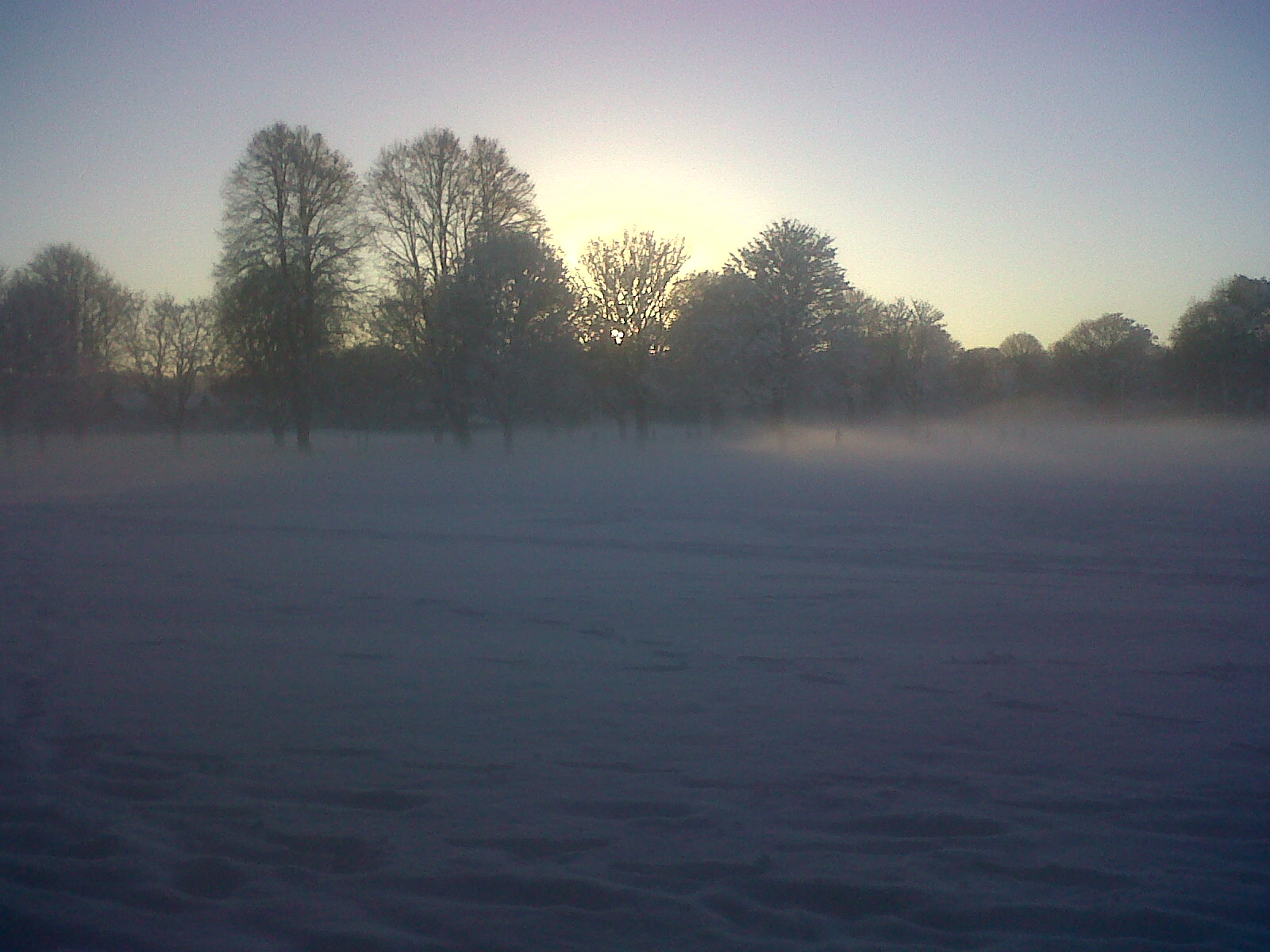
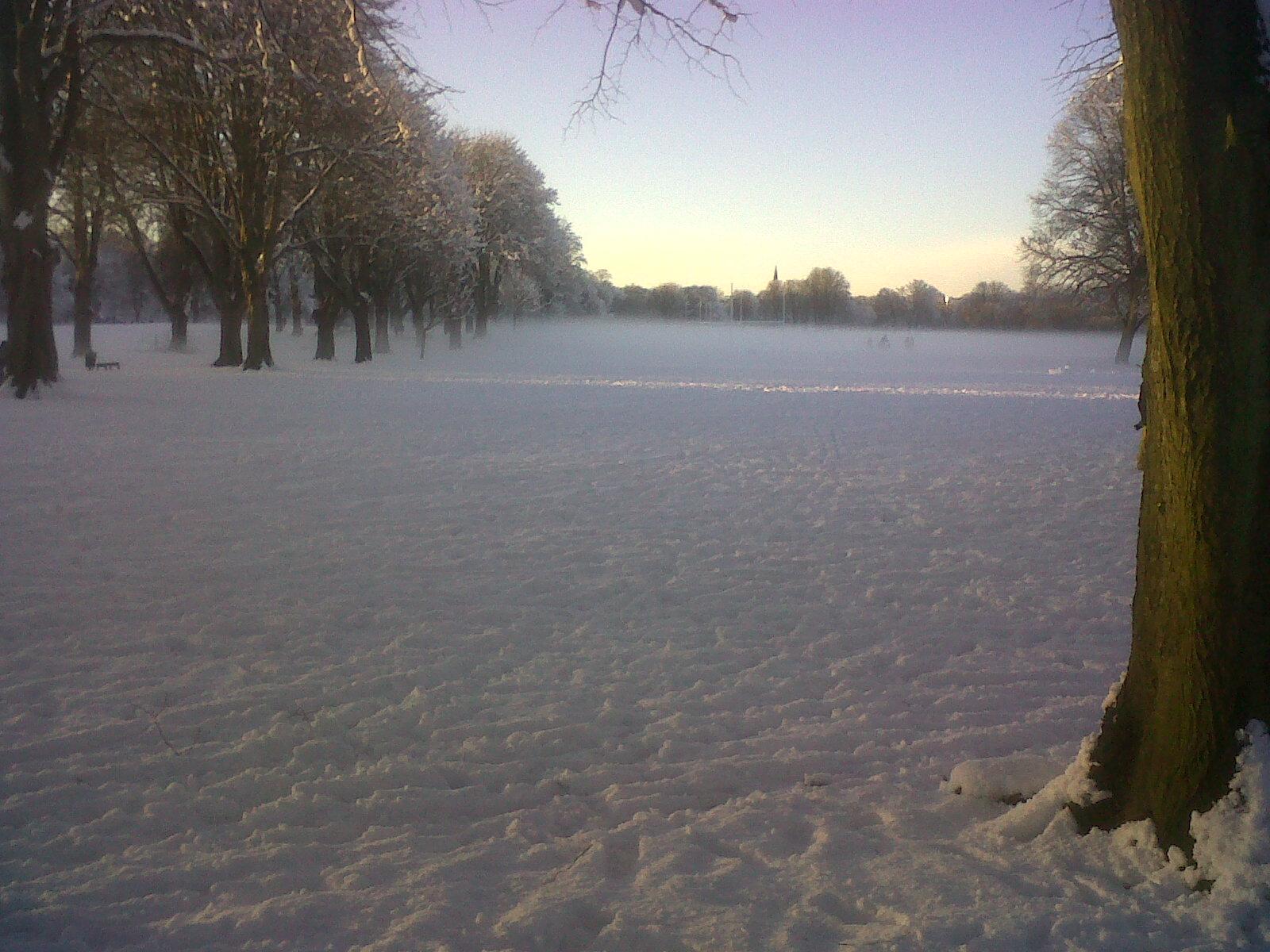
Just back from a shopping expedition during which I walked through the snowbound Pontcanna Fields. Fog was rising above the snow just as the sun was setting, creating some stunning lighting effects. Unfortunately I only had my Blackberry with me so I couldn’t take any really high quality pics, but these should give you an idea.

This first is looking North towards Llandaff Cathedral whose spire you can just see in the distance:

The second gives you a better view of the mist..

…and these two are of the sun setting behind the trees to the west:


Share/Bookmark

Term’s Ending

Posted in Biographical on December 18, 2010 by telescoper

Well there we are. After a clutch of meetings and the ritual handings-in of interim project reports by students, as of yesterday teaching term is now officially over. Most of the students left yesterday afternoon (to try to beat the inclement weather) and most of the rest will be departing this weekend. A merry Christmas to one and all.

Now we have a week until Christmas itself, and then a break until 10th January when teaching resumes. The first week back is “guided study week” and is immediately followed by examinations. Teaching proper doesn’t start again until Monday 31st January, so those of us who won’t have exams to mark (yay!) will have a relatively gentle reintroduction to termly life.

Monday 20th December is our departmental Christmas lunch – a notoriously boozy affair which usually wipes out the whole afternoon and usually involves senior members of staff disgracing themselves – but after that I think there should be time to finish a couple of papers that have been waiting on my desk for quite a while, awaiting revisions and responses to referees. I am also supposed to give a talk at a meeting of the Wales Institute of Mathematical and Computational Sciences (on Tuesday), if I can find out where it is.

I’m going to see my folks in the Frozen North for Christmas itself, or at least I’m going to try. The way things are at the moment it’s not looking hopeful. Snow fell overnight in Cardiff at an even greater rate than English wickets in Perth and I’d say there was a good six inches of the stuff on the pavements when I went to get the paper this morning. Still, there’s a week for it to clear so hopefully things improve before I actually have to travel anywhere.

The day after Boxing Day I’ll be back here in Cardiff ,trying to get on with some writing, with a short pause for New Year. Holidays are the best time to get some proper work done, and I’m looking forward to finishing off a book project I’ve been working on for ages. I doubt if I’ll have time to blog much until the new term starts, but we’ll see how much I need a displacement activity.

I was hoping to be able to pass on news about the funding situation for STFC, which I was expecting to hear about yesterday, but apparently the latest rumour is that no announcements will be made until next week at the earliest. The final Astronomy Grants Panel plenary session, at which we should wrap up this year’s recommendations, now isn’t going to take place until 25th January which means a lot of people are going to have a long anxious wait. It’s hardly a satisfactory situation, but there you have it.


Share/Bookmark