Donning my community service hat, I’ll just pass on some important news from the Science and Technology Facilities Council (STFC) concerning Astronomy research grants. The message is contained in an email that has been circulated concerning the new grant system and you can also find it at Paul Crowther’s website here. I urge all astronomers to read the text in full. I believe separate instructions are going out to particle physics and nuclear physics groups concerning their grants.
Detailed guidance on how to apply the consolidated grants is not yet available.
A lot of questions remain to be answered, such as how on Earth people are going to be able to write a big proposal in the short time available when there are as yet no proper instructions, how groups with several existing grants will go about consolidating them when they all have different start and end dates, how the consolidated grants will be assessed, etc.
Also, it is now clear that results of the existing grant round (for grants due to start in April 2011) will not be forthcoming until January at the earliest, so that Swindon Office will be trying to sort out the new system at the same time as trying to complete the last round of the old one.
The combinations of delays to this round with the hasty implementation of a drastically different scheme for the next round is bound to cause a lot of problems both for STFC staff and researchers wanting to apply for grants, not to mention the Astronomy Grants Panel (of which I am a member).
The main purpose of this change is to save administrative costs at STFC, but it seems to me the main effect will be transfer an increased burden to universities, at least in the short term. Once again everything’s being done by the seat of the pants, with a complete lack of joined-up thinking.
Please don’t shoot the messenger, or anyone else on the AGP!
There’s a thing going around on Facebook which purports to be a list of the 100 “best” books rated by the BBC Book Club. I’m a bit confused by this because the list actually published by the BBC Book Club is rather different. Apparently the BBC thinks that most people have read only 6 of them anyway. Anyway, I’ve put the list here and marked the ones I’ve read in bold. I am interested to see how many my discerning readers have read, so please count the ones you have read and answer the quick poll.
In order to count you have to have read the whole book, not just bits!
1 Pride and Prejudice – Jane Austen
2 The Lord of the Rings – JRR Tolkien
3 Jane Eyre – Charlotte Bronte
4 Harry Potter series – JK Rowling
5 To Kill a Mockingbird – Harper Lee
6 The Bible
7 Wuthering Heights – Emily Bronte
8 Nineteen Eighty Four – George Orwell
9 His Dark Materials – Philip Pullman
10 Great Expectations – Charles Dickens
11 Little Women – Louisa M Alcott
12 Tess of the D’Urbervilles – Thomas Hardy
13 Catch 22 – Joseph Heller
14 Complete Works of Shakespeare
15 Rebecca – Daphne Du Maurier
16 The Hobbit – JRR Tolkien
17 Birdsong – Sebastian Faulks
18 Catcher in the Rye – JD Salinger
19 The Time Traveler’s Wife – Audrey Niffenegger
20 Middlemarch – George Eliot
21 Gone With The Wind – Margaret Mitchell
22 The Great Gatsby – F Scott Fitzgerald
24 War and Peace – Leo Tolstoy
25 The Hitch Hiker’s Guide to the Galaxy – Douglas Adams
27 Crime and Punishment – Fyodor Dostoyevsky
28 Grapes of Wrath – John Steinbeck
29 Alice in Wonderland – Lewis Carroll
30 The Wind in the Willows – Kenneth Grahame
31 Anna Karenina – Leo Tolstoy
32 David Copperfield – Charles Dickens
33 Chronicles of Narnia – CS Lewis
34 Emma -Jane Austen
35 Persuasion – Jane Austen
36 The Lion, The Witch and the Wardrobe – CS Lewis
37 The Kite Runner – Khaled Hosseini
38 Captain Corelli’s Mandolin – Louis De Bernieres
39 Memoirs of a Geisha – Arthur Golden
40 Winnie the Pooh – A.A. Milne
41 Animal Farm – George Orwell
42 The Da Vinci Code – Dan Brown
43 One Hundred Years of Solitude – Gabriel Garcia Marquez
44 A Prayer for Owen Meaney – John Irving
45 The Woman in White – Wilkie Collins
46 Anne of Green Gables – LM Montgomery
47 Far From The Madding Crowd – Thomas Hardy
48 The Handmaid’s Tale – Margaret Atwood
49 Lord of the Flies – William Golding
50 Atonement – Ian McEwan
51 Life of Pi – Yann Martel
52 Dune – Frank Herbert
53 Cold Comfort Farm – Stella Gibbons
54 Sense and Sensibility – Jane Austen
55 A Suitable Boy – Vikram Seth
56 The Shadow of the Wind – Carlos Ruiz Zafon
57 A Tale Of Two Cities – Charles Dickens
58 Brave New World – Aldous Huxley
59 The Curious Incident of the Dog in the Night-time – Mark Haddon
60 Love In The Time Of Cholera – Gabriel Garcia Marquez
61 Of Mice and Men – John Steinbeck
62 Lolita – Vladimir Nabokov
63 The Secret History – Donna Tartt
64 The Lovely Bones – Alice Sebold
65 Count of Monte Cristo – Alexandre Dumas
66 On The Road – Jack Kerouac
67 Jude the Obscure – Thomas Hardy
68 Bridget Jones’s Diary – Helen Fielding
69 Midnight’s Children – Salman Rushdie
70 Moby Dick – Herman Melville
71 Oliver Twist – Charles Dickens
72 Dracula – Bram Stoker
73 The Secret Garden – Frances Hodgson Burnett
74 Notes From A Small Island – Bill Bryson
75 Ulysses – James Joyce
76 The Inferno – Dante
77 Swallows and Amazons – Arthur Ransome
78 Germinal – Emile Zola
79 Vanity Fair – William Makepeace Thackeray
80 Possession – AS Byatt
81 A Christmas Carol – Charles Dickens
82 Cloud Atlas – David Mitchell
83 The Color Purple – Alice Walker
84 The Remains of the Day – Kazuo Ishiguro
85 Madame Bovary – Gustave Flaubert
86 A Fine Balance – Rohinton Mistry
87 Charlotte’s Web – E.B. White
88 The Five People You Meet In Heaven – Mitch Albom
89 Adventures of Sherlock Holmes – Sir Arthur Conan Doyle
90 The Faraway Tree Collection – Enid Blyton
91 Heart of Darkness – Joseph Conrad
92 The Little Prince – Antoine De Saint-Exupery
93 The Wasp Factory – Iain Banks
94 Watership Down – Richard Adams
95 A Confederacy of Dunces – John Kennedy Toole
96 A Town Like Alice – Nevil Shute
97 The Three Musketeers – Alexandre Dumas
98 Hamlet – William Shakespeare
99 Charlie and the Chocolate Factory – Roald Dahl
100 Les Miserables – Victor Hugo
Any opinions on great books not on the list welcome through the comments box!
Posted in Uncategorized on December 3, 2010 by telescoper
I couldn’t resist reposting this. It’s hilarious.
(Note: this post is `just for fun;' no premeds, doctors, researchers, or nobel laureates were meant to be offended in the writing of this post.) The bane of many American physics grad students is teaching introductory physics to premed students. Due to the nature of med school admissions, one ends up with classrooms full of students who cannot afford to get anything less than an A+++ if they hope to make it to (Ivy League) Med School. Further, du … Read More
Not for the first time in my life I find myself a bit of a laughing stock, after blowing my top during a seminar at Cardiff yesterday by retired Professor Mike Disney. In fact I got so angry that, much to the amusement of my colleagues, I stormed out. I don’t often lose my temper, and am not proud of having done so, but I reached a point when the red mist descended. What caused it was bad science and, in particular, bad statistics. It was all a big pity because what could have been an interesting discussion of an interesting result was ruined by too many unjustified assertions and too little attention to the underlying basis of the science. I still believe that no matter how interesting the results are, it’s the method that really matters.
The interesting result that Mike Disney talked about emerges from a Principal Components Analysis (PCA) of the data relating to a sample of about 200 galaxies; it was actually published in Nature a couple of years ago; the arXiv version is here. It was the misleading way this was discussed in the seminar that got me so agitated so I’ll give my take on it now that I’ve calmed down to explain what I think is going on.
In fact, Principal Component Analysis is a very simple technique and shouldn’t really be controversial at all. It is a way of simplifying the representation of multivariate data by looking for the correlations present within it. To illustrate how it works, consider the following two-dimensional (i.e. bivariate) example I took from a nice tutorial on the method.
In this example the measured variables are Pressure and Temperature. When you plot them against each other you find they are correlated, i.e. the pressure tends to increase with temperature (or vice-versa). When you do a PCA of this type of dataset you first construct the covariance matrix (or, more precisely, its normalized form the correlation matrix). Such matrices are always symmetric and square (i.e. N×N, where N is the number of measurements involved at each point; in this case N=2) . What the PCA does is to determine the eigenvalues and eigenvectors of the correlation matrix.
The eigenvectors for the example above are shown in the diagram – they are basically the major and minor axes of an ellipse drawn to fit the scatter plot; these two eigenvectors (and their associated eigenvalues) define the principal components as linear combinations of the original variables. Notice that along one principal direction (v1) there is much more variation than the other (v2). This means that most of the variance in the data set is along the direction indicated by the vector v1, and relatively little in the orthogonal direction v2; the eigenvalue for the first vector is consequently larger than that for the second.
The upshot of this is that the description of this (very simple) dataset can be compressed by using the first principal component rather than the original variables, i.e. by switching from the original two variables (pressure and temperature) to one variable (v1) we have compressed our description without losing much information (only the little bit that is involved in the scatter in the v2 direction.
In the more general case of N observables there will be N principal components, corresponding to vectors in an N-dimensional space, but nothing changes qualitatively. What the PCA does is to rank the eigenvectors according to their eigenvalue (i.e. the variance associated with the direction of the eigenvector). The first principal component is the one with the largest variance, and so on down the ordered list.
Where PCA is useful with large data sets is when the variance associated with the first (or first few) principal components is very much larger than the rest. In that case one can dispense with the N variables and just use one or two.
In the cases discussed by Professor Disney yesterday the data involved six measurable parameters of each galaxy: (1) a dynamical mass estimate; (2) the mass inferred from HI emission (21cm); (3) the total luminosity; (4) radius; (5) a measure of the central concentration of the galaxy; and (6) a measure of its colour. The PCA analysis of these data reveals that about 80% of the variance in the data set is associated with the first principal component, so there is clearly a significant correlation present in the data although, to be honest, I have seen many PCA analyses with much stronger concentrations of variance in the first eigenvector so it doesn’t strike me as being particularly strong.
However, thinking as a physicist rather than a statistician there is clearly something very interesting going on. From a theoretical point of view one would imagine that the properties of an individual galaxy might be controlled by as many as six independent parameters including mass, angular momentum, baryon fraction, age and size, as well as by the accidents of its recent haphazard merger history.
Disney et al. argue that for gaseous galaxies to appear as a one-parameter set, as observed here, the theory of galaxy formation and evolution must supply at least five independent constraint equations in order to collapse everything into a single parameter.
This is all vaguely reminiscent of the Hertzsprung-Russell diagram, or at least the main sequence thereof:
You can see here that there’s a correlation between temperature and luminosity which constrains this particular bivariate data set to lie along a (nearly) one-dimensional track in the diagram. In fact these properties correlate with each other because there is a single parameter model relating all properties of main sequence stars to their mass. In other words, once you fix the mass of a main sequence star, it has a fixed luminosity, temperature, and radius (apart from variations caused by age, metallicity, etc). Of course the problem is that masses of stars are difficult to determine so this parameter is largely hidden from the observer. What is really happening is that luminosity and temperature correlate with each other, because they both depend on the hidden parameter mass.
I don’t think that the PCA result disproves the current theory of hierarchical galaxy formation (which is what Disney claims) but it will definitely be a challenge for theorists to provide a satisfactory explanation of the result! My own guess for the physical parameter that accounts for most of the variation in this data set is the mass of the dark halo within which the galaxy is embedded. In other words, it might really be just like the Hertzsprung-Russell diagram…
But back to my argument with Mike Disney. I asked what is the first principal component of the galaxy data, i.e. what does the principal eigenvector look like? He refused to answer, saying that it was impossible to tell. Of course it isn’t, as the PCA method actually requires it to be determined. Further questioning seemed to reveal a basic misunderstanding of the whole idea of PCA which made the assertion that all of modern cosmology would need to be revised somewhat difficult to swallow. At that point of deadlock, I got very angry and stormed out.
I realise that behind the confusion was a reasonable point. The first principal component is well-defined, i.e. v1 is completely well defined in the first figure. However, along the line defined by that vector, P and T are proportional to each other so in a sense only one of them is needed to specify a position along this line. But you can’t say on the basis of this analysis alone that the fundamental variable is either pressure or temperature; they might be correlated through a third quantity you don’t know about.
Anyway, as a postscript I’ll say I did go and apologize to Mike Disney afterwards for losing my rag. He was very forgiving, although I probably now have a reputation for being a grumpy old bastard. Which I suppose I am. He also said one other thing, that he didn’t mind me getting angry because it showed I cared about the truth. Which I suppose I do.
Just a quick post to commemorate the record-breaking First Test of the Ashes series between England and Australia in Brisbane that finished yesterday. It was notable for a number of reasons, including Australian bowler Peter Siddle’s hat-trick in England’s first innings, and some fine batting by Mike Hussey and Brad Haddin in Australia’s first innings, but chiefly for an extraordinary fightback by England’s batsmen in their 2nd innings which took them to an amazing 517 for 1 declared from a situation in which they might well have folded. Well played Messrs Strauss, Cook and Trott for all getting centuries and saving the game.
The way the press have been going on about the result you’d think England had won, but it was only a draw. There’s a long way to go – another four Tests to be precise – before the fate of the Ashes is decided. Still, England have already done better than they did last time they played an Ashes series in Australia. They lost that one 5-0!
I thought I’d post this little poem by Simon Rae to mark the occasion. There wasn’t that much evidence of high-quality spin bowling in the First Test, but A Red Ball Spins is more about the fact that although it might be winter here and the domestic season long over, somewhere in the world there’s always cricket, lovely cricket…
A red ball spins, a swallow’s flight, That every generation follows From rituals first performed in meadows To epic Tests in packed arenas.
Shadows signal the close of play Then slip through turnstiles into light: Another match, another day. Around the world the red balls spins.
Off to Oxford for the rest of the day to give a talk, which is apparently either a colloquial seminar or a seminal colloquium. I haven’t worked out which. Anyway, I thought I’d leave you with a wonderful bit of music by the genius that was György Ligeti. This piece, called Lontano, is one of the many works by this composer I have on my iPod so I’ll be listening to it again as the train speeds (?) through the snowy countryside taking me towards the dreaming spires..
The authors claim to have found evidence that supports Roger Penrose‘s conformal cyclic cosmology in the form of a series of (concentric) rings of unexpectedly low variance in the pattern of fluctuations in the cosmic microwave background seen by the Wilkinson Microwave Anisotropy Probe (WMAP). There’s no doubt that a real discovery of such signals in the WMAP data would point towards something radically different from the standard Big Bang cosmology.
I haven’t tried to reproduce Gurzadyan & Penrose’s result in detail, as I haven’t had time to look at it, and I’m not going to rule it out without doing a careful analysis myself. However, what I will say here is that I think you should take the statistical part of their analysis with a huge pinch of salt.
Here’s why.
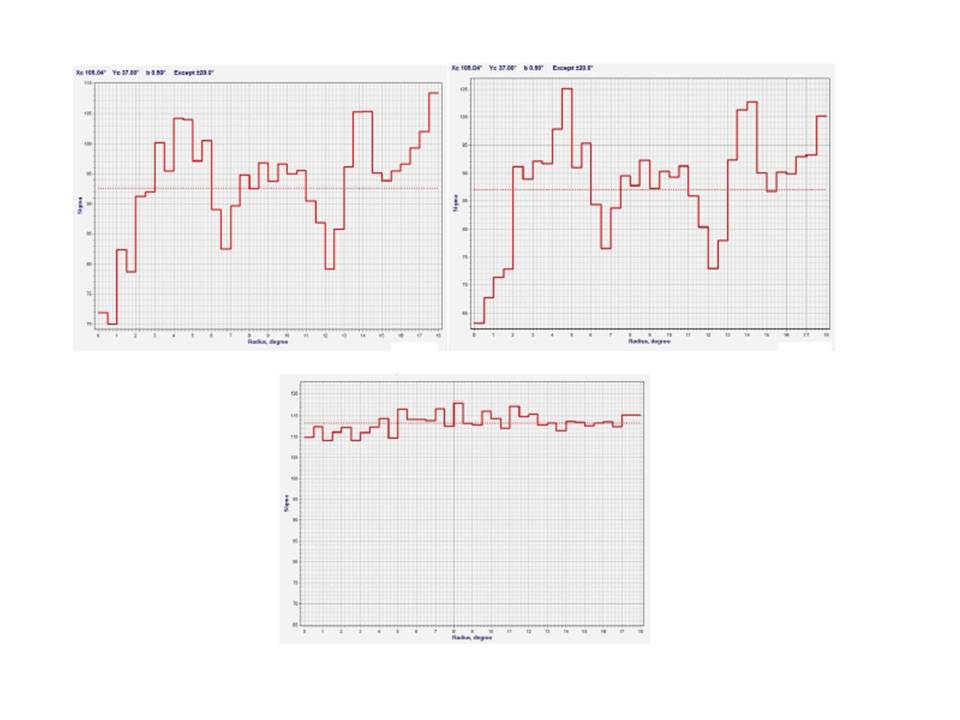
The authors report a hugely significant detection of their effect (they quote a “6-σ” result; in other words, the expected feature is expected to arise in the standard cosmological model with a probability of less than 10-7. The type of signal can be seen in their Figure 2, which I reproduce here:
Sorry they’re hard to read, but these show the variance measured on concentric rings (y-axis) of varying radius (x-axis) as seen in the WMAP W (94 Ghz) and V (54 Ghz) frequency channels (top two panels) compared with what is seen in a simulation with purely Gaussian fluctuations generated within the framework of the standard cosmological model (lower panel). The contrast looks superficially impressive, but there’s much less to it than meets the eye.
For a start, the separate WMAP W and V channels are not the same as the cosmic microwave background. There is a great deal of galactic foreground that has to be cleaned out of these maps before the pristine primordial radiation can be isolated. The fact similar patterns can be found in the BOOMERANG data by no means rules out a foreground contribution as a common explanation of anomalous variance. The authors have excluded the region at low galactic latitude (|b|<20°) in order to avoid the most heavily contaminated parts of the sky, but this is by no means guaranteed to eliminate foreground contributions entirely. Here is the all-sky WMAP W-band map for example:
Moreover, these maps also contain considerable systematic effects arising from the scanning strategy of the WMAP satellite. The most obvious of these is that the signal-to-noise varies across the sky, but there are others, such as the finite size of the beam of the WMAP telescope.
Neither galactic foregrounds nor correlated noise are present in the Gaussian simulation shown in the lower panel, and the authors do not say what kind of beam smoothing is used either. The comparison of WMAP single-channel data with simple Gaussian simulations is consequently deeply flawed and the significance level quoted for the result is certainly meaningless.
Having not looked looked at this in detail myself I’m not going to say that the authors’ conclusions are necessarily false, but I would be very surprised if an effect this large was real given the strenuous efforts so many people have made to probe the detailed statistics of the WMAP data; see, e.g., various items in my blog category on cosmic anomalies. Cosmologists have been wrong before, of course, but then so have even eminent physicists like Roger Penrose…
Another point that I’m not sure about at all is even if the rings of low variance are real – which I doubt – do they really provide evidence of a cyclic universe? It doesn’t seem obvious to me that the model Penrose advocates would actually produce a CMB sky that had such properties anyway.
Above all, I stress that this paper has not been subjected to proper peer review. If I were the referee I’d demand a much higher level of rigour in the analysis before I would allow it to be published in a scientific journal. Until the analysis is done satisfactorily, I suggest that serious students of cosmology shouldn’t get too excited by this result.
It occurs to me that other cosmologists out there might have looked at this result in more detail than I have had time to. If so, please feel free to add your comments in the box…
IMPORTANT UPDATE: 7th December. Two papers have now appeared on the arXiv (here and here) which refute the Gurzadyan-Penrose claim. Apparently, the data behave as Gurzadyan and Penrose claim, but so do proper simulations. In otherwords, it’s the bottom panel of the figure that’s wrong.
ANOTHER UPDATE: 8th December. Gurzadyan and Penrose have responded with a two-page paper which makes so little sense I had better not comment at all.
Just a quick grouchy post about crosswords. The results of Azed No. 2006 “Spoonerisms” have been published. Once again, I drew a blank in the setting competition, although I did at least solve the puzzle correctly. This is one of Azed’s “funnies” in that the clues either contain a spoonerism in the definition part or indicate a spoonerism of the answer to be entered in the grid. You can find a full analysis of the clues and their solutions here.
Azed’s Spoonerism puzzles are apparently very popular with solvers. I found the puzzle mildly diverting, but I didn’t enjoy this one very much, as most of the spoonerisms were either very obvious or a bit dodgy. I don’t think MAO TOAST is a spoonerism of OUTMOST, for example; surely that would have to be something like TAO MOST?
Anyway, that’s not the origin of my gripe. The clue writing competition required a clue for the word “GROAN” incorporating a spoonerism in the definition. The winning clue, as judged by Azed, was the following:
See king crowned, grand on horse, organ playing some allegro anthems
The spoonerism here is “see king crowned” for “creaking sound” (i.e. the groan associated with a ship’s timbers, etc). However, in my opinion, the vowel sounds here simply don’t work: the “ee” in “see king” isn’t the same as the “ea” in “creaking”, and the stress pattern is different too – “see king” has evenly stressed syllables whereas “creaking” has a stress on the first syllable.
On top of the problematic spoonerism, this clue has no less than three cryptic indications – G+ROAN (grand on horse), an anagram of “ORGAN” indicated by “playing”, and a hidden word “some alleGRO AN thems”.
I quote Azed’s own opinion:
A good cryptic clue contains three elements:
1. a precise definition
2. a fair subsidiary indication
3. nothing else
It doesn’t say three subsidiary indications! I’ve noticed that the winning Azed competition clues often have multiple cryptic parts, so obviously Azed is more lenient than I would be. I just don’t like clues that hedge their bets. Three weak cryptic allusions aren’t as good as one clever one.
Just my opinion, of course…
For what it’s worth, my failed attempt at GROAN was
Seeking crowned King’s leg over one
I think “seeking” is better than “see king” for the reasons I described above, but I admit the cryptic part is questionable – King is “GR”, the apostrophe is short for “has”, and “leg over one” is O(A)N with leg referring to the cricketing expression.
Brightly the sun of summer shone,
Green fields and waving woods upon,
And soft winds wandered by;
Above, a sky of purest blue,
Around, bright flowers of loveliest hue,
Allured the gazer’s eye.
But what were all these charms to me,
When one sweet breath of memory
Came gently wafting by?
I closed my eyes against the day,
And called my willing soul away,
From earth, and air, and sky;
That I might simply fancy there
One little flower — a primrose fair,
Just opening into sight;
As in the days of infancy,
An opening primrose seemed to me
A source of strange delight.
Sweet Memory! ever smile on me;
Nature’s chief beauties spring from thee,
Oh, still thy tribute bring!
Still make the golden crocus shine
Among the flowers the most divine,
The glory of the spring.
Still in the wall-flower’s fragrance dwell;
And hover round the slight blue bell,
My childhood’s darling flower.
Smile on the little daisy still,
The buttercup’s bright goblet fill
With all thy former power.
For ever hang thy dreamy spell
Round mountain star and heather bell,
And do not pass away
From sparkling frost, or wreathed snow,
And whisper when the wild winds blow,
Or rippling waters play.
Is childhood, then, so all divine?
Or Memory, is the glory thine,
That haloes thus the past?
Not all divine; its pangs of grief,
(Although, perchance, their stay be brief,)
Are bitter while they last.
Nor is the glory all thine own,
For on our earliest joys alone
That holy light is cast.
With such a ray, no spell of thine
Can make our later pleasures shine,
Though long ago they passed.
The views presented here are personal and not necessarily those of my employer (or anyone else for that matter).
Feel free to comment on any of the posts on this blog but comments may be moderated; anonymous comments and any considered by me to be vexatious and/or abusive and/or defamatory will not be accepted. I do not necessarily endorse, support, sanction, encourage, verify or agree with the opinions or statements of any information or other content in the comments on this site and do not in any way guarantee their accuracy or reliability.




 In the Dark