Snowy Saturday

Posted in Biographical, Sport with tags , , , on November 27, 2010 by telescoper

Up early this morning, cold notwithstanding, to take part in an all-day workshop on Public Attitudes to Science conducted by the market-research organization IPSOS-Mori on behalf of the Department for Business Innovation and Skills (BIS) I can’t really say much about what happened since it’s an ongoing research project, but it was very interesting and particularly nice to talk to the participants (who were aged 18-24). My role was as a “science expert” so my job was to explain a bit about how the kind of science I do actually works in practice, compared with what they thought before the event.

On the way home I had to find my way back through the crowded streets of Cardiff. Today was the last day of the autumn rugby internationals, and Wales were playing New Zealand at home. There was a fantastic atmosphere in the city, as always on match days, although the combination of a rather boisterous rugby crowd with large numbers of Christmas shoppers did slow down my journey home. The game just ended, Wales 25 New Zealand 37; not as one-sided as many feared and a much better spectacle than last week’s awful match against Fiji.

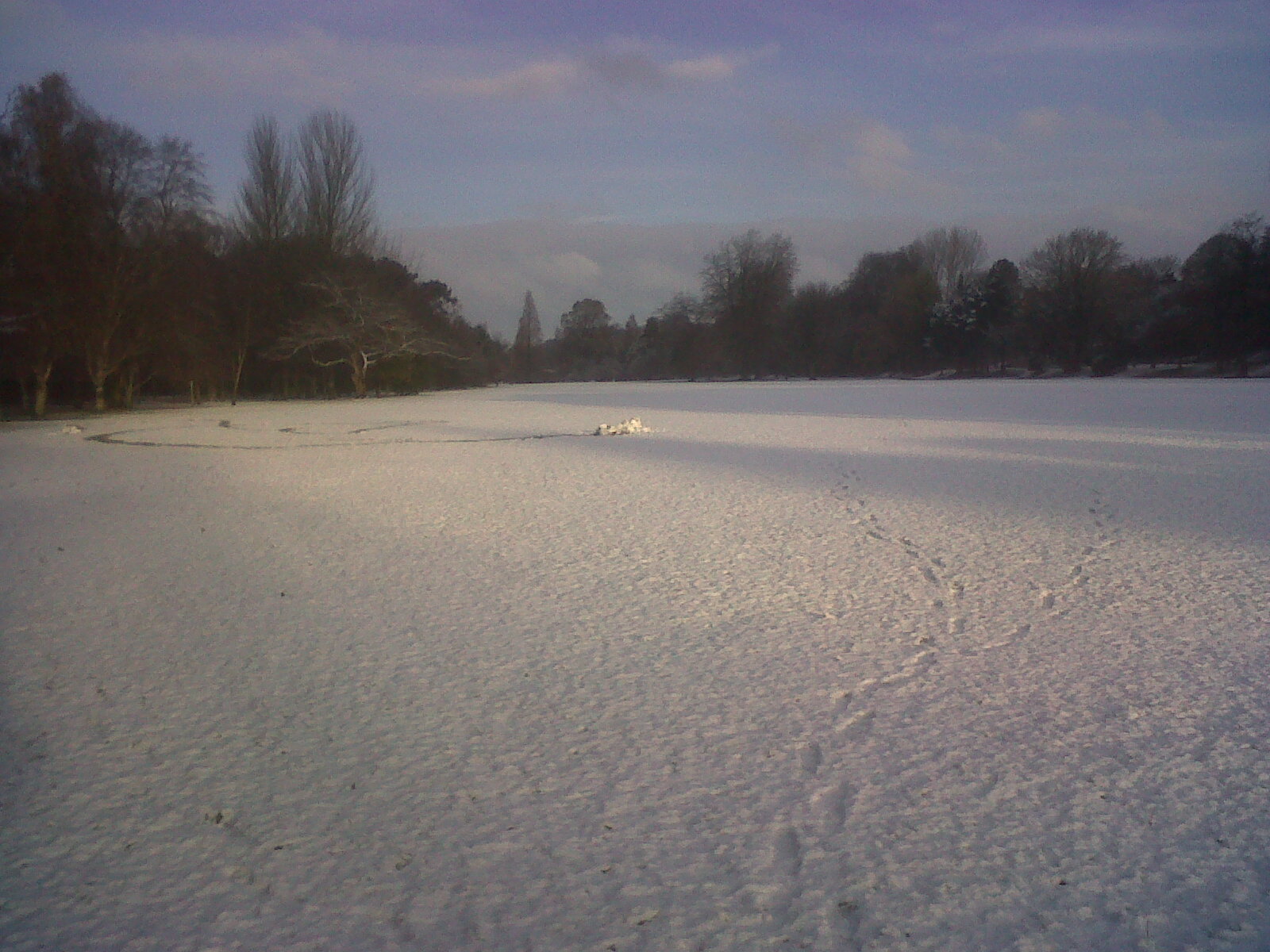
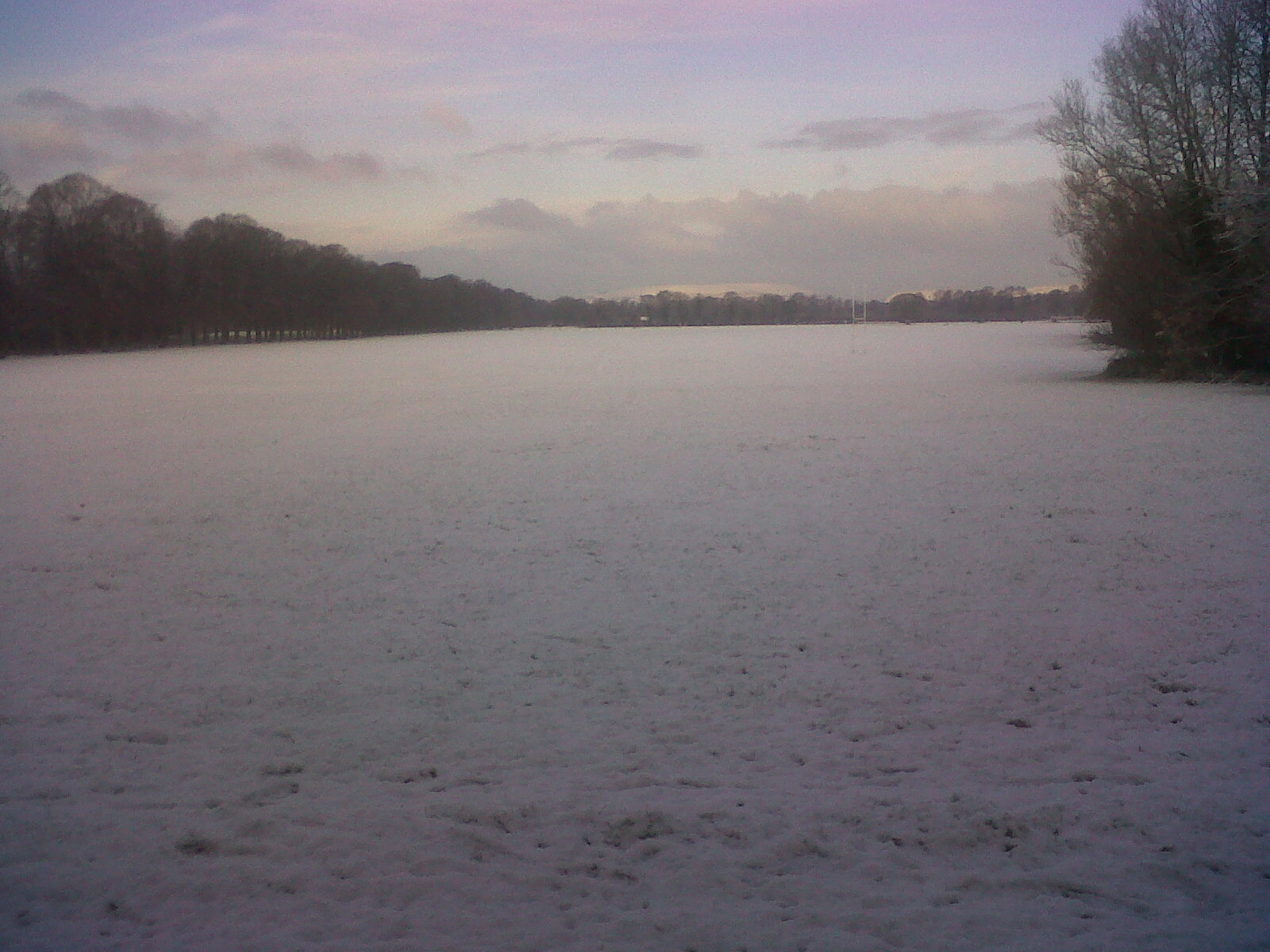
I took a few pictures of Bute Park on my way to the event this morning. It looked very beautiful, but it wasn’t half cold early on. I doubt if there’ll be much rugby played on the sports fields for a while, because the ground is frozen solid at the moment!


Share/Bookmark

A Gloom of Uninspired Research

Posted in Education, Poetry, Politics, Science Politics with tags , , , , , , , on November 26, 2010 by telescoper

I don’t mind admitting that I’m a bit down today. Being stuck at home with a fever and sore throat, and with mounting backlog of things to do isn’t helping my mood. On top of that I’ve got a general sense of depression about the future.

On the one hand there’s the prospect of huge increases in tuition fees for students, the motivation for many demonstrations all around the country (including an occupation here at Cardiff). I have to admit I’m firmly on the side of the students. It seems to me that what is happening is that whereas we used to finance our national gluttony by borrowing on over-valued property prices, we’ve now decided to borrow instead from the young, forcing them to pay for what we got for free instead of paying for it ourselves; it’s no wonder they’re angry. Call me old-fashioned, but I think universities should be funded out of general taxation. How many universities, and what courses, are different questions and I suspect I differ from the younger generation on the answers.

The other depressing thing relates to the other side of academic life, research. The tide of managerialism looks like sweeping away every last vestige of true originality in scientific research, in a drive for greater “efficiency”. I’ve already blogged about how the Science & Technology Facilities Council (STFC) is introducing a new system for grants which will make it impossible for individual researchers with good ideas to get money to start new research projects. Now it seems the Engineering and Physical Sciences Research Council (EPSRC) is going to go down the same road. It looks likely that in future only large-scale, low-risk research done in big consortia will be funded. Bandwagons are in; creativity is out.

Improving “efficiency” sounds like a good idea, but efficiency of what? These plans may reduce the cost of administering research grants, but they won’t do anything to increase the rate of scientific progress. Still, scientific progress can’t be entered easily on a spreadsheet so I suppose in this day and age that means it doesn’t matter.

I found the following in a story in this weeks Times Higher,

A spokeswoman for the Science and Technology Facilities Council also cited stability and flexibility as the main rationales for merging its grants programmes into one “consolidated grant”, a move announced earlier this month.

It looks like STFC has seconded someone from the  Ministry of Truth. The change to STFC’s grant system is in fact driven by two factors. One is to save money, which is what they’ve been told to do so no criticism there. The other is that the costly fiasco that is the new RCUK Shared Services Centre was so badly conceived that it has a grant system that is unable to adminster 5-year rolling grants of the type we have been used to having in astronomy. On top of that, research grants will last only 3 years (as opposed to the previous 5-year duration). There’s a typically Orwellian inversion  going on in our spokesperson’s comment: for “stability and flexibility”, read “instability and inflexibility”.

We’re not children. We all know that times are tough, but we could do with a bit less spin and a bit more honesty from the people ruining running British science. Still, I’m sure the resident spin doctors at STFC are “efficient”, and these days that’s all that matters.

The following excerpt from Wordsworth’s The Excursion pretty much sums it up.

Life’s autumn past, I stand on winter’s verge;
And daily lose what I desire to keep:
Yet rather would I instantly decline
To the traditionary sympathies
Of a most rustic ignorance, and take
A fearful apprehension from the owl
Or death-watch: and as readily rejoice,
If two auspicious magpies crossed my way;–
To this would rather bend than see and hear
The repetitions wearisome of sense,
Where soul is dead, and feeling hath no place;
Where knowledge, ill begun in cold remark
On outward things, with formal inference ends;
Or, if the mind turn inward, she recoils
At once–or, not recoiling, is perplexed–
Lost in a gloom of uninspired research;
Meanwhile, the heart within the heart, the seat
Where peace and happy consciousness should dwell,
On its own axis restlessly revolving,
Seeks, yet can nowhere find, the light of truth.


Share/Bookmark

That’s a Plenty

Posted in Jazz with tags , on November 25, 2010 by telescoper

By way of a little Thanksgiving gift to my friends and colleagues over in the US of Stateside, and also to warm the cockles of everyone shuddering here in the cold snap that’s fallen over Blighty, here’s a rare taste of hot jazz from a very young Benny Goodman.

This track was recorded in 1928, long before the start of the Swing Era of which Benny Goodman’s Orchestra was in the vanguard, leading Mr BG to be called “The King of Swing”. His clarinet sound is a bit rougher around the edges than he achieved in the slick performances of his later years, but then he was only 19 at the time and he certainly plays with a huge amount of drive.

This was recorded with a trio of himself on clarinet, a piano (Mel Stitzel) and a drummer (Bob Conselman). After he formed his big band in the thirties he continued to make records with a band of the same format, but featuring Teddy Wilson on piano and Gene Krupa on drums. I never quite worked out why he preferred not to have a bass player in the small group recordings (although he often included Lionel Hampton on vibes), but this older track at least demonstrates that he was consistent in that respect!

And another thing. I’m not an expert, but to my ears there’s more than a hint of the sound of  Klezmer music in this recording. Waddayathink?

Ways of Thinking

Posted in Biographical, The Universe and Stuff with tags , , on November 25, 2010 by telescoper

I’m putting one more Richard Feynman clip up. This one struck me as particularly interesting, because it touches on a question I’ve often asked myself: what goes on in your head when do you mathematical calculations? I think I agree with Feynman’s suggestion that different people think in very different ways about the same kind of calculation or other activity.

There’s no doubt in my mind that I’ve become slower and slower at doing mathematics as I’ve got older, and probably less accurate too. I think that’s partly just age – and perhaps the cumulative effect of too much wine! – but it’s partly because I have so many other things to think about these days that it’s hard to spend long hours without interruption thinking about the same problem the way I could when I was a student or a postdoc.

In any case, although much of my research is mathematical, I’ve never really thought of myself as being in any sense a mathematical person. Many of my colleagues have much better technical skills in that regard than I’ve ever had. I was never particularly good at maths at school either. I was sufficiently competent at maths to do physics, of course, but I was much better at other things at that age. My best subject at O-level was Latin, for example, which possibly indicates that my brain prefers to work verbally (or perhaps symbolically) rather than, as no doubt many others’ do, geometrically or in some other abstract way.

Another strange thing is the role of vision in doing mathematics. I can’t do maths at all without writing things down on paper. I have to be able to see the equations to think about solving them. Amongst other things this makes it difficult when you’re working things out on a blackboard (or whiteboard); you have to write symbols so large that your field of view can’t take in a whole equation. I often have to step back up one of the aisles to get a good look at what I’m doing like that. Other physicists – notably Stephen Hawking – obviously manage without writing things down at all. I find it impossible to imagine having that ability.

But I endorse what Richard Feynman says at the beginning of the clip. It’s really all about being interested in the questions, which gives you the motivation to acquire the skills needed to find the answers. I think of it as being like music. If you’re drawn into the world of music, even if you’re talented you have to practice long for long hours before you can really play an instrument. Few can reach the level of Feynman (or a concert pianist) of course – I’m certainly not among either of those categories! – but I think physics is at least as much perspiration as inspiration.

In contrast to many of my colleagues I’m utterly hopeless at chess – and other games that require very sophisticated pattern-reading skills – but good at crosswords and word-puzzles. Maybe I’m in the wrong job?


Share/Bookmark

Uncertain Universities…

Posted in Education, Politics with tags , , , , on November 24, 2010 by telescoper

Interesting snippets of Higher Education news today from the BBC website.

It seems that the Higher Education Funding Council for Wales (HECFW) has voiced concerns about the sustainability of no less than five Welsh universities. Although it hasn’t named them, I think it’s likely to be those most dependent on state funding which is pretty certain to shrink drastically over the next few years. I’ll leave it as an exercise for the reader to identify the five most likely to fold. This news has emerged as a result of a request by the BBC under the Freedom of Information Act.

This comes as no surprise to me, actually. It’s clear that, for its size and population,  Wales has too many separate institutions currently regarded as “universities”. A sustainable system would have less than half the number than we have now, but managing the change to a more rational structure is bound to be a difficult process, especially if it is allowed to happen by organized neglect (which seems to be the plan). Wales drastically underfunds its Higher Education sector compared to England anyway and, with what jam there is spread over far too many institutions, there’s very little by way of resources to devote to any real sort of strategic development.

Another interesting bit of information in the BBC report is that the Welsh Assembly is expected to outline its response to the Browne Review before Christmas. I was expecting the WAG to but  the introduction of any new fee system will probably have to wait until after the Welsh Assembly elections next May.

Meanwhile Cardiff University students are holding a protest against the possible introduction of fees at the very moment I am writing this, as part of a day of action across the UK. Although there are no definite plans to increase fees in Wales at the moment because the WAG has not announced its policy, I think most of us working in academia think a big increase in fees is imminent in Wales, just as it is in England (provided the necessary legislation gets through the House of Commons). It remains to be seen, however, whether Welsh universities will be allowed to charge as much as English ones, i.e. up to £9000 per annum.


Share/Bookmark

On the Nature of Time

Posted in Uncategorized with tags , , on November 24, 2010 by telescoper

I couldn’t resist posting this little piece, taken from an episode of The Goon Show first broadcast in 1957. Spike Milligan wrote most of the scripts for this long-running and hugely popular radio show as well as playing several of the characters including, in this clip, the gormless Eccles heard in dialogue with Bluebottle, played by Peter Sellers.

The Goon Show shattered the conventions of radio comedy with its anarchic humour, nonsensical plots, and sheer silliness; it was a direct ancestor of Monty Python’s Flying Circus, a debt acknowledged by the Python team. However, the strain of producing weekly scripts for The Goon Show exacted a heavy toll on Spike Milligan who had numerous nervous breakdowns. Not surprisingly, given the rate at which they had to be written, the episodes are uneven in quality but at times Spike Milligan’s comic writing rose to extraordinary heights of genius. Such as this joyfully absurd sequence, which I think is totally brilliant.

Postscript. After The Goon Show came to an end in 1960, Eccles and Bluebottle moved on to other careers. Rumour has it they’ve both applied to be the next Chief Executive of STFC.


Share/Bookmark

Bayes and his Theorem

Posted in Bad Statistics with tags , , , , , , on November 23, 2010 by telescoper

My earlier post on Bayesian probability seems to have generated quite a lot of readers, so this lunchtime I thought I’d add a little bit of background. The previous discussion started from the result

P(B|AC) = K^{-1}P(B|C)P(A|BC) = K^{-1} P(AB|C)

where

K=P(A|C).

Although this is called Bayes’ theorem, the general form of it as stated here was actually first written down, not by Bayes but by Laplace. What Bayes’ did was derive the special case of this formula for “inverting” the binomial distribution. This distribution gives the probability of x successes in n independent “trials” each having the same probability of success, p; each “trial” has only two possible outcomes (“success” or “failure”). Trials like this are usually called Bernoulli trials, after Daniel Bernoulli. If we ask the question “what is the probability of exactly x successes from the possible n?”, the answer is given by the binomial distribution:

P_n(x|n,p)= C(n,x) p^x (1-p)^{n-x}

where

C(n,x)= n!/x!(n-x)!

is the number of distinct combinations of x objects that can be drawn from a pool of n.

You can probably see immediately how this arises. The probability of x consecutive successes is p multiplied by itself x times, or px. The probability of (n-x) successive failures is similarly (1-p)n-x. The last two terms basically therefore tell us the probability that we have exactly x successes (since there must be n-x failures). The combinatorial factor in front takes account of the fact that the ordering of successes and failures doesn’t matter.

The binomial distribution applies, for example, to repeated tosses of a coin, in which case p is taken to be 0.5 for a fair coin. A biased coin might have a different value of p, but as long as the tosses are independent the formula still applies. The binomial distribution also applies to problems involving drawing balls from urns: it works exactly if the balls are replaced in the urn after each draw, but it also applies approximately without replacement, as long as the number of draws is much smaller than the number of balls in the urn. I leave it as an exercise to calculate the expectation value of the binomial distribution, but the result is not surprising: E(X)=np. If you toss a fair coin ten times the expectation value for the number of heads is 10 times 0.5, which is five. No surprise there. After another bit of maths, the variance of the distribution can also be found. It is np(1-p).

So this gives us the probability of x given a fixed value of p. Bayes was interested in the inverse of this result, the probability of p given x. In other words, Bayes was interested in the answer to the question “If I perform n independent trials and get x successes, what is the probability distribution of p?”. This is a classic example of inverse reasoning. He got the correct answer, eventually, but by very convoluted reasoning. In my opinion it is quite difficult to justify the name Bayes’ theorem based on what he actually did, although Laplace did specifically acknowledge this contribution when he derived the general result later, which is no doubt why the theorem is always named in Bayes’ honour.

This is not the only example in science where the wrong person’s name is attached to a result or discovery. In fact, it is almost a law of Nature that any theorem that has a name has the wrong name. I propose that this observation should henceforth be known as Coles’ Law.

So who was the mysterious mathematician behind this result? Thomas Bayes was born in 1702, son of Joshua Bayes, who was a Fellow of the Royal Society (FRS) and one of the very first nonconformist ministers to be ordained in England. Thomas was himself ordained and for a while worked with his father in the Presbyterian Meeting House in Leather Lane, near Holborn in London. In 1720 he was a minister in Tunbridge Wells, in Kent. He retired from the church in 1752 and died in 1761. Thomas Bayes didn’t publish a single paper on mathematics in his own name during his lifetime but despite this was elected a Fellow of the Royal Society (FRS) in 1742. Presumably he had Friends of the Right Sort. He did however write a paper on fluxions in 1736, which was published anonymously. This was probably the grounds on which he was elected an FRS.

The paper containing the theorem that now bears his name was published posthumously in the Philosophical Transactions of the Royal Society of London in 1764.

P.S. I understand that the authenticity of the picture is open to question. Whoever it actually is, he looks  to me a bit like Laurence Olivier…


Share/Bookmark

A Song for Saint Cecilia’s Day

Posted in Poetry with tags , on November 22, 2010 by telescoper

In case you didn’t know, today is St Cecilia‘s Day, so I thought I’d post this marvellous poem composed in 1687 by John Dryden

FROM harmony, from heavenly harmony,
This universal frame began:
When nature underneath a heap
Of jarring atoms lay,
And could not heave her head,
The tuneful voice was heard from high,
‘Arise, ye more than dead!’
Then cold, and hot, and moist, and dry,
In order to their stations leap,
And Music’s power obey.
From harmony, from heavenly harmony,
This universal frame began:
From harmony to harmony
Through all the compass of the notes it ran,
The diapason closing full in Man.

What passion cannot Music raise and quell?
When Jubal struck the chorded shell,
His listening brethren stood around,
And, wondering, on their faces fell
To worship that celestial sound:
Less than a God they thought there could not dwell
Within the hollow of that shell,
That spoke so sweetly, and so well.
What passion cannot Music raise and quell?

The trumpet’s loud clangour
Excites us to arms,
With shrill notes of anger,
And mortal alarms.
The double double double beat
Of the thundering drum
Cries Hark! the foes come;
Charge, charge, ’tis too late to retreat!

The soft complaining flute,
In dying notes, discovers
The woes of hopeless lovers,
Whose dirge is whisper’d by the warbling lute.

Sharp violins proclaim
Their jealous pangs and desperation,
Fury, frantic indignation,
Depth of pains, and height of passion,
For the fair, disdainful dame.

But O, what art can teach,
What human voice can reach,
The sacred organ’s praise?
Notes inspiring holy love,
Notes that wing their heavenly ways
To mend the choirs above.

Orpheus could lead the savage race;
And trees unrooted left their place,
Sequacious of the lyre;
But bright Cecilia rais’d the wonder higher:
When to her organ vocal breath was given,
An angel heard, and straight appear’d
Mistaking Earth for Heaven.

GRAND CHORUS.

As from the power of sacred lays
The spheres began to move,
And sung the great Creator’s praise
To all the Blest above;
So when the last and dreadful hour
This crumbling pageant shall devour,
The trumpet shall be heard on high,
The dead shall live, the living die,
And Music shall untune the sky!


Share/Bookmark

A Little Bit of Bayes

Posted in Bad Statistics, The Universe and Stuff with tags , , , , , , on November 21, 2010 by telescoper

I thought I’d start a series of occasional posts about Bayesian probability. This is something I’ve touched on from time to time but its perhaps worth covering this relatively controversial topic in a slightly more systematic fashion especially with regard to how it works in cosmology.

I’ll start with Bayes’ theorem which for three logical propositions (such as statements about the values of parameters in theory) A, B and C can be written in the form

P(B|AC) = K^{-1}P(B|C)P(A|BC) = K^{-1} P(AB|C)

where

K=P(A|C).

This is (or should be!)  uncontroversial as it is simply a result of the sum and product rules for combining probabilities. Notice, however, that I’ve not restricted it to two propositions A and B as is often done, but carried throughout an extra one (C). This is to emphasize the fact that, to a Bayesian, all probabilities are conditional on something; usually, in the context of data analysis this is a background theory that furnishes the framework within which measurements are interpreted. If you say this makes everything model-dependent, then I’d agree. But every interpretation of data in terms of parameters of a model is dependent on the model. It has to be. If you think it can be otherwise then I think you’re misguided.

In the equation,  P(B|C) is the probability of B being true, given that C is true . The information C need not be definitely known, but perhaps assumed for the sake of argument. The left-hand side of Bayes’ theorem denotes the probability of B given both A and C, and so on. The presence of C has not changed anything, but is just there as a reminder that it all depends on what is being assumed in the background. The equation states  a theorem that can be proved to be mathematically correct so it is – or should be – uncontroversial.

Now comes the controversy. In the “frequentist” interpretation of probability, the entities A, B and C would be interpreted as “events” (e.g. the coin is heads) or “random variables” (e.g. the score on a dice, a number from 1 to 6) attached to which is their probability, indicating their propensity to occur in an imagined ensemble. These things are quite complicated mathematical objects: they don’t have specific numerical values, but are represented by a measure over the space of possibilities. They are sort of “blurred-out” in some way, the fuzziness representing the uncertainty in the precise value.

To a Bayesian, the entities A, B and C have a completely different character to what they represent for a frequentist. They are not “events” but  logical propositions which can only be either true or false. The entities themselves are not blurred out, but we may have insufficient information to decide which of the two possibilities is correct. In this interpretation, P(A|C) represents the degree of belief that it is consistent to hold in the truth of A given the information C. Probability is therefore a generalization of the “normal” deductive logic expressed by Boolean algebra: the value “0” is associated with a proposition which is false and “1” denotes one that is true. Probability theory extends  this logic to the intermediate case where there is insufficient information to be certain about the status of the proposition.

A common objection to Bayesian probability is that it is somehow arbitrary or ill-defined. “Subjective” is the word that is often bandied about. This is only fair to the extent that different individuals may have access to different information and therefore assign different probabilities. Given different information C and C′ the probabilities P(A|C) and P(A|C′) will be different. On the other hand, the same precise rules for assigning and manipulating probabilities apply as before. Identical results should therefore be obtained whether these are applied by any person, or even a robot, so that part isn’t subjective at all.

In fact I’d go further. I think one of the great strengths of the Bayesian interpretation is precisely that it does depend on what information is assumed. This means that such information has to be stated explicitly. The essential assumptions behind a result can be – and, regrettably, often are – hidden in frequentist analyses. Being a Bayesian forces you to put all your cards on the table.

To a Bayesian, probabilities are always conditional on other assumed truths. There is no such thing as an absolute probability, hence my alteration of the form of Bayes’s theorem to represent this. A probability such as P(A) has no meaning to a Bayesian: there is always conditioning information. For example, if  I blithely assign a probability of 1/6 to each face of a dice, that assignment is actually conditional on me having no information to discriminate between the appearance of the faces, and no knowledge of the rolling trajectory that would allow me to make a prediction of its eventual resting position.

In tbe Bayesian framework, probability theory  becomes not a branch of experimental science but a branch of logic. Like any branch of mathematics it cannot be tested by experiment but only by the requirement that it be internally self-consistent. This brings me to what I think is one of the most important results of twentieth century mathematics, but which is unfortunately almost unknown in the scientific community. In 1946, Richard Cox derived the unique generalization of Boolean algebra under the assumption that such a logic must involve associated a single number with any logical proposition. The result he got is beautiful and anyone with any interest in science should make a point of reading his elegant argument. It turns out that the only way to construct a consistent logic of uncertainty incorporating this principle is by using the standard laws of probability. There is no other way to reason consistently in the face of uncertainty than probability theory. Accordingly, probability theory always applies when there is insufficient knowledge for deductive certainty. Probability is inductive logic.

This is not just a nice mathematical property. This kind of probability lies at the foundations of a consistent methodological framework that not only encapsulates many common-sense notions about how science works, but also puts at least some aspects of scientific reasoning on a rigorous quantitative footing. This is an important weapon that should be used more often in the battle against the creeping irrationalism one finds in society at large.

I posted some time ago about an alternative way of deriving the laws of probability from consistency arguments.

To see how the Bayesian approach works, let us consider a simple example. Suppose we have a hypothesis H (some theoretical idea that we think might explain some experiment or observation). We also have access to some data D, and we also adopt some prior information I (which might be the results of other experiments or simply working assumptions). What we want to know is how strongly the data D supports the hypothesis H given my background assumptions I. To keep it easy, we assume that the choice is between whether H is true or H is false. In the latter case, “not-H” or H′ (for short) is true. If our experiment is at all useful we can construct P(D|HI), the probability that the experiment would produce the data set D if both our hypothesis and the conditional information are true.

The probability P(D|HI) is called the likelihood; to construct it we need to have   some knowledge of the statistical errors produced by our measurement. Using Bayes’ theorem we can “invert” this likelihood to give P(H|DI), the probability that our hypothesis is true given the data and our assumptions. The result looks just like we had in the first two equations:

P(H|DI) = K^{-1}P(H|I)P(D|HI) .

Now we can expand the “normalising constant” K because we know that either H or H′ must be true. Thus

K=P(D|I)=P(H|I)P(D|HI)+P(H^{\prime}|I) P(D|H^{\prime}I)

The P(H|DI) on the left-hand side of the first expression is called the posterior probability; the right-hand side involves P(H|I), which is called the prior probability and the likelihood P(D|HI). The principal controversy surrounding Bayesian inductive reasoning involves the prior and how to define it, which is something I’ll comment on in a future post.

The Bayesian recipe for testing a hypothesis assigns a large posterior probability to a hypothesis for which the product of the prior probability and the likelihood is large. It can be generalized to the case where we want to pick the best of a set of competing hypothesis, say H1 …. Hn. Note that this need not be the set of all possible hypotheses, just those that we have thought about. We can only choose from what is available. The hypothesis may be relatively simple, such as that some particular parameter takes the value x, or they may be composite involving many parameters and/or assumptions. For instance, the Big Bang model of our universe is a very complicated hypothesis, or in fact a combination of hypotheses joined together,  involving at least a dozen parameters which can’t be predicted a priori but which have to be estimated from observations.

The required result for multiple hypotheses is pretty straightforward: the sum of the two alternatives involved in K above simply becomes a sum over all possible hypotheses, so that

P(H_i|DI) = K^{-1}P(H_i|I)P(D|H_iI),

and

K=P(D|I)=\sum P(H_j|I)P(D|H_jI)

If the hypothesis concerns the value of a parameter – in cosmology this might be, e.g., the mean density of the Universe expressed by the density parameter Ω0 – then the allowed space of possibilities is continuous. The sum in the denominator should then be replaced by an integral, but conceptually nothing changes. Our “best” hypothesis is the one that has the greatest posterior probability.

From a frequentist stance the procedure is often instead to just maximize the likelihood. According to this approach the best theory is the one that makes the data most probable. This can be the same as the most probable theory, but only if the prior probability is constant, but the probability of a model given the data is generally not the same as the probability of the data given the model. I’m amazed how many practising scientists make this error on a regular basis.

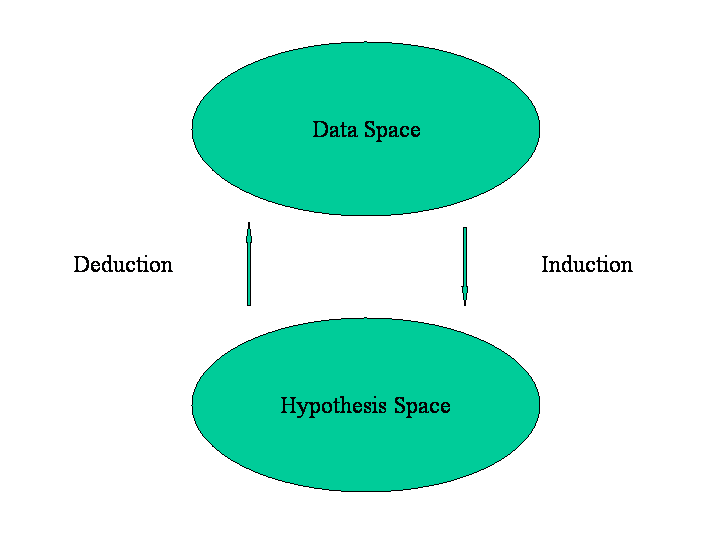
The following figure might serve to illustrate the difference between the frequentist and Bayesian approaches. In the former case, everything is done in “data space” using likelihoods, and in the other we work throughout with probabilities of hypotheses, i.e. we think in hypothesis space. I find it interesting to note that most theorists that I know who work in cosmology are Bayesians and most observers are frequentists!


As I mentioned above, it is the presence of the prior probability in the general formula that is the most controversial aspect of the Bayesian approach. The attitude of frequentists is often that this prior information is completely arbitrary or at least “model-dependent”. Being empirically-minded people, by and large, they prefer to think that measurements can be made and interpreted without reference to theory at all.

Assuming we can assign the prior probabilities in an appropriate way what emerges from the Bayesian framework is a consistent methodology for scientific progress. The scheme starts with the hardest part – theory creation. This requires human intervention, since we have no automatic procedure for dreaming up hypothesis from thin air. Once we have a set of hypotheses, we need data against which theories can be compared using their relative probabilities. The experimental testing of a theory can happen in many stages: the posterior probability obtained after one experiment can be fed in, as prior, into the next. The order of experiments does not matter. This all happens in an endless loop, as models are tested and refined by confrontation with experimental discoveries, and are forced to compete with new theoretical ideas. Often one particular theory emerges as most probable for a while, such as in particle physics where a “standard model” has been in existence for many years. But this does not make it absolutely right; it is just the best bet amongst the alternatives. Likewise, the Big Bang model does not represent the absolute truth, but is just the best available model in the face of the manifold relevant observations we now have concerning the Universe’s origin and evolution. The crucial point about this methodology is that it is inherently inductive: all the reasoning is carried out in “hypothesis space” rather than “observation space”.  The primary form of logic involved is not deduction but induction. Science is all about inverse reasoning.

For comments on induction versus deduction in another context, see here.

So what are the main differences between the Bayesian and frequentist views?

First, I think it is fair to say that the Bayesian framework is enormously more general than is allowed by the frequentist notion that probabilities must be regarded as relative frequencies in some ensemble, whether that is real or imaginary. In the latter interpretation, a proposition is at once true in some elements of the ensemble and false in others. It seems to me to be a source of great confusion to substitute a logical AND for what is really a logical OR. The Bayesian stance is also free from problems associated with the failure to incorporate in the analysis any information that can’t be expressed as a frequency. Would you really trust a doctor who said that 75% of the people she saw with your symptoms required an operation, but who did not bother to look at your own medical files?

As I mentioned above, frequentists tend to talk about “random variables”. This takes us into another semantic minefield. What does “random” mean? To a Bayesian there are no random variables, only variables whose values we do not know. A random process is simply one about which we only have sufficient information to specify probability distributions rather than definite values.

More fundamentally, it is clear from the fact that the combination rules for probabilities were derived by Cox uniquely from the requirement of logical consistency, that any departure from these rules will generally speaking involve logical inconsistency. Many of the standard statistical data analysis techniques – including the simple “unbiased estimator” mentioned briefly above – used when the data consist of repeated samples of a variable having a definite but unknown value, are not equivalent to Bayesian reasoning. These methods can, of course, give good answers, but they can all be made to look completely silly by suitable choice of dataset.

By contrast, I am not aware of any example of a paradox or contradiction that has ever been found using the correct application of Bayesian methods, although method can be applied incorrectly. Furthermore, in order to deal with unique events like the weather, frequentists are forced to introduce the notion of an ensemble, a perhaps infinite collection of imaginary possibilities, to allow them to retain the notion that probability is a proportion. Provided the calculations are done correctly, the results of these calculations should agree with the Bayesian answers. On the other hand, frequentists often talk about the ensemble as if it were real, and I think that is very dangerous…


Share/Bookmark

Come White Van Man to Bute Park Now…

Posted in Bute Park, Politics with tags , on November 20, 2010 by telescoper

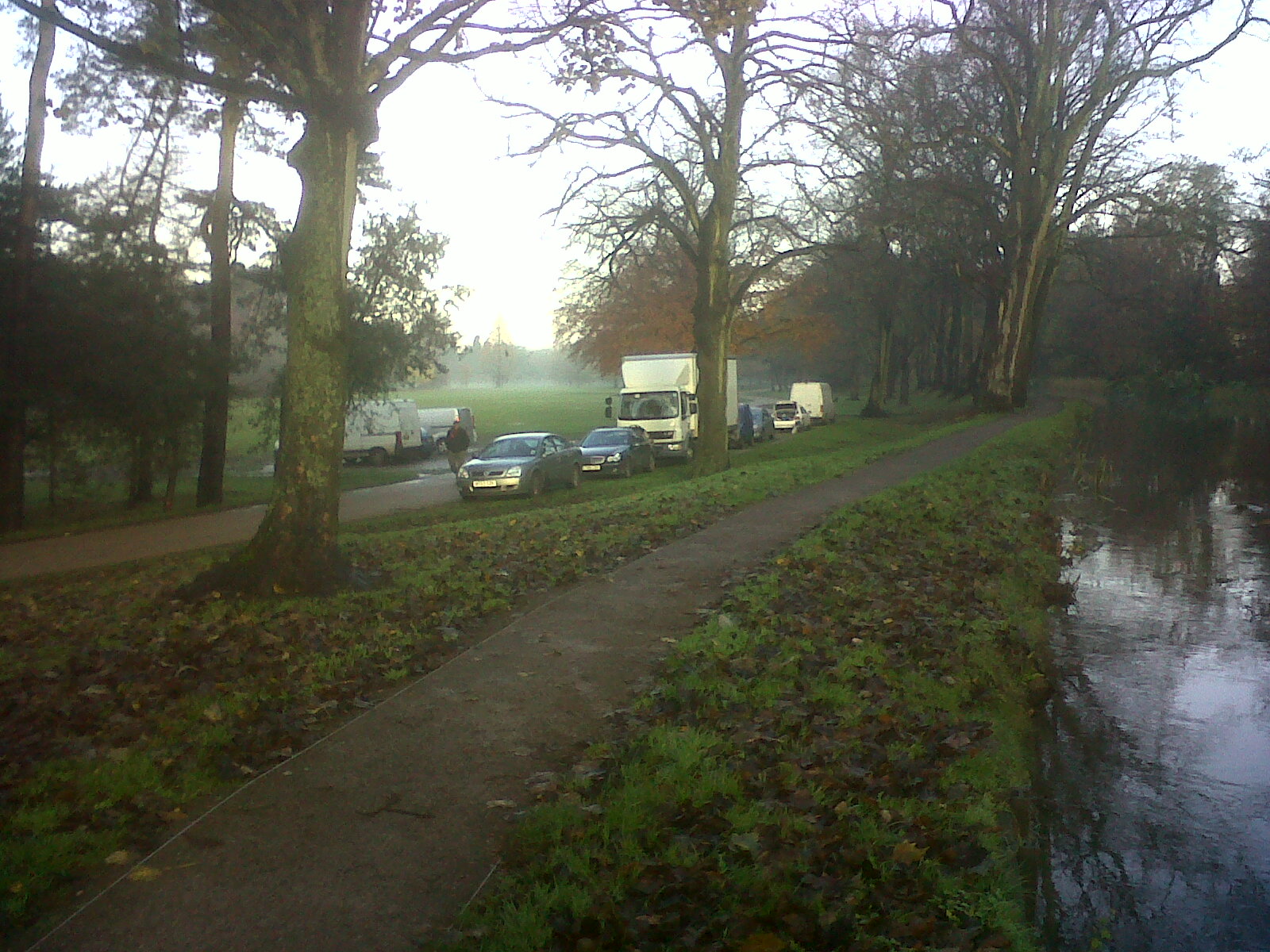
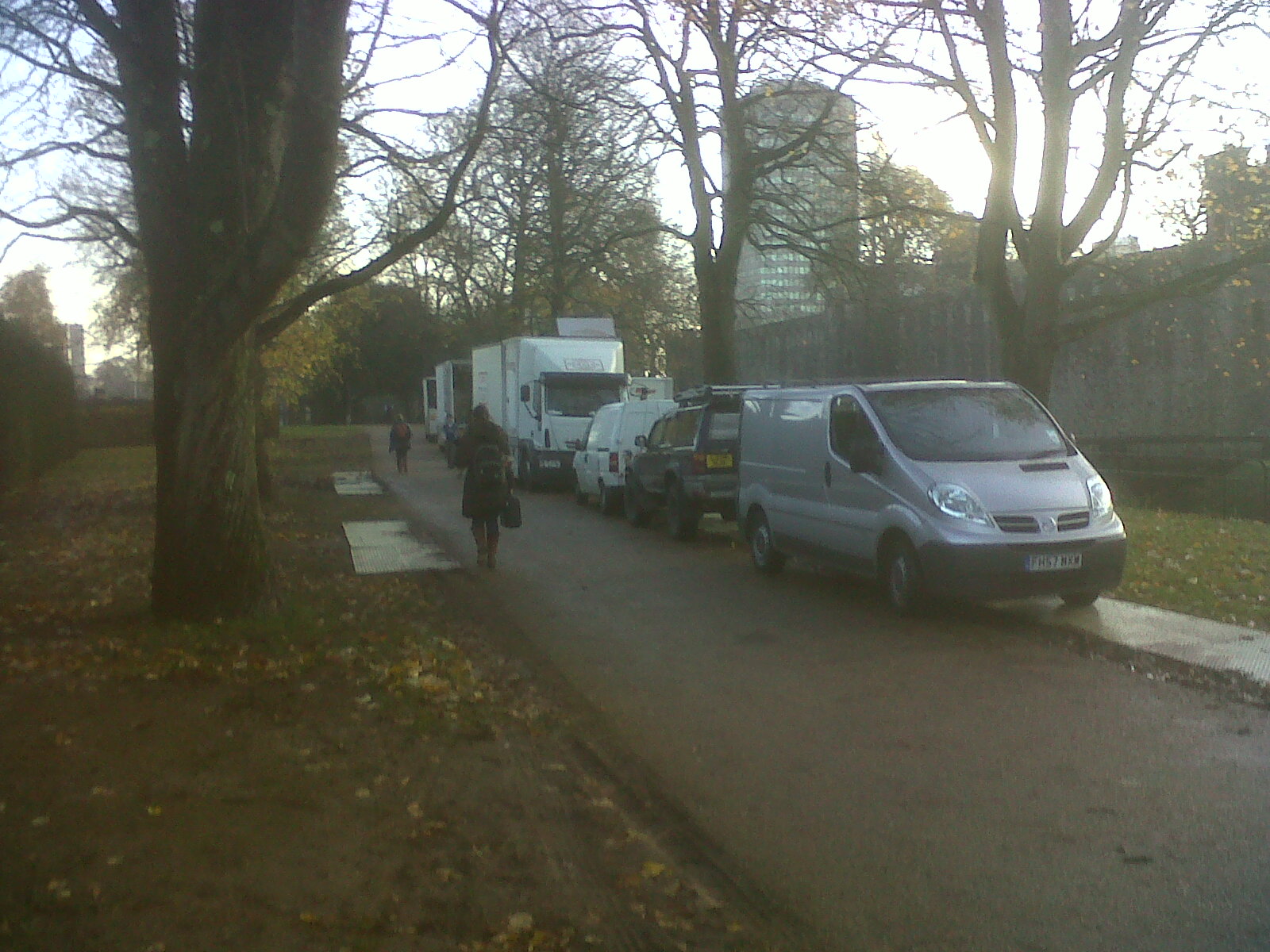
If you needed any proof of Cardiff City Council’s dishonesty about the likely effects of their new road into Bute Park then just take a look at these examples of private vehicles littering this once beautiful site. I should also say that there used to be signs proclaiming a 5mph speed limit on the public footpaths, but these have all been taken away, giving the dreaded White Van Man a licence to drive at high speed around the Park. I’ve stopped walking through it, in fact, on my way to work in the mornings as it has become too unpleasant battling my way through the traffic. Much more of this and I’m afraid Bute Park just won’t be fit for humans…


Share/Bookmark