(Guest Post) The GREAT10 Challenge

Posted in The Universe and Stuff with tags , , on December 8, 2010 by telescoper

I haven’t had any guest posts for a while, so I was happy to respond to an offer from Tom Kitching to do one about the GREAT10 challenge. I’ve been working a bit on weak gravitational lensing myself recently – or rather my excellent and industrious postdoc Dipak Munshi has, and I’ve been struggling to keep up! Anyway, here’s Tom’s contribution…

–0–

This guest post is about the the GREAT10 challenge, which was launched this week, I’ll briefly explain why this is important for cosmology, what the GREAT10 challenge is, and how you can take part. For more information please visit the website, or read the GREAT10 Handbook.

GREAT10 is focussed on weak gravitational lensing. This is an effect that distorts the shape of every galaxy we see, introducing a very small additional ellipticity to galaxy images. Weak lensing is a interesting cosmological probe because it can be used to measure both the rate of growth of structure and the geometry of the Universe. This enables extremely precise determinations of dark energy, dark matter and modified gravity. We can either use it to make maps of the dark matter distribution or to generate statistics, such as correlation functions, that depend sensitively on cosmological parameters.
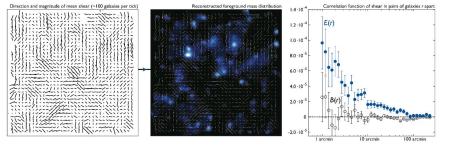
As shown in the Figure (click it for a higher-resolution version), the weak lensing effect varies as a function of position (left; taken from Massey et al. 2007), which can be used to map dark matter (centre) or the correlation function of the shear can be constructed (right; taken from Fu et al. 2008).

However, the additional ellipticity induced by weak lensing generates only about a 1% change in the surface brightness profile for any galaxy, far too small to been seen by eye, so we need to extract this “shear” signal using software and analyse its effect statistically over many millions of galaxies. To make things more complicated,  images contain noise, and are blurred by a PSF (or convolution kernel) caused by atmospheric turbulence and telescope effects.
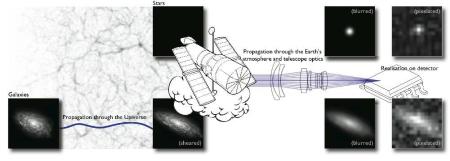
So the image of a galaxy is sheared by the large scale structure, then blurred by the PSF of the atmosphere and telescope, and finally distorted further by being represented by pixels in a camera. Star images are not sheared, but are blurred by the PSF. The challenge is to measure the shear effect (which is small) in the presence of all these other complications.

GREAT10 provides an environment in which algorithms and methods for measuring the shear, and dealing with the PSF, can be developed. GREAT10 is a public challenge, and we encourage everyone to take part, in particular we encourage new ideas from different areas of astronomy, computer science and industry. The challenge contains two aspects :

  • The Star Challenge : Is to the reconstruct the Point Spread Function, or convolution kernel, in astronomical images, which occurs because of the slight blurring effects of the telescope and atmosphere. The PSF varies across each image and is only sparsely sampled by stars, which are pixelated and noisy. The challenge is to reconstruct the PSF at non-star positions.
  • The Galaxy Challenge : Is to measure the shapes of galaxies to reconstruct the gravitational lensing signal in the presence of noise and a known Point Spread Function. The signal is a very small change in the galaxies’ ellipticity, an exactly circular galaxy image would be changed into an ellipse; however real galaxies are not circular. The challenge is to measure this effect over 52 million galaxies.

The challenges are run as a competition, and will run for 9 months. The prize for the winner is a trip to the final meeting at JPL, Pasadena, and an iPad or similar (sorry Peter! I know you don’t like Apple), but of course the real prize is the knowledge that you will have helped in creating the tools that will enable us to decipher the puzzle of understanding our Universe.

For more discussion on GREAT10 see MSNBC, WIRED and NASA.

–0–

EDITOR’S NOTE: I assume that second prize is two iPads…


Share/Bookmark

Astronomy Look-alikes, No. 43

Posted in Astronomy Lookalikes with tags , , on December 7, 2010 by telescoper

It’s been a while since I posted a lookee-likee, so how about this one?

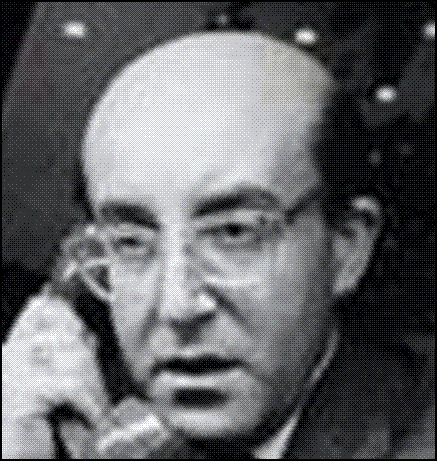
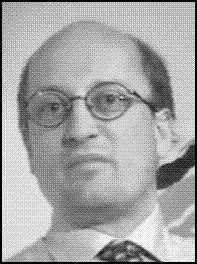
Has anyone else noticed that astronomer Dave Clements bears a strong resemblance to President Merkin Muffley, a character played by Peter Sellers in the motion picture Dr Strangelove? I wonder if by any chance they might be related?

Dr Dave Clements

Merkin Muffley


Share/Bookmark

The Sun’s not Behaving…

Posted in The Universe and Stuff with tags , , , on December 6, 2010 by telescoper

Check out this dramatic and slightly alarming picture of a huge filament emanating from the surface of the Sun, courtesy of NASA’s Solar Dynamics Observatory. The filament is about 700,000km long, apparently – that’s an entire Solar Radius. It’s expected to collapse back into the Sun at some point, an event which should be rather exciting! For more details see here.

Even better, here’s a close-up animation.


It reminds me a bit of that Balrog thing in The Lord of the Rings that gave Gandalf such a good run for his money.


Share/Bookmark

The Earthly Paradise: Apology

Posted in Poetry with tags , , on December 6, 2010 by telescoper

Of Heaven or Hell I have no power to sing,
I cannot ease the burden of your fears,
Or make quick-coming death a little thing,
Or bring again the pleasure of past years,
Nor for my words shall ye forget your tears,
Or hope again for aught that I can say,
The idle singer of an empty day.

But rather, when aweary of your mirth,
From full hearts still unsatisfied ye sigh,
And, feeling kindly unto all the earth,
Grudge every minute as it passes by,
Made the more mindful that the sweet days die–
–Remember me a little then I pray,
The idle singer of an empty day.

The heavy trouble, the bewildering care
That weighs us down who live and earn our bread,
These idle verses have no power to bear;
So let em sing of names rememberèd,
Because they, living not, can ne’er be dead,
Or long time take their memory quite away
From us poor singers of an empty day.

Dreamer of dreams, born out of my due time,
Why should I strive to set the crooked straight?
Let it suffice me that my murmuring rhyme
Beats with light wing against the ivory gate,
Telling a tale not too importunate
To those who in the sleepy region stay,
Lulled by the singer of an empty day.

Folk say, a wizard to a northern king
At Christmas-tide such wondrous things did show,
That through one window men beheld the spring,
And through another saw the summer glow,
And through a third the fruited vines a-row,
While still, unheard, but in its wonted way,
Piped the drear wind of that December day.

So with this Earthly Paradise it is,
If ye will read aright, and pardon me,
Who strive to build a shadowy isle of bliss
Midmost the beating of the steely sea,
Where tossed about all hearts of men must be;
Whose ravening monsters mighty men shall slay,
Not the poor singer of an empty day

by William Morris (1834-1896).


Share/Bookmark

Why should Wales subsidise English universities?

Posted in Education, Finance, Politics with tags , , , , on December 5, 2010 by telescoper

As the argument about increased tuition fees for English universities  intensifies in the run-up to Thursday’s debate in the House of Commons,  the Welsh Assembly Government last week announced that fees for students in Wales would rise to a basic level of £6000 per year, with a possible increase to £9000 “in certain circumstances”.

I’m a bit surprised that the WAG made this announcement in advance of the vote in Westminster, as it seems to me to be by no means certain that England will introduce the post-Browne system that Wales is copying. If the increased fee measure for England doesn’t get through Parliament then Welsh universities will find themselves out on a limb.

More generally, I find it extremely disappointing that there seems to be absolutely no independent thinking going on in Wales about Higher Education funding. The responsibility for this is devolved to the WAG, but time and time again it simply copies what the English are doing. What’s the point of having devolution if you haven’t got politicians willing and able to be different from the Westminster crowd?

One thing that Welsh Assembly Minister Leighton Andrews did announce that isn’t the case in England is that students domiciled in Wales would be protected from any tuition fee rise by a new system of grants, meaning that the Welsh Assembly will pick up the tab for Welsh students. They will still have to pay the existing fee level of £3290 per annum, but the WAG will pay the extra (between about £3K and £6K). This is good news for the students of course, but the grants will be available to Welsh students not just for Welsh universities but wherever they choose to study. Since about 16,000 Welsh students are currently at university in England, this means that the WAG is handing over a great big chunk (at least 16,000 × £3000 = £48 million) of its hard-earned budget straight back to England. It’s a very strange thing to do when the WAG is constantly complaining that the Barnett formula doesn’t give them enough money in the first place.

What’s more, the Welsh Assembly grants for Welsh students will be paid for by top-slicing the teaching grants that HECFW makes to Welsh universities. So further funding cuts for universities in Wales are going to be imposed precisely in order to subsidise English universities. This is hardly in the spirit of devolution either!

English students wanting to study in Wales will have to pay full whack, but will be paying to attend universities whose overall level of state funding is even lower than in England (at least for STEM subjects whose subsidy is protected in England). Currently about 25,000 English students study in Wales compared with the 16,000 Welsh students who study in England. If the new measures go ahead I can see fewer English students coming to Wales, and more Welsh students going to England. This will have deeply damaging consequences for the Welsh Higher Education system.

It’s very surprising that the Welsh Nationalists, Plaid Cymru, who form part of the governing coalition in the Welsh Assembly, have gone along with this strange move. It’s good for Welsh students, but not good for Welsh universities. I would have thought that the best plan for Welsh students would be to keep up the bursaries but apply them only for study in Wales. That way both students and institutions will benefit and the Welsh Assembly’s budget will actually be spent in Wales, which is surely what is supposed to happen…

POSTCRIPT: Leighton Andrews’ speech to the Welsh Assembly can be seen here.


Share/Bookmark

Change of the Century

Posted in Jazz with tags , , , , , on December 4, 2010 by telescoper

It’s cold and rainy outside so I thought I’d indulge myself by posting a bit of music. When I was in Oxford last week I was treated to a glass or two of wine after my seminar and during the conversation I was mildy castigated by Pedro Ferreira for not posting enough “modern jazz”, and especially not enough Ornette Coleman. I explained that I always feel like I’m cheating when I just put up a bit of music without actually writing something about it at the same time, and I especially feel that way about pieces that some people might find a bit challenging.

Anyway, I went through my collection just now and found the pioneering album Change of the Century which is well represented on Youtube (and not cursed by the copyright mafia), so here we go…

Coleman’s music must have sounded strange and dissonant for listeners in the late 1950s but it was soon assimilated and became part of the language of jazz from the 1960s onwards. This album dates from 1959, right at the start of his acceptance as a major artist. This album is actually also one of his most listenable LPs and contains a number of tunes which are catchy and even singable. There are obvious overtones of Charlie Parker throughout, but Ornette is already introducing some novel features, especially the use of suspended rhythmic figures which Miles Davis was to call the “stopping and swinging” approach to improvisation.

The album also features Don Cherry on trumpet, Billy Higgins on drums and the superb Charlie Haden on bass so it’s by no means a solo vehicle for Ornette Coleman’s alto saxophone. Indeed, some of the most exciting moments in the album belong to the intricate alto-trumpet unison passages, which are so complicated but played with unbelievable accuracy by the musicians. The following track, simply called Free, provides good examples.

Ornette Coleman’s playing, though, is truly remarkable: agile, constantly moving and full of nervous energy, but also bursting away from the constraints of the bar lines and sometimes taking ideas over the boundary between one chorus and the next. In this respect he was fortunate to have Haden and Higgins playing behind him because they seem to be able to sense the direction of these spontaneous departures, giving the music a close-knit unity which sets it apart from so many other groups recorded at the same time.

If you’re interested in modern jazz you really should get this album. It’s consistently brilliant. As a taster, here’s the track called Free, which is my favourite.

Don Cherry and Billy Higgins are sadly no longer with us, but Ornette Coleman is still going strong. I hope to post some reflections on his later work in due course.


Share/Bookmark

Meanwhile, Down Under…

Posted in Cricket with tags , , , , , , on December 4, 2010 by telescoper

At the end of day two of the Second Ashes Test between England and Australia, England were 317 for 2 in response to Australia’s 245 all out. Cook is 136 not out and Petersen 85 not out. Going well for England down under in the heat of Adelaide, I’d say. Australian captain Ricky Ponting seems to be hoping for help from above..

..although, given that this is in Australia, surely his hands are actually pointing downwards?


Share/Bookmark

Important News from STFC

Posted in Science Politics with tags , , , on December 4, 2010 by telescoper

Donning my community service hat,  I’ll just pass on some important news from the Science and Technology Facilities Council (STFC) concerning Astronomy research grants. The message is contained in an email that has been circulated concerning the new grant system and you can also find it at Paul Crowther’s website here. I urge all astronomers to read the text in full. I believe separate instructions are going out to particle physics and nuclear physics groups concerning their grants.

The main points are that:

  • The new system of consolidated grants will be implemented for the forthcoming deadline (7th April 2011).
  • There will be no more standard grants.
  • Detailed guidance on how to apply the consolidated grants is not yet available.

A lot of questions remain to be answered, such as how on Earth people are going to be able to write a big proposal in the short time available when there are as yet no proper instructions, how groups with several existing grants will go about consolidating them when they all have different start and end dates, how the consolidated grants will be assessed, etc.

Also, it is now clear that results of the existing grant round (for grants due to start in April 2011) will not be forthcoming until January at the earliest, so that Swindon Office will be trying to sort out the new system at the same time as trying to complete the last round of the old one.

The combinations of delays to this round with the hasty implementation of a drastically different scheme for the next round is bound to cause a lot of problems both for STFC staff and researchers wanting to apply for grants, not to mention the Astronomy Grants Panel (of which I am a member).

The main purpose of this change is to save administrative costs at STFC, but it seems to me the main effect will be transfer an increased burden to universities, at least in the short term. Once again everything’s being done by the seat of the pants, with a complete lack of joined-up thinking.

Please don’t shoot the messenger, or anyone else on the AGP!


Share/Bookmark

Are you well read?

Posted in Literature with tags on December 3, 2010 by telescoper

There’s a thing going around on Facebook which purports to be a list of the 100 “best” books rated by the BBC Book Club. I’m a bit confused by this because the list actually published by the BBC Book Club is rather different. Apparently the BBC thinks that most people have read only 6 of them anyway. Anyway, I’ve put the list here and marked the ones I’ve read in bold. I am interested to see how many my discerning readers have read, so please count the ones you have read and answer the quick poll.

In order to count you have to have read the whole book, not just bits!

1 Pride and Prejudice – Jane Austen

2 The Lord of the Rings – JRR Tolkien

3 Jane Eyre – Charlotte Bronte

4 Harry Potter series – JK Rowling

5 To Kill a Mockingbird – Harper Lee

6 The Bible

7 Wuthering Heights – Emily Bronte

8 Nineteen Eighty Four – George Orwell

9 His Dark Materials – Philip Pullman

10 Great Expectations – Charles Dickens

11 Little Women – Louisa M Alcott

12 Tess of the D’Urbervilles – Thomas Hardy

13 Catch 22 – Joseph Heller

14 Complete Works of Shakespeare

15 Rebecca – Daphne Du Maurier

16 The Hobbit – JRR Tolkien

17 Birdsong – Sebastian Faulks

18 Catcher in the Rye – JD Salinger

19 The Time Traveler’s Wife – Audrey Niffenegger

20 Middlemarch – George Eliot

21 Gone With The Wind – Margaret Mitchell

22 The Great Gatsby – F Scott Fitzgerald

24 War and Peace – Leo Tolstoy

25 The Hitch Hiker’s Guide to the Galaxy – Douglas Adams

27 Crime and Punishment – Fyodor Dostoyevsky

28 Grapes of Wrath – John Steinbeck

29 Alice in Wonderland – Lewis Carroll

30 The Wind in the Willows – Kenneth Grahame

31 Anna Karenina – Leo Tolstoy

32 David Copperfield – Charles Dickens

33 Chronicles of Narnia – CS Lewis

34 Emma -Jane Austen

35 Persuasion – Jane Austen

36 The Lion, The Witch and the Wardrobe – CS Lewis

37 The Kite Runner – Khaled Hosseini

38 Captain Corelli’s Mandolin – Louis De Bernieres

39 Memoirs of a Geisha – Arthur Golden

40 Winnie the Pooh – A.A. Milne

41 Animal Farm – George Orwell

42 The Da Vinci Code – Dan Brown

43 One Hundred Years of Solitude – Gabriel Garcia Marquez

44 A Prayer for Owen Meaney – John Irving

45 The Woman in White – Wilkie Collins

46 Anne of Green Gables – LM Montgomery

47 Far From The Madding Crowd – Thomas Hardy

48 The Handmaid’s Tale – Margaret Atwood

49 Lord of the Flies – William Golding

50 Atonement – Ian McEwan

51 Life of Pi – Yann Martel

52 Dune – Frank Herbert

53 Cold Comfort Farm – Stella Gibbons

54 Sense and Sensibility – Jane Austen

55 A Suitable Boy – Vikram Seth

56 The Shadow of the Wind – Carlos Ruiz Zafon

57 A Tale Of Two Cities – Charles Dickens

58 Brave New World – Aldous Huxley

59 The Curious Incident of the Dog in the Night-time – Mark Haddon

60 Love In The Time Of Cholera – Gabriel Garcia Marquez

61 Of Mice and Men – John Steinbeck

62 Lolita – Vladimir Nabokov

63 The Secret History – Donna Tartt

64 The Lovely Bones – Alice Sebold

65 Count of Monte Cristo – Alexandre Dumas

66 On The Road – Jack Kerouac

67 Jude the Obscure – Thomas Hardy

68 Bridget Jones’s Diary – Helen Fielding

69 Midnight’s Children – Salman Rushdie

70 Moby Dick – Herman Melville

71 Oliver Twist – Charles Dickens

72 Dracula – Bram Stoker

73 The Secret Garden – Frances Hodgson Burnett

74 Notes From A Small Island – Bill Bryson

75 Ulysses – James Joyce

76 The Inferno – Dante

77 Swallows and Amazons – Arthur Ransome

78 Germinal – Emile Zola

79 Vanity Fair – William Makepeace Thackeray

80 Possession – AS Byatt

81 A Christmas Carol – Charles Dickens

82 Cloud Atlas – David Mitchell

83 The Color Purple – Alice Walker

84 The Remains of the Day – Kazuo Ishiguro

85 Madame Bovary – Gustave Flaubert

86 A Fine Balance – Rohinton Mistry

87 Charlotte’s Web – E.B. White

88 The Five People You Meet In Heaven – Mitch Albom

89 Adventures of Sherlock Holmes – Sir Arthur Conan Doyle

90 The Faraway Tree Collection – Enid Blyton

91 Heart of Darkness – Joseph Conrad

92 The Little Prince – Antoine De Saint-Exupery

93 The Wasp Factory – Iain Banks

94 Watership Down – Richard Adams

95 A Confederacy of Dunces – John Kennedy Toole

96 A Town Like Alice – Nevil Shute

97 The Three Musketeers – Alexandre Dumas

98 Hamlet – William Shakespeare

99 Charlie and the Chocolate Factory – Roald Dahl

100 Les Miserables – Victor Hugo

Any opinions on great books not on the list welcome through the comments box!


Share/Bookmark

Medical researcher discovers integration, gets 75 citations (via An American Physics Student in England)

Posted in Uncategorized on December 3, 2010 by telescoper

I couldn’t resist reposting this. It’s hilarious.

(Note: this post is `just for fun;' no premeds, doctors, researchers, or nobel laureates were meant to be offended in the writing of this post.) The bane of many American physics grad students is teaching introductory physics to premed students. Due to the nature of med school admissions, one ends up with classrooms full of students who cannot afford to get anything less than an A+++ if they hope to make it to (Ivy League) Med School. Further, du … Read More

via An American Physics Student in England