For Your Listening Pleasure…

Posted in The Universe and Stuff with tags , , , on November 12, 2009 by telescoper

Well, this is blogging made easy. I’ve just cut-and-pasted the following item directly from the School’s news page with very few alterations, but it’s all done for a good reason, so please read on:

A leading member of the School of Physics and Astronomy at Cardiff University, whose research helped create one of the most powerful and ambitious astronomical satellites ever made will feature in a two-part Radio 4 programme.

The Herschel Space Telescope is a two-part series to be aired on Radio 4 on Wednesday 18th November, 11:00-11:30am and Wednesday 25th November, 11:00-11:30am. BBC science reporter Jonathan Amos follows the engineers and scientists working on the SPIRE instrument for the European Space Agency’s Herschel satellite. Herschel is one of the most important missions in the history of European spaceflight and was launched successfully on May 14 this year.

The SPIRE instrument was built by an international team led by Professor Matt Griffin, School of Physics and Astronomy. The programme tells the story of the UK SPIRE team, including several members from Cardiff, as they prepared for the launch of Herschel and as the first results came in.

As well as Professor Griffin, other members of staff in the School of Physics and Astronomy who contributed to the project are also featured. They include: Professor Steve Eales, Dr Jon Davies, Dr Kate Isaak, and Dr Pete Hargrave as well as post-doctoral researchers Dr Jason Kirk, Dr Michael Pohlen, and Dr Luca Cortese.

Professor Matt Griffin

Herschel carries the biggest mirror ever sent to space and is already giving astronomers their best view yet of the Universe at far-infrared and sub-millimetre wavelengths. It can peer through obscuring clouds of dust to look at the early stages of star birth and galaxy formation; it can examine the composition and chemistry of comets and planetary atmospheres in the Solar System; and it is able to study the star-dust ejected by dying stars into interstellar space which forms the raw material for planets like the Earth.

Professor Griffin said: “With its big telescope and sophisticated and sensitive instruments, including SPIRE, Herschel is a very powerful observatory for many studies from our own solar system to the most distant galaxies. Already we can see that its results will reveal how stars like the Sun are forming in our own galaxy today, how planetary systems can develop from the dust and gas around young stars, and how the galaxies grew and evolved over cosmic time.

“Astronomers from Cardiff are at the forefront in making these exciting scientific discoveries – we are delighted that the work of Cardiff scientists will be featured in such an important radio programme.”

I should also point out that BBC Radio 4 programmes can be listened to online, and are available to download for a week after the broadcast from the BBC website (even to foreigners).

PS. I should also mention that today’s “Material World” (another Radio 4 programme) was a special edition from Cardiff University and also featured an astronomy item. If you missed it, or if you want to hear it again, you can listen to it here.


Viva Voce

Posted in Biographical, The Universe and Stuff with tags , on November 11, 2009 by telescoper

Just back from a flying visit to the beautiful city of Edinburgh, where I was involved in the examination of a PhD candidate at the Institute for Astronomy, which is housed on the site of the Royal Observatory.

For those of you not familiar with how this works, a PhD involves doing research into a particular topic and then writing up what you’ve done in a thesis. The thesis is a substantial piece of work, often in the region of 100,000 words (200 pages or so), which is then assessed by two examiners (one internal to the university at which the research was done, and one external). They read copies of the thesis and then the candidate has to defend it in an oral examination, which was what happened today, after which they make a recommendation to the university about whether the degree should be awarded.

At most universities the supervisor does not attend the oral examination, but is not normally required to go into hiding for the day, which is what seemed to happen in this case…

There aren’t many rules for how a viva voce examination should be conducted or how long it should last, but the can be as short as, say, 2 hours and can be as long as 5 hours or more. The examiners usually ask a mixture of questions, some about the details of the work presented and some about the general background. The unpredictable content of a viva voce examination makes it very difficult to prepare for, and it can be difficult and stressful for the candidate (as well as just tiring, as it can drag on for a long time). However, call me old-fashioned but I think if you’re going to get to call youself Doctor of Philosophy you should expect to have to work for it. Some might disagree.

As it happens, my own PhD examination 20 years ago was quite long (about 4hrs 30 minutes) and my external examiner was John Peacock, who happened to be the supervisor of today’s candidate Berian James. It wasn’t a deliberate consequence of me wanting to take vicarious revenge as external examiner on John’s student, but this turned out to be a long examination too. We did break twice (once, briefly, for the remembrance day silence and then for a longer period for lunch), but it was still a lengthy affair.

Obviously I can’t give details of what went on in the examination except that it was long primarily because the thesis was very interesting and gave us lots to discuss. In the end internal examiner Philip Best and I agreed to recommend the award of a PhD. Berian then went off to celebrate while we completed the necessary paperwork. At Edinburgh as in most UK universities, the examiners simply make a recommendation to a higher authority (e.g. Board of Graduate Studies) to formally award the degree, but in the overwhelming majority of cases they follow the recommendation.

After doing the paperwork I still had time to join the party for a glass or two of fizzy. At the do and at various points during the day I had the chance to say hello to some old friends, including Andy Taylor, Bob Mann, and Alan Heavens who all work at the ROE and Richard Nelson who was there for a meeting that I hadn’t known about when we arranged the date and time of the viva.

All in all, it was a very pleasant trip. Although I had to dash around to and from airports a bit getting to and from Scotland, all the planes went on time and since it’s less than an hour flying time from Cardiff to Edinburgh, it was all remarkably hassle-free.

Just before I left to get a taxi to the airport I had a quick chat with one of the PhD students, Alina Kiessling, who joked that I must be rushing off to write about the day on my blog. I never had time to read blogs when I was a PhD student (but  they hadn’t been invented then).

Perhaps I should start charging people to put their name in lights on In the Dark…

Planck’s Progress

Posted in The Universe and Stuff with tags , , on November 10, 2009 by telescoper

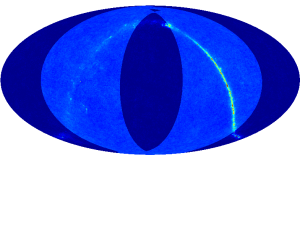
Only time for a very quick post today, so I thought I’d just pass on some news I got via Chris North about how Planck is doing. As it happens, the satellite has recently reached  the point where it has observed about half the sky. It spins on its axis in rather stately fashion (at about one revolution per minute) and, as it moves in its orbit, that sweeps the telescope across the celestial sphere. Each scan is almost a great circle, but  these gradually creep around over about a six month period to cover the whole sky.

The nice picture below, in ecliptic coordinates, shows how far it has got. You can also see the Galactic plane, arching across the sky and showing up clearly at the frequencies Planck is sensitive to.

Planck3NovSkyCoverage

The Planck Consortium had an official meeting last week in Bologna at which they drank lots of wine and ate lots of food, but other than that nobody who was there has told me anything.

It’s all very hush hush don’t you know.

Dulce et Decorum Est

Posted in Poetry with tags , on November 9, 2009 by telescoper

Folowing on from yesterday’s post, here’s probably the greatest poem by the greatest of all the poets of the First World War, Wilfred Owen. He captures the horror and brutality of war in language so potent that it still retains the ability to shock even now, 90 years later. Every image attacks the myth of war as a noble or glamorous thing and the cumulative effect of this onslaught is overwhelming. The title comes from a phrase in Horace, also quoted in the last lines of the verse: Dulce et decorum est pro patria mori (It is sweet and suitable to die for your country).

There is a nice short video clip featuring Jeremy Paxman that really says it all, but it’s just as powerful if you read the text yourself.

Bent double, like old beggars under sacks,
Knock-kneed, coughing like hags, we cursed through sludge,
Till on the haunting flares we turned our backs
And towards our distant rest began to trudge.
Men marched asleep. Many had lost their boots
But limped on, blood-shod. All went lame; all blind;
Drunk with fatigue; deaf even to the hoots
Of disappointed shells that dropped behind.

GAS! Gas! Quick, boys!– An ecstasy of fumbling,
Fitting the clumsy helmets just in time;
But someone still was yelling out and stumbling
And floundering like a man in fire or lime.–
Dim, through the misty panes and thick green light
As under a green sea, I saw him drowning.

In all my dreams, before my helpless sight,
He plunges at me, guttering, choking, drowning.

If in some smothering dreams you too could pace
Behind the wagon that we flung him in,
And watch the white eyes writhing in his face,
His hanging face, like a devil’s sick of sin;
If you could hear, at every jolt, the blood
Come gargling from the froth-corrupted lungs,
Obscene as cancer, bitter as the cud
Of vile, incurable sores on innocent tongues,–
My friend, you would not tell with such high zest
To children ardent for some desperate glory,
The old Lie: Dulce et decorum est
Pro patria mori
.

Acts of Remembrance

Posted in Uncategorized with tags , , , , on November 8, 2009 by telescoper

So here we are again. Once more it’s Remembrance Sunday, an occasion to remember those who have given their lives in conflicts past and present. This is always held on the second Sunday in November in the United Kingdom, so that it is close to the date of anniversary of the armistice that formally ended the First World War, on 11th November 1918. Another way to commemorate this  is the observance of two minutes’ silence at 11am on 11th November itself. I plan to do that, this Wednesday (which is the 11th November). In fact, I shall  be in the middle of a PhD examination in Edinburgh at that time, so I hope the candidate and the internal examiner don’t object! It is, however, one of the very few things that I’m not willing to compromise about.

Another is the wearing of a poppy. The poppy appeal raises money for veterans and their families, but the wearing of these little red paper flowers is something that not everyone feels comfortable with. Some people think that to wear a poppy is to celebrate militarism or even Britain’s imperialist past. I don’t see it that way at all. If someone asked me to wear a badge to support Britain’s participation in the invasion of Iraq, I’d certainly refuse, in fact.

I wrote about my reaction to the horror and futility of war about this time last year, so I’ll try not to repeat myself except to say that, to me, the poppy is not about celebrating war or military prowess, it’s simply about remembering those who died. In fact, one of the main reasons the paraphernalia of  Remembrance Day observances (the poppy, the cenotaph, the tomb of the unknown soldier, and all that) were set up in the first place was to remind not just people but also governments of the devastation caused byWorld War One. That’s why the Remembrance Day ceremonial laying of wreaths takes place in Whitehall, right at the heart of government. The ritual  was specifically intended to be a warning to the politicians who had brought the conflict about not to allow it to happen again.

As a young lefty student I grappled with the implications of the poppy appeal. The Peace Pledge Union produces white poppies, as an overtly anti-war symbol of remembrance. For a time I wore a white poppy but, although I am against war, I don’t think a policy of non-violence would have helped much against the Nazis and therefore can’t really call myself an out-and-out  pacifist. One year I wore both white and red poppies, but since then I’ve decided to stick with a red one.

Of course many in the Establishment would like the poppy to turn into a symbol of obedience, a kind of alternative national flag. Some people choose not to wear it precisely for that reason. The sight of some hypocritical warmongerers wearing the poppy at the Cenotaph on these occasions sickens me, but their betrayal does not make me want to stop wearing it myself. Neither does the fact that our politicians seem content to give away the freedoms that so many died to protect.

Some poppy sellers use the slogan  Wear Your Poppy With Pride, but the original meaning  is much better expressed by the original, Lest We Forget. I’m not sure I wear mine with pride at all, in fact. What I feel is really more like shame, at the wastefulness and stupidity of armed conflict. I count myself incredibly lucky that I have never had to live through anything like that, not only because I’ve had a peaceful and comfortable life, but also because I have never been tested in the way previous generations were. I wear the poppy to acknowledge their bravery and to recognize my own good fortune.

On Friday evening I went with a bunch of  Cardiff astronomers to a pub near the department for a couple of pints, as at the end of most weeks. For a while we talked about poppies and their meaning. Some of us were wearing  them, some weren’t. Various views were aired. One view was that it they saw the poppy as supporting the ongoing wars in Iraq and Afghanistan. Others expressed distaste for the fact that the poppy had become a kind of meaningless fashion accessory, or that wearing it had become compulsory, at least for newsreaders and other TV celebrities. Another pointed out that the last British veterans of the Great War, Harry Patch and Henry Allingham both died earlier this year, within a few days of each other, and that made the poppy irrelevant.

I respect these points of view, but don’t agree with them. I think the fact that there are no living survivors of the trenches makes it more, not less, important to remember those that died. It’s not just about the First World War anyway. Nor is it just about servicemen. When I stand for the two minutes silence I remember those all who fell fighting on all sides of all wars, and  fallen civilians too.

I didn’t support the invasions of Iraq or Afghanistan and I don’t understand what the continued presence of British soldiers in such places is supposed to be achieving other than more death. But why should the dead of Helmand 2009 deserve less respect than those of Flanders 1917? I wear the poppy for them, not for the fools that sent them there.

When the newsreader Jon Snow decided not to wear a poppy on TV a few years ago, there were angry complaints. I’m sure he didn’t mean disrespect to the cause but disliked the pressure being put on him to conform. I can see his point. It has to be voluntary if it is to mean anything at all. I would probably refuse to wear a poppy myself if someone tried to make it compulsory. But in the end I agree with Euan Ferguson’s piece in today’s Observer. The picture shows a bunch of the contestants from X-factor (which is, apparently, a popular television programme) all wearing poppies.

Ferguson writes

I recall a time, it seems just – just! – about 20 years ago, presumably around the time most of these X Factor contestants were crying their first (but by no means their last) tears, that anyone handing the stroppy younger me a poppy would be met with mystification and reluctance, as if they were offering me a cormorant. Although it’s possible the group in this photograph was suitably “advised” for their very public trip to the West End premiere of A Christmas Carol, the many under-20s stopping outside London’s King’s Cross to buy poppies last week from squaddies suggests a real change of attitude. Gone are the sulky, rebellious, anti-poppy teens of old, now seeming as distant as CND marches.

The young appear not only proud to wear them, but are almost using them as accessories: here, oversized, silky, something even of a statement. Elsewhere, there’s the tasteful option of those rather fine little enamel badges. I’ve seen people take out the little green paper foliage and opt for the simple scarlet. Sarah Brown managed to attract criticism for sporting an extra large one.

Is it all healthy? Well, I don’t like pressure being put on people to conform. Orthodoxy and fear are always to be regretted and today’s society is over-condemnatory, swift to its manufactured outrage. But this change seems to have come from below, not been ordered by bullies: the daily reports of life and death in the forces, of the danger other 20-year-olds daily find themselves facing. And is the symbolism of the poppy being degraded as it is customised? No. You can’t do much to the fabulous simplicity of this symbol. And the poppy doesn’t preach: it’s not about “right” or “wrong” wars, but about brave dead soldiers. And the message was, never, Remember in the way we tell you to remember. It is, simply, Lest We Forget.

Memphis Shake

Posted in Jazz with tags , on November 7, 2009 by telescoper

Today has been a very busy day, so I haven’t had time to put finger to keyboard at all. I always feel I’m letting the side down if I don’t post every day, but I’ve only got a few minutes before going for dinner. Fortunately I’ve got a list of little fillers for such occasions so I thought I’d try this one on you. Experience suggests you will either love it or hate it!

I’ve blogged before about the pioneering clarinettist Johnny Dodds, who appeared on an astonishingly high fraction of the greatest recordings of the era of classic jazz. But although he was a jazz age superstar he remained until his death in 1940 a modest and self-effacing man who never tried to hog the limelight.

One day in December 1926, Johnny Dodds happened to be in the Chicago studios of the Victor record company. The band that happened to be recording at that time was an obscure folk group from Louisville (Kentucky)with the unpromising sounding name of The Dixieland Jug Blowers. After some discussion, Johnny Dodds agreed to sit in with them while they recorded a tune called Memphis Shake. They weren’t really a jazz band and didn’t use the usual jazz instruments. There is what sounds like an alto sax on this record, but there is also a fiddle, banjo and, of course, the “jug”  (an earthenware whisky jar or some such item, played  by blowing across the top to produce a whimsical kind of bass). The idea of a jugband probably sound very hokey now, but were in fact extremely popular in the pre-jazz era and well into the 1920s. Other than the fact that they were led by a chap called Earl Macdonald and the fiddle is played by Clifford Hayes, I really don’t know anything else about the personnel.

As you’ll hear, Johnny Dodds takes quite a back seat, but his presence on this record turned it into a little  piece of jazz history and original 78s of this are much sought after among collectors. It is a bit of an oddity. It’s not really jazz and it’s not really folk, but what it is is one of the most joyously carefree pieces of music you will ever hear in your life. Even if it’s not your cup of tea, I hope it at least brings a smile to your face as it does to mine whenever I hear it.

Valley Comprehensive

Posted in Poetry with tags , , on November 6, 2009 by telescoper

The other day I wandered into a bookshop in Cardiff and happened upon a collection of poems by Patrick Jones called darkness is where the stars are (published by the wonderful Cinnamon Press). In case you weren’t aware, Patrick Jones a Welsh poet who is the brother of Nicky Wire, the bass player of the Manic Street Preachers and he has collaborated with the band extensively over the years.  You can find his official website here.

This particular collection of poems was at the centre of a controversy around this time last year because a campaigning group called Christian Voice decided it was blasphemous and protested in large numbers outside Waterstone’s Bookshop where the book was to be launched at an event at which poet was planning to read some of his work. The launch was cancelled at  the advice of the local Police, for  “safety reasons”. Jones later read some of his poems at the Welsh Assembly.

Whatever its motivations this protest clearly backfired because the book gained  more publicity than a publisher of modern poetry could ever dream of. It certainly made me curious about it last year, although I soon forget about it. However, seeing it again more recently, I finally decided to buy it.

As an atheist, I’m not competent to pronounce on whether or not it is blasphemous, although some of the poems do deal uncompromisingly with themes about which many are extremely sensitive, especially religion and sexuality.

I thought I’d put one of the poems on here by way of an advertisement for the collection as a whole which Peter Tatchell describes on the cover as “thoughtful, provocative and challenging”.  I picked a poem called Valley Comprehensive. Although written from the point of view of an English teacher bemoaning the regimentation of modern school education, it struck a chord with me in the light of yesterday’s post. Science education nowadays also has too much of an emphasis on the memorising of facts and too little on the drawing about the creative abilities of the human brain. I always thought the main problem is that the word “learn” can be taken to mean “memorise” as well as “discover”. Too much education concentrates on the former rather than the latter.

I don’t think it really matters so much whether you use words or equations to express ideas. Poets and physicists are not as different as you might think, except writing poetry is harder.

when questions become answers
when stars are merely facts
as the white board becomes all knowing lord
and red pens stamp our destiny on our stooping backs

the beauty of learning dies
when minds cannot search and find
just swallow factations whole
when exam results and league tables
fire the engines of education
it’s the premiership in the classroom
no room for the least able
the noose tightens on free thought
as sets slyly amputate aspiration

only those who will pass the tests
will be allowed to take the tests

as
the unchosen
stammer in silence
tread water in clock watched anticipation
until their failure is legitimised
and school becomes brain asphyxiation

no wonder in the universe
no questions for their gods
i’d rather a tree taught me how to grow
than
tell a class how not to write

only those who will pass the tests
will be allowed to take the tests

shouldn’t education be
about teaching children

how,

not

what

to think?

(reproduced with the kind permission of Cinnamon Press).

Godless Uncertainty

Posted in Bad Statistics with tags , , , , , , on November 5, 2009 by telescoper

As usual I’m a bit slow to comment on something that’s been the topic of much twittering and blogging over the past few days. This one is the terrible article by A.N. Wilson in, inevitably, the Daily Mail. I’ve already fumed once at the Mail and didn’t really want to go off the deep end again so soon after that. But here goes anyway. The piece by Wilson is a half-baked pile of shit not worth wasting energy investigating too deeply, but there are a few points I think it might be worth making even if I am a bit late with my rant.

The article is a response to the (justifiable) outcry after the government sacked Professor David Nutt, an independent scientific adviser, for having the temerity to give independent scientific advice. His position was Chair of the Advisory Council on the Misuse of Drugs, and his sin was to have pointed out the ludicrous inconsistency of government policies on drug abuse compared to other harmful activities such as smoking and drinking. The issues have been aired, protests lodged and other members of the Advisory Council have resigned in protest. Except to say I think the government’s position is indefensible I can’t add much here that hasn’t been said.

This is the background to Wilson’s article which is basically a backlash against the backlash. The (verbose) headline states

Yes, scientists do much good. But a country run by these arrogant gods of certainty would truly be hell on earth.

Obviously he’s not afraid of generalisation. All scientists are arrogant; everyone knows it because it says so in the Daily Mail. There’s another irony too. Nutt’s argument was all about the proper way to assess risk arising from drug use, and was appropriately phrased  in language not of certainty but of probability. But the Mail never lets truth get in the way of a good story.

He goes on

The trouble with a ‘scientific’ argument, of course, is that it is not made in the real world, but in a laboratory by an unimaginative academic relying solely on empirical facts.

It’s desperately sad that there are people – even moderately intelligent ones like Wilson – who think that’s what science is like. Unimaginative? Nothing could be further from the truth. It takes a great deal of imagination (and hard work) to come up with a theory. Few scientists have the imagination of an Einstein or a Feynman, but at least most of us recognize the importance of creativity in advancing knowledge.  But even imagination is not enough for a scientist. Once we have a beautiful hypothesis we must then try to subject it to rigorous quantitative testing. Even if we have spent years nurturing it, we have to let it die if it doesn’t fit the data. That takes courage and integrity too.

Imagination. Courage. Integrity. Not qualities ever likely be associated with someone who writes for the Daily Mail.

That’s not to say that scientists are all perfect. We are human. Sometimes the process doesn’t work at all well. Mistakes are made. There is occasional misconduct. Researchers get too wedded to their pet theories. There can be measurement glitches. But the scientific method at least requires its practitioners to approach the subject rationally and objectively, taking into account all relevant factors and eschewing arguments based on sheer prejudice. You can see why Daily Mail writers don’t like scientists. Facts make them uncomfortable.

Wilson goes on to blame science for some of the atrocities perpetrated by Hitler:

Going back in time, some people think that Hitler invented the revolting experiments performed by Dr Mengele on human beings and animals.

But the Nazis did not invent these things. The only difference between Hitler and previous governments was that he believed, with babyish credulity, in science as the only truth. He allowed scientists freedoms which a civilised government would have checked.

Garbage. Hitler knew nothing about science. Had he done so he wouldn’t have driven out a huge proportion of the talented scientists in Germany’s universities and stuffed their departments full of ghoulish dolts who supported his prejudices.

It was only after reading the article that it was pointed out to be that this particularly offensive passage invoked Godwin’s Law: anyone who brings Hitler into an argument has already lost the debate.

Wilson’s piece seems to be a modern-day manifestation of old problem, famously expounded by C.P. Snow in his lecture on Two Cultures. The issue is that the overwhelming majority of people in positions of power and influence, including the media, are entirely illiterate from a scientific point of view. Science is viewed by most people with either incomprehension or suspicion (and sometimes both).

As society becomes more reliant on science and technology, the fewer people there are that seem to understand what science is or how it works. Moronic articles like Wilson’s indicate the depth of the problem.
Who needs scientific literacy when you can get paid a large amount of money for writing sheer drivel?

I’m sure a great many scientists would agree with most of what I’ve said but I’d like to end with a comment that might be a bit more controversial. I do agree to some extent with Wilson, in that I think some scientists insist on claiming things are facts when they don’t have that status at all. I remember being on a TV programme in which a prominent cosmologist said that he thought the Big Bang was as real to him as the fact that the Sun is shining. I think it’s quite irrational to be that certain. Time and time again scientists present their work to the public in a language that suggests unshakeable self-belief. Sometimes they are badgered into doing that by journalists who want to simplify everything to a level they (and the public) can understand. But some don’t need any encouragement. Too many scientists are too comfortable presenting their profession as some sort of priesthood even if they do stop short of playing God.

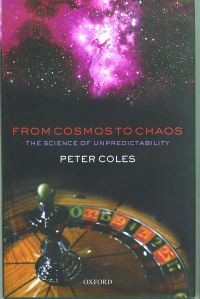
2006-11-09-1525-20The critical importance of dealing rationally with uncertainty in science, both within itself and in its relationship to society at large, was the principal issue I addressed in From Cosmos to Chaos, a paperback edition of which is about to be published by Oxford University Press..

From the jacket blurb:

Why do so many people think that science is about absolute certainty when, at its core, it is actually dominated by uncertainty?

I’ve blogged before about why I think scientists need to pay much more attention to the role of statistics and probability when they explain what they do to the wider world.

And to anyone who accuses me of using the occasion presented by Wilson’s article to engage in gratuitous marketing, I have only one answer:

BUY MY BOOK!

I want it painted … beige?

Posted in The Universe and Stuff with tags , , , , , on November 4, 2009 by telescoper

I was quite pleased when I saw that Pass Notes No 2,677 in Today’s Guardian was about “the universe”. Like the other pieces in this series, it looks at the subject matter from a deliberately bizarre angle, focussing on the fact that it appears to be coloured beige, or at least if you blend the light from all the stars we can see in the right proportions, that’s the colour you would get.

Actually the work discussed in this item was done quite along time ago; it was featured in a New Scientist article in 2002. One of the authors, Karl Glazebrook had previously claimed that the colour produced by all the stars in all the galaxies that could be seen was in fact something like turquoise. For some reason, this trivial bit of science fluff captured the (obviously limited) imagination of journalists around the world. However it turned out to be have been wrong and a grave announcement was made pointing out that the Universe was actually more like beige. This story gave a few people their 15 minutes of fame, but I think the episode made cosmologists as a whole look very silly.

I had hoped this would be forgotten but, the Guardian decided to revive memories of the affair today, with obviously humorous intent. They also called Glazebrook an “astrologist”, although that appears to have been a mistake rather than a joke as it has now been changed to “astrophysicist”.

Anyway, this important observation requires a theoretical explanation and I now want to step into the limelight beigelight to offer a radical insight into the vexed issue of cosmological chromaticity.
My hypothesis has its inspiration in TV shows like House Doctor in which homeowners wishing to impress prospective purchasers are always advised to paint everything beige or magnolia. Since the Divine Creator appears to have decorated the Universe according to the same prescription, the obvious inference is that the cosmos is about to be put on the market. He might have had the courtesy to tell the sitting tenants.

Come to think of it, Glazebrook missed a trick here. We astrophysicists are always being castigated for not doing anything that leads to wealth creation. What he should have done was to produce a paint with the same colour as the Universe. Glazebrook Beige has a nice ring to it.

Highlights

Posted in Biographical, The Universe and Stuff with tags , , on November 2, 2009 by telescoper

Despite popular demand, here is more of the Unravelling the Universe show I posted a little bit from a few days ago. My total screen time on this programme only amounted to a couple of minutes, so I asked if it was possible to do an appropriate edit of the hour-long footage. Unfortunately, Ed got the wrong idea, so removed most of the highlights and left practically only the few minutes with me in them. You just can’t get the help these days.

The film  was shot in a studio in Greenford and I had to hang around there a long time before they even started shooting. I think that was because of the lights. I need a special form of  illumination if I am to present the illusion of having three dimensions. The director had insisted I wear my leather jacket for the sequence and under the very powerful lights I was sweating so much I had to wear make-up to stop me shining.

They reckon that there is a ratio of about 100:1 of film shot to film broadcast on programmes like this, and this is probably even higher when the subject is as inarticulate as me. In my memory it certainly took several hours just for my little bits.

If nothing else this tape gives you the chance to see Rocky Kolb in a splendid jumper that puts that of the new Lucasian professor well and truly in the shade. What was that about chromodynamics?