Intimations of Immortality from a Little Red Book

Posted in Poetry with tags , on September 27, 2008 by telescoper

It’s now late september and there’s no sign that the Indian summer we’ve been having is going to fade. Once again, I’m sitting outside in the sunshine while Columbo daydreams. In the newspapers there’s yet more panic about the global financial crisis and the US Government’s attempts to persuade Congress to bail out the profligate bankers. The Republicans don’t want to play along, apparently because they don’t like the idea of government getting involved in the markets. I’m opposed to it for the opposite reason, which is I think those who have caused the problem should be the ones that pay for it. If the UK government decides to bail out any banks, I hope it will be at the price of public representation on their boards or even nationalisation.

Not long ago there was talk about energy companies having a windfall tax levied upon them owing to the sudden leap in their profits arising from high oil and gas prices. This seemed like a good idea to me. A retrospective windfall tax on city bonuses to pay for any packages cobbled together to pay the financial sector’s debts appears at least as justifiable as that proposed for the energy sector.

It’s now about a year since my father died. He hadn’t left a will so I had to travel to Weymouth to tidy up his things and organise a funeral. I hadn’t seen him much in recent years and was never particularly close, since my parents split up when I was about 12 and I went to live with my mother when that happened.

My dad never really came to terms with life after the break up of the family. His business eventually went down the tubes and he left Newcastle to live in Weymouth near his sister, my Auntie Ann, who had lived there for quite a while. He had a history of heart problems so his death wasn’t really a shock, but it did bring feelings of guilt to me, for not having kept in touch very well, as well sudden and unpredictable pangs of nostalgia which I’m still a bit prone to.

Among the memories that popped uncontrollably into my mind last year was a visit we made as a family to the house of my late Auntie Vi, who I don’t think I ever met. I don’t remember when this was but it was just after she died, when I guess I was probably about seven or eight which would make it around 1970 or so. My dad was among those invited to the house to help clear it by taking away anything they wanted.

I don’t remember the house very well except that it was rather dark, decorated with Victorian designs, and cluttered with heavy old-fashioned furniture. I imagined Auntie Vi (or “Violetta”, which was her real name) to be quite scary, perhaps like a governess in some gothic novel. I don’t know much about her except that she wasn’t well liked by the rest of the family. There was talk of some scandal, but I never found out what it was. I was just intrigued how she got the name Violetta. Perhaps her parents liked opera.

The only relic from that visit that I still know about was a little red book that we took home with us. It was a book of Poems by Wordsworth which my mum kept when she split up with my dad and moved out. I asked her about it last year, after my dad’s funeral, and was quite surprised to find she still had it. She gave it to me to keep, and it is on the table beside me now as I write this.

Out of curiosity last year I looked for the date the little book was published, but couldn’t find one anywhere inside. I don’t know why, but the lack of that little bit of information bothered me. I looked on the web to see if there was information about this or similar books was to be found. No luck.

I turned instead to the task of finding out whatever I could about the publisher. The book is in a series called “Canterbury Poets” which was published by the Walter Scott Publishing company (London, New York and Felling). That made be laugh. As if anyone could ever have imagined Felling to be on a par with New York or London!

I had assumed that Sir Walter Scott was the famous novelist of Ivanhoe and the Waverley novels, but digging about a little I found out that it was named for someone else entirely. This particular Sir Walter Scott was born in 1826. He had very little formal education, but became a highly successful businessman. By the 1880s he owned a large network of business interests in the North East, primarily involving engineering and construction companies. In 1882 Scott expanded his empire by buying a publishing company “The Tyne Publishing Company”, which had just gone bust. Scott built a new factory (at Felling) and established a new office in London for his new publishing house, and the Walter Scott Publishing Company was born.

I think Scott must have been a very shrewd entrepreneur because the printing business grew rapidly, primarily through its list of editions of classic works of literature that were out of copyright. The Canterbury Poets series was first published in 1884, which is also the date of their first edition of the Wordsworth. These books were extremely well made, with hard covers, fine quality paper and good stitching . They sold for a shilling, which is an astonishingly low price for books of this quality. I can’t be sure, but have a feeling that a lot of them were given as “rewards” , for good behaviour at sunday schools and the like. That market accounted for a lot of the book trade in those days.Sir Walter Scott died in 1910 and the company ceased trading in 1931. At its peak it did indeed have offices in New York, and also sold large quantities of books in Australia.

I found this all out quite easily, because the Walter Scott Company turned out to be quite famous for the role it played in the story of working class literacy, but it didn’t tell me about the specific edition I had. However, I did discover that a scholarly work had been published in 1997 that contained a complete biliography of all the works it published until the company finally went down the tubes. Quite apart from the connection with my peculiar Aunt, I found the whole story quite fascinating. I sent off for the bibliography, which is basically a kind of catalogue that painstakingly records the size, typeface, cover design, and printers colophons for all known editions. (It’s quite boring to read, as you can imagine). I searched through it to find references to William Wordsworth. Number 99c is the entry for the “Poems” of William Wordsworth.

With a bit of work I established that the specific edition I have was first published in 1892 but reprinted many times after that. Details of the book, however, indicate that my version was actually printed in 1902. Among the clues is the fact that the colophon states “The Walter Scott Publishing Co, Ltd.” and it didn’t become a limited company until 1902. The company also moved its London and New York offices a couple of times which helps pin down the date, as these changes are noted on the imprint.

So there you have it. The little red book was printed in Felling in 1902, which happens to be the same year that my little house in Pontcanna was built, just after the death of Queen Victoria. I don’t know how old Auntie Vi was when she died, but she must have been a young girl when she got it and had obviously kept it all the rest of her life. That fits with the way her name is written in pencil, in what looks like a child’s hand, inside the front cover.

The book isn’t particularly valuable. A lot were printed and it’s not particularly rare. I’m not sure Wordsworth is very collectible nowadays either. I am still amazed, though, how well it had withstood the passage of time. Today’s books are cheaply bound and printed on chatty paper. Most modern paperbacks are in bad condition only a few years after you buy them. They made things to last in those days.

It seems appropriate to end with one of Wordsworth’s poems, of which (I forgot to mention) I’m very fond indeed. I’ve picked the start of the Ode “Intimations of Immortality from Recollections of Early Childhood”, partly because there’s a wonderful setting of this work to music by Gerald Finzi which was performed at this years Proms.

I think it’s apt enough.

There was a time when meadow, grove, and stream,
The earth, and every common sight,
To me did seem
Apparelled in celestial light
The glory and the freshness of a dream
It is not now as it hath been of yore;-
Turn whereso’er I may,
By night or day
The things which I have seen I now can see no more.

The Rainbow comes and goes.
And lovely is the Rose,
The Moon doth with delight
Look round her when the heavens are bare,
Waters on a starry night
Are beautiful and fair;
The sunshine is a glorious birth;
But yet I know, where’er I go,
That there hath past away a glory from the earth.

Nana for Vice-President!

Posted in Uncategorized with tags , on September 26, 2008 by telescoper

Despite the change in hairstyle, there is no concealing the fact that John McCain’s running mate for the forthcoming US Presidential Elections is none other than Greek cantatrice and 1970s eurovision icon, Nana Mouskouri. Perhaps we should have been told.

Is there an Elephant in the Room?

Posted in Cosmic Anomalies, The Universe and Stuff with tags , on September 26, 2008 by telescoper

A couple of weeks ago I was in Cambridge giving a talk at a nice cosmology meeting housed in the splendid Centre for Mathematical Sciences. How the other half lives. The building is not only palatial, it is also very well designed for informal interactions and discussions. When I was a student at Cambridge this building didn’t exist and the Department of Applied Mathematics and Theoretical Physics was housed in rather ramshackle but characterful buildings in Silver Street, right in the city centre. I don’t know what department is there now.

I gave a talk with the title “Fishing for Elephants in the CMB”. I always think it’s a good idea not to give too much away in the title, although perhaps in this case I went a bit too far. Quite apart from the mixed metaphor, it doesn’t really give any clue at all as to what I was talking about. Mind you, I’m not sure at the end of the talk the audience was any the wiser either.

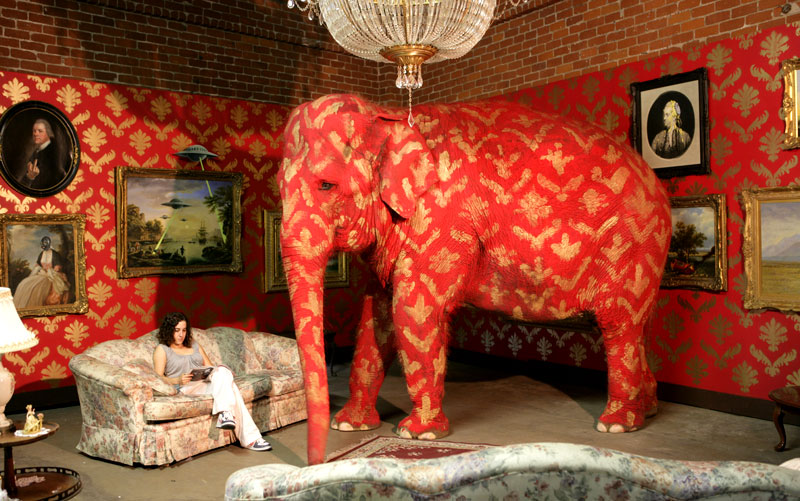
The idea for the title came from the phrase “There’s an Elephant in the Room”, a curious expression that even has its own wikipedia entry, as well as being the title of the picture shown here made by the artist Banksy. It refers to something that is large and obvious, but is being ignored for some reason, usually because it is considered impolite to draw attention to it. My talk of course wasn’t about real elephants but the possibility that there may be a metaphorical one in the field of cosmology, something that is consciously ignored by most of the community.

In yesterday’s post, I referred to the importance of the cosmic microwave background in establishing the so-called “concordance model” of cosmology. But as well as providing compelling evidence in support of this theory, the CMB has also thrown up a few bits of evidence that are quite difficult to reconcile with the standard description of the Universe.

Perhaps the most famous of these anomalies is the so-called “Axis of Evil“, which is an unexplained alignment of features in the pattern of temperature fluctuations observed across the sky by the Wilkinson Microwave Anisotropy Probe (WMAP) satellite. In the concordance picture, the fluctuations are basically random so there shouldn’t be coherent alignments like this.

But the Axle of Elvis isn’t the only curiosity in the cosmology shop. There is also a significant asymmetry between North and South on the sky (with respect to the ecliptic plane) when the two celestial hemispheres should be statistically indistinguishable if the standard model is correct.

There also exists a peculiar cold spot. Of course a fluctuating temperature pattern must contain places colder than average and places hotter than average. However, the standard model assumes these are drawn from a Gaussian (or “normal“) distribution, in which large fluctuations are extremely rare. The cold spot we see in the WMAP is colder than the coldest cold spot expected if the standard model is right, with odds of greater than 1000:1 against.

And there’s more. Statistical measures of the fluctuation pattern, such as the correlation function, pixel variance and quadupole moment, all give results for the real sky that are discordant with theory, although admittedly some are more significant than others. There are others too but I have no time to go into them, except to say that they may be related to the ones I’ve already mentioned, or at least share a common cause.

So what’s going on? The most conservative view is that there is nothing in the data that can’t be explained by the standard model and what we are seeing is a consequence of over-interpreting one or two chance coincidences. In the words of Fred Menger

“If tortured sufficiently, data will confess to anything.“

There may indeed be some truth to this, but serious attempts have been made to assess the statistical significance of the various results and my personal reaction is that, while coincidences do happen, it is unwise to dismiss 1000:1 results as mere flukes. On the other hand, these assessments are difficult and the significance may have been miscalculated.

More likely is the presence of some slight unidentified systematic artefact in the data. Not being an experimentalist it’s unfair to cast doubts on the brilliant work of the WMAP team, but one should keep an open mind about this possibility.

But as a theorist I have to admit that the most exciting possibility is that, lurking out there somewhere, are clues to a radical departure from orthodox theory. Many suggestions have been made, and no doubt most of them will be shown to be wrong. But the most dramatic thing that can happen in science is when the only game in town is “none of the above” and we are forced to think outside the box altogether.

I’m certainly not going to argue that we need to ditch the standard model or that cosmologists should all become obsessed with these tantalising conundrums. But in focussing exclusively on questions related to the standard model and its parameters, we may be throwing away a great deal of potentially exciting information. Every now and again, it’s worth checking your waste basket in case there’s something in it that you really shouldn’t have binned.

I realise that there are probably too many mixed metaphors in this piece. They’re a habit of mine and when you get to my age it’s difficult to change. After all, you can’t teach an old leopard to change its spots in midstream.


Mesmeric Universes

Posted in The Universe and Stuff with tags , , on September 25, 2008 by telescoper

It’s probably going to be difficult to describe what these images really are without going into enormous amounts of technical detail, but I think they are fun so I thought I’d put the pictures up with only a brief description. The remind me a little bit of the sort of hypnotic swirl sometimes used to put people under, although there’s a bit more to them than that.

According to our the standard “Big Bang” model, our Universe satisfies the Cosmological Principle which is that it is both homogeneous and isotropic, i.e. that it is the same in every location and looks the same in all directions. Of course we know our Universe isn’t exactly like that because it contains lumps of stuff called galaxies that correspond to variations in its density, but if look at sufficiently large scales it begins to look smooth. Sand is lumpy if you look close at it, but if you look at it from a long way away it looks smooth. The universe is supposed to be similarly smooth if you take a coarse-grained view.

The primary reason for incorporating the Cosmological Principle into models of the Universe is to make the mathematics simple. Einstein’s General Theory of Relativity is such a difficult theory that there are very few situations where the equations can actually be solved. One case where exact solution is relatively easy to achieve is that of homogeneous and isotropic space, which is such a symmetric state of affairs that much of the complexity of the Einstein equations disappears. Cosmological models based on this solution are generally called the Friedman models, after Alexander Friedman who first derived the solutions in the 1920s.

Despite their simplicity, the Friedman models turned out to be surprisingly accurate at describing our actual Universe which we now know to be very close to homogeneous and isotropic. Evidence for this comes from the Cosmic Microwave Background (CMB) which is astonishingly smooth across the sky. Variations in the sky temperature of the CMB are about one part in a hundred thousand of the mean temperature, which is smoother than the surface of a billiard ball.

However, it remains possible that our Universe may be slightly asymmetric and it is interesting to know what the CMB would look like if this were the case. Unfortunately there is no general cosmological solution available, so we have to tread slowly. One approach is to look at Universes which are homogeneous (the same in every place) but not isotropic (they look different in different directions). This might be describe the situation if the Universe were expanding more quickly in one direction that the others, or if it were rotating.

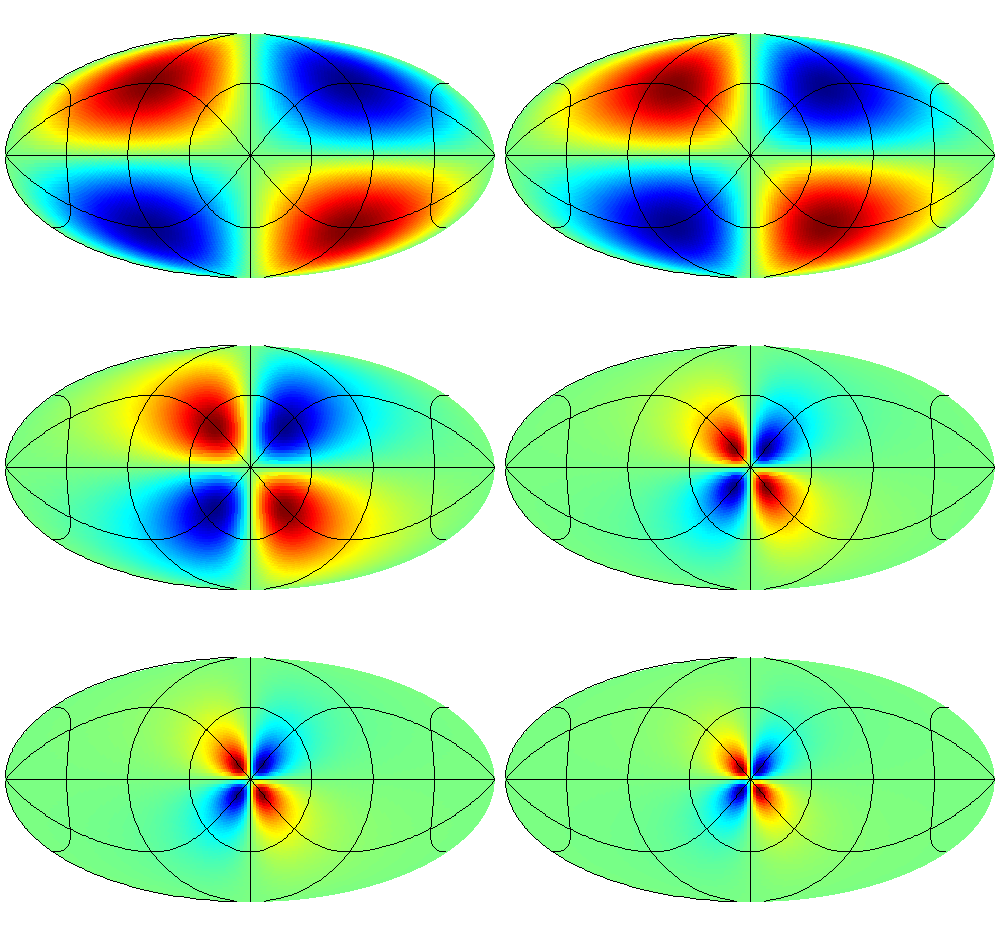
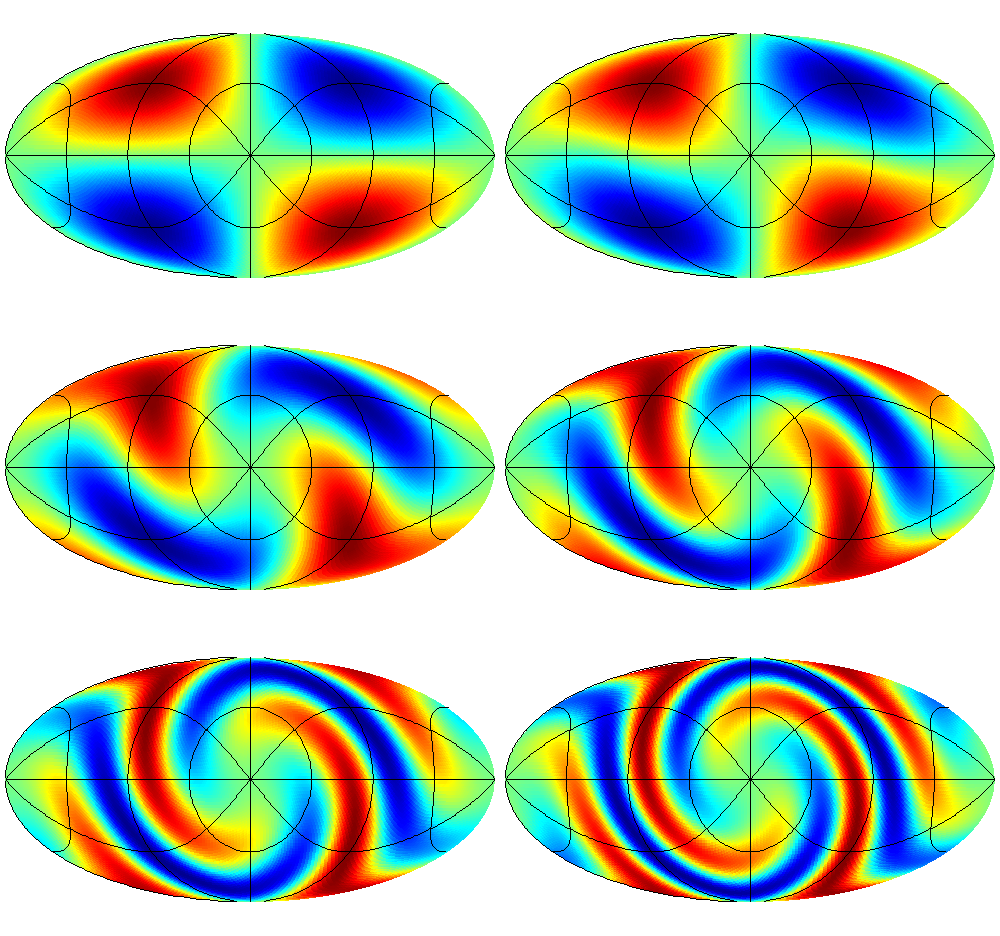
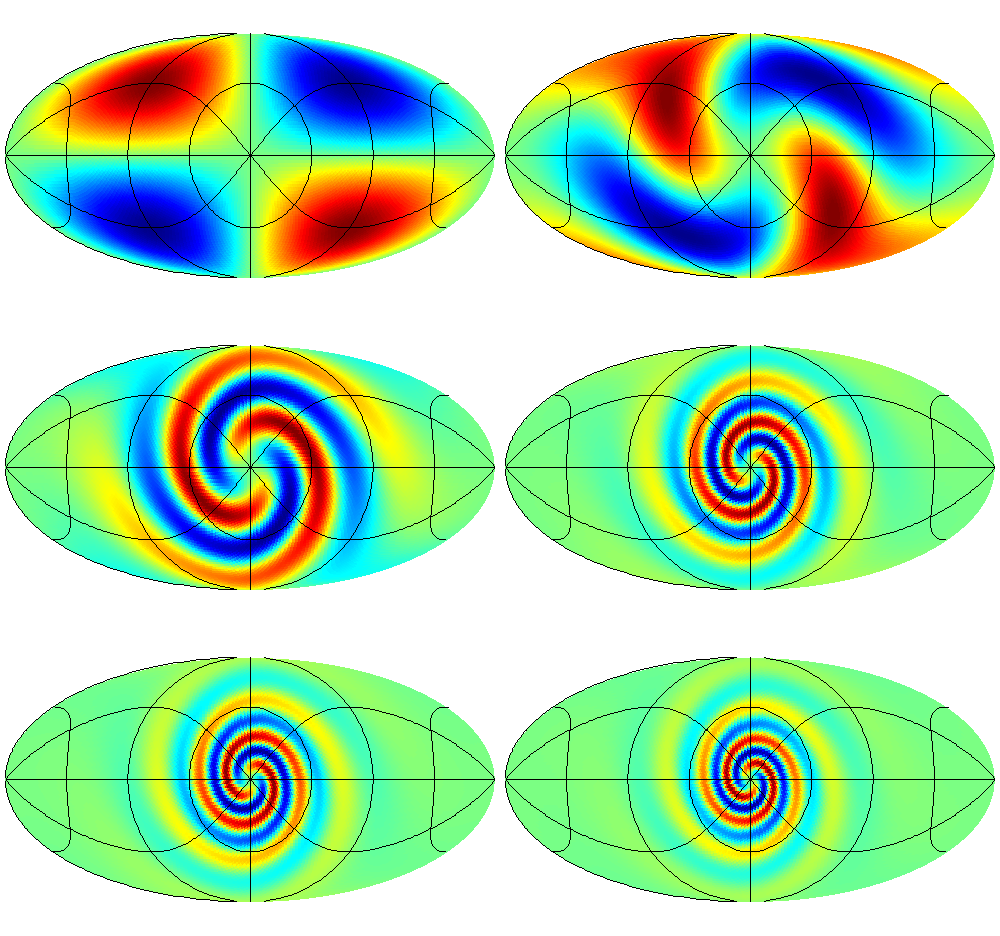
Actually the theory of homogeneous anisotropic universe models is quite well established and there is a full classification of all the possibilities, into the nine so-called Bianchi types. This is mathematically very complicated, so I won’t give details. However, my PhD student Rockhee has been calculating what the CMB pattern would look like in these models and the results are very pretty so I’ve included a few examples here. The little animated gifs show what the sky looks like as the Universe evolves in such cases. In all cases it starts as a pure quadrupole, i.e. a 90 degree variation across the sky. You might have to click on the image to see the animation.

The first one is Bianchi Type V. This is an example of a model in which the space is curved, so that as time goes on the initial quadrupole is focussed by gravitational effects into a smaller and smaller region of the sky. The preferred direction in this (and the other models) is picked to be in the centre of the image and the projection shows the whole sky. Hot spots are blue and cold spots are red, which is the way a physicist should plot temperature.

The next example is Bianchi Type VII_0 which is a flat Universe with rotation. What happens is that the initial quadrupole in this case gets twisted by the rotating space-time into a sort of spiral pattern. Late on in the evolution of such a Universe, an observer would see an interesting swirly structure in the cosmic microwave background.

The final example is my favourite, Bianchi Type VII_h. This one is a sort of combination of the two above examples. It has both rotation and curvature, so there is a swirly pattern which also gets focussed into a small bit of the sky. An observer living in such a Universe would see a prominent spot on the sky lying in the direction of the axis, which in this case is chosen to be in the centre of the diagram.

We’ve also been working out what the sky would look like in polarized light for these, but that’s even more complicated. If you’re really interested, I’ll post a link to the paper when it’s done…

Death and Conkers

Posted in Uncategorized with tags , , on September 24, 2008 by telescoper

Strange connections. No sooner do I post a meandering item about the autumn weather bringing about flashbacks when I get two – quite different echoes – from today’s Guardian.

The first came from the obituary pages, where I read of the death on September 21st 2008 of Professor Sir Brian Pippard, aged 88.

I never knew him personally. In fact he retired from his post as Cavendish Professor of Physics in 1982, which was the year I started my undergraduate degree at Cambridge, so I was never taught by him. His research was predominantly in the area of superconductivity, which is far from my own speciality, so I never knew him through that route either.  But I did develop a kind of respect for him through a little book he compiled, called Cavendish Problems in Classical Physics.

This was on the list of required textbooks I got before I started my time as a student and I still have it today. As its name suggests, this contains all manner of problems about very mainstream topics in physics: electricity, magnetism, mechanics, and so on. Some of them are short, some long, but all have interesting little twists in them and each is instructive in its own way. 

I tried some of these problems on first year physics students at Cardiff last academic year and they turned out to be excessively challenging. In other words, the students couldn’t do them. I don’t want to go into a rant about declining standards of school science teaching, but it is a fact that A-level physics nowadays provides absolutely no preparation for tackling the likes of the  Cavendish Problems because it does not cultivate the kind of lateral thinking needed even to formulate these problems. Instead the students tend to be taken through standard exercises that they learn by rote and regurgitate in examinations. Anything different to what they’ve been led through completely throws them. I’m generalizing horribly, I know, but there’s a lot of truth in there.

It’s not so much that students can’t complete the Cavendish problems, but that they don’t even know how to start. It’s a shame that the art of genuine problem solving is so badly neglected in today’s schools, especially because its the bit that’s the most fun .  The brain can be so much more than a memory device, if only we could free up future generations of young minds by abandoning the obsession with modularised, factoid based teaching.

I think Brian Pippard would have agreed.

The other of today’s autumnal flashbacks was triggered by a short piece about the humble horse chestnut tree.  At this time of year the ground underneath these trees is covered with conkers which are collected by schoolboys and used in the game of the same name.  Or at least that’s what used to happen.

Apparently, for several years now horse chestnut trees have been struggling with adverse weather and attacks from moths. Now they have an even tougher enemy, a virulent disease called bleeding canker. This causes a sticky ooze to emanate from the trunk and branches of the trees, the leaves to die much earlier than usual and, worst of all,  the conkers to be very small or even non-existent. The bacterium that causes this disease  now infects about half the horse chestnut trees in the United Kingdom, and there is no known cure.

The death of high school physics is bad enough, but how can we ever cope without conkers?

Poetry Corner

Posted in Uncategorized with tags , on September 23, 2008 by telescoper

COMPOSED A FEW MILES BELOW TINTERN ABBEY, ON NEVER REVISITING THE BANKS OF THE WYE DURING A TOUR. September 22 , 2008.

When Tintern Abbey still had bells,
Which it does not now because it’s ruin’d,
Imagine when those bells were rung
And echoed across the Sylvan Wye.
Was their sound by those who heard them
Called a Tintern-abulation?

Peter Coles

The MacGuffin Factor

Posted in Science Politics, The Universe and Stuff with tags , , , on September 22, 2008 by telescoper

Unpick the plot of any thriller or suspense movie and the chances are that somewhere within it you will find lurking at least one MacGuffin. This might be a tangible thing, such the eponymous sculpture of a Falcon in the archetypal noir classic The Maltese Falcon or it may be rather nebulous, like the “top secret plans” in Hitchcock’s The Thirty Nine Steps. Its true character may be never fully revealed, such as in the case of the glowing contents of the briefcase in Pulp Fiction , which is a classic example of the “undisclosed object” type of MacGuffin. Or it may be scarily obvious, like a doomsday machine or some other “Big Dumb Object” you might find in a science fiction thriller. It may even not be a real thing at all. It could be an event or an idea or even something that doesn’t exist in any real sense at all, such the fictitious decoy character George Kaplan in North by Northwest.

Whatever it is or is not, the MacGuffin is responsible for kick-starting the plot. It makes the characters embark upon the course of action they take as the tale begins to unfold. This plot device was particularly beloved by Alfred Hitchcock (who was responsible for introducing the word to the film industry). Hitchcock was however always at pains to ensure that the MacGuffin never played as an important a role in the mind of the audience as it did for the protagonists. As the plot twists and turns – as it usually does in such films – and its own momentum carries the story forward, the importance of the MacGuffin tends to fade, and by the end we have often forgotten all about it. Hitchcock’s movies rarely bother to explain their MacGuffin(s) in much detail and they often confuse the issue even further by mixing genuine MacGuffins with mere red herrings.

North by North West is a fine example of a multi-MacGuffin movie. The centre of its convoluted plot involves espionage and the smuggling of what is only cursorily described as “government secrets”. But although this is behind the whole story, it is the emerging romance, accidental betrayal and frantic rescue involving the lead characters played by Cary Grant and Eve Marie Saint that really engages the characters and the audience as the film gathers pace. The MacGuffin is a trigger, but it soon fades into the background as other factors take over.

There’s nothing particular new about the idea of a MacGuffin. I suppose the ultimate example is the Holy Grail in the tales of King Arthur and the Knights of the Round Table and, much more recently, the Da Vinci Code. The original Grail itself is basically a peg on which to hang a series of otherwise disconnected stories. It is barely mentioned once each individual story has started and, of course, is never found.

Physicists are fond of describing things as “The Holy Grail” of their subject, such as the Higgs Boson or gravitational waves. This always seemed to me to be an unfortunate description, as the Grail quest consumed a huge amount of resources in a predictably fruitless hunt for something whose significance could be seen to be dubious at the outset.The MacGuffin Effect nevertheless continues to reveal itself in science, although in different forms to those found in Hollywood.

The Large Hadron Collider (LHC), switched on to the accompaniment of great fanfares last week, provides a nice example of how the MacGuffin actually works pretty much backwards in the world of Big Science. To the public, the LHC was built to detect the Higgs Boson, a hypothetical beastie introduced to account for the masses of other particles. If it exists the high-energy collisions engineered by LHC should reveal its presence. The Higgs Boson is thus the LHC’s own MacGuffin. Or at least it would be if it were really the reason why LHC has been built. In fact there are dozens of experiments at CERN and many of them have very different motivations from the quest for the Higgs.

Particle physicists are not daft, however, and they have realised that the public and, perhaps more importantly government funding agencies, need to have a really big hook to hang such a big bag of money on. Hence the emergence of the Higgs as a sort of master MacGuffin, concocted specifically for public consumption, which is much more effective politically than the plethora of mini-MacGuffins which, to be honest, would be a fairer description of the real state of affairs.

Even this MacGuffin has its problems, though. The Higgs mechanism is notoriously difficult to explain to the public, so some have resorted to a less specific but more misleading version: “The Big Bang”. As I’ve already griped, the LHC will never generate energies anything like the Big Bang did, so I don’t have any time for the language of the “Big Bang Machine”, even as a MacGuffin.

While particle physicists might pretend to be doing cosmology, we astrophysicists have to contend with MacGuffins of our own. One of the most important discoveries we have made about the Universe in the last decade is that its expansion seems to be accelerating. Since gravity usually tugs on things and makes them slow down, the only explanation that we’ve thought of for this perverse situation is that there is something out there in empty space that pushes rather than pulls. This has various possible names, but Dark Energy is probably the most popular, adding an appropriately noirish edge to this particular MacGuffin. It has even taken over in prominence from its much older relative, Dark Matter, although that one is still very much around.

We have very little idea what Dark Energy is, where it comes from, or how it relates to other forms of energy we are more familiar with, so observational astronomers have jumped in with various grandiose strategies to find out more about it. This has spawned a booming industry in survey of the distant Universe (such as the Dark Energy Survey) all aimed ostensibly at unravelling the mystery of the Dark Energy. It seems that to get any funding at all for cosmology these days you have to sprinkle the phrase “Dark Energy” liberally throughout your grant applications.

The old-fashioned “observational” way of doing astronomy – by looking at things hard enough until something exciting appears (which it does with surprising regularity) – has been replaced by a more “experimental” approach, more like that of the LHC. We can no longer do deep surveys of galaxies to find out what’s out there. We have to do it “to constrain models of Dark Energy”. This is just one example of the not necessarily positive influence that particle physics has had on astronomy in recent times and it has been criticised very forcefully by Simon White.

Whatever the motivation for doing these projects now, they will undoubtedly lead to new discoveries. But my own view is that there will never be a solution of the Dark Energy problem until it is understood much better at a conceptual level, and that will probably mean major revisions of our theories of both gravity and matter. I venture to speculate that in twenty years or so people will look back on the obsession with Dark Energy with some amusement, as our theoretical language will have moved on sufficiently to make it seem irrelevant.

But that’s how it goes with MacGuffins. Even the Maltese Falcon turned out to be a fake in the end.

p.s. I heard on Saturday that the LHC is having some problems with its magnets and will actually be off-line for a few months. Last week I heard a particle physicist describing the great switch-on as like “Christmas”. This turns out to have been truer than he can have imagined. Only a week has passed and his most expensive toy is already broken…

Equinox

Posted in Biographical with tags , on September 22, 2008 by telescoper

Yesterday I sat in the garden doing the crosswords in the weekend papers. This was the first Sunday in my new home that I’ve been able to do that without getting drenched by the continuously pouring rain. Now the summer is officially over and the weather takes a perverse turn for the better. Although my house is quite close to a big road, it was very quiet all afternoon.

Columbo has really taken to the decking that occupies the far corner of the little garden. He lies on his back with his eyes closed, his big belly as white as my freshly pegged out laundry. Closing his eyes, he waves his paws around as he tries to catch butterflies or birds or whatever other imaginary creatures flutter through the dreamscape of a cat’s mind.

The weather is unsettling. It’s warm, but somehow the warmth doesn’t quite fill the air; somewhere inside it there’s a chill that reminds you that autumn is not far away.

I find this kind of weather a bit spooky because it always takes me back to the time when I left home to go to University, as thousands of fledgling students are about to do this year in their turn. I did it 26 years ago, getting on a train at Newcastle Central station with my bags of books and clothes. I said goodbye to my parents there. There was never any question of them taking me in the car all the way to Cambridge. It wasn’t practical and I wouldn’t have wanted them to do it. After changing from the Inter City at Peterborough onto a local train, we trundled through the flatness of East Anglia until it reached Cambridge. The weather, at least in my memory, was exactly like today.

I don’t remember much about the actual journey, but I must have felt a mixture of fear and excitement. Nobody in my family had ever been to University before, let alone to Cambridge. Come to think of it, nobody from my family has done so since either. I was a bit worried about whether the course I would take in Natural Sciences would turn out to be difficult, but I think my main concern was how I would fit in generally.

I had been working between leaving school and starting my undergraduate course, so I had some money in the bank and I was also to receive a full grant. I wasn’t really worried about cash. But I hadn’t come from a posh family and didn’t really know the form. I didn’t have much experience of life outside the North East either. I’d been to London only once before going to Cambridge, and had never been abroad.

I didn’t have any posh clothes, a deficiency I thought would mark me as an outsider. I had always been grateful for having to wear a school uniform (which was bought with vouchers from the Council) because it meant that I dressed the same as the other kids at School, most of whom came from much wealthier families. But this turned out not to matter at all. Regardless of their family background, students were generally a mixture of shabby and fashionable, like they are today. Physics students in particular didn’t even bother with the fashionable bit. Although I didn’t have a proper dinner jacket for the Matriculation Dinner, held for all the new undergraduates, nobody said anything about my dark suit which I was told would be acceptable as long as it was a “lounge suit”. Whatever that is.

Taking a taxi from the station, I finally arrived at Magdalene College. I waited outside, a bundle of nerves, before entering the Porter’s Lodge and starting my life as a student. My name was found and ticked off and a key issued for my room in the Lutyen’s building. It turned out to be a large room, with a kind of screen that could be pulled across to divide the room into two, although I never actually used this contraption. There was a single bed and a kind of cupboard containing a sink and a mirror in the bit that could be hidden by the screen. The rest of the room contained a sofa, a table, a desk, and various chairs, all of them quite old but solidly made. Outside my  room, on the landing, was the gyp room, a kind of small kitchen, where I was to make countless cups of tea over the following months, although I never actually cooked anything there.

I struggled in with my bags and sat on the bed. It wasn’t at all like I had imagined. I realised that no amount of imagining would ever really have prepared me for what was going to happen at University.

I  stared at my luggage. I suddenly felt like I had landed on a strange island where I didn’t know anyone, and couldn’t remember why I had gone there or what I was supposed to be doing.

After 26 years you get used to that feeling.

Nice work if you can get it..

Posted in Books, Talks and Reviews with tags , , , on September 19, 2008 by telescoper

I’ve just discovered that my review of Steven Weinberg’s new book “Cosmology” has been published today in the American journal Science. ( I think the link will only work if you or your institution has a subscription to the magazine.) It’s quite a nice job getting to review books like this, not because you get paid a lot (in fact, usually you don’t get paid at all), but because you get a free copy of the book and there is a clear incentive to read it. Reviews themselves are quite easy to do, as they’re usually only around a thousand words so don’t take more than an hour or so to rattle off.

The case of this particular book is quite unusual, thought, because Science usually only includes reviews of popular-level books, and this one is very technical. However, because Weinberg is such an eminent and well known physicist and this work is a long-awaited update of his classic Gravitation and Cosmology (published in 1972), it makes an interest subject for a review even if it is probably impossible for a non-specialist to actually read and understand all of it. It’s definitely not for the mathematically faint-hearted. In the review I stayed off the mathematical details and tried to explain how this book exemplifies the changes that have taken place in cosmology over the past thirty or forty years. Anyway, as you will see if you read the review, I liked the updated book a lot but I think it’s definitely for connoisseurs rather than absolute beginners.

Selling Shorts in the September Sun

Posted in Finance with tags , on September 19, 2008 by telescoper

I’ve been following the wild instabilities in the stock market over the last few weeks with a mixture of amusement and despair. On the one hand it’s not at all unpleasant to see some overpaid city slickers brought back down to earth, but on the other it’s alarming to see how the world economy depends so strongly on a the whims of a bunch of erratic traders.

After what seems like weeks of falls on the stock market, shares suddenly leaped up by about 8% this morning on news that the government had banned “short-selling” on a particular set of shares. As I understand it, short selling basically means you borrow shares in a company and then sell them in the hope that the price will fall. When it does, you buy back the shares at a lower price, return them to wherever you borrowed them from, and pocket the difference. Basically it’s a bet on the future behaviour of the shares. This violates one of my two rules about gambling, namely that you should only gamble with your own money and it is a bit surprising it was ever allowed anyway.

On the other hand, even this is a bit more transparent than the practice of buying and selling derivatives, where you don’t even have to possess (however temporarily) the thing you sell. This kind of activity is what hedge funds do all the time. They operate on the principle that you can make different kinds of bets at the same time in such a way as to guarantee a win. Bookies on a racetrack are smart enough to ensure that a punter can never make a combination of bets that ensures a profit, but this is not the case with shares and other financial dealings.

Anyway, apparently the reason why banking shares have plummetted recently is that there’s been a lot of short selling and the government decided to stop it, at least temporarily. I suppose it’s good that they are actually trying to do something to stop the chaos, but I think the underlying problem is that the UK and other western economies have been living beyond their means for many years and, despite best efforts to paper over the cracks, some kind of retribution is inevitable. It wouldn’t surprise me if next week the FTSE dived again as emerges that hedge funds weren’t really responsible for the problem in the first place.

Maybe the reason why the FTSE has really been falling has been overlooked. Over the last two years since the credit crunch became apparent, the weather in the UK has been very poor. Two summers of heavy rain may have had more influence on the optimism of city traders that interbank lending rates. Perhaps that’s the kind of liquidity that really gets them down (geddit?). This week the weather is nicer, so shares have risen. I’m sure you can correlate the FTSE index with the weather and a result at least as significant as with any other econometric indicator.

I’ve got a little bit of personal interest in this because, although I’m not really a player on the stock market, I do have a 10-year investment plan that matures at the end of October this year. If I’d been able to bale out this time last year I would have made a healthy profit on it, but now it looks like this years losses will wipe most of that out. Even if they don’t, it’s been a white knuckle ride so when I do get the cash I’ll probably put it somewhere much safer, allthough I don’t know what is really safe these days and I’m maxed out on grannie bonds.

In the meantime, I’m just left with the feeling that so much of our modern economy is not only artificial but also impenetrable to ordinary people. In a sense it doesn’t matter very much if a few city tossers get burned, but the fallout from the ongoing Credit Crunch will have a real impact on the lives of ordinary people through redundancies and loan defaults as unsustainable companies go to the wall. We all fool ourselves that we live in a democracy where we can influence the way the country is run, but the fact of the matter is that governments really don’t have the resources to control or even influence global capitalism to any great extent.

Surely there has to be a better way…