Irrationalism and Deductivism in Science

Posted in Bad Statistics, The Universe and Stuff with tags , , , , , , , , , , , , , , on March 11, 2024 by telescoper

I thought I would use today’s post to share the above reading list which was posted on the wall at the meeting I was at this weekend; it was only two days long and has now finished. Seeing the first book on the list, however, it seems a good idea to follow this up with a brief discussion -largely inspired by David Stove’s book – of some of the philosophical issues raised at the workshop.

It is ironic that the pioneers of probability theory, principally Laplace, unquestionably adopted a Bayesian rather than frequentist interpretation for his probabilities. Frequentism arose during the nineteenth century and held sway until recently. I recall giving a conference talk about Bayesian reasoning only to be heckled by the audience with comments about “new-fangled, trendy Bayesian methods”. Nothing could have been less apt. Probability theory pre-dates the rise of sampling theory and all the frequentist-inspired techniques that modern-day statisticians like to employ.

Most disturbing of all is the influence that frequentist and other non-Bayesian views of probability have had upon the development of a philosophy of science, which I believe has a strong element of inverse reasoning or inductivism in it. The argument about whether there is a role for this type of thought in science goes back at least as far as Roger Bacon who lived in the 13th Century. Much later the brilliant Scottish empiricist philosopher and enlightenment figure David Hume argued strongly against induction. Most modern anti-inductivists can be traced back to this source. Pierre Duhem has argued that theory and experiment never meet face-to-face because in reality there are hosts of auxiliary assumptions involved in making this comparison. This is nowadays called the Quine-Duhem thesis.

Actually, for a Bayesian this doesn’t pose a logical difficulty at all. All one has to do is set up prior probability distributions for the required parameters, calculate their posterior probabilities and then integrate over those that aren’t related to measurements. This is just an expanded version of the idea of marginalization, explained here.

Rudolf Carnap, a logical positivist, attempted to construct a complete theory of inductive reasoning which bears some relationship to Bayesian thought, but he failed to apply Bayes’ theorem in the correct way. Carnap distinguished between two types or probabilities – logical and factual. Bayesians don’t – and I don’t – think this is necessary. The Bayesian definition seems to me to be quite coherent on its own.

Other philosophers of science reject the notion that inductive reasoning has any epistemological value at all. This anti-inductivist stance, often somewhat misleadingly called deductivist (irrationalist would be a better description) is evident in the thinking of three of the most influential philosophers of science of the last century: Karl PopperThomas Kuhn and, most recently, Paul Feyerabend. Regardless of the ferocity of their arguments with each other, these have in common that at the core of their systems of thought likes the rejection of all forms of inductive reasoning. The line of thought that ended in this intellectual cul-de-sac began, as I stated above, with the work of the Scottish empiricist philosopher David Hume. For a thorough analysis of the anti-inductivists mentioned above and their obvious debt to Hume, see David Stove’s book Popper and After: Four Modern Irrationalists. I will just make a few inflammatory remarks here.

Karl Popper really began the modern era of science philosophy with his Logik der Forschung, which was published in 1934. There isn’t really much about (Bayesian) probability theory in this book, which is strange for a work which claims to be about the logic of science. Popper also managed to, on the one hand, accept probability theory (in its frequentist form), but on the other, to reject induction. I find it therefore very hard to make sense of his work at all. It is also clear that, at least outside Britain, Popper is not really taken seriously by many people as a philosopher. Inside Britain it is very different,and I’m not at all sure I understand why. Nevertheless, in my experience, most working physicists seem to subscribe to some version of Popper’s basic philosophy.

Among the things Popper has claimed is that all observations are “theory-laden” and that “sense-data, untheoretical items of observation, simply do not exist”. I don’t think it is possible to defend this view, unless one asserts that numbers do not exist. Data are numbers. They can be incorporated in the form of propositions about parameters in any theoretical framework we like. It is of course true that the possibility space is theory-laden. It is a space of theories, after all. Theory does suggest what kinds of experiment should be done and what data is likely to be useful. But data can be used to update probabilities of anything.

Popper has also insisted that science is deductive rather than inductive. Part of this claim is just a semantic confusion. It is necessary at some point to deduce what the measurable consequences of a theory might be before one does any experiments, but that doesn’t mean the whole process of science is deductive. He does, however, reject the basic application of inductive reasoning in updating probabilities in the light of measured data; he asserts that no theory ever becomes more probable when evidence is found in its favour. Every scientific theory begins infinitely improbable, and is doomed to remain so.

Now there is a grain of truth in this, or can be if the space of possibilities is infinite. Standard methods for assigning priors often spread the unit total probability over an infinite space, leading to a prior probability which is formally zero. This is the problem of improper priors. But this is not a killer blow to Bayesianism. Even if the prior is not strictly normalizable, the posterior probability can be. In any case, given sufficient relevant data the cycle of experiment-measurement-update of probability assignment usually soon leaves the prior far behind. Data usually count in the end.

The idea by which Popper is best known is the dogma of falsification. According to this doctrine, a hypothesis is only said to be scientific if it is capable of being proved false. In real science certain “falsehood” and certain “truth” are almost never achieved. Theories are simply more probable or less probable than the alternatives on the market. The idea that experimental scientists struggle through their entire life simply to prove theorists wrong is a very strange one, although I definitely know some experimentalists who chase theories like lions chase gazelles. To a Bayesian, the right criterion is not falsifiability but testability, the ability of the theory to be rendered more or less probable using further data. Nevertheless, scientific theories generally do have untestable components. Any theory has its interpretation, which is the untestable baggage that we need to supply to make it comprehensible to us. But whatever can be tested can be scientific.

Popper’s work on the philosophical ideas that ultimately led to falsificationism began in Vienna, but the approach subsequently gained enormous popularity in western Europe. The American Thomas Kuhn later took up the anti-inductivist baton in his book The Structure of Scientific Revolutions. Kuhn is undoubtedly a first-rate historian of science and this book contains many perceptive analyses of episodes in the development of physics. His view of scientific progress is cyclic. It begins with a mass of confused observations and controversial theories, moves into a quiescent phase when one theory has triumphed over the others, and lapses into chaos again when the further testing exposes anomalies in the favoured theory. Kuhn adopted the word paradigm to describe the model that rules during the middle stage,

The history of science is littered with examples of this process, which is why so many scientists find Kuhn’s account in good accord with their experience. But there is a problem when attempts are made to fuse this historical observation into a philosophy based on anti-inductivism. Kuhn claims that we “have to relinquish the notion that changes of paradigm carry scientists ..closer and closer to the truth.” Einstein’s theory of relativity provides a closer fit to a wider range of observations than Newtonian mechanics, but in Kuhn’s view this success counts for nothing.

Paul Feyerabend has extended this anti-inductivist streak to its logical (though irrational) extreme. His approach has been dubbed “epistemological anarchism”, and it is clear that he believed that all theories are equally wrong. He is on record as stating that normal science is a fairytale, and that equal time and resources should be spent on “astrology, acupuncture and witchcraft”. He also categorised science alongside “religion, prostitution, and so on”. His thesis is basically that science is just one of many possible internally consistent views of the world, and that the choice between which of these views to adopt can only be made on socio-political grounds.

Feyerabend’s views could only have flourished in a society deeply disillusioned with science. Of course, many bad things have been done in science’s name, and many social institutions are deeply flawed. But one can’t expect anything operated by people to run perfectly. It’s also quite reasonable to argue on ethical grounds which bits of science should be funded and which should not. But the bottom line is that science does have a firm methodological basis which distinguishes it from pseudo-science, the occult and new age silliness. Science is distinguished from other belief-systems by its rigorous application of inductive reasoning and its willingness to subject itself to experimental test. Not all science is done properly, of course, and bad science is as bad as anything.

The Bayesian interpretation of probability leads to a philosophy of science which is essentially epistemological rather than ontological. Probabilities are not “out there” in external reality, but in our minds, representing our imperfect knowledge and understanding. Scientific theories are not absolute truths. Our knowledge of reality is never certain, but we are able to reason consistently about which of our theories provides the best available description of what is known at any given time. If that description fails when more data are gathered, we move on, introducing new elements or abandoning the theory for an alternative. This process could go on forever. There may never be a final theory. But although the game might have no end, at least we know the rules….

Broken Science Initiative

Posted in Bad Statistics with tags , , , , , , on March 10, 2024 by telescoper

This weekend I find myself at an invitation-only event in Phoenix, Arizona, organized by the Broken Science Initiative and called  The Broken Science Epistemology Camp. I flew here on Thursday and will be returning on Tuesday, so it’s a flying visit to the USA.  I thank the organizers Greg Glassman and Emily Kaplan for inviting me. I wasn’t sure what to expect when I accepted the invitation to come but I welcomed the chance to attend an event that’s a bit different from the usual academic conference. There are some suggestions here for background reading which you may find interesting.

Yesterday we had a series of wide-ranging talks about subjects such as probability and statistics, the philosophy of science, the problems besetting academic research, and so on. One of the speakers was eminent psychologist  Gerd Gigerenzer, the theme of whose talk was the use of p-values in statistic and the effects of bad statistical reasoning in reporting research results and wider issues generated by this. You can find a paper covering many of the points raised by Gigerenzer here (PDF).

I’ve written about this before on this blog – see here for example – and I thought it might be useful to re-iterate some of the points here.

The p-value is a frequentist concept that corresponds to the probability of obtaining a value at least as large as that obtained for a test statistic under a “null hypothesis”. To give an example, the null hypothesis might be that two variates are uncorrelated; the test statistic might be the sample correlation coefficient r obtained from a set of bivariate data. If the data were uncorrelated then r would have a known probability distribution, and if the value measured from the sample were such that its numerical value would be exceeded with a probability of 0.05 then the p-value (or significance level) is 0.05.

Whatever the null hypothesis happens to be, the way a frequentist would proceed would be to calculate what the distribution of measurements would be if it were true. If the actual measurement is deemed to be unlikely (say that it is so high that only 1% of measurements would turn out that big under the null hypothesis) then you reject the null, in this case with a “level of significance” of 1%. If you don’t reject it then you tacitly accept it unless and until another experiment does persuade you to shift your allegiance.

But the p-value merely specifies the probability that you would reject the null-hypothesis if it were correct. This is what you would call making a Type I error. It says nothing at all about the probability that the null hypothesis is actually a correct description of the data or that some other hypothesis is needed. To make that sort of statement you would need to specify an alternative hypothesis, calculate the distribution based on it, and determine the statistical power of the test, i.e. the probability that you would actually reject the null hypothesis when the alternative hypothesis, rather than the null, is correct. To fail to reject the null hypothesis when it’s actually incorrect is to make a Type II error.

If all this stuff about p-values, significance, power and Type I and Type II errors seems a bit bizarre, I think that’s because it is. It’s so bizarre, in fact, that I think most people who quote p-values have absolutely no idea what they really mean. Gerd Gigerenzer gave plenty of examples of this in his talk.

A Nature piece published some time ago argues that in fact that results quoted with a p-value of 0.05 turn out to be wrong about 25% of the time. There are a number of reasons why this could be the case, including that the p-value is being calculated incorrectly, perhaps because some assumption or other turns out not to be true.  For instance, a widespread example is assuming that the variates concerned are normally distributed. Unquestioning application of off-the-shelf statistical methods in inappropriate situations is a serious problem in many disciplines, but is particularly prevalent in the social sciences when samples are also typically rather small.

The suggestion that this issue can be resolved  by simply choosing stricter criteria, i.e. a p-value of 0.005 rather than 0.05, does not help because the p-value is an answer to a question about what the hypothesis says about the probability of the data, which is quite different from that which a scientist would really want to ask, namely what the data have to say about a given hypothesis. Frequentist hypothesis testing is intrinsically confusing compared to the logically clearer Bayesian approach, which does focus on the probability of a hypothesis being right given the data, rather than on properties that the data might have given the hypothesis. If I had my way I’d ban p-values altogether.

The p-value is just one example of a statistical device that is too often applied mechanically without real understanding, as a black box, and which can be manipulated through data dredging (or “p-hacking”). Gerd Gigerenzer went on to bemoan the general use of “mindless statistics”, the prevalence of “statistical rituals” and referred to much statistical reasoning as “a meaningless ordeal of pedantic computations”. It

Bad statistics isn’t the only thing wrong with academic research, but it is a significant factor.

Introducing alphaXiv

Posted in Open Access with tags , on March 9, 2024 by telescoper

I’ve been busy all day so just have time to mention an interesting new development to do with arXiv. There is a new site called alphaXiv, which is a forum for anyone to comment line-by-line on arXiv papers. It also allows you to “get responses directly from authors of the paper or from established research teams from Stanford and Harvard”, which seems to imply that authors can’t be from established research teams unless they are from Stanford or Harvard!

Anyway, you can try alphaXiv here.

I think this is a great idea in principle; it will be fascinating to see how it works out in practice. My main reservation stems from (i) it seems that there is no moderation of comments and (ii) anonymous comments are allowed; there is therefore a significant danger of abusive behaviour as is often the case on, e.g., Reddit.

I’d welcome reactions via the comments box below from anyone who has tried this already or who has thoughts about it generally!

Publishing Revenue and the Learned Societies

Posted in Open Access with tags , , , , , on March 8, 2024 by telescoper

A couple of days ago I posted a reaction to a shockingly dishonest article I saw in Physics World which has led me to resign my Fellowship of the Institute of Physics (IoP). I thought I would spend a bit of time now to raising some wider points (which I’ve raised before) about the extent that such organizations (including, in my field,  the Royal Astronomical Society and the Institute of Physics) rely for their financial security upon the revenues generated by publishing traditional journals and why this is not in the best interests of their disciplines.

Take IOP Publishing. This is a wholly-owned subsidiary of the Institute of Physics that has an annual turnover of around £60M generated from books and journals. This revenue is the largest contribution to the income that the IoP needs to run its numerous activities relating to the promotion of physics.  A similar situation pertains to the Royal Astronomical Society, although on a smaller scale, as it relies for much of its income from Monthly Notices of the Royal Astronomical Society, in which I have published quite a few papers in the past.

Not surprisingly, these and other learned societies are keen to protect their main source of cash and have lobbied very hard for the “Gold” Open Access some authorities are attempting to foist on the research community, rather than the far more sensible and sustainable approaches to Open Access employed, for example, by the Open Journal of Astrophysics.

There are two major reasons why I object to this approach, one practical and one ethical.

First, I consider it to be inevitable that the traditional journal industry will very soon be completely bypassed in favour of  other forms of publishing. The internet has changed the entire landscape of scientific publication. It’s now so cheap and so easy to disseminate knowledge that traditional journals are already virtually redundant, especially in my field of astrophysics where we have been using the arXiv for so long that many of us hardly ever look at journals.

The comfortable income stream that has been used by the IoP to “promote Physics”, as well as to furnish its  building in King’s Cross and office in Dublin, will dry up unless these organizations find a way of defending it. The “Gold” OA favoured by such organizations their attempt to stem the tide. I think this move into Gold `Open Access’, paid for by ruinously expensive Article Processing Charges paid by authors (or their organizations) is unsustainable because the research community will see through it and refuse to pay. I can already see signs of this happening.

The other problematic aspect of the approach of these learned societies is that I think it is fundamentally dishonest. University and other institutional libraries are provided with funds to provide access to published research, not to provide a backdoor subsidy for a range of extraneous activities that have nothing to do with that purpose. The learned societies do many good things – and some are indeed outstandingly good – but that does not give them the right to siphon off funds from their constituents by a sort of stealth levy.  Voluntary institutional affiliation, paid for by a fee, would be a much fairer way of funding these activities.

A couple of days ago I decided to cease paying the annual subscription to, and resign my Fellowship of, the Institute of Physics. I was reasonably comfortable spending some of my own money supporting physics, but don’t agree with  researchers having to fork out huge amounts of money in involuntary payment of APCs to the IOP. I will decide in the next few days whether or not to resign also from the Royal Astronomical Society for the same reason.

Some time ago I had occasion to visit the London offices of a well-known charitable organization which shall remain nameless. The property they occupied was glitzy, palatial, and obviously very expensive. I couldn’t help wondering how they could square the opulence of their headquarters with the quoted desire to spend as much as possible on their good works. Being old and cynical, I came to the conclusion that, although charities might start out with the noblest intentions, there is a grave danger that they simply become self-serving, viewing their own existence in itself as more important than what they do for others.

The commercial academic publishing industry has definitely gone that way. It arose because of the need to review, edit, collate, publish and disseminate the fruits of academic labour. Then the ease with which profits could be made led it astray. It now fulfills little or no useful purpose, but simply consumes financial resources that could be put to much better effect actually doing science. I think the scientific community knows this very well, and hopefully the parasite will die a natural death.

The question for learned societies is whether they can find a sustainable funding model that isn’t reliant upon effectively purloining funds from research budgets. If their revenue from publishing does fall, can they replace it? And, if not, in what form can they survive?

A Man of the World?

Posted in Biographical with tags , , on March 7, 2024 by telescoper

As I sit in an airport waiting for yet another flight I played around with a website that makes a map with countries that you have visited marked on it. Mine looks now like this:

Although I think I’ve travelled quite a lot, I haven’t really seen that much of the world when you look at it. In fact the map drastically overestimates my coverage as I’ve only seen one city in Australia and one in Canada, and have only visited a few states in the USA (not Alaska, for example).

On “Purpose-Led Publishing”

Posted in Open Access with tags , , , , , , , , , , on March 6, 2024 by telescoper

I was flabbergasted by the cheek of an article that recently appeared in Physics World by Michael Brooks announcing that:

I can’t speak about the American Institute of Physics or the American Physical Society but in the context of the Institute of Physics – of which I am a Fellow and in whose house magazine the article appears – I draw your attention to the last sentence of the above excerpt which contains a commitment to “invest funds generated from publishing back into research” (my emphasis).

Really? The IOP invests in research? That’s news to me. How do I apply for a grant? Will they fund my next PhD student?

The IOP invests its funds in many things – many of them worthy – but it does not spend a significant part of the vast income it generates from its publishing house on research. The claim that it does is just dishonest. There’s point in mincing words.

This is an important distinction, particularly so that publishing in most IOP journals now requires the payment of a hefty Article Processing Charge (APC; Artificial Profit Charge would be more apt) which often has to be paid for out of research grants. Previously the revenue of IOP Publishing was appropriated from library budgets through subscriptions, so physicists were less aware of just how much the IOP was raking in. Now that researchers are having to find the funds themselves from research grants it has become more obvious that the IOP is actually a drain on research funds, not a source of them. The APC is a levy on research, designed to generate funds for other things. I think this model is indefensible. What gives the IOP the right to impose charges that far exceed the cost of disseminating scientific results in order to appropriate funds for its other activities?

Moreover, even if the IOP did fund research, what benefit would that be to a researcher in Spain, South Korea or Singapore or indeed anywhere outside the UK and Ireland?

The slogan for the initiative described in the article is “Purpose-led Publishing”. That reminds me of an old saying from systems theory: the Purpose Of a System Is What it Does (POSIWID). What the system does in this case is to raise funds for the IOP. That’s its purpose. Everything else is just marketing spiel.

The claim that IOP Publishing does not make a profit is disingenuous too. It does make a substantial profit. The only difference between it and the likes of Elsevier is where the profits go. A true not-for-profit publisher would charge only at the level to cover the costs of publication. The Purpose that should be leading Publishing in physics is the dissemination of scientific results, not the generation of revenue for sundry other things.

I have avoided publishing in IOP journals for many years because I think the approach of IOP Publishing is unethical. Now I have decided that I no longer wish to be associated with the IOP in any way. I have paid the subscription for 2024 but when that lapses I won’t renew it. Enough is enough.

Sydney looking back

Posted in Biographical with tags , , , , on March 5, 2024 by telescoper

I am a bit jet-lagged, and don’t have the energy for anything too strenuous, so I thought I’d post a couple of reflections of my time in Sydney. Actually I wrote this piece yesterday but was so tired I forgot to post it!

The first thing I should say is that Sydney is a very fine city. I really enjoyed my time there. Although I had four weeks there are still many things I didn’t get to do. Had I been on holiday for a month I might have seen more, but I was actually working a lot of the time. Perhaps I’ll go back when I’ve retired! It was a last-minute decision to go, actually. I only decided in January to make the trip. Had I had more time to plan things I would have been more organized.

One issue with Sydney is that it is very expensive. That goes for food and drink as well as accommodation. I might have found a cheaper place to stay had I looked earlier, of course, but everyone there told me it was always difficult to find rental properties. A while ago I read a story about how and why many young Irish people are moving to Australia. Sydney is even more expensive than Dublin to live in, and there’s just as much difficulty in finding somewhere to rent. On the other hand, in Australia there is a lot more sunshine than in Ireland!

Sydney is also very cosmopolitan and culturally diverse. The most obvious sign of this is the huge range of different cuisines. I rented an apartment with a kitchen rather than a hotel room because I was there for so long that I thought I would do a significant amount of cooking. As it turned out, though, there were many relatively inexpensive eateries nearby, some of them very good indeed, so I didn’t cook all that much.

A Cockatoo or Three

Another thing that struck me at first was the huge difference in flora and fauna, especially the birds. I’ve mentioned some of them before but I should say something about the cockatoos. These are far more numerous than I’d imagined and are rather gregarious, often swooping around in large flocks. They are cute but somewhat deranged creatures, often very noisy and sometimes downright destructive. You don’t want to let one into your house. They are naturally inquisitive and use their strong beaks and dextrous claws to dismantle things. Like all indigenous birds, cockatoos are protected by law. I rather think they are aware of this immunity as they are very cheeky. Strange as they are, I got used to their squawking and screeching. I miss them a bit already.

Anyway, I’m now pretty much recovered from the jet lag – just in time for another flight. It’s going to be a busy ten days or so before I return to Barcelona. A student of mine has their viva examination next week. Although at Maynooth University the supervisor doesn’t attend these examinations, I feel I should be on hand to buy champagne and offer congratulations. And talking of congratulations, I just found out this morning that, after a number of postdoctoral positions, a former PhD student of mine has joined the staff at a UK university. I’m very happy about that – what special delight you feel when you hear one of your former PhD students has got a permanent job!

Homeward Bound

Posted in Biographical with tags , , on March 3, 2024 by telescoper
The Blue Mountains

Here I am in Abu Dhabi airport, about 2/3 of the way home from Sydney, with just enough time for a quick post. We took off about 4pm Sydney time and I had a window seat with a good view of take-off and parts of Australia, including the famous Blue Mountains just to the West of Sydney, but it soon got dark. My flight leaves Abu Dhabi at 2.20am local time and arrives in Dublin at 6.30am local time, so most of this will be in darkness too!

Anyway, farewell Sydney! I’ve enjoyed being in you!

Update: After some minor excitement caused by my having a nosebleed on the plane, I made it back to Dublin in one piece and on time, though there was a long delay on the bus from the Airport owing to an ‘incident’ on the M1 near the airport, so I was about an hour later than expected getting home. I won’t be here for long before I jet off again, but I do need a little time to rest.

New Publication at the Open Journal of Astrophysics

Posted in OJAp Papers, Open Access, The Universe and Stuff with tags , , , , , , , on March 2, 2024 by telescoper

It’s a rainy Saturday afternoon here in Sydney, and here’s the last update from the Open Journal of Astrophysics before I change time zones. In fact there is only one paper to report this week, being  the 16th paper in Volume 7 (2024)  and the 131st altogether. It was published on February 29th 2024.

The title is “Bound circumplanetary orbits under the influence of radiation pressure: Application to dust in directly imaged exoplanet systems” and it  is in the folder marked Earth and Planetary Astrophysics. It presents an investigation into the effect of radiation pressure on bound orbits, with applications to the behaviour of dust in exoplanet systems in general and to the Fomalhaut system in particular. The authors are Bradley Hansen of UCLA and Kevin Hayakawa of California State University (both in the USA).

Here is the overlay of the paper containing the abstract:

You can click on the image of the overlay to make it larger should you wish to do so. You can also find the officially accepted version of the paper on the arXiv here.

There are quite a few papers in the pipeline which I expect to be published during the next week or soon after.

Weather Conditions

Posted in Biographical, LGBTQ+, Maynooth with tags , , , , on March 2, 2024 by telescoper

This is my last full day in Sydney and – by sheer coincidence – it happens to be Sydney Gay & Lesbian Mardi Gras! I will probably go out later to watch some of the fun, although it seems it’s very likely to rain on the Parade; it’s very overcast this morning, although the temperature is still 24°C.

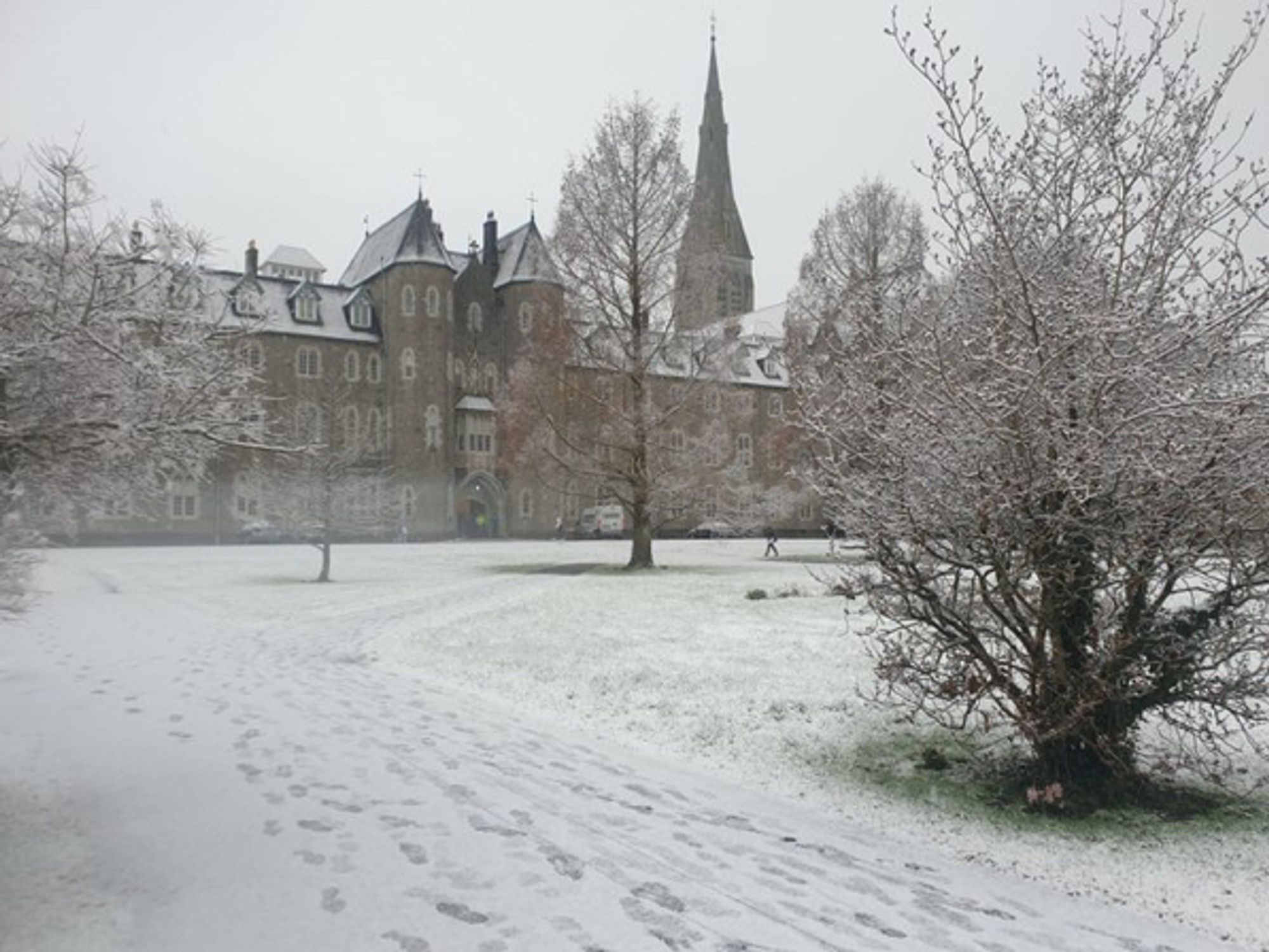
Talking of the weather, I noticed on social media that yesterday it snowed in Maynooth (and elsewhere in Ireland). The contrast with what I’ve been experiencing in Sydney will be rather extreme:

I was a bit concerned that the snow might cause problems with my return flight and/or onward transport, but I’m told that it was soon washed away by rain.

I’ll only be making a brief stop in Maynooth before travelling to (different) warmer climes, of which more in due course.