Archive for 3x2pt analysis

Weekly Update at the Open Journal of Astrophysics – 08/03/2025

Posted in OJAp Papers, Open Access, The Universe and Stuff with tags , , , , , , , , , , , , , , , , , , , , on March 8, 2025 by telescoper

Time for the weekly Saturday morning update of papers published at the Open Journal of Astrophysics. Since the last update we have published four new papers, which brings the number in Volume 8 (2025) up to 25 and the total so far published by OJAp up to 260.

In chronological order of publication, the four papers published this week, with their overlays, are as follows. You can click on the images of the overlays to make them larger should you wish to do so.

The first paper to report is “Partition function approach to non-Gaussian likelihoods: information theory and state variables for Bayesian inference” by Rebecca Maria Kuntz, Heinrich von Campe, Tobias Röspel, Maximilian Philipp Herzog, and Björn Malte Schäfer, all from the University of Heidelberg (Germany). It was published on Wednesday March 5th 2025 in the folder Cosmology and NonGalactic Astrophysics and it discusses the relationship between information theory and thermodynamics with applications to Bayesian inference in the context of cosmological data sets.


You can read the officially accepted version of this paper on arXiv here.

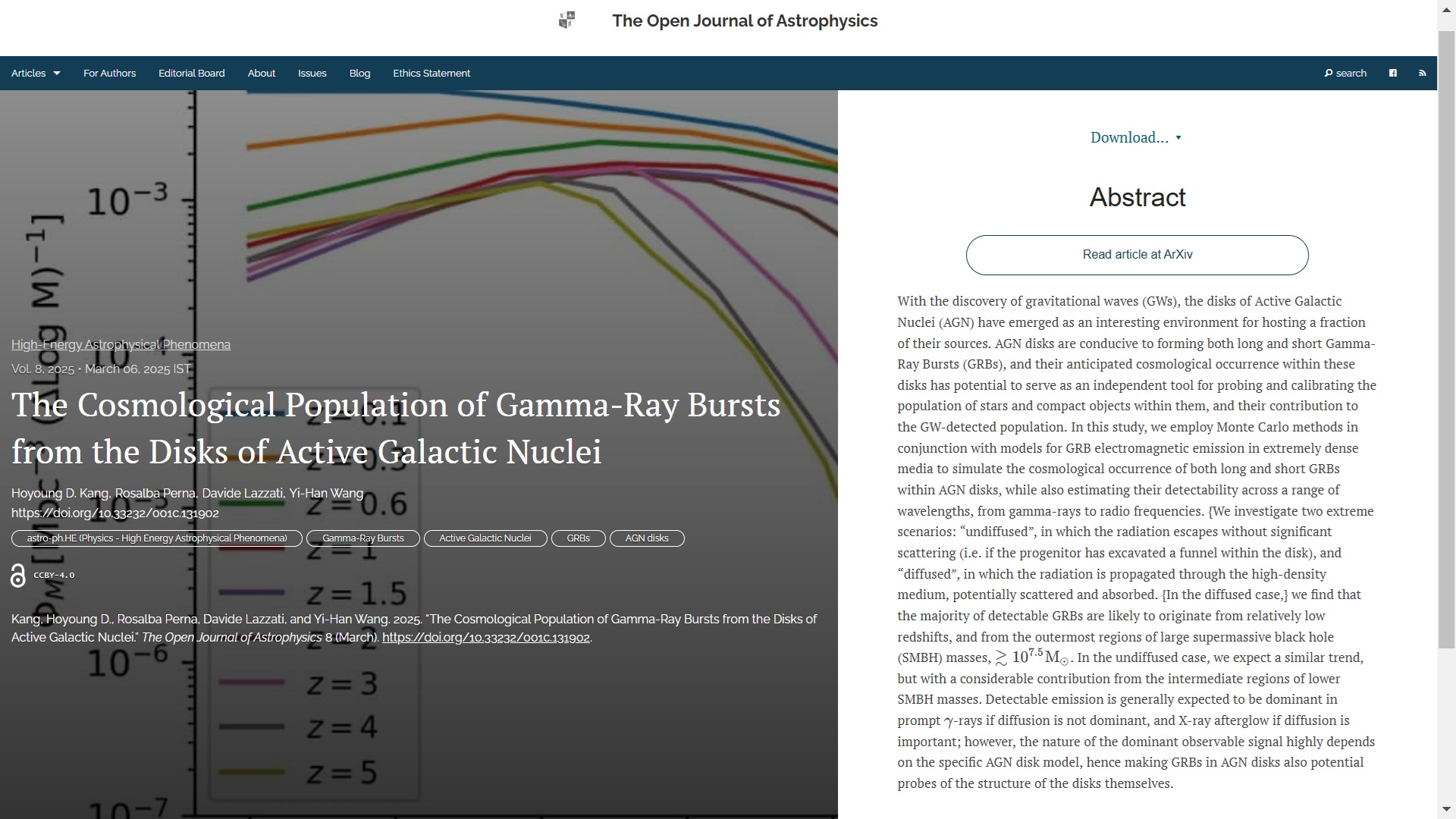
The second paper of the week  is “The Cosmological Population of Gamma-Ray Bursts from the Disks of Active Galactic Nuclei” by Hoyoung D. Kang & Rosalba Perna (Stony Brook), Davide Lazzati (Oregon State), and Yi-Han Wang (U. Nevada), all based in the USA. It was published on Thursday 6th March 2025 in the folder High-Energy Astrophysical Phenomena. The authors use models for GRB electromagnetic emission to simulate the cosmological occurrence and observational detectability of both long and short GRBs within AGN disks
You can find the officially accepted version of this paper on arXiv here.

The next two papers were published on Friday 7th March 2025.

The distribution of misalignment angles in multipolar planetary nebulae” by Ido Avitan and Noam Soker (Technion, Haifa, Israel) analyzes the statistics of measured misalignment angles in multipolar planetary nebulae implies a random three-dimensional angle distribution limited to <60 degrees. It is in the folder Solar and Stellar Astrophysics.

Here is the overlay:


The official published version can be found on the arXiv here.

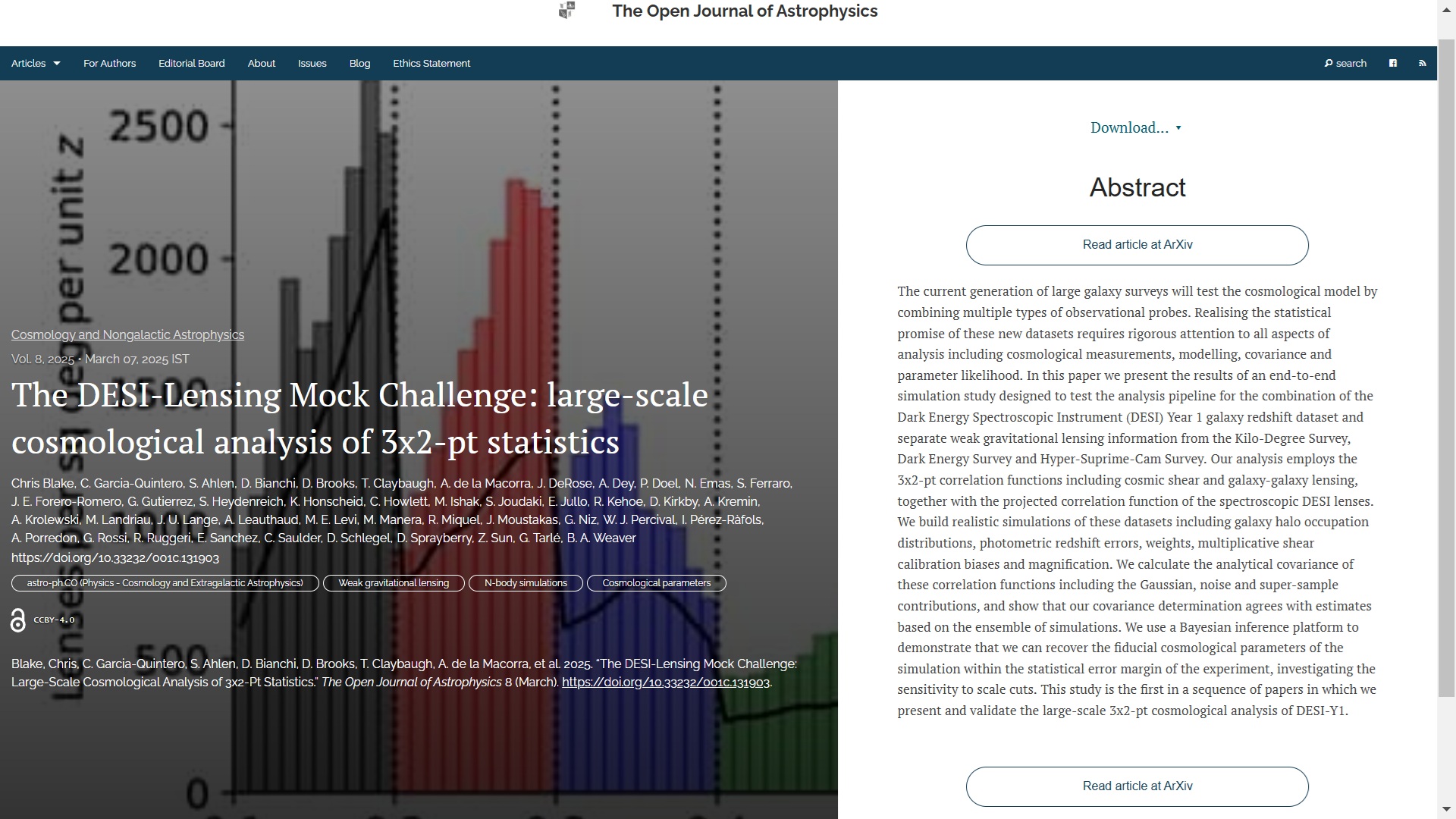
The last paper to report this week is “The DESI-Lensing Mock Challenge: large-scale cosmological analysis of 3×2-pt statistics” by Chris Blake (Swinburne, Australia) and 43 others; this is a large international collaboration and I apologize for not being able to list all the authors here!

This one is in the folder marked Cosmology and NonGalactic Astrophysics; it presents an end-to-end simulation study designed to test the analysis pipeline for the Dark Energy Spectroscopic Instrument (DESI) Year 1 galaxy redshift dataset combined with weak gravitational lensing from other surveys.

The overlay is here:
 

You can find the “final” version on arXiv here.

That’s all for this week. It’s good to see such an interesting variety of topics. I’ll do another update next Saturday

Four New Publications at the Open Journal of Astrophysics

Posted in OJAp Papers, Open Access, The Universe and Stuff with tags , , , , , , , , , , , on December 7, 2024 by telescoper

It’s Satuday morning once again so here’s another quick update of activity at the Open Journal of Astrophysics. Since the last update a week ago we have published  four papers, which takes the count in Volume 7 (2024) up to 110 and the total published altogether by OJAp up to 225.

In chronological order of publication, the four papers published this week, with their overlays, are as follows. You can click on the images of the overlays to make them larger should you wish to do so.

First one up is “The impact of feedback on the evolution of gas density profiles from galaxies to clusters: a universal fitting formula from the Simba suite of simulations” by Daniele Sorini & Sownak Bose (Durham University, UK), Romeel Davé (University of Edinburgh, UK), and Daniel Anglés-Alcázar (University of Connecticut, USA). The paper, which is in the folder marked Astrophysics of Galaxies, presents a study of the effects of stellar and/or AGN feedback on the shape and evolution of gas density profiles in galaxy haloes using the SIMBA simulations. It was published on Tuesday 3rd December 2024.

Here is a screen grab of the overlay, which includes the abstract:


You can find the officially accepted version of the paper on the arXiv here.

The second paper to announce, also published on 3rd December 2024, and is also the folder “Astrophysics of Galaxies, is “Self-regulated growth of galaxy sizes along the star-forming main sequence” by Shweta Jain (U. Kentucky, USA), Sandro Tacchella (U. Cambridge, UK) and Moein Mosleh (Shiraz University, Iran).  This paper suggestes an identification of a possible self-regulating mechanism in galaxy size growth involving the interplay between feedback from star formation and newly accreted gas.

You can see the overlay here:


The accepted version of this paper can be found on the arXiv here.

The third paper, published on Thursday 6th December 2024 in the folder marked Cosmology and NonGalactic Astrophysics, is called  “BLAST: Beyond Limber Angular power Spectra Toolkit. A fast and efficient algorithm for 3×2 pt analysis” by Sofia Chiarenza, Marco Bonici & Will Percival (Waterloo, Canada) and Martin White (Berkeley, USA). It presents BLAST, an efficient algorithm for calculating angular power spectra without employing the Limber approximation or assuming a scale-dependent growth rate, based on the use of Chebyshev polynomials. The code is written in Julia.

Here is the overlay


The final version accepted on arXiv is here.

Last in this batch, published on 6th December 2024, and in the folder Astrophysics of Galaxies, is “On the universality of star formation efficiency in galaxies” by Ava Polzin & Andrey V. Kravtsov (U. Chicago) and Vadim A. Semenov & Nickolay Y. Gnedin (CfA Harvard), all based in the USA. The paper presents an argument that the universality of observational estimates of star formation efficiency per free-fall time can be plausibly explained by the turbulence-driven and feedback-regulated properties of star-forming regions.

You can find the official accepted version on the arXiv here.

We seem to have recovered from a small Thanksgiving lull and, looking at the OJAp workflow, I think we’ll have a similar number of publications next week. I’ll do another update next weekend!