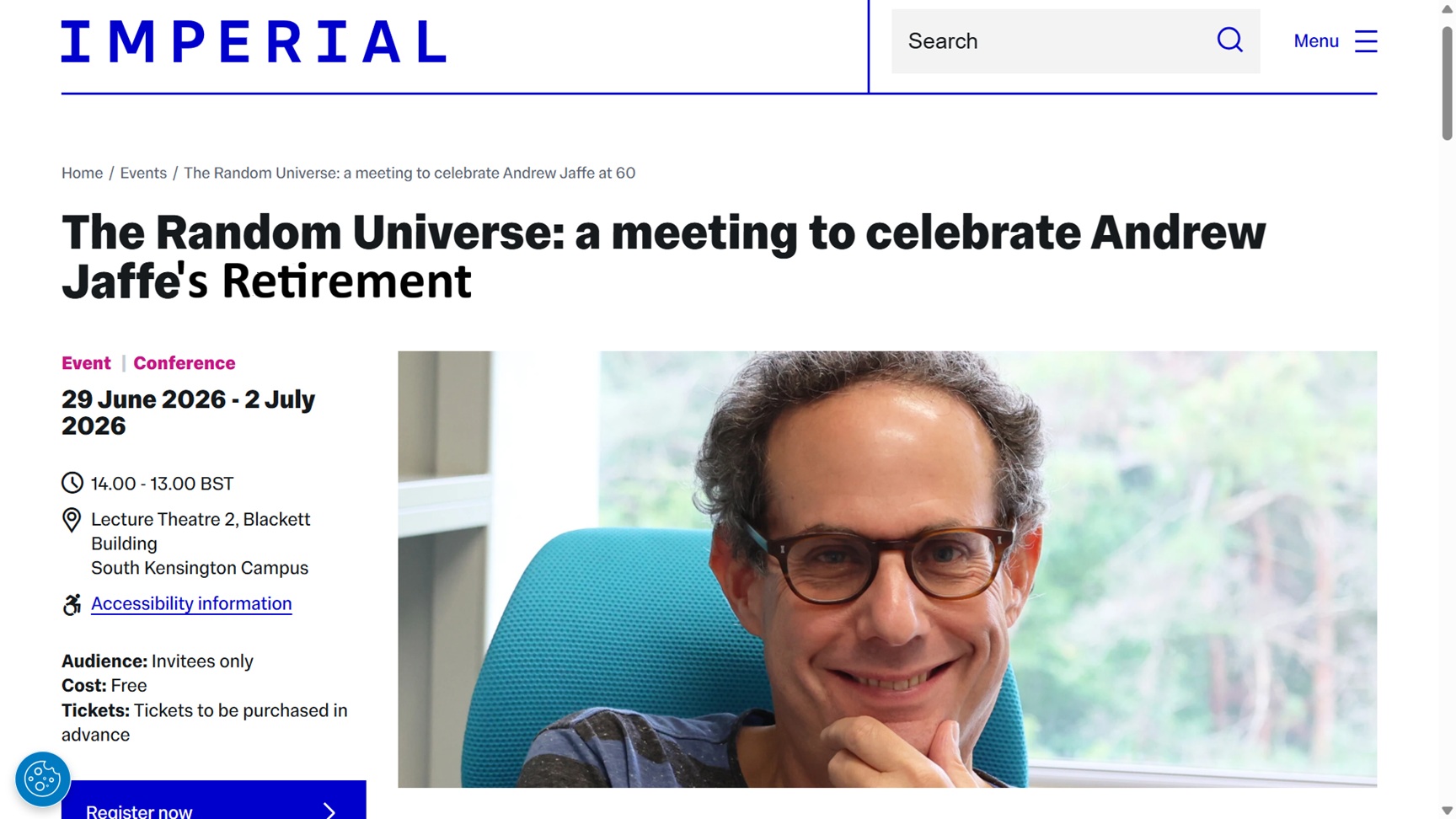
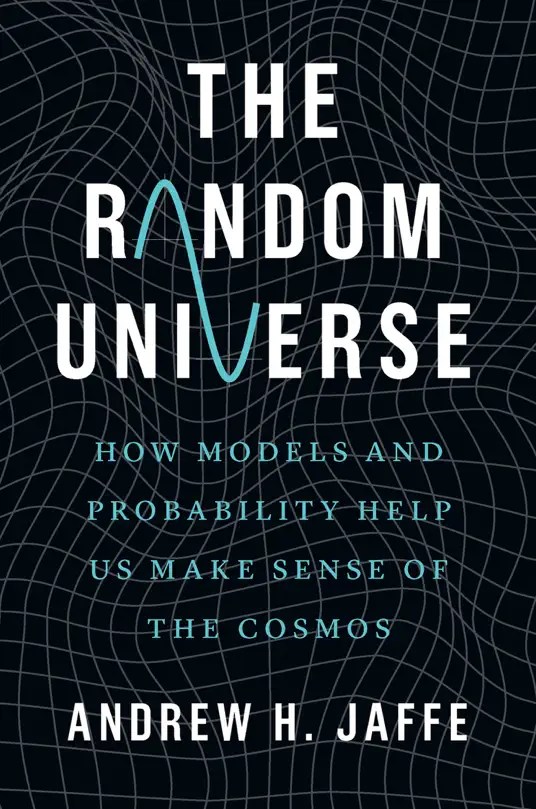
So here I am, in that London. I’m attending a small meeting called A Random Universe which is celebrating the occasion of the 60th Birthday of cosmologist Andrew Jaffe. The meeting is being held at South Kensington Technical Imperial College and covers cosmology, statistics, topology, and a number of other things. The title comes from a book Andrew has published:
I’m ashamed to admit I haven’t read it yet – it was published last year – but I will do. An amusing thing is that I wanted to use that title for a book I wrote some time ago but the publisher rejected it! I also noticed just now that the book uses the definite article whereas the conference has the indefinite article.
I had other things to do yesterday so I missed the first day of the meeting, and my train into London was delayed by an hour because of “a cow on the line”, which necessitated a lengthy diversion via Coventry, so I missed much of this morning too. I did make some use of the time, though, publishing three papers in the Open Journal of Astrophysics using a commendably stable Wi-Fi connection on the train.
One thing I didn’t miss, however, was an interesting panel discussion under the title AI and Inference. There wasn’t much about inference in the discussion, but it did cover some interesting ground. Cosmologists are well used to Machine Learning, which is often claimed to be a form of Artificial Intelligence, though I wouldn’t classify it as such. In fact,the large survey analyses that constitute a major part of contemporary cosmological research would not be feasible without the deployment of machine learning methods. I think it’s likely that newer methods of Generative AI and Agentic systems based on Large Language Modules will lead to increases in scientific productivity in the short term too. Whatever happens in the longer term, several years in the future, is very hard to predict, but is likely to invilve big changes in the way science is done. I’ll just say that I’m not sorry that I will be retiring in two years!
Apparently the “Holy Grail” of the Tech Bros is to find ways of creating artificial “General Intelligence”. There was an audience vote about whether this would be accomplished with the five years or so some claim. I abstained, on the grounds that I really don’t know what “General Intelligence” is supposed to mean in the first place. I would also remind readers that the Holy Grail was an object of dubious significance the Quest for which consumed considerable resources and ultimately failed.
Another topic that came up is whether AI methods will ever be truly creative. This is an interesting question because I don’t think we know very much about how creativity in any form, including the intuitive leaps that have led to advances in science, arises in human brains. I wrote a post about “Light-bulb” moments here.
One immediate effect of LLMs on science is in the publishing world. At OJAp we are experiencing a tidal wave of AI-generated slop and other garbage. This is very wearisome and I think will only get worse. We don’t rule out the use of AI in papers at OJAp, but authors must disclose what they have done and how they have tested it. Things may change in the future, but I think that in the current era of science the big problem is not that AI methods can’t be used by good scientists for good research but that AI methods make it far too easy for fools to generate superficially plausible nonsense. I don’t see any easy solution to this but maybe there is an upside, in that will hasten the end of the system of academic publishing which has in any case long outlined its usefulness.