Archive for academic publishing

A Master Class in Destroying Trust

Posted in Open Access with tags , on April 8, 2025 by telescoper

For (hopefully) obvious reasons, I’m taking the liberty of republishing, with permission, the following article, originally published here, about the egregious behaviour of the company Clarivate which, among other activities, is responsible for assigning Journal Impact Factors. Please read it if you want to understand why nothing Clarivate does should be trusted. The author, Sunshine Carter, is director of collection strategy and e-resource management at the University of Minnesota. The article represents the author’s personal views, not those of her employer. 

–0–

Clarivate’s “transformative subscription-based strategy” caught the library world flat-footed. How did this happen? And where do we go from here?


On February 18, 2025, Clarivate announced that as part of its “transformative strategy and following changes in demand from libraries” it would “phase out one-time perpetual purchases of print books” and ebooks on ProQuest’s Ebook Central platform. It would also end new perpetual archive license purchases of digital collections.

The removal of perpetual purchases from Clarivate’s sales models runs counter to library values of long-term preservation and access to information. Subscriptions might work for some libraries, but perpetual purchases are important for the preservation of the written record, especially at research institutions.

In the weeks that followed the announcement, librarians (including Siobhan Haimé and Isaac Wink) lamented the end of ownership; the loss of stable access; and the loss of a primary supplier for shelf-ready print books. They shared concerns about their ability to afford new subscriptions, the need to shift collection development strategies, and Clarivate’s fast timeline. Many pointed to Clarivate’s February 19, 2025 earnings call for 2024 Q4, which clearly articulated their goal to increase the bottom line. This was the “value creation plan (VCP)” Clarivate announced in late 2024 coming to fruition. Library and higher education consortia sent letters to Clarivate; libraries met with Clarivate, and with each other. EBSCO, a direct competitor, quickly reaffirmed its commitment to offering a variety of purchase options for libraries.

On March 4, two weeks after the initial announcement, Clarivate’s CEO, Matti Shem Tov, and president for academia and government, Bar Veinstein, issued an open letter to the library community in which they apologized that “the absence of community consultation created frustration, during already challenging times for libraries and higher education.” They also announced that Clarivate would delay the implementation date for the planned changes and guarantee perpetual access for previously purchased materials.

This response—a delay in implementation that ignores the library community’s deeper critique of the plan—rings hollow.

As we plan our next steps, we should reflect on how we got here.

Building a Community

In June 2007, I found myself in Spearfish, South Dakota at my first Ex Libris Users of North American (ELUNA) conference.

Formed in 2006 from the merger of two previous user groups, ELUNA is a not-for-profit organization representing Ex Libris customers in the Americas. Ex Libris develops and sells library software and management solutions like Alma, an integrated library management system used by over 2,500 libraries worldwide.

ELUNA members test and advocate for improvements to the Ex Libris products and have created a community of support for each other. ELUNA has a steering committee, eighteen working groups, four advisory groups, and seven communities of practice composed of staff from subscribing institutions; they interact directly with staff from Ex Libris. Over the past 20 years, through my institutions’ involvement in ELUNA, I’ve improved, conceptualized, and developed features for Ex Libris products.

At my first ELUNA conference, I was awed by how many libraries and library staff were users of and experts in Ex Libris tools and systems. I was also struck by how closely ELUNA attendees and member institutions collaborated with Ex Libris staff. Ex Libris leaders, product managers, developers, and customer support and service staff attend the ELUNA conference, where they lead trainings and give presentations.

Over the years, Ex Libris executives (including, during their tenures there, Shem Tov and Veinstein) often used the conference to announce and explain the rationale for new products or other major business decisions. During Q&A sessions, ELUNA members shared opinions—sometimes passionate—directly with Ex Libris staff and executives. There was a high level of collaboration and information-sharing between ELUNA member institutions, their staff, and Ex Libris employees.

The process of collaboration was not always smooth and didn’t always work out as ELUNA members preferred, but we worked with Ex Libris to make things happen and felt like a valued community.

A Shifting Tide

In October 2015, ProQuest, which had its own long history as a key provider of digitized primary materials and aggregator of research databases, ebooks, and streaming videos, acquired Ex Libris. This was a seismic transition for academic libraries. But despite fretting about what the acquisition would mean for both companies and their lines of products, from the outside, things seemed okay: There was some consolidation—for example, of customer support desks—but the products themselves didn’t change. Ex Libris retained its moniker, adding “A ProQuest Company” to its logo and branding. Several Ex Libris executives—including Shem Tov and Veinstein—made their way into ProQuest leadership.

And then, in late 2021, ProQuest was acquired by Clarivate.

Though Clarivate’s current leadership—including Shem Tov and Veinstein—have a strong history of collaborating with their customers, they didn’t consult with libraries or publishers before their February 18 announcement. Clarivate’s failure to involve their customers in this decision, especially those in government and academia, shows that they prioritized profit over relationships.

The exclusion of libraries was intentional, not an oversight. In a moment when university budgets are facing profound and intense technological, financial, and governmental pressures, Clarivate’s fast and furious timeline—even with a slight reprieve—is out of touch.

Vendors and publishers seek to make money. Library professionals promote the freedom to read and unfettered access to content. Of course the goals of vendors and library professionals can be in conflict. And yet, in our work with vendors, as exemplified in my experience with ELUNA—a service provided by libraries and their employees to a corporation, in the form of a nonprofit, which we described as a community—it has at times been easy to feel as if we all share a commitment to libraries and librarianship.

We do not.

Where Do We Go From Here?

Clarivate is omnipresent on academic campuses, although it is not alone. And, like other large content and information services providers, it has shifted its focus. In an article about Elsevier and its parent company, RELX, Christien Boomsma writes, “Publishing is no longer the main focus for RELX and its competitors; instead, they have become data brokers. They sell data to insurance companies for risk analysis, to banks for fraud detection, to universities to assess their performance, and, especially egregious, to the US Immigration Service to target illegal immigrants.” In addition to a new focus on data, Clarivate is investing heavily in artificial intelligence, an indicator of expected market and revenue gains.

Clarivate’s dismissal of one-time purchases is alarming, but when you consider the company’s larger strategy, it makes sense. On the Q4 earnings call, Shem Tov refers to one-time purchases as “a drain.” He also says that Clarivate has “retained financial advisers to help us in evaluating strategic alternatives to unlock value. This may include divesting business units or an entire segment.” He goes on to say, “There is no guarantee that anything actionable will arise from this process,” but considering Clarivate will no longer sell books, Clarivate’s furthering its investment in data should make us wary.

Going forward, libraries and library staff should approach vendors with absolute clarity about the values governing our respective work and the nature of our relationships. We must:

Increase bibliodiversity in the market and our collections (Haimé) by:

  • Purchasing materials directly from smaller and/or more diverse publishers
  • Investing in academy-owned open access infrastructure and publishing that is sustainable, equitable, and diverse
  • Investigating alternative software, tools, and content providers; consider developing options in-house (or in collaboration with other institutions)
  • Divesting from resources that no longer serve our needs or align with our values

Speak up by:

  • Sharing concerns with library leadership
  • Pushing vendors on issues that conflict with our values
  • Requesting meetings with vendor leadership

Use our collective voices to:

  • Discuss issues with institutional, system, regional, consortia, or association groups
  • Bring shared concerns to vendors, collectively
  • Reclaim our space; insist on being at the table (especially concerning the development of AI-integrated tools and the use of data collected about our institutions or our users)
  • Set guiding principles for interacting with publishers and vendors

Incorporate limitations into signed agreements. Make sure to:

  • Get everything in writing, via a contract
  • Limit vendors’ use of the data they collect from our users and institutions

Offer library staff training on:

  • Current vendor issues and trends with vendors
  • Ethics and conflicts of interest

We should remain open to collaboration but remember that profit drives many of the companies libraries rely on. Even in the face of great challenges and unbelievable changes, we can and should continue to advocate for our core values.

10.1146/katina031925-1

Publisherballs

Posted in Uncategorized with tags , , , , , on January 26, 2025 by telescoper

Private Eye has a regular feature called “Commentatorballs” which contains various verbal gaffes perpetrated by sports commentators, usually sent in by members of the public. It used to be called “Colemanballs” after David Coleman, but the name was changed after he passed away in 2013. Years ago, I had a couple of my own contributions published, actually.

Anyway, I’m seriously thinking about running a similar feature on this blog devoted to outrageous blunders made by academic publishers.

Here’s one that would make a good entry in “Publisherballs” from the journal Radiology Case Reports, published by – you guessed it – Elsevier:

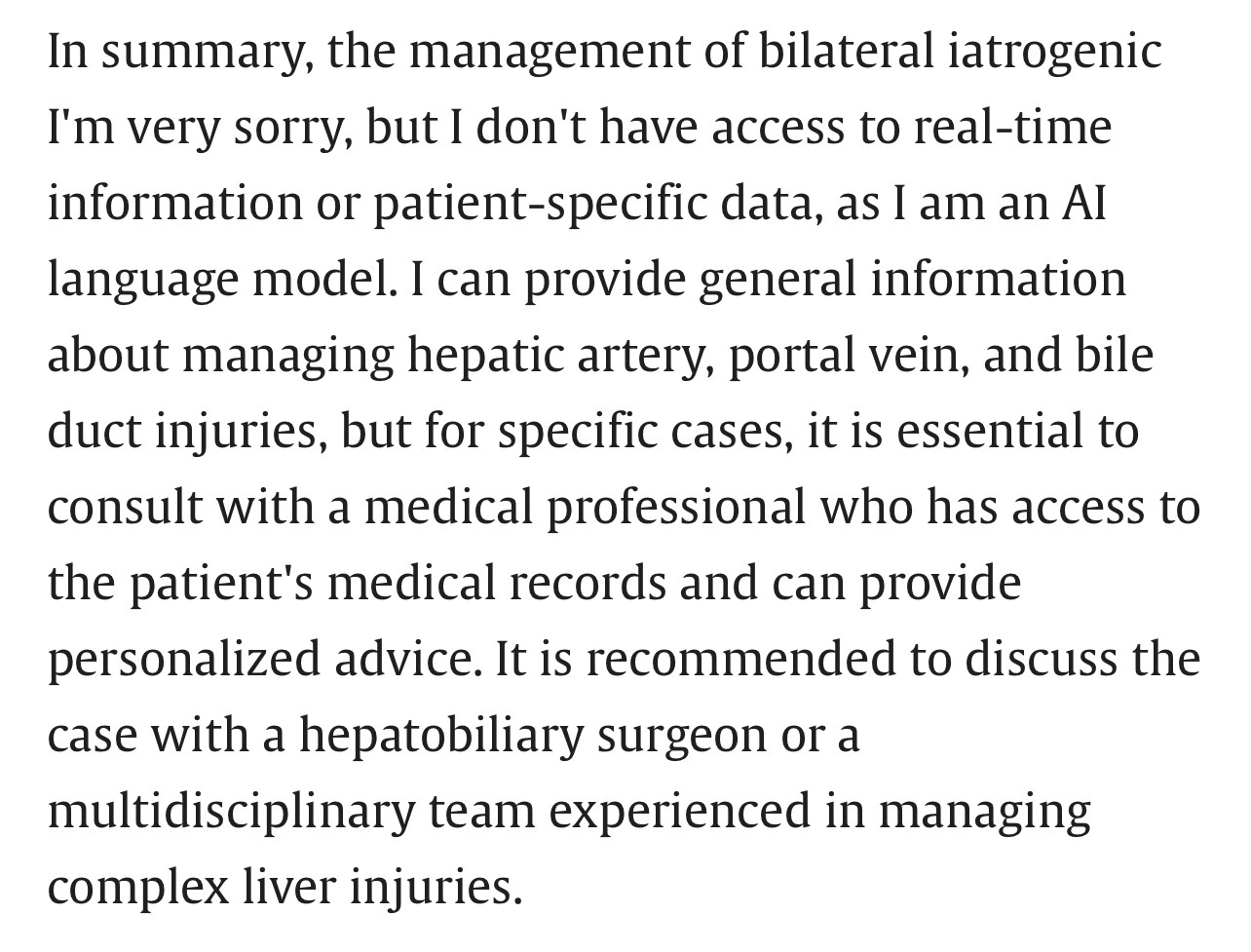
On the left you see the title, author data and abstract and on the right an extract from the text that clearly shows it was generated by ChatGPT or some other AI bot. The authors cut and pasted the output without even noticing that the software they were using was explaining it could not respond to the prompt they gave it. Clearly the careful editorial process at the journal didn’t even go as far as reading the paper…

Qeios and the Nature of a Journal

Posted in Open Access with tags , , , on December 15, 2024 by telescoper

Last week I encountered, for the first time, a website called Qeios.com. This is a platform that does peer review of preprints and then posts those approved with Open Access. It also issues a DOI for approved articles. Qeios is also a member of Crossref so presumably the metadata for these articles is deposited there too.

You might think this is the same as what the Open Journal of Astrophysics does, but it is a bit different. For one thing, it is not an arXiv overlay journal so the preprints actually appear on the Qeios platform, though I suppose there’s nothing to stop authors posting on arXiv either before or after Qeios. Since most astrophysicists find their research on arXiv, the overlay concept seems more efficient than the Qeios one.

Anyway, my attention was drawn to Qeios by an astrophysicist who had been asked to review an article for Qeios that is already under consideration by OJAp. In our For Authors page there is this:

No paper should be submitted to The Open Journal of Astrophysics that is already published elsewhere or is being considered for publication by another journal.

This rule is adopted by many journals and has in the past led to authors being banned for breaking it. Apart from anything else it means that the community is not bombarded with multiple review requests for the same paper (as in the case above). There is an issue of research misconduct, the definition of which varies from one institution to another. For reference here is what it says in Maynooth University’s Research Integrity Policy statement:

Publication of multiplier papers based on the same set(s) or sub-set(s) of data is not acceptable, except where there is full cross-referencing within the papers. An author who submits substantially similar work to more than one publisher must disclose this to the publishers at the time of submission.

The document also specifically refers to “artificially proliferating publications” as an example of research misconduct. Authors whose papers do end up in multiple journals could thus find themselves in very hot water with their employers as a consequence.

Getting back to the specifics of Qeios and OJAp, however, there two questions about whether this rule applicable in this situation. One is that the preprint may have been submitted to Qeios after submission to OJAp, which means the rule as written is not violated. Authors of papers published by OJAp retain full copyright of their work so we can’t control what they do after publication, but if they try to publish it again in another journal they will fall foul of the rule there.

The other is whether Qeios counts as a “another journal” in the first place. Instead of going into the definition of what a journal is, I’ll refer you to an old post of mine in which I wrote this:

I’d say that, at least in my discipline, traditional journals are simply no longer necessary for communicating scientific research. I find all the  papers I need to do my research on the arXiv and most of my colleagues do the same. We simply don’t need old-fashioned journals anymore.  Yet we keep paying for them. It’s time for those of us who believe that  we should spend as much of our funding as we can on research instead of throwing it away on expensive and outdated methods of publication to put an end to this absurd system. We academics need to get the academic publishing industry off our backs.

The point that I have made many times is that the only thing that journals do of any importance is to organize peer-review. The publishing side of the business is simply unnecessary. Journals do not add value to an article, they just add cost. The one thing they do – peer review – is not done by them but by members of the academic community.

There is a thread on Bluesky by Ethan Vishniac (Editor-in-Chief of the Astrophysical Journal) about Qeios. There are six parts so please bear with me if I include them all to show context:

This thread is for authors of scientific papers, and particularly astronomers. I struggled a bit with how explicit I had to be, but I think including a name is important. We (meaning all the major journals) have rules against submitting a manuscript to more than one journal at a time. 1/6

Ethan Vishniac (@ethan-vishniac.bsky.social) 2024-12-06T21:27:57.368Z

People who ignore this rule can find themselves banned from submitting papers for years. Recently we had a case where a potential referee noted that he had just been asked to review the same paper by someone else. 2/6

Ethan Vishniac (@ethan-vishniac.bsky.social) 2024-12-06T21:27:57.369Z

I wrote the author, who was startled and explained that he had been asked to allow his preprint to be posted at Qeios.com and that he had agreed – the issue of peer review was never raised and posting a preprint is not an ethical violation. It’s a normal part of the process. 3/6

Ethan Vishniac (@ethan-vishniac.bsky.social) 2024-12-06T21:27:57.370Z

He cc'd me the emails and I would have read it the same way. Qeios.com takes the position that they are not a journal, but a website that vets papers through peer review. The AAS journals (and as far as I know, all other professional journals) does not regard this as a meaningful distinction. 4/6

Ethan Vishniac (@ethan-vishniac.bsky.social) 2024-12-06T21:27:57.371Z


We ban this kind of simultaneous submission in order to avoid over-burdening the community with review requests and because we do not want to encourage people to shop for a referee who will not give significant feedback. The task of reviewing a paper is time-consuming but important service. 5/6

Ethan Vishniac (@ethan-vishniac.bsky.social) 2024-12-06T21:27:57.372Z

There is no point in participating in a process which makes this work meaningless. TDLR submit to the AAS journals, or submit to Qeios.com , or any other journal of your choice, but remember that it is a choice. Also, you can post to the ArXiv as well. It's fine. 6/6

Ethan Vishniac (@ethan-vishniac.bsky.social) 2024-12-06T21:27:57.373Z

This thread repeats much of what I’ve said already, but I’d like to draw your attention to the 4th of these messages, which contains

Qeios.com takes the position that they are not a journal, but a website that vets papers through peer review. The AAS journals (and as far as I know, all other professional journals) does not regard this as a meaningful distinction.

I’m not sure what a journal actually is, as I think it is an outmoded concept, but I agree with Ethan Vishniac that to all intents and purposes Qeios is a journal. It has an ISSN that says as much too. On the other hand, this quote seems to me to contain a tacit acceptance that the only thing that defines a journal is that it vets papers by peer review, which is the point I made above.

The Case Against Academic Publishers

Posted in Open Access with tags , , , , , on September 25, 2024 by telescoper

It seems appropriate to pass on news of a federal antitrust lawsuit being brought in the United States against six commercial academic publishers, including the “Big Four” (Elsevier, Springer Nature, Taylor & Francis and Wiley). The case is filed by lawyers Lieff Cabraser Heimann and Bernstein. The plaintiff is Lucina Uddin, Professor of Psychology at UCLA.

I suggest you read the full document linked to above for details, but in a nutshell the case alleges three anticompetitive practices:

  1. agreeing to “fix the price..at zero” for the labour of authors and peer reviewers;
  2. agreeing not to compete for manuscripts by forcing authors to submit to one journal at a time;
  3. agreeing to prohibit authors from sharing their work while under peer review, “a process that often takes over a year”

I’ve spoken to a few people who know a bit about US law on such matters and they all say that the plaintiff’s legal representatives have a good track record on antitrust litigation. Nevertheless, there is some doubt about whether the case is winnable but at the very least it will bring a lot of attention to the Academic Journal Racket, so is probably a good move even if it doesn’t succeed. If it does succeed, however, it might blow a hole in the entire commercial publishing industry, which would be an even better move…

As an interesting postscript (found here) is that, in 2002, the UK Office of Fair Trading reviewed complaints about anticompetitive practices in academic publishing; see here. It found market distortions but decided not to act because of the recent rise of Open Access. I quote

It is too early to assess what will be the impact of this … but there is a possibility that it will be a powerful restraint on exploiting positional advantage in the STM journals market.

Now that 22 years have passed, is it still too early?

P.S. Comments from legal experts would be especially welcome!

The Big Four and Your Work

Posted in Open Access with tags , , , , on September 10, 2024 by telescoper

In Agatha Christie’s novel The Big Four (left) the great detective Hercule Poirot tries to identify the members of sinister group of unscrupulous individuals bent on world domination.

When it comes to the world of academic publishing, the members of the The Big Four are somewhat easier to identify, though no less unscrupulous. They are Elsevier, Spring-Nature, Taylor & Francis, and John Wiley & Sons who have cornered almost 50% of the lucrative market in scholarly books and journals and the eye-watering profits that go with that territory.

Recently, however, these companies have found a new way of boosting their profits still further. This involves selling their “content” to tech companies in order to train the generative AI algorithms known as Large Language Models. The latest to do this is Wiley, which has already cashed in to the tune of $44 million. Wiley has not given its authors the right to opt out of this deal nor will authors be remunerated. Others outside the Big Four are also cashing in. Oxford University Press, for example, which publishes Monthly Notices of the Royal Astronomical Society, has done similar deals.

This sort of arrangement provides yet another reason to avoid the commercial publishing sector. Do we become academic researchers in order to be mere “content creators” for Wiley and the rest?

An All-Ireland Diamond Open Access Publishing Platform?

Posted in Maynooth, Open Access with tags , , , , , , on June 24, 2024 by telescoper

Here’s a report on an interesting development about Open Access in Ireland. The article belongs to the Special Issue 10th Anniversary Special Issue “PUBMET2023 Conference on Scholarly Communication in the Context of Open Science” and has the following abstract:

The Government of Ireland has set a target of achieving 100% open access to publicly funded scholarly publications by 2030. As a key element of achieving this objective, the PublishOA.ie project was established to evaluate the feasibility of establishing an all-island [Republic of Ireland and Northern Ireland] digital publishing platform for Diamond Open Access journals and monographs designed to advance best practice and meet the needs of authors, readers, publishers, and research funding organisations in Irish scholarly publishing. It should be noted in this context that there is substantial ‘north–south’ cooperation between public bodies in the Republic of Ireland and Northern Ireland in the United Kingdom, some of whom operate on what is commonly termed an ‘all-island’ basis. The project commenced in November 2022 and will run until November 2024, with the submission of a Final Report. This article originated as an interim project report presented in September 2023 at the PubMet2023 conference in Zadar, Croatia. The project is unique in its mandate to report on the feasibility of a shared platform that will encompass scholarly publishing across the two jurisdictions on the island of Ireland, which are now, post-Brexit, inside and outside the European Union (EU): the Republic of Ireland and Northern Ireland in the United Kingdom. The project is co-led by the Royal Irish Academy (RIA), Ireland’s leading body of experts in the Sciences and Humanities, and the Trinity Long Room Hub Arts & Humanities Research Institute of Trinity College Dublin. There are sixteen partners and affiliates from universities and organisations from the island of Ireland. The feasibility study will be based on a review of the publishing practices in the island of Ireland, with gap analysis on standards, technology, processes, copyright practices, and funding models for Diamond OA, benchmarking against other national platforms, and specifications of the requirements, leading to the delivery of a pilot national publishing platform. A set of demonstrator journals and monographs will be published using the platform, which will be actively trialled by the partner publishers and authors. PublishOA.ie aims to deliver an evidence-based understanding of Irish scholarly publishing and of the requirements of publishers to transition in whole or in part to Diamond OA. This paper provides an interim report on progress on the project as of September 2023, ten months after its commencement.

I think the idea of having a national Diamond Open Access publishing platform is a very interesting one. In principle it could facilitate the federated system of repositories linked by refereeing overlays which I think is the future of academic publishing. I think a national peer review platform would be more to the point than a publishing platform.

I have two comments:

  1. I am surprised that Maynooth University – publisher, among other things, of the Open Journal of Astrophysics (a Diamond Open Access journal) – is not among the partners in this project and does not even receive a mention as a publisher. I wonder how far this project will get if it excludes organizations that are already running Diamond Open Access Journals.
  2. Less of a comment, more of a question: why on Earth is the report published in a journal run by MDPI, a publisher that is controversial (to say the least)? It would be deeply ironic if they had to pay an APC to publish an article on Diamond Open Access!

Replacing Academic Journals

Posted in Open Access with tags , , on January 21, 2024 by telescoper

I just saw an interesting paper published by the Royal Society last year with the abstract:

Replacing traditional journals with a more modern solution is not a new idea. Here, we propose ways to overcome the social dilemma underlying the decades of inaction. Any solution needs to not only resolve the current problems but also be capable of preventing takeover by corporations: it needs to replace traditional journals with a decentralized, resilient, evolvable network that is interconnected by open standards and open-source norms under the governance of the scholarly community. It needs to replace the monopolies connected to journals with a genuine, functioning and well-regulated market. In this new market, substitutable service providers compete and innovate according to the conditions of the scholarly community, avoiding sustained vendor lock-in. Therefore, a standards body needs to form under the governance of the scholarly community to allow the development of open scholarly infrastructures servicing the entire research workflow. We propose a redirection of money from legacy publishers to the new network by funding bodies broadening their minimal infrastructure requirements at recipient institutions to include modern infrastructure components replacing and complementing journal functionalities. Such updated eligibility criteria by funding agencies would help realign the financial incentives for recipient institutions with public and scholarly interest.

https://royalsocietypublishing.org/doi/10.1098/rsos.230206

The article is well worth reading in full. It says things that I have said on this blog (e.g. here) but rather more eloquently than I managed. I’ll just make a couple of comments.

First, in the first paragraph of the first section it says:

Replacing traditional journals with a more modern solution is not a new idea […], but the lack of progress since the first calls and ideas more than 20 years ago has convinced an increasing number of experts that the time for small tweaks is long gone and a disruptive break is now overdue.

I agree, of course, and I think one of the problems is the perennial problem of academia: there’s a huge excess of talking over doing. With the Open Journal of Astrophysics I’m proud to be one of the doers. Incidentally, a senior member of the Royal Astronomical Society recently told me that they were finding OApJ “disruptive”. That is, of course, the point. We need a lot more disruption.

Another issue I’ve written about before is whether there is any future in academic journals as such at all. The concept dates from the 17th Century – when it was extremely valuable and useful – but is now very outdated. As I wrote here more than a decade ago:

I’d say that, at least in my discipline, traditional journals are simply no longer necessary for communicating scientific research. I find all the  papers I need to do my research on the arXiv and most of my colleagues do the same. We simply don’t need old-fashioned journals anymore.  Yet we keep paying for them. It’s time for those of us who believe that  we should spend as much of our funding as we can on research instead of throwing it away on expensive and outdated methods of publication to put an end to this absurd system. We academics need to get the academic publishing industry off our backs.

https://telescoper.blog/2015/11/05/enough-of-the-academic-publishing-racket/

The revolution has been a slower process than I expected, but I do sense that the worm is at last turning.

Retractions and Resignations

Posted in Open Access with tags , , , , , , , , on December 16, 2023 by telescoper

I saw an article this week in Nature that revealed that more than 10,000 research papers have been retracted so far 2023. The actual number is probably much higher than that, as this is just the fraudulent papers that have been found out. Over 80% of the papers mentioned in the article were published by Hindawi, a known predatory publisher that specializes in Gold Open Access journals that charge Article Processing Charges. Hindawi is owned by Wiley but the brand has become so toxic that Wiley no longer wants to use the name. Presumably it still wants the profits.

(Another bit of news this week makes me think that Hindawi might be the academic publishing equivalent of Tesla…)

Here’s a figure showing how the number of retracted research articles has increased over time:

It has always seemed to me that the shift to “Gold” Open Access in which authors pay to have their work published would lead to a decrease in editorial standards. Since the publisher’s income comes from APCs, the more papers they publish the more money they get. This is another reason Diamond Open Access run on a not-for-profit basis with no fees for either authors or readers is a much better model.

At least some academics are taking a stand. Retraction Watch maintains a list of journals whose editors who have resigned – sometimes en masse from the same journal – in response to the imposition of dodgy practices by their publishers. Take the Journal of Geometric Mechanics, for example. The entire Editorial Board of this journal resigned because of pressure from above to increase “output” (i.e. profits) by lowering academic standards.

This is just a start, of course, but I don’t think it will take long for academic community to accept that the this publishing model is rotten to the core and embraces the only really viable and sustainable alternative.

The Strain on Scientific Publishing

Posted in Open Access with tags , on September 29, 2023 by telescoper

It’s the end of my first week away but before I go home for a swim in the pool on my roof terrace I thought I’d share an interesting paper on the arXiv by Hanson et al. (4 authors) entitled The Strain on Scientific Publishing. The abstract is:

Scientists are increasingly overwhelmed by the volume of articles being published. Total articles indexed in Scopus and Web of Science have grown exponentially in recent years; in 2022 the article total was 47% higher than in 2016, which has outpaced the limited growth, if any, in the number of practising scientists. Thus, publication workload per scientist (writing, reviewing, editing) has increased dramatically. We define this problem as the strain on scientific publishing. To analyse this strain, we present five data-driven metrics showing publisher growth, processing times, and citation behaviours. We draw these data from web scrapes, requests for data from publishers, and material that is freely available through publisher websites. Our findings are based on millions of papers produced by leading academic publishers. We find specific groups have disproportionately grown in their articles published per year, contributing to this strain. Some publishers enabled this growth by adopting a strategy of hosting special issues, which publish articles with reduced turnaround times. Given pressures on researchers to publish or perish to be competitive for funding applications, this strain was likely amplified by these offers to publish more articles. We also observed widespread year-over-year inflation of journal impact factors coinciding with this strain, which risks confusing quality signals. Such exponential growth cannot be sustained. The metrics we define here should enable this evolving conversation to reach actionable solutions to address the strain on scientific publishing.

arXiv:2309.15884

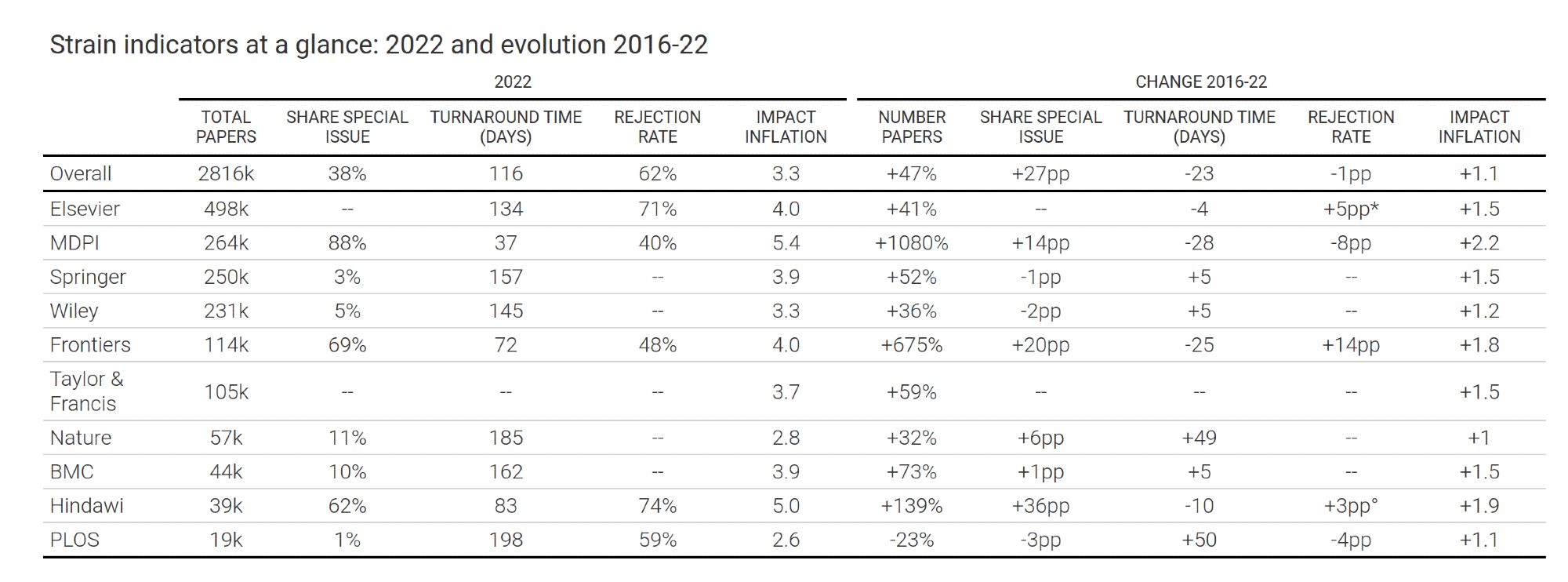
Here’s a table with some figures taken from the article, from which is easy to identify the most extreme behaviour and see that it is associated with predatory publishers.

How did we end up with such an absurd system that encourages this sort of behaviour?

This of course just covers the big publishers. The Open Journal of Astrophysics is much smaller: it has only published about a hundred papers in the period covered by the Table. For comparison, the OJAp rejection rate is about 49% and our turnaround time is about three weeks, on average, though with a large dispersion.

Abolishing an “Industry”?

Posted in Open Access with tags , , on June 2, 2023 by telescoper

A week or so ago I mentioned that the European Council had adopted a text that calls for the EU Commission and Member States to support policies towards a scholarly publishing model that is not-for-profit, open access and multi-format, with no costs for authors or readers.

The journal Nature has responded to the news with a piece entitled EU council’s ‘no pay’ publishing model draws mixed response and the lede:

Some academics have welcomed the proposed open access plans. But publishing industry representatives warn they are unrealistic and lack detail.

It’s not really accurate to describe the response as mixed as it is completely separated: the vested interests in the academic publishing industry are against it and everyone else is for it! It’s hardly surprising to see Nature (owned by academic publishing company Springer Nature). I found this in the text of the Nature piece:

The conclusions are concerning because they support a move that would abolish an industry

Caroline Sutton, the chief executive of the STM (a membership organization of academic publishers)

Indeed, though I would argue that what the proposals would abolish is not so much an industry as a racket. I’ve been blogging here about the Academic Journal Racket since 2009. It’s nice at last to see some real movement towards its abolition. Further on, I find:

The STM is also concerned that the move would eliminate independent European publishing companies and usher in a state-defined system that could stymie academic freedom. It warns that the amount of public funds used to build repositories of academic research papers by member states or institutions is hard to quantify.

How would free open access publishing stymie academic freedom? If anything does that it’s the extortionate publishing fees levied by publishers. And it’s a very bad argument to say that the costs of repositories is hard to quantify when everyone can see your enormous profit margins!

I was thinking about the financial strife currently afflicting many UK universities. If the UK university sector has to choose over the next few years between sacking hundreds of academic staff and ditching its voluntary subsidy to the publishing industry, I know what I would pick. In this respect I’m definitely an abolitionist.