Archive for ACT

Weekly Update from the Open Journal of Astrophysics – 25/10/2025

Posted in OJAp Papers, Open Access, The Universe and Stuff with tags , , , , , , , , , , , , , , , , , , , , on October 25, 2025 by telescoper

It may be a Bank Holiday weekend here in Ireland, but it’s still time for the usual Saturday update of the week’s new papers at the Open Journal of Astrophysics (although a bit later in the day than usual). Since the last update we have published another five papers, which brings the number in Volume 8 (2025) up to 161, and the total so far published by OJAp up to 396.

This week’s update  is rather unusual because there are four papers in a series (or, more precisely, mathematically speaking, a sequence) all published on the same day (Wednesday October 22nd 2025), in the same folder (Cosmology and NonGalactic Astrophysics), with the same first author (Dhayaa Anbajagane of the University of Chicago), with long author lists and many co-authors in common. These papers all relate to the DECADE cosmic shear project. Instead of doing them one by one, therefore, I’ve decided to put all four overlays together and provide links to all the papers afterwards. As I’m trying to encourage people to follow our feed on the Fediverse via Mastodon (where I announce papers as they are published, including the all-important DOI),  I’ll include links to each announcement there too.
  1. The DECADE cosmic shear project I: A new weak lensing shape catalog of 107 million galaxies“, accepted version on arXiv here.
  2. The DECADE cosmic shear project II: photometric redshift calibration of the source galaxy sample“, accepted version on arXiv here.
  3. The DECADE cosmic shear project III: validation of analysis pipeline using spatially inhomogeneous data“, accepted version on arXiv here.
  4. The DECADE cosmic shear project IV: cosmological constraints from 107 million galaxies across 5,400 deg2 of the sky“, accepted version on arXiv here.

The fediverse announcements follow:

Open Journal of Astrophysics

New Publication at the Open Journal of Astrophysics: "The DECADE cosmic shear project I: A new weak lensing shape catalog of 107 million galaxies" by Dhayaa Anbajagane (University of Chicago, USA) et al. (54 authors)

doi.org/10.33232/001c.146158

October 22, 2025, 12:42 pm 2 boosts 0 favorites

Open Journal of Astrophysics

New Publication at the Open Journal of Astrophysics: "The DECADE cosmic shear project II: photometric redshift calibration of the source galaxy sample" by Dhayaa Anbajagane (University of Chicago, USA) et al. (53 authors)

doi.org/10.33232/001c.146159

October 22, 2025, 1:07 pm 2 boosts 0 favorites

Open Journal of Astrophysics

New Publication at the Open Journal of Astrophysics: "The DECADE cosmic shear project III: validation of analysis pipeline using spatially inhomogeneous data" by Dhayaa Anbajagane (University of Chicago, USA) et al. (53 authors)

doi.org/10.33232/001c.146160

October 22, 2025, 1:57 pm 1 boosts 0 favorites

Open Journal of Astrophysics

New Publication at the Open Journal of Astrophysics: "The DECADE cosmic shear project IV: cosmological constraints from 107 million galaxies across 5,400 deg^2 of the sky" by Dhayaa Anbajagane (University of Chicago, USA) et al. (75 authors)

doi.org/10.33232/001c.146161

October 22, 2025, 2:47 pm 1 boosts 0 favorites


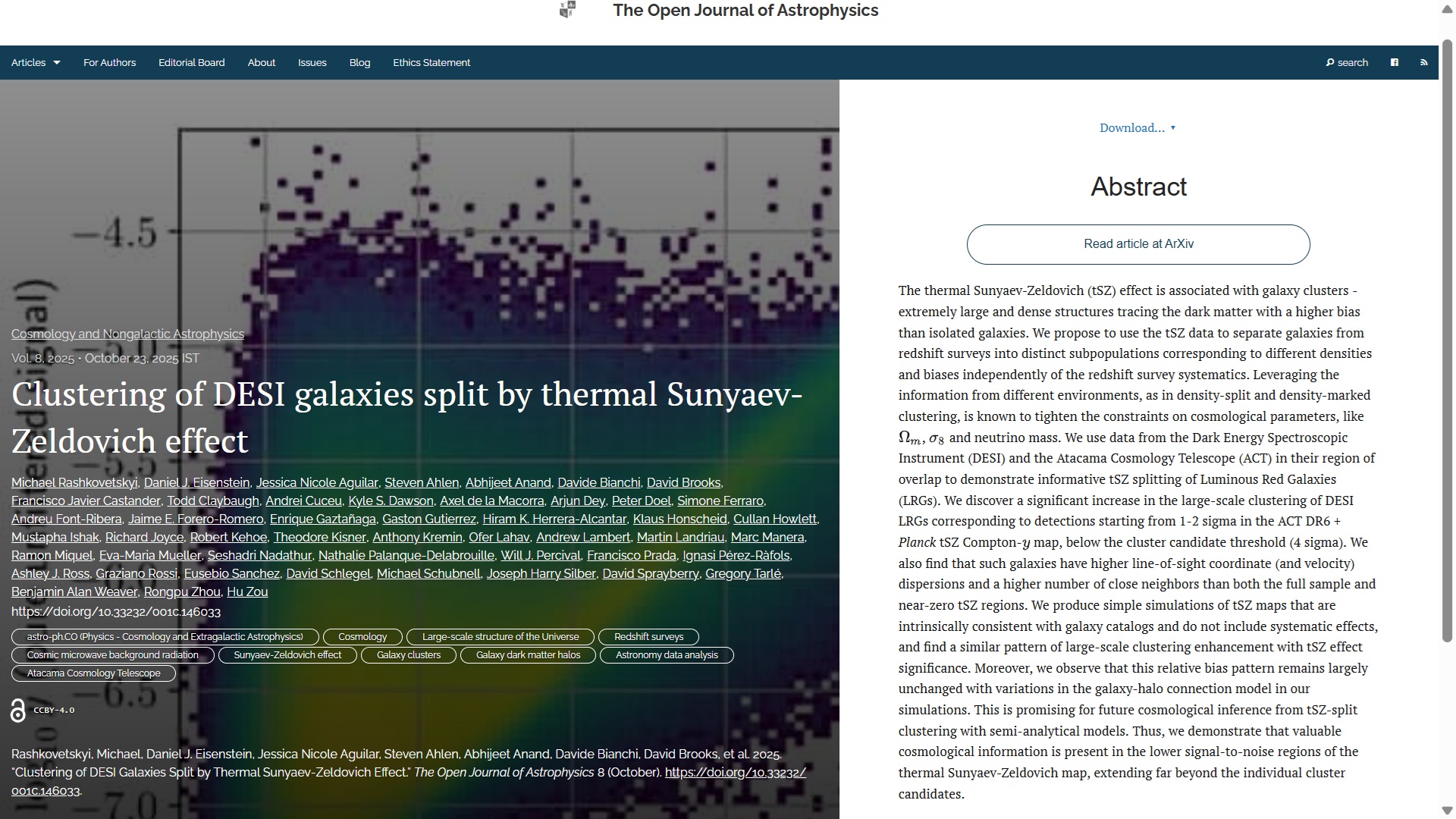
The fifth and final paper for this week is “Clustering of DESI galaxies split by thermal Sunyaev-Zeldovich effect” by Michael Rashkovetskyi of the Harvard-Smithsonian Center for Astrophysics, or CfA for short, and 48 others. This one was published on Wednesday 23rd October in the folder Cosmology and NonGalactic Astrophysics. This paper explores how the clustering properties of galaxies mapped by the Dark energy Spectroscopic Instrument (DESI) relate to the local thermal Sunyaev-Zeldovich emission mapped by the Atacama Cosmology Telescope (ACT). The overlay is here:
The officially accepted version can be found on arXiv here, and the fediverse announcement is here:

Open Journal of Astrophysics

New Publication at the Open Journal of Astrophysics: "Clustering of DESI galaxies split by thermal Sunyaev-Zeldovich effect" by Michael Rashkovetskyi (Cfa Harvard-Smithsonian, USA) et al. (49 authors)

doi.org/10.33232/001c.146033

October 23, 2025, 8:28 am 1 boosts 0 favorites


That concludes the papers for this week. With one week to go and our total at 396, I still think we might reach the 400 total by the end of October.

Results from the Atacama Cosmology Telescope

Posted in Cardiff, The Universe and Stuff with tags , , , , , , , on March 19, 2025 by telescoper

Today is going to be a very busy day on the cosmology front – with the Euclid Q1 Data Release coming out at 11am GMT – but I’ll start off by sharing news of final data release (DR6) by the Atacama Cosmology Telescope. This was announced yesterday and includes former colleagues at Cardiff University, so congratulations to them and all concerned. Here is a pretty picture showing one of the beautiful cosmic microwave background polarization and intensity maps:

Intensity and Polarization maps from ACT: arXiv:2503.14451

There are three related preprints on the arXiv today:

There’s a lot to digest in these papers but a quick skim of the abstracts gives two pertinent points. First, from the second paper:

We find that the ACT angular power spectra estimated over 10,000 deg2, and measured to arcminute scales in TT, TE and EE, are well fit by the sum of CMB and foregrounds, where the CMB spectra are described by the ΛCDM model. Combining ACT with larger-scale Planck data, the joint P-ACT dataset provides tight limits on the ingredients, expansion rate, and initial conditions of the universe.

They also find that, when combined with CMB lensing from ACT and Planck, and baryon acoustic oscillation data from the Dark Energy Spectroscopic Instrument (DESI Y1), the ACT data give a “low” value for the Hubble constant: H0=68.22 ± 0.36 km s-1 Mpc-1.

The third paper also says

In general, models introduced to increase the Hubble constant or to decrease the amplitude of density fluctuations inferred from the primary CMB are not favored by our data.

The “Hubble tension” remains!

New Results from the Atacama Cosmology Telescope

Posted in The Universe and Stuff with tags , , , , , , on April 12, 2023 by telescoper

I wish to draw your attention to a clutch of new papers out on the arXiv today (here, here and here) which describe latest results from the Atacama Cosmology Telescope (ACT for short). There was a webinar about this yesterday, which I failed to attend because I forgot about it.

The first of the papers listed above summarizes the key science results, which include a mass map obtained from gravitational lensing of the cosmic microwave background and its implications for cosmology.

As cosmic background photons propagate freely through space, i.e. without scattering, from the time of recombination to the observer, they are deflected by the gravitational effect of the large-scale distribution of matter in the Universe. This lensing effect leaves imprints in the temperature and polarization anisotropies, which can be used to reconstruct a map of the lensing potential, the gradient of which determines the lensing deflections. Structures in the CMB temperature pattern look bigger on the sky if we view them through an overdense clump of dark matter. By looking how the typical size of hot and cold spots in the CMB temperature map vary across the sky, it is possible to reconstruct the lensing deflections and hence the distribution of dark matter integrated along the line of sight. Since the structure through which the radiation passes is changing with time, this sort of map can provide constraints on models for the evolution of structure.

To cut a long story short, here is the map obtained using Data Release 6 of the ACT data over about 25% of the sky:

There’s a lot of information in the three papers but the key conclusion can be found in the last sentence of the abstract of the first paper:

Our results provide independent confirmation that the universe is spatially flat, conforms with general relativity, and is described remarkably well by the ΛCDM model, while paving a promising path for neutrino physics with gravitational lensing from upcoming ground-based CMB surveys.

Nothing revolutionary, then, but interesting nevertheless. There is an article on the BBC website about these results.