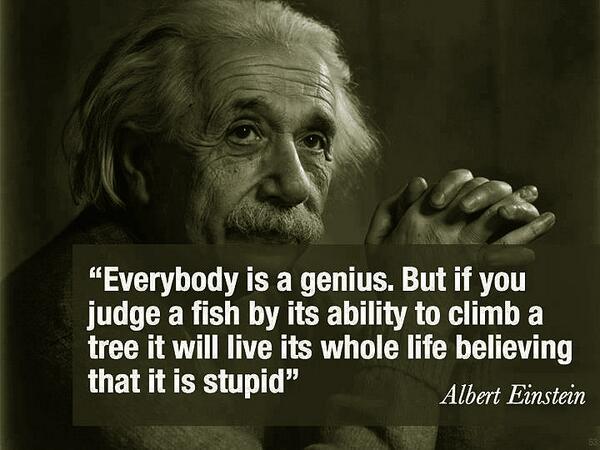
There are two interesting things about the above Einstein meme that has been doing the rounds. The first is that there’s absolutely no evidence that I can find that Albert Einstein ever said the words attributed to him; that’s also true for the vast majority of Einstein quotes, in fact.
The other interesting thing (and I risk being labelled a pedant here) is that there are species of fish, such as the Mangrove Rivulus, that really are able to climb trees…
You may recall that I gave a talk recently at a meeting called The Origins of the Expanding Universe in Flagstaff, Arizona. I put the slides up here. Well, the organizers have now put videos of the presentations online so you have the chance to see mine, warts and all.
I was relieved when I saw this on Youtube that the organizers were kind enough to edit out the embarrassing bit at the start when my laptop refused to talk to the data projector and I had to swap to another one. Sorting all that out seemed to take ages, which didn’t help my frame of mind and I was even more nervous than I would have been anyway given that this was my first public appearance after a rather difficult summer. Those are my excuses for what was, frankly, not a particularly good talk. But at least I survived. Better is the end of a thing than the beginning thereof.
For those of you interested in such things, here are the slides I used in my talk at the Origins of the Expanding Universe conference. I spoke about the events on and after 29th May 1919, when measurements were made during a total eclipse of the Sun that have gone down in history as vindicating Einstein’s (then) new general theory of relativity. I’ve written quite a lot about this in past years, including a little book and a slightly more technical paper. This was a relevant topic for the conference because it wasn’t until general theory of relativity was established as a viable theory of gravity that an explanation could be developed of Slipher’s measurements of galaxy redshifts in terms of an expanding Universe.
Taking refuge in my office this lunchtime for a sandwich and a cup of coffee I turned to the latest edition of Physics World and came across an funny little story about a physicist (who is completely new to me) with the splendid name of Fritz Hasenöhrl.
The news story relates to a paper on the arXiv, part of the abstract of which I’ve copied below:
In 1904 Austrian physicist Fritz Hasenohrl (1874-1915) examined blackbody radiation in a reflecting cavity. By calculating the work necessary to keep the cavity moving at a constant velocity against the radiation pressure he concluded that to a moving observer the energy of the radiation would appear to increase by an amount , which in early 1905 he corrected to …
Since I’ve been doing a bit of dimensional analysis with first-year students, I’m a bit surprised that the authors of this paper read so much into the fact that Hasenöhrl’s formula bears a superficial resemblance to Einstein’s most famous formula , probably the best known and at the same time worst understood equation in physics. In fact any physicist worth his or her salt no matter how incorrect their reasoning would have to get something like , with some dimensionless number, simply because the answer has to have the correct dimensions to be an energy.
Expressing energy in terms of the basic dimensions mass , length and time is probability easiest to do when you think of mechanical work (force×distance). Since Newton’s laws give a force equal to mass×acceleration, a force has dimensions , so work (a form of energy) has dimensions . Now try to make this out of a combination of a mass () and a velocity () and you’ll find that it has to be mass×velocity2. You can’t get the dimensionless constant this way, but the combination of and must be the way it is in Einstein’s formula.
Anyway, all this suddenly reminded me of a day long ago when I appeared on peak-time television in the consumer affairs programme Watchdog, explaining – or, rather, attempting to explain – the physics behind the way gas bills are calculated. Apparently someone had written in to the programme asking why it was that they weren’t just being charged for the volume of gas that had flowed through their meter, but that the cost involved a complicated calculation involving something called the calorific value of the gas.
The answer is fairly obvious, actually. The idea is that to make competition fairer between different forms of energy (particularly gas and electricity) the bills should be for the amount of energy you have used rather than the amount of gas. Since the source of fuel varies from day to day so does its chemical composition and hence the amount of energy that can be extracted from it when it is burned. Gas companies therefore monitor the calorific value, using it to convert the amount of gas you have used into an amount of energy.
On the programme I was confronted by the curmudgeonly Edward Enfield (father of comedian Harry Enfield) who took the line that it was all unnecessarily complicated and that the bill should just be for the amount of gas used, rather in the same way that petrol is sold. When I tried to explain that the way it was done was really fairer, because it was really the energy that mattered, it quickly became obvious that he didn’t really understand what energy was or how it was defined. He didn’t even get the difference between energy and power. I suspect that goes for many members of the general public.
It was all a bit tongue-in-cheek, but I enjoyed the sparring. Eventually he came out with a question about why energy was given by rather than or something else. So I launched into an explanation of dimensional analysis and why couldn’t be an energy because it has the wrong dimensions. His eyes glazed over. The shoot ended. My splendidly erudite and logically rigorous exposition of dimensional analysis never made it into the broadcast programme.
In the course of linking my previous post to Richard Feynman’s wikipedia page, I happened upon an interesting fact:
Feynman (in common with the famous physicists Edward Teller and Albert Einstein) was a late talker; by his third birthday he had yet to utter a single word.
I therefore have something in common with these famous physicists. I didn’t learn to speak until I was well past my third birthday, as my mum never tires of reminding me. In fact, as I have blogged about before, I was a very slow developer in other ways and when I started school was immediately earmarked as an educational basket case.
Which is obviously where the similarity between me and these chaps ends, as I certainly don’t have “exceptional and innate analytical prowess”. I am however intrigued by the fact that I at least shared their failure to develop language abilities on the same timescale as “normal” infants. I don’t know very much at all about this field, even to the extent of not knowing at what age most children learn to talk…
So here’s a couple of questions for my readers out there in blogoland. Were any of you late talkers? And how unusual is it for a child not to speak until they’re three years old?
In 1905 Albert Einstein had his “year of miracles” in which he published three papers that changed the course of physics. One of these is extremely famous: the paper that presented the special theory of relativity. The second was a paper on the photoelectric effect that led to the development of quantum theory. The third paper is not at all so well known. It was about the theory of Brownian motion. In fact, Einstein spent an enormous amount of time and energy working on problems in statistical physics, something that isn’t so well appreciated these days as his work on the more glamorous topics of relativity and quantum theory.
Brownian motion, named after the botanist Robert Brown, is the perpetual jittering observed when small particles such as pollen grains are immersed in a fluid. It is now well known that these motions are caused by the constant bombardment of the grain by the fluid molecules. The molecules are too small to be seen directly, but their presence can be inferred from the visible effect on the much larger grain.
Brownian motion can be observed whenever any relatively massive particles (perhaps large molecules) are immersed in a fluid comprising lighter particles. Here is a little video showing the Brownian motion observed by viewing smoke under a microscope. There is a small coherent “drift” motion in this example but superimposed on that you can clearly see the effect of gas atoms bombarding the (reddish) smoke particles:
The mathematical modelling of this process was pioneered by Einstein (and also Smoluchowski), but has now become a very sophisticated field of mathematics in its own right. I don’t want to go into too much detail about the modern approach for fear of getting far too technical, so I will concentrate on the original idea.
Einstein took the view that Brownian motion could be explained in terms of a type of stochastic process called a “random walk” (or sometimes “random flight”). I think the first person to construct a mathematical model to describethis type of phenomenon was the statistician Karl Pearson. The problem he posed concerned the famous drunkard’s walk. A man starts from the origin and takes a step of length L in a random direction. After this step he turns through a random angle and takes another step of length L. He repeats this process n times. What is the probability distribution for R, his total distance from the origin after these n steps? Pearson didn’t actually solve this problem, but posed it in a letter to Nature in 1905. Only a week later, a reply from Lord Rayleigh was published in the same journal. He hadn’t worked it all out, written it up and sent it within a week though. It turns out that Rayleigh had solved essentially the same problem in a different context way back in 1880 so he had the answer readily available when he saw Pearson’s letter.
Pearson’s problem is a restricted case of a random walk, with each step having the same length. The more general case allows for a distribution of step lengths as well as random directions. To give a nice example for which virtually everything is known in a statistical sense, consider the case where each component of the step, i.e. x and y, are independent Gaussian variables, which have zero mean so that there is no preferred direction:
A similar expression holds for p(y). Now we can think of the entire random walk as being two independent walks in x and y. After n steps the total displacement in x, say, xn is given by
and again there is a similar expression for the distribution of yn . Notice that each of these distribution has a mean value of zero. On average, meaning on average over the entire probability distribution of realizations of the walk, the drunkard doesn’t go anywhere. In each individual walk he certainly does go somewhere, of course, but he is equally likely to move in any direction the probabilistic mean has to be zero. The total net displacement from the origin, rn , is just given by Pythagoras’ theorem:
from which it is quite easy to establish that the probability distribution has to be
This is called the Rayleigh distribution, and this kind of process is called a Rayleigh “flight”. The mean value of the displacement is just σ√n. By virtue of the ubiquitous central limit theorem, this result also holds in the original case discussed by Pearson in the limit of very large n. So this gives another example of the useful rule-of-thumb that quantities arising from fluctuations among n entities generally give a result that depends on the square root of n.
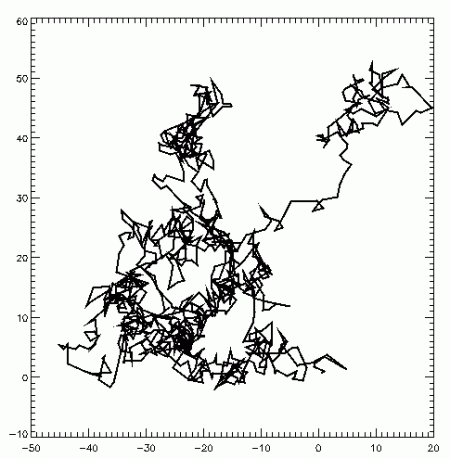
The figure below shows a simulation of a Rayleigh random walk. It is quite a good model for the jiggling motion executed by a Brownian particle.
The step size resulting from a collision of a Brownian particle with a molecule depends on the mass of the molecule and of the particle itself. A heavier particle will be relatively unaffected by each bash and thus take longer to diffuse than a lighter particle. Here is a nice video showing three-dimensional simulations of the diffusion of sugar molecules (left) and proteins (right) that demonstrates this effect.
Of course not even the most inebriated boozer will execute a truly random walk. One would expect each step direction to have at least some memory of the previous one. This gives rise to the idea of a correlated random walk. Such objects can be used to mimic the behaviour of geometric objects that possess some stiffness in their joints, such as proteins or other long molecules. Nowadays theory of Brownian motion and related stochastic phenomena is now considerably more sophisticated than the simply random flight models I have discussed here. The more general formalism can be used to understand many situations involving phenomena such as diffusion and percolation, not to mention gambling games and the stock market. The ability of these intrinsically “random” processes to yield surprisingly rich patterns is, to me, one of their most fascinating aspects. It takes only a little tweak to create order from chaos.
I’ve just finished reading The Life of Charles Ives by Stuart Feder, which I bought some time ago with my Cambridge University Press author discount and I’ve had on my shelves without getting around to read it until this week. It’s a very interesting and informative biography of one of the strangest but most fascinating composers in the history of classical music.
Charles Ives was by any standards a daring musical innovator. Some of his compositions involve atonal structures and some involve different parts of the orchestra playing in different time signatures. He also wrote strange and wonderful piano pieces, including some which involved re-tuning the piano to obtain scales involving quarter-tones. Among this maelstrom of modern ideas he also liked to add quotations from folk songs and old hymns which gives his work a paradoxically nostalgic tinge.
His pieces are often extremely diffficult to play (so I’m told) and sometimes not that easy to listen to, but while he’s often perplexing he can also be exhilarating and very moving. Other composers might play off two musical ideas against each other, but Ives would smash them together and to hell with the dissonance. I think the wholeheartedness of his eccentricity is wonderful, but I know that some people think he was just a nut.. You’ll have to make your own mind up on that.
My favourite quote of his can be found scrawled on a hand-written score which he sent to his copyist:
“Please don’t try to make things nice! All the wrong notes are right. Just copy as I have – I want it that way.”
But the point of adding this post to my blog was that in the course of reading the biography, it struck me that there is a strange parallel between the life of this controversial and not-too-well known composer and that of Albert Einstein who is certainly better known, especially to people reading what purports to be a physics blog.
For one thing their lifespans coincide pretty closely. Charles Ives was born in 1874 and died in 1954; Albert Einstein lived from 1879 to 1955. Of course the one was born in America and the latter in Germany. One inhabited the world of music and the other science; Ives, in fact, made his living in the insurance business and only composed in his spare time while Einstein spent most of his career in academia, after a brief period working in a patent office. Not everything Ives wrote was published professionally and he also rewrote things extensively, so it is difficult to establish exact dates for things especially for a non-expert like me. In any case I don’t want to push things too far and try to argue that some spooky zeitgeist acted at a distance to summon the ideas from each of them in his own sphere. I just think it is curious to observe how similar their world lines were, at least in some respects.
We all know that Einstein’s “year of miracles” was 1905, during which he published classic papers on special relativity, brownian motion and the photoelectric effect. What was arguably Ives’ greatest composition, The Unanswered Question, was completed in 1906 (although it was revised later). This piece is subtitled “A Cosmic Landscape” and it’s a sort of meditation on the philosophical problem of existence: the muted strings (which are often positioned offstage in concert performances) symbolize silence while the solo trumpet evokes the individual struggling to find meaning within the void. Here’s a fine performance of this work recorded at La Scalain Milan, in which the strings are onstage while the trumpet is in the audience. I love the way that at the end nobody seems to know if they have finished!
The Unanswered Question is probably Ives’ greatest masterpiece, but it wasn’t the only work he composed in 1906. A companion piece called Central Park in the Dark also dates from that year and they are sometimes performed together as a kind of diptych which offers interesting contrasts. While the former is static and rather abstract, the latter is dynamic and programmatic (in that it includes realistic evocations of night-time sounds).
Einstein’s next great triumph was his General Theory of Relativity in 1915, an extension of the special theory to include gravity and accelerated motion, which which came only after years of hard work learning the required difficult mathematics. Ives too was hard at work for the next decade which resulted in other high points, although they didn’t make him a household name like Einstein. The Fourth Symphony is an extraordinary work which even the best orchestras find extremely difficult to perform. Even better in my view is Three Places in New England (completed in 1914) , which contains my own favourite bit of Ives. The last movement, The Housatonic at Stockbridge is very typical of his unique approach, with a beautifully paraphrased hymn tune floating over the top of complex meandering string figures until the piece ends in a tumultuous crescendo.
After this period, both Einstein and Ives carried on working in their respective domains, and even with similar preoccupations. Einstein was in search of a unified field theory that could unite gravity with the other forces of nature, although the approach led him away from the mainstream of conventional physics research and his later years he became an increasingly marginal figure.
By about 1920 Ives had written five full symphonies (four numbered ones and one called the Holidays Symphony) but his ambition beyond these was perhaps just as grandiose as Einstein’s: to create a so-called “Universe Symphony” which he described (in typically bewildering fashion) as
“A striving to present – to contemplate in tones rather than in music as such, that is – not exactly within the general term or meaning as it is so understood – to paint the creation, the mysterious beginnings of all things, known through God to man, to trace with tonal imprints the vastness, the spiritual eternities, from the great unknown to the great unknown.”
I guess such an ambitious project – to create an entirely new language of “tones” that could give expression to timeless eternity, a kind of musical theory of everything – was doomed to failure. Although Ives was an experienced symphonic composer he couldn’t find a way to realise his vision. Only fragments of the Universe Symphony remain (although various attempts have been made by others to complete it).
In fact, the end of Ives’ creative career was much more sudden and final than Einstein who, although he never again reached the heights he had scaled in 1915 – who could? – remained a productive and respected scientist until his death. Ives had a somewhat melancholic disposition and from time to time suffered from depression. By 1918 he already felt that his creative flame was faltering, but by 1926 the spark was extinguished completely. His wife, appropriately named Harmony, remembered the precise day when this happened at their townhouse in New York:
“He came downstairs one day with tears in his eyes, and said he couldn’t seem to compose anymore – nothing went well, nothing sounded right.”
Although Charles Ives lived almost another thirty years he never composed another piece of music after that day in 1926. I find that unbearably sad, but at least a lot of his work is available and now fairly widely played. Alongside the pieces I have mentioned, there are literally hundreds of songs, some of which are exceptionally beautiful, and dozens of smaller works including piano and violin sonatas.
Although they both lived in the same part of America for many years, I don’t think Charles Ives and Albert Einstein ever met. I wonder what they would have made of each other if they had?
If you believe in the multiverse, of course, then there is a part of it in which they do meet. Einstein was an enthusiastic violinist so there will even be a parallel world in which Einstein is playing the Ives’ Violin Sonata on Youtube.
The views presented here are personal and not necessarily those of my employer (or anyone else for that matter).
Feel free to comment on any of the posts on this blog but comments may be moderated; anonymous comments and any considered by me to be vexatious and/or abusive and/or defamatory will not be accepted. I do not necessarily endorse, support, sanction, encourage, verify or agree with the opinions or statements of any information or other content in the comments on this site and do not in any way guarantee their accuracy or reliability.
 , which in early 1905 he corrected to
  …
… , probably the best known and at the same time worst understood equation in physics. In fact any physicist worth his or her salt no matter how incorrect their reasoning would have to get something like
  , with
  some dimensionless number, simply because the answer has to have the correct dimensions to be an energy.
 , length
  and time
  is probability easiest to do when you think of mechanical work (force×distance). Since Newton’s laws give a force equal to mass×acceleration, a force has dimensions
  , so work (a form of energy) has dimensions
  . Now try to make this out of a combination of a mass (
 ) and you’ll find that it has to be mass×velocity2. You can’t get the dimensionless constant this way, but the combination of
  and
and  must be the way it is in Einstein’s formula.
 or something else. So I launched into an explanation of dimensional analysis and why




 In the Dark