Only time for a short post today, but I think this may turn out to be an important result. There’s a paper by Morishima et al. on the arXiv with the rather dry title Post-Newtonian effects of Dirac particle in curved spacetime – III : the muon g-2 in the Earth’s gravity, which suggests that the anomalous magnetic dipole moment of the muon.
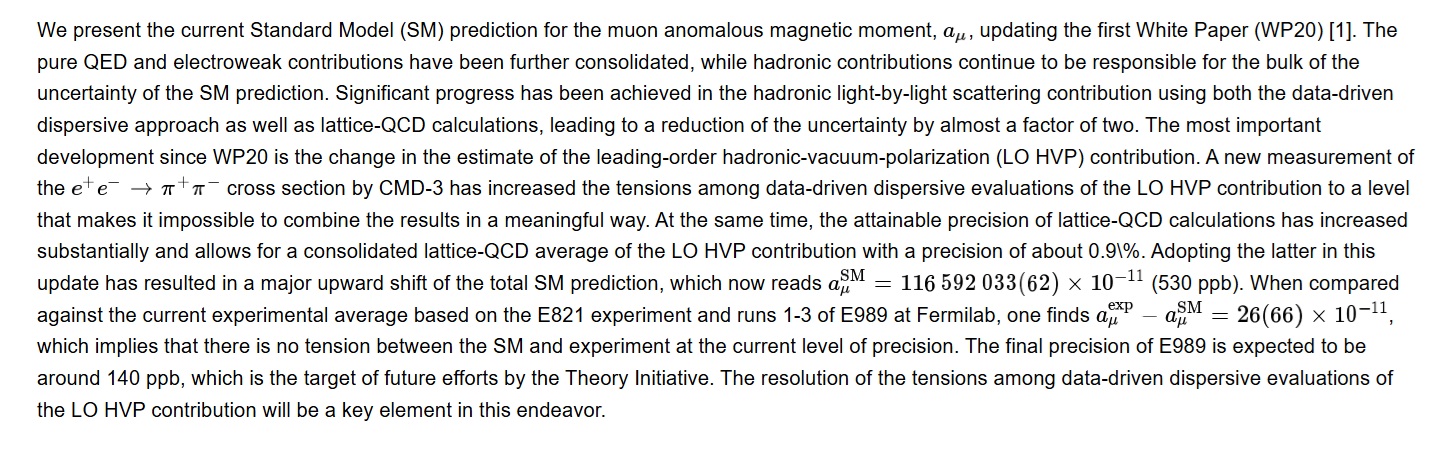
Here is the abstract of the paper. You can click on it to make it bigger.

In a nutshell the anomaly is that according to basic relativistic quantum theory in the form of the Dirac equation, the muon (and any other charged spin-1/2 fermion) should have a magnetic dipole moment μ of magnitude (given in terms of its mass m and fundamental constants) by μ=geħ/4m with the g-factor g=2 for Dirac fermions. The anomaly is that this can be measured and it appears that g differs from zero by a small but significant amount, i.e. (g-2) is not zero. It has been widely suggested that this discrepancy suggests the existence of physics beyond the Standard Model of Partlce Physics. Well, gravity is not included in the Standard Model so I suppose this could still be right, but the it this calculation may well disappoint those who were hoping that (g-2) might provide evidence for, e.g., supersymmetry when it looks like it might be something rather more mundane, ie the Earth’s gravity!
UPDATE: It appears there is an error in the paper; see here. You may stand down.
UPDATE: Well, that was pretty fast. There’s now a paper on the arXiv by Matt Visser that gives a detailed refutation of the above claim. Here is the abstract:
In three very recent papers, (an initial paper by Morishima and Futamase, and two subsequent papers by Morishima, Futamase, and Shimizu), it has been argued that the observed experimental anomaly in the anomalous magnetic moment of the muon might be explained using general relativity. It is my melancholy duty to report that these articles are fundamentally flawed in that they fail to correctly implement the Einstein equivalence principle of general relativity. Insofar as one accepts the underlying logic behind these calculations (and so rejects general relativity) the claimed effect due to the Earth’s gravity will be swamped by the effect due to Sun (by a factor of fifteen), and by the effect due to the Galaxy (by a factor of two thousand). In contrast, insofar as one accepts general relativity, then the claimed effect will be suppressed by an extra factor of [(size of laboratory)/(radius of Earth)]^2. Either way, the claimed effect is not compatible with explaining the observed experimental anomaly in the anomalous magnetic moment of the muon.
That’s how science goes!


 In the Dark