Archive for APC

Like a Million Pounds…

Posted in Biographical, Open Access with tags , , , , , , , on December 4, 2025 by telescoper

I’ve come down with some sort of lurgy and had to cancel a tutorial that was due to take place today, which I am sorry about. I did, however, manage to rise from my sick bed earlier this morning to publish a paper at the Open Journal of Astrophysics. When I checked the publishing dashboard I saw that this one is paper No. 425. This is a significant figure if you reckon by the cost of an Article Processing Charge (APC) at Monthly Notices of the Royal Astronomical Society. The current APC is £2356 per paper. If you multiply this by 425 the result is just over a million pounds (£1,001,300 to be exact). The Open Journal of Astrophysics, being a Diamond Open Access journal, is totally free for authors.

I mentioned a couple of weeks ago, that this is a small fraction of the money being wasted by the astronomical community worldwide on publication charges but if even a small operation like ours can save a million pounds, just think of what could happen if we all published this way! For one thing, there would certainly be more money available for actual research. That doesn’t only go for astronomy, of course: almost every scientific discipline is being ripped off by publishers who have hijacked the Open Access movement to generate income from APCs.

I’ll repeat the quotation I posted yesterday about a scandal relating to corporate publishing giant Elsevier

The scandal exposes the windfall profits of scientific publishers, who in recent years have amassed billions of dollars in earnings from public funds earmarked for science.

It’s a shocking idea, I know, but what if we spent public funds on what they are supposed to be spent on rather than handing millions to greedy publishers?

Money and Open Access

Posted in Open Access with tags , , , , , , , on November 24, 2025 by telescoper

I was thinking when I did Saturday’s update of the week’s new papers at the Open Journal of Astrophysics that I should convey some idea of the amount of money being saved by using Diamond Open Access.

So far this year we have published 181 articles in the Open Journal of Astrophysics. That’s a very small fraction – a few percent – of the output of the established journals in the area, Astrophysical Journal, Astronomy & Astrophysics and Monthly Notices of the Royal Astronomical Society, MNRAS.

I will take MNRAS as an example for comparison. Last time I looked, the Article Processing Charge (APC) (i.e. publication fee) for a paper submitted there is £2356. Our 181 papers published this year would have cost their authors £426,436 had they had to pay the MNRAS APC. Some – especially in the UK – do not pay directly, but have an equivalent amount taken from their institution(s) via Read-and-Publish agreements. The charge therefore does not come directly from the authors’ funds but from their institution, but that is just splitting hairs. The point about OJAp is that neither authors nor their institutions have to pay.

For comparison, a year’s stipend for a PhD student outside London at UKRI rates is £20,780. That means that the total amount saved by publishing in OJAp rather than MNRAS (£426,436) would be more than the cost of 20 PhD students. It might even be enough (just) to pay your Vice-Chancellor’s salary…

You might well think that is a trivial amount of money compared to the total circulating in science funding, but the real point is that it represents only a tiny fraction of the money being siphoned off from astrophysics research into other activities. Taking all the APCs paid (or page charges or other words that mean “publication fee”) to all the journals, the total figure is probably at least 50 times the £426,436 obtained above. That would be a figure in excess of £20 million. That is not a trivial amount of money. Even for a Vice-Chancellor.

Wouldn’t you and your institution rather keep your grant funds to spend on research than hand it over – directly or indirectly – to publishers? I know I would!

Our Million-Dollar Journal!

Posted in Open Access with tags , , , , on August 25, 2025 by telescoper

The Article Processing Charge (APC) for publishing a paper in Monthly Notices of the Royal Astronomical Society (MNRAS) is now £2356. Converting that to dollars at current rates gives about $3150 per paper.

As of today, 25th August 2025, the Open Journal of Astrophysics has published 359 articles.

Using the dollar cost of an MNRAS APC as a benchmark – many journals charge more – this means that we have now saved the global astrophysics community about $1.1M (for an outlay of around $10K).

Yes, we are still a small journal but the size of that figure should help you understand how much money is being wasted globally on publishing fees that could instead be spent on actual research.

It’s good to see that more and more researchers are seeing the light and switching to Diamond Open Access. Today we published the 124th article in Volume 8 (2025) of the Open Journal of Astrophysics. This means that we have so far in 2025 published more papers than we published in the whole of 2024. At the end of August we will be about two-thirds of the way through the year so I expect we will publish more than 180 articles this year.

I’d like to take this opportunity to thank everyone involved in running this journal: the Editors, staff at Maynooth University Library who help us, the host of volunteer referees, and of course our authors. I’m confident that, together, we can change the publishing landscape in astrophysics, and put the power (and money) back in the hands of researchers instead of greedy publishers.

This is a slightly-edited version of a post I made last week for the Open Journal of Astrophysics blog.

Counting the Cost of Gold Open Access

Posted in Open Access with tags , , , , , , , , , on July 10, 2024 by telescoper

If you’re interested in how Article Processing Charges (APCs) have changed over the past five years, the data from six major publishers are now available accompanied by a paper on the arXiv with the abstract:

This paper introduces a dataset of article processing charges (APCs) produced from the price lists of six large scholarly publishers – Elsevier, Frontiers, PLOS, MDPI, Springer Nature and Wiley – between 2019 and 2023. APC price lists were downloaded from publisher websites each year as well as via Wayback Machine snapshots to retrieve fees per journal per year. The dataset includes journal metadata, APC collection method, and annual APC price list information in several currencies (USD, EUR, GBP, CHF, JPY, CAD) for 8,712 unique journals and 36,618 journal-year combinations. The dataset was generated to allow for more precise analysis of APCs and can support library collection development and scientometric analysis estimating APCs paid in gold and hybrid OA journals.

There’s even an interactive data explorer here, at which link you can also find this very informative summary graphic:

Surprise, surprise: the vast majority have gone up!

These figures apply to Gold and Hybrid Open Access publications, but not to Diamond Open Access journals which are free to both authors and readers and avoid these rip-off charges. In my opinion research institutions would be much better off investing in Diamond Open Access publishing than sending their hard-earned cash to profiteering outfits such as Elsevier.

Academic Publishing: Never Mind the Quality…

Posted in Open Access with tags , , , , , , , , on March 16, 2024 by telescoper

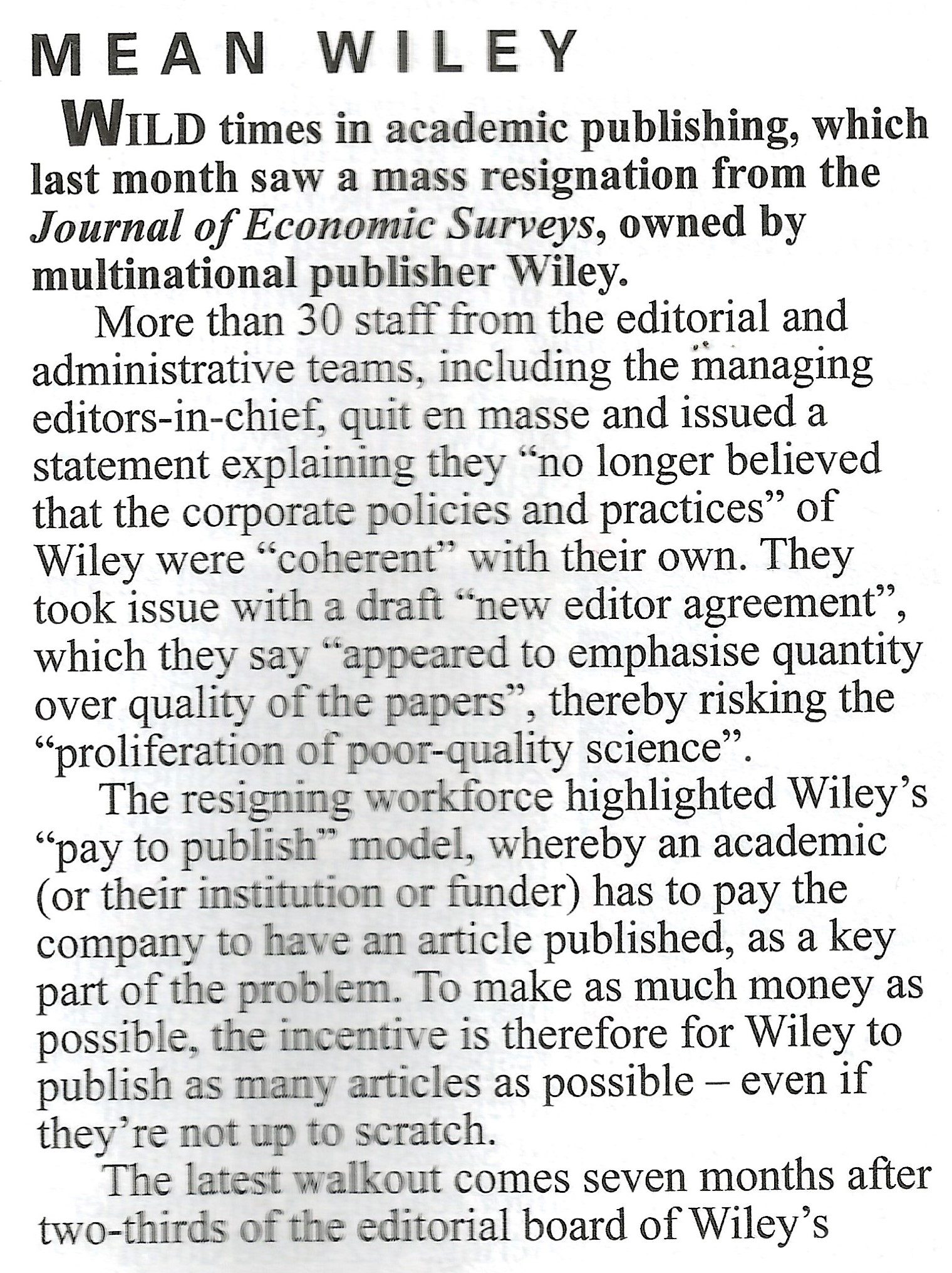
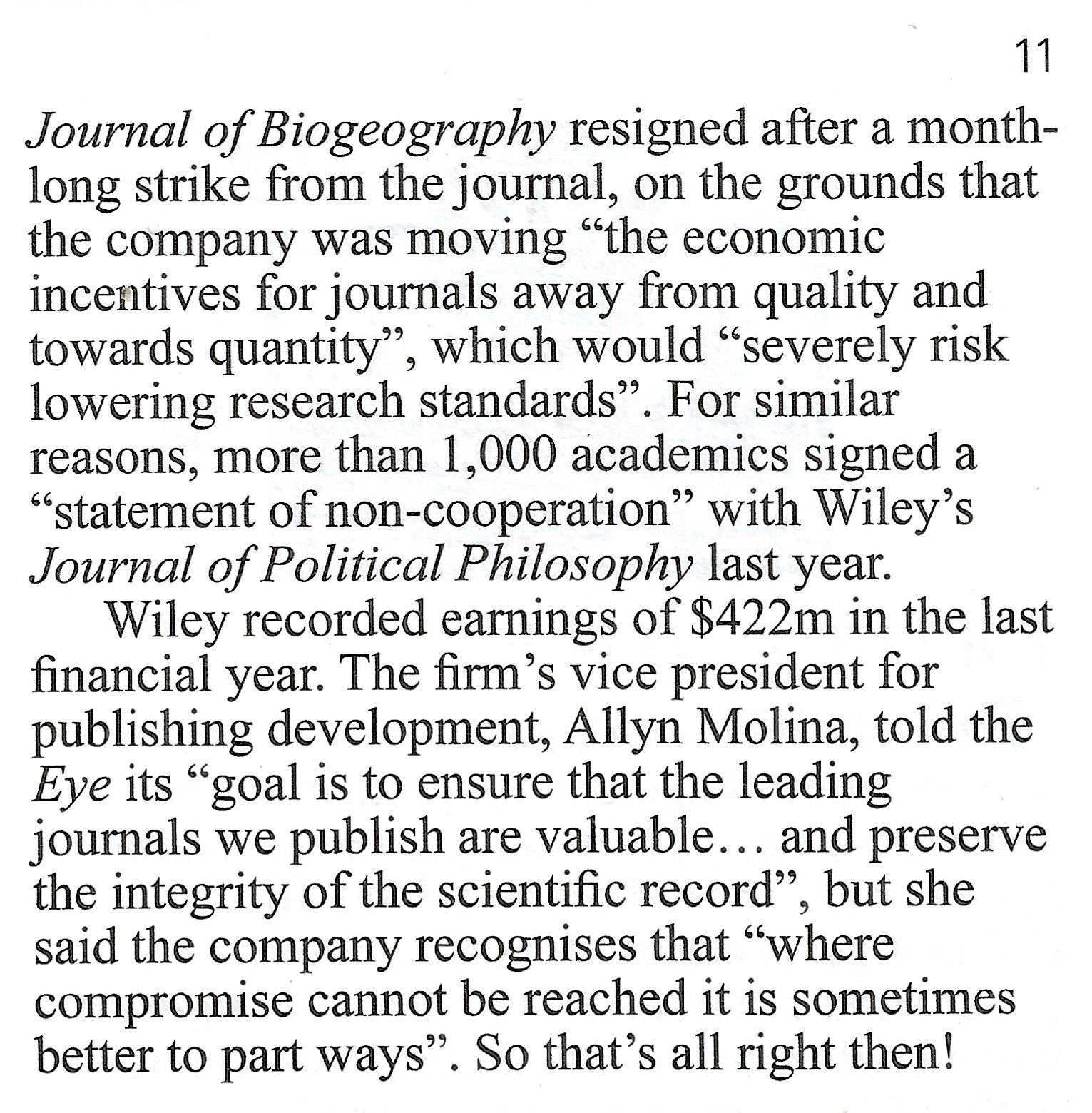
I was interested to see that the latest issue of Private Eye contains a short item about academic publishing:

I’ve heard many stories of this type, with publishers putting pressure on their Editorial Boards to allow more papers to be published. This is undoubtedly motivated by the Gold Open Access model in which authors or their institutions are forced to pay thousands of dollars upfront to publish papers. Since the publisher makes an eye-watering profit on every article, why not publish as many as possible? The recent decision by the Royal Astronomical Society adopt this model is highly likely to have a similar effect there, as its journals will be able to increase revenue at the expense of quality. Under the older subscription-based system, publishers could sell their product to libraries on the basis of quality but they no longer need to do that to make a profit.

The academic publishing industry is perverse enough without adding this obvious incentive to lower editorial standards. There are far too many low quality papers being published already, a situation driven not only by the profiteering of the publishing industry but also by the absurd policies of academia itself which require researchers to churn out huge numbers of papers to get promotion, win research grants, etc.

This part of the academic system is definitely broken. To fix it, academic publishing must be taken out of the hands of commercial publishers and put into the care of research institutions whose libraries are perfectly capable of publishing and curating articles on a non-profit basis. But that won’t be enough: we need also to overhaul how we do research assessment. The principles outlined in the San Francisco Declaration on Research Assessment would be a start.

Progress on Open Access?

Posted in Open Access with tags , , , , , , , on April 27, 2023 by telescoper

The current state of play with regard to Open Access publishing is very disappointing. The academic publishing industry seems to have persuaded the powers that be to allow them to charge exorbitant article processing charges (APCs) to replace revenues lost from subscriptions when they publish a paper free to readers. This simply transfers the cost from reader to author, and excludes those authors who can’t afford to pay.

This current system of ‘Gold’ Open Access is a scam, and it’s a terrible shame we have ended up having it foisted upon us. Fortunately, being forced to pay APCs of many thousands of euros to publish their papers, researchers are at last starting to realize that they are being ripped off. Recently, the entire Editorial Board of Neuroimage and its sister journal Neuroimage: Reports resigned in protest at the `extreme’ APC levels imposed by the publisher, Elsevier. I’m sure other academics will follow this example, as it becomes more and more obvious that the current arrangements are unsustainable. Previously the profits of the big publishers were hidden in library budgets. Now they are hitting researchers and their grants directly, as authors now have to pay, and people who previously hadn’t thought much about the absurdity of it all are now realizing what a racket academic publishing really is.

The people at the top have been slow to grasp this reality, but there are signs that this is at last happening, In the USA there has been the Nelson Memorandum (see discussion here). Now there is movement in the European Union, with member states apparently set on agreeing a  text to be published next month (May 2023) that calls for immediate open access the default, with no author fees. This is clearly how Open Access should be, though I am still worried that the sizeable publishing lobby will try to persuade research agencies and institutions to pay the existing fees on behalf of authors, which does not solve the problem but merely hides it.

I know I’m not alone in thinking that the current publishing ecosystem is doomed and will die a natural death soon enough. The replacement should be a worldwide network of institutional and/or subject-based repositories that share research literature freely for the common good. Universities and research centres should simply bypass the grotesque parasite that is the publishing industry. Indeed, I would be in favour of hastening the demise of the Academic Journal Racket by having institutions make it a disciplinary offence for any researcher to pay an APC.

We are lucky in physics and astronomy because arXiv has already done the hard work for us. Indeed, it is now a truth universally acknowledged* that every new research paper worth reading in these disciplines can be found on arXiv. Old-style journals are no longer necessary. It is great that arXiv is being joined by similar ventures in other fields, such as BiorXiv and EarthArxiv. A list of existing repositories can be found here. I’m sure many more will follow. What is needed is a global effort to link these repositories to each other and to peer review mechanisms. One way is through overlays as demonstrated by the Open Journal of Astrophysics, there being no reason why the idea can’t be extended beyond arXiv. Other routes are possible, of course, and I would love to see different models developed. I think the next few years are going to be very exciting.

*It is also a truth universally acknowledged that anyone who doesn’t understand the reference to “a truth university acknowledged” has not read Pride and Prejudice by Jane Austen…

Thoughts on `Plan S’, `cOAlition S’ and Open Access Publishing

Posted in Open Access with tags , , , , , , on September 22, 2018 by telescoper

Those of you who have been following my recent updates on progress with The Open Journal of Astrophysics may be interested to hear about `Plan S’, which is a proposal by 11 European Nations to give the public free access to publicly funded science. The 11 countries involved in this initiative are: France, Italy, Austria, Ireland, Luxembourg, the Netherlands, Norway, Poland, Slovenia, Sweden, and the UK. Since the plan will not come into effect until 1st January 2020, which is after the UK leaves the EU it is by no means clear whether the UK will actually be involved in ERC initiatives after that. Norway is not in the EU but is associated to the ERC. It is unlikely that the UK will have a similar status after Brexit.

Anyway, these 11 countries have formed `cOAlition S’ – the `OA’ is for `Open Access’ – to carry out the plan, which can be found here.

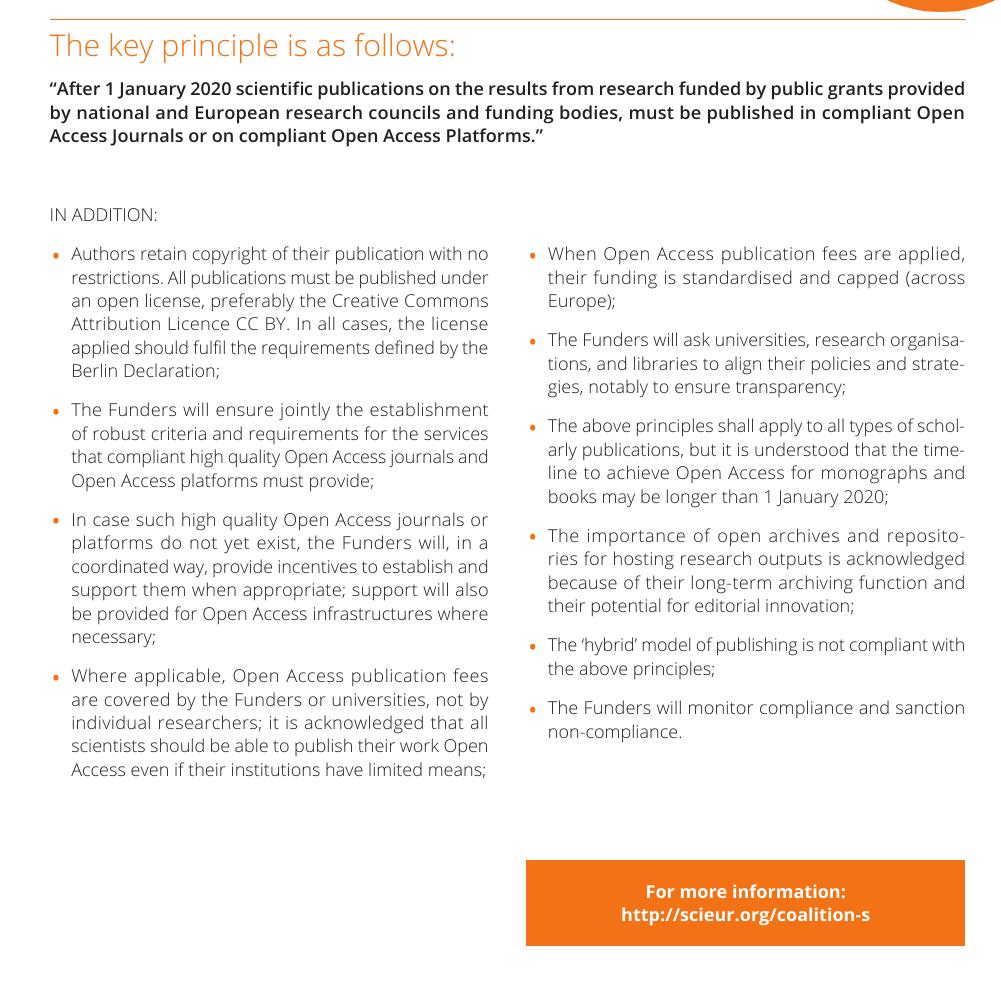
Here is a summary:

You can read more about it here. I have not yet looked at the details of what will be regarded as `compliant’ in terms of Open Access but if the the Open Journal of Astrophysics is not fully compliant as it stands, I expect it can be made so (although we are a genuinely international journal not limited to the 11 countries involved in Plan S).

Anyway, although I support Plan S in general terms what I sincerely hope will not happen with this initiative is that researchers and their institutions get mugged into paying an extortionate `Gold’ Open Access Article Processing Charge (APC) which is simply a means for the academic publishing industry to maintain its inflated profit margins at the expense of actual research. The Open Journal of Astrophysics is Green rather than Gold. In fact the cost of maintaining and running the platform is about $1000 per annum, and the marginal cost for processing each paper is $10 or actually $11 if you count registering published articles with CrossRef (though we do not incur that cost if the article is rejected). In effect running the entire journal costs less than a typical APC for Gold Open Access for one physics paper. Those costs will be born by my institution, Maynooth University. The UK was conned into going down this route some years ago by the publishing lobby, and I hope the other cOAlition S partners do not fall for the same scam.