I wasn’t planning to do another update this week but I thought it would be best to complete the publications for 2025 at the Open Journal of Astrophysics, so that I don’t have to do a bigger update in the new year, and I have a bit of time this morning, so here we go.
Since the last update we have published four papers which brings the number in Volume 8 (2025) up to 201. Adding the 12 papers in the Supplement, this brings the final total for the year up to 213, and the total so far published by OJAp up to 448. In 2023 we published just 50 papers, so we have more than quadrupled in two years.
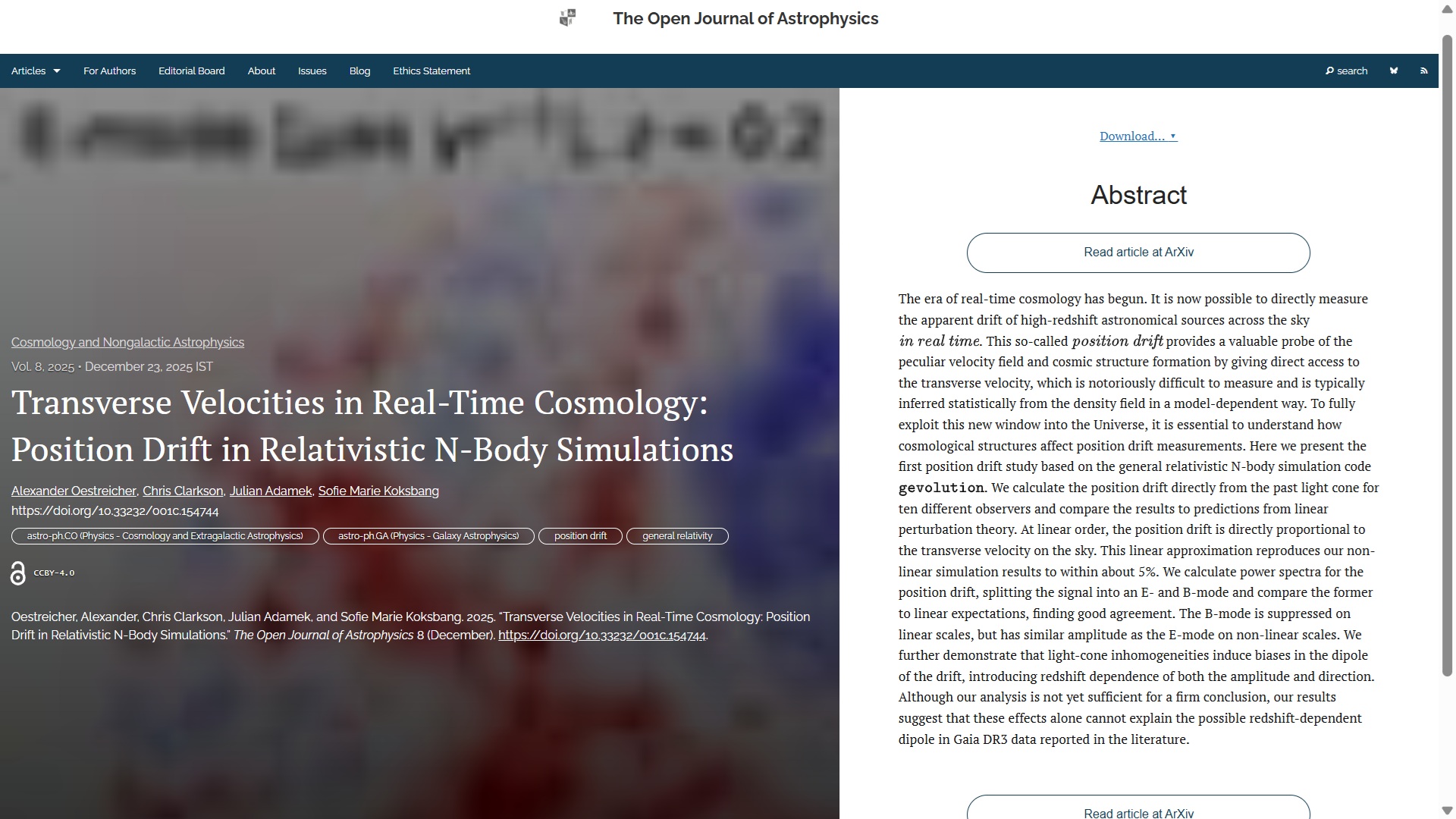
The first paper this week is “Transverse Velocities in Real-Time Cosmology: Position Drift in Relativistic N-Body Simulations” by Alexander Oestreicher (University of Southern Denmark), Chris Clarkson (QMUL, UK), Julian Adamek (Universität Zürich, CH) and Sofie Marie Koksbang (U. Southern Denmark). This study uses a general relativistic N-body simulation code to explore how cosmological structures affect position drift measurements, a new method for studying cosmic structure formation and velocity fields. This was published on Tuesday 23rd December 2025 in the folder Cosmology and Nongalactic Astrophysics.
The overlay is here:
You can find the officially accepted version on arXiv here and this is the announcement on Mastodon (Fediscience):

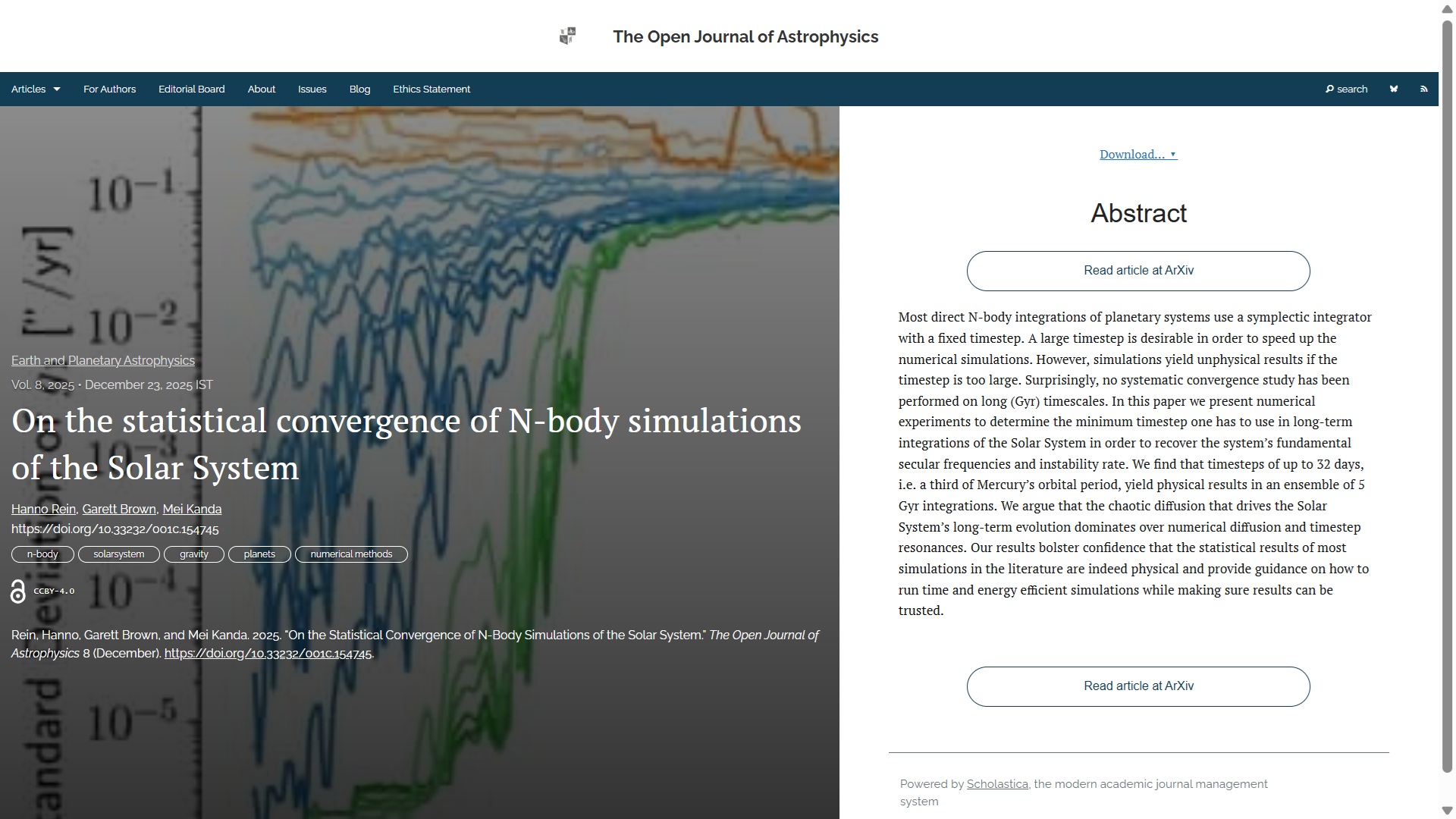
The second paper of the week is “On the statistical convergence of N-body simulations of the Solar System” by Hanno Rein, Garett Brown and Mei Kanda (U. Toronto, Canada). This study presents numerical experiments to determine the minimum timestep for long-term simulations of the Solar System, finding that timesteps up to 32 days yield physical results. It was published on Tuesday December 23rd in the folder Earth and Planetary Astrophysics.
The overlay is here:
You can find the official version of this one on arXiv here. The federated announcement on Mastodon is here:
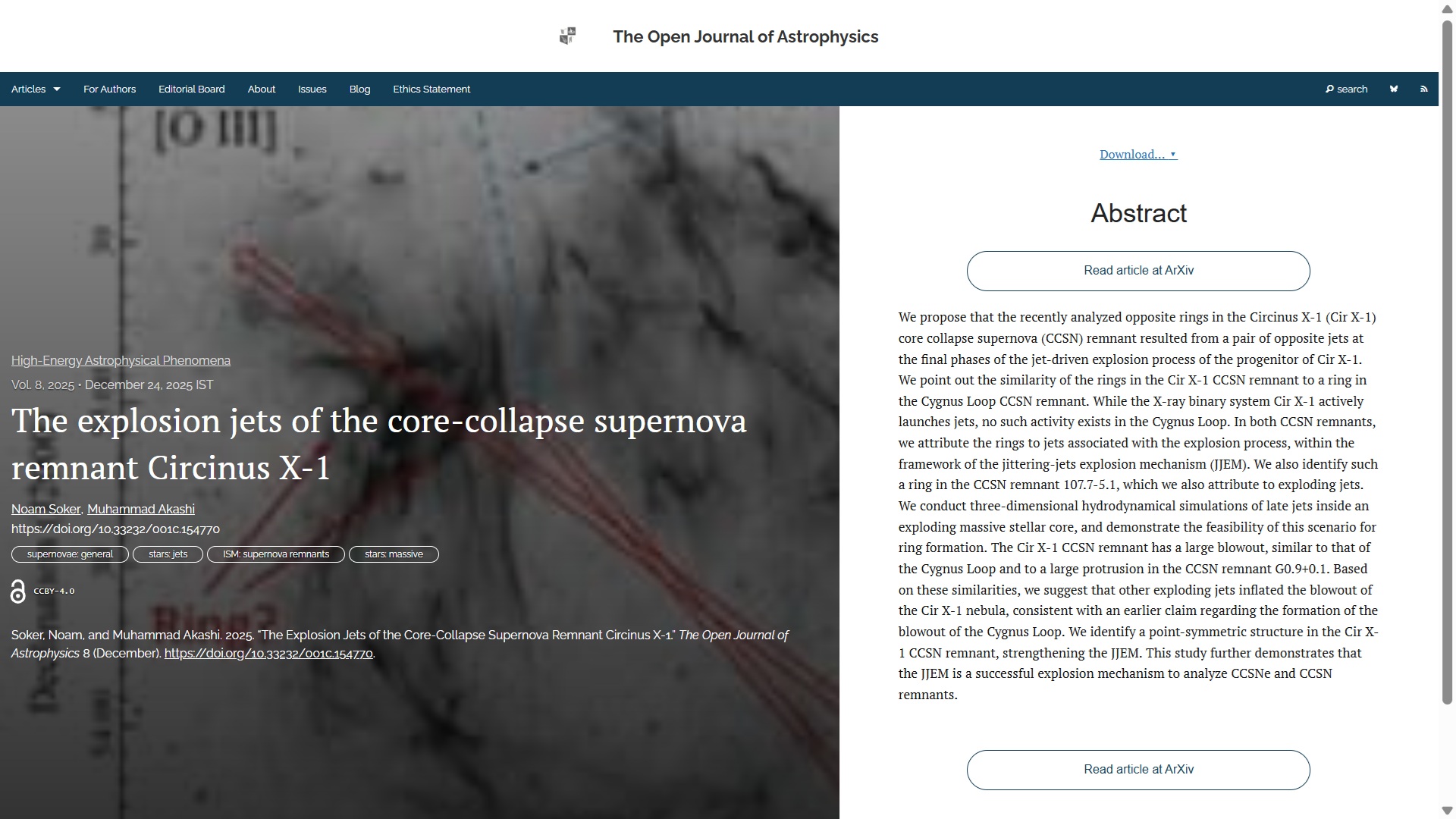
Next, published on 24th December 2025 in the folder High-Energy Astrophysical Phenomena, we have “The explosion jets of the core-collapse supernova remnant Circinus X-1” by Noam Soker and Muhammad Akashi (Technion, Haifa, Israel). This paper suggests that the rings in the Circinus X-1 supernova remnant resulted from jet-driven explosions, supporting the jittering-jets explosion mechanism theory for core collapse supernovae.
The overlay is here:
The officially accepted paper can be found on arXiv here and the announcement on Mastodon is here
Finally for 2025 we have “Quantifying the Fermi paradox via passive SETI: a general framework” by Matthew Civiletti (City University of New York, USA). This was published on Wednesday 24th December in the folder Instrumentation and Methods for Astrophysics. The author uses SETI observations and the Drake Equation to calculate the probability of detecting at least one extraterrestrial signal, highlighting the model’s limitations and potential improvements. The overlay is here:

The officially accepted version can be found on arXiv here and the Mastodon announcement here:
And that concludes the updates for 2025. I’ll be back in a week with the first update of 2026, which will include the first paper(s) of Volume 9.
I’d like to thank everyone who has supported the Open Journal of Astrophysics this year – Editors, Reviewers, Authors and the excellent Library staff at Maynooth – and who have made it such a bumper year. In 2023 we published just 50 papers, so we have more than quadrupled in two years. How many will we publish in 2026?

 In the Dark