It’s time for another Saturday update of activity at the Open Journal of Astrophysics. Since the last update we have published a further four papers, bringing the number in Volume 9 (2026) to 249 and the total so far published by OJAp up to 697.
I continue to include the posts made on our Mastodon account (on Fediscience); these announcements also contain a clickable form of the DOI for each paper. Our Mastodon account has regular updates and other announcements from OJAp too, including posts from the OJAp blog.
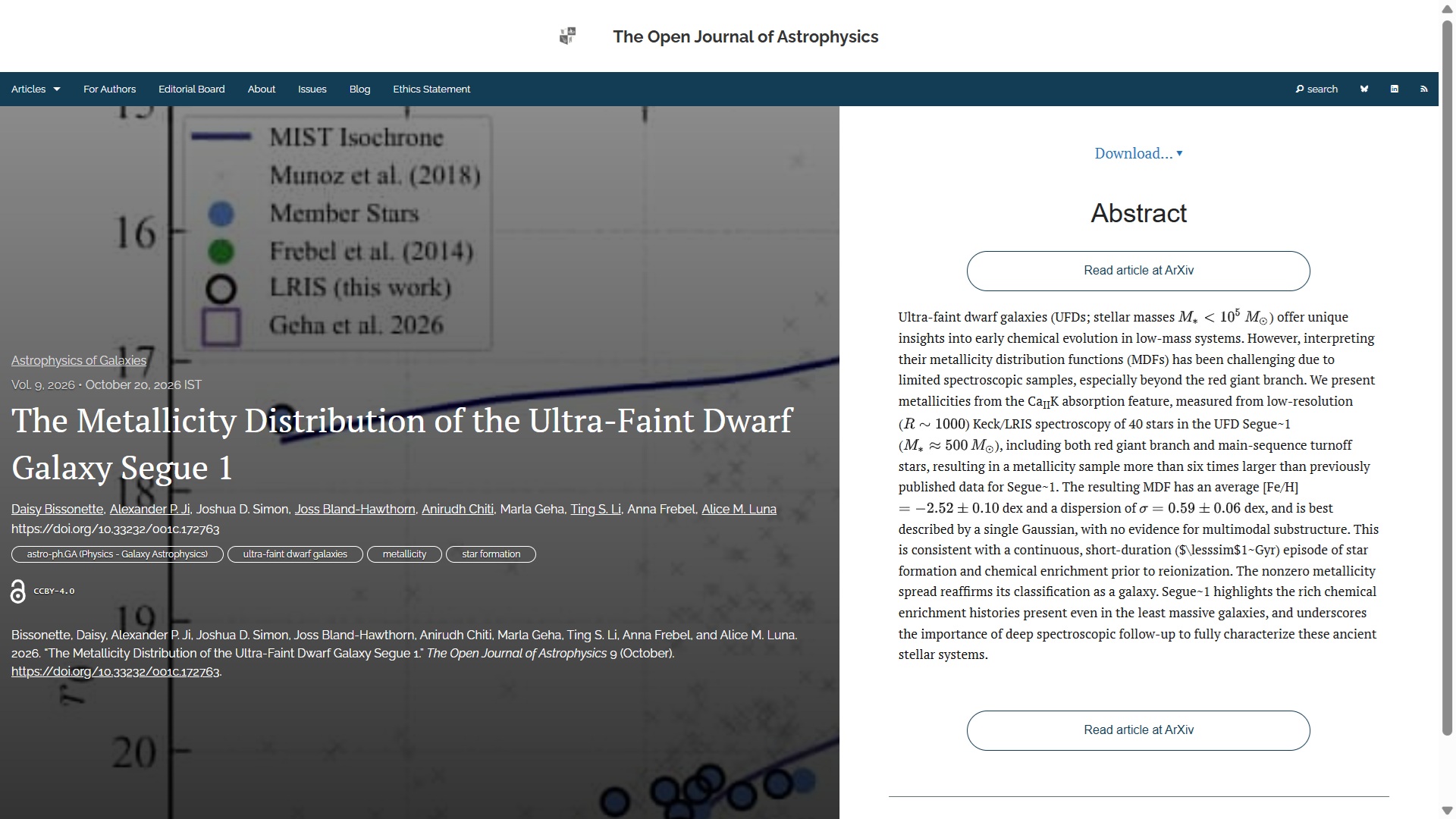
The first paper this week was published on Tuesday 20th October in the folder Astrophysics of Galaxies. The title is “The Metallicity Distribution of the Ultra-Faint Dwarf Galaxy Segue 1” by Daisy Bissonette (U. Chicago, USA) and 8 others based in the USA, Australia and Canada. The article explains that new data on the metallicity of ultra-faint dwarf galaxy Segue 1 reveal a continuous, short-duration episode of star formation and chemical enrichment, confirming its classification as a galaxy.
The overlay for this one is here:
You can find the officially accepted version on arXiv here and the announcement on Fediverse here:

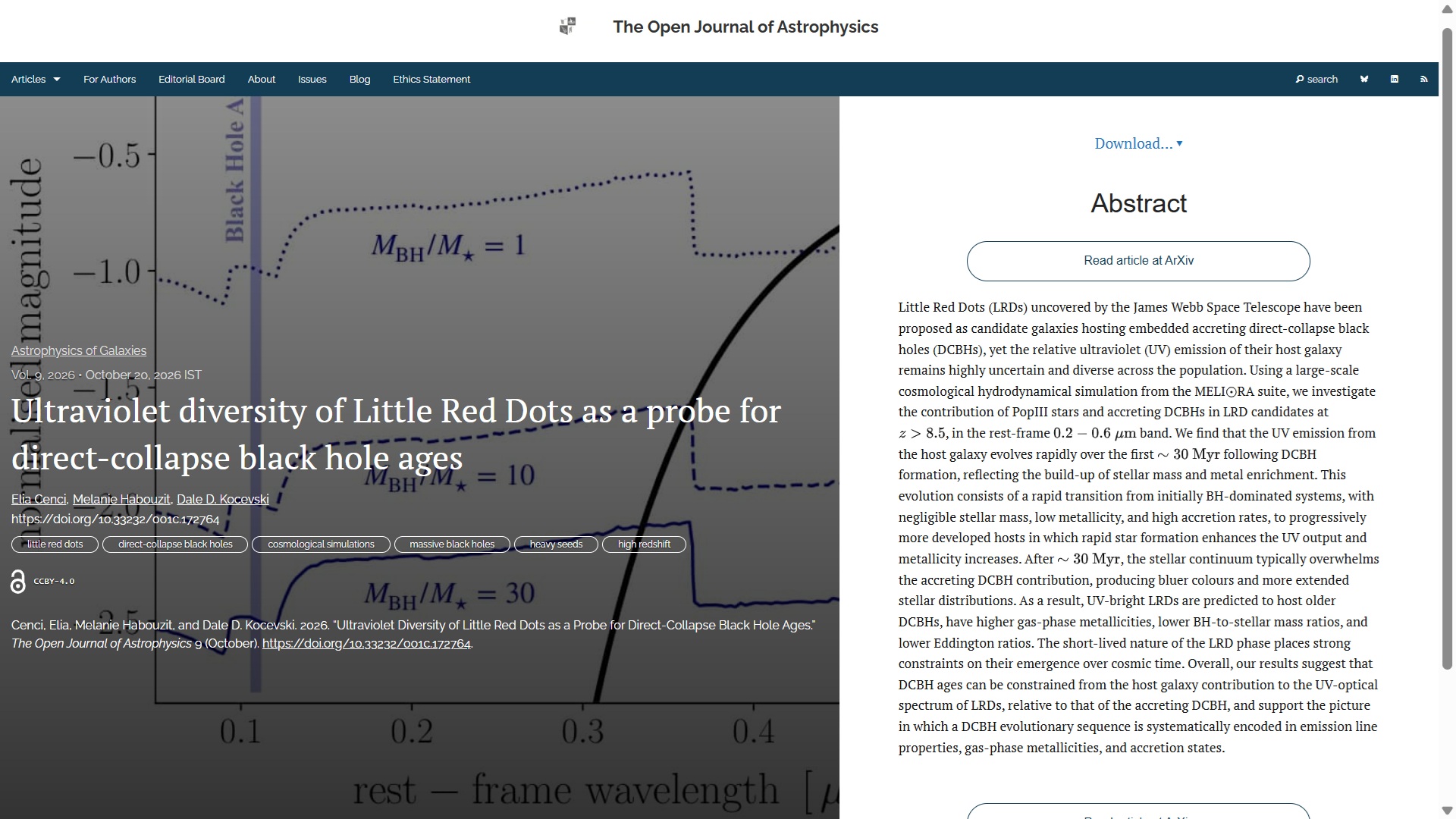
The second paper for this week, also published on Tuesday 20th October in the folder Astrophysics of Galaxies, “Ultraviolet diversity of Little Red Dots as a probe for direct-collapse black hole ages” by Elia Cenci & Melanie Habouzit (U. Geneva, Switzerland) and Dale D. Kocevski (Colby College, USA). This article uses simulations to explore UV emissions from galaxies hosting direct-collapse black holes (DCBHs), finding that these emissions evolve rapidly, reflecting changes in stellar mass and metal enrichment.
The overlay looks like this:
The official version of the paper can be found on arXiv here and the Fediverse announcement here:
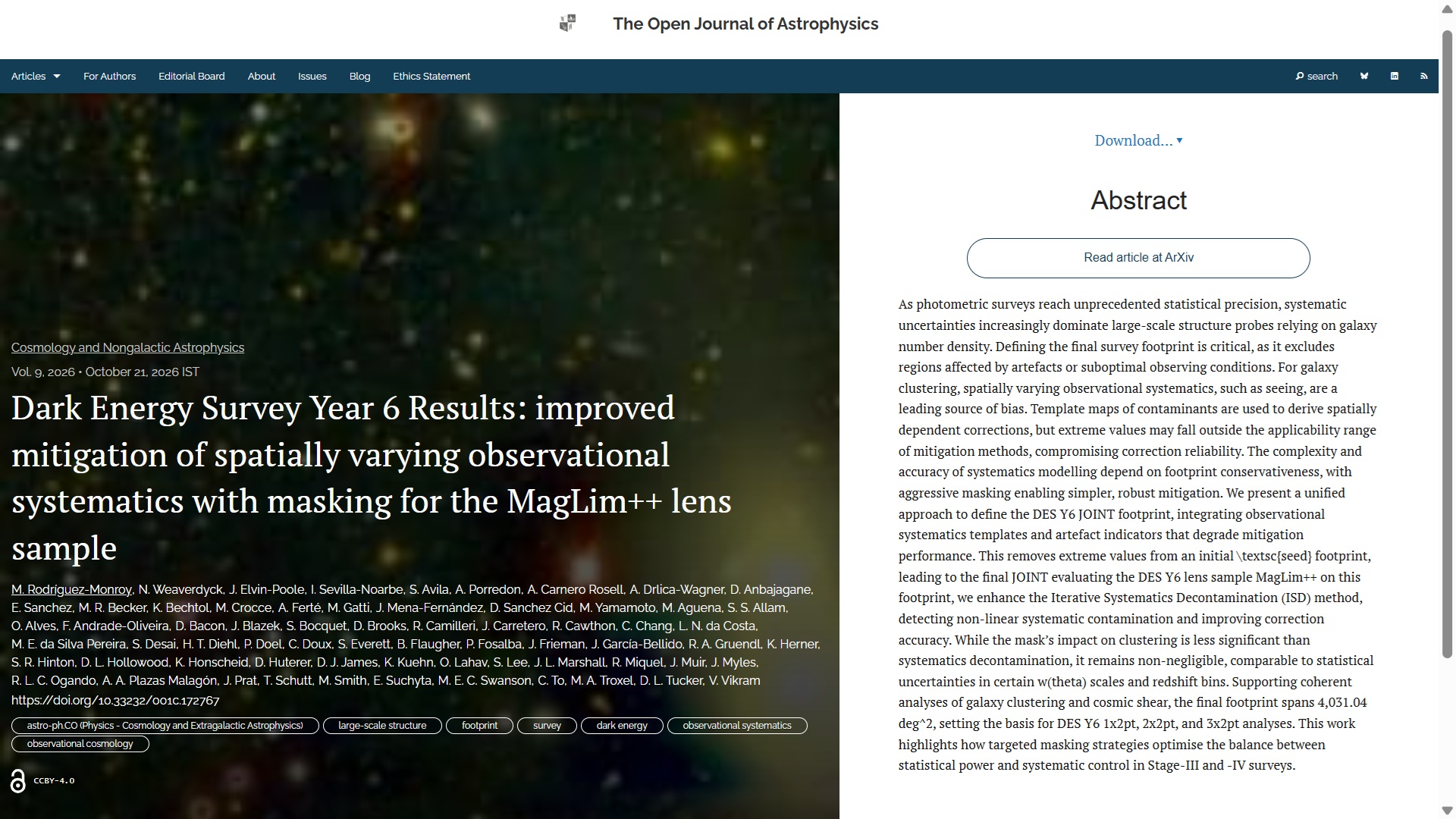
The third paper of the week, published on Wednesday October 21st 20206, is “Dark Energy Survey Year 6 Results: improved mitigation of spatially varying observational systematics with masking for the MagLim++ lens sample” by M. Rodríguez-Monroy (Universidad Autónoma de Madrid, Spain) and 65 others from around the world. This paper, which is in the folder Cosmology and Nongalactic Astrophysics, presents a unified definition of the DES (Dark Energy Survey) Y6 JOINT footprint in photometric surveys, improving the modelling of systematics and contamination correction, and optimising the balance between statistical power and systematic control.
The overlay for this is here:
The accepted version of this one can be found on the arXiv here and the Mastodon announcement here:
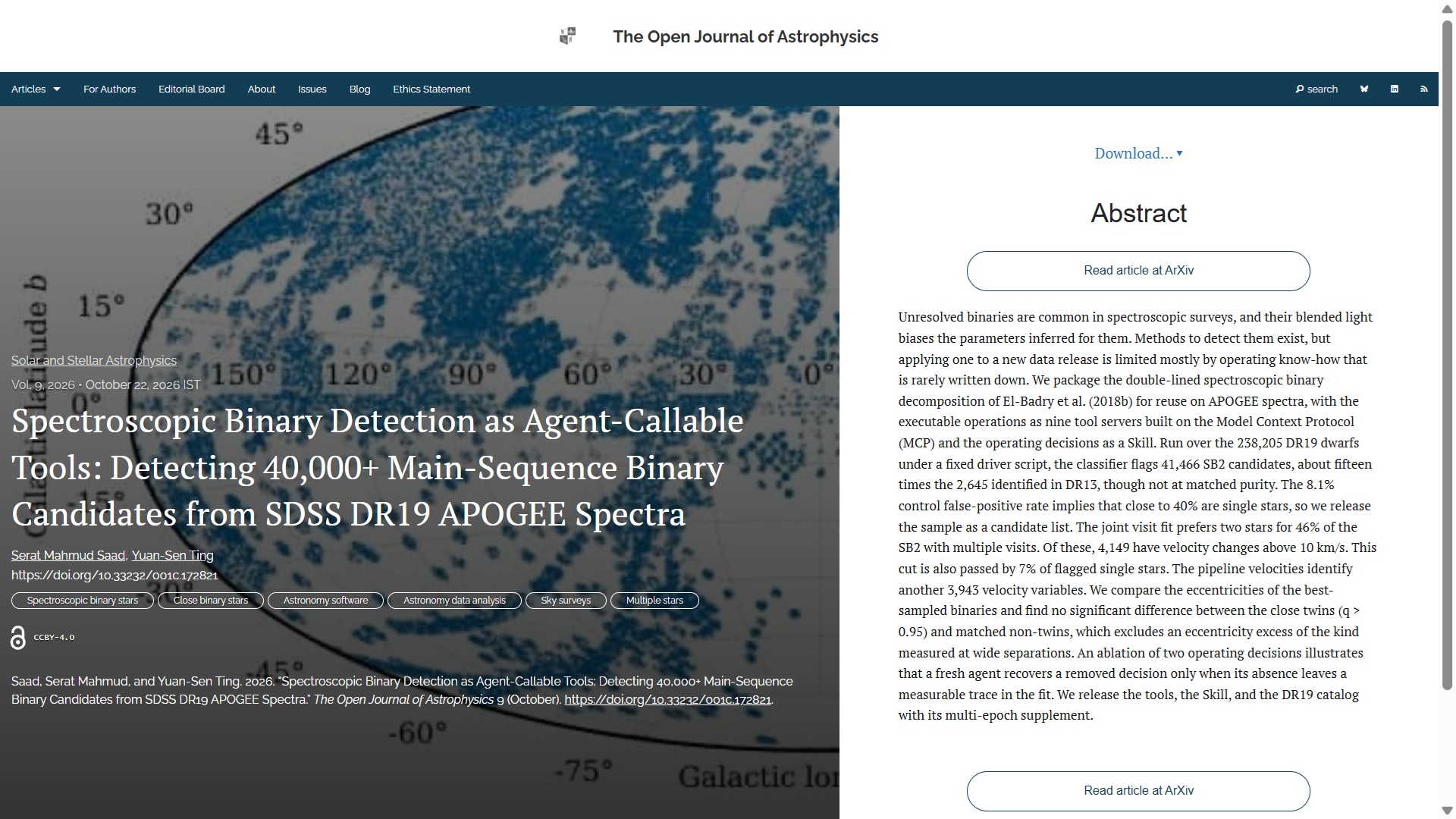
The fourth and last article of the week, published on Thursday 22nd October in the folder Solar and Stellar Astrophysics is “Spectroscopic Binary Detection as Agent-Callable Tools: Detecting 40,000+ Main-Sequence Binary Candidates from SDSS DR19 APOGEE Spectra” by Serat Mahmud Saad and Yuan-Sen Ting (Ohio State University, USA). The study repackages a method for detecting unresolved binaries in spectroscopic surveys, significantly increasing the number of identified candidates. The tools, skill, and catalog are made publicly available.
The overlay is here:
The official version of the paper can be found on arXiv here and the Fediverse announcement here:
That concludes this week’s update. I had anticipate that we’ll pass the 250 mark this week, but business has been slower than of late so we’ll have to wait until next week for that. It is noticeable that the arXiv submission process is slower now than it used to be, presumably because of the huge influx of AI slop that the moderators have to deal with.


