It’s time once more for another Saturday update of activity at the Open Journal of Astrophysics. Since the last update we have published a further eight papers, including one correction to an article already published, bringing the number in Volume 9 (2026) to 217 and the total so far published by OJAp up to 664. This is the third week running that we have published 7 new papers.
I continue to include the posts made on our Mastodon account (on Fediscience); these announcements also contain a clickable form of the DOI for each paper. Our Mastodon account has regular updates and other announcements from OJAp too, including posts from the OJAp blog.
The first paper this week was published on Monday 21st September in the folder Solar and Stellar Astrophysics. The title is “The Payne Zero Project I: Stellar Spectra from Physical Models in Seconds” and it is by Yuan-Sen Ting (Ohio State U., USA) and Elliot M. Kim (Cornell U., USA). The study introduces Payne Zero, a tool that reorganizes stellar spectra calculations for GPU-native synthesis, significantly speeding up the process and enabling direct physical fitting and atomic-data calibration at survey scale.
The overlay for this one is here:
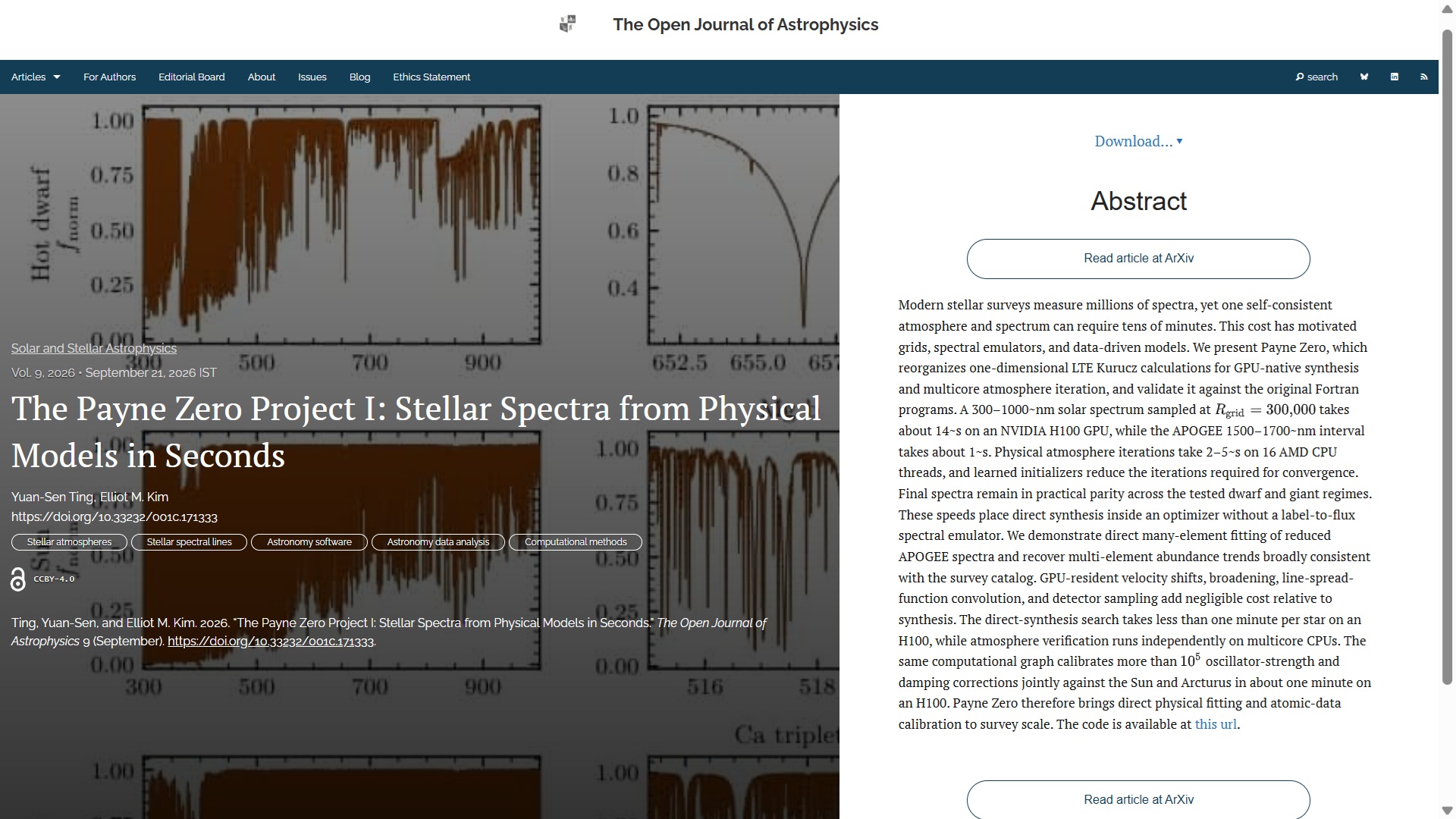
You can find the officially accepted version on arXiv here and the announcement on Fediverse here:

The second paper for this week, published on Tuesday 22nd September, is titled “RUBIES: The Evolution of the Ionization Parameter from 0 < z < 9” and is in the folder Astrophysics of Galaxies. The authors are Nikko Cleri (Penn State U., USA) and 12 others based in the USA, Switzerland and Germany. The article involves an examination of the time evolution of the ionization parameter in galaxies, finding that it increases with redshift and specific star formation rate, and decreases with stellar mass.
The overlay looks like this:
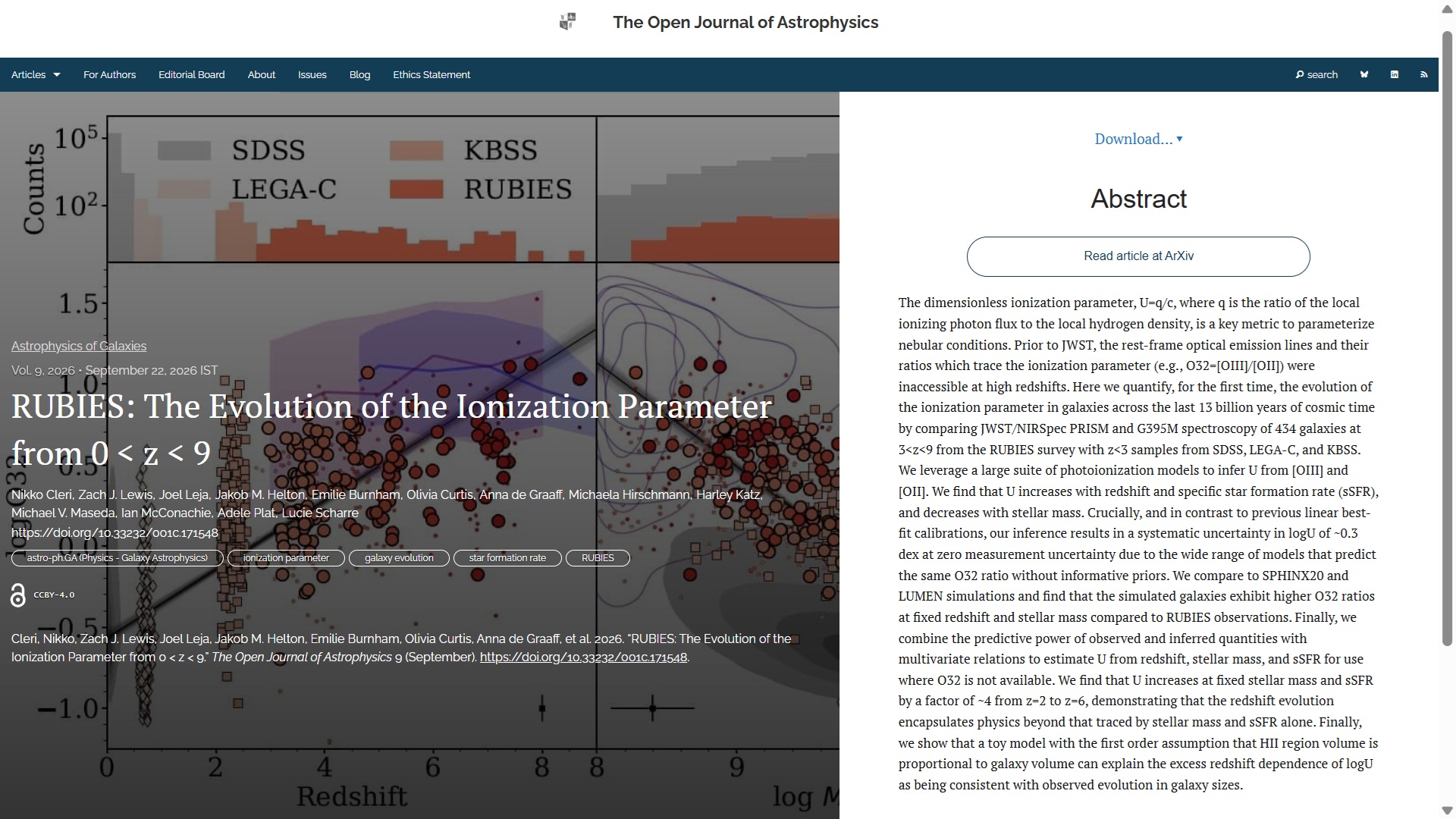
The official version of the paper can be found on arXiv here and the Fediverse announcement here:
The third paper of the week, also published on Tuesday 22nd September 2026 and in the folder Astrophysics of Galaxies, is “Kinematics of the Weak Cool-Core Cluster A3571 Observed with XRISM: Low Cooling Rate Balanced by Low Heating Rate?” by Hannah McCall (U. Chicago, USA) and 12 others based all around the world. This study examines gas kinematics in the relaxed, AGN-feedback-free galaxy cluster A3571 using XRISM observations. Findings suggest sloshing motions may significantly contribute to the heating budget.
The overlay is here:
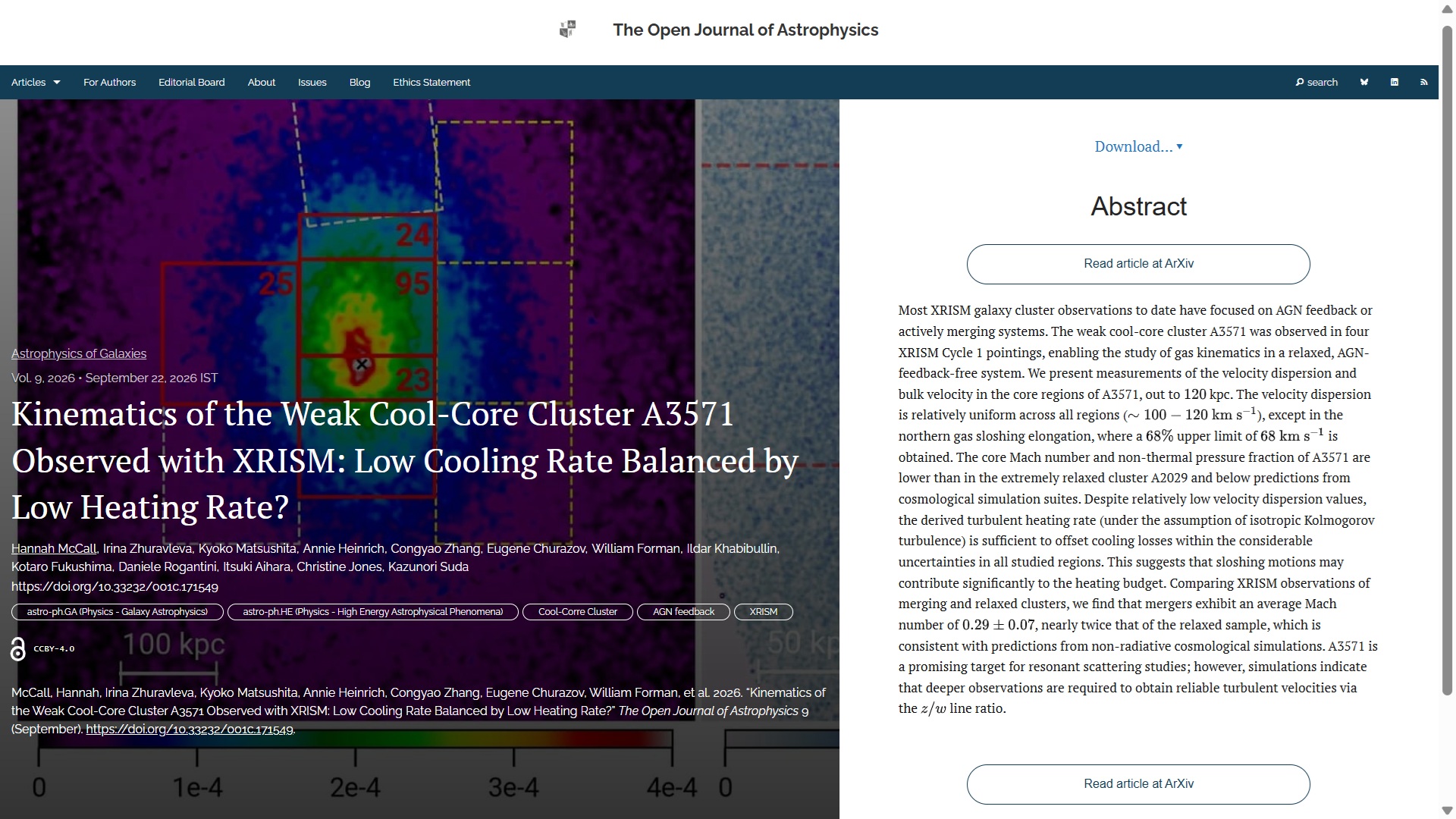
The official version of the paper can be found on arXiv here and the Fediverse announcement here:
The fourth paper of the week, the first of three published on Wednesday 23rd September, is “The Simons Observatory: Development of a Pipeline to Detect Rapid Transients in Time-Ordered Data” by Justin Clancy (U. Melbourne, Australia) and 16 others from around the world. The study introduces a method for detecting fast, dynamic astrophysical transients using cosmic microwave background survey telescopes, demonstrating its effectiveness in the Simons Observatory time-domain pipeline. It is in the folder Instrumentation and Methods for Astrophysics.
The overlay is here:
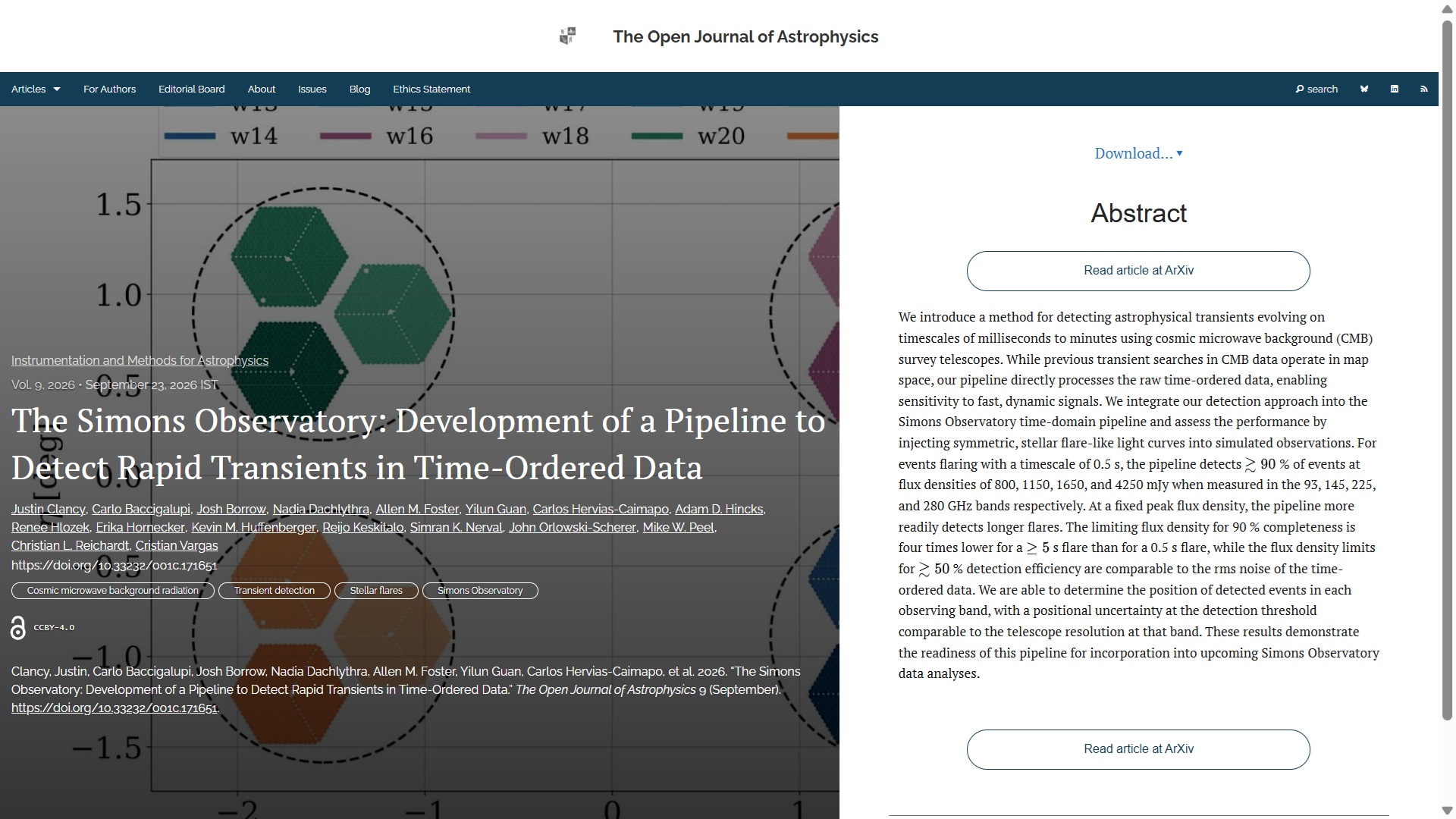
The officially-accepted version of the paper can be found on arXiv here and the Fediverse announcement here:
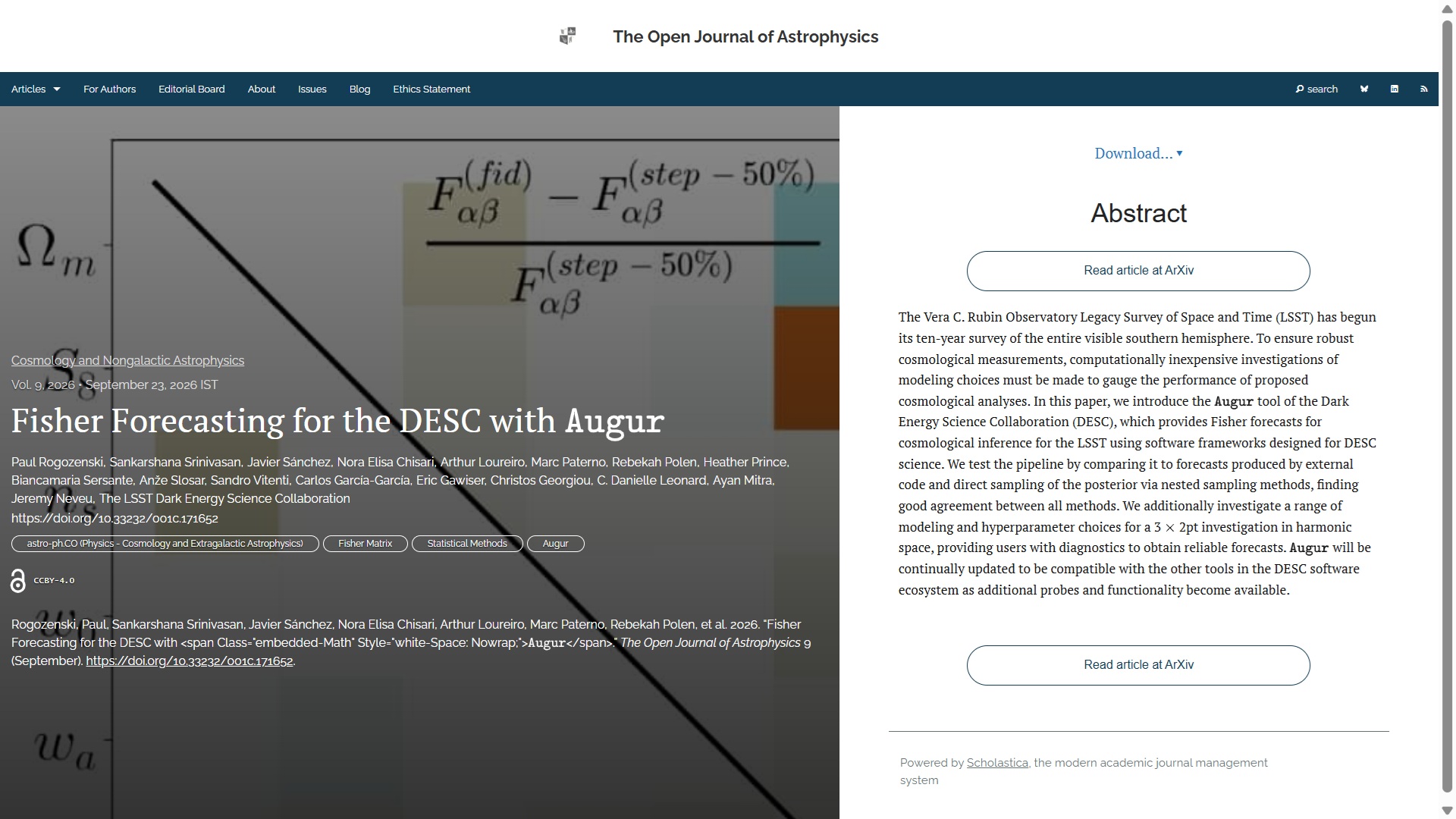
The fifth paper of the week is “Fisher Forecasting for the DESC with Augur” by Paul Rogozenski (Carnegie Mellon U., USA) and 16 others on behalf of the The LSST Dark Energy Science CollaborationThis was also published on Wednesday 16th September, but in the folder Cosmology and Nongalactic Astrophysics. This paper introduces the Augur tool, designed to provide Fisher forecasts for cosmological inference for the Vera C. Rubin Observatory Legacy Survey of Space and Time (LSST).
The overlay for this one looks like this:
The officially-accepted version of this paper is on arXiv here and the Mastodon announcement on the fediverse here:
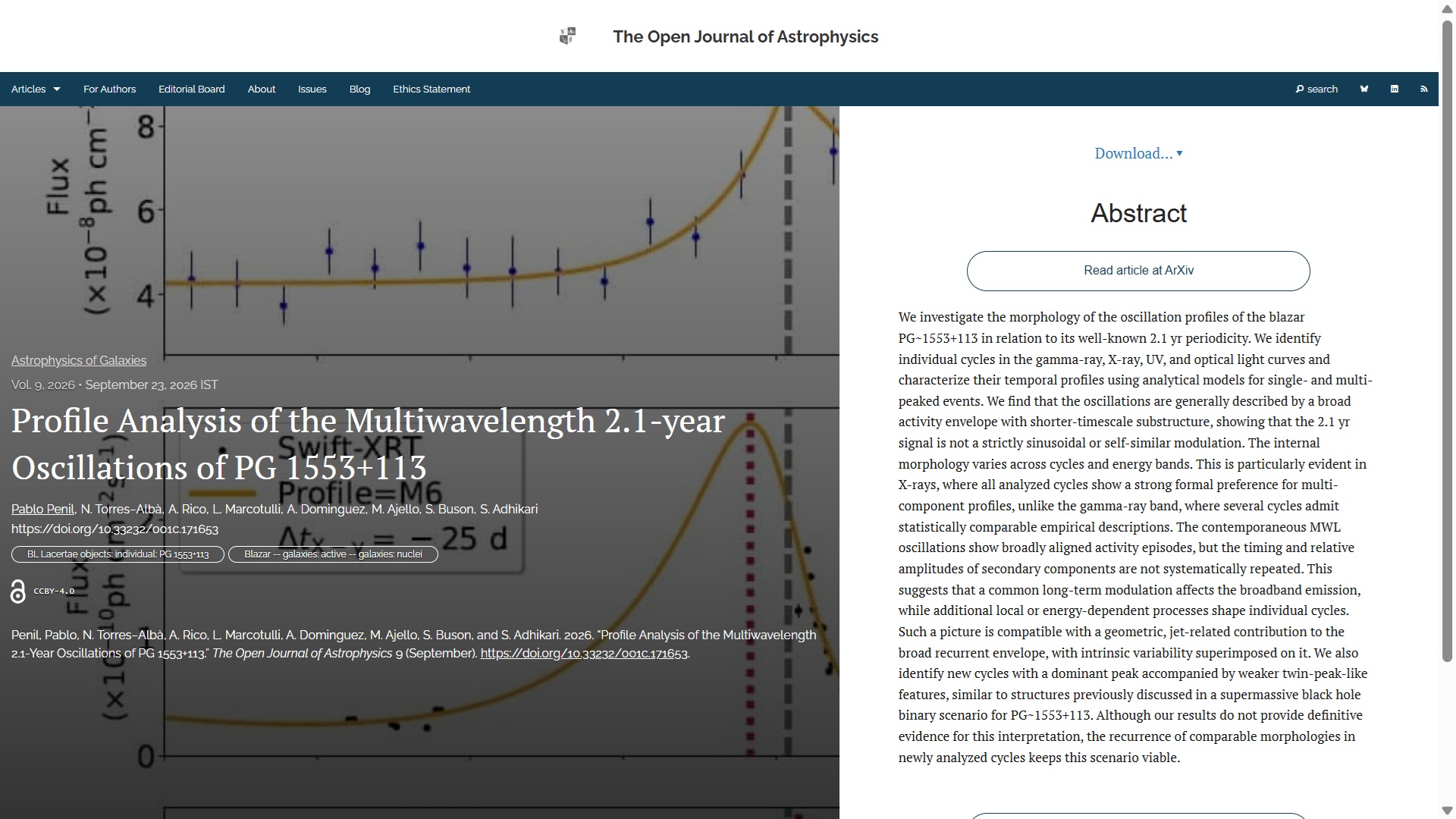
The sixth paper of the week is “Profile Analysis of the Multiwavelength 2.1-year Oscillations of PG 1553+113” by Pablo Penil (Clemson U. USA) and 7 others based in the USA, Germany and Spain. This was also published on Wednesday 23rd September, in the Astrophysics of Galaxies. The study examines the oscillation profiles of blazar PG~1553+113, finding that its 2.1-year periodicity is not strictly sinusoidal and varies across energy bands.
The overlay is here:
The officially accepted version is on arXiv here and the Mastodon announcement here:
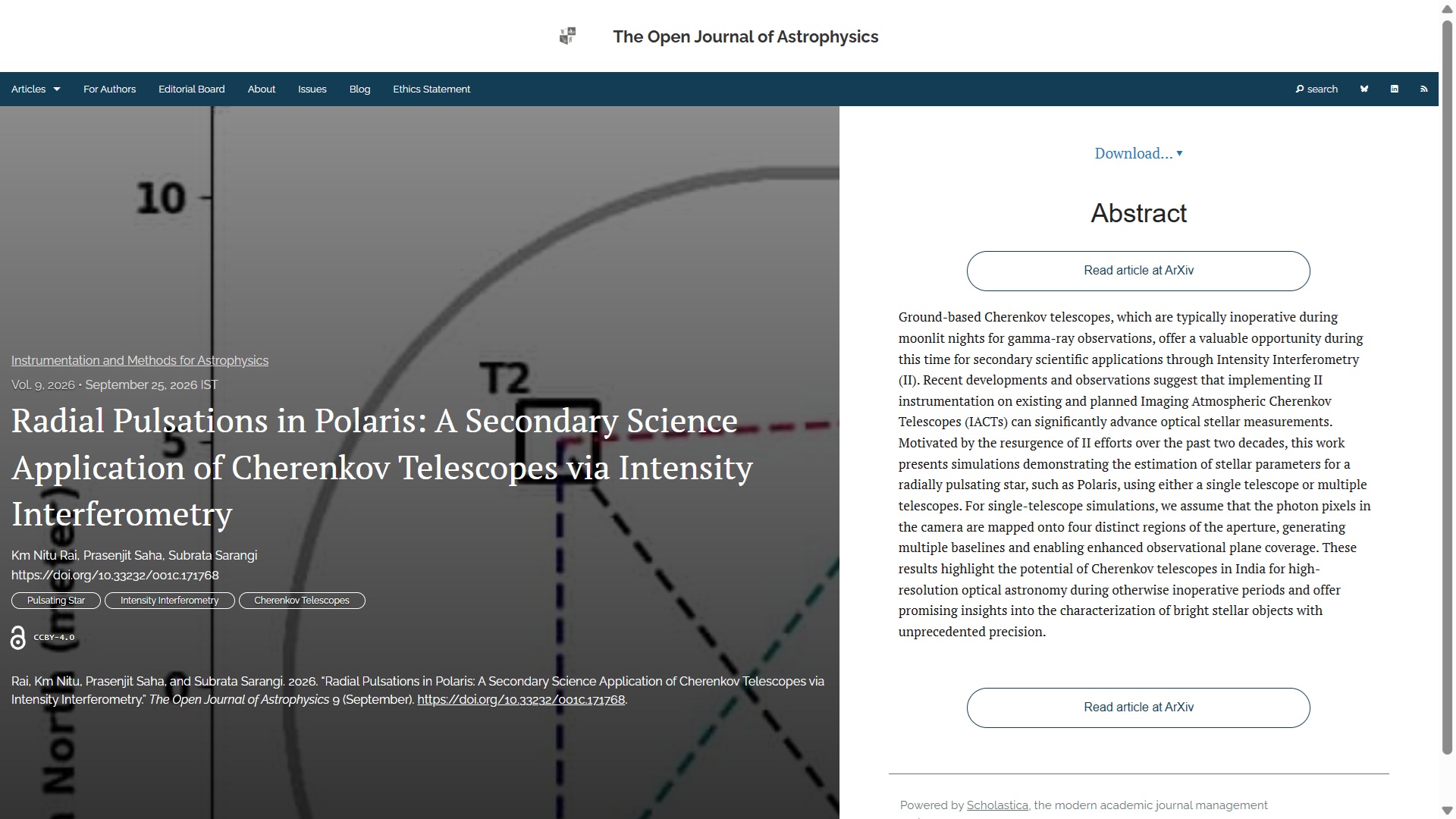
Our seventh, and last, new paper of the week is “Radial Pulsations in Polaris: A Secondary Science Application of Cherenkov Telescopes via Intensity Interferometry” by Km Nitu Rai (IISER, India), Prasenjit Saha (U. Zurich, Switzerland) and Subrata Sarangi (IUCAA, India). This study demonstrates how Cherenkov telescopes, typically unused during moonlit nights, can be used for advanced optical stellar measurements, particularly for characterizing bright stars such as Polaris.
The overlay is here:
The final version of this paper is on the arXiv here and the Mastodon announcement here:
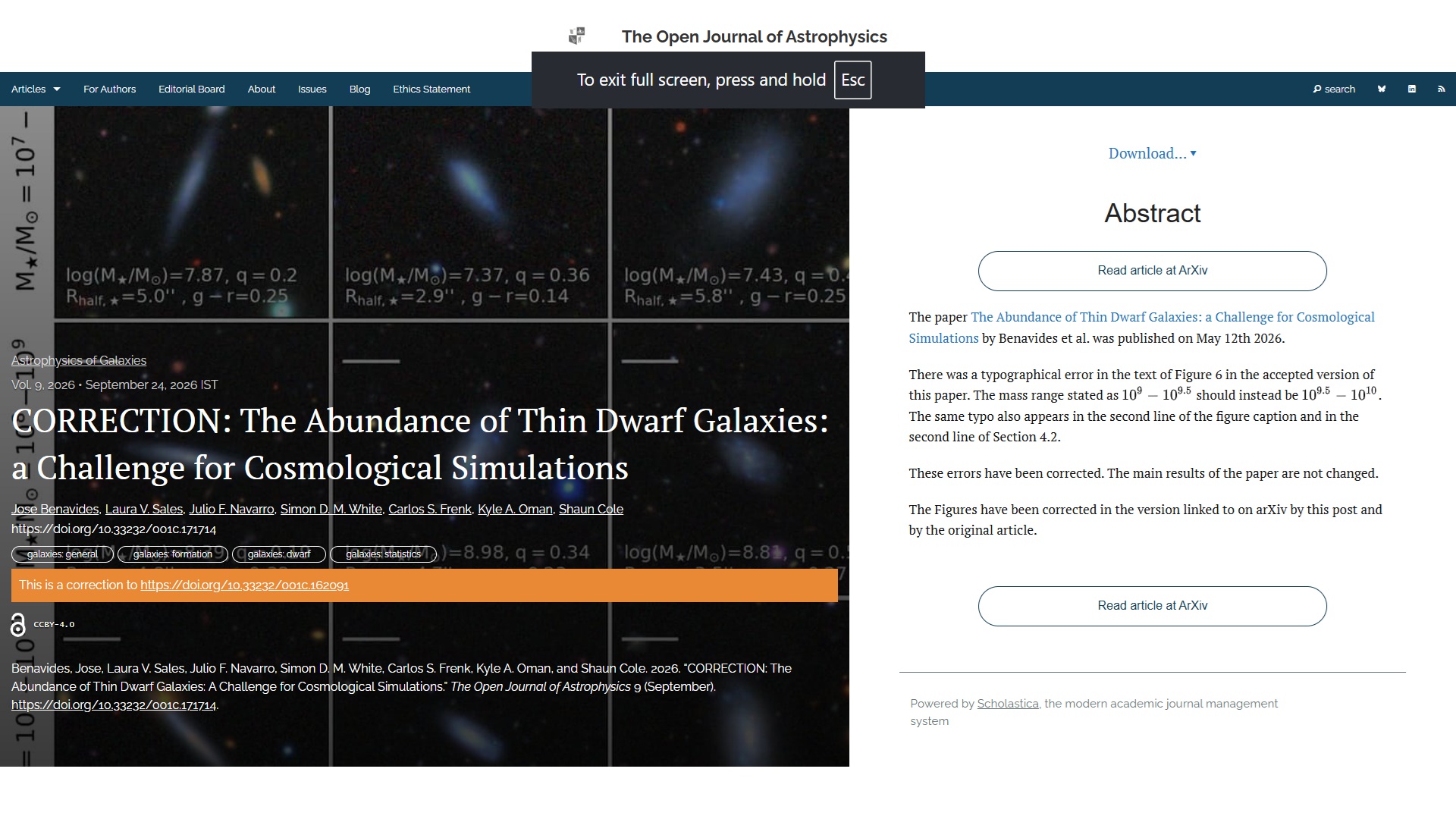
And finally we have one (minor) correction to a previously published article. The overlay of the correction notice is here:
The mastodon announcement is here:
The corrected version of this paper can be found on arXiv here.
That concludes this week’s update. I’ll just add a mention of yesterday’s post announcing that the Open Journal of Astrophysics is a Q1 Journal. It will be interesting to see if that stimulates another increase in submissions. As things are going we seem likely to publish about 300 papers this year. I’ll also mention that an exciting development is in the pipeline for next week, but I can’t say more until it happens.


