Archive for astronomy

Cauchy Statistics

Posted in Bad Statistics, The Universe and Stuff with tags , , , , on June 7, 2010 by telescoper

I was attempting to restore some sort of order to my office today when I stumbled across some old jottings about the Cauchy distribution, which is perhaps more familiar to astronomers as the Lorentz distribution. I never used in the publication they related to so I thought I’d just quickly pop the main idea on here in the hope that some amongst you might find it interesting and/or amusing.

What sparked this off is that the simplest cosmological models (including the particular one we now call the standard model) assume that the primordial density fluctuations we see imprinted in the pattern of temperature fluctuations in the cosmic microwave background and which we think gave rise to the large-scale structure of the Universe through the action of gravitational instability, were distributed according to Gaussian statistics (as predicted by the simplest versions of the inflationary universe theory).  Departures from Gaussianity would therefore, if found, yield important clues about physics beyond the standard model.

Cosmology isn’t the only place where Gaussian (normal) statistics apply. In fact they arise  generically,  in circumstances where variation results from the linear superposition of independent influences, by virtue of the Central Limit Theorem. Noise in experimental detectors is often treated as following Gaussian statistics, for example.

The Gaussian distribution has some nice properties that make it possible to place meaningful bounds on the statistical accuracy of measurements made in the presence of Gaussian fluctuations. For example, we all know that the margin of error of the determination of the mean value of a quantity from a sample of size n independent Gaussian-dsitributed varies as 1/\sqrt{n}; the larger the sample, the more accurately the global mean can be known. In the cosmological context this is basically why mapping a larger volume of space can lead, for instance, to a more accurate determination of the overall mean density of matter in the Universe.

However, although the Gaussian assumption often applies it doesn’t always apply, so if we want to think about non-Gaussian effects we have to think also about how well we can do statistical inference if we don’t have Gaussianity to rely on.

That’s why I was playing around with the peculiarities of the Cauchy distribution. This comes up in a variety of real physics problems so it isn’t an artificially pathological case. Imagine you have two independent variables X and Y each of which has a Gaussian distribution with zero mean and unit variance. The ratio Z=X/Y has a probability density function of the form

p(z)=1/\pi(1+z^2),

which is a form of the Cauchy distribution. There’s nothing at all wrong with this as a distribution – it’s not singular anywhere and integrates to unity as a pdf should. However, it does have a peculiar property that none of its moments is finite, not even the mean value!

Following on from this property is the fact that Cauchy-distributed quantities violate the Central Limit Theorem. If we take n independent Gaussian variables then the distribution of sum X_1+X_2 + \ldots X_n has the normal form, but this is also true (for large enough n) for the sum of n independent variables having any distribution as long as it has finite variance.

The Cauchy distribution has infinite variance so the distribution of the sum of independent Cauchy-distributed quantities Z_1+Z_2 + \ldots Z_n doesn’t tend to a Gaussian. In fact the distribution of the sum of any number of  independent Cauchy variates is itself a Cauchy distribution. Moreover the distribution of the mean of a sample of size n does not depend on n for Cauchy variates. This means that making a larger sample doesn’t reduce the margin of error on the mean value!

This was essentially the point I made in a previous post about the dangers of using standard statistical techniques – which usually involve the Gaussian assumption – to distributions of quantities formed as ratios.

We cosmologists should be grateful that we don’t seem to live in a Universe whose fluctuations are governed by Cauchy, rather than (nearly) Gaussian, statistics. Measuring more of the Universe wouldn’t be any use in determining its global properties as we’d always be dominated by cosmic variance..

 

Turning the Tables

Posted in Science Politics with tags , , , on May 30, 2010 by telescoper

In Andy Fabian‘s Presidential Address to the Royal Astronomical Society (published in the June 2010 issue of Astronomy and Geophysics) he discusses the impact of UK astronomy both on academic research and wider society. It’s a very interesting article that makes a number of good points, not the least of which is how difficult it is to measure “impact” for a fundamental science such as astronomy. I encourage you all to read the piece.

One of the fascinating things contained in that article is the following table, which shows the number of papers published in Space Sciences (including astronomy) in the period 1999-2009 (2nd column) with their citation counts (3rd Column) and citations per paper (4th column):

USA 53561 961779 17.96
UK(not NI) 18288 330311 18.06
Germany 16905 279586 16.54
England 15376 270290 17.58
France 13519 187830 13.89
Italy  11485 172642 15.03
Japan 8423 107886 12.81
Canada 5469 102326 18.71
Netherlands 5604 100220 17.88
Spain 6709 88979 13.26
Australia 4786 83264 17.40
Chile 3188 57732 18.11
Scotland 2219 48429 21.82
Switzerland 2821 46973 16.65
Poland 2563 32362 12.63
Sweden 2065 30374 14.71
Israel 1510 29335 19.43
Denmark 1448 26156 18.06
Hungary 761 16925 22.24
Portugal  780 13258 17.00
Wales 693 11592 16.73

I’m not sure why Northern Ireland isn’t included, but I suspect it’s because the original compilation (from the dreaded ISI Thompson database) lists England, Scotland, Wales and Northern Ireland separately and the latter didn’t make it into the top twenty; the entry for the United Kingdom is presumably constructed from the numbers for the other three. Of course many highly-cited papers involve international collaborations, so some of the papers will be in common to more than one country.

Based on citation counts alone you can see that the UK is comfortably in second place, with a similar count per paper to the USA.  However, the number that really caught my eye is Scotland’s citations per paper which, at 21.82, is significantly higher than most. In fact, if you sort by this figure rather than by the overall citation count then the table looks very different:


Hungary 761 16925 22.24
Scotland 2219 48429 21.82
Israel 1510 29335 19.43
Canada 5469 102326 18.71
Chile 3188 57732 18.11
UK (not NI) 18288 330311 18.06
Denmark 1448 26156 18.06
USA 53561 961779 17.96
Netherlands 5604 100220 17.88
England 15376 270290 17.58
Australia 4786 83264 17.40
Portugal  780 13258 17.00
Wales 693 11592 16.73
Switzerland 2821 46973 16.65
Germany 16905 279586 16.54
Italy  11485 172642 15.03
Sweden 2065 30374 14.71
France 13519 187830 13.89
Spain 6709 88979 13.26
Japan 8423 107886 12.81
Poland 2563 32362 12.63

Wales climbs to a creditable 13th place while the UK as a whole falls to 6th. Scotland is second only to Hungary. Hang on. Hungary? Why does Hungary have an average of  22.24 citations per paper? I’d love to know.  The overall number of papers is quite low so there must be some citation monsters among them. Any ideas?

Notice how some of the big spenders in this area – Japan, Germany, France and Italy – slide down the table when this metric is used. I think this just shows the limitations of trying to use a single figure of merit. It would be interesting to know – although extremely difficult to find out – how these counts relate to the number of people working in space sciences in each country. The UK, for example, is involved in about a third as many publications as the USA but the number of astronomers in the UK must be much less than a third of the corresponding figure for America. It would be interesting to see a proper comparison of all these countries’ investment in this area, both in terms of people and in money…

..which brings me to Andy Lawrence’s recent blog post which reports that the Italian Government is seriously considering closing down the INAF (Italy’s National Institute for Astrophysics). What this means for astronomy and astrophysics funding in Italy I don’t know. INAF has only existed since 2002 anyway, so it could just mean an expensive bureaucracy will be dismantled and things will go back to the way they were before then. On the other hand, it could be far worse than that and since Berlusconi is involved it probably will be.

Those in control of the astronomy budget in this country have also made it clear that they think there are too many astronomers in the UK, although the basis for this decision escapes me.  Recent deep cuts in grant funding have already convinced some British astronomers to go abroad. With more cuts probably on the way, this exodus is bound to accelerate. I suspect those that leave  won’t be going to Italy, but I agree with Andy Fabian that it’s very difficult to see how the UK will be able to hold  its excellent position in the world rankings for much longer.

Clustering in the Deep

Posted in Bad Statistics, The Universe and Stuff with tags , , , , , , on May 27, 2010 by telescoper

I couldn’t resist a quick lunchtime post about the results that have come out concerning the clustering of galaxies found by the HerMES collaboration using the Herschel Telescope. There’s quite a lengthy press release accompanying the new results, and there’s not much point in repeating the details here, so I’ll just show a wonderful image showing thousands of galaxies and their far-infrared colours.

Image Credit: European Space Agency, SPIRE and HERMES consortia

According to the press release, this looks “like grains of sand”. I wonder if whoever wrote the text was deliberately referring to Genesis 22:17?

.. they shall multiply as the stars of the heaven, and as the grains of sand upon the sea shore.

However, let me take issue a little with the following excerpt from said press release:

While at a first glance the galaxies look to be scattered randomly over the image, in fact they are not. A closer look will reveals that there are regions which have more galaxies in, and regions that have fewer.

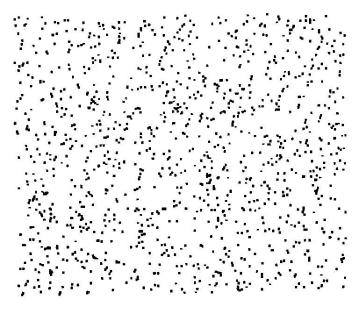
A while ago I posted an item asking what “scattered randomly” is meant to mean. It included this picture

This is what a randomly-scattered set of points actually looks like. You’ll see that it also has some regions with more galaxies in them than others. Coincidentally, I showed the same  picture again this morning in one of my postgraduate lectures on statistics and a majority of the class – as I’m sure do many of you seeing it for the first time –  thought it showed a clustered pattern. Whatever “randomness” means precisely, the word certainly implies some sort of variation whereas the press release implies the opposite. I think a little re-wording might be in order.

What galaxy clustering statistics reveal is that the variation in density from place-to-place is greater than that expected in a random distribution like that shown. This has been known since the 1960s, so it’s not  the result that these sources are clustered that’s so important. In fact, The preliminary clustering results from the HerMES surveys – described in a little more detail in a short paper available on the arXIv – are especially  interesting because they show that some of the galaxies seen in this deep field are extremely bright (in the far-infrared), extremely distant, high-redshift objects which exhibit strong spatial correlations. The statistical form of this clustering provides very useful input for theorists trying to model the processes of galaxy formation and evolution.In particular, the brightest objects at high redshift have a propensity to appear preferentially in dense concentrations, making them even more strongly clustered than rank-and-file galaxies. This fact probably contains important information about the environmental factors responsible for driving their enormous luminosities.

The results are still preliminary, but we’re starting to see concrete evidence of the impact Herschel is going to have on extragalactic astrophysics.

iBores

Posted in Uncategorized with tags , , , , , on May 26, 2010 by telescoper

I try my best to get on with my fellow human beings. I’m a sociable sort of chap, within reason. I’m pretty tolerant of other peoples’ opinions. I don’t expect other people to be interested in everything I am, and it doesn’t worry me too much if they turn out to be fascinated by things that I find bizarre or simply unininteresting. And since I’ve never been one to go with the crowd just for the sake of it, it doesn’t get me down if I’m left out when others enjoy something I find boring.

But there are a few things that sometimes make me feel like I was born on a different planet. Nothing drives home this feeling of alienation more than listening to people talk about Apple products, especially the dreaded Mac computers. Stephen Fry is the worst culprit, publically slavering over his Macs – I believe he owns several – to an extent that severely jeopardises his status as English National Treasure.

The Apple fraternity is particularly prominent in Astronomy. Go to an astronomy conference and you’re likely to find gaggles of them drooling over each other’s laptops and notebooks. You’re also likely to be sitting in the audience twiddling your thumbs for ages while one of the speakers fiddles about trying to get their computer to work with the data projector. If that happens, you can bet your bottom dollar that it’s a Mac that’s to blame.

Macs are brilliant, you hear their owners say. Well, perhaps they are almost as good as real computers, except you need to bring special adaptors to connect them to anything at all, you won’t be able to use the internet, the software isn’t compatible with this that and the other, they’re roughly twice the price of a PC with equivalent (or better) capabilities, and the hard disk is almost certain to seize after about a year. But so what if they don’t work as well as a proper machine? If you have one, you have a passport to Nerd Nirvana. In the kingdom of the geeks, it’s the geek with a Mac that is king.

I hope you’ll forgive me for not jumping aboard the Mac Bandwagon (Applecart?). I just don’t get it. Otherwise intelligent people have tried to convert me and succeeded only in scaring me. It’s the glazed eyes and puerile obsessiveness that does it. A Mac must come with some sort of brainwashing device that makes owners blind to its obvious limitations. I hope there’s a cure, otherwise the MacZombies will take over the world.

It’s not just Macs, of course, but all the gadgets prefixed by the dreaded “i”: iPod, iPhone, iPad, iNeedaweewee and iDunnowhat.

I do have an iPod, in fact. It’s fine. No better and no worse than an ordinary MP3 player, of course, but perfectly OK for its purpose. Apart from the earphones,  which are deliberately manufactured to be entirely useless so you have to go and buy proper ones straight away.

Incidentally, I never never got around to filing a patent for my invention, the uPod. This is a similar device to an iPod, but the wearer of the earphones experiences perfect silence while the uPod broadcasts an annoying tinny racket to everyone within a 10-metre radius. It  is designed for use in the quiet coach on a train.

The software you have to use with an iPod  is quite another thing. I’m thoroughly sick of iTunes, which I believe to be controlled by aliens with the intention of destroying the Earth. It keeps taking over my computer and insisting that it is it and nothing else that should control all my media files. Moreover, update your iTunes with care. You can’t undo the upgrade and the likelihood is your new software won’t be compatible with your old iPod. An evil trick to make you buy new hardware. Shame on you, Apple.

A Crapple Device

On the other hand, I don’t have an iPhone and have no intention of getting one. I know people who have them and show me all the “apps” they have on it. Fine. I hope there’s an app for finding a job after you get sacked for playing with your iPhone all the time instead  of doing your work. Give me my  Blackberry over your  iPhone, anytime.

And as for the iPad, there are only two problems with it. It’s too small for a doorstop and too big for a paperweight.

You’re probably wondering what caused me to vent my spleen about the evil empire of Crapple. Up until today I’ve kept quiet about my feelings lest I appear a bit weird. Regular readers of this blog will know that I’m the very epitome of normality. But today I read something that has put me in touch with my inner Luddite and given me the  inner strength to stand up and speak out against the obvious threat to our civilisation caused by these Apple gizmos and the people they control.

Today’s excellent new issue of Private Eye has a new cartoon strip – called iBores – which takes a brave stand against the Menace of the Mac. It’s a must-read for all Mac addicts, and just may save the human race from Apple oblivion. The fightback starts today.

A Star is Porn

Posted in The Universe and Stuff with tags , , , on May 16, 2010 by telescoper

I started thinking about the analogy between astronomy and pornography after seeing a hilarious blog post by Amanda Bauer  that has a connection with my forthcoming (popular) book, which has the working title Naked Universe. It’s basically a collection of essays about cosmology, trying to look at the subject from unusual and provocative angles. I decided to give you a bit of a flavour of this connection here. It’s intended to be a bit of a joke, but it does make a semi-serious point about the difference between astronomy and other branches of science.

Although it’s one of the oldest fields of scientific enquiry, astronomy possesses a number of features that set it apart from most other branches of science. One of the most important is that it isn’t really an experimental science, but an observational one. Hands-on disciplines, specifically those involving laboratory experiments,  require a dialogue between the scientist and nature. The scientist can control the physical parameters of the system under scrutiny and explore its behaviour under different conditions in order to establish patterns and test theoretical explanations. The scientist chooses the questions to ask, the experiment is run, and nature gives its answer. If more information is needed, another experiment is set up with different parameter choices.

Astronomy is different. Its subject matter, the Universe of stars and galaxies,  is remote and inaccessible.   We only have what is “out there” already. We had no hand in setting it up, and we can’t intervene if it behaves in an unexpected way. We are forced to work only with what has been given to us. Out there in the darkness the Cosmos may be beautiful, but all we can do is look at  pictures of it. We never get to experience it in the flesh. Experimentalists have real intercourse with nature, but astronomers have to be content with being mere voyeurs.

This is not to say that all astronomers are dirty old men in grubby raincoats – although I have to say that I know a few who could be described like that – but  many mainstream scientists do indeed tend to look down on us, at least partly because of the unconventional practices I’ve alluded to. On the other hand,  I suspect they also secretly envy us. From time to time they probably also have a guilty peek at their favourite pictures too.  Every time physicists look at astronomical images, do they feel just a little bit guilty?

You can hardly go on the internet these days without finding a website devoted to pornography astronomy.This is hardly surprising because both astronomy and pornography have led to technological advances that helped fuel the digital revolution. Astronomy gave us the CCD camera, which ushered in the digital camera that has made it much easier for both amateurs and professionals to make their own pornographic astronomical images. On the other hand, the porn industry was largely responsible for the rapid evolution of video-streaming technology. That must be why astronomers spend so much of their time doing video conferences…

Astronomers also led the way in the development of virtual reality. Frustrated by their inability to get  up close and personal with the objects of their desire, they have resorted to the construction of elaborate three-dimensional computer simulations. In these they can interact with and manipulate what goes on until they reach a satisfactory outcome. I’ve never found this kind of thing at all rewarding – the simulations are just not sufficiently realistic –  but large numbers of cosmologists seem to be completely hooked on them.

The Club Guest

Posted in Uncategorized with tags , , on May 15, 2010 by telescoper

Yesterday I went, as I do from time to time, to the Royal Astronomical Society’s monthly meeting and thence to the RAS Club for dinner. This was the last such meeting before the summer hiatus – they resume in October – and also incorporated the Society’s Annual General Meeting at which new officers are elected, amongst them the new President.  Andy Fabian was the outgoing President, having completed his two-year tour of duty, and he was replaced by Roger Davies.

It was also revealed at this meeting that next year’s National Astronomy Meeting would be in Llandudno. Usually this event is organized by a university and is held in a university town. This year it was in Glasgow, for example. However, the University of Sheffield has pulled out of organizing the 2011 NAM and no other was willing to take on the considerable task of organizing it at such short notice. It was therefore decided to break with tradition and hold the event not on a university campus but at a holiday resort. I’ve never been to Llandudno, but I think it could be great for us astronomers here in Wales to have the Principality host NAM. I suspect, however, that it wasn’t regional politics, but economics, that held sway in reaching the decision. Llandudno is perhaps a bit cheaper than most English seaside towns. I can already hear some of my English colleagues starting to whinge about how difficult it will be to get there, but we’ll see. I just hope I can persuade them to hold it outside Cardiff’s teaching term otherwise I won’t be able to  go even if it is in Wales.

It was interesting to learn about all these developments, and the subsequent Open Meeting was not without interest either. We had talks about volcanic ash (topical, that one), martian meteorites, high-altitude balloon flights and stellar disks. A mixed bag of talks, but all of them very enjoyable.

However, this meeting turned out to be remarkable for a completely different reason. At the end of one of the lectures in the open meeting, a strange woman entered the lecture theatre, walked down the aisle and took a seat in the front row. In fact she first tried to sit in Roger Davies’ seat – he was standing in order to supervise the question-and-answers at the end of the talk – but he asked her to move. Finding a free seat a bit further along,  she removed her hat and  proceeded to brush her hair ostentatiously. As the other talks went on she appeared to pay very little attention to them, preferring instead to look around the room.  I had never seen her before, but open meetings like this often attract visitors and in any case acting a bit strangely is by no means inconsistent with being an astronomer.

The Mystery Guest

After the meeting closed I went for a glass of wine to Burlington House and then to the Athenaeum. There was quite a crowd there and as usual we all had a glass of wine before sitting down. It was only when we started to eat that I realised that this mysterious lady (left) was actually sitting at another table. Since the RAS Club is for members (and their guests) only, I assumed she was with one of the invited speakers at the meeting who, as is usual in such cases, had been invited to the club afterwards as a club guest.

I thought nothing more about this until I saw the Club Treasurer, Margaret Penston, looking a bit agitated,  go to her table and ask The Mystery Guest a question. I couldn’t hear what. Our visitor then stood up, announced she had to be going and left quickly before anyone could do anything about it. It turned out she wasn’t anyone’s guest at all, but had just latched onto a group of people leaving for the club, each of whom assumed one of the others knew her. It being England, nobody asked her who she was or what she was doing there. I have no idea who she was or why she had decided to attach herself to the RAS Club that evening.

All this was hilarious enough but, after she’d gone, it emerged that she had paid for her dinner by “borrowing” money from a genuine club guest, an American astronomer who happened to be sitting next to her and to whom she had introduced herself as the “Contessa” of something or other. Our American friend may have thought it was all an elaborate practical joke, but he was clearly completely dumbfounded by the episode. The Club had a whip round to pay him back the money he had lent her.

On top of all this, some other members of the Club  then pointed out that she had done something  similar on at least three  previous occasions, in locations ranging from Paris to London. Why none of her previous victims had identified her yesterday and drawn attention to her past history I have no idea. If they had she would have been removed earlier.

If the relatively small gathering we had on Friday could furnish three previous examples of this kind of behaviour, then it seems likely that it’s part of a pattern. However, it doesn’t seem likely that she makes her living doing this sort of thing because she’s only  “borrowed” amounts from £5 to £70. Perhaps astronomers aren’t the best choice of target.

I wonder if anyone reading this blog recognizes her and can shed light on her curious behaviour?

First Science from Herschel

Posted in The Universe and Stuff with tags , , , on May 4, 2010 by telescoper

A comment posted today on a previous item reminded me that this is supposed to be a science blog, so I thought it would be a good idea to put up a brief message about the status of Herschel.

Today is the first day of the Herschel First Results Symposium which is being held on the premises of ESTEC at Noordwijk in The Netherlands; you can see the poster below. There’s quite a strong Cardiff contingent there, and the meeting will go on until Friday, so it’s a going to be a bit quiet around here for the rest of the week.

The results being presented at this Symposium are covered by a strict ESA policy and most of them are embargoed, at least  for the time being. However, you can keep up with the meeting to some extent on Twitter, as I’ve been doing from time to time. Just follow #eslab2010. There are also edited highlights on the Herschel Mission Blog. It’s a bit frustrating only getting the odd snippet, but it does at least give you an idea of what’s going on and a heads-up for things that will be released officially soon.

In fact pretty soon a load of Herschel images and other results will be made public and I’ll be spoilt for choice as to what to post on here. In fact, I think all the presentations at the Symposium will be put online after it’s finished. There’s also going to be a deluge of science papers on the arXiv, the result of a lot of hard work (not to say a total panic) by those directly involved in analysing the first data to come through from the telescope. I’m looking forward to that, although there’s no way I’ll have time to read them all!

It’s hard to believe that it’s just a little under a year since we gathered in a state of nervous tension (moderated by a steady intake of alcohol) to watch the launch of Planck and Herschel. I don’t think I’m giving away any secrets when I write that the mission has been an outstanding success so far, even exceeding its specified performance in some respects.

I’ll be posting some Herschel goodies from time to time once the embargo is lifted, but until that happens you’ll just have to wait. I could tell you more but if I did I’d have to kill you.

PS. To return to my first sentence, I’m not even sure I should call this a science blog. I think of it as a personal blog, written by a person who happens to be a scientist…

Another Day, Another Panel..

Posted in Science Politics with tags , , , on April 13, 2010 by telescoper

I’m completely knackered, and my dinner’s warming up, so I’ll keep this relatively brief…

I got up at 5am this morning to take the train  to London  in order to attend the first meeting of the STFC Astronomy Grants Panel (AGP) for this year. The deadline passed in early April, and the applications have now all been received by Swindon Office so now the AGP has to swing into action, like a well-oiled machine, to rank the applications and make recommendations as to which ones should receive funding.

This meeting was chaired by the new Astronomy Grants Supremo,  the e-astronomer (although on STFC business he uses his pseudonym, Andy Lawrence). The real hard work comes in a succession of meetings later in the year, but this one was basically in order for us newbies to learn the ropes and to get a bit of background before we get going. Actually, I’ve been on such panels before – I chaired the Astronomy Theory Panel a few years ago, before moving to Cardiff – but it’s all changed quite a lot and I’m actually glad  I had the chance to learn about the new procedures. It was nice to see the other people involved too, some of whom I didn’t know before and some of whom I’ve known for years (often from other panels). When you get older as an academic, life turns into a Succession of  Panels. Sigh. I wonder if there are Panels in the Afterlife?

The backdrop to this round was provided by the deep cuts in Astronomy research that emerged from last year’s STFC  Prioritisation Exercise. We heard a summary of the Financial Position that was shocking in its magnitude as well as depressing in its likely long-term effects. In 2008, STFC funded “new” 92 postdoctoral research positions across the UK making the total number of astronomy PDRAs at that time about 295 (a PDRA usually lasts three years). In 2009 the number of new positions dropped to 69, and projections suggest a  number of about 60 this year. This will put the number of astronomy PDRAs at about 180, just short of a 40% cut with respect to the 2008 number. Moreover, last year saw a significant reduction in the number of rolling grants by about a third, although many of these carried on at a reduced level as standard (3-year) grants. Projections suggest that current funding levels will see 70% of the UK’s rolling grants unrolled in this way; this figure is higher than for this round because of  short-term injection of cash from RCUK – the famous £14 Million – that ameliorated the cuts this year and the fact that this year’s grant funding had slightly more money in it than other years of the three-year cycle for historical reasons. A full report of last year’s grants round should be available on the STFC website soon.

UPDATE: It is there now.

Of course it remains to be seen what happens in practice, and how this compares with projections of this sort. I won’t be able to say much on this blog about the process from now on – for reasons of confidentiality – but I can assure everyone reading this that everyone on the AGP wants to fund excellent science and will do everything they can to make the system work in a way that achieves this in the fairest possible manner. It’s inevitable, though, that in these tough times some excellent research will not be supported. That’s the thing that makes these Panels so stressful.

Anyway, apart from my growing apprehension of the scale of the task in front of us, the trip to London was otherwise pleasant. A lovely train journey in the sunshine through the beautiful spring greenery of Wales and England was very relaxing, and I even got tomorrow’s lecture written on the way. The meeting took place in a cramped and stuffy room at the Royal Institute of British Architects, a building of such poor design that you might think RIBA would disown it. Come to think of it, no. It probably won an award. Crap buildings so often do.

Oh, and the caterers forgot to supply our lunch on time too. Eventually we got a few measly sandwiches at about 2pm. Not impressive. Still, the main meetings will all be in Swindon. What a delight.

The way home wasn’t such fun. One of the engines of the train conked out shortly after leaving Paddington so we couldn’t go at proper speed and I got back to Cardiff 20 minutes late. It was still sunny, though, and I’d just put some lovely new music on my iPod so I wasn’t too bothered.

Now my dinner’s ready. And this has been 700 words. That’s not particularly brief, even by my standards…

Protostars in the Rosette Nebula

Posted in The Universe and Stuff with tags , , , , , on April 13, 2010 by telescoper

Every now and again I remember that I should  pretend that this is an astronomy blog. A new press release from the European Space Agency just reminded me again, by unveiling a wonderful new Herschel image of part of the Rosette Nebula:

This isn’t really one for the cosmologists as it concerns a star-forming region in our own Galaxy. Herschel collects the infrared light given out by cool dust; this image is a three-colour composite made of wavelengths at 70 microns (blue), 160 microns (green) and 250 microns (red). It was made with observations from Herschel’s Photoconductor Array Camera and Spectrometer (PACS) and the Spectral and Photometric Imaging Receiver (SPIRE). The bright smudges are dusty cocoons containing massive protostars. The small spots near the centre of the image are lower mass protostars.

This is a wonderful demonstration of how Herschel is able to see massive objects – probably about ten times the mass of the Sun – previously hidden from view within the nebular dust. Studies such as this will help astronomers understand much better the processes by which stars form in regions such as this.

PS. If you want to know why this is called the Rosette Nebula, you need to see what the whole thing looks like in optical light:

The Citation Game

Posted in Science Politics with tags , , , on April 8, 2010 by telescoper

Last week I read an interesting bit of news in the Times Higher that the forthcoming Research Excellence Framework (REF) seems to be getting cold feet about using citation numbers as a metric for quantifying research quality. I shouldn’t be surprised about that, because I’ve always thought it was very difficult to apply such statistics in a meaningful way. Nevertheless, I am surprised – because meaningfulness has never seemed to me to be very high on the agenda for the Research Excellence Framework….

There are many issues with the use of citation counts, some of which I’ve blogged about before, but I was interested to read another article in the Times Higher, in this weeks issue, commenting on the fact that some papers have ridiculously large author lists. The example picked by the author, Gavin Fairbairn (Professor of Ethics and Language at Leeds Metropolitan University), turns out – not entirely surprisingly – to be from the field of astronomy. In fact it’s The Sloan Digital Sky Survey: Technical Summary which is published in the Astronomical Journal and has 144 authors. It’s by no means the longest author list I’ve ever seen, in fact, but it’s certainly very long by the standards of the humanities. Professor Fairbairn goes on to argue, correctly, that there’s no way every individual listed among the authors could have played a part in the writing of the paper. On the other hand, the Sloan Digital Sky Survey is a vast undertaking and there’s no doubt that it required a large number of people to make it work. How else to give them credit for participating in the science than by having them as authors on the paper?

Long author lists are increasingly common in astronomy these days, not because of unethical CV-boosting but because so many projects involve large, frequently international, collaborations. The main problem from my point of view, however, is not the number of authors, but how credit is assigned for the work in exercises like the REF.

The basic idea about using citations is fairly sound: a paper which is important (or “excellent”, in REF language) will attract more citations than less important ones because more people will refer to it when they write papers of their own. So far, so good. However the total number of citations for even a very important paper depends on the size and publication rate of the community working in the field. Astronomy is not a particularly large branch of the physical sciences but is very active and publication rates are high, especially when it comes to observational work.  In condensed matter physics citation rates are generally a lot lower, but that’s more to do with the experimental nature of the subject. It’s not easy, therefore, to compare from one field to another. Setting that issue to one side, however, we come to the really big issue, which is how to assign credit to authors.

You see, it’s not authors that get citations, it’s papers. Let’s accept that a piece of work might be excellent and that this excellence can be quantified by the number of citations N it attracts. Now consider a paper written by a single author that has excellence-measure N versus a paper with 100 authors that has the same number of citations. Don’t you agree that the individual author of the first paper must have generated more excellence than each of the authors of the second? It seems to me that it stands to reason that the correct way to apportion credit is to divide the number of citations by the number of authors (perhaps with some form of weighting to distinguish drastically unequal contributions). I contend that such a normalized citation count is the only way to quantify the excellence associated with an individual author.

Of course whenever I say this to observational astronomers they accuse me of pro-theory bias, because theorists tend to work in smaller groups than observers. However, that ignores the fact that not doing what I suggest leads to a monstrous overcounting of the total amout of excellence. The total amount of excellence spread around the community for the second paper in my example is not N but 100N. Hardly surprising, then, that observational astronomers tend to have such large h-indices – they’re all getting credit for each others contributions as well as their own! Most observational astronomers’ citation measures reduce by a factor of 3 or 4 when they’re counted properly.

I think of the citation game as being a bit like the National Lottery. Writing a paper is like buying a ticket. You can buy one yourself, or you can club together and buy one as part of a syndicate. If you win with your own ticket, you keep the whole jackpot. If a syndicate wins, though, you don’t expect each member to win the total amount – you have to share the pot between you.