Archive for astronomy

The Chromoscope

Posted in The Universe and Stuff with tags , , , , on December 5, 2009 by telescoper

Just a quick post to plug the chromoscope, which is “an accessible, easy tool that anyone can use to explore and understand the sky at multiple wavelengths”. It was originally created for the Royal Society Summer Science Exhibition 2009 by Stuart Lowe (Jodrell Bank), Chris North (Cardiff), and Robert Simpson (Cardiff) and is now available online for your education and enjoyment.

It has its own blog on which there’s a load of information about  all the different data sets used to make it (covering the range from radio to X-ray), and there’s even a video to explain how it works so I don’t have to!

I was there for part of the Summer Exhibition (I blogged about it, in fact) so had the chance to play with the original version, which was set up for  large display screens on the Herschel/Planck exhibit. Have a go with it yourself on the small screeen by clicking here!

Spire Spectra

Posted in The Universe and Stuff with tags , , , , , , on November 27, 2009 by telescoper

OK, so it turns out I lied about not posting today. It’s not because I’m a dishonest professor, though. It’s just that I couldn’t resist drawing your attention to the new results that have just been released by the European Space Agency. To whet your appetite, have a shufty at this exquisite far infrared spectrum of the star VY Canis Majoris taken using the SPIRE instrument for which Cardiff is the lead institute.

VY Canis Majoris (VY CMa) is a red hypergiant, an enormous evolved star located in the constellation Canis Major. With a radius 2600 times that of the Sun, it is the largest known star and it is also one of the most luminous stars known. It is located about 4900 light years away from Earth, has a luminosity in excess of 100,000  solar luminosities, and a mass in the range 30-40 solar masses.

The shell of gas it has ejected displays a complex structure, the so-created circumstellar envelope is among the most remarkable chemical laboratories known in the universe, creating a rich set of organic and inorganic molecules and dust species. Through stellar winds, these inorganic and organic compounds are injected into the interstellar medium, from which new stars orbited by new planets may form. Most of the carbon supporting life on planet Earth was probably made by this kind of evolved star. VY CMa is close to the end of its life and could explode as a supernova at any time.

Spectroscopic results may be a bit less photogenic than pretty pictures, but they often yield much more physically relevant information than simple images. As I’ve mentioned before, it is in spectroscopy where we find the difference between astronomy and astrophysics (or, less politely, between stamp collecting and science).  In this case the spectrum gives a detailed breakdown of the chemical mixture present in the matter ejected by this star.

You can find other stunning examples of Herschel’s infrared spectroscopic capabilities here and you can read more about the involvement of Cardiff astronomers in these stunning new science results on our own pages here.

There’s also a story on the BBC Website.

A Little Bit of Chaos

Posted in The Universe and Stuff with tags , , , , , , , , on November 21, 2009 by telescoper

The era of modern physics could be said to have begun in 1687 with the publication by Sir Isaac Newton of his great Philosophiae Naturalis Principia Mathematica, (Principia for short). In this magnificent volume, Newton presented a mathematical theory of all known forms of motion and, for the first time, gave clear definitions of the concepts of force and momentum. Within this general framework he derived a new theory of Universal Gravitation and used it to explain the properties of planetary orbits previously discovered but unexplained by Johannes Kepler. The classical laws of motion and his famous “inverse square law” of gravity have been superseded by more complete theories when dealing with very high speeds or very strong gravity, but they nevertheless continue supply a very accurate description of our everyday physical world.

Newton’s laws have a rigidly deterministic structure. What I mean by this is that, given precise information about the state of a system at some time then one can use Newtonian mechanics to calculate the precise state of the system at any later time. The orbits of the planets, the positions of stars in the sky, and the occurrence of eclipses can all be predicted to very high accuracy using this theory.

At this point it is useful to mention that most physicists do not use Newton’s laws in the form presented in the Principia, but in a more elegant language named after Sir William Rowan Hamilton. The point about Newton’s laws of motion is that they are expressed mathematically as differential equations: they are expressed in terms of rates of changes of things. For instance, the force on a body gives the rate of change of the momentum of the body. Generally speaking, differential equations are very nasty things to solve which is a shame because most a great deal of theoretical physics involves them. Hamilton realised that it was possible to express Newton’s laws in a way that did not involve clumsy mathematics of this type. His formalism was equivalent, in the sense that one could obtain the basic differential equations from it, but easier to use in general situations. The key concept he introduced – now called the Hamiltonian – is a single mathematical function that depends on both the positions q and momenta p of the particles in a system, say H(q,p). This function is constructed from the different forms of energy (kinetic and potential) in the system, and how they depend on the p’s and q’s, but the details of how this works out don’t matter. Suffice to say that knowing the Hamiltonian for a system is tantamount to a full classical description of its behaviour.

Hamilton was a very interesting character. He was born in Dublin in 1805 and showed an astonishing early flair for languages, speaking 13 of them by the time he was 13. He graduated from Trinity College aged 22, at which point he was clearly a whiz-kid at mathematics as well as languages. He was immediately made professor of astronomy at Dublin and Astronomer Royal for Ireland. However, he turned out to be hopeless at the practicalities of observational work. Despite employing three of his sisters to help him in the observatory he never produced much of astronomical interest. Mathematics and alcohol seem to have been the two real loves of his life.

It is a fascinating historical fact that the development of probability theory during the late 17th and early 18th century coincided almost exactly with the rise of Newtonian Mechanics. It may seem strange in retrospect that there was no great philosophical conflict between these two great intellectual achievements since they have mutually incompatible views of prediction. Probability applies in unpredictable situations; Newtonian Mechanics says that everything is predictable. The resolution of this conundrum may owe a great deal to Laplace, who contributed greatly to both fields. Laplace, more than any other individual, was responsible to elevated the deterministic world-view of Newton to a scientific principle in its own right. To quote:

We ought then to regard the present state of the Universe as the effect of its preceding state and as the cause of its succeeding state.

According to Laplace’s view, knowledge of the initial conditions pertaining at the instant of creation would be sufficient in order to predict everything that subsequently happened. For him, a probabilistic treatment of phenomena did not conflict with classical theory, but was simply a convenient approach to be taken when the equations of motion were too difficult to be solved exactly. The required probabilities could be derived from the underlying theory, perhaps using some kind of symmetry argument.

The s-called “randomizing” devices used in all traditional gambling games – roulette wheels, dice, coins, bingo machines, and so on – are in fact well described by Newtonian mechanics. We call them “random” because the motions involved are just too complicated to make accurate prediction possible. Nevertheless it is clear that they are just straightforward mechanical devices which are essentially deterministic. On the other hand, we like to think the weather is predictable, at least in principle, but with much less evidence that it is so!

But it is not only systems with large numbers of interacting particles (like the Earth’s atmosphere) that pose problems for predictability. Some deceptively simple systems display extremely erratic behaviour. The theory of these systems is less than fifty years old or so, and it goes under the general title of nonlinear dynamics. One of the most important landmarks in this field was a study by two astronomers, Michel Hénon and Carl Heiles in 1964. They were interested in what would happens if you take a system with a known analytical solutions and modify it.

In the language of Hamiltonians, let us assume that H0 describes a system whose evolution we know exactly and H1 is some perturbation to it. The Hamiltonian of the modified system is thus

 H(q_i,p_i)=H_0(q_i, p_i) + H_1 (q_i, p_i)

What Hénon and Heiles did was to study a system whose unmodified form is very familiar to physicists: the simple harmonic oscillator. This is a system which, when displaced from its equilibrium, experiences a restoring force proportional to the displacement. The Hamiltonian description for a single simple harmonic oscillator system involves a function that is quadratic in both p and q:

H=\frac{1}{2} \left( q_1^2+p_1^2\right)

The solution of this system is well known: the general form is a sinusoidal motion and it is used in the description of all kinds of wave phenomena, swinging pendulums and so on.

The case Henon and Heiles looked at had two degrees of freedom, so that the Hamiltonian depends on q1, q2, p1 and p2:

H=\frac{1}{2} \left( q_1^2+p_1^2 + q_2^2+p_2^2\right)

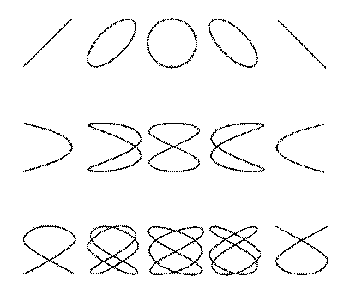
 However, in this example, the two degrees of freedom are independent, meaning that there is uncoupled motion in the two directions. The amplitude of the oscillations is governed by the total energy of the system, which is a constant of the motion. Other than this, the type of behaviour displayed by this system is very rich, as exemplified by the various Lissajous figures shown in the diagram below. Note that all these figures are produced by the same type of dynamical system of equations: the different shapes are consequences of different initial conditions and different coefficients (which I set to unity in the form above).
 

 If the oscillations in each direction have the same frequency then one can get an orbit which is a line or an ellipse. If the frequencies differ then the orbits can be much more complicated, but still pretty. Note that in all these cases the orbit is just a line, i.e. a one-dimensional part of the two-dimensional space drawn on the paper.

More generally, one can think of this system as a point moving in a four-dimensional phase space defined by the coordinates q1, q2, p1 and p2; taking slices through this space reveals qualitatively similar types of orbit for, say, p2 and q2 as for p1 and p2. The motion of the system is confined to a lower-dimensional part of the phase space rather than filling up all the available phase space. In this particular case, because each degree of freedom moves in only one of its two available dimensions, the system as a whole moves in a two-dimensional part of the four-dimensional space.

This all applies to the original, unperturbed system. Hénon and Heiles took this simple model and modified by adding a term to the Hamiltonian that was cubic rather than quadratic and which coupled the two degrees of freedom together. For those of you interested in the details their Hamiltonian was of the form

 H=\frac{1}{2} \left( q_1^2+p_1^2 + q_2^2+p_2^2\right) +q_1^2q_2+ \frac{1}{3}q_2^3


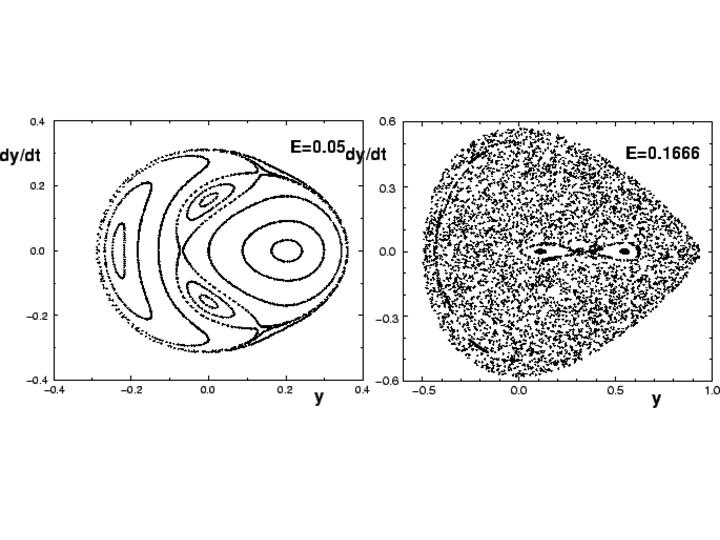
The first set of terms in the brackets is the unmodified form, describing a simple harmonic oscillator; the other two terms are new. The result of this simple alteration is really quite surprising. They found that, for low energies, the system continued to behave like two uncoupled oscillators; the orbits were smooth and well-behaved. This is not surprising because the cubic modifications are smaller than the original quadratic terms if the amplitude is small.  For higher energies the motion becomes a bit more complicated, but the phase space behaviour is still characterized by continuous lines, as shown in the left hand part of the following figure.
 

However, at higher values of the energy (right), the cubic terms become more important, and something very striking happens. A two-dimensional slice through the phase space no longer shows the continuous curves that typify the original system, but a seemingly disorganized scattering of dots. It is not possible to discern any pattern in the phase space structure of this system: it appear to be random.


Nowadays we describe the transition from these two types of behaviour as being accompanied by the onset of chaos. It is important to note that this system is entirely deterministic, but it generates a phase space pattern that is quite different from what one would naively expect from the behaviour usually associated with classical Hamiltonian systems. To understand how this comes about it is perhaps helpful to think about predictability in classical systems. It is true that precise knowledge of the state of a system allows one to predict its state at some future time.  For a single particle this means that precise knowledge of its position and momentum, and knowledge of the relevant H, will allow one to calculate the position and momentum at all future times.

But think a moment about what this means. What do we mean by precise knowledge of the particle’s position? How precise? How many decimal places? If one has to give the position exactly then that could require an infinite amount of information. Clearly we never have that much information. Everything we know about the physical world has to be coarse-grained to some extent, even if it is only limited by measurement error. Strict determinism in the form advocated by Laplace is clearly a fantasy. Determinism is not the same as predictability.

In “simple” Hamiltonian systems what happens is that two neighbouring phase-space paths separate from each other in a very controlled way as the system evolves. In fact the separation between paths usually grows proportionally to time. The coarse-graining with which the input conditions are specified thus leads to a similar level of coarse-graining in the output state. Effectively the system is predictable, since the uncertainty in the output is not much larger than in the input.

In the chaotic system things are very different. What happens here is that the non-linear interactions represented in the Hamiltonian play havoc with the initial coarse-graining. Phase-space orbits that start out close to each other separate extremely violently (typically exponentially) and in a way that varies from one part of the phase space to another.  What happens then is that particle paths become hopelessly scrambled and the mapping between initial and final states becomes too complex to handle. What comes out  the end is practically impossible to predict.

The Academic Journal Racket

Posted in Open Access, Science Politics with tags , , , , , on November 18, 2009 by telescoper

I’ve had this potential rant simmering away at the back of my mind for a while now, since our last staff meeting to be precise.  In common, I suspect, with many other physics and astronomy departments, here at Cardiff we’re bracing ourselves for an extended period of budget cuts to help pay for our government’s charitable donations of taxpayer’s money to the banking sector.

English universities are currently making preparations for a minimum 10% reduction in core funding, and many are already making significant numbers of redundancies. We don’t know what’s going to happen to us here in Wales yet, but I suspect it will be very bad indeed.

Anyway, one of the items of expenditure that has been identified as a source of savings as we try to tighten our collective belts is the cost of academic journals.  I nearly choked when the Head of School revealed how much we spend per annum on some of the journal subscriptions for physics and astronomy.  In fact, I think university and departmental libraries are being taken to the cleaners by the academic publishing industry and it’s time to make a stand.

Let me single out one example. Like many learned societies, the Institute of Physics (the professional organisation for British physicists) basically operates like a charity. It does, however, have an independent publishing company that is run as a profit-making enterprise. And how.

In 2009 we paid almost £30K (yes, THIRTY THOUSAND POUNDS) for a year’s subscription to the IOP Physics package, a bundled collection  of mainstream physics journals. This does not include Classical and Quantum Gravity or the Astrophysical Journal (both of which I have published in occasionally) which require additional payments running into thousands of pounds.

The IOP is not the only learned society to play this game. The Royal Astronomical Society also has a journal universally known as MNRAS (Monthly Notices of the Royal Astronomical Society) which earns it a considerable amount of revenue from its annual subscription of over £4K per department. Indeed, I don’t think it is inaccurate to say that without the income from MNRAS the RAS itself would face financial oblivion. I dare say MNRAS also earns a tidy sum for its publisher Wiley

If you’re not already shocked by the cost of these subscriptions, let me  outline the way academic journal business works, at least in the fields of physics and astronomy. I hope then you’ll agree that we’re being taken to the cleaners.

First, there is the content. This consists of scientific papers submitted to the journal by researchers, usually (though not exclusively) university employees. If the paper is accepted for publication the author receives no fee whatsoever and in some cases even has to pay “page charges” for the privilege of seeing the paper in print. In return for no fee, the author also has to sign over the copyright for the manuscript to the publisher. This is entirely different from the commercial magazine  market, where contributors are usually paid a fee for writing a piece, or  book publishing, where authors get a royalty on sales (and sometimes an advance).

Next there is the editorial process. The purpose of an academic journal – if there is one – is to ensure that only high quality papers are published. To this end it engages a Board of Editors to oversee this aspect of its work. The Editors are again usually academics and, with a few exceptions, they undertake the work on an unpaid basis. When a paper arrives at the journal which lies within the area of expertise of a particular editor, he or she identifies one or more suitable referees drawn from the academic community to provide advice on whether to publish it. The referees are expected to read the paper and provide comments as well as detailed suggestions for changes. The fee for referees? You guess it. Zilch. Nada.

The final part of the business plan is to sell the content (supplied for free), suitably edited (for free) and refereed (for free) back to the universities  paying the wages of the people who so generously donated their labour. Not just sell, of course, but sell at a grossly inflated price.

Just to summarise, then: academics write the papers, do the refereeing and provide the editorial oversight for free and we then buy back the product of our labours at an astronomical price. Why do we participate in this ridiculous system? Am I the only one who detects the whiff of rip-off? Isn’t it obvious that we (I mean academics in universities) are spending a huge amout of time and money achieving nothing apart from lining the pockets of these exploitative publishers?

And if it wasn’t bad enough, there’s also the matter of inflation. There used to be a myth that advances in technology should lead to cheaper publishing.Nowadays authors submit their manuscripts electronically, they are sent electronically to referees and they are typset automatically if and when accepted. Most academics now access journals online rather than through paper copies; in fact some publications are only published electronically these days. All this may well lead to cheaper publishing but it doesn’t lead to cheaper subscriptions. The forecast inflation rate for physics journals over this year is about 8.5%, way above the Retail Price Index, which is currently negative.

Where is all the money going? Right into the pockets of the journal publishers. Times are tough enough in the university sector without us giving tens of thousands of pounds per year, plus free editoral advice and the rest, to these rapacious companies. Enough is enough.

It seems to me that it would be a very easy matter to get rid of academic journals entirely (at least from the areas of physics and astronomy that I work in). For a start, we have an excellent free repository (the arXiv) where virtually every new research paper is submitted. There is simply no reason why we should have to pay for journal subscriptions when papers are publically available there. In the old days, the journal industry had to exist in order for far flung corners of the world to have access to the latest research. Now everyone with an internet connection can get it all. Journals are redundant.

The one thing the arXiv does not do is provide editorial control, which some people argue is why we have to carry on being fleeced in the way I have described. If there is no quality imprint from an established journal how else would researchers know which papers to read? There is a lot of dross out there.

For one thing,  not all referees put much effort into their work so there’s a lot of dross in refereed journals anyway. And, frustratingly, many referees sit on papers for months on end before sending in a report that’s only a couple of sentences. Far better, I would say, to put the paper on the arXiv and let others comment on it, either in private with the authors or perhaps each arXiv entry should have a comments facility, like a blog, so that the paper could be discussed interactively. The internet is pushing us in a direction in which the research literature should be discussed much more openly than it is at present, and in which it evolves much more as a result of criticisms and debate.

Finally, the yardstick by which research output is now being measured – or at least one of the metrics – is not so much a count of the number of refereed papers, but the number of citations the papers have attracted. Papers begin to attract citations – through the arXiv – long before they appear in a refereed journal and good papers get cited regardless of where they are eventually published.

If you look at citation statistics for refereed journals you will find it very instructive. A sizeable fraction of papers published in the professional literature receive no citations at all in their lifetime. So we end up paying over the odds for papers that nobody even bothers to read. Madness.

It could be possible for the arXiv (or some future version of it) to have its own editorial system, with referees asked to vet papers voluntarily. I’d be much happier giving my time in this way for a non-profit making system than I am knowing that I’m aiding and abetting racketeers. However, I think I probably prefer the more libertarian solution. Put it all on the net with minimal editorial control and the good stuff will float to the top regardless of how much crud there is.

Anyway, to get back to the starting point of this post, we have decided to cancel a large chunk of our journal subscriptions, including the IOP Physics package which is costing us an amount close to the annual salary of  a lecturer. As more and more departments decide not to participate in this racket, no doubt the publishers will respond by hiking the price for the remaining customers. But it seems to me that this lunacy will eventually have to come to an end.

And if the UK university sector has to choose over the next few years between sacking hundreds of academic staff and ditching its voluntary subsidy to the publishing industry, I know what I would pick…

For Your Listening Pleasure…

Posted in The Universe and Stuff with tags , , , on November 12, 2009 by telescoper

Well, this is blogging made easy. I’ve just cut-and-pasted the following item directly from the School’s news page with very few alterations, but it’s all done for a good reason, so please read on:

A leading member of the School of Physics and Astronomy at Cardiff University, whose research helped create one of the most powerful and ambitious astronomical satellites ever made will feature in a two-part Radio 4 programme.

The Herschel Space Telescope is a two-part series to be aired on Radio 4 on Wednesday 18th November, 11:00-11:30am and Wednesday 25th November, 11:00-11:30am. BBC science reporter Jonathan Amos follows the engineers and scientists working on the SPIRE instrument for the European Space Agency’s Herschel satellite. Herschel is one of the most important missions in the history of European spaceflight and was launched successfully on May 14 this year.

The SPIRE instrument was built by an international team led by Professor Matt Griffin, School of Physics and Astronomy. The programme tells the story of the UK SPIRE team, including several members from Cardiff, as they prepared for the launch of Herschel and as the first results came in.

As well as Professor Griffin, other members of staff in the School of Physics and Astronomy who contributed to the project are also featured. They include: Professor Steve Eales, Dr Jon Davies, Dr Kate Isaak, and Dr Pete Hargrave as well as post-doctoral researchers Dr Jason Kirk, Dr Michael Pohlen, and Dr Luca Cortese.

Professor Matt Griffin

Herschel carries the biggest mirror ever sent to space and is already giving astronomers their best view yet of the Universe at far-infrared and sub-millimetre wavelengths. It can peer through obscuring clouds of dust to look at the early stages of star birth and galaxy formation; it can examine the composition and chemistry of comets and planetary atmospheres in the Solar System; and it is able to study the star-dust ejected by dying stars into interstellar space which forms the raw material for planets like the Earth.

Professor Griffin said: “With its big telescope and sophisticated and sensitive instruments, including SPIRE, Herschel is a very powerful observatory for many studies from our own solar system to the most distant galaxies. Already we can see that its results will reveal how stars like the Sun are forming in our own galaxy today, how planetary systems can develop from the dust and gas around young stars, and how the galaxies grew and evolved over cosmic time.

“Astronomers from Cardiff are at the forefront in making these exciting scientific discoveries – we are delighted that the work of Cardiff scientists will be featured in such an important radio programme.”

I should also point out that BBC Radio 4 programmes can be listened to online, and are available to download for a week after the broadcast from the BBC website (even to foreigners).

PS. I should also mention that today’s “Material World” (another Radio 4 programme) was a special edition from Cardiff University and also featured an astronomy item. If you missed it, or if you want to hear it again, you can listen to it here.


I want it painted … beige?

Posted in The Universe and Stuff with tags , , , , , on November 4, 2009 by telescoper

I was quite pleased when I saw that Pass Notes No 2,677 in Today’s Guardian was about “the universe”. Like the other pieces in this series, it looks at the subject matter from a deliberately bizarre angle, focussing on the fact that it appears to be coloured beige, or at least if you blend the light from all the stars we can see in the right proportions, that’s the colour you would get.

Actually the work discussed in this item was done quite along time ago; it was featured in a New Scientist article in 2002. One of the authors, Karl Glazebrook had previously claimed that the colour produced by all the stars in all the galaxies that could be seen was in fact something like turquoise. For some reason, this trivial bit of science fluff captured the (obviously limited) imagination of journalists around the world. However it turned out to be have been wrong and a grave announcement was made pointing out that the Universe was actually more like beige. This story gave a few people their 15 minutes of fame, but I think the episode made cosmologists as a whole look very silly.

I had hoped this would be forgotten but, the Guardian decided to revive memories of the affair today, with obviously humorous intent. They also called Glazebrook an “astrologist”, although that appears to have been a mistake rather than a joke as it has now been changed to “astrophysicist”.

Anyway, this important observation requires a theoretical explanation and I now want to step into the limelight beigelight to offer a radical insight into the vexed issue of cosmological chromaticity.
My hypothesis has its inspiration in TV shows like House Doctor in which homeowners wishing to impress prospective purchasers are always advised to paint everything beige or magnolia. Since the Divine Creator appears to have decorated the Universe according to the same prescription, the obvious inference is that the cosmos is about to be put on the market. He might have had the courtesy to tell the sitting tenants.

Come to think of it, Glazebrook missed a trick here. We astrophysicists are always being castigated for not doing anything that leads to wealth creation. What he should have done was to produce a paint with the same colour as the Universe. Glazebrook Beige has a nice ring to it.

The Edge of Darkness

Posted in The Universe and Stuff with tags , , , on October 29, 2009 by telescoper

I just picked up an item from the BBC Website that refers to news announced in this week’s edition of Nature of the discovery of a gamma-ray burst detected by NASA’s Swift satellite.  The burst itself was detected in April this year and I had a sneak preview that something exciting was going to be announced earlier this month at the Royal Astronomical Society meeting on October 9th. However, today’s press releases still managed to catch me on the hop owing to the fact that a rather different story had distracted my attention…

In fact, detections of gamma-ray bursts are not all that rare. Swift observes one every few days on average. Once such a source is found through its gamma-ray emission, a signal is sent to astronomers around the world who then work like crazy to detect an optical counterpart. If and when they find one, they try to measure the spectrum of light emitted in order to determine the source’s redshift. This is very difficult for the distant ones, and is not  always successful.

However, what happened in this case – called GRB 090423 – was that a spectrum was that not one but two independent teams obtained optical spectra of the  object in which the gamma-ray burst must have happened. What each time found was that their spectrum showed a sharp cut-off at wavelengths shorter than a given limiting value.

Hydrogen is very effective at absorbing radiation with wavelengths shorter than 91.2 nm (the so-called Lyman limit, which is in the ultraviolet part of the spectrum), and all galaxies contain large amounts of hydrogen; hence galaxies are virtually dark at wavelengths shorter than 91.2 nm in their rest-frame. The position of the break in an observed frame will be at a different wavelength owing to the effect of the cosmological redshift.

The Lyman break for the host of  GRB 090423 appears not in the ultraviolet but in the infrared, indicating a very large redshift. In fact, it’s a truly spectacular  8.2.

Together with the direct observations of galaxies at high redshifts I blogged about a month or so ago, this discovery helps push back the frontiers of our knowledge of the Universe not just in space but also in time. A quick calculation reveals that in the standard cosmological model, light from a source at redshift 8.2 has taken about 13.1 billion light years to reach us. The gamma-ray burst therefore exploded about 600 million years after the Big Bang.

Another interesting thing about this source is its duration. The optical afterglow of a gamma-ray burst  decays with time. Gamma-ray bursts are usually classified as either short or long, depending on the decay time with the dividing line between the two classes being around 2 seconds. The optical afterglow of GRB 090423 lasted about ten seconds. But that doesn’t make it a long burst. We actually see the afterglow stretched out in time by the same redshift factor as an individual photon’s wavelength. So in the rest frame of the source the optical glow was only a bit over a second in duration, i.e. it was a short burst.

Long gamma-ray bursts are thought to be associated with core-collapse supernovae which arise from the self-destruction of very massive stars with very short lifetimes. The fact that such things die young means that they are only found where star formation has happened very recently. One might expect the earliest gamma-ray bursts to therefore be of this type.

I don’t think anyone is really sure what the shorter ones really are, but they  seem to happen in regions without active star formation in which the stellar populations are quite old, such as in elliptical galaxies. The fact that the most distant GRB yet discovered happens to be a short burst is very interesting. How can there be an old stellar population at a time when the  Universe itself was so young?

If the Big Bang theory is correct, astronomers  should eventually be able to reach back so far in time that the Universe was so young that no stars had had time to form. There would be no sources of light to detect so we would have reached the edge of darkness. We’re not there yet, but we’re getting closer.

Exploitation

Posted in Poetry, Science Politics with tags , , on October 27, 2009 by telescoper

At the last Meeting of the RAS Council on October 9th 2009, Professor Keith Mason, Chief Executive of the Science and Technology Facilities Council (STFC), made a presentation after which he claimed that STFC spends too much on “exploitation”, i.e. on doing science with the facilities it provides. This statement clearly signals an intention to cut grants to research groups still further and funnel a greater proportion of STFC’s budget into technology development rather than pure research.

Following on from Phillip Helbig’s challenge a couple of posts ago, I decided to commemorate the occasion with an appropriate sonnet, inspired by Shakespeare’s Sonnet 14.

TO.THE.ONLIE.BEGETTER.OF.THIS.INSU(LT)ING.SONNET.

Mr K.O.M.

It seems Keith Mason doesn’t give a fuck
About the future of Astronomy.
“The mess we’re in is down to rotten luck
And our country’s  ruin’d economy”;
Or that’s the tale our clueless leader tells
When oft by angry critics he’s assailed,
Undaunted he in Swindon’s office dwells
Refusing to accept it’s him that failed.
And now he tells us we must realise:
We spend “too much on science exploitation”.
Forget the dreams of research in blue skies
The new name of the game is wealth creation.
A truth his recent statement underlines
Is that we’re doomed unless this man resigns.

I could not sleep for thinking of the sky

Posted in Poetry with tags , on October 21, 2009 by telescoper

A comment from another blogger about an item of mine containing another bit of poetry led me to put up this astronomy-inspired poem, by the former Poet Laureate John Masefield. It’s from a cycle called Lollingdown Downs, and is actually the 12th poem in the sequence. I hope you like it.

I could not sleep for thinking of the sky,
The unending sky, with all its million suns
Which turn their planets everlastingly
In nothing, where the fire-haired comet runs.

If I could sail that nothing, I should cross
Silence and emptiness with dark stars passing,
Then, in the darkness, see a point of gloss
Burn to a glow, and glare, and keep amassing,

And rage into a sun with wandering planets
And drop behind, and then, as I proceed,
See his last light upon his last moon’s granites
Die to a dark that would be night indeed.

Night where my soul might sail a million years
In nothing, not even death, not even tears.


I Did Expect the Spanish Inquisition…

Posted in Biographical, Science Politics with tags , , , on October 14, 2009 by telescoper

So that was it. D-Day.

Our application to the Science and Technology Facilities Council (STFC) for a rolling grant to cover the next 5 years of astronomy research went in a  few months ago. Over the summer we got feedback from independent referees. But today was the crunch. The dreaded panel visit.

In the old days the grants panel used to visit the applicants at their own institute, chat to the postdocs and staff, help themselves to free food, and generally get a feel for the place over a period of a couple of days. Now, all that cosiness has gone. Nowadays the applicants visit the panel.  Mohammed and the Mountain and all that (except I’m not sure which is which).

A large group of astronomers are involved in this application, but STFC rules permit only three representatives to make the pilgrimage to Swindon in order to testify in front of the experts. I was among the chosen few, although I was not particularly grateful for this honour.

This would have been stressful enough, but there is grim talk of slashed budgets and looming financial disaster for UK astronomy. The successful launch of Planck and Herschel in May, followed by the exceptionally promising snippets of data that we’ve been getting, has strengthened what was already a very strong case. These events should have given us all the cards. The trouble is, it looks like the casino has gone bust.

We were all a bit nervous, I can tell you, as we travelled to Swindon on the early train from Cardiff. Steve Eales is Principal Investigator on the grant and he’s a self-confessed morning person so he went on a ludicrously early train in case something happened to delay him. Derek Ward-Thompson and I followed on a more sensible one, but we all got there safely and on time in the end.

We started with a presentation by Steve which he delivered in superb style, keeping exactly to time but also ticking all the boxes we were asked to cover in the instructions we got. The science updates from the last 6 months are really impressive, and it was all made even more dramatic when he told the panel that the new Herschel images they were seeing were not public and therefore that they shouldn’t look at them.

Then we were due for 45 minutes questioning by the panel. I thought it might be something like Blind Date because there were three of us to do the answering. Question Number One for Contestant Number Two, that sort of thing, except that we anticipated slightly more technical questions and we weren’t expecting Cilla Black to be there.

But there weren’t many questions at all. In fact, I had only one question (on the cosmology part). It was curiously anti-climactic after having had a near-sleepless night worrying about it. This could mean either that they’d already decided to close us down, that they’d already decided we were brilliant, or that they already knew there was no money so there wasn’t any point in asking anything.

So 25 minutes into the 45 allotted we were shown the door and headed back to Cardiff by train. It was like Monty Python in reverse: we did expect the Spanish Inquisition, but it never happened…

We jabbered nervously on the return journey because the adrenalin was still going, speculating about what it all meant but not coming to any real conclusions except that Steve had given a great presentation and that we had all answered the questions as well as we could have been expected to. It’s all out of our hands now.

The trouble is that we’re not likely to get a new grant announcement until April 2010, which is actually when the grant is supposed to start. The postdoctoral researchers we currently employ will have to wait until then to hear about possible extensions to their contracts. Perhaps by April  the management will have sorted out the current STFC crisis so we can get on and do some science with the wonderful new data.

On the other hand, perhaps not….