Archive for astronomy

Another Day at the ArXiv..

Posted in Cosmic Anomalies, The Universe and Stuff with tags , , , , , , , on October 8, 2009 by telescoper

Every now and again I remember that this is supposed to be some sort of science blog. This happened again this morning after three hours of meetings with my undergraduate project students. Dealing with questions about simulating the cosmic microwave background, measuring the bending of light during an eclipse, and how to do QCD calculations on a lattice reminded me that I’m supposed to know something about stuff like that.

Anyway, looking for something to post about while I eat my lunchtime sandwich, I turned to the estimable arXiv and turned to the section marked astro-ph, and to the new submissions category, for inspiration.

I’m one of the old-fashioned types who still gets an email every day of the new submissions. In the old days there were only a few, but today’s new submissions were 77 in number, only about half-a-dozen of which seemed directly relevant to things I’m interested in. It’s always a bit of a struggle keeping up and I often miss important things. There’s no way I can read as widely around my own field as I would like to, or as I used to in the past, but that’s the information revolution for you…

Anyway, the thing that leapt out at me first was an interesting paper by Dikarev et al (accepted for publication in the Astrophysical Journal) that speculates about the possibility that dust grains in the solar system might be producing emission that messes up measurements of the cosmic microwave background, thus possibly causing the curious cosmic anomalies seen by WMAP I’ve blogged about on more than one previous occasion.

Their abstract reads:

Analyses of the cosmic microwave background (CMB) radiation maps made by the Wilkinson Microwave Anisotropy Probe (WMAP) have revealed anomalies not predicted by the standard inflationary cosmology. In particular, the power of the quadrupole moment of the CMB fluctuations is remarkably low, and the quadrupole and octopole moments are aligned mutually and with the geometry of the Solar system. It has been suggested in the literature that microwave sky pollution by an unidentified dust cloud in the vicinity of the Solar system may be the cause for these anomalies. In this paper, we simulate the thermal emission by clouds of spherical homogeneous particles of several materials. Spectral constraints from the WMAP multi-wavelength data and earlier infrared observations on the hypothetical dust cloud are used to determine the dust cloud’s physical characteristics. In order for its emissivity to demonstrate a flat, CMB-like wavelength dependence over the WMAP wavelengths (3 through 14 mm), and to be invisible in the infrared light, its particles must be macroscopic. Silicate spheres from several millimetres in size and carbonaceous particles an order of magnitude smaller will suffice. According to our estimates of the abundance of such particles in the Zodiacal cloud and trans-neptunian belt, yielding the optical depths of the order of 1E-7 for each cloud, the Solar-system dust can well contribute 10 microKelvin (within an order of magnitude) in the microwaves. This is not only intriguingly close to the magnitude of the anomalies (about 30 microKelvin), but also alarmingly above the presently believed magnitude of systematic biases of the WMAP results (below 5 microKelvin) and, to an even greater degree, of the future missions with higher sensitivities, e.g. PLANCK.

I haven’t read the paper in detail yet, but will definitely do so. In the meantime I’d be interested to hear the reaction to this claim from dusty experts!

Of course we know there is dust in the solar system, and were reminded of this in spectacular style earlier this week by the discovery (by the Spitzer telescope) of an enormous new ring around Saturn.

That tenuous link gives me an excuse to include a gratuitous pretty picture:

It may look impressive, but I hope things like that are not messing up the CMB. Has anyone got a vacuum cleaner?

The Milky Way in a New Light

Posted in The Universe and Stuff with tags , , , , , on October 2, 2009 by telescoper

I note that the Herschel mission now has its own blog, so I no longer have to try to remember to put all the sexy images on here. However, at the end of a worrying week for UK astronomy, I thought it would be a good idea to put up one of the wonderful new infra-red images of the Milky Way just obtained from Herschel. This is the first composite colour picture made in “parallel mode”, i.e. by using the PACS and SPIRE instruments together. Together the two instruments cover a wavelength range from 70 to 500 microns. The resulting image uses red to represent the cooler long-wavelength emission (seen by SPIRE) and bluer colours show hotter areas. The region of active star formation shown is close to the Galactic plane; detailed images such as this, showing the intricate filamentary structure of the material in this stellar nursery, will help us to understand better how what the complex processes involved in stellar birth.

Medawar on Johnson on Milton on Science

Posted in Science Politics with tags , , , , on October 1, 2009 by telescoper

Have recent events left you with a sinking feeling that science isn’t valued in today’s modern world? Are you aggrieved that the great and the good nowadays seem to be so unimpressed by research for research’s sake and require us instead to divert our energies into “useful things” (whatever they are)?

Looking for something to optimistic to say I turned to Peter Medawar‘s book Advice to a Young Scientist and found, to my disappointment, that actually there’s nothing new about this attitude. For example, Medawar explains, no less a character than Dr Samuel Johnson, in his Life of Milton  offered the following rant about Milton’s daft idea of setting up an academy in which the scholars should learn astronomy physics and chemistry as well as the usual school subjects:

But the truth is that the knowledge of external nature, and the sciences which that knowledge requires or includes, are not the great or the frequent business of the human mind. Whether we provide for action or conversation, whether we wish to be useful or pleasing, the first requisite is the religious and moral knowledge of right and wrong; the next is an acquaintance with the history of mankind, and with those examples which may be said to embody truth and prove by events the reasonableness of opinions. Prudence and Justice are virtues and excellences of all times and of all places; we are perpetually moralists, but we are geometricians only by chance. Our intercourse with intellectual nature is necessary; our speculations upon matter are voluntary and at leisure. Physiological learning is of such rare emergence that one man may know another half his life without being able to estimate his skill in hydrostaticks or astronomy, but his moral and prudential character immediately appears.

Medawar attempts to cheer up his readers  by responding with the following feeble platitude

Scientists whose work is prospering and who find themselves deeply absorbed in and transported by their research feel quite sorry for those who do not share the same sense of delight; many artists feel the same, and it makes them indifferent to – and is certainly a fully adequate compensation for –  any respect they think owed to them by the general public.

Tripe. Delight doesn’t put your dinner on the table. It’s not enough to feel smug about how clever you are: we need to convince people that science is worth doing because it’s worth doing for its own sake, and worth funding by the taxpayer for the same reason. Feeling sorry for people who don’t get the message is a sickeningly patronising attitude to take.

I should point out that the rest of the book isn’t all as bad as this, but  the mood I’m in today the best advice I could offer a young scientist at the moment wouldn’t require a whole book anyway:

Don’t!

Alarm Bells at STFC

Posted in Science Politics with tags , , on September 30, 2009 by telescoper

The  financial catastrophe engulfing the Science and Technology Facilities Council (STFC) has suddenly reared its (very ugly) head again.

Here is a statement posted yesterday on their webpage.

STFC Council policy on grants

STFC Council examined progress of its current science and technology prioritisation exercise at a strategy session on 21 and 22 September. Without prejudging the outcome of the prioritisation, Council agreed that prudent financial management required a re-examination of upcoming grants.

Council therefore agreed that new grants will be issued only to October 2010 in the first instance. This temporary policy is in place pending the outcome of the prioritisation exercise, expected in the New Year.

According to the e-astronomer the  STFC  has written to all Vice-chancellors and Principals of UK universities to tell them about this move. I gather the intention is that this measure will be temporary, but it looks deeply ominous to me. Those of us whose rolling grant requests for  5 years from April 2010 are currently being assessed face the possibility of receiving grants for only 6 months of funding. On the other hand, I’m told that what is more likely is that our grant won’t be announced until January or February, after the hitlist prioritisation exercise has been completed in the New Year. Hardest hit will be the particle physicists whose rolling grants start on 1st October 2009 (tomorrow), which will have only a year’s funding on them…

It seems that STFC has finally realised the scale of its budgetary problems and payback time is looming. I honestly think we could be doomed…

Index Rerum

Posted in Biographical, Science Politics with tags , , , , , , , , , on September 29, 2009 by telescoper

Following on from yesterday’s post about the forthcoming Research Excellence Framework that plans to use citations as a measure of research quality, I thought I would have a little rant on the subject of bibliometrics.

Recently one particular measure of scientific productivity has established itself as the norm for assessing job applications, grant proposals and for other related tasks. This is called the h-index, named after the physicist Jorge Hirsch, who introduced it in a paper in 2005. This is quite a simple index to define and to calculate (given an appropriately accurate bibliographic database). The definition  is that an individual has an h-index of  h if that individual has published h papers with at least h citations. If the author has published N papers in total then the other N-h must have no more than h citations. This is a bit like the Eddington number.  A citation, as if you didn’t know,  is basically an occurrence of that paper in the reference list of another paper.

To calculate it is easy. You just go to the appropriate database – such as the NASA ADS system – search for all papers with a given author and request the results to be returned sorted by decreasing citation count. You scan down the list until the number of citations falls below the position in the ordered list.

Incidentally, one of the issues here is whether to count only refereed journal publications or all articles (including books and conference proceedings). The argument in favour of the former is that the latter are often of lower quality. I think that is in illogical argument because good papers will get cited wherever they are published. Related to this is the fact that some people would like to count “high-impact” journals only, but if you’ve chosen citations as your measure of quality the choice of journal is irrelevant. Indeed a paper that is highly cited despite being in a lesser journal should if anything be given a higher weight than one with the same number of citations published  in, e.g., Nature. Of course it’s just a matter of time before the hideously overpriced academic journals run by the publishing mafia go out of business anyway so before long this question will simply vanish.

The h-index has some advantages over more obvious measures, such as the average number of citations, as it is not skewed by one or two publications with enormous numbers of hits. It also, at least to some extent, represents both quantity and quality in a single number. For whatever reasons in recent times h has undoubtedly become common currency (at least in physics and astronomy) as being a quick and easy measure of a person’s scientific oomph.

Incidentally, it has been claimed that this index can be fitted well by a formula h ~ sqrt(T)/2 where T is the total number of citations. This works in my case. If it works for everyone, doesn’t  it mean that h is actually of no more use than T in assessing research productivity?

Typical values of h vary enormously from field to field – even within each discipline – and vary a lot between observational and theoretical researchers. In extragalactic astronomy, for example, you might expect a good established observer to have an h-index around 40 or more whereas some other branches of astronomy have much lower citation rates. The top dogs in the field of cosmology are all theorists, though. People like Carlos Frenk, George Efstathiou, and Martin Rees all have very high h-indices.  At the extreme end of the scale, string theorist Ed Witten is in the citation stratosphere with an h-index well over a hundred.

I was tempted to put up examples of individuals’ h-numbers but decided instead just to illustrate things with my own. That way the only person to get embarrased is me. My own index value is modest – to say the least – at a meagre 27 (according to ADS).   Does that mean Ed Witten is four times the scientist I am? Of course not. He’s much better than that. So how exactly should one use h as an actual metric,  for allocating funds or prioritising job applications,  and what are the likely pitfalls? I don’t know the answer to the first one, but I have some suggestions for other metrics that avoid some of its shortcomings.

One of these addresses an obvious deficiency of h. Suppose we have an individual who writes one brilliant paper that gets 100 citations and another who is one author amongst 100 on another paper that has the same impact. In terms of total citations, both papers register the same value, but there’s no question in my mind that the first case deserves more credit. One remedy is to normalise the citations of each paper by the number of authors, essentially sharing citations equally between all those that contributed to the paper. This is quite easy to do on ADS also, and in my case it gives  a value of 19. Trying the same thing on various other astronomers, astrophysicists and cosmologists reveals that the h index of an observer is likely to reduce by a factor of 3-4 when calculated in this way – whereas theorists (who generally work in smaller groups) suffer less. I imagine Ed Witten’s index doesn’t change much when calculated on a normalized basis, although I haven’t calculated it myself.

Observers  complain that this normalized measure is unfair to them, but I’ve yet to hear a reasoned argument as to why this is so. I don’t see why 100 people should get the same credit for a single piece of work:  it seems  like obvious overcounting to me.

Another possibility – if you want to measure leadership too – is to calculate the h index using only those papers on which the individual concerned is the first author. This is  a bit more of a fiddle to do but mine comes out as 20 when done in this way.  This is considerably higher than most of my professorial colleagues even though my raw h value is smaller. Using first author papers only is also probably a good way of identifying lurkers: people who add themselves to any paper they can get their hands on but never take the lead. Mentioning no names of  course.  I propose using the ratio of  unnormalized to normalized h-indices as an appropriate lurker detector…

Finally in this list of bibliometrica is the so-called g-index. This is defined in a slightly more complicated way than h: given a set of articles ranked in decreasing order of citation numbers, g is defined to be the largest number such that the top g articles altogether received at least g2 citations. This is a bit like h but takes extra account of the average citations of the top papers. My own g-index is about 47. Obviously I like this one because my number looks bigger, but I’m pretty confident others go up even more than mine!

Of course you can play with these things to your heart’s content, combining ideas from each definition: the normalized g-factor, for example. The message is, though, that although h definitely contains some information, any attempt to condense such complicated information into a single number is never going to be entirely successful.

Comments, particularly with suggestions of alternative metrics are welcome via the box. Even from lurkers.

Astrostats

Posted in Bad Statistics, The Universe and Stuff with tags , , , , , , , , , on September 20, 2009 by telescoper

A few weeks ago I posted an item on the theme of how gambling games were good for the development of probability theory. That piece  contained a mention of one astronomer (Christiaan Huygens), but I wanted to take the story on a little bit to make the historical connection between astronomy and statistics more explicit.

Once the basics of mathematical probability had been worked out, it became possible to think about applying probabilistic notions to problems in natural philosophy. Not surprisingly, many of these problems were of astronomical origin but, on the way, the astronomers that tackled them also derived some of the basic concepts of statistical theory and practice. Statistics wasn’t just something that astronomers took off the shelf and used; they made fundamental contributions to the development of the subject itself.

The modern subject we now know as physics really began in the 16th and 17th century, although at that time it was usually called Natural Philosophy. The greatest early work in theoretical physics was undoubtedly Newton’s great Principia, published in 1687, which presented his idea of universal gravitation which, together with his famous three laws of motion, enabled him to account for the orbits of the planets around the Sun. But majestic though Newton’s achievements undoubtedly were, I think it is fair to say that the originator of modern physics was Galileo Galilei.

Galileo wasn’t as much of a mathematical genius as Newton, but he was highly imaginative, versatile and (very much unlike Newton) had an outgoing personality. He was also an able musician, fine artist and talented writer: in other words a true Renaissance man.  His fame as a scientist largely depends on discoveries he made with the telescope. In particular, in 1610 he observed the four largest satellites of Jupiter, the phases of Venus and sunspots. He immediately leapt to the conclusion that not everything in the sky could be orbiting the Earth and openly promoted the Copernican view that the Sun was at the centre of the solar system with the planets orbiting around it. The Catholic Church was resistant to these ideas. He was hauled up in front of the Inquisition and placed under house arrest. He died in the year Newton was born (1642).

These aspects of Galileo’s life are probably familiar to most readers, but hidden away among scientific manuscripts and notebooks is an important first step towards a systematic method of statistical data analysis. Galileo performed numerous experiments, though he certainly carry out the one with which he is most commonly credited. He did establish that the speed at which bodies fall is independent of their weight, not by dropping things off the leaning tower of Pisa but by rolling balls down inclined slopes. In the course of his numerous forays into experimental physics Galileo realised that however careful he was taking measurements, the simplicity of the equipment available to him left him with quite large uncertainties in some of the results. He was able to estimate the accuracy of his measurements using repeated trials and sometimes ended up with a situation in which some measurements had larger estimated errors than others. This is a common occurrence in many kinds of experiment to this day.

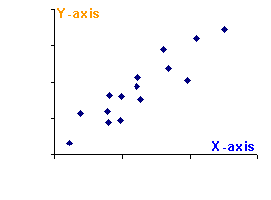
Very often the problem we have in front of us is to measure two variables in an experiment, say X and Y. It doesn’t really matter what these two things are, except that X is assumed to be something one can control or measure easily and Y is whatever it is the experiment is supposed to yield information about. In order to establish whether there is a relationship between X and Y one can imagine a series of experiments where X is systematically varied and the resulting Y measured.  The pairs of (X,Y) values can then be plotted on a graph like the example shown in the Figure.
XY

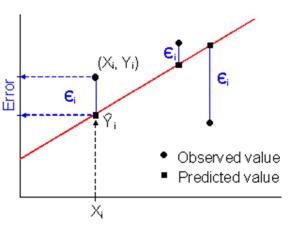
In this example on it certainly looks like there is a straight line linking Y and X, but with small deviations above and below the line caused by the errors in measurement of Y. This. You could quite easily take a ruler and draw a line of “best fit” by eye through these measurements. I spent many a tedious afternoon in the physics labs doing this sort of thing when I was at school. Ideally, though, what one wants is some procedure for fitting a mathematical function to a set of data automatically, without requiring any subjective intervention or artistic skill. Galileo found a way to do this. Imagine you have a set of pairs of measurements (xi,yi) to which you would like to fit a straight line of the form y=mx+c. One way to do it is to find the line that minimizes some measure of the spread of the measured values around the theoretical line. The way Galileo did this was to work out the sum of the differences between the measured yi and the predicted values mx+c at the measured values x=xi. He used the absolute difference |yi-(mxi+c)| so that the resulting optimal line would, roughly speaking, have as many of the measured points above it as below it. This general idea is now part of the standard practice of data analysis, and as far as I am aware, Galileo was the first scientist to grapple with the problem of dealing properly with experimental error.
error

The method used by Galileo was not quite the best way to crack the puzzle, but he had it almost right. It was again an astronomer who provided the missing piece and gave us essentially the same method used by statisticians (and astronomy) today.

Karl Friedrich Gauss was undoubtedly one of the greatest mathematicians of all time, so it might be objected that he wasn’t really an astronomer. Nevertheless he was director of the Observatory at Göttingen for most of his working life and was a keen observer and experimentalist. In 1809, he developed Galileo’s ideas into the method of least-squares, which is still used today for curve fitting.

This approach involves basically the same procedure but involves minimizing the sum of [yi-(mxi+c)]2 rather than |yi-(mxi+c)|. This leads to a much more elegant mathematical treatment of the resulting deviations – the “residuals”.  Gauss also did fundamental work on the mathematical theory of errors in general. The normal distribution is often called the Gaussian curve in his honour.

After Galileo, the development of statistics as a means of data analysis in natural philosophy was dominated by astronomers. I can’t possibly go systematically through all the significant contributors, but I think it is worth devoting a paragraph or two to a few famous names.

I’ve already mentioned Jakob Bernoulli, whose famous book on probability was probably written during the 1690s. But Jakob was just one member of an extraordinary Swiss family that produced at least 11 important figures in the history of mathematics.  Among them was Daniel Bernoulli who was born in 1700.  Along with the other members of his famous family, he had interests that ranged from astronomy to zoology. He is perhaps most famous for his work on fluid flows which forms the basis of much of modern hydrodynamics, especially Bernouilli’s principle, which accounts for changes in pressure as a gas or liquid flows along a pipe of varying width.
But the elder Jakob’s work on gambling clearly also had some effect on Daniel, as in 1735 the younger Bernoulli published an exceptionally clever study involving the application of probability theory to astronomy. It had been known for centuries that the orbits of the planets are confined to the same part in the sky as seen from Earth, a narrow band called the Zodiac. This is because the Earth and the planets orbit in approximately the same plane around the Sun. The Sun’s path in the sky as the Earth revolves also follows the Zodiac. We now know that the flattened shape of the Solar System holds clues to the processes by which it formed from a rotating cloud of cosmic debris that formed a disk from which the planets eventually condensed, but this idea was not well established in the time of Daniel Bernouilli. He set himself the challenge of figuring out what the chance was that the planets were orbiting in the same plane simply by chance, rather than because some physical processes confined them to the plane of a protoplanetary disk. His conclusion? The odds against the inclinations of the planetary orbits being aligned by chance were, well, astronomical.

The next “famous” figure I want to mention is not at all as famous as he should be. John Michell was a Cambridge graduate in divinity who became a village rector near Leeds. His most important idea was the suggestion he made in 1783 that sufficiently massive stars could generate such a strong gravitational pull that light would be unable to escape from them.  These objects are now known as black holes (although the name was coined much later by John Archibald Wheeler). In the context of this story, however, he deserves recognition for his use of a statistical argument that the number of close pairs of stars seen in the sky could not arise by chance. He argued that they had to be physically associated, not fortuitous alignments. Michell is therefore credited with the discovery of double stars (or binaries), although compelling observational confirmation had to wait until William Herschel’s work of 1803.

It is impossible to overestimate the importance of the role played by Pierre Simon, Marquis de Laplace in the development of statistical theory. His book A Philosophical Essay on Probabilities, which began as an introduction to a much longer and more mathematical work, is probably the first time that a complete framework for the calculation and interpretation of probabilities ever appeared in print. First published in 1814, it is astonishingly modern in outlook.

Laplace began his scientific career as an assistant to Antoine Laurent Lavoiser, one of the founding fathers of chemistry. Laplace’s most important work was in astronomy, specifically in celestial mechanics, which involves explaining the motions of the heavenly bodies using the mathematical theory of dynamics. In 1796 he proposed the theory that the planets were formed from a rotating disk of gas and dust, which is in accord with the earlier assertion by Daniel Bernouilli that the planetary orbits could not be randomly oriented. In 1776 Laplace had also figured out a way of determining the average inclination of the planetary orbits.

A clutch of astronomers, including Laplace, also played important roles in the establishment of the Gaussian or normal distribution.  I have also mentioned Gauss’s own part in this story, but other famous astronomers played their part. The importance of the Gaussian distribution owes a great deal to a mathematical property called the Central Limit Theorem: the distribution of the sum of a large number of independent variables tends to have the Gaussian form. Laplace in 1810 proved a special case of this theorem, and Gauss himself also discussed it at length.

A general proof of the Central Limit Theorem was finally furnished in 1838 by another astronomer, Friedrich Wilhelm Bessel– best known to physicists for the functions named after him – who in the same year was also the first man to measure a star’s distance using the method of parallax. Finally, the name “normal” distribution was coined in 1850 by another astronomer, John Herschel, son of William Herschel.

I hope this gets the message across that the histories of statistics and astronomy are very much linked. Aspiring young astronomers are often dismayed when they enter research by the fact that they need to do a lot of statistical things. I’ve often complained that physics and astronomy education at universities usually includes almost nothing about statistics, because that is the one thing you can guarantee to use as a researcher in practically any branch of the subject.

Over the years, statistics has become regarded as slightly disreputable by many physicists, perhaps echoing Rutherford’s comment along the lines of “If your experiment needs statistics, you ought to have done a better experiment”. That’s a silly statement anyway because all experiments have some form of error that must be treated statistically, but it is particularly inapplicable to astronomy which is not experimental but observational. Astronomers need to do statistics, and we owe it to the memory of all the great scientists I mentioned above to do our statistics properly.

Atlantes

Posted in Science Politics, The Universe and Stuff with tags , , , , , , on September 10, 2009 by telescoper

I’ve just noticed a  post on another blog about the  meeting of the Herschel ATLAS consortium that’s  going on in Cardiff at the moment, so I thought I’d do a quickie here too. Actually I’ve only just been accepted into the Consortium so quite a lot of the goings-on are quite new to me.

The Herschel ATLAS (or H-ATLAS for short) is the largest open-time key project involving Herschel. It has been awarded 600 hours of observing time  to survey 550 square degrees of sky in 5 wavelenth bands: 110, 170, 250, 350, & 500 microns. It is hoped to detect approximately 250,000 galaxies,  most of them in the nearby Universe, but some will undoubtedly turn out to be very distant, with redshifts of 3 to 4; these are likely to be very interesting for  studies of galaxy evolution.

Herschel is currently in its performance verification (PV) phase, following which there will be a period of science validation (SV). During the latter the ATLAS team will have access to some observational data to have a quick look to see that it’s  behaving as anticipated. It is planned to publish a special issue of the journal Astronomy & Astrophysics next year that will contain key results from the SV phase, although in the case of ATLAS many of these will probably be quite preliminary because only a small part of the survey area will be sampled during the SV time.

Herschel seems to be doing fine, with the possible exception of the HIFI instrument which is currently switched off owing to a fault in its power supply. There is a backup, but the ESA boffins don’t want to switch it back on and risk further complications until they know why it failed in the first place. The problem with HIFI has led to some rejigging of the schedule for calibrating and testing the other two instruments (SPIRE and PACS) but both of these are otherwise doing well.

The data for H-ATLAS proper hasn’t started arriving yet so the meeting here in Cardiff was intended to sort out the preparations, plan who’s going to do what, and sort out some organisational issues. With well over a hundred members, this project has to think seriously about quite a lot of administrative and logistical matters.

One of the things that struck me as particular difficult is the issue of authorship of science papers. In observational astronomy and cosmology we’re now getting used to the situation that has prevailed in experimental particle physics for some time, namely that even short papers have author lists running into the hundreds. Theorists like me usually work in teams too, but our author lists are, generally speaking, much shorter. In fact I don’t have any publications  yet with more than six or seven authors; mine are often just by me and a PhD student or postdoc.

In a big consortium, the big issue is not so much who to include, but how to give appropriate credit to the different levels of contribution. Those senior scientists who organized and managed the survey are clearly key to its success, but so also are those who work at the coalface and are probably much more junior. In between there are individuals who supply bits and pieces of specialist software or extra comparison data. Nobody can pretend that everyone in a list of 100 authors has made an identical contribution, but how can you measure the differences and how can you indicate them on a publication? Or  shouldn’t you try?

Some suggest that author lists should always be alphabetical, which is fine if you’re “Aarseth” but not if you’re “Zel’dovich”. This policy would, however, benefit “al”, a prolific collaborator who never seems to make it as first author..

When astronomers write grant applications for STFC one of the pieces of information they have to include is a table summarising their publication statistics. The total number of papers written has  to be given, as well as the number in which the applicant  is  the first author on the list,  the implicit assumption being that first authors did more work than the others or that first authors were “leading” the work in some sense.

Since I have a permanent job and  students and postdocs don’t, I always make junior collaborators  first author by default and only vary that policy if there is a specific reason not to. In most cases they have done the lion’s share of the actual work anyway, but even if this is not the case it is  important for them to have first author papers given the widespread presumption that this is a good thing to have on a CV.

With more than 100 authors, and a large number of  collaborators vying for position, the chances are that junior people will just get buried somewhere down the author list unless there is an active policy to protect their interests.

Of course everyone making a significant contribution to a discovery has to be credited, and the metric that has been used for many years to measure scientific productivity is the numbered of authored publications, but it does seem to me that this system must have reached breaking point when author lists run to several pages!

It was all a lot easier in the good old days when there was no data…

PS. Atlas was a titan who was forced to hold the sky  on his shoulders for all eternity. I hope this isn’t expected of members of the ATLAS consortium, none of who are titans anyway (as far as I can tell). The plural of Atlas is Atlantes, by the way.

Hubble Flash

Posted in The Universe and Stuff with tags , , , , , on September 9, 2009 by telescoper

Just a quick post to point out that brand new “Early Release” images have just appeared following the recent refurbishment of the Hubble Space Telescope.

You can read the accompanying press release here, so I’ll just post this brief description:

These four images are among the first observations made by the new Wide Field Camera 3 aboard the upgraded NASA Hubble Space Telescope.

The image at top left shows NGC 6302, a butterfly-shaped nebula surrounding a dying star. At top right is a picture of a clash among members of a galactic grouping called Stephan’s Quintet. The image at bottom left gives viewers a panoramic portrait of a colorful assortment of 100,000 stars residing in the crowded core of Omega Centauri, a giant globular cluster. At bottom right, an eerie pillar of star birth in the Carina Nebula rises from a sea of greenish-colored clouds.

My own favourite has to be Stephan’s Quintet, but they all look pretty fantastic.

Cosmic Haiku

Posted in Poetry, The Universe and Stuff with tags , , , on September 6, 2009 by telescoper

I haven’t had much time to post today and will probably be too busy next week for anything too substantial, so I thought I’d resort to a bit of audience participation. How about a few Haiku on themes connected to astronomy, cosmology or physics?

Don’t be worried about making the style of your contributions too authentic, just make sure they are 17 syllables in total, and split into three lines of 5, 7 and 5 syllables respectively.

Here’s a few of my own to give you an idea!

Quantum Gravity:
The troublesome double-act
Of Little and Large

Gravity’s waves are
Traceless; which does not mean they
Can never be found

The Big Bang wasn’t
So big, at least not when you
Think in decibels.

Cosmological
Constant and Dark Energy
Are vacuous names

Microwave Background
Photons remember a time
When they were hotter

Isotropic and
Homogeneous metric?
Robertson-Walker

Galaxies evolve
In a complicated way
We don’t understand

Acceleration:
Type Ia Supernovae
Gave us the first clue

Cosmic Inflation
Could have stretched the Universe
And made it flatter

Astrophysicist
Is what I’m told is my Job
Title. Whatever.

Contributions welcome via the comments box. The best one gets a chance to win Bully’s star prize.

The Inductive Detective

Posted in Bad Statistics, Literature, The Universe and Stuff with tags , , , , , , , on September 4, 2009 by telescoper

I was watching an old episode of Sherlock Holmes last night – from the classic  Granada TV series featuring Jeremy Brett’s brilliant (and splendidly camp) portrayal of the eponymous detective. One of the  things that fascinates me about these and other detective stories is how often they use the word “deduction” to describe the logical methods involved in solving a crime.

As a matter of fact, what Holmes generally uses is not really deduction at all, but inference (a process which is predominantly inductive).

In deductive reasoning, one tries to tease out the logical consequences of a premise; the resulting conclusions are, generally speaking, more specific than the premise. “If these are the general rules, what are the consequences for this particular situation?” is the kind of question one can answer using deduction.

The kind of reasoning of reasoning Holmes employs, however, is essentially opposite to this. The  question being answered is of the form: “From a particular set of observations, what can we infer about the more general circumstances that relating to them?”. The following example from a Study in Scarlet is exactly of this type:

From a drop of water a logician could infer the possibility of an Atlantic or a Niagara without having seen or heard of one or the other.

The word “possibility” makes it clear that no certainty is attached to the actual existence of either the Atlantic or Niagara, but the implication is that observations of (and perhaps experiments on) a single water drop could allow one to infer sufficient of the general properties of water in order to use them to deduce the possible existence of other phenomena. The fundamental process is inductive rather than deductive, although deductions do play a role once general rules have been established.

In the example quoted there is  an inductive step between the water drop and the general physical and chemical properties of water and then a deductive step that shows that these laws could describe the Atlantic Ocean. Deduction involves going from theoretical axioms to observations whereas induction  is the reverse process.

I’m probably labouring this distinction, but the main point of doing so is that a great deal of science is fundamentally inferential and, as a consequence, it entails dealing with inferences (or guesses or conjectures) that are inherently uncertain as to their application to real facts. Dealing with these uncertain aspects requires a more general kind of logic than the  simple Boolean form employed in deductive reasoning. This side of the scientific method is sadly neglected in most approaches to science education.

In physics, the attitude is usually to establish the rules (“the laws of physics”) as axioms (though perhaps giving some experimental justification). Students are then taught to solve problems which generally involve working out particular consequences of these laws. This is all deductive. I’ve got nothing against this as it is what a great deal of theoretical research in physics is actually like, it forms an essential part of the training of an physicist.

However, one of the aims of physics – especially fundamental physics – is to try to establish what the laws of nature actually are from observations of particular outcomes. It would be simplistic to say that this was entirely inductive in character. Sometimes deduction plays an important role in scientific discoveries. For example,  Albert Einstein deduced his Special Theory of Relativity from a postulate that the speed of light was constant for all observers in uniform relative motion. However, the motivation for this entire chain of reasoning arose from previous studies of eletromagnetism which involved a complicated interplay between experiment and theory that eventually led to Maxwell’s equations. Deduction and induction are both involved at some level in a kind of dialectical relationship.

The synthesis of the two approaches requires an evaluation of the evidence the data provides concerning the different theories. This evidence is rarely conclusive, so  a wider range of logical possibilities than “true” or “false” needs to be accommodated. Fortunately, there is a quantitative and logically rigorous way of doing this. It is called Bayesian probability. In this way of reasoning,  the probability (a number between 0 and 1 attached to a hypothesis, model, or anything that can be described as a logical proposition of some sort) represents the extent to which a given set of data supports the given hypothesis.  The calculus of probabilities only reduces to Boolean algebra when the probabilities of all hypothesese involved are either unity (certainly true) or zero (certainly false). In between “true” and “false” there are varying degrees of “uncertain” represented by a number between 0 and 1, i.e. the probability.

Overlooking the importance of inductive reasoning has led to numerous pathological developments that have hindered the growth of science. One example is the widespread and remarkably naive devotion that many scientists have towards the philosophy of the anti-inductivist Karl Popper; his doctrine of falsifiability has led to an unhealthy neglect of  an essential fact of probabilistic reasoning, namely that data can make theories more probable. More generally, the rise of the empiricist philosophical tradition that stems from David Hume (another anti-inductivist) spawned the frequentist conception of probability, with its regrettable legacy of confusion and irrationality.

My own field of cosmology provides the largest-scale illustration of this process in action. Theorists make postulates about the contents of the Universe and the laws that describe it and try to calculate what measurable consequences their ideas might have. Observers make measurements as best they can, but these are inevitably restricted in number and accuracy by technical considerations. Over the years, theoretical cosmologists deductively explored the possible ways Einstein’s General Theory of Relativity could be applied to the cosmos at large. Eventually a family of theoretical models was constructed, each of which could, in principle, describe a universe with the same basic properties as ours. But determining which, if any, of these models applied to the real thing required more detailed data.  For example, observations of the properties of individual galaxies led to the inferred presence of cosmologically important quantities of  dark matter. Inference also played a key role in establishing the existence of dark energy as a major part of the overall energy budget of the Universe. The result is now that we have now arrived at a standard model of cosmology which accounts pretty well for most relevant data.

Nothing is certain, of course, and this model may well turn out to be flawed in important ways. All the best detective stories have twists in which the favoured theory turns out to be wrong. But although the puzzle isn’t exactly solved, we’ve got good reasons for thinking we’re nearer to at least some of the answers than we were 20 years ago.

I think Sherlock Holmes would have approved.