Last term I gave a short talk to interested students within the School of Physics & Astronomy here at Cardiff University about postgraduate research in which I aimed to pass on some, hopefully useful, information about how to go about applying for PhDs in Physics and Astronomy. Since the time is rapidly approaching when applications need to be sent in, I thought I’d repeat here a few general remarks that might be useful to people elsewhere who are thinking of taking the plunge when they graduate. I’m aiming this primarily at UK students applying for places in the UK; special considerations apply for students wanting to do graduate research abroad.
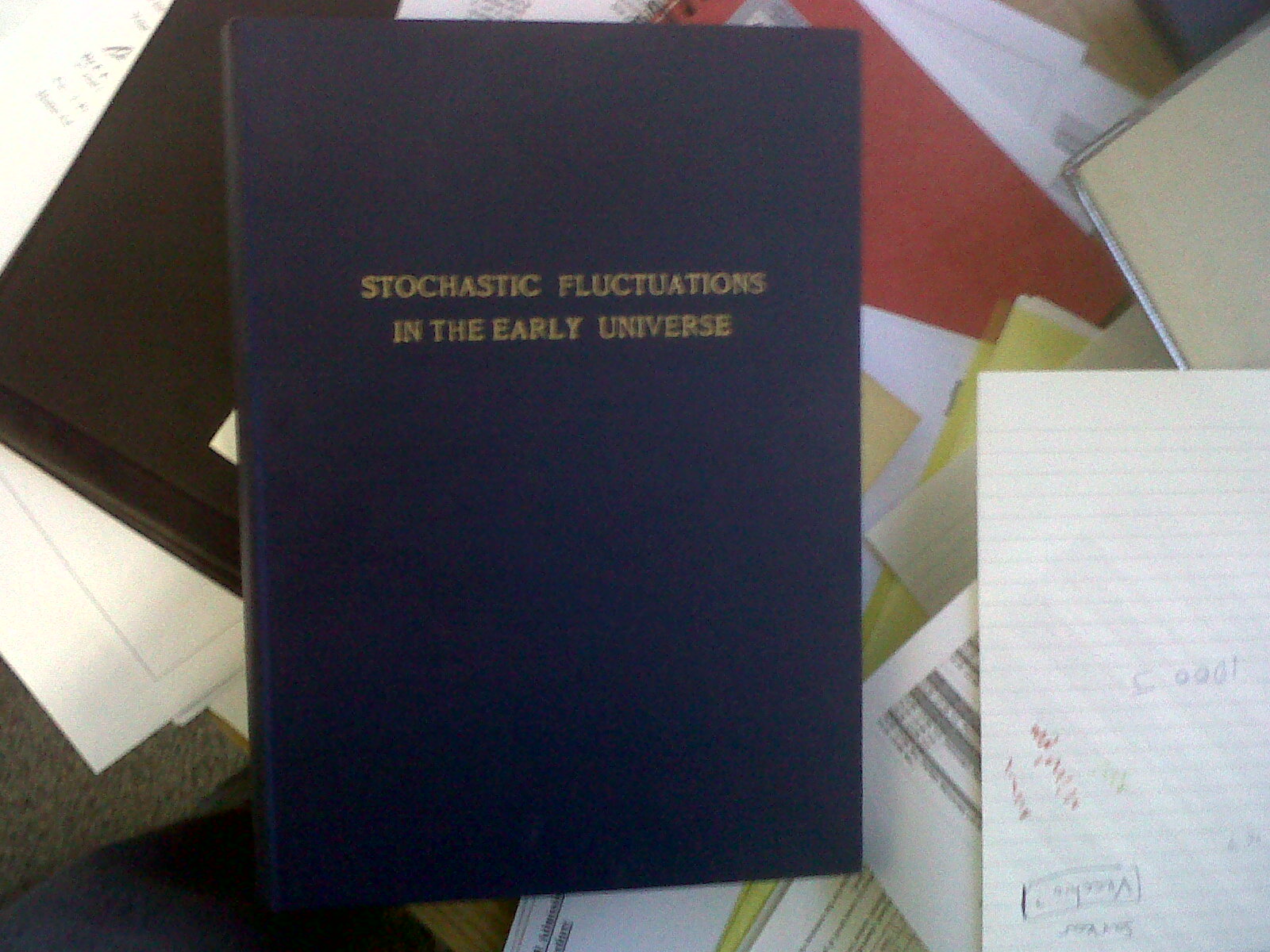 What is a PhD? The answer to that is relatively easy; it’s a postgraduate research degree. In order to obtain a PhD you have to present a thesis like that shown on the left (which happens to be mine, vintage 1988), typically in the range 100-250 pages long. A thesis has to satisfy two conditions for the award of the degree: it should contain original research, which is publishable in an academic journal; and it should present a coherent discussion of that original work within the context of ongoing work in the area of study. In Physics & Astronomy, the PhD is pretty much a prerequisite for any career in academic research, and it usually takes between 3 and 4 years to complete. After submission of the thesis you will have to undergo a viva voce examination conducted by two examiners, one internal and one external. This is quite a tough test, which can last anywhere between about 2 and about 6 hours, during which you can be asked detailed questions about your research and wide-ranging questions about the general area.
The Money Side. In the UK most PhDs are supported financially by the research councils, either EPSRC (most physics) or STFC (nuclear & particle physics, astronomy). These generally award quotas of studentships to departments who distribute them to students they admit. A studentship will cover your fees and pay a stipend, currently £14296 pa. That doesn’t sound like a lot, but you should at least remember that it is a stipend rather than a wage; it is therefore not taxed and there is no national insurance payable. There is a fee (currently £4121) payable for a PhD course, but that only comes into play if you are planning to fund yourself. If you receive a studentship it will normally cover the fee as an additional component. What I mean by that is you don’t need to pay it out of the stipend, it is separate. In top of that, research council funding also supplies a Research Training Grant which covers, e.g., travel and small items of equipment so you don’t need to pay for those out of your stipend either.
How do I choose a PhD? During the course of a postgraduate degree you are expected to become an expert in the area in which you specialize. In particular you should reach the point where you know more about that specific topic than your supervisor does. You will therefore have to work quite a lot on your own, which means you need determination, stamina and enthusiasm. In my view the most important criterion in your choice of PhD is not the institution where you might study but the project. You need to be genuinely excited by the topic in order to drive yourself to keep through the frustrations (of which there will be many). So, find an area that interests you and find the departments that do active research in that area by looking on the web. Check out the recent publications by staff in each department, to ensure that they are active and to have something to talk about at interview!
Qualifications. Most universities have a formal requirement that candidates for admission to the PhD should have a “good honours degree”, which basically means at least an Upper Second Class Honours degree. Some areas are more competitive than others, however, and in many disciplines you will find you are competing with a great many applicants with First Class degrees.
How to apply successfully. The application procedure at most universities is quite simple and can be done online. You will need to say something about the area in which you wish to do research (e.g. experiment/theory, and particular field, e.g. cosmology or star formation). You’ll also need a CV and a couple of references. Given the competition, it’s essential that you prepare. Give your curriculum vitae some attention, and get other people (e.g. your personal tutor) to help you improve it. It’s worth emphasizing particular skills (e.g. computing). If you get the chance, make use of your summer vacations by taking on an internship or other opportunity to get a taste of research; things like that will undoubtedly give your CV an edge.
The Interview. Good applicants will be invited for an interview, which is primarily to assess whether you have the necessary skills and determination, but also to match applicants to projects and supervisors. Prepare for your interview! You will almost certainly be asked to talk about your final-year project, so it will come across very badly if you’re not ready when they ask you. Most importantly, mug up about your chosen field. You will look really silly if you haven’t the vaguest idea of what’s going on in the area you claimed to be interested in when you wrote your application!
Don’t be shy! There’s nothing at all wrong with being pro-active about this process. Contact academic staff at other universities by email and ask them about research, PhD opportunities. That will make a good impression. Also, don’t be afraid to ask for advice. Although we’re all keen to recruit good PhD students for our own departments, we academics are conscious that it is also our job to give impartial advice. Ask your tutor’s opinion.
How many places should I apply for? Some research areas are more fashionable than others so the level of competition varies with field. As a general rule I would advise applying for about half-a-dozen places, chosen because they offer research in the right area. Apply to fewer than that and you might lose out to the competition. Apply to many more and you might not have time to attend the interviews.
What’s the timetable? Most applications come in early in the new year for entry to the PhD in the following September/October. The Christmas break is therefore a pretty good time to get your applications sorted out. Interviews are normally held in February or March, and decisions made by late March. STFC runs a deadline system whereby departments can not force students to accept or decline offers before the end of March, so there should be ample time to visit all your prospective departments before having to make any decisions.
That’s all I can think of for now. I hope at least some of these comments are useful to undergraduates anywhere in the UK thinking of applying for a PhD. If there are any further questions, please feel free to ask through the comments box. Likewise if I’ve missed anything important, please feel free to suggest additions in the same manner…
Follow @telescoper
 independent Gaussian-dsitributed varies as
  ; the larger the sample, the more accurately the global mean can be known. In the cosmological context this is basically why mapping a larger volume of space can lead, for instance, to a more accurate determination of the overall mean density of matter in the Universe.
 and
and  each of which has a Gaussian distribution with zero mean and unit variance. The ratio
  has a
has a  ,
, has the normal form, but this is also true (for large enough
  doesn’t tend to a Gaussian. In fact the distribution of the sum of any number of independent Cauchy variates is itself a Cauchy distribution. Moreover the distribution of the mean of a sample of size
  and
and  respectively then
  where
where  and
and  are respectively the fluxes received from the two stars;
 Galileo wasn’t as much of a mathematical genius as Newton, but he was highly imaginative, versatile and (very much unlike Newton) had an outgoing personality. He was also an able musician, fine artist and talented writer: in other words a true Renaissance man. His fame as a scientist largely depends on discoveries he made with the telescope. In particular, in 1610 he observed the four largest satellites of Jupiter, the phases of Venus and sunspots. He immediately leapt to the conclusion that not everything in the sky could be orbiting the Earth and openly promoted the Copernican view that the Sun was at the centre of the solar system with the planets orbiting around it. The Catholic Church was resistant to these ideas. He was hauled up in front of the Inquisition and placed under house arrest. He died in the year Newton was born (1642).
 But the elder Jakob’s work on gambling clearly also had some effect on Daniel, as in 1735 the younger Bernoulli published an exceptionally clever study involving the application of probability theory to astronomy. It had been known for centuries that the orbits of the planets are confined to the same part in the sky as seen from Earth, a narrow band called the Zodiac. This is because the Earth and the planets orbit in approximately the same plane around the Sun. The Sun’s path in the sky as the Earth revolves also follows the Zodiac. We now know that the flattened shape of the Solar System holds clues to the processes by which it formed from a rotating cloud of cosmic debris that formed a disk from which the planets eventually condensed, but this idea was not well established in the time of Daniel Bernouilli. He set himself the challenge of figuring out what the chance was that the planets were orbiting in the same plane simply by chance, rather than because some physical processes confined them to the plane of a protoplanetary disk. His conclusion? The odds against the inclinations of the planetary orbits being aligned by chance were, well, astronomical.
 It is impossible to overestimate the importance of the role played by
  A general proof of the Central Limit Theorem was finally furnished in 1838 by another astronomer,