Archive for astronomy

STFC Consolidated Grants Review

Posted in Finance, Science Politics with tags , , , , , , , , on October 28, 2014 by telescoper

It’s been quite a while since I last put my community service hat on while writing a blog post, but here’s an opportunity. Last week the Science and Technology Facilities Council (STFC) published a Review of the Implementation of Consolidated Grants, which can be found in its entirety here (PDF). I encourage all concerned to read it.

Once upon a time I served on the Astronomy Grants Panel whose job it was to make recommendations on funding for Astronomy through the Consolidated Grant Scheme, though this review covers the implementation across the entire STFC remit, including Nuclear Physics, Particle Physics (Theory), Particle Physics (Experiment) and Astronomy (which includes solar-terrestrial physics and space science). It’s quite interesting to see differences in how the scheme has been implemented across these various disciplines, but I’ll just include here a couple of comments on the Astronomy side of things.

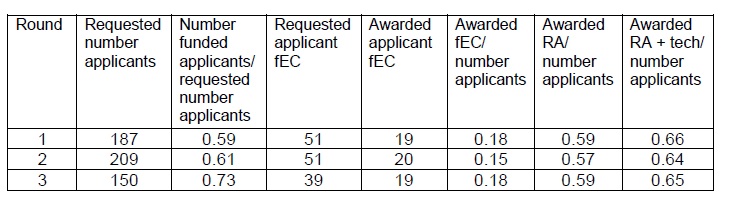
First, here is a table showing the number of academic staff for whom support was requested over the three years for which the consolidated grant system has been in existence (2011, 2012 and 2013 for rounds 1, 2 and 3 respectively).  You can see that the overall success rate was slightly better in round 3, possibly due to applicants learning more about the process over the cycle, but otherwise the outcomes seem reasonably consistent:

STFC_Con1

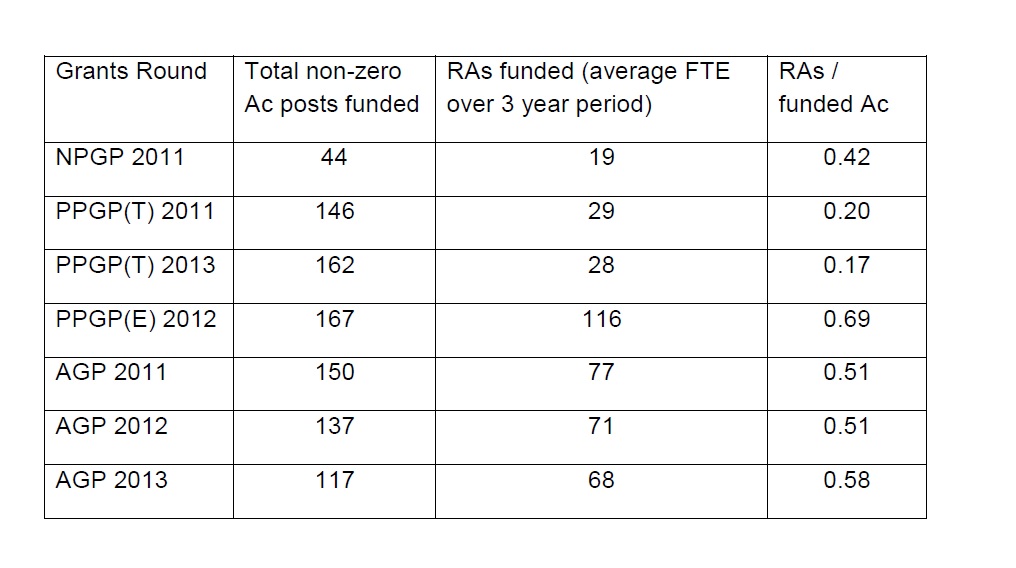
The last three rows of this table  on the other hand show quite clearly the impact of the “flat cash” settlement for STFC science funding on Postdoctoral Research Assistant (PDRA) support:
STFC_Con

Constant cash means ongoing cuts in real terms; there were 11.6% fewer Astronomy PDRAs supported in 2013 than in 2011. Job prospects for the next generation of astronomers continue to dwindle…

Any other comments, either on these tables or on the report as a whole, are welcome through the comments box.


It’s Official, it’s PLATO!

Posted in Science Politics, The Universe and Stuff with tags , , , , on February 19, 2014 by telescoper

Just a quick post to pass on the news that the European Space Agency has officially selected the third M-Class mission to form part of its Cosmic Vision Programme (which covers the period 2015-2025). The lucky winner is PLATO (PLAnetary Transits and  Oscillations of stars) and it will detect extra-solar planets by monitoring relatively nearby stars, searching for tiny, regular dips in brightness as planets transit in front of them. It will also study astroseismological activity, enabling a precise characterisation of the host star of each planet discovered, including its mass, radius and age.

plato_satelliteIt is expected that PLATO will find and analyse thousands of  such exoplanetary systems in this way, with an emphasis on discovering and characterizing Earth-sized planets and super-Earths in the habitable zone of their parent star. PLATO will be launched on a Soyuz rocket from Europe’s Spaceport in Kourou by 2024 for an initial six-year mission. It will operate from the Second Lagrange Point, or L2 for short. It’s an intriguing design consisting of 34 small telescopes (left).

PLATO joins Solar Orbiter and Euclid, which were chosen in 2011 as ESA’s first two M-class missions. Solar Orbiter will be launched in 2017 to study the Sun and solar wind from a distance of less than 50 million km, while Euclid, to be launched in 2020, will focus on dark energy, dark matter and the structure of the Universe.

The decision to select PLATO wasn’t exactly a surprise as it was singled out as the leading candidate by an expert panel last month, but there was nevertheless some nervousness among certain senior astronomers at the Royal Astronomical Society on Friday in advance of the formal decision. I suspect they’ll all be out celebrating tonight!

Hot News! Supernova in M82

Posted in The Universe and Stuff with tags , , , , , on January 22, 2014 by telescoper

Very exciting news today – a supernova has gone off in Messier 82. In fact, according to this sequence of images from Japan it actually started to brighten about a week ago:

psn-m82

Being arranged in Japanese fashion, you have to read these from top to bottom but starting at the right, so the supernova can be seen to be steadily brightening, i.e. decreasing in magnitude from 17.0 to 11.9. That means it’s now visible with binoculars and will have been seen already by many amateur astronomers. The exciting question this time is whether we’ll get any neutrinos from it!

UPDATE: I’m told that, close as it is, M82 is probably too far to detect neutrinos. Boo.

This is the nearest supernova since 1987a which was observed in, er, 1987. This is the nearest Type Ia supernova for a very long time (possibly 1937), so it’s of considerable interest for the use of such objects in cosmology. There have been other close ones since the nearest one I can remember, 1987a, which was observed in, er, 1987 but all have been Type II.

UPDATE: Thanks for the people who pointed out my error which I’ve left in to show that I don’t know much about supernovae so you shouldn’t phone me up to ask.

An Astronomical Teaser

Posted in Cute Problems, The Universe and Stuff with tags , , , , on January 1, 2014 by telescoper

For those of you who feel up to a little brain-teaser after last night’s revels, try this little problem which involves the use of everybody’s favourite type of astronomical measurement, the magnitude system. Answers through the comment box please!

A binary star at a distance of 100 pc has such a small separation between its component stars that it is unresolved by a telescope. If the apparent visual magnitude of the combined image of the system is 10.5, and one star is known to have an absolute visual magnitude of 9.0, what is the absolute visual magnitude of the other star?

Countdown to GAIA

Posted in The Universe and Stuff with tags , , , on December 18, 2013 by telescoper

Just a quick post to point out that tomorrow morning at 9.12am GMT will see the launch of the European Space Agency’s Gaia mission.  You can watch the launch live here from about 8.50 GMT. I’ll be in a meeting at 9am tomorrow morning, so I’m probably going to miss it.

Gaia arrives on the Launchpad at Kourou, French Guyana, on 13th December

Gaia arrives on the Launchpad at Kourou, French Guyana, on 13th December

I remember first hearing about Gaia about 15 years ago when I was on a PPARC advisory panel and was simultaneously amazed  by the ambition of its objectives and sceptical that it would ever get off the ground. Now its almost ready to go, so fingers crossed for a successful launch tomorrow.

Coincidentally, Gaia is among the various telescopes and observatories featured in the STFC Roadshow we put on  viewfor an Astronomy Master Class we have been putting on for local schools over the last couple of days here at the University of Sussex:

IMG-20131218-00248

Gaia is a global space astrometry mission, which will make the largest, most precise three-dimensional map of our Galaxy by surveying more than a thousand million stars. In some sense it is the descendant of the Hipparcos mission launched in 1989, but it’s very much more than that. Gaia will monitor each of its target stars about 70 times over a five-year period. It is expected to discover hundreds of thousands of new celestial objects, such as extra-solar planets and brown dwarfs, and observe hundreds of thousands of asteroids within our own Solar System. The mission is also expected to yield a wide variety of other benefits, including new tests of the  General Theory of Relativity.

Gaia will create an extraordinarily precise three-dimensional map of more than a thousand million stars throughout our Galaxy (The Milky Way) and beyond, mapping their motion, luminosity, temperature and chemical composition as well as any changes in such properties. This huge stellar census will provide the data needed to tackle an enormous range of important problems related to the origin, structure and evolutionary history of our Galaxy. Gaia will do all this by repeatedly measuring the positions of all objects down to an apparent magnitude of 20. A thousand million stars is about 1% of the entire stellar population of the Milky Way.

For the brighter objects, i.e. those brighter than magnitude 15, Gaia will measure their positions to an accuracy of 24 microarcseconds, comparable to measuring the diameter of a human hair at a distance of 1000 km. Distances of relatively nearby stars will be measured to an accuracy of 0.001%. Even stars near the Galactic Centre, some 30 000 light-years away, will have their distances measured to within an accuracy of 20%.

It’s an astonishing mission that will leave an unbelievably rich legacy not only for the astronomers working on the front-line operations of Gaia but for generations to come. I have a feeling that there might be  a few sleepless nights tonight waiting for the launch, but I suppose astronomers should be used to that!

UPDATE: 19/12/2013 Success! Launch went smoothly, separation of the Gaia spacecraft achieved. Now we have to wait for a month or so for it to get to L2, settle itself down, and then start doing science. The first data release isn’t due for 22 months…Bon Voyage!

Doctor Who at 50

Posted in Biographical, Music, Television, The Universe and Stuff with tags , , , , , on November 23, 2013 by telescoper

Today is the official 50th birthday celebration of Doctor Who and, since The Doctor and myself are of the same vintage, I thought I’d repeat an old post about the show. I just listened to the original theme music again before posting this and I still think it sounds amazingly fresh.

–0–

As a Professor of Astrophysics I am often asked “Why on Earth did you decide to make a career out of such a crazy subject?”

I guess many astronomers, physicists and other scientists have to answer this sort of question. For many of them there is probably a romantic reason, such as seeing the rings of Saturn or the majesty of the Milky Way on a dark night. Others will probably have been inspired by TV documentary series such as The Sky at Night, Carl Sagan’s Cosmos or even Horizon which, believe it or not, actually used to be quite good but which is nowadays uniformly dire. Or it could have been something a bit more mundane but no less stimulating such as a very good science teacher at school.

When I’m asked this question I’d love to be able to put my hand on my heart and give an answer of that sort but the truth is really quite a long way from those possibilities. The thing that probably did more than anything else to get me interested in science was a Science Fiction TV series or rather not exactly the series but the opening titles.

The first episode of Doctor Who was broadcast in the year of my birth, so I don’t remember it at all, but I do remember the astonishing effect the credits had on my imagination when I saw later episodes as a small child. Here is the  opening title sequence as it appeared in the very first series featuring William Hartnell as the first Doctor.

To a younger audience it probably all seems quite tame, but I think there’s a haunting, unearthly beauty to the shapes conjured up by Bernard Lodge. Having virtually no budget for graphics, he experimented in a darkened studio with an old-fashioned TV camera and a piece of black card with Doctor Who written on it in white. He created the spooky kaleidoscopic patterns you see by simply pointing the camera so it could see into its own monitor, thus producing a sort of electronic hall of mirrors.

What is so fascinating to me is how a relatively simple underlying concept could produce a rich assortment of patterns, particularly how they seem to take on an almost organic aspect as they merge and transform. I’ve continued to be struck by the idea that complexity could be produced by relatively simple natural laws which is one of the essential features of astrophysics and cosmology. As a practical demonstration of the universality of physics this sequence takes some beating.

As well as these strange and wonderful images, the titles also featured a pioneering piece of electronic music. Officially the composer was Ron Grainer, but he wasn’t very interested in the commission and simply scribbled the theme down and left it to the BBC to turn it into something useable. In stepped the wonderful Delia Derbyshire, unsung heroine of the BBC Radiophonic Workshop who, with only the crudest electronic equipment available, turned it into a little masterpiece. Ethereal yet propulsive, the original theme from Doctor Who is definitely one of my absolute favourite pieces of music and I’m glad to see that Delia Derbyshire is now receiving the acclaim she deserves from serious music critics.

It’s ironic that until earlier this year I used to live  in Cardiff, where the newer episodes of Doctor Who and its spin-off, the anagrammatic Torchwood, are made. One of the great things about the early episodes of Doctor Who was that the technology simply didn’t exist to do very good special effects. The scripts were consequently very careful to let the viewers’ imagination do all the work. That’s what made it so good. I’m pleased that the more recent incarnations of this show also don’t go overboard on the visuals. Perhaps that’s a conscious attempt to appeal to people who saw the old ones as well as those too young to have done so. It’s just a pity the modern opening title music is so bad…

Anyway, I still love Doctor Who after all these years. It must sound daft to say that it inspired me to take up astrophysics, but it’s truer than any other explanation I can think of. Of course the career path is slightly different from a Timelord, but only slightly.

At any rate I think The Doctor is overdue for promotion. How about Professor Who?

Sussex Astronomy Research – The Videos!

Posted in The Universe and Stuff with tags , , , , , , , , on November 19, 2013 by telescoper

As autumn turns to winter the thoughts of many an undergraduate turn to the task of applying for PhDs. Nowadays this involves a lot of trawling through webpages looking for interesting projects and suitable funding opportunities.

In order to help prospective postgraduates this year, the Astronomy Centre at the University of Sussex has produced a number of videos to give some information about the available projects. To start with, here are four examples, covering topics in theoretical, computational and observational astrophysics:

For information, we’re expecting to offer at least six PhD studentships in Astronomy for September 2014 entry. Also there’s a University-wide postgraduate open day coming up on December 4th..

Why is Astronomy Important?

Posted in The Universe and Stuff with tags , , , , on November 5, 2013 by telescoper

There’s an interesting and unusual article on the arXiv today entitled Why is Astronomy Important? Here is the abstract:

For a long time astronomers and other scientists believed that the importance of their work was evident to society. But in these difficult days of financial austerity, even the most obvious benefits of science have to undergo careful scrutiny. Eradicating poverty and hunger is a worldwide priority, and activities that do not directly attempt to resolve these issues can be hard to justify and support. However, several studies have told us that investing in science education, research and technology provides a great return not only economically, but culturally and indirectly for the population in general and has helped countries to face and overcome crises. The scientific and technological development of a country or region is closely linked to its human development index a statistic that is a measure of life expectancy, education and income.

The full text of the paper can be found on the IAU website here.

The article focusses on matters relating to the transfer of technology between astronomy and, e.g. industry, aerospace, and medicine, its effect on technology we are familiar with in everyday life, on astronomy as an exemplar of international collaboration and on its wider cultural and philosophical impact. Many of the points made in this article can also be found in the Royal Astronomical Society‘s free publication Beyond the Stars: Why Astronomy Matters which is available for free online here.

I recommend you read the full article and make your own mind up about why astronomy is important. I have just two comments, which are partly questions. The first is that I’ve always had a bit of a problem with the interpretation of correlations like that mentioned in the last sentence of the abstract (between technological development and the human development index). The issue is the basic one that correlation of two phenomena does not necessarily imply that one causes the other. Is it really possible to establish rigorously a causal link between spending money on astronomy and wider societal benefits? I’m not saying that there isn’t such a link, just that it’s difficult to interpret evidence which is dependent on so many factors. Could one not argue instead that more developed countries spend more money on astronomy because they can afford to?

The other thing that troubles me with arguments of the type presented in the paper is that there is a danger that  emphasizing the transfer of knowledge to other disciplines as the rationale for funding astronomy implicitly negates the argument that astronomy has intrinsic worth of its own. In other words, answering the question “Why is Astronomy important?” seems to accept at the outset that it isn’t.  If it is indeed the case that we can only justify astronomy because it has produced spin-offs in, e.g., medicine, why not just spend more money on medicine and forget the astronomy?

I’m not saying that the technology transfer arguments carry no weight, just that they are definitely double-edged and should be used with caution. For the record, I think we should fund Astronomy (and other sciences) primarily because they are an essential part of the fabric of our culture and civilization; all the rest is icing on the cake. In other words, I support state funding for the sciences for very much the same reasons as for the arts.  I’m fully aware, however, that this unlikely to persuade the powers that be as effectively as an appeal to economic benefits; that’s why science funding has fared so much better than arts funding in this age of austerity.

Introduction to the PhD for Physics or Astronomy students

Posted in Education with tags , , , , , , on October 22, 2013 by telescoper

It’s the time of year when final-year students start to think about the possibility of doing a PhD after they have graduated, so I I thought I’d jot down here a few general remarks that might be useful to people who are thinking of taking the plunge. I’ve posted on such matters before, but this is something that comes around every year so I hope you’ll excuse the repeat. I’m aiming this primarily at UK students applying for places in the UK; special considerations apply for students wanting to do graduate research abroad.

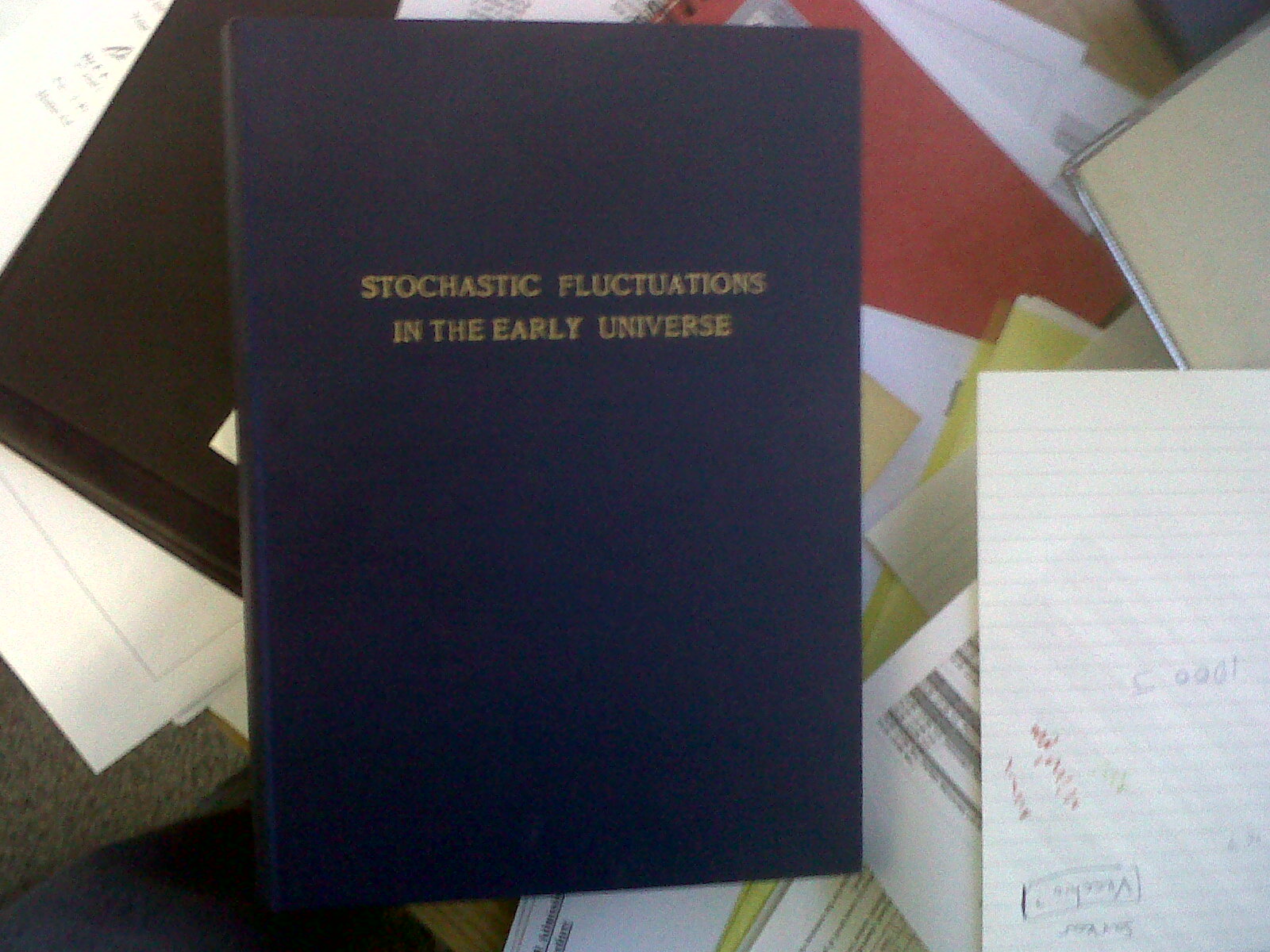
What is a PhD? The answer to that is relatively easy; it’s a postgraduate research degree. In order to obtain a PhD you have to present a thesis like that shown on the left (which happens to be mine, vintage 1988), typically in the range 100-250  pages long. A thesis has to satisfy two conditions for the award of the degree: it should contain original research, which is publishable in an academic journal; and it should present a coherent discussion of that original work within the context of ongoing work in the area of study. In Physics & Astronomy, the PhD is pretty much a prerequisite for any career in academic research, and it usually takes between 3 and 4 years to complete. After submission of the thesis you will have to undergo a viva voce examination conducted by two examiners, one internal and one external. This is quite a tough test, which  can last anywhere between about 2 and about 6 hours, during which you can be asked  detailed questions about your research and wide-ranging questions about the general area.

The Money Side. In the UK most PhDs are supported financially by the research councils, either EPSRC (most physics) or STFC (nuclear & particle physics, astronomy). These generally award quotas of studentships to departments who distribute them to students they admit. A studentship will cover your fees and pay a stipend, currently £13590 pa. That doesn’t sound like a lot, but you should at least remember that it is a stipend rather than a wage; it is therefore not taxed and there is no national insurance payable.

How do I choose a PhD? During the course of a postgraduate degree you are expected to become an expert in the area in which you specialize. In particular you should reach the point where you know more about that specific topic than your supervisor does. You will therefore have to work quite a lot on your own, which means you need determination, stamina and enthusiasm. In my view the most important criterion in your choice of PhD is not the institution where you might study but the project. You need to be genuinely excited by the topic in order to drive yourself to keep through the frustrations (of which there will be many). So, find an area that interests you and find the departments that do active research in that area by looking on the web. Check out the recent publications by staff in each department, to ensure that they are active and to have something to talk about at interview!

Qualifications. Most universities have a formal requirement that candidates for admission to the PhD should have a “good honours degree”, which basically means at least an Upper Second Class Honours degree. Some areas are more competitive than others, however, and in many disciplines you will find you are competing with a great many applicants with First Class degrees.

How to apply successfully. The application procedure at most universities is quite simple and can be done online. You will need to say something about the area in which you wish to do research (e.g. experiment/theory, and particular field, e.g. cosmology or star formation). You’ll also need a CV and a couple of references. Given the competition, it’s essential that you prepare. Give your curriculum vitae some attention, and get other people (e.g. your personal tutor) to help you improve it. It’s worth emphasizing particular skills (e.g. computing). If you get the chance, make use of your summer vacations by taking on an internship or other opportunity to get a taste of research; things like that will undoubtedly give your CV an edge.

The Interview. Good applicants will be invited for an interview, which is primarily to assess whether you have the necessary skills and determination, but also to match applicants to projects and supervisors. Prepare for your interview! You will almost certainly be asked to talk about your final-year project, so it will come across very badly if you’re not ready when they ask you. Most importantly, mug up about your chosen field. You will look really silly if you haven’t the vaguest idea of what’s going on in the area you claimed to be interested in when you wrote your  application!

Don’t be shy! There’s nothing at all wrong with being pro-active about this process. Contact academic staff at other universities by email and ask them about research, PhD opportunities. That will make a good impression. Also, don’t be afraid to ask for advice. Although we’re all keen to recruit good PhD students for our own departments, we academics are  conscious that it is also our job to give impartial advice. Ask your tutor’s opinion.

How many places should I apply for? Some research areas are more fashionable than others so the level of competition varies with field. As a general rule I would advise applying for about half-a-dozen places, chosen because they offer research in the right area. Apply to fewer than that and you might lose out to the competition. Apply to many more and you might not have time to attend the interviews.

What’s the timetable?  Most applications come in early in the new year for entry to the PhD in the following October. The Christmas break is therefore a pretty good time to get your applications sorted out. Interviews are normally held in February or March, and decisions made by late March. STFC runs a deadline system whereby departments can not force students to accept or decline offers before the end of March, so there should be ample time to visit all your prospective departments before having to make any decisions.

Here are some of the slides I used for a talk on such matters a year or so ago, which you might find useful.

That’s all I can think of for now. I hope at least some of these comments are useful to undergraduates anywhere in the UK thinking of applying for a PhD. If there are any further questions, please feel free to ask through the comments box. Likewise if I’ve missed anything important, please feel free to suggest additions in the same manner…
How do physicists and astronomers team up to write research papers?

Posted in Science Politics with tags , on October 16, 2013 by telescoper

Busy busy today so just time to reblog this, an interesting article about the irresistible rise of the multi-author paper. What fraction of the “authors” actually play any role at all in writing these papers? Am I the only one that thinks this has very profound implications for the way we interpret bibliometric analyses?

Augusto Carballido's avatarMoonshot

The way in which physicists and  astronomers team up to write technical papers has changed over the years, and not only is it interesting to look at this behavior for its own sake, but by analyzing the data it may be possible to better understand what role, if any, does the number of authors  have on the scientific impact of a paper. Likewise, such an analysis can allow physics and astronomy journals to make decisions about their publishing policies.

I was curious about the trends in the number of authors per refereed astronomy paper, so I set out to write an R script that would read in data from the NASA Astrophysics Data System, an online database of both refereed and non-refereed academic papers in astronomy and physics. The script counts the monthly number of refereed astronomy and physics papers between January 1967 and September 2013, as well as…

View original post 670 more words