Archive for Astrophysics

Your PhD Questions Answered (?)

Posted in Education, The Universe and Stuff with tags , , , , , , on March 10, 2013 by telescoper

As I mentioned last week, one of the main items on the agenda at the moment is recruitment of new PhD students. As usual, this finds me having to operate on both sides of the fence,  playing a role in selecting students whilst also trying to advise students on how to target their applications, prepare for interview, and choose between offers (for those who manage to get a place).

In my field (astrophysics), the primary route for funding a PhD comes through the Science and Technology Facilities Council (STFC) which operates a national deadline (31st March) before which candidates can not be required to make a decision. This deadline sets the timescale for departments to decide too, as we clearly want to make sure all our first choice applicants get their offers before the cutoff date.

The national deadline prevents students from being pressured into making decisions before they have heard back from all the institutions to which they have applied, so in that sense it’s a good idea. On the other hand, it does mean that there’s often frantic activity on deadline day as offers are accepted or declined. Reserves have to be contacted quickly when a favoured candidate withdraws to go somewhere else and not all of them may still be available. A student who has been waiting anxiously without a first-choice offer may suddenly receive a lifeline on deadline day.

Getting offers is one thing, but deciding between them is quite another. There are many things to take into account, and the criteria are by no means clear. I’m not the only person to have been thinking about this. There are personal matters, of course. Is it a nice place? Are the people friendly? Do you think you can get on with your potential supervisor? That sort of thing. But there’s also the actual research. Is the project really what you want to do? Is is likely to open up a future career in research, or just be a dead end? Is the mixture of theory and experiment (or observation) what you would like?

One of the issues that often arises when I discuss research with potential PhD students is how structured the project  is. Some projects are  mapped out by the supervisor in great detail, with specific things to be done in a specific order with well-defined milestones against which progress can be measured. Others, especially but not exclusively theoretical ones, are much more of the nature of “here’s an interesting idea – let’s study it and see where it leads”. Most PhDs are somewhere between these two extremes, but it’s probably true that experimental PhDs are more like the former, whereas theoretical ones are more like the latter. Mine, in theoretical astrophysics, ended up evolving quite considerably from its starting point.

I’ve always been grateful to my supervisor for allowing me the freedom to follow my own curiosity. But I think it was essential to be given an initial focus, in the form of a specific project to cut my teeth on. Getting a calculation finished, written up and published gave me the confidence to start out on my own, but I did need a lot of guidance during that initial phase. We a;ll need to learn how to walk before we can run.

Another aspect of this is what the final thesis should look like. Should it be a monolithic work, focussed on one very specific topic, or can it be an anthology of contributions across a wider area?  Again, it’s a question of balance. I think that a PhD thesis should be seen as a kind of brochure advertising the skills and knowledge of the student that produced it. Versatility is a good quality, so if you can do lots of different things then your thesis should represent that. On the other hand, you also need to demonstrate the ability to carry out a sustained and coherent piece of research. Someone who flits around knocking out lots of cutesy “ideas papers” may get a reputation for being a bit of a dabbler who is unable or unwilling to tackle problems in depth. The opposite extreme would be a person who is incapable of generating new ideas, but excellent once pointed in a specific direction. The best scientists, in my opinion, have creative imagination as well as technical skill and stamina.  It’s a matter of balance, and some scientists are more balanced than others. There are some (scary) individuals who are brilliant at everything, of course., but us mere mortals have to make the most of our limited potential.

The postdoc market that lies beyond your PhD is extremely tough. To survive you need to maximize the chances of getting a job, and that means being able to demonstrate a suitability for as many opportunities as possible that come up. So if you want to do theory, make sure that you know at least something about observations and data analysis. Even if you prefer analytic work, don’t be too proud to use a computer occasionally. Research problems often require  you to learn new things before you can tackle them. Get into the habit of doing that while you’re a student, and you’re set to continue for the rest of your career. But you have to do all this without spreading yourself too thin, so don’t shy away from the chunky calculations that keep you at your desk for days on end. It’s the hard yards that win you the match.

When it comes to choosing supervisors, my advice would be to look for one who has a reputation for supporting their students, but avoid those who want to exert excessive control. I think it’s a supervisor’s duty to ensure that PhD student becomes as independent as possible as quickly as possible, but to be there with help and advice if things go wrong. Sadly there are some who treat PhD students simply as assistants, and give little thought to their career development.

But if all this sounds a bit scary, I’ll add just one thing. A PhD offers a unique challenge. It’s hard work, but stimulating and highly rewarding. If you find a project that appeals to you, go for it. You won’t regret it.

Open for Mathematics, Physics, Astronomy (and Astrophysics)…

Posted in Education, The Universe and Stuff with tags , , , , , , , , on February 23, 2013 by telescoper

I’ve been here on campus at the University of Sussex all day helping out with an Admissions Day. We were all a bit apprehensive in the School of Mathematical and Physical Sciences about today simply because so many students and guests were scheduled to come that we wondered how well we could organize the large number of groups being shown around. There was also the question of the British weather. It was very cold this morning, with flurries of snow as I made my way to campus. I was wondering whether the weather might put some people off travelling, but as it happened we had a lot of visitors and although we were very busy there was a very good buzz about the place.

Notwithstanding the inclement weather this morning there are also definite signs that spring is on the way:

IMG-20130221-00065

Anyway, it was nice to have the chance to talk to prospective students and parents in both Mathematics and Physics & Astronomy. Although Mathematics, Physics and Astronomy are combined within the School, there are clear distinctions between the way Mathematics and Physics are taught so the topics discussed with Mathematics students tended to be different from those in Physics and Astronomy. However, a chat with one group led eventually to the question What’s the difference between Astronomy and Astrophysics? This is something I’m asked quite often, and have blogged about before, but I thought I’d repeat it here for those who might stumble across it.

The Oxford English Dictionary gives the following primary definition for astronomy:

The science which treats of the constitution, relative positions, and motions of the heavenly bodies; that is, of all the bodies in the material universe outside of the earth, as well as of the earth itself in its relations to them.

Astrophysics, on the other hand, is described as

That branch of astronomy which treats of the physical or chemical properties of the celestial bodies.

So astrophysics is regarded as a subset of astronomy which is primarily concerned with understanding the properties of stars and galaxies, rather than just measuring their positions and motions.

It is possible to assign a fairly precise date when astrophysics first came into use in English because, at least in the early years of the subject, it was almost exclusively associated with astronomical spectroscopy. Indeed the OED gives the following text as the first occurence of astrophysics, in 1869:

As a subject for the investigations of the astro-physicist, the examination of the luminous spectras of the heavenly bodies has proved a remarkably fruitful one

The scientific analysis of astronomical spectra began with a paper by   William Hyde Wollaston in the Philosophical Transactions of the Royal Society Vol. 102, p. 378, 1802. He was the first person to notice the presence of dark bands in the optical spectrum of the Sun. These bands were subsequently analysed in great detail by Joseph von Fraunhofer in a paper published in 1814 and are now usually known as Fraunhofer lines.  Technical difficulties  made it impossible to obtain spectra of stars other than the Sun for a considerable time, but  William Huggins finally succeeded in 1864. A drawing of his pioneering spectroscope is shown below.

Meanwhile, fundamental work by Gustav Kirchoff and Robert Bunsen had been helping  to establish an understanding of the spectra produced by hot gases.  The identification of features in the Sun’s spectrum  with similar lines produced in laboratory experiments led to a breakthrough in our understanding of the Universe whose importance shouldn’t be underestimated. The Sun and stars were inaccessible to direct experimental test during the 19th Century (as they are now). But spectroscopy now made it possible to gather evidence about their chemical composition as well as physical properties. Most importantly, spectroscopy provided definitive evidence that the Sun wasn’t made of some kind of exotic unknowable celestial material, but of the same kind of stuff (mainly Hydrogen) that could be studied on Earth.  This realization opened the possibility of applying the physical understanding gained from small-scale experiments to the largest scale phenomena that could be seen. The science of astrophysics was born.

One of the leading journals in which professional astronomers and astrophysicists publish their research is called the Astrophysical Journal, which was founded in 1895 and is still going strong. The central importance of the (still) young field of spectroscopy can be appreciated from the subtitle given to the journal:

Initially the branch of physics most important to astrophysics was atomic physics since the lines in optical spectra are produced by electrons jumping between different atomic energy levels. Spectroscopy of course remains a key weapon in the astrophysicist’s arsenal but nowadays the term astrophysics is taken to mean any application of physical laws to astronomical objects. Over the years, astrophysics has therefore gradually incorporated nuclear and particle physics as well as thermodynamics, relativity and just about every other branch of physics you can think of.

I realise, however, that this  isn’t really the answer to the question that potential students want to ask. What they (probably) want to know is what is the difference between undergraduate courses called Astronomy and those called Astrophysics? The answer to this one depends very much on where you want to study. Generally speaking the differences are in fact quite minimal. You probably do a bit more theory in an Astrophysics course than an Astronomy course, for example. Your final-year project might have to be observational or instrumental if you do Astronomy, but might be theoretical in Astrophysics.  If you compare the complete list of modules to be taken, however, the difference will be very small.

Over the last twenty years or so, most Physics departments in the United Kingdom have acquired some form of research group in astronomy or astrophysics and have started to offer undergraduate degrees with some astronomical or astrophysical content. My only advice to prospective students wanting to find which course is for them is to look at the list of modules and projects likely to be offered. You’re unlikely to find the name of the course itself to be very helpful in making a choice.

One of the things that drew me into astrophysics as a discipline (my current position is Professor of Theoretical Astrophysics as well as being Head of School) is that it involves such a wide range of techniques and applications, putting apparently esoteric things together in interesting ways to develop a theoretical understanding of a complicated phenomenon. I only had a very limited opportunity to study astrophysics during my first degree as I specialised in Theoretical Physics.  This wasn’t just a feature of Cambridge. The attitude in most Universities in those days was that you had to learn all the physics before applying it to astronomy. Over the years this has changed, and most departments offer some astronomy right from Year 1.

I think this change has been for the better because I think the astronomical setting provides a very exciting context to learn physics. If you want to understand, say, the structure of the Sun you have to include atomic physics, nuclear physics, gravity, thermodynamics, radiative transfer and hydrostatics all at the same time. This sort of thing makes astrophysics a good subject for developing synthetic skills while more traditional physics teaching focusses almost exclusively on analytical skills.

Skepsis Revived

Posted in Politics, The Universe and Stuff with tags , , , , , , , , on November 14, 2012 by telescoper

I appear to be in recycling mode this week, so I thought I’d carry on with a rehash of an old post about skepticism.  The excuse for this was an item in one of the Guardian science blogs about the distinction between Skeptic and sceptic. I must say I always thought they were simply alternative spellings, the “k” being closer to the original Greek and “c” being Latinised (via French). The Oxford English dictionary merely states that “sceptic” is more widespread in the UK and Commonwealth whereas “skeptic” prevails in North America. Somehow, however, this distinction has morphed into one variant meaning a person who has a questioning attitude to or is simply unconvinced by what claims to be knowledge in a particular area, and another meaning a “denier”, the latter being an “anti-sceptic” who believes wholeheartedly and often without evidence in whatever is contrary to received wisdom. A scientists should, I think, be the former, but the latter represents a distinctly unscientific attitude.

Anyway, yesterday I blogged a little bit about dark energy as, according to the standard model, this accounts for about 75% of the energy budget of the Universe. It’s also something we don’t understand very well at all. To make a point, take a look at the following picture (credit to the High-z supernova search team).

 What is plotted is the redshift of each supernova (along the x-axis), which relates to the factor by which the universe has expanded since light set out from it. A redshift of 0.5 means the universe was compressed by a factor 1.5 in all dimensions at the time when that particular supernova went bang. The y-axis shows the really hard bit to get right. It’s the estimated distance (in terms of distance modulus) of the supernovae. In effect, this is a measure of how faint the sources are. The theoretical curves show the faintness expected of a standard source observed at a given redshift in various cosmological models. The bottom panel shows these plotted with a reference curve taken out so the trend is easier to see. Actually, this is quite an old plot and there are many more points now but this is the version that convinced most cosmologists when it came out about a decade ago, which is why I show it here.

The argument drawn from these data is that the high redshift supernovae are fainter than one would expect in models without dark energy (represented by the \Omega_{\Lambda}  in the diagram. If this is true then it means the luminosity distance of these sources is greater than it would be in a decelerating universe. Their observed properties can be accounted for, however, if the universe’s expansion rate has been accelerating since light set out from the supernovae. In the bog standard cosmological models we all like to work with, acceleration requires that \rho + 3p/c^2 be negative. The “vacuum” equation of state p=-\rho c^2 provides a simple way of achieving this but there are many other forms of energy that could do it also, and we don’t know which one is present or why…

This plot contains the principal evidence that has led to most cosmologists accepting that the Universe is accelerating.  However, when I show it to first-year undergraduates (or even to members of the public at popular talks), they tend to stare in disbelief. The errors are huge, they say, and there are so  few data points. It just doesn’t look all that convincing. Moreover, there are other possible explanations. Maybe supernovae were different beasties back when the universe was young. Maybe something has absorbed their light making them look fainter rather than being further away. Maybe we’ve got the cosmological models wrong.

The reason I have shown this diagram is precisely because it isn’t superficially convincing. When they see it, students probably form the opinion that all cosmologists are gullible idiots. I’m actually pleased by that.  In fact, it’s the responsibility of scientists to be skeptical about new discoveries. However, it’s not good enough just to say “it’s not convincing so I think it’s rubbish”. What you have to do is test it, combine it with other evidence, seek alternative explanations and test those. In short you subject it to rigorous scrutiny and debate. It’s called the scientific method.

Some of my colleagues express doubts about me talking as I do about dark energy in first-year lectures when the students haven’t learned general relativity. But I stick to my guns. Too many people think science has to be taught as great stacks of received wisdom, of theories that are unquestionably “right”. Frontier sciences such as cosmology give us the chance to demonstrate the process by which we find out about the answers to big questions, not by believing everything we’re told but by questioning it.

My attitude to dark energy is that, given our limited understanding of the constituents of the universe and the laws of matter, it’s the best explanation we have of what’s going on. There is corroborating evidence of missing energy, from the cosmic microwave background and measurements of galaxy clustering, so it does have explanatory power. I’d say it was quite reasonable to believe in dark energy on the basis of what we know (or think we know) about the Universe.  In other words, as a good Bayesian, I’d say it was the most probable explanation. However, just because it’s the best explanation we have now doesn’t mean it’s a fact. It’s a credible hypothesis that deserves further work, but I wouldn’t bet much against it turning out to be wrong when we learn more.

I have to say that too many cosmologists seem to accept the reality of dark energy  with the unquestioning fervour of a religious zealot.  Influential gurus have turned the dark energy business into an industrial-sized bandwagon that sometimes makes it difficult, especially for younger scientists, to develop independent theories. On the other hand, it is clearly a question of fundamental importance to physics, so I’m not arguing that such projects should be axed. I just wish the culture of skepticism ran a little deeper.

Another context in which the word “skeptic” crops up frequently nowadays is  in connection with climate change although it has come to mean “denier” rather than “doubter”. I’m not an expert on climate change, so I’m not going to pretend that I understand all the details. However, there is an interesting point to be made in comparing climate change with cosmology. To make the point, here’s another figure.

There’s obviously a lot of noise and it’s only the relatively few points at the far right that show a clear increase (just as in the first Figure, in fact). However, looking at the graph I’d say that, assuming the historical data points are accurate,  it looks very convincing that the global mean temperature is rising with alarming rapidity. Modelling the Earth’s climate is very difficult and we have to leave it to the experts to assess the effects of human activity on this curve. There is a strong consensus from scientific experts, as monitored by the Intergovernmental Panel on Climate Change, that it is “very likely” that the increasing temperatures are due to increased atmospheric concentrations of greenhouse gas emissions.

There is, of course, a bandwagon effect going on in the field of climatology, just as there is in cosmology. This tends to stifle debate, make things difficult for dissenting views to be heard and evaluated rationally,  and generally hinders the proper progress of science. It also leads to accusations of – and no doubt temptations leading to – fiddling of the data to fit the prevailing paradigm. In both fields, though, the general consensus has been established by an honest and rational evaluation of data and theory.

I would say that any scientist worthy of the name should be skeptical about the human-based interpretation of these data and that, as in cosmology (or any scientific discipline), alternative theories should be developed and additional measurements made. However, this situation in climatology is very different to cosmology in one important respect. The Universe will still be here in 100 years time. We might not.

The big issue relating to climate change is not just whether we understand what’s going on in the Earth’s atmosphere, it’s the risk to our civilisation of not doing anything about it. This is a great example where the probability of being right isn’t the sole factor in making a decision. Sure, there’s a chance that humans aren’t responsible for global warming. But if we carry on as we are for decades until we prove conclusively that we are, then it will be too late. The penalty for being wrong will be unbearable. On the other hand, if we tackle climate change by adopting greener technologies, burning less fossil fuels, wasting less energy and so on, these changes may cost us a bit of money in the short term but  frankly we’ll be better off anyway whether we did it for the right reasons or not. Of course those whose personal livelihoods depend on the status quo are the ones who challenge the scientific consensus most vociferously. They would, wouldn’t they?

This is a good example of a decision that can be made on the basis of a  judgement of the probability of being right. In that respect , the issue of how likely it is that the scientists are correct on this one is almost irrelevant. Even if you’re a complete disbeliever in science you should know  how to respond to this issue, following the logic of Blaise Pascal. He argued that there’s no rational argument for the existence or non-existence of God but that the consequences of not believing if God does exist (eternal damnation) were much worse than those of behaving as if you believe in God when he doesn’t. For “God” read “climate change” and let Pascal’s wager be your guide….

A Name for Open Astrophysics?

Posted in Open Access with tags , , , , , on November 4, 2012 by telescoper

Regular readers of this blog may recall that  while ago  I posted an item in which I suggested setting up The Open Journal of Astrophysics. The motivation behind this was to demonstrate that it is possible to run an academic journal which is freely available to anyone who wants to read it, as well as at minimal cost to authors. Basically, I want to show that it is possible to “cut out the middle man” in the process of publishing scientific research and that by doing it ourselves we can actually do it better.

I was unwell for much of the summer, and more recently have had lots to do in connection with my forthcoming move to Sussex, so things have moved more slowly than I’d hoped but I just wanted to take this opportunity to give my assurance that this project is definitely going ahead. We have a (good) website design with ample space and other resources to run it, and a sufficient number of persons of suitable eminence have agreed to serve on the Editorial Board. It will basically be a front-end for the Arxiv, but will have a number of interesting additional features which make it a lot  more than that.  I’d prefer to save further details to the official launch, which is now planned to take place in January (as it would probably get buried in the pre-Xmas rush if we tried to launch before then). I can also confirm that the service we will provide will be free at the start, although if the volume of submissions grows we may have to charge a small fee for refereeing. And when I say “small” I mean small, not the hundreds or thousands of pounds charged by the rip-off merchants.

One thing I would like some ideas about, however, is the name. My working title for this project is The Open Journal of Astrophysics, which I think is OK but what I’d really like to do is break away from the old language of academic publishing as much as possible. I did think of the People’s Revolutionary Journal of Astrophysics, but feared that it might then split into Trotskyite and Marxist-Leninist factions. In any case the very name “journal” suggests something published periodically, whereas my idea is to have something that is updated continuously whenever papers are accepted. I’m therefore having second thoughts about having the word “Journal” in the title at all. Open Astrophysics might suffice, but I’m sure someone out there can come up with a better name. I know that Shakespeare said that a rose by any other name would smell as sweet, but I think a good title might make the difference between success and failure for this initiative…

That gives me the idea of enlisting the help of the denizens of the internet for some help in coming up with a better title; given the nature of the project, this seems an entirely appropriate way of proceeding. So please engage in collective or individual brainstorming sessions and let me have your suggestions through the comments box!

Open Journal of Astrophysics: Update

Posted in Open Access with tags , , , , , on August 27, 2012 by telescoper

Regular readers of this blog (Sid and Doris Bonkers) may recall that a few weeks ago I posted an item in which I suggested setting up The Open Journal of Astrophysics. The motivation behind this was to demonstrate that it is possible to run an academic journal which is freely available to anyone who wants to read it, as well as at minimal cost to authors. Basically, I want to show that it is possible to “cut out the middle man” in the process of publishing scientific research and that by doing it ourselves we can actually do it better.

I have been unwell for much of the summer, so haven’t been able to carry this project on as much as I would have liked, and  I also received many messages offering help and advice that I have been unable to reply to individually. But I can assure you that I haven’t forgotten about the idea, nor have I quietly withdrawn the financial backing I suggested in my earlier post. Indeed, my interest in, and excitement, about this project has grown significantly over the summer as new possibilities have been suggested and my resentment about how the academic publishing industry hijacked the Finch Report has deepened.

In fact, quite a lot of effort has already been put in by people elsewhere thinking about how to set this journal up in the best way to make maximal use of digital technology to produce something radically different from the stale formats offered by existing journals.  I hope to be able to report back soon with more details of how it will work, when we propose to launch the site, and even what its name will be, Open Journal of Astrophysics being just a working title. I think it’s far better to wait until we have a full prototype going before going further.

In the meantime, however, I have a request to make. The Open Journal of Astrophysics will need an Editorial Board with expertise across all astrophysics, so they can select referees and deal with the associated correspondence.  The success of this venture will largely depend on establishing trust with the research community and one way of doing that will be by having eminent individuals on the Editorial Board. I will be contacting privately various scientists who have already offered their assistance in this, but if any senior astronomers and/or astrophysicists out there are interested in playing a part please contact me. I can’t offer much in the way of remuneration, but I think this is an opportunity to get involved in a venture that in the long run will benefit the astronomical community immensely.

Oh, and please feel free pass this on to folks you think might be interested even if you yourself are not!

Pathways to Research

Posted in Education, The Universe and Stuff with tags , , , , , on August 24, 2012 by telescoper

The other day I had a slight disagreement with a colleague of mine about the best advice to give to new PhD students about how to tackle their research. Talking to a few other members of staff about it subsequently has convinced me that there isn’t really a consensus about it and it might therefore be worth a quick post to see what others think.

Basically the issue is whether a new research student should try to get into “hands-on” research as soon as he or she starts, or whether it’s better to spend most of the initial phase in preparation: reading all the literature, learning the techniques required, taking advanced theory courses, and so on. I know that there’s usually a mixture of these two approaches, and it will vary hugely from one discipline to another, and especially between theory and experiment, but the question is which one do you think should dominate early on?

My view of this is coloured by my own experience as a PhD (or rather DPhil student) twenty-five years ago. I went directly from a three-year undergraduate degree to a three-year postgraduate degree. I did a little bit of background reading over the summer before I started graduate studies, but basically went straight into trying to solve a problem my supervisor gave me when I arrived at Sussex to start my DPhil. I had to learn quite a lot of stuff as I went along in order to get on, which I did in a way that wasn’t at all systematic.

Fortunately I did manage to crack the problem I was given, with the consequence that got a publication out quite early during my thesis period. Looking back on it I even think that I was helped by the fact that I was too ignorant to realise how difficult more expert people thought the problem was. I didn’t know enough to be frightened. That’s the drawback with the approach of reading everything about a field before you have a go yourself…

In the case of the problem I had to solve, which was actually more to do with applied probability theory than physics, I managed to find (pretty much by guesswork) a cute mathematical trick that turned out to finesse the difficult parts of the calculation I had to do. I really don’t think I would have had the nerve to try such a trick if I had read all the difficult technical literature on the subject.

So I definitely benefited from the approach of diving headlong straight into the detail, but I’m very aware that it’s difficult to argue from the particular to the general. Clearly research students need to do some groundwork; they have to acquire a toolbox of some sort and know enough about the field to understand what’s worth doing. But what I’m saying is that sometimes you can know too much. All that literature can weigh you down so much that it actually stifles rather than nurtures your ability to do research. But then complete ignorance is no good either. How do you judge the right balance?

I’d be interested in comments on this, especially to what extent it is an issue in fields other than astrophysics.

Open for Clearing in Physics and Astronomy

Posted in Education with tags , , , , , , , , on August 16, 2012 by telescoper

It being A-level results day, I thought I’d try a little experiment and use this blog to broadcast an unofficial announcement that, owing to additional government funding for high-achieving subjects, the School of Physics and Astronomy at Cardiff University is able to offer extra places on all undergraduate courses starting this September for suitably qualified students.

An institutional review of intake numbers by HEFCW (Higher Education Funding Council for Wales) resulted in the award of extra funded places for undergraduate entry in 2012. Of particular benefit are those STEM (science, technology, engineering and mathematics) subjects seen as strategically important by the UK government. Therefore, the School of Physics and Astronomy is pleased to announce acceptance of late UCAS applications from those candidates expected to achieve our entrance requirements.

Those current applicants who have already applied through the standard UCAS procedure and who have been offered places need not be concerned as these new places are IN ADDITION to those we were expecting to fill.

Applications can be made through Clearing on UCAS after discussions with the Admissions Team.

Course codes (for information)

BSc Physics (F300) and BSc Astrophysics (F511)

MPhys Physics (F303) and MPhys Astrophysics (F510)

BSc Physics with professional placement (F302)

BSc Theoretical and Computational Physics (F340)

BSc Physics with Medical Physics (F350)

Course enquiries can be made to Dr Carole Tucker, Undergraduate Admissions Tutor, via email to Physics-ug@cardiff.ac.uk or call the admissions teams on 029 2087 4144 / 6457.

Good luck!

The H-index is Redundant…

Posted in Bad Statistics, Science Politics with tags , , , , , on January 28, 2012 by telescoper

An interesting paper appeared on the arXiv last week by astrophysicist Henk Spruit on the subject of bibliometric indicators, and specifically the Hirsch index (or H-index) which has been the subject of a number of previous blog posts on here. The author’s surname is pronounced “sprout”, by the way.

The H-index is defined to be the largest number H such that the author has written at least H papers having H citations. It can easily be calculated by looking up all papers by a given author on a database such as NASA/ADS, sorting them by (decreasing) number of citations, and working down the list to the point where the number of citations of a paper falls below the number representing position in the list. Normalized quantities – obtained by dividing the number of citations a paper receives by the number of authors of that paper for each paper – can be used to form an alternative measure.

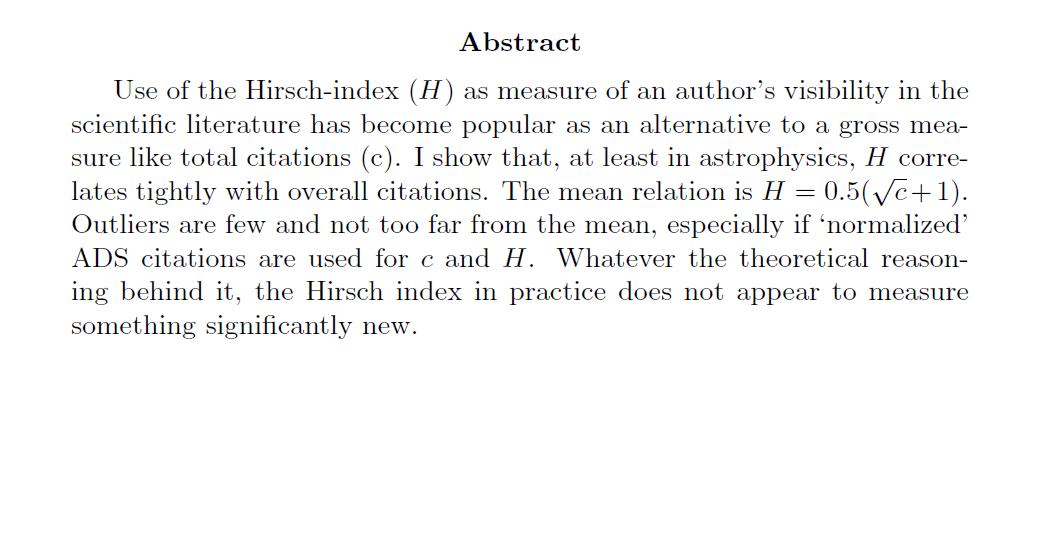
Here is the abstract of the paper:

Here are a couple of graphs which back up the claim of a near-perfect correlation between H-index and total citations:

The figure shows both total citations (right) and normalized citations (left); the latter, in my view, a much more sensible measure of individual contributions. The basic problem of course is that people don’t get citations, papers do. Apportioning appropriate credit for a multi-author paper is therefore extremely difficult. Does each author of a 100-author paper that gets 100 citations really deserve the same credit as a single author of a paper that also gets 100 citations? Clearly not, yet that’s what happens if you count total citations.

The correlation between H index and the square root of total citation numbers has been remarked upon before, but it is good to see it confirmed for the particular field of astrophysics.

Although I’m a bit unclear as to how the “sample” was selected I think this paper is a valuable contribution to the discussion, and I hope it helps counter the growing, and in my opinion already excessive, reliance on the H-index by grants panels and the like. Trying to condense all the available information about an applicant into a single number is clearly a futile task, and this paper shows that using H-index and total numbers doesn’t add anything as they are both measuring exactly the same thing.

A very interesting question emerges from this, however, which is why the relationship between total citation numbers and h-index has the form it does: the latter is always roughly half of the square-root of the former. This suggests to me that there might be some sort of scaling law describing onto which the distribution of cites-per-paper can be mapped for any individual. It would be interesting to construct a mathematical model of citation behaviour that could reproduce this apparently universal property….

Giant Steps, from Astrophysics to Jazz

Posted in Jazz, The Universe and Stuff with tags , , , , on January 21, 2012 by telescoper

I’m indebted to Alan Heavens (currently of Edinburgh University, shortly to move to Imperial College) for drawing my attention to outstanding young jazz pianist and composer Dan Tepfer. I’ve been listening to quite a lot of Dan’s music, over the past few days and I think he’s brilliant. What’s even more interesting about him from the point of view of this blog is his background:  he is a former Astrophysics student (at the University of Edinburgh). He changed direction away from academic studies in order to focus on his music, relocated to New York and has subsequently received rave reviews for his performances both live and on various albums. He tours extensively in the USA and worldwide; next time he’s in the UK I’m definitely going to check out one of his live gigs. Do visit his website; as a taster here’s his  highly original (and pretty long) live version of the John Coltrane classic Giant Steps..

Baby Planet Pictures…

Posted in Astrohype, The Universe and Stuff with tags , , on October 20, 2011 by telescoper

My eye was caught this morning by this dramatic picture on the front page of the Guardian website, linked to a story about the discovery of a very young planet:

I wonder how many people looking at it thought that it was an actual picture of a planet actually forming? In fact the above graphic is just an “artist’s conception” of the view near the planet, which is called LkCa 15b. The real picture is considerably less dramatic:

What you see is (left) a disk of dust and gas surrounding a star cleverly made visible by masking out the light from the star, which is much brighter than the disk.  On the right you can see a blow up of the inner region of the system, which appears to show a Jupiter-like planet associated with an irregular blob of material, out of which it probably condensed and from which it may still be accreting.

The size of the picture on the right is worth noting. The angle indicated is 76 milli-arcseconds. This is the angle subtended by  the  width of a  human hair at distance of about 130 metres…