Archive for baryon acoustic oscillations

Cosmology Results from DESI

Posted in Astrohype, The Universe and Stuff with tags , , , , , , on March 20, 2025 by telescoper

Yesterday evening (10pm Irish Time) saw the release of new results from the Dark Energy Spectroscopic Instrument (DESI), completing a trio of major announcements of cosmological results in the space of two days (the Atacama Cosmology Telescope and the Euclid Q1 release being the others). I didn’t see the DESI press conference but you can read the press release here.

There were no fewer than eight DESI papers on the astro-ph section of the arXiv this morning. Here are the titles with links:

You can see from the titles that the first seven of these relate to the second data release (DR2; three years of data) from DESI; the last one listed here is a description of the first data release (DR1), which is now publicly available.

Obviously there is a lot of information to digest in these papers so here are two members of the DESI collaboration talking with Shaun Hotchkiss on Cosmology Talks about the key messages from the analysis of Baryon Acoustic Oscillations (the BAO in the titles of the new papers):

A lot has been made in the press coverage of these results about the evidence that the standard cosmological model is incomplete; see, e.g., here. Here are a few comments.

As I see it, taken on their own, the DESI BAO results are broadly consistent with the ΛCDM model as specified by the parameters determined by the Cosmic Microwave Background (CMB) inferred from Planck. Issues do emerge, however, when these results are combined with other data sets. The most intriguing of these arises with the dark energy contribution. The simplest interpretation of dark energy is that it is a cosmological constant (usually called Λ) which – as explained here – corresponds to a perfect fluid with an equation-of-state p=wρc2 with w=-1. In this case the effective mass density of the dark energy ρ remains constant as the universe expands. To parametrise departures from this constant behaviour, cosmologists have replaced this form with the form w(a)=w0+wa(1-a) where a(t) is the cosmic scale factor. A cosmological constant Λ would correspond to a point (w0=-1, wa=0) in the plane defined by these parameters, but the only requirement for dark energy to result in cosmic acceleration is that w<-1/3, not that w=-1.

The DESI team allow (w0, wa) to act as free parameters and let the DESI data constrain them, either alone or in combinations with other data sets, finding evidence for departures from the “standard values”. Here’s an example plot:

The DESI data don’t include the standard point (at the intersection of the two dashed lines) but the discrepancy gets worse when other data (such as supernovae and CMB) are folded in, as in this picture. The weight of evidence suggests a dark energy contribution which is decreasing with time.

These results are certainly intriguing, and a lot of credit is due to the DESI collaboration for working so hard to identify and remove possible systematics in the analysis (see the papers above) but what do they tell us about ΛCDM?

My view is that we’ve never known what the dark energy actually is or why it is so large that it represents 70% of the overall energy density of the Universe. The Λ in ΛCDM is really just a place-holder, not there for any compelling physical reason but because it is the simplest way of accounting for the observations. In other words, it’s what it is because of Occam’s Razor and nothing more. As with any working hypothesis, the standard cosmological model will get updated whenever new information comes to light (as it is doing now) and/or if we get new physical insights into the origin of dark energy.

Do the latest observations cast doubt on the standard model? I’d say no. We’re seeing an evolutionary change from “We have no idea what the dark energy is but we think it might be a cosmological constant” to “We still have no idea what the dark energy is but we think it might not be a cosmological constant”.
Presentation of the BAO DESI results at ICCUB Uni Barcelona – by Licia Verde & Héctor Gil Marin

Posted in The Universe and Stuff with tags , , , , on April 8, 2024 by telescoper

Last week, when I wrote about the new results from the Dark Energy Spectroscopic Instrument (DESI) I mentioned that there would be a seminar here at ICCUB about that very topic. Well, the seminar, by Licia Verde & Héctor Gil Marin, was recorded and here it is:

DESI Year 1 Results: Baryon Acoustic Oscillations

Posted in Barcelona, Euclid, The Universe and Stuff with tags , , , , on April 4, 2024 by telescoper

There has been a lot of excitement around the ICCUB today – the press have been here and everything – ahead of the release of the Year 1 results from the Dark Energy Spectroscopic Instrument (DESI). The press release from the Lawrence Berkeley Laboratory in California can be found here.

The papers were just released at 5pm CEST and can be found here. The key results pertain to Baryon Acoustic Oscillations (BAOs) which can be used to track the expansion rate and geometry of the Universe. This is one of the techniques that will be used by Euclid.

There’s a lot of technical information to go through and I have to leave fairly soon. Fortunately we have seminar tomorrow that will explain everything at a level I can understand:

I will update this post with a bit more after the talk, but for the time being I direct you to the high-level cosmological implications are discussed in this paper (which is Paper VI from DESI).

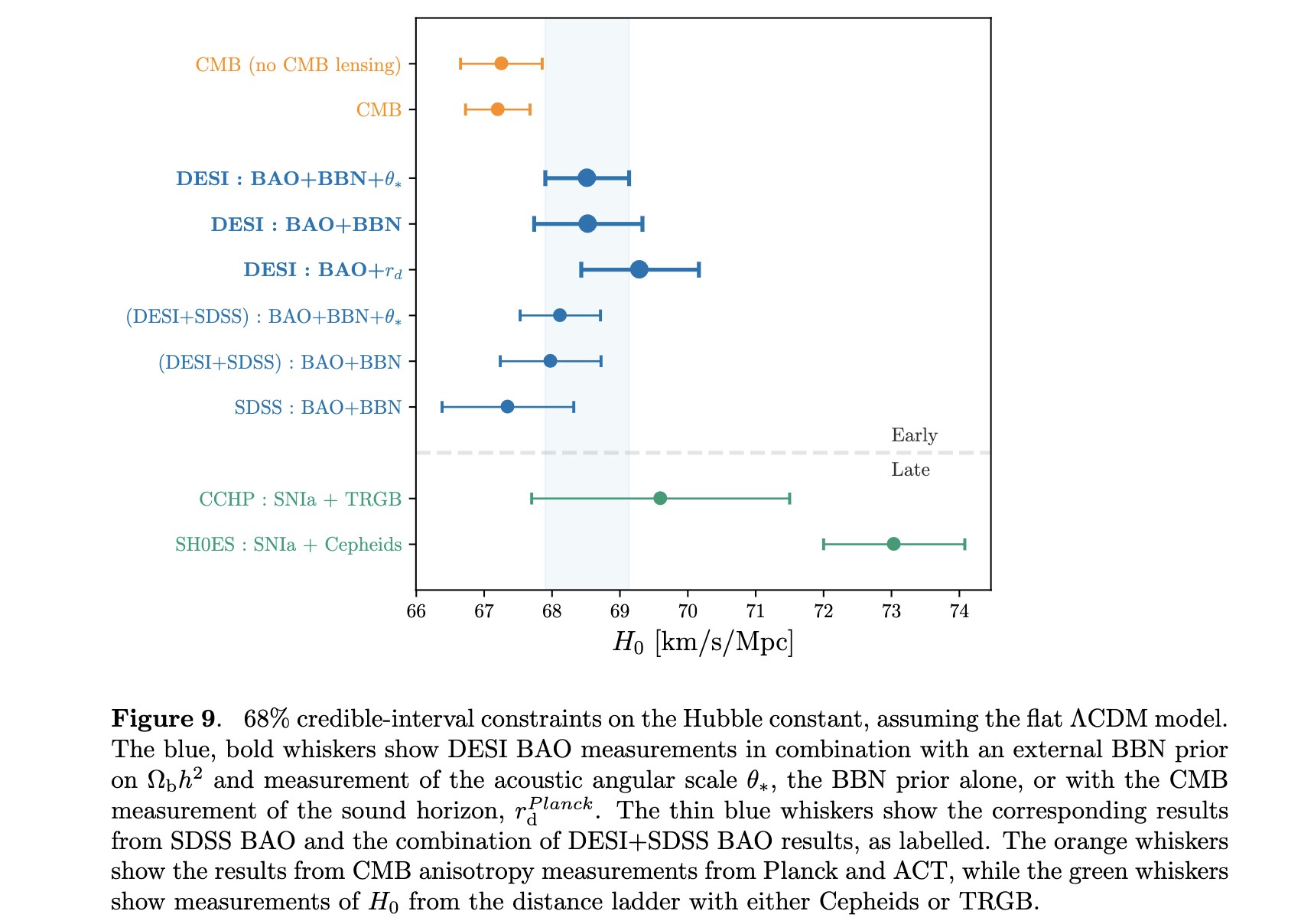
If your main interest is in the Hubble Tension then I direct you to this Figure:

Depending on the other data sets included, the value obtained is around 68.5 ± 0.7 in the usual units, closer to the (lower) Planck CMB value than the (higher) Supernovae values but not exactly in agreement; the error bars are quite small too.

You might want to read my thoughts about distances estimated from angular diameters compared with distances measured using luminosity distances here.

If you’re wondering whether there is any evidence for departures from the standard cosmology, another pertinent comment is:

In summary, DESI data, both alone and in combination with other cosmological probes, do not show any evidence for a constant equation of state parameter different from −1 when a flat wCDM model is assumed.

DESI 2024 VI: Cosmological Constraints from the Measurements of Baryon Acoustic Oscillations

More complicated models of time-varying dark energy might work, but there’s no strong evidence from the current data.

That’s all from me for now, but feel free to comment through the box below with any hot takes!

UPDATE: As expected there has been quite a lot of press coverage about this – see the examples below – mostly concentrating on the alleged evidence for “new physics”. Personally I think the old physics is fine!

DES and the BAO Scale

Posted in The Universe and Stuff with tags , , , , on February 22, 2024 by telescoper

I just saw a press release about new results from the Dark Energy Survey relating to measurements of baryon acoustic oscillations. These are basically the residue of the oscillations seen in the power spectrum of the cosmic microwave background (CMB) temperature distribution imprinted on the galaxy distribution. They are somewhat less obvious that the primordial temperature fluctuations because the growth of structure produces a much larger background but they are measurable (and indeed are one of the things Euclid will measure).

Anyway, there is a very nice detailed description in the press release and you can find the preprint of the work in full on arXiv here, so I’ll just show the key figure:

The effective redshift of this measurement is about 0.85; in the CMB the redshift is about 1000. You can see that there is a characteristic scale but it is slightly offset from that predicted using the standard ΛCDM model based on the Planck determination of cosmological parameters. One has to be careful in interpreting this diagram because it is determined using autocorrelation functions; the errors on different bins are therefore correlated, not statistically independent. They are also, as you can see, quite large. Nonetheless, it’s a tantalizing result…

The Euclid Launch Kit!

Posted in Euclid, The Universe and Stuff with tags , , , , , on May 17, 2023 by telescoper

As the launch of the European Space Agency’s Euclid mission approaches, though we don’t know official launch date yet, the associated publicity machines are ramping up for the big occasion. The latest bit of merch is the Euclid Launch Kit.

Sadly, this does not allow you to build your own Falcon 9 launcher which is what I inferred from the name. What it is is an interactive PDF file that allows you to navigate around and learn things about the satellite, its orbit, its instruments and the science case. I think it’s pretty good. You can download it here. It’s over 100 MB though, so beware if you have a very slow connection.

To whet your appetite, here some graphics extracted from the launch kit. You can click on the tiles to make them bigger.

The two science images relate to weak gravitational lensing and baryon acoustic oscillations; for more details you can click on the relevant links.

Cosmology Talks: DESI detects BAOs!

Posted in The Universe and Stuff with tags , , , , on May 15, 2023 by telescoper

It’s been too long since I last posted one of the cosmology talks curated on YouTube by Sean Hotchkiss so I will endeavour to put that right by posting one today.

In this video, Jeongin Moon, David Valcin and Christoph Saulder talk about the first cosmologically relevant results from DESI (the Dark Energy Spectroscopic Instrument), including the first detection of the BAOs (Baryon Acoustic Oscillations) therefrom. It’s pretty impressive for a first detection with only two months worth of data, so the final result with the full data set should be spectacular!

You can of course read the paper related to these results (by Moon et al.) on the arXiv here.

Cosmological Constraints on Alternative Gravity Theories

Posted in The Universe and Stuff with tags , , , , , , , on July 11, 2022 by telescoper

The standard model of cosmology is based on Einstein’s theory of general relativity. In order to account for cosmological observations this has required the introduction of dark matter – which also helps explain the properties of individual galaxies – and dark energy. The result model, which I would describe as a working hypothesis, is rather successful but it is reasonable to question whether either or both of the dark components can be avoided by adopting an alternative theory of gravity instead of Einstein’s.

There is an interesting paper by Kris Pardo and David Spergel on arXiv that argues that none of the modifications of Einstein’s theory currently on the market is able to eliminate the need for dark matter. Here is the abstract of this paper:

It’s a more sophisticated version of an argument that has been going around at least in qualitative form for some time. The gist of it is that the distinctive pattern of fluctuations in the cosmic microwave background, observed by e.g. the Planck experiment, arise from coupling between baryons and photons in the early Universe. Similar features can be observed in the distribution of galaxies – where they are called Baryon Acoustic Oscilations (BAO) at a more recent cosmic epoch, but they are are much weaker. This is easily explicable if there is a dark matter component that dominates gravitational instability at late times but does not couple to photons via electromagnetic interactions. This is summed up in the following graphic (which I think I stole from a talk by John Peacock) based on data from about 20 years ago:

If there were no dark matter the coherent features seen in the power spectrum of the galaxy distribution would be much stronger; with dark matter dominating they are masked by the general growth of the collisionless component so their relative amplitude decreases.

The graphic shows how increasing the dark matter component from 0.1 to 0.3, while keeping the baryon component fixed, suppresses the wiggles corresponding to BAOs. The data suggest a dark matter contribution at the upper end of that range, consistent with the standard cosmology.

Of course if there are were no baryons at all there wouldn’t be fluctuations in either the CMB polarization or the galaxy distribution so both spectra would be smooth as shown in the graphic, but in that case there wouldn’t be anyone around to write about them as people are made of baryons.

This general conclusion is confirmed by the Pardo & Spergel paper, though it must be said that the argument doesn’t mean that modified gravity is impossible. It’s just that it seems nobody has yet thought of a specific model that satisfies all the constraints. That may change.

Voids, Galaxies and Cosmic Acceleration

Posted in The Universe and Stuff with tags , , , , , , on February 4, 2020 by telescoper

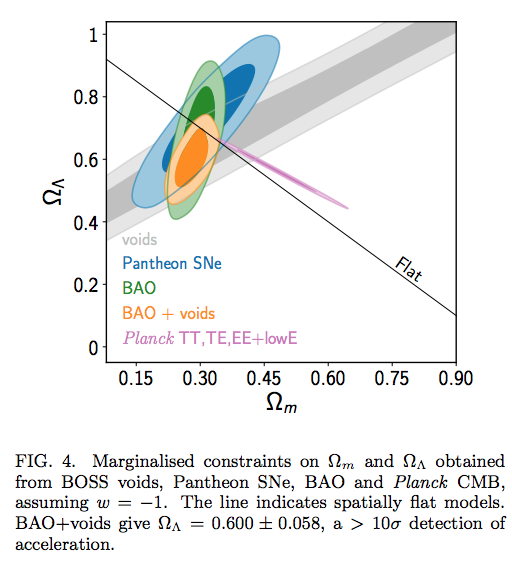
Time for a quick plug for a paper by Nadathur et al. that appeared on the arXiv recently with the title Testing low-redshift cosmic acceleration with large-scale structure. Here is the abstract:

You can make it bigger by clicking on the image. You can download a PDF of the entire paper here.

The particularly interesting thing about this result is that it gives strong evidence for models with a cosmological constant (or perhaps some other form of dark energy), in a manner that is independent of the other main cosmological constraints (i.e. the Cosmic Microwave Background or Type 1a Supernovae). This constraint is based on combining properties of void regions (underdensities) with Baryon Acoustic Oscillations (BAOs) to produce constraints that are stronger than those obtained using BAOs on their own. The data used derives largely from the BOSS survey.

As well as this there’s another intriguing result, or rather two results. First is that the the BAO+voids data from redshifts z<2 gives H0 = 72.3 ± 1.9, while, on the other hand adding, BAO information from the Lyman-alpha forest for from z>2 gives a value H0 = 69 \pm 1.2, favouring Planck over Riess. Once again, the `tension’ over the value of the Hubble constant appears to be related to using nearby rather than distant sources.

ESA Endorses Euclid

Posted in Euclid, Science Politics, The Universe and Stuff with tags , , , , , , on June 20, 2012 by telescoper

I’m banned from my office for part of this morning because the PHYSX elves are doing mandatory safety testing of all my electrical whatnots. Hence, I’m staying at home, sitting in the garden, writing this little blog post about a bit of news I found on Twitter earlier.

Apparently the European Space Agency, or rather the Science Programme Committee thereof, has given the green light to a space mission called Euclid whose aim is to “map the geometry of the dark Universe”, i.e. mainly to study dark energy. Euclid is an M-class mission, pencilled in for launch in around 2019, and it is basically the result of a merger between two earlier proposals, the Dark Universe Explorer (DUNE, intended to measure effects of weak gravitational lensing) and the Spectroscopic All Sky Cosmic Explorer (SPACE, to measure wiggles in the galaxy power spectrum known as baryon acoustic oscillations); Euclid will do both of these.

Although I’m not directly involved, as a cosmologist I’m naturally very happy to see this mission finally given approval. To be honest, I am a bit sceptical about how much light Euclid will actually shed on the nature of dark energy, as I think the real issue is a theoretical not an observational one. It will probably end up simply measuring the cosmological constant to a few extra decimal places, which is hardly the issue when the value we try to calculate theoretically is a over a hundred orders of magnitude too large! On the other hand, big projects like this do need their MacGuffin..

The big concern being voiced by my colleagues, both inside and outside the cosmological community, is whether Euclid can actually be delivered within the agreed financial envelope (around 600 million euros). I’m not an expert in the technical issues relevant to this mission, but I’m told by a number of people who are that they are sceptical that the necessary instrumental challenges can be solved without going significantly over-budget. If the cost of Euclid does get inflated, that will have severe budgetary implications for the rest of the ESA science programme; I’m sure we all hope it doesn’t turn into another JWST.

I stand ready to be slapped down by more committed Euclideans for those remarks.

Dark Energy is Real. Really?

Posted in Astrohype, The Universe and Stuff with tags , , , , , on May 20, 2011 by telescoper

I don’t have much time to post today after spending all morning in a meeting about Assuring a Quality Experience in the Graduate College and in between reading project reports this afternoon.

However, I couldn’t resist a quickie just to draw your attention to a cosmology story that’s made it into the mass media, e.g. BBC Science. This concerns the recent publication of a couple of papers from the WiggleZ Dark Energy Survey which has used the Anglo-Australian Telescope. You can read a nice description of what WiggleZ (pronounced “Wiggle-Zee”) is all about here, but in essence it involves making two different sorts of measurements of how galaxies cluster in order to constrain the Universe’s geometry and dynamics. The first method is the “wiggle” bit, in that it depends on the imprint of baryon acoustic oscillations in the power-spectrum of galaxy clustering. The other involves analysing the peculiar motions of the galaxies by measuring the distortion of the clustering pattern introduced seen in redshift space; redshifts are usually denoted z in cosmology so that accounts for the “zee”.

The paper describing the results from the former method can be found here, while the second technique is described there.

This survey has been a major effort by an extensive team of astronomers: it has involved spectroscopic measurements of almost a quarter of a million galaxies, spread over 1000 square degrees on the sky, and has taken almost five years to complete. The results are consistent with the standard ΛCDM cosmological model, and in particular with the existence of the  dark energy that this model implies, but which we don’t have a theoretical explanation for.

This is all excellent stuff and it obviously lends further observational support to the standard model. However, I’m not sure I agree with the headline of press release put out by the WiggleZ team  Dark Energy is Real. I certainly agree that dark energy is a plausible explanation for a host of relevant observations, but do we really know for sure that it is “real”? Can we really be sure that there is no other explanation?  Wiggle Z has certainly produced evidence that’s sufficient to rule out some alternative models, but that’s not the same as proof.  I worry when scientists speak like this, with what sounds like certainty, about things that are far from proven. Just because nobody has thought of an alternative explanation doesn’t mean that none exists.

The problem is that a press release entitled “dark energy is real” is much more likely to be picked up by a newspaper radio or TV editor than one that says “dark energy remains best explanation”….

Share/Bookmark