I stumbled across this on Youtube and just had to share it. I’ve got this track on an old vinyl LP of Charlie Parker performances recorded live at Birdland, the famous New York jazz club named in his (Bird’s) honour. I don’t think any of the tracks on that album have ever been reissued on CD or for download so I was both surprised and delighted to find this. It was recorded live in 1953, so it’s a bit lo-fi, but what’s particularly interesting is the unusual collection of instruments. Bird is alto sax as usual, but the rest of the band consists of Cornelius Thomas on drums, Bernie McKay on guitar and Milt Buckner on the Hammand Organ. That’s very far from a typical bebop band. Milt Buckner’s organ accompaniment is perhaps an acquired taste but Charlie Parker clearly enjoyed this setting. He plays beautifully throughout, especially during the exciting chase sequence with the drummer near the end. The tune was written by Parker’s old sparring partner Dizzy Gillespie and is based on the chords of Whispering, an old ballad written in 1920. I’m not sure why Dizzy Gillespie decided to hang his tune on that particular harmonic progression, but it’s a thrill to hear Bird racing through the changes in such exhilarating style.
Follow @telescoperArchive for bebop
Groovin’ High
Posted in Jazz with tags bebop, Birdland, Charlier Parker, Groovin' High, Milt Buckner on May 18, 2015 by telescoperBloomdido – In Memoriam Charlie Parker
Posted in Jazz with tags bebop, Bloomdido, Blues, Charlie Parker, Dizzy Gillespie, Jazz, Thelonious Monk on March 12, 2015 by telescoper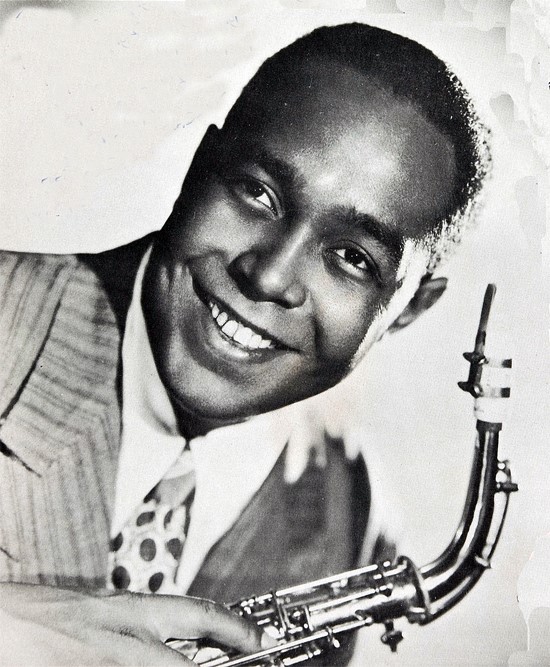
Today marks the 60th anniversary of the death of the great saxophonist Charlie Parker (“Bird”) on 12th March 1955. I’ve written quite a few posts relating to Charlie Parker over the years but today has provided a good excuse to spend my lunchtime writing another one, this time featuring one of my favourite tracks from one of my favourite albums. First released in 1952 but in fact recorded in two separate sessions in 1949 and 1950, the album Bird and Diz was actually the last studio album made under the joint leadership of Charlie Parker and Dizzy Gillespie, the two main architects of the bebop revolution; the track I’ve picked has the added advantage of featuring another great musical genius on piano, Thelonious Monk.
The Charlie Parker composition Bloomdido is yet another of his variations on the blues, though this one is a bit less intricate than some of the others he wrote. Here are the chords for Bloomdido:
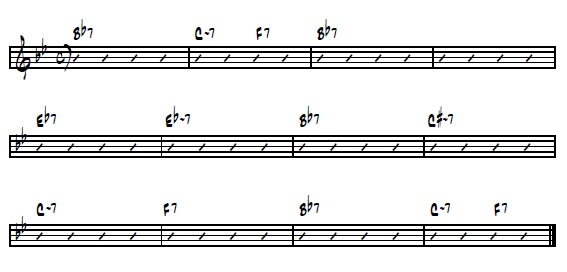
You can see that the progression is based around the standard three chords of a blues in B♭. The foundation is a “tonic” chord (T) based on the root note of whatever key it’s played in, in this case B♭. This sometimes a basic triad consisting of the first, third and five notes of a major scale starting on that note or, as in this example, including the dominant 7th so it’s B♭7. The next chord is the subdominant chord (S), shifting things up by a perfect fourth relative to the tonic, in this case an E♭7 and then finally we have the dominant (D) which brings us up by a fifth from the original root note, in this case F7.
The basic blues sequence in B♭ would be four bars of B♭7 (T), two of E♭7 (S), back to B♭7 (T) for two, then the characteristic bluesy cadence returning to two bars of B♭7 (T) via one bar each of F7 (D) and E♭7 (S). The sequence for Bloomdido has a few alterations, including a characteristic turnaround at the end instead of the tonic, but is otherwise fairly recognizable. I guess the first part of the title is a play on the blues origin too, though I wonder if the second part suggests that some of the alterations are inspired by the A-section of the Juan Tizol standard Perdido?
Some people tell me they find Charlie Parker’s music “too technical” and that somehow if music “needs to be explained” it’s not good music. I don’t understand that attitude at all. I find this music so fascinating and exciting to listen to that I want to try to dig a little bit into it and find out what’s going underneath the surface. It’s particularly striking what a difference a few substitutions and passing chords can make to the overall harmonic “feel” of a piece like this compared to a standard blues sequence, for example. But you don’t need to study the chords to appreciate the sheer beauty of the music that Charlie Parker built on these harmonic foundations; his solo on this track, as on so many others he recorded in his short life, is just sublime even if you don’t realise how hard it is to play! I guess it all depends whether your way of enjoying a thing is to sit back and let it wash over you, or for it to inspire you to find out more. Many of the physicists I know are deeply interested in music. Perhaps that’s because they’re the sort of people who don’t just think “wow that’s beautiful”, they tend to think “wow that’s beautiful – how does it work?”.
Charlie Parker and Albert Einstein died in the same year, just over a month apart, the former in March 1955 and the latter in April. They were two very different geniuses but it’s as difficult to imagine physics without Einstein as jazz without Bird.
Follow @telescoperThe Giant Steps of Buddy DeFranco
Posted in Jazz with tags bebop, Buddy DeFranco, Charlie Parker, clarinet, Glen Miller, John Coltrane, Terry Gibbs on January 11, 2015 by telescoperChristmas Eve saw the passing of another great Jazz artist, the clarinettist Buddy DeFranco , at the grand old age of 91. Not surprisingly, glowing tributes to him have appeared in all the mainstream media as well as in specialist jazz sources as he was an absolutely superb musician as well as a distinctive stylist. Alongside countless other measures of his greatness and popularity, he won no less than twenty Downbeat Magazine Awards and nine Metronome Magazine Awards as the number one jazz clarinettist in the world.
It’s an interesting facet of jazz history that the clarinet, a mainstay of jazz styles from the New Orleans roots through to the Swing Era, fell into disfavour in the post-war era with the advent of bebop when it was largely eclipsed by the saxophone. Very few musicians persisted with the clarinet into the era of modern jazz, but Buddy DeFranco was one who did. That’s not to say that he disliked swing music though. In fact he began his career playing with big bands of that era, such as those led by Gene Krupa and Tommy Dorsey. One of the most famous bands of that era, the Glenn Miller Orchestra, formed in 1935 and saw its greatest popularity during the Second World War. It was disbanded in 1944 on the death of its leader, but it started again in 1956 and, although it has had a number of changes of personnel, it is still going strong. So strong that there’s a minimum two year waiting list if you want to book the Glenn Miller Orchestra for a gig! With the 70th anniversary of the end of World War Two coming up this year, I’ve no doubt that there’ll be a great deal of nostalgia evoked by renditions of Moonlight Serenade..
The distinctive sound of the original Glenn Miller Orchestra largely derived from the unusual arrangement of its reed section: usually four saxophones playing in harmony, topped by a high clarinet lead. Many jazz fans found that blend a bit too honeyed compared with the likes of, e.g., the Count Basie Orchestra but there’s no question that it gave the band an immediately recognisable sound. Despite his predilection for more modern jazz idioms, especially bebop, Buddy DeFranco obviously very much liked the idea of a big band with a clarinet playing such a prominent part and, in fact, he was the leader and musical director of the revived Glenn Miller Orchestra from 1966 until 1974, and also guested with them on a number of occasions after that.
Anyway, Buddy DeFranco was one of the most technically accomplished clarinettists in all of jazz. Very few have ever been able to match his control, particularly in the upper register. But what I admired most about him was his willingness to take on material not usually associated with his instrument. Here’s a great example, of him playing the John Coltrane classic Giant Steps together with Terry Gibbs on vibraphone. When I saw the relatively low quality reproduction of the film I assumed the sound quality would be similarly poor, but some superb remastering work has been done and this sounds terrific.
Rest In Peace, Buddy DeFranco (1923-2014).
Follow @telescoperCharlie Christian: Swing to Bop
Posted in Jazz with tags bebop, Benny Goodman, Charlie Christian, electric guitar, guitar, Jazz, swing era, Swing to Bop on November 2, 2014 by telescoperI was transferring some old CDs onto my iPod the other day, and in the process of doing that I realized that in all the six years I’ve been running this blog I haven’t posted a single item about the great guitarist Charlie Christian, who did more than any other individual to promote the use of the electrical guitar and thus had an enormous influence on the development of 20th century music. The only reason I can think of why his is not a household name is that he died so young, in 1942, of tuberculosis, at the age of just 25.
Born in 1916, Charlie Christian came to prominence with Benny Goodman‘s orchestra during the 1930s. That in itself merits a remark. Benny Goodman was one of the first white bandleaders in the Swing Era to have black musicians in his band at a time when both musicians and audiences were generally racially segregated in the United States of America. Goodman deserves great credit for picking the best musicians he could find, regardless of the colour of their skin; Lionel Hampton is another prominent example. Bringing the young Charlie Christian into his band also testifies not only to his refusal to pander to racism, but also his willingness to experiment with new musical ideas, not least taking the guitarist out of the rhythm section and placing him as front-line soloist.
Here’s an excellent example of Charlie Christian playing with Benny Goodman’s Orchestra in 1939. I remember that my Dad wasn’t all that keen on Benny Goodman’s clarinet playing, which he regarded as “too clinical”. In fact many jazz writers also tend to refer to Benny Goodman’s playing as “unemotional”. I can’t agree. I admit that the band is a bit “slick”, but the clarinet on this track is absolutely sensational to me, and I find it a joy to listen to over and over again. There’s also fine Cootie Williams on trumpet on this version of Fats Waller’s composition Honeysuckle Rose:
Commercial records from the 1930s were strictly limited by the available technology to 3 minutes’ duration, so Charlie Christian’s solo on that track is necessarily brief. You can hear much more of him on the historically important amateur recordings made during the early 1940s of late-night jam sessions at Minton’s Playhouse in New York City. This is an excerpt from a piece called Swing to Bop recorded in 1941, which shows how far Charlie Christian had advanced in just a couple of years. His improvised solo is way ahead of its time in the way it develops through an effortless string of musical ideas into an exploration of the harmonic possibilities of the chord sequence that I find absolutely sensational to listen to.
Not many people knew it at the time, because tracks like this weren’t made commercially available, but a musical revolution was brewing. Charlie Christian changed the course of jazz history, helping to usher in the bebop era, but his influence on rock-and-roll guitar is also incalculable.
Incidentally, I think Swing to Bop is actually the Count Basie tune Topsy in disguise, or at least the chords thereof. Listen to Topsy here and see if you agree..
Follow @telescoperBird’s Nest
Posted in Jazz with tags bebop, Bird, Bird's Nest, Charlie Parker, Errol Garner, Rhythm Changes on August 25, 2013 by telescoperI know it’s a Bank Holiday weekend, but I’ve got so many things to do that I don’t have time for anything but a brief post today. I heard this track on BBC Radio 3 last night and it brought back a lot of memories for me so I thought I’d post it here with some brief comments. When I was at school most of my friends seemed to be into heavy metal, which I found completely tedious, so while they were out buying LPs by Hawkwind or Iron Maiden I was acquiring a secret collection of classic jazz records. Among my most prized purchases was a boxed set of six vinyl discs entitled The Legendary Dial Masters; they’re now available on CD, of course. I listened to these records over and over again and can easily understand why they’re regarded as some of the greatest musical performances of the twentieth century, not only in Jazz but in all music.
There’s a curious story about the Dial sessions, in that they took place in Hollywood California as part of an “exclusive” one-year contract (signed in 1946) between Dial records and Charlie Parker, who just happened to have signed another exclusive contract with the Savoy label based in New York. By this time in his life, Parker was already seriously addicted to heroin and this example of duplicity is consistent with other aspects of his behaviour: he regularly cheated and scrounged off friends and strangers in order to feed his habit and probably gave relatively little thought to the consequences of being found out. In this case, the clear breach of contract was pretty quickly rumbled, which could have led to a lawsuit, but it seems to have been settled amicably by the record labels, who agreed that both sets of recordings could be made commercially available.
It would take scores of blog posts to do justice to these great tracks, so I’ll just make a few comments now. First thing to mention is that the LPs forming the boxed set don’t just include the final versions as released, but usually a number of incomplete or discarded takes. At the session in question, recorded on February 19th 1947, there are 13 takes in all for just four tunes. It’s fascinating listening to these alternative versions (which are often, in my view, just as good if not better than the “final” version), not least because they demonstrate the wonderful spontaneity of Charlie Parker’s playing. They also have an experimental feel to them. The track I heard last night, Bird’s Nest, is, on one level, yet another bebop composition based on the chord changes of the George Gershwin standard “I got rhythm”, but what’s very special about it is just how free his improvisation is, both rhythmically and harmonically. It is, of course, well known that Charlie Parker’s nickname was “Bird” (originally Yardbird), and this track in particularly demonstrates that his playing really was very like birdsong – agile, quirky and above all intensely beautiful. The main difference is that most birdsong is actually atonal, which Bird’s music was not.
Another thing worth mentioning about this track is the identity of the piano player. When I heard it last night it triggered a vague memory that Errol Garner made some records with Charlie Parker. Was this one of them? I honestly couldn’t remember, but became increasingly convinced when I heard the piano solo. Later on, a quick search through my discography revealed that I was right. It is indeed a young Errol Garner. Although he doesn’t play badly, he doesn’t sound to me either comfortable or convincing playing bebop. Nevertheless, this session gives an important glimpse into the musical development of a major artist. You could say the same thing about the other tracks made around the same time by Bird and the young Miles Davis.
But that’s enough words. The whole point about music is that it says something that can’t be said with words. Birds manage perfectly well without them too.
Follow @telescoperCon Alma
Posted in Jazz, The Universe and Stuff with tags ALMA, Atacana Large Millimetre Array, bebop, Dizzy Gillespie on March 14, 2013 by telescoperWell, Herschel may be going blind but it seems that just as one observatory gets ready to close its eyes on the Universe, another one gets ready to open them. Yesterday saw the official opening of the Atacama Large Millimetre Array (known to its friends as ALMA). What better way to celebrate the opening of this remarkable observatory than with an appropriately-named piece of music.
Con Alma is an original composition by Dizzy Gillespie who plays it on this track made with his big band in 1954, a period when Dizzy was experimenting with various fusions of bebop with Latin-American rhythms. It’s a deceptively complicated tune, with lots of changes of key to keep everyone on their toes. It may be more Cuban than Chilean in influence, but that’s the closest I could think of!
Follow @telescoperAblution
Posted in Jazz with tags All the things you are, bebop, Jazz, Jerome Kern, Lee Konitz, Ronnie Ball on August 26, 2012 by telescoperI haven’t posted any jazzy bits for a while. I don’t know why. Anyway, I just found this track, called Ablution, by alto saxophonist Lee Konitz . Unless my ears deceive me the pianist on this track is Ronnie Ball (British, by the way) whose comping makes no attempt to disguise the fact that it is a variation on the famous Jerome Kern tune All The Things You Are, the unusual chords of which have made it a popular vehicle for jazz musicians to improvise on ever since it was written back in 1939. In the bebop era it was typical practice to base original compositions on top of the chord sequences of standard tunes, and this is a prime example although I don’t know in this case whether Lee Konitz managed to get away without paying composer’s royalties!
Follow @telescoper
My Little Suede Shoes
Posted in Jazz with tags bebop, Charlie Parker, Jazz, Johnny Griffin, My Little Suede Shoes on June 23, 2012 by telescoperIf this wonderful video is anything to go by, the late great Johnny Griffin had splendid taste in footwear..as he got these shoes from Charlie Parker himself.
Follow @telescoperRemembering Bird
Posted in Jazz with tags bebop, Charlie Parker, Jazz, Kim, Rhythm Changes on March 18, 2012 by telescoperLast week saw the 57th anniversary of the death of Charlie Parker, aka Bird, a musical genius on the saxophone whose influence not only on jazz but on twentieth century music is incalculable. I’ve posted quite a few tracks by Bird over the years and one thing I’ve learned from doing that is that he’s by no means everyone’s cup of tea. I can’t do anything about that, of course, but I can at least point out the existence of his wonderful legacy to those (regrettably many) people who’ve never heard of him or his musicI still remember the mixture of astonishment and exhilaration I felt when I first heard him on record and if I can give that sense of joy to just one person via the blogosphere then it’s worth a hundred posts.
Here’s Kim, another one of Bird’s tunes based on the rhythm changes, with an alto sax solo improvised at breakneck speed and with incredible virtuosity. The other day I was talking to a friend of mine who only has a passing interest in jazz and he asked me whether Charlie Parker really was that good. Well, if you’re asking that question to yourself, listen to this and then you’ll have the answer. As far as I’m concerned this is three minutes of pure awesome….
Follow @telescoperBillie’s Bounce
Posted in Jazz with tags bebop, Bille's Bounce, Buddy DeFranco, Charlie Parker, clarinet on July 28, 2011 by telescoperI thought I’d put this up because I’ve just found it and I think it’s great. It’s an interesting facet of jazz history that the clarinet, a mainstay of jazz styles from the New Orleans roots through to the Swing Era, fell into disfavour in the post-war era with the advent of bebop when it was largely replaced by the saxophone. Very few musicians persisted with the clarinet into the era of modern jazz, but this is one that did. It’s the superb Buddy DeFranco, one of the most technically accomplished clarinettists in all of jazz – few have ever been able to match his control in the upper register. The tune they’re playing is a Charlie Parker composition called Billie’s Bounce, another tune based on the standard 12-bar blues sequence (in F) but with some alterations. As far as my chord book says, it basically goes like this:
| F7| F7 | B♭7| F7|| B♭7| B♭7|F7| F7| G7| C7| F7| C7|
while the standard blues progression in F would go like
| F7| F7| F7 |F7 | B♭7| B♭7| F7| F 7| C7| B♭7| F7| F7|
It’s a Charlie Parker trademark to have a “turnaround” at the end, with the dominant chord C7 instead of the tonic F and, as you’ll hear, these changes produce quite a different feel to the standard blues sequence.
Anyway, one thing I particularly love about this performance is the perfunctory instruction given by Buddy DeFranco at the start: “Play the Blues in F for a while”. That’s all they needed to send them on their way.
Follow @telescoper
 In the Dark