Archive for bebop

Move

Posted in Jazz with tags , , , , on May 23, 2011 by telescoper

Well, it’s 1pm and my third-year students are just sitting down for two hours of fun with their Nuclear and Particle Physics examination. For my part I’m obliged to sit by the phone for the next two hours in case there’s a problem with the examination paper. Ideal excuse for a quick blog post while I eat my sandwich.

I also notice from my trusty wordpress dashboard that this is my 1000th post since I started blogging, way back in late 2008.  Time to indulge myself, then. I haven’t posted much jazz recently so I thought I’d share this classic recording with you. It’s from my favourite era of jazz – the late 1950s – and my favourite kind of jazz, bebop, which by then had matured, ripened and hardened considerably since its birth in the 1940s.

This gives me the excuse to mention a nice article in Saturday’s Grauniad about the poet Philip Larkin, his love for “trad” and his hatred for the “modern” jazz exemplified by bebop. It’s entirely a matter of personal taste, of course, but speaking for myself I can say that I’ve never had any problem loving jazz of all ages. For me, though, it reached a peak in the late 50s with musicians of the calibre of Miles Davis, John Coltrane, and Ornette Coleman.

This particular track features alto-saxophonist Lou Donaldson whom many jazz critics regarded as a pale imitation of the pioneering be-bop icon Charlie Parker but whose playing I’ve always admired. In my book, anyone brave enough to follow Charlie Parker deserves the highest esteem. In any case when Lou Donaldson walked into the Van Gelder studio in Hackensack, New Jersey on July 28th 2008 he clearly had fire in his belly.

The tune is entitled Move and it was written by drummer Denzil Best. It’s quite unusual for a drummer also to be a composer, but Best wrote a number of classic jazz tunes. I even managed to find the chords that make up this one’s 32 bar AABA structure…
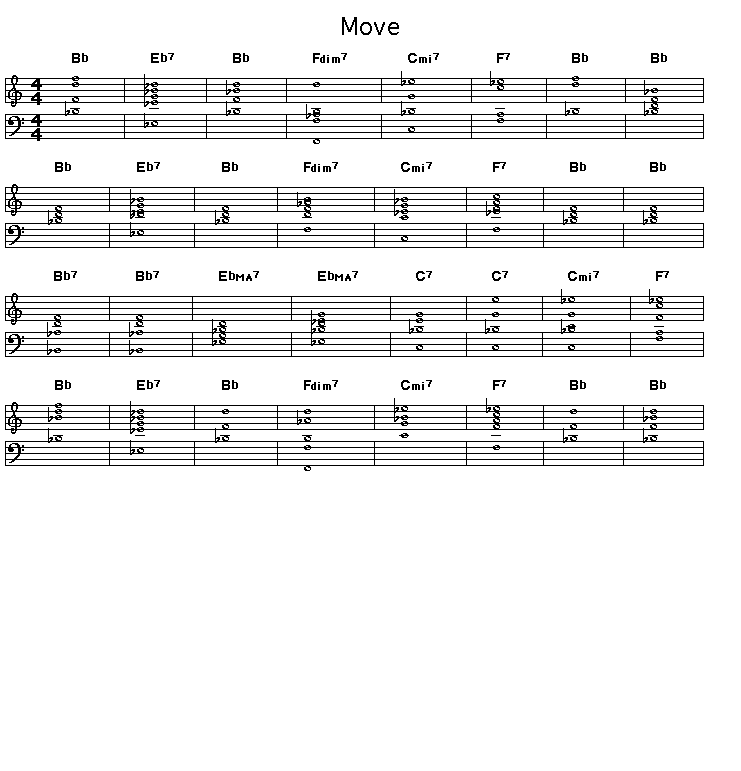
Many bebop compositions are based on the chord progressions of standard tunes, such as How High the Moon or I Got Rhythm, but with the melody replaced by something much more intricate than the original tune. I don’t recognize the chords above from anywhere else so it may be an entirely original composition by Denzil Best. I’m sure there’s a jazz buff out there who will correct me if I’m wrong. In any case the jagged melody is archetypal bebop stuff – complex and angular, very difficult to play but intensely exciting to listen to.

Share/Bookmark

Slim’s Jam

Posted in Jazz with tags , , , , , on August 5, 2010 by telescoper

It’s been a tiring and frustrating day during which I accomplished very little, apart from becoming tired and frustrated. I think I’m going to have an early night, but before doing that I thought I’d share this old record with you. There’s not much information about it on Youtube, but I actually have it on an very battered vinyl LP. The sleevenote doesn’t give the exact date of the recording session, but it was somewhere around the middle of December 1945.

The band is dubbed Slim Gaillard and his Orchestra, but it’s just a seven-piece band. It is, however, notable for the presence on it of two giants of the bebop era, Charlie Parker and Dizzy Gillespie. I thought I’d put it on here primarily because it has such a relaxed atmosphere and is a lot of fun to listen to, as well as providing a fascinating window into this transitional period of American Jazz in which Charlie Parker was the leading figure.

Before 1945 Charlier Parker had worked mainly as a featured soloist in big bands of the swing era, including those of Jay McShann, Earl Hines and Billy Eckstine; after 1945 he almost exclusively performed and recorded in small groups. The year 1945 was also important for two other reasons: it was the first year he was able to record any of his own compositions and it was the first time he was able to record with Dizzy Gillespie in a band made entirely of like-minded musicians, rather than a mixed bag as on this track.

Another quite interesting thing I almost forgot to mention is that this particular 1945 track is – I think – the earliest known recording of Charlie Parker’s voice…

This period also marked the beginning of Parker’s acceptance as an important solo voice by music critics and by the “hipper” sections of the American public. This spreading awareness of his importance is why both he and Dizzy were invited to perform on the West Coast of America, specifically at Billy Berg’s club in Hollywood. It was during a short residency there that Slim’s Jam was recorded.

Apart from Charlie Parker (alto sax) and Dizzy Gillespie (trumpet), the band also contained the relatively unknown swing-era musician Jack Mcvea (tenor sax) as well as young bebop devotee Dodo Marmarosa (piano). The drummer was the great Zutty Singleton, who in fact played on some of the Hot Five recordings with Louis Armstrong in the 1920s, and the bass was “Bam” Brown. Slim Gaillard played guitar on this track as well as doing the intros in characteristic fashion.

Slim Gaillard was a truly remarkable character who led a remarkable life, as his wikipedia page makes clear. He was a talented musician in his own right, but also a wonderful comedian and storyteller. He’s most famous for the novelty jazz acts he formed with musicians such as Slam Stewart and, later, Bam Brown; their stream of consciousness vocals ranged far afield from the original lyrics along with wild interpolations of nonsense syllables such as MacVoutie and O-reeney; one such performance figures in the 1957 novel On the Road by Jack Kerouac. It’s also very much the style of the commentary he adds to this track.

In later life Slim Gaillard travelled a lot in Europe – he could speak 8 languages in addition to English – and spent long periods living in London. He died there, in fact, in 1991, aged 75. I saw him a few times myself when I used to go regularly to Ronnie Scott’s Club. A tall, gangly man with a straggly white beard and wonderful gleam in his eye, he cut an unmistakeable in the bars and streets of Soho. He rarely had to buy himself a drink as he was so well known and such an entertaining fellow that a group always formed around him whenever he went into a pub in order to enjoy his company. You never quite knew what he was going to do next, in fact. I once saw him sit down and play a piano with his palms facing upwards, striking the notes with the backs of his fingers. Other random things worth mentioning are that Slim Gaillard’s daughter was married to Marvin Gaye and it is generally accepted that the word “groovy” was coined by him (Slim). I know it’s a cliché, but he really was a larger-than-life character and a truly remarkable human being.

They don’t make ’em like Slim any more, but you can get a good idea of what a blast he was by listening to this record, which is bound to bring a smile to the  most crabbed of faces. But alongside the offbeat  humour there’s some terrific playing too. Charlie Parker’s virtuoso blues-inflected choruses and Dizzy Gillespie’s dissonant pyrotechnics  form a strong stylistic contrast with Jack McVea’s earlier tenor sax solo which sounds positively old-fashioned by comparison.

Anyway, it’s time for bed-o-voutie so I’ll say goodbye-o-reenie with a little hot cocoa on it. I gotta get up early in the mornin’ myself…

Cherokhee!

Posted in Jazz with tags , , , on June 15, 2010 by telescoper

This is a recent discovery I just had to post. It was was made at a private recording session in 1943 in Kansas City, the home town of Charlie Parker. It was never released commercially and features Parker on alto saxophone with just a guitar and drum accompaniment. This recording must have been made during the musicians’ strike of 1942-44 that contributed to the fact the bebop movement (which Parker pioneered) was out of the public eye during its incubation period. Parker had moved to New York City in 1939 and was playing regularly in Harlem  jazz clubs during the recording blackout, so I don’t know what he was doing back in Kansas City in 1943 to be making this track.

It’s a fascinating version of the tune called Cherokhee that Parker used as the basis of the bebop classic Ko-ko I discussed in a post last year, and which shows him already playing in a recognizably Parkeresque style, but only hinting at the harmonic adventurousness he was to develop just a year or two later; Ko-ko was first performed, I think, in 1945.  Very few examples survive of his playing from this transitional period, so this is a fascinating bit of  musical history as well as being a fine performance in its own right.

Making the Changes

Posted in Jazz with tags , , , , on September 15, 2009 by telescoper

I often find myself trying to explain to people why I love listening to Jazz. Most people either don’t know much about it or don’t like it at all, especially if it’s “modern”. The trouble is, explaining why it’s so hard to play jazz doesn’t usually make people want to go and listen to it.  “There’s no proper tune”  and  “It’s just noise” are just a couple of the comments I heard in a pub a few weeks ago when somebody put a Miles Davis track on the internet jukebox.

It’s partly a matter of language, of course. The most exquisite Japanese poetry probably sounds like noise to a Westerner who can’t understand the language. When it comes to jazz,  even if you do know a bit about the music you’re by no means guaranteed an easy listening experience. But, played at the highest level, with a driving rhythm section and a star soloist improvising through a constantly shifting pattern of harmonies, there’s no music to match it for sheer white-knuckle intensity.

Far from being “just noise”,   jazz is a tightly disciplined musical form. The freedom given to the soloist to create their own melody comes in fact at a very high price because the melodic line of a jazz solo must constantly recalibrate itself in relationship to the harmonic changes going on beneath it. The chord progression within which the original melody was embedded provides the soloist with the challenge of playing something that fits as well as being new and interesting to listen to.  Usually the actual tune is played only briefly at the start and thereafter becomes pretty much irrelevant until recapitulated at the end of the performance. What really matters to a jazz soloist is not the original melody but the chords.

Each chord establishes a tonal centre and a related scale that  furnishes a reference frame in the space of possible musical notes. When the rest of the band makes the chord changes the soloist must transform to a different coordinate system. The progression of chords as the tune unfolds thus has the effect of pushing and pulling the soloist in different tonal directions. A great jazz solo requires strict adherence to this framework and it imposes tremendous discipline on all the musicians involved.

In a slow 12-bar blues the gravitational effect of the relatively simple chord pattern is especially strong, which is no doubt why it has such a powerfully expressive effect when the soloist plays a “blue note” such as a flattened fifth on top of major scale chords.

In more complicated tunes keeping your place within the constantly shifting harmonic framework is a real challenge, especially if the chord progression is complicated and especially at fast tempi in which the chord changes go flying past at a rate of knots. Such numbers turn into a rollercoaster ride for both musicians and audience.

It’s not just the speed of fingers that makes great soloists so electrifying, but their astonishing mental agility. I remember seeing the great saxophonist Sonny Stitt at Ronnie Scott’s club in London playing the jazz standard How the Moon. Nothing unusual about that because it’s part of the jazz repertoire. The thing was, though, that he played 12 choruses, each one in a different key. How he managed to keep track of everything is completely beyond me. I wasn’t the only one in the audience shaking his head in disbelief.

Giant Steps by John Coltrane is an example I posted a while ago of a supreme piece of high-speed improvisation, and I thought I’d follow it up with this wonderful performance  in which the legendary Charlie Parker plays an extended solo, very fast.

The tune is in fact a variation of a 1930s hit  called Cherokee. Most popular tunes have a 32 bar basic format of the type AABA, with B representing the bridge or middle eight. Cherokee has a similar structure, but is 64 bars long. Its chord progression is both complicated and unusual, with lots of changes to remember especially in the (16-bar) bridge which is fiendishly difficult to play. This makes it fertile ground for improvising on and it quickly became a standard test vehicle for jazz soloists and a yardstick by which saxophonists in particular tended to measure each other’s skill.

During the bebop era it became fairly common practice for musicians to borrow chord sequences from other tunes. Many Charlie Parker pieces, such as Anthropology, are based on the chords from I Got Rhythm for example. There’s a famous story about a recording session involving Charlie Parker during which the band decided to do a version of Cherokee (i.e. using the chord sequence but with a different melody). During the take, however, they absent-mindedly played the actual melody rather than playing something else over the chords. There was a cry of anguish from producer in the control room who had hoped that if they stayed off the actual tune of Cherokee he wouldn’t have to pay composers royalties and the performance ground to a halt.  Shortly after, they did another take, called it Ko-ko and it quickly became a bop classic. This is a later version of Ko-ko, played live, during which Bird runs through the changes like a man possessed. What it must be like to be able to play like this!

Vintage Bird

Posted in Jazz with tags , , , on July 14, 2009 by telescoper

I’ve gone  far too long without posting something by the great alto saxophonist Charlie Parker (“Bird”), undoubtedly one of the most influential musicians of the twentieth century. Together with trumpeter Dizzy Gillespie, Bird effectively created a  revolution in Jazz after the end of World War II in the form of a new style called bebop.

Like many Jazz legends, Charlie Parker died young as a result of chronic alcoholism and, especially in his case, drug addiction. He became hooked on heroin when he was a teenager and when he couldn’t get heroin he used anything else he could. The result was a body ravaged by abuse and a career frequently interrupted by illness. When he died, at the age of 35, the doctor who signed his death certificate estimated his age as “about 60”.

I remember, as a teenager,  finding a Charlie Parker LP  in a second-hand record shop and buying it for 50p. When I got home I put it straight on the record player and couldn’t believe my ears when I heard the staggering virtuosity of his playing. I just didn’t realise the alto sax could be played the way he played it. I’ve been a devout Charlie Parker fan ever since, although most of recorded output is quite difficult to get your hands on. In fact, the first record I bought as an LP has never been released on CD, which I think is a scandal.

Many people I know can’t really stand any Jazz that’s stylistically dated after about 1940. I have never really understood this attitude.  To my mind the two tracks I’ve picked here, recorded in 1948, sound as fresh and exciting to me now as they did when I first heard them 30 years ago. They also seem to me firmly rooted in a wonderful tradition of music-making that reaches back to Louis Armstrong and King Oliver and forward to the likes of John Coltrane, Eric Dolphy and Ornette Coleman. Anyway, I’m not going to preach. I love this music and it’s up to you whether you agree or not.

Parker’s ideas didn’t just remain within jazz, and bebop had a huge cultural influence on post-war America. It never became as popular as pre-war Jazz,  but had a devoted following on both sides of the Atlantic and breathed new creative life into a form that was in danger of becoming stale and commercialized.

The first piece  is called Ah Leu Cha and – as far as I’m aware – it is the only tune Bird ever wrote that involves any kind of counterpoint (provided by a very young Miles Davis on trumpet). The second track is a majestic solo blues called Parker’s Mood which demonstrates his deep understanding of and appreciation of the traditional 12-bar blues format.

Anthropology

Posted in Jazz with tags , , on February 21, 2009 by telescoper

Just to balance the books here’s a wonderful version of the classic bebop tune Anthropology, performed by Bud Powell who I mentioned in my previous post about Thelonious Monk.

This really is authentic bebop, with its complex yet propulsive drum patterns and jagged melodic lines characterized by unusual intervals and little punctuating tags at the end of each phrase in the solo. Also brilliant, but quite different to Monk, Bud Powell was very much a direct translation onto the keyboard of the saxophone and trumpet styles of Charlie Parker and Dizzy Gillespie.

The tune was written by them too, although it uses essentially the same chords as George Gershwin’s I Got Rhythm. It  was a standard bebop procedure to write a new melodic line on top of an existing harmonic structure and give the result a new name. Jazz improvisation is always based on the harmonies (chord changes) rather than the tune, so this is a way to build new compositions quickly with the knowledge that the harmonic foundations would be sound. In the  40s there was a classic Charlie Parker recording session during which the band decided to do such a variation of the standard Cherokee (written by Ray Noble). In the middle of the performance they absent-mindedly played the Cherokee theme and there was a cry of anguish from the control room by the Producer who obviously hoped that if they stayed off the actual tune of Cherokee he wouldn’t have to pay composer’s royalties. So that take was abandoned, and they did another. The final version was called Koko and it’s one of the Charlie Parker classics. Many other classic bop tunes were made in this way, with different standard tunes underneath them. Necessity and budget restrictions are the mothers of invention.

Oh, and just listen to the fantastic double bass by the brilliant (and then very young) Niels-Henning Orsted Pedersen who drives it along like the clappers!

When you read about the structure of bebop it seems so complicated and obscure that it’s hard to believe that the result is such a thrill to listen to. I think it  is the highest point of twentieth century music-making, both in the creativity and skill of its proponents and in the sheer excitement of its sound which is made all the more remarkable when you realise how difficult it is to play!