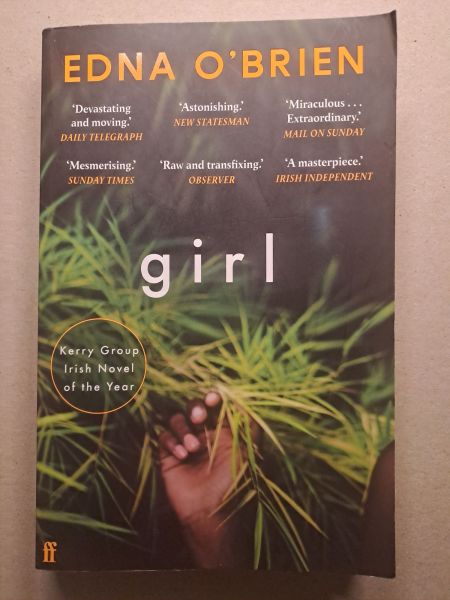
Irish novelist Edna O’Brien passed away two years ago. When I read of her death I didn’t know anything about her writing except that her first novel, Country Girls, had been banned in Ireland. That made me decide to read some of her work. As it happens the first book by her that I came across was the last she wrote, in 2019, which I bought over a year ago and has been sitting on my coffee table ever since. I started reading it this evening and found it so compelling that I couldn’t put it down until I had finished it.
Girl is set in Nigeria and is told in the voice of Maryam, a young girl who is kidnapped, along with her schoolmates, by the jihadists of Boko Haram. Maryam and the other schoolgirls are subjected to appaling horror and degradation described in unflinching detail. Eventually Maryam is given as a prize to a Boko Haram soldier Mahmoud, and bears his baby (simply called Babby). Maryam escapes with Babby with another girl, and drifts into and out of danger. Upon eventually returning home she is punished by her family, but the book ends on an optimistic note as she finds sanctuary.
The story is grim but O’Brien clearly had a great gift for storytelling, with subtle shifts in style as Maryam’s mental state shifts between horror, to relief, to sad reminiscence of happier times. In her acknowledgements at the end, the author explains that Maryam’s tale is actually a synthesis of accounts of various ordeals experienced by real-life women, to whom she spoke to in two visits to Nigeria, where she also learned something of the linguistic mannerisms of Maryam’s people. It is quite an achievement for an Irish woman in her late eighties to find a convincing voice for a young Nigerian girl subjected to pains surely beyond imagination. I think it’s a brilliantly moving book.
Girl has been criticised for O’Brien’s appropriation of the voice of a different culture, which (it has been claimed) makes it feel like an artificial exercise. A book of this kind by a Nigerian author would no doubt be more “authentic” in many important respects, but what I took from it (apart from the beautiful prose) is the emotional authenticity of the emotional tone and her desire to celebrate the strength of the many women whose struggles come together in the story of Maryam. The violent oppression of women is widespread in this world, so Maryam is a universal figure – a survivor.


