Archive for Cardiff University

Acting and Clearing

Posted in Education, Finance, Politics, Science Politics with tags , , , , , , on August 14, 2011 by telescoper

Now that I’m back from my trip to Copenhagen, it’s going to be back to work with a vengeance. To those of you who think academics have massively long summer breaks, I can tell you that mine ends on Monday when I will be doing a stint as Acting Head of School. That’s not usually a particularly onerous task during the summer months, but next week happens to be the week that A-level results come out and it promises to be a hectic and critical period. It’s obviously a sheer coincidence that all the other senior professors have decided to take their leave at this time…

There are several reasons for this being a particularly stressful time. First the  number of potential students applying to study Physics (and related subjects) this forthcoming academic year (2011/12) in the School of Physics & Astronomy at Cardiff University was up by a whopping 53% on last year. I blogged about this a few months ago when it became obvious that we were having a bumper year.

The second reason is that Cardiff’s  School of Physics & Astronomy has been given a big increase in funded student numbers  from HEFCW. In fact we’ve been given an extra 60 funded places (over two years), which is a significant uplift in our quota and a much-needed financial boost for the School. This has happened basically because of HECFW‘s desire to bolster STEM subjects as part of a range of measures related to the Welsh Assembly Government’s plans for the regions. Preparations have been made to accommodate the extra students in tutorial groups and we’re even modifying one of our larger lecture rooms to increase capacity.

Unfortunately the extra places were announced after the normal applications cycle was more-or-less completed, so the admissions team had been proceeding on the basis that demand would exceed supply for this year so has set our undergraduate offers rather high. In order to fill the extra places that have been given to us late in the day, even with our vastly increased application numbers, we will  almost certainly have to go into the clearing system to recruit some of the extra students.

In case you didn’t realise,  universities actually get a sneak preview of the A-level results a couple of days before the applicants receive them. This helps us plan our strategy, whether to accept “near-misses”, whether to go into clearing, etc.

On top of these local factors there is the sweeping change in tuition fees coming in next year (2012-13). Anxious to avoid the vastly increased cost of future university education many fewer students will be opting to defer entry than in previous years. Moreover, some English universities have had cuts in funded student places making entry highly competitive. As an article in today’s Observer makes clear, this all means that clearing is likely to be extremely frantic this year.

And once that’s out of the way I’ll be working more-or-less full time until late September on business connected with the STFC Astronomy Grants Panel, a task likely to be just as stressful as UCAS admissions for both panel members and applicants.

Ho hum.

The Curious Case of the Twisted Ring

Posted in The Universe and Stuff with tags , , , , , , , on July 21, 2011 by telescoper

Just time for a quickie this morning, prompted by the appearance of our own Professor Matt Griffin on the Today programme on BBC Radio 4 earlier on talking about newly published results from the Herschel Space Observatory. I didn’t hear it live as I’m strictly a Radio 3 person, but it must have made a pleasant change from stories about the imminent collapse of the euro and continuing extraordinay revelations about widespread corruption involving the British media, police force and political establishment. Among all this doom and gloom it’s nice to hear news of something that’s actually successful.

Anyway, the news from Herschel is that it has unveiled a ring structure in the centre of our Milky Way galaxy. The ribbon of gas and dust is more than 600 light years across and appears to be twisted, for reasons which have yet to be explained. The origin of the ring could yield important clues about the history of the Milky Way.

Warmer gas and dust from the Centre of our Galaxy is shown in blue in the  image below, while the colder material appears red. The ring, in yellow, is made of gas and dust at a temperature of just 15 degrees above absolute zero. The bright regions are denser, and include some of the most massive and active sites of star formation in our Galaxy.

and here it is with the curious ring drawn on with crayons:

The central region of our Galaxy is dominated by an elongated structure, rather like a bar, which stirs up the material in the outer galaxy as it rotates over millions of years and is probably connected with the spiral structure seen in the disk of the Milky Way. The ring seen by Herschel lies right in the middle of this bar, encircling the region which harbours a super-massive black hole at the centre of our galaxy. The ring of gas is twisted, so we see two loops which appear to meet in the middle. These are seen in yellow in the image above, tilted slightly such that they run from top-left to bottom-right. Secondly, it seems to be slightly offset from the very centre of our Galaxy. The reason for the ring’s twist and offset are unknown, but understanding their origin may help explain the origin of the ring itself. Computer simulations indicate that bars and rings such as those we see in the centre of our Galaxy can be formed by gravitational interactions, either within the Milky Way itself or between it and the nearby Andromeda galaxy, M31.

For the experts, and others interested, the scientific paper containing these results can be found here.

Class of ’11

Posted in Biographical, Education with tags , , on July 19, 2011 by telescoper

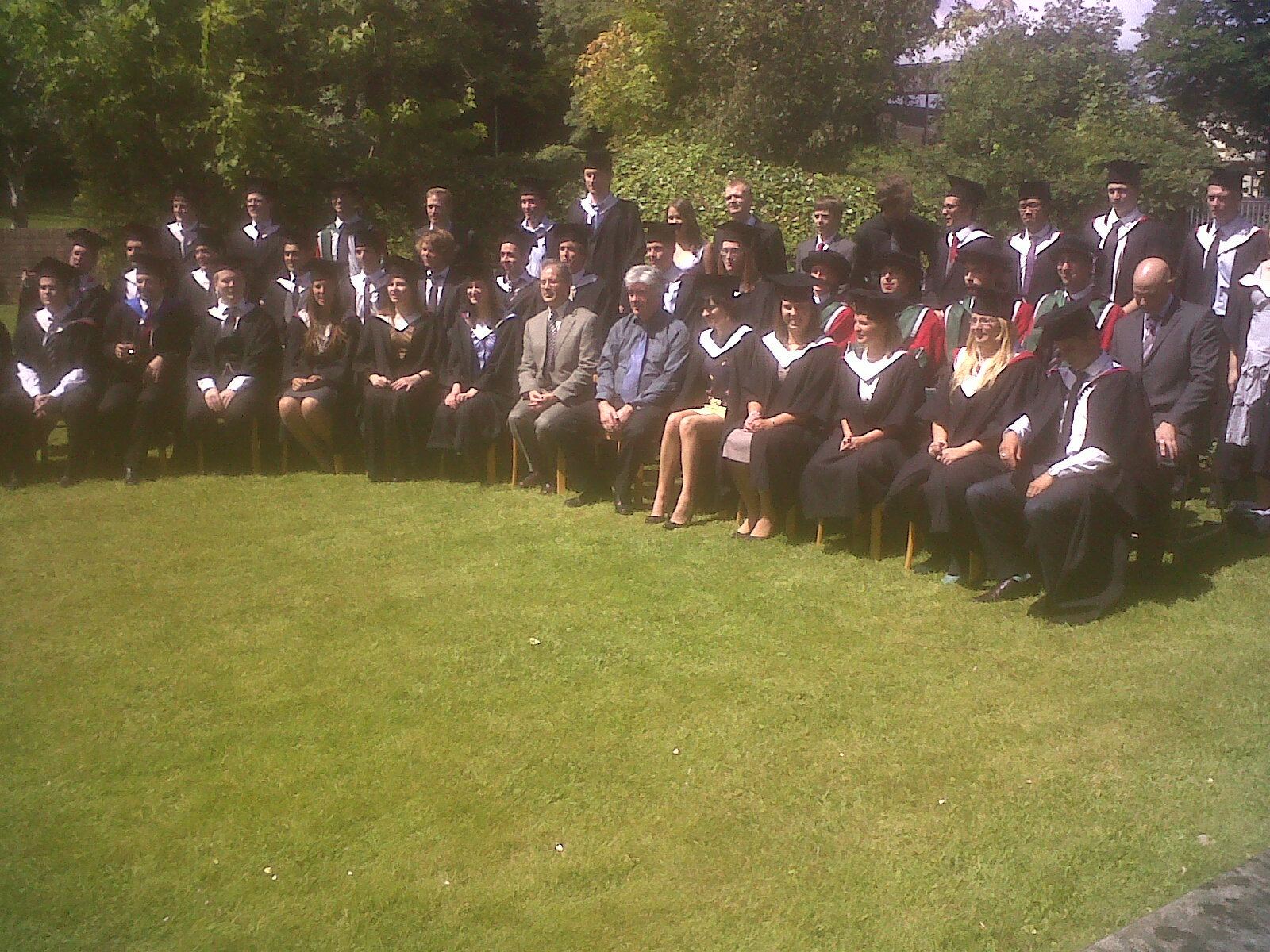
Just a quick note to mark today’s graduation ceremony for students in the School of Physics & Astronomy at Cardiff University, which took place at 10 o’clock this morning in St David’s Hall. I took part in the staff procession this year – as I have done on several previous occasions – so was there bright and early, all togged up in academic drag, ready for the kick-off. You can see a replay of the whole thing here so I don’t need to describe it in detail; I’m seated towards the left hand side of the stage so am fortunately out of shot for most of the video.

I admit to having had a bit of a hangover this morning because yesterday evening I attended a posh (black tie) graduation dinner at the invitation of the Vice-Chancellor. The splendid dinner was preceded by a drinks reception that lasted a full hour – at which much champagne was quaffed – and then followed by some lengthy and rather uninspiring speeches, during which I sought solace in the form of port. When proceedings were over, a few of us decanted ourselves into a local bar for a bit more to drink. I only realised how much I must have drunk when Columbo woke me up by jumping on my bed at 5am at which point I felt distinctly sub-optimal.

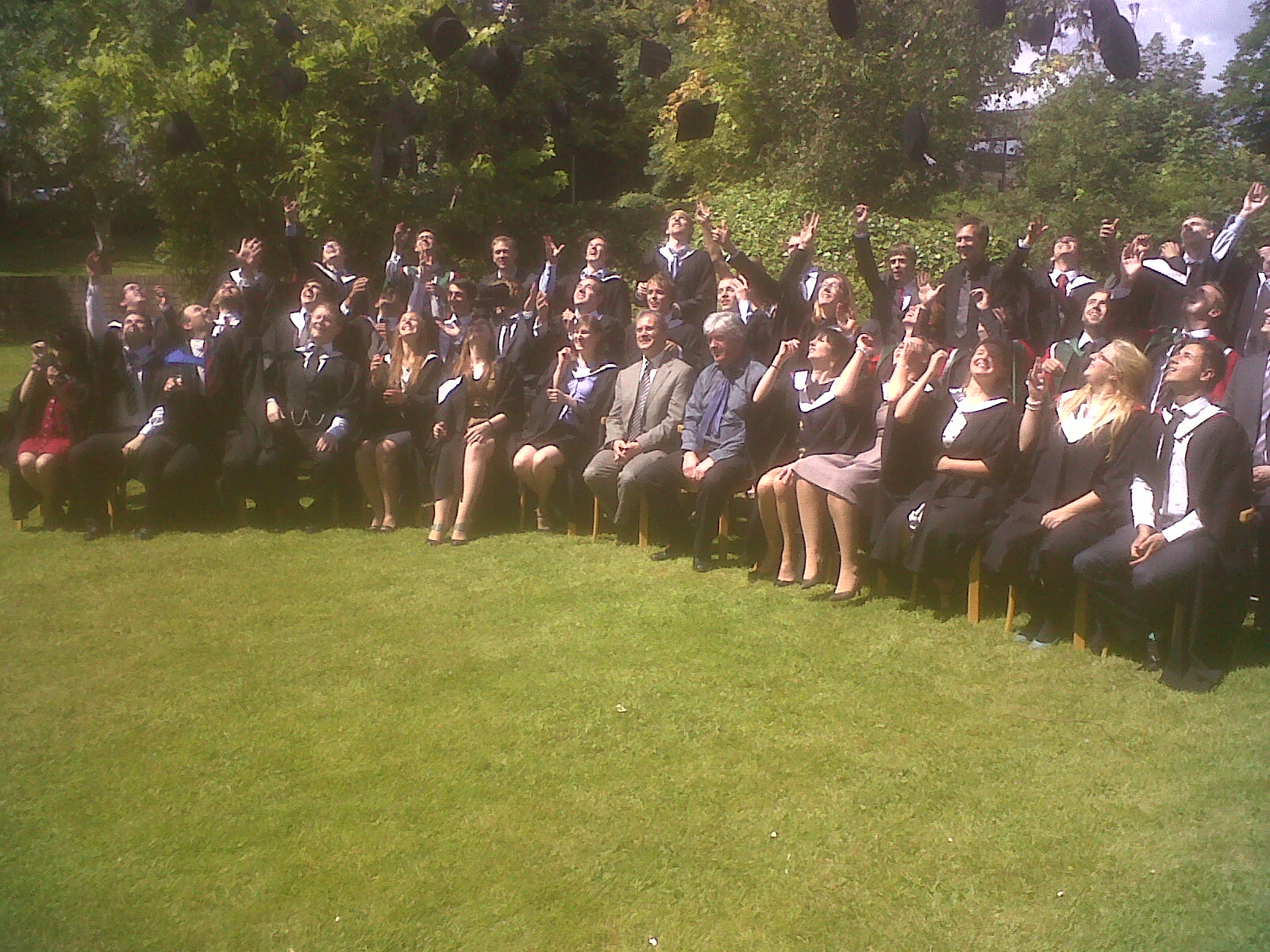
After the graduation ceremony there was a reception for graduates, parents, partners and assorted hangers-on back at the School of Physics & Astronomy followed by the obligatory pictures with the Head of School, Walter Gear, and Director of Undergraduate Studies, Bernard Richardson, including several attempts at the old “mortar-boards-in-the-air” shot…

..of which my attempt with a phone camera came out surprisingly well!

The MPhys students graduating this year are the first such group that I’ve seen go all the way from first year to graduation, as I moved to Cardiff University in 2007.  Graduation is always a bittersweet occasion, with joy  at the students’ success, but also sadness that we have to say goodbye.   Some will be staying to do PhDs and some will remain in Cardiff for a host of other reasons, but there’s a  number of students in this group that I will miss a lot.


Cardiff News

Posted in Education, Politics with tags , , , , , on July 12, 2011 by telescoper

It’s been a while since I’ve blogged about local affairs, but the emergence of three items of news in the past few days has given me an opportunity to remedy that.

First, and hot off the press this morning, is the news that Cardiff University has at last decided who its next Vice-Chancellor will be after the incumbent,  David Grant, retires next year. The lucky winner is Professor Colin Riordan, who is currently Vice-Chancellor of the University of Essex (which apparently exists). His background is in the humanities, and his speciality post-war German literature. Since his previous institution doesn’t have a Physics Department, we’re probably  safe for a few years until he finds out Cardiff has one and decides to close it.

Anyway, Professor Riordan became a Vice Chancellor for the first time at the age of 48, which is the same age I am now. Maybe I should be climbing aboard the gravy train? I hear there’s a vacancy as Vice Chancellor at the University of Essex. I would apply, but I fear I have all the wrong vices…

That brings me to yesterday’s news that Cardiff University, along with all the proper most other universities in Wales, is to charge annual tuition fees of, you guessed it, £9K. This is despite recent reports that the Higher Education Funding Council for Wales (HEFCW) was set to refuse permission to set such high fees. I always thought it was inevitable that Welsh universities would want to charge as much as possible to bring funding levels closer to those in England, but it remains to be seen what effect the new regime will have on student recruitment.  The £9K level is substantially higher than the Welsh Assembly Government’s initial estimate of £7K so it also remains to be seen what the implications are for the WAG budget. We live in interesting times…

However, not wishing to end on a down note, I’ll finish by passing on a bit of up-beat news. Apparently – according to the esteemed National Geographic Magazine – Cardiff is one of the top ten places in the world to visit in 2011, coming in at Number 6 in  this rigorously compiled and totally objective league table. I’m usually a bit skeptical about such things, but who could possibly disagree with the ranking?

1. Muskoka Orange County, Ontario, Canada
2. Patagonia, Argentina
3. San Juan Islands, Washington
4. Minneapolis, Minnesota
5. Glacier Bay National Park, Alaska
6. Cardiff, Wales
7. Stockholm Archipelago Sweden
8. Azores, Portugal
9. Roatan, Honduras
10. Istria, Croatia

Hang on a minute. Minneapolis? At Number 4?

Welsh fee plans up in the air…

Posted in Education, Politics with tags , , , , , , , , on June 15, 2011 by telescoper

I had just finished the exciting job of marking my examinations and collating all the results with coursework when I noticed a rumour circulating on twitter about the Higher Education Funding Council for Wales (HEFCW) having rejected plans by all Welsh universities to charge higher fees than the basic £4K laid down by the Welsh Assembly Government. The rumour later developed into a story on the NUS website and then on the local BBC News, Wales Online and the Times Higher.

In case you’re not up with the intricacies of Welsh Higher Education policy, universities here in the Principality will, from 2012, be allowed to charge fees of up to £9K per annum (as in England) if and only if they have approval from HEFCW for plans relating “to widening access and to improving the student experience.” Note there’s apparently no requirement of providing a better education in that. As a mere university teacher I have no idea at all what has gone into Cardiff University’s plan nor do I know why it is deemed satisfactory. Such things are done by our lords and masters in the University administration.

It does seem strange, though, that the process works this way, i.e. that HEIs have to produce plans that they hope will be accepted by HEFCW. Why doesn’t HEFCW simply tell the HEIs what they have to do to be able to charge the fees? I wonder how the clear the guidance from HEFCW was. It might be a case of “Read my mind to see what I want, and if you don’t give it to me I’ll shoot you”.

Universities wishing to charge £9K (which is, predictably, nearly all of them) had to submit their plans to HEFCW by the end of May. Several universities did so, including Cardiff, Aberystwyth, Bangor, and even Glamorgan, who all want to charge the maximum £9K. HEFCW has now announced that none of them meet the standard needed to charge more than £4k. There’s still quite a bit of time for universities to amend their plans before the deadline of 11th July, so this is by no means the end of the story, but it has certainly set alarm bells ringing where I work!

The point is that the Welsh Assembly Government is heavily cutting the funds it allocates to Welsh Universities from 2012, so if institutions are not allowed to charge sufficiently high fees to recoup that loss then many departments are going to be in really big trouble, especially those teaching expensive subjects.

Education Minister Leighton Andrews is quoted as saying

I asked for Hefcw to be thorough and robust when scrutinising the fee plans submitted by our higher education and further education institutions. It is clear that they have been and I heartily endorse this.

There are a number of ways of reading the lie of the land here. One is that it’s actually a sensible process of consultation between individual institutions and HEFCW. Since this is uncharted territory for both there may well be things that need to be clarified on both sides, and HEFCW may therefore be engaging in a sensible process of consultation and iteration in order to help institutions produce acceptable plans. It could also represent an element brinkmanship, so the Minister and HEFCW can be seen to be flexing a bit of muscle, in contrast to the situation in England, where it appears the government has no power to prevent institutions charging higher fees. I always felt it was inevitable that Cardiff, as a Russell Group University, would want to charge £9K, but I can imagine Leighton Andrews being irritated by places like Glamorgan wanting to charge the same.

Whatever game is being played, it’s a very dangerous one and the stakes are very high. The Welsh Assembly Government has already indicated it will pay the fees of any Welsh domiciled students wherever they study in the UK. For the most part that will mean £9K per student per year for Welsh students wanting to study in England. If Welsh universities can only charge £4K per year for students coming from England to Wales then there will be a huge imbalance in funds flowing in and out of the higher education sector. In effect, the Welsh Assembly Government will be subsidising English universities at the expense of Welsh ones.

Currently the number of English students coming to Wales exceeds the number of Welsh students studying in England. The WAG’s plan relies on a net influx of funds to offset the cuts in central funding needed to pay student bursaries. However, English students do not come in equal numbers to all Welsh institutions. More come to Cardiff University than, say, Bangor. So how will this extra income from England benefit the Welsh HE sector generally? Is the proposal to cut HEFCW funds to Universities who succeed in attracting English cash cows students and redistribute the dosh among those institutions that don’t? That hardly seems equitable to me.

I’m certainly not in a panic about this news, although I may be on July 11th when we find out the final outcome. In the meantime, as a humble academic at the bottom of the ladder when it comes to such matters, I’ll get on with my teaching and research and pray that those in charge actually know what they’re doing…

The Final Analysis

Posted in Education with tags , , , , on June 14, 2011 by telescoper

It’s that time of year again. The annual meeting of the Board of Examiners of the School of Physics & Astronomy at Cardiff University met this afternoon to consider the marks for students due to graduate this year and to draw up recommendations for the final degree classifications.

This year’s meeting was actually quite interesting and, at just over two hours, somewhat shorter than some we’ve had in previous years.  A group of students has already gathered in the foyer waiting for the dreaded list to be posted, and many will no doubt be celebrating or drowning their sorrows in local hostelries shortly after their fate is revealed.

Cardiff is a little old-fashioned in the way the final examiners’ meetings are conducted. For a start we still have a system of viva voce examinations for borderline candidates; they happened yesterday, in fact. Many universities have dispensed with this aspect of the process, but I still think they’re worthwhile. The Board of Examiners, including the two External Examiners,  also still has some discretion in how it arrives at the degree boundaries (which are nominally at 70% for a first, 60% for a 2.1, 50% for a 2.2, and 40% for a 3rd).

The tide is turning against this very traditional approach, however, and there are moves here to dispense with the viva examinations and with academic discretion. I’m not sure when this will happen, but it’s likely to be sooner rather than later. I think the main reason for this is to make the system more automatic so there’s less chance of legal challenge. In any case there doesn’t seem to me that there can be any educational reason for it.

The one thing that strikes me about the system we have is that it’s the whole business of classifying degrees into broad categories which is where the problem lies.  It was suggested some time ago that we should dispense with, e.g., the “Desmond” (2.2) and the “Thora Hird” (3rd) and instead simply give each student a transcript containing details of the entire spectrum of their academic performance. It’s been suggested again just recently too. That would seem to me to make much more sense than the current system of classifying degrees which involves (a) trying to condense a huge amout of information – examination marks, coursework, project assignments and the like – into a single number and then (b) drawing boundaries based on this number precisely where the distribution is most densely peaked. However, years have passed and nothing concrete has happened. The academic world is good at inertia.

Anyway, this isn’t the time or the place for a lengthy diatribe about the ins-and-outs of degree classifications. I’ve got to go back to marking my 1st year examination papers shortly in fact; these are considered by a separate meeting of the Board of Examiners.

It is time, however, for me to congratulate all our graduating students on their success. It’s the first group of Cardiff MPhys students that I’ve seen all the way through from entry  to graduation. I’ll be sad to see them go, but wish them all the best as they venture forth into the real world. At least I hope to see them back next month for graduation.  Until then, however, all I’ll  say is

Congratulations!

Local Matters

Posted in Education, Finance, Politics, Science Politics with tags , , , , , on May 12, 2011 by telescoper

I think I’ve caught up with most of the signficant things that happened during my travels, so I thought I’d end this series of updates with some local news from Cardiff (and Wales generally).

First, I can pass on some information relating to the  number of potential students applying to study Physics (and related subjects) this forthcoming academic year (2011/12) in the School of Physics & Astronomy at Cardiff University.  I blogged about this a few months ago when it became obvious that we were having a bumper year. As it turns out, we finished with applications up by a whopping 53% on last year.

Second, and related to the first item, the detailed allocations of university funding in Wales have finally filtered down all the way from HEFCW, through the Cardiff University management, and onto individual schools.  As it happens, this has also turned out not too badly for us here in Physics & Astronomy. For various reasons we’ve finally been given the increase in student numbers that we have been requesting for some time without success. In fact we’ve been given an extra 60 funded places, which is a significant uplift in our quota and a much-needed financial boost for the School. This has happened basically because of HECFW‘s desire to bolster STEM subjects as part of a range of measures related to the Welsh Assembly Government’s plans for the regions.

Unfortunately the admissions team have so far been proceeding on the basis that demand would exceed supply for this year so has set our undergraduate offers rather high. In order to fill the extra places that have been given to us late in the day, even with our vastly increased application numbers we may have to go into the clearing system to recruit some of the extra bodies. We’ll have to wait until the A-level results come out in August, however, before we know what the situation really is.

It would have been a lot easier if we’d known the rules at the start of the game, rather than near the end, but that’s the way it goes when politicians start tinkering with things…

We will have to lay on extra tutorials and laboratory sessions to cope with the anticipated increase in student numbers, which will be a bit of a struggle, but the extra money they bring in should keep the wolf from the door for a while.

Another thing worth mentioning concerns research in Wales. In the run-up to the Welsh Assembly elections, the Campaign for Science and Engineering (CASE) produced a couple of interesting documents. One was about science policy in the devolved nations and the other was a comparison of STEM subjects across the UK.

These documents make it clear that Wales lags far beyond England and (particularly) Scotland in terms of investment in, and productivity of, its scientific research.  In its  recommendations for Wales, CASE included

    • The Higher Education Funding Council for Wales must increase its investment in research – as well as improving the research base directly, this investment should bring more success in winning competitive, UK-wide funding. The indirect costs of charitably funded research should continue to be covered.
    • Policies should continue to build up the critical mass of research through collaboration, including with overseas researchers or businesses.

As I reported recently, we (Cardiff, Swansea and Aberystwyth) have tried to persuade HECFW to fund a Welsh physics initiative, intended to achieve precisely what CASE suggests. Unfortunately HECFW turned our bid down. At least for the short term, additional investment in physics research is clearly not on the agenda for HEFCW.  There’s not much sign of it happening in the future either, but we will have to wait and see…

Share/Bookmark

A review of my attempt at stand-up

Posted in Books, Talks and Reviews with tags , on May 8, 2011 by telescoper

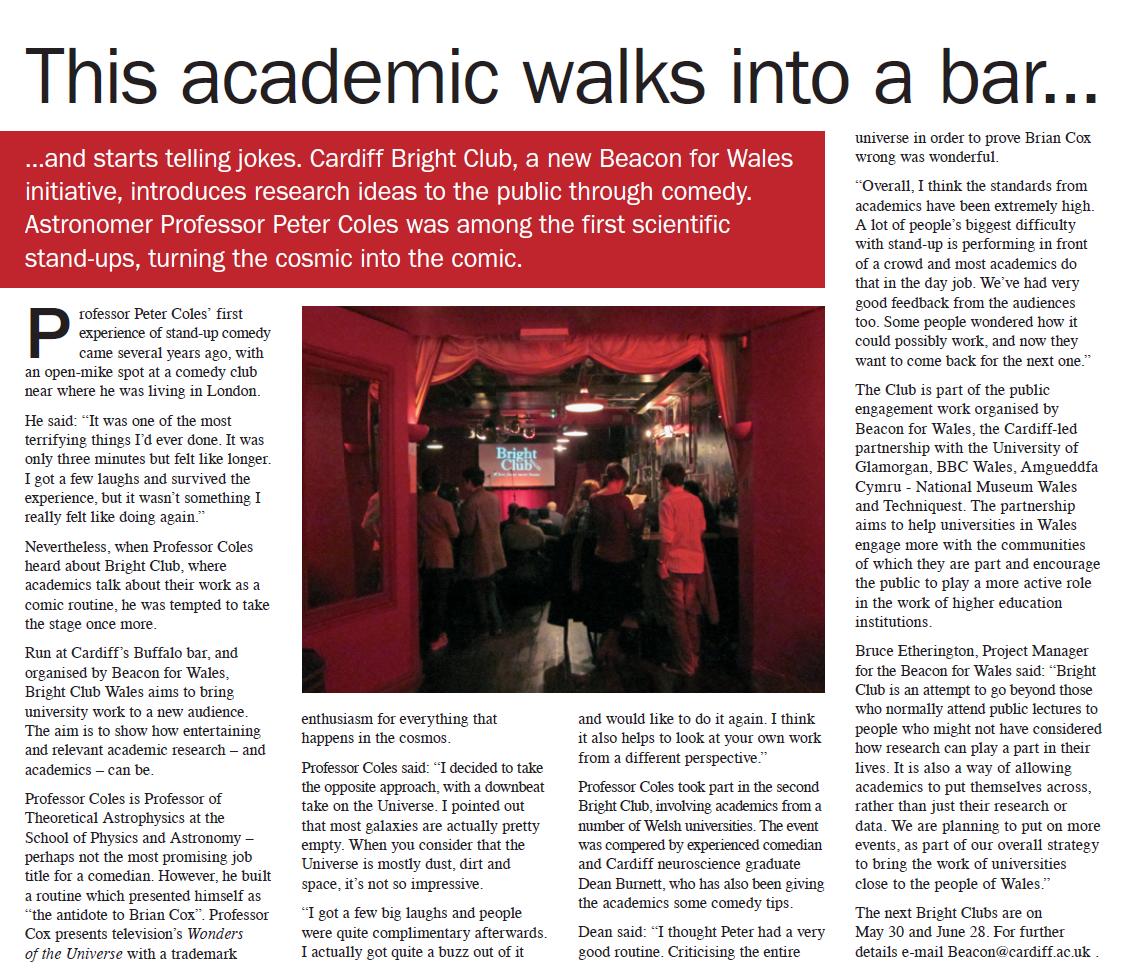
It seems my 12-minute stab at being a comedian at Bright Club Wales has led me to the dizzy heights of fame. So much so that I’ve even appeared in the latest issue of Cardiff University News (which you can read online here). Here’s the piece, though you might need to click on it to make it big enough to read..

Incidentally, the next Bright Club Wales will be on Monday 30th May, at the Buffalo Bar in Cardiff. I’m sure it will be fun!

Share/Bookmark

Loose Ends

Posted in Biographical, Education, Finance with tags , , , , , on April 2, 2011 by telescoper

Just a brief post today, I think, in order to tie up a few loose ends from this week.

For reasons that I really don’t understand my blog suddenly became very popular on Thursday (31st March), attracting nearly 5000 hits in a day. That’s nearly four times my current daily average and a couple of thousand more than my previous busiest day. So this week I had my busiest day, last week was my busiest week, and last month was my busiest month. I guess it’s all downhill from here.

I couldn’t figure out what happened to cause all this interest, as not all the hits were on any specific article and no particular search terms were used to find this blog, at least not that I could figure out. I presume that it was my sarcastic take on Wonders of the Universe that was behind it. At any rate that was the post that generated the deluge of abusive comments that my spam filter caught.

Anyway, other items of relevant news are that two new members of Staff joined the School of Physics & Astronomy yesterday (April 1st; no, seriously…) and there are a couple more expected to join soon. It’s nice to have a few new faces around the place, and I’m sure they’ll all be bringing new ideas about research and teaching to the physics side of the School.

A week or so ago I passed on some pretty disappointing news about the funding climate here in Welsh universities. More details emerged this week about what this means for individual institutions; you can find the full list of allocations here (PDF). The figures don’t tally with those in the newspaper article I referred to in the previous post which was presumably inaccurate.

The picture isn’t as bad as I feared but, with a total cut of about 5% (in cash terms) across the sector it could hardly be described as good, especially when inflation is running about 5% on top of that. My employer, Cardiff University, has done slightly better than average, with a cut of only 3% in cash.

However – and it’s really delightful to be able to pass on some good news for once – the School of Physics & Astronomy has just been awarded a pretty large increase in its quota of undergraduate students. This is excellent, as I’ve previously reported that we have had a huge surge in applications this year. We’ll have to work hard to squeeze the extra bodies into laboratories, tutorials and even lecture theatres, but the income they will generate should help us carry out the strategic plans we have developed, perhaps bringing in even more new members of staff.

I’m still a bit grumpy, though, as our teaching terms has another two weeks to run, while some lucky bastards have finished already and are now on their Easter holidays…


Share/Bookmark

A Tale of Two Balls

Posted in Biographical, Education with tags , , , , on March 26, 2011 by telescoper

This morning was definitely the one after the night before, as Friday was the occasion of the Annual Chaos Society Physics Ball. The Chaos Society organises a number of social events for both staff and students from the School of Physics & Astronomy at Cardiff University. This year’s ball was nearly a whole month earlier than last year’s, because we’re not having a term break before Easter this year as Easter is so late. There’s still another three weeks of teaching, in fact, whereas in most years we would stop now and resume after Easter.

Anyway, the do last night started off with a champagne reception at the Parc Thistle Hotel in central Cardiff, followed by dinner and dancing in the function room there. There was a fine band playing a sort of funky soul jazz mix at the start and end of dinner. There were a bit loud to make conversation possible at the beginning, but once the food arrived they took a break and resumed when coffee was served. Instead of attempting to make ourselves heard over the music, I decided to try to set the ball rolling by getting up and dancing with a lady called Tanys, who was a guest of the Head of School Walter Gear. Nobody else joined us, but it was fun anyway.

We then went “informal” so to speak. The DJ got going, but I didn’t reckon much to the music so went and mixed in the bar. Some final-year students celebrating having secured PhD places here and there, so congratulations to them, and there was a beautiful moment when Michael proposed to Matthew. They’re not allowed to be properly married here in the UK, and a proposal of “civil partnership” doesn’t quite have the same ring to it, but it was one of the highlights of the evening. Matthew accepted, of course.

After that we adjourned to a boutique nightclub called Crystal, an exotic place with peculiar soft furnishings and a bevy of bare chested muscle men in attendance. Around 3am I was poured into a taxi and got home quarter of an hour or so later, reasonably intact. Bad hangover this morning, though.

I’d like to add my personal thanks to the organisers of what was a hugely enjoyable evening, the Chaos Society generally and especially Natasha who did sterling work persuading so many people to come along. This was the third of these bashes I’ve been to, and it was definitely the best.

I’ve worked in a number of universities so far in my career as a jobbing astrophysicist, but the students at Cardiff are by far the friendliest and the most fun of all the groups I’ve had the pleasure to teach. And, yes, it does mean an awful lot to me when people tell me to my face that they enjoy my lectures. Even if they are drunk when they do so!

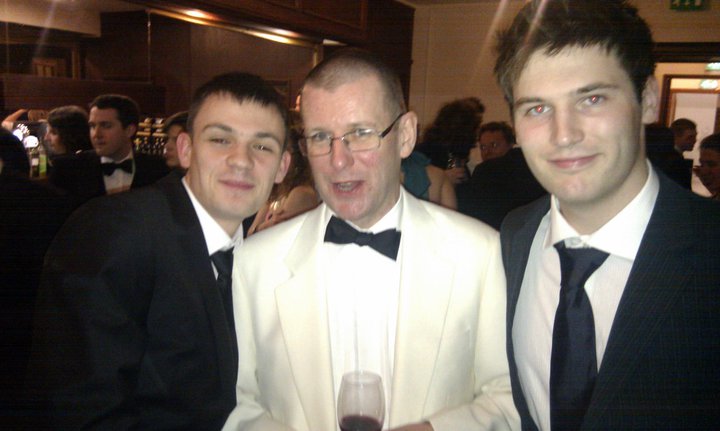
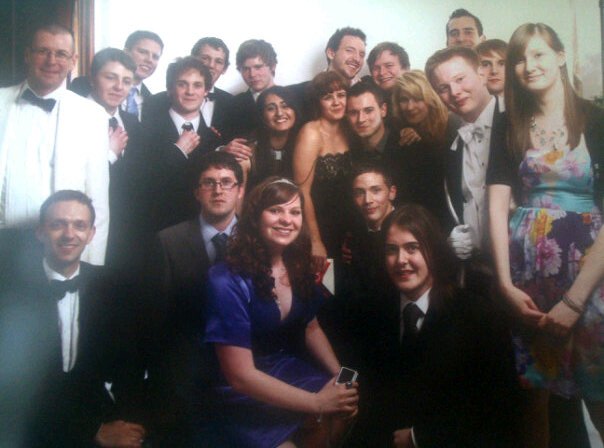
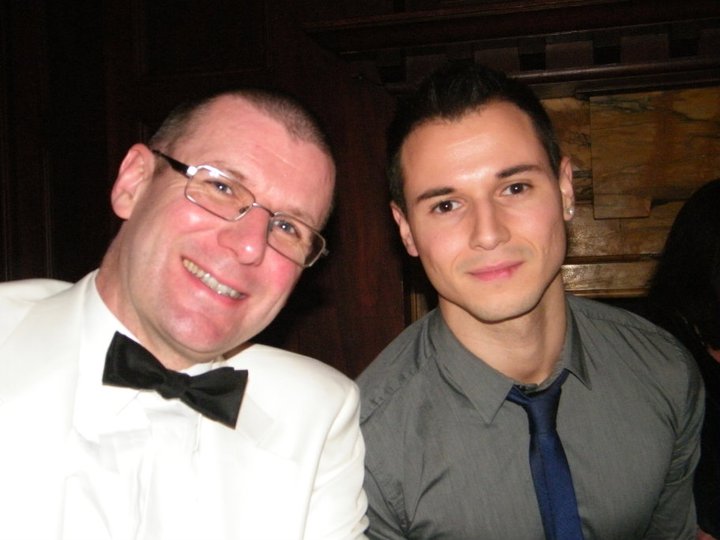
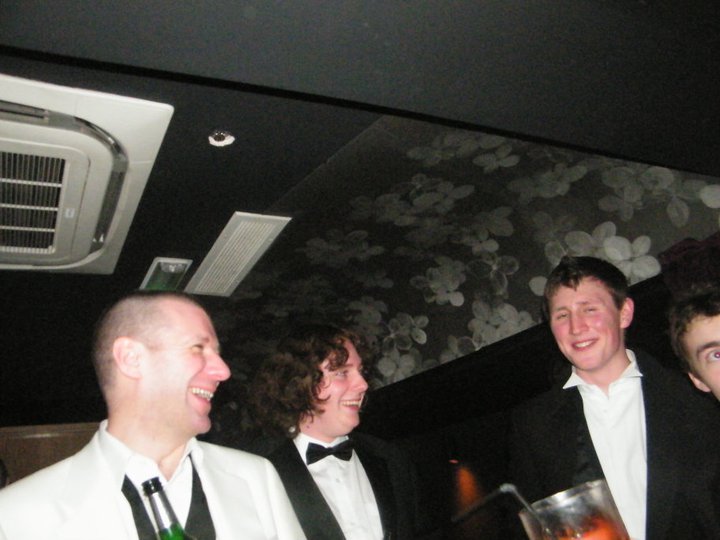
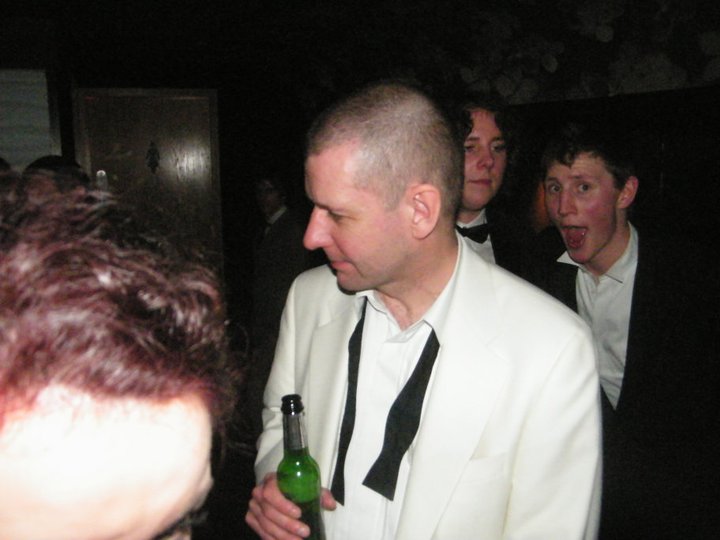
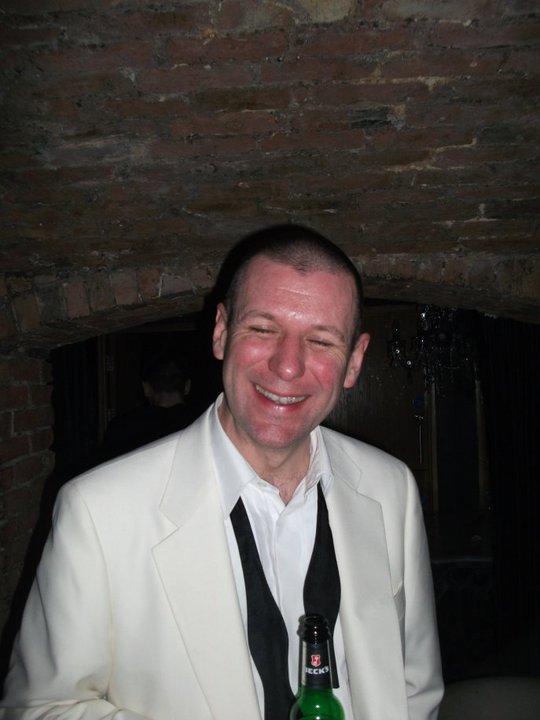
Anyway, some pictures are floating around on facebook. Here’s a couple, and I may add some more as they emerge from various cameras and phones. Of course it must be some kind of optical defect that makes me look so old in these, or perhaps it’s just because I’m surrounded by people less than half my age?

You’ll notice that I got the old white DJ out. Strictly speaking, UK tradition dictates that these should only be worn when abroad but I like wearing one when the weather is nice as it was yesterday whether it’s consistent with etiquette or not. There were plenty more serious breaches going on last night anyway, chiefly involving gentlemen removing their jackets at the dining table which is extremely poor manners.

You’re probably wondering what the second ball  refers to in the title of this post. Well, it’s just to remark that today in Cardiff  Wales played England at Football  (the “Association” variety, with a round ball, which I believe in some backward countries is called “soccer”). It was good to have an excuse for avoiding the city centre, and I was in a sufficiently vegetative state not to venture out of the house at all until the match was over. England beat Wales comfortably, 2-0.

UPDATE: Here’s a few more pictures, starting with one of me and the lovely Matthew. Well, at least one of us is photogenic…

These two were snapped at the club later on…

Here’s a couple more, one of me and the gorgeous Flo…

..and one last one, which I suspect was taken very late in the proceedings


Share/Bookmark