Archive for Coronavirus

A Longer Haul

Posted in Education, Maynooth with tags , , on March 24, 2020 by telescoper


To nobody’s great surprise today we received official confirmation that there will be no face-to-face teaching for the rest of the semester at Maynooth University; teaching had been go on until early May. This news also made it into the Irish Independent. The previous announcement was that classes would not resume until 29th March (this Friday), now they won’t resume until the next academic year begins, in September. There will also be no in situ examinations, with all assessments being switched either to homework or remote assessments. We were pretty sure this was coming, as there is no sign yet of a reduction in the spread* of Coronavirus in Ireland, so we are as prepared as we can be for this contingency, although we now know we’re in it for a longer haul than originally announced.

Today I’ve been setting up a laboratory session for my module on Computational Physics. Instead of working in our computer lab under supervision, the students will have to work through a set of Python coding problems on their own. They’re doing numerical integration this week, by the way: being a bit old-fashioned I like to call this quadrature. The demonstrator and I will however be available (via Microsoft Teams) to deal with queries. This isn’t ideal of course but the software does allow participants to share screens, as well as audio and video chat so, I’m quite optimistic that it will work out reasonably well. I’m planning to deliver a lecture to the students on this module on Thursday which, given that the group is reasonably small, should also work reasonably well.

Update: I had a big problem uploading files to Microsoft Teams, which I couldn’t fix. I need to get that sorted out or it won’t be possible to share plots, graphs, etc. Hopefully it’s just a temporary glitch, but it’s very annoying.

My early experience with Microsoft Teams wasn’t marvellous, which led me to tweet:

I have to say though that it is perfectly functional (so far), once you get used to it. I still prefer Zoom, though.

My only other gripe is that working from home seems to have made some colleagues a little bit trigger-happy with the `ReplyAll’ button on their email.

Anyway, it seems that last night, on the wrong side of the Irish Sea, Boris Johnson finally got around to reading out the statement Emmanuel Macron dictated to him last week and the United Kingdom is finally having some form of discipline imposed. We await possible announcements of further strengthening of the restrictions already in place here in Ireland, but for the time being we carry on pretty much as before. There are few people around and about in Maynooth and many of the shops and all the pubs are closed, but it’s still possible to shop without experiencing a feeding frenzy.

On top of all that, it’s a lovely sunny day!

*I’ve put a page here tracking the daily increase in number of COVID-19 cases in Ireland.

Shopping Mad

Posted in Biographical, Covid-19, Maynooth with tags , , , , on March 22, 2020 by telescoper

Empty shelves in Asda, Swansea

I don’t know how widespread scenes like that pictured above actually are, but there seems to be a lot of panic buying and/or stockpiling going on.

Worse still are scenes like this:

Social distancing doesn’t seem to be a priority among these people.

It all seems a bit ironic to see this demonstrable lack of public-spiritedness alongside the usual rhetoric about the “Dunkirk Spirit”. With the latter in mind I’ve updated Winston Churchill’s famous wartime peroration from 1940 in a manner more suitable for the 2020s:

We shall fight in Tesco, we shall fight in Aldi and Asda, we shall fight with growing panic and growing stupidity in the aisles, we shall defend our toilet rolls, whatever the cost may be. We shall fight for the pasta, we shall fight for the hand-wash…(continued, page 94)

Anyway for what it’s worth I still haven’t noticed any shortages of food or household goods where I’m living. It may be different elsewhere of course but Maynooth is doing fine in that regard.

This is not to say I haven’t changed my shopping habits at all. I’ve never been in the habit of doing big shopping trips. I live alone, don’t have a freezer and my fridge is quite small. I tend therefore to buy bits and pieces as I need them. I prefer fresh food and, usually eating lunch in the College when I’m at work, I don’t need a main meal in the evening.

Now I’m having lunch at home every day I need to buy a bit more, which is one change. Mindful that a stricter lock down might be coming soon, I have also begun buying a few things I wouldn’t normally buy. To my usual shopping I’ve added the odd item of tinned food but never more than a can or two at a time. I also bought some powdered milk in case fresh milk becomes unavailable.

I haven’t eaten any of the tinned goods I’ve bought yet: I am still eating fresh things as they seem to be readily available. Who knows when or if that will change.

I realise my personal situation makes coping with this social distancing malarkey rather easier than most but I think certain individuals are making it even more difficult for the others with their selfish behaviour. I suppose there will always be some.

Anyway, do feel free to share your own experiences of shortages or lack thereof through the comments box.

A Note from Maynooth

Posted in Biographical, Covid-19, Education, Maynooth with tags , , , , on March 18, 2020 by telescoper

I’m indebted to colleagues from Maynooth University Special Collections & Archives for sending out the following bit of history.

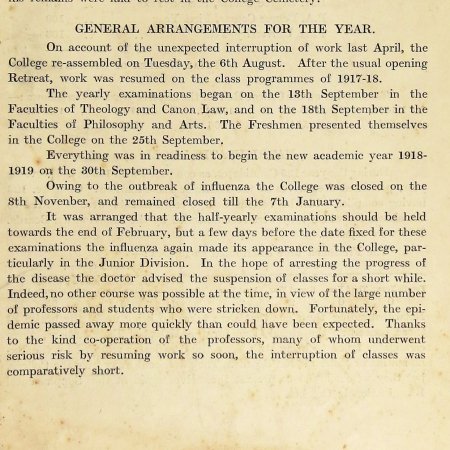
It is now over 100 years ago the 1918 “Spanish ‘flu” influenza pandemic came to Maynooth College. It was officially closed from 8th November until 7th January and 60 students remained in the infirmaries. Over 500 students went home and sadly 11 of these did not survive the pandemic. More details below.

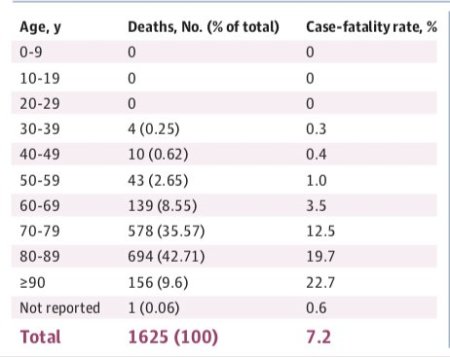
One difference between 1918 and 2020 is that the Spanish flu mainly affected the young. Covid-19 is remarkably different, as these grim mortality statistics from Italy demonstrate:

Nobody at all under the age of 30 has died (so far) of Covid-19 in Italy. It’s the mortality rate for those over 70 that is terrifying. This is just the rate so far. Many of those currently in intensive care won’t make it, so these figures will probably change significantly.

Last night the Taioseach Leo Varadkar gave an unusual address to the nation, which pointed out the gravity of the situation facing Ireland and indeed the world in genderal, which is even more serious that a century ago. In particular he stressed that the COVID-19 emergency would probably last well into the summer.

I don’t agree with Varadkar on many political issues but I think his speech last night was very good. He praised Ireland’s front line medical staff, but also found time to mention the teachers and lecturers who trying their best to deliver remote teaching. Above all, though, he was honest.

I feel very lucky right now, not only to be so far unaffected by Coronavirus but also to be living and working in a small University town in Ireland right now.

There are no obvious shortages of anything and my local (small) supermarket has put out hand wash and wipes for people to use on baskets and trolleys.

We’re also in a Study Week that has at least given us some time to figure out how to move to online teaching by next Monday when we are supposed to start again.

We are probably going to be in this for months rather than weeks but aat least we academics are in no imminent danger of losing our jobs. The same is not true for the folk working in local shops, restaurants and other businesses. We owe it to them to do what we can to support the local community and its economy as much as possible.

In particular, I’ve often remarked that we are lucky in a small town like Maynooth to have quite a few nice cafés and restaurants. Some of these have switched to takeaway or delivery mode during the emergency. I wouldn’t normally use a takeaway service but I will do now, and I suggest my colleagues and friends in Maynooth might do likewise. If we don’t support these establishments now we might lose them for good.

That goes for other local businesses too!

Public Health and Open Science – Updated

Posted in Covid-19 with tags , , , on March 16, 2020 by telescoper

Preface: I wrote this on Monday 16th March, before the release of a report from Imperial College admitting that the previous modelling was based on incorrect assumptions. Most of what I argued still stands but I have updated a few points.

–o–

The current Coronavirus outbreak is posing a great many questions not only about how governments should act but also about how they should communicate with the public. One aspect of this issue that came up last week was an open letter (now closed) asking the UK Government to release the data and models underpinning its COVID-19 strategy. In the interest of full disclosure, I didn’t sign it but only because I’m no longer based in the UK.

Although this letter received many signatures, I was very surprised by the negativity with which it was greeted from some corners of the scientific community. Those of us who work in astrophysics are of course used to open sharing of data and models being the norm. Some of us even see it as an essential component of the scientific method, so I was a bit shocked to see hostility from some other scientists. I think the reason was largely that it wouldn’t help to people without expert knowledge playing around with the data, getting hold of the wrong end of the stick, and jumping to erroneous conclusions. There is of course a danger of that, but in the absence of openness people are jumping to conclusions anyway and conspiracy theories are rife.

For what it’s worth, my view is that if governments can’t get those with scientific training on board then it has no chance with the general population. Astrophysicists, for example, at least understand what an exponential curve really means. Those of us who have a scientific background will not stop asking questions – nor, I think, should we. That’s how we view the world and for many equations and numbers are how we make sense of things.

So, undaunted by the calls that I should shut up because I’m not an expert, but prefaced by a clear admission that I am not an expert, I’m going to comment on a question that a lot of people are asking: why is the UK Government’s Coronavirus strategy so different from that adopted in other countries?

I didn’t watch the press conference last week that ignited this question, but I have listed to clips. The controversial issue is that of so-called herd immunity. Here is a quote by Sir Patrick Vallance, the UK’s chief scientific advisor:

Our aim is to try to reduce the peak, broaden the peak, not suppress it completely; also, because the vast majority of people get a mild illness, to build up some kind of herd immunity.

Now in the absence of a vaccine there isn’t going to be herd immunity in the sense that I understand it, but (as I have already said) I am not an expert. I think the key words are `some kind of’ in the above quote. What is envisaged is a large number of people getting infected, hopefully only contracting mild symptoms, but in any case subsequently acquiring immunity. It would be bad news for this line of thought if it turns out that people can be reinfected, as indeed seems to be the case.

After listening to the press briefings, however, it seems to me that this idea isn’t a key driver of the science policy and that Vallance simply used the phrase `herd immunity’ inadvisedly.

So if that’s not the reason why would the UK’s approach be so different from other countries? Again I preface this by admitting that I’m not an expert.

At the core of a public health strategy to combat a pandemic will be mathematical models of the spread of infection. I only know a little bit about these but I’d guess that most government agencies will have similar models (though there might be different choices of parameters reflecting different populations). But that’s not all the strategy will be based on. Among the other factors are:

  1. the resources available for treating infected persons; and
  2. the likely behaviour of the population (and hence the infection rate) as a result of any measures taken.
  3. A decision about what it means for a strategy to be ‘optimal’.
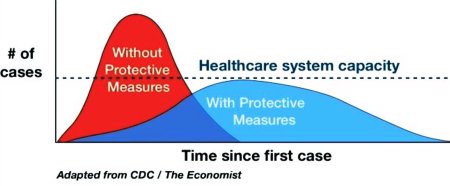
In the first of these the UK is clearly in a very different situation from most of the rest of the world: the National Health Service has (per capita) far fewer hospital beds and, most importantly, far fewer intensive care unit facilities than other developed nations. The latter, in any case, run at close to capacity even at normal times so the resource available is severely limited. The need to `flatten the curve’ would therefore seem to be even more pressing for the United Kingdom than in many other nations.

Update: the Imperial College report explains that previous models made unrealistically optimistic assumptions about the number of infected persons requiring critical treatment. The old strategy would have led to upwards of 250,000 deaths as the NHS would have been swamped. This was exactly what was being pointed out by ‘inexpert’ commenters on social media.

Here is a dramatic confirmation of this:
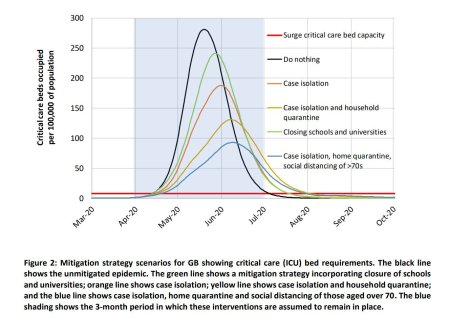
The red line represents UK current critical care capacity. No amount of ‘flattening’ will be enough to avoid the NHS being overwhelmed.

That is a difference in input, but it doesn’t explain why the UK is not taking more stringent measures on social distancing. Quite the opposite, in fact. Apparently the Government has already accepted that hospitals are going to be overrun and that things are going to be very grim indeed for a long time.

By way of support for this interpretation, Boris Johnson recently announced that the elections scheduled for May 2020 will be postponed for a whole year, rather than the six months recommended by the Electoral Commission. It is a reasonably inference that the Government does not believe that this will be anywhere near over by the end of 2020. That signals that it won’t be able to put extra resources in place on the timescale needed to deal effectively with COVID-19 as China and South Korea seem to have done.

It seems, then, that the reason for not enforcing stricter policies now is item 2 above, and it is a judgment based on behavioural psychology: that severe social distancing measures would not be effective because people would get bored or there would be widespread social unrest if folk were asked to endure them for many months. That very pessimistic view of the likely behaviour of the UK population may well be realistic but assuming it has serious implications for mortality.

My interpretation of this is that the Government thinks people won’t really pay enough attention to social distancing instructions until the body count starts to become very scary indeed which, with exponential growth leading to a doubling of cases, every 2-3 days, won’t take very long.

So that brings me the reason why I think there is no way the UK Government is going to release its modelling calculations, namely that they contain numbers for how many people are going to die over the next few months. It won’t do that because it thinks the numbers would just cause people to panic. That may be a correct call too. Those of us who work in subjects like astrophysics don’t have to worry that releasing our data and models will terrify people.

There’s also point (3) about what defines an optimal strategy, as constrained by (1) & (2). The criterion could be overall mortality, but one can imagine that a government might decide to include economic cost as well or instead. One can certainly imagine the UK Government making such a choice.

I’ll add one final comment.

Here in Ireland the HSE has increased the level of testing in recognition of the evidence that community transmission seems to be more probable than previously thought. A surge in the number of confirmed cases of COVID-19 is expected.

Meanwhile, in the United Kingdom, the National Health Service is no longer carrying out any community testing:
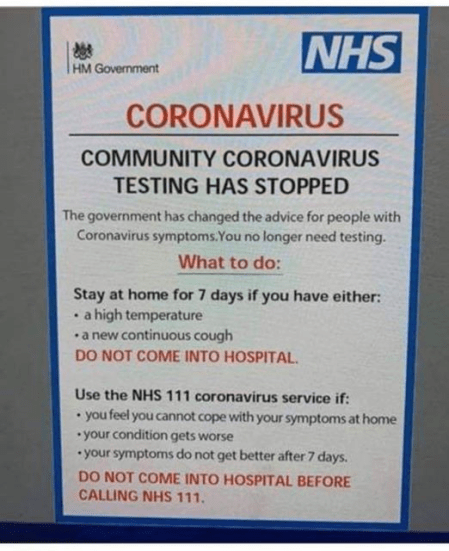
I suspect the reason for this is a combination of (1) and (2). Counting deaths rather than infections is arguably a more reliable indicator of the growth of the epidemic and it is certainly cheaper. Moreover, one way of keeping the numbers down to avoid frightening people is to stop counting them…

Update: As of yesterday Germany had 5813 COVID cases and had 13 deaths; Norway had 1356 cases and only 3 deaths. The UK claimed 1391 cases but 35 deaths. These numbers provide drastic evidence of undercounting cases in the UK.

Business (Cards) as Usual

Posted in Biographical, Covid-19, Education, Maynooth with tags , , on March 15, 2020 by telescoper

One of the things that happened just before Maynooth University closed down last week was that I received delivery of my new business cards:

I’m sure they will prove useful at some point in the future, but I can’t see myself handing any out for a while!

I have subtly removed the telephone numbers from the above image because I was warned that people could use my number to do nefarious things, such as trying to contact me. They are my work numbers, of course, so I never answer them anyway, but you can’t be too careful.

Incidentally, today the Taoiseach Leo Varadkar announced that pubs and bars in Ireland should close down until March 29th, which will include the St Patrick’s Day holiday on Tuesday. I don’t know why this wasn’t done earlier and wonder how many people have been infected with Coronavirus because of the delay.

Anyway, after a weekend of not working, tomorrow we resume working from home. Fortunately it’s Study Week so we don’t have to try doing remote teaching until next week.

A Sign of Panic Buying?

Posted in Biographical, Maynooth with tags , , , on March 15, 2020 by telescoper

The media are full of stories of people panic buying and hoarding various items, chiefly toilet tolls and hand-wash, but also food. I hadn’t seen much evidence of that in Maynooth until I noticed this sign yesterday outside the Roost:

I had no idea food shortages were so bad. I tried following the advice on the notice, but found the door a bit too chewy for my taste.

A few minutes later I was in Supervalu doing my regular Saturday shop without problems.

But seriously folks everywhere, there is absolutely no need to stockpile groceries. It won’t do you any good and it may seriously inconvenience others. There’s plenty to go round if we all behave reasonably, so show a bit of civic responsibility and think of your fellow humans!

In other words, don’t be like this:

Anyway, one thing I have been stockpiling is crosswords and I’m going to spend most of today doing them!

Break Points

Posted in Biographical, Covid-19, Education, Maynooth with tags , on March 11, 2020 by telescoper

It is now Week 6 of the Spring Semester at Maynooth University.  My lectures on Engineering Mathematics take th place on Monday, Tuesday and Wednesday so today I gave the 18th of the semester, which means I am halfway through the module. Next week is a scheduled Study Week so there are no lectures planned after this Friday until 23rd March. Just two days to go before the breaking

It remains to be seen whether teaching does indeed resume on that day. If the coronavirus situation in Ireland gets much worse we may stay closed for a longer period.

There is a subdued mood around campus, and the number of students in my class this afternoon was significantly lower than usual. I don’t know whether that is because of coronavirus or because some students have headed home early for the break or because they didn’t fancy learning about curves and tangent vectors!

Last night the University issued updated guidance. The main thing is that we stay open but the Conferring Ceremonies for postgraduate degrees scheduled for Thursday and Friday next week have been postponed indefinitely.  The students will formally receive their degrees in absentia although they will (hopefully) be able to attend a ceremony to get their certificates in person at some point in the not-too-distant future.

I blogged on Monday about contingency planning and I’ve been spending quite a lot of time this week making the best arrangements possible for students in case we don’t reopen on 23rd March. That includes getting all the notes and examples sheets ready for Engineering Mathematics, which is now done.

My other module is Computational Physics. For that one there’s a small project that the students do (usually) in pairs. I published the list of projects for the students to pick from earlier than originally planned and will hopefully be able to allocate them before the end of this week. That way, if there’s a campus closure they can at least get on with their projects. Fortunately Python is free so they can run code on their laptops. All the other resources for that module will be available online too so disruption shouldn’t be too bad: even if we have to cancel the laboratory sessions the students can still work through the scripts on their own.

What will happen with examinations is not yet clear, but those don’t take place until May so they’re not the immediate priority!

I asked the students in my Engineering Mathematics at the end of this afternoon’s lecture please to keep an eye on their email and social media for announcements about changes in the situation. The positive message for students is that they are actually at very low risk of serious illness themselves (although they should of course take precautions to ensure they don’t infect others).

I feel a bit guilty for thinking about the positive message for staff, but I do have quite a bit of writing-up to do and a nice long campus closure would seem to provide an ideal opportunity to `self-isolate’ and get on with it. For the time being, though, it’s business as usual…

Coronavirus Contingency

Posted in Covid-19, Education, Maynooth with tags , , , , on March 9, 2020 by telescoper

Today we heard that the annual St Patrick’s Day Parades due to take place around Ireland next week on 17th March have been cancelled. Although it seems the Government was reluctant to take this decision, it seems to me an entirely sensible precaution.

I also noticed an article this weekend that academic staff at a St Mary Immaculate College in Limerick have been asked to draw up “…contingency plans for delivering module content in the event of there being on-campus restrictions due to the coronavirus.”

I’d be very surprised if there is an educational institute that has not asked staff to undertake contingency planning of this sort. It would indeed be irresponsible to fail to plan for such an eventuality. The fact that such processes are going on is no reason at all for students or staff to feel anxious.

All Heads of Department here at Maynooth (including myself) have been briefed about the University’s contingency planning and have in turn briefed their staff. In general this planning, which is led by the official advice from the Health and Safety Executive (HSE), seems sensible and proportionate. It also seems very similar to what is going on in Limerick.

For the time being here in Maynooth teaching carries on as normal, but if the situation deteriorates and the advice from HSE changes then contingency arrangements will be adopted. That may include restricting student access to campus and delivering some teaching online instead of in person. That won’t be ideal but it could be managed and we’ll do it circumstances require it.

We have a Study Week break for the week including St Patrick’s Day so after this Friday students won’t be on campus in large numbers anyway. That gives us a bit of time to assess developments.

In the meantime I’ll just share the official poster again.

The Spread of the Coronavirus

Posted in Covid-19, Uncategorized with tags , on March 7, 2020 by telescoper

I thought I would share the above graphic because provides a simple yet very effective illustration of why
it is so important to delay the spread of the Coronavirus, and why strict precautions are being taken to achive that.

The primary cause of death for patients suffering from COVID-19, the disease carried by this virus is that inflamation of the lining of the alveoli in the lungs makes it harder for oxygen to diffuse across into the capillaries and for carbon dioxide to diffuse out. As outlined in the report I shared a few days ago, severe cases therefore require treatment that involves being supplied with oxygen via a respirator for a long period, perhaps weeks. The number of available respirators and intensive care units generally is likely to prove the factor that limits the capacity of hospitals to cope.

The situation might be worse in England because the NHS only has about 2.3 hospital beds per thousand of the population so the capacity limit may be hit much earlier. For reference, Ireland is not much better on 2.96, Scotland has 4.2 and Germany has 8; see here for OECD figures from other countries.

Delaying the spread of the virus may prevent health services from being overwhelmed by spreading out the peak in the manner indicated in the diagram even if the total number of cases were not to reduce. Pushing back the bulk of the distribution by weeks or months may also help if the virus is seasonal – it may transmit infection less efficiently during the spring or summer than it does during the winter.

In the light of this it can’t do any harm to share the HSE advice for Ireland again.

Now wash your hands please.

The WHO-China Report on Corvid-19

Posted in Covid-19, Uncategorized with tags , , on March 4, 2020 by telescoper

As it is a matter of topical and general interest I thought it would be worthwhile sharing the joint World Health Organization – China report on Coronavirus, which you can find here. There is also a discussion thread on Reddit here.

A key figure from this report shows that the number of new cases of Covid-19 has indeed been declining:

The report indicates why and how this has happened. For example, when a cluster of several infected people occurred in China, it was most often (78-85%) caused by an infection within the family transmitted by droplets and other carriers of infection in close contact with an infected person. Transmission by fine aerosols in the air over long distances is not one of the main causes of transmission.

Do read the report. While not being complacent about the scale of the public health challenge, it is a valuable antidote to some of the scaremongering going on.