Archive for Cosmic Dawn

Weekly Update from the Open Journal of Astrophysics – 21/02/2026

Posted in OJAp Papers, Open Access, The Universe and Stuff with tags , , , , , , , , , , , , , , , , , , , , , , , , , , , , , , , , on February 21, 2026 by telescoper

It’s Saturday once more so time for another update of activity at the Open Journal of Astrophysics. Since the last update we have published a further six papers, bringing the number in Volume 9 (2026) to 36 and the total so far published by OJAp up to 484.

I will continue to include the posts made on our Mastodon account (on Fediscience) to encourage you to visit it. Mastodon is a really excellent service, and a more than adequate replacement for X/Twitter (which nobody should be using); these announcements also show the DOI for each paper.

The first paper to report this week is “SKA-Low simulations for a cosmic dawn/epoch of reionisation deep field” by Anna Bonaldi, Philippa Hartley, Simon Purser & Omkar Bait (SKAO, UK), Eunseong Lee (U. Manchester, UK), Robert Braun (SKAO), Florent Mertens (Sorbonne Université, France), Andrea Bracco (Osservatorio Astrofisico di Arcetri, IT), Wendy Williams (SKAO) and Cath Trott (Curtin U., Australia). This paper presents a simulation of an SKA-Low cosmic dawn/epoch of reionisation observation to advance foreground-mitigation approaches: the simulation includes various sky components and modelled errors, allowing for efficacy assessment. It was published on Monday 16th February in the folder Cosmology and Nongalactic Astrophysics.

The overlay is here:
You can find the officially accepted version on arXiv here and the announcement on Fediverse here:

Open Journal of Astrophysics

New Publication at the Open Journal of Astrophysics: "SKA-Low simulations for a cosmic dawn/epoch of reionisation deep field" by Anna Bonaldi, Philippa Hartley, Simon Purser & Omkar Bait (SKAO, UK), Eunseong Lee (U. Manchester, UK), Robert Braun (SKAO), Florent Mertens (Sorbonne Université, France), Andrea Bracco (Osservatorio Astrofisico di Arcetri, IT), Wendy Williams (SKAO) and Cath Trott (Curtin U., Australia)

doi.org/10.33232/001c.157763

February 16, 2026, 8:28 am 1 boosts 1 favorites

The second paper is “V717 Andromedae: An Active Low Mass Ratio Contact Binary” by Surjit S. Wadhwa (Western Sydney U. Australia), Marko Grozdanovic (Astronomical Observatory Belgrade, Serbia), and Nicholas F.H Tothill, Miroslav D. Filipovic, Ain Y. De Horta (Western Sydney U.). This was also published on Monday 1th February, but in the folder Solar and Stellar Astrophysics. The article discusses the contact binary V717 Andromedae, an extreme low mass ratio system with high inclination and moderate contact, showing signs of chromospheric activity but stable and not a merger candidate

The overlay for this one is here:
The official version of the paper can be found on arXiv here and the Fediverse announcement here:

Open Journal of Astrophysics

New Publication at the Open Journal of Astrophysics: "V717 Andromedae: An Active Low Mass Ratio Contact Binary" by Surjit S. Wadhwa (Western Sydney U. Australia), Marko Grozdanovic (Astronomical Observatory Belgrade, Serbia), and Nicholas F.H Tothill, Miroslav D. Filipovic, Ain Y. De Horta (Western Sydney U.)

doi.org/10.33232/001c.157764

February 16, 2026, 8:56 am 0 boosts 0 favorites

Next, published on Tuesday 17th February in the folder High-Energy Astrophysical Phenomena, is “DIPLODOCUS II: Implementation of transport equations and test cases relevant to micro-scale physics of jetted astrophysical sources” by Christopher N Everett (Oxford U., UK), Marc Klinger-Plaisier (U. Amsterdam, NL) and Garret Cotter (Oxford). This one discusses further applications of DIPLODOCUS, which is a framework developed for particle distribution transport, with its numerical implementation detailed in Diplodocus.jl. It uses a new sampling technique and is tested on micro-scale physical effects. The first paper in the series can be found here.

The overlay is here:
The official version can be found on arXiv here and the Fediverse announcement is here:

Open Journal of Astrophysics

New Publication at the Open Journal of Astrophysics: "DIPLODOCUS II: Implementation of transport equations and test cases relevant to micro-scale physics of jetted astrophysical sources" by Christopher N Everett (Oxford U., UK), Marc Klinger-Plaisier (U. Amsterdam, NL) and Garret Cotter (Oxford)

doi.org/10.33232/001c.157823

February 17, 2026, 7:13 am 1 boosts 2 favorites

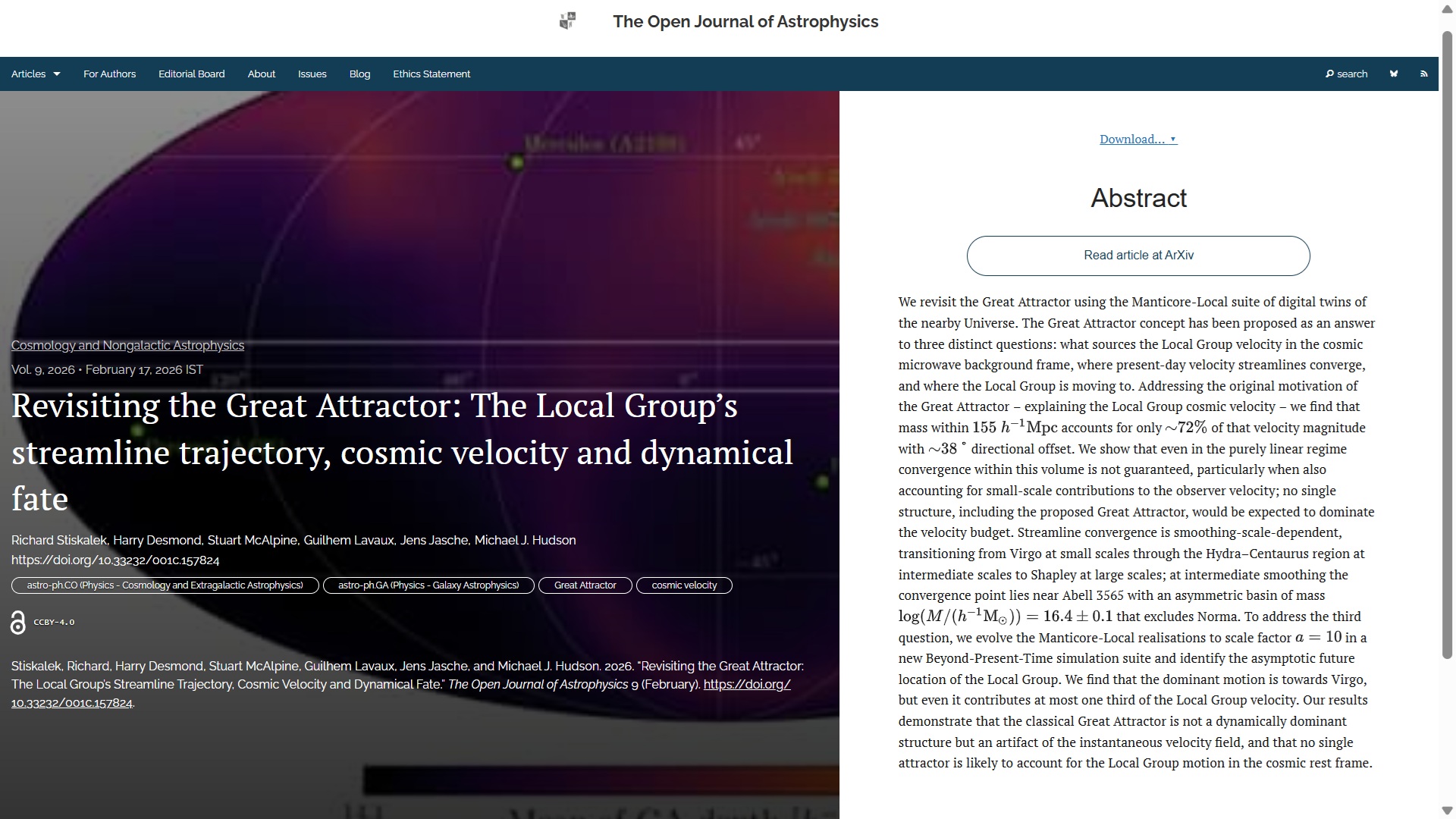
The fourth paper this week, also published on Tuesday 17th February, but in the folder Cosmology and Nongalactic Astrophysics is “Revisiting the Great Attractor: The Local Group’s streamline trajectory, cosmic velocity and dynamical fate” by Richard Stiskalek (Oxford U., UK), Harry Desmond (U. Portsmouth, UK), Stuart McAlpine (Stockholm, SE), Guilhem Lavaux (Sorbonne Université, FR), Jens Jasche (Stockholm) and Michael J. Hudson (U. Waterloo, Canada). This paper revisits the so-called “Great Attractor” concept, finding that it doesn’t dominate the Local Group’s cosmic velocity; multiple structures contribute to the motion, with no single attractor accounting for the flow.

Here is the overlay:
The official version can be found on arXiv here and the Fediverse announcement is here:

Open Journal of Astrophysics

New Publication at the Open Journal of Astrophysics: "Revisiting the Great Attractor: The Local Group’s streamline trajectory, cosmic velocity and dynamical fate" by Richard Stiskalek (Oxford U., UK), Harry Desmond (U. Portsmouth, UK), Stuart McAlpine (Stockholm, SE), Guilhem Lavaux (Sorbonne Université, FR), Jens Jasche (Stockholm) and Michael J. Hudson (U. Waterloo, Canada)

doi.org/10.33232/001c.157824

February 17, 2026, 7:33 am 3 boosts 1 favorites

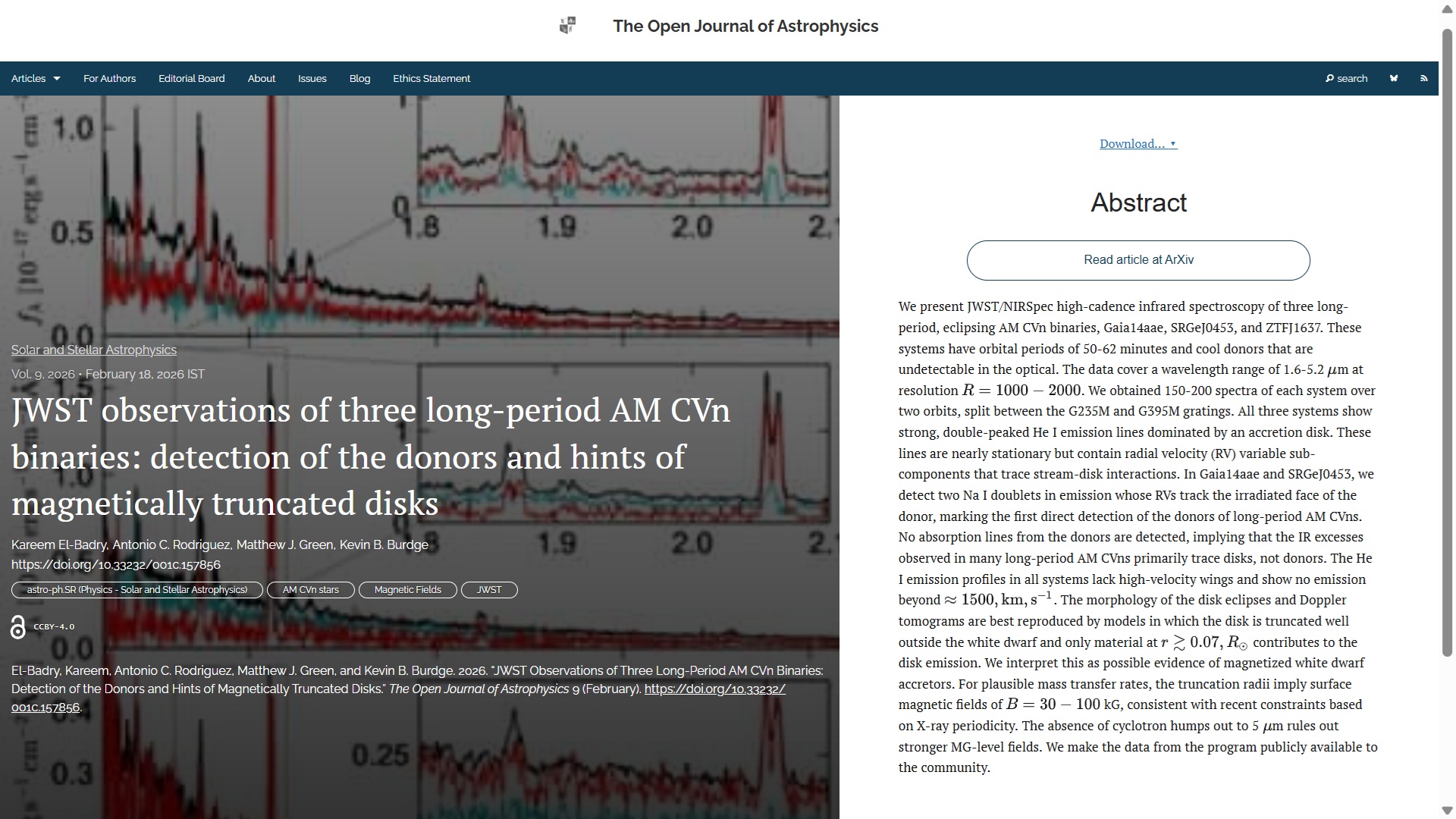
The fifth paper this week, is “JWST observations of three long-period AM CVn binaries: detection of the donors and hints of magnetically truncated disks” by Kareem El-Badry (Caltech), Antonio C. Rodriguez (CfA Harvard), Matthew J. Green (U. Oklahoma) & Kevin B. Burdge (MIT); all based in the USA. The article was published on Thursday 19th February 2026 in the folder Solar and Stellar Astrophysics. The paper describes high-cadence infrared spectroscopy used to analyze three long-period, eclipsing AM CVn (AM Canum Venaticorum) binaries; findings suggest the presence of magnetized white dwarf accretors, with surface magnetic fields of 30-100 kG.

The overlay is here:
The accepted version can be found on arXiv here, and the fediverse announcement is here:

Open Journal of Astrophysics

New Publication at the Open Journal of Astrophysics: "JWST observations of three long-period AM CVn binaries: detection of the donors and hints of magnetically truncated disks" by Kareem El-Badry (Caltech), Antonio C. Rodriguez (CfA Harvard), Matthew J. Green (U. Oklahoma) & Kevin B. Burdge (MIT); all in USA

doi.org/10.33232/001c.157856

February 18, 2026, 8:15 am 1 boosts 0 favorites

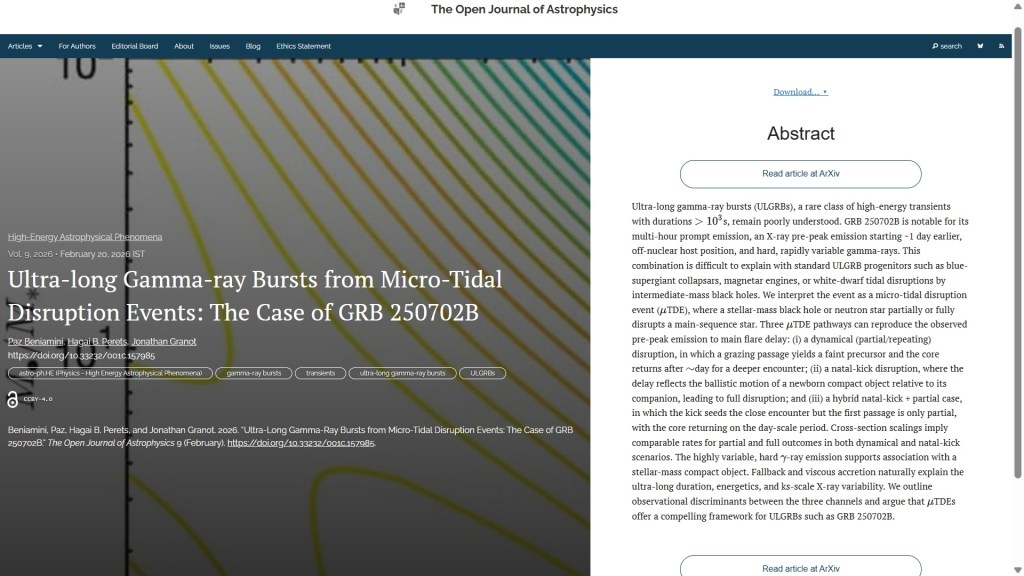
Finally for this week we have “Ultra-long Gamma-ray Bursts from Micro-Tidal Disruption Events: The Case of GRB 250702B” by Paz Beniamini (Open University, IL), Hagai B. Perets (Technion, IL) and Jonathan Granot (Open University, IL); all based in Israel. The paper was published on Friday 18th February 2026 in the folder High-Energy Astrophysical Phenomena.

The overlay is here:
You can find the officially accepted version on arXiv here and the Mastodon announcement is here:

Open Journal of Astrophysics

New Publication at the Open Journal of Astrophysics: "Ultra-long Gamma-ray Bursts from Micro-Tidal Disruption Events: The Case of GRB 250702B" by Paz Beniamini (Open University, IL), Hagai B. Perets (Technion, IL) and Jonathan Granot (Open University, IL)

doi.org/10.33232/001c.157985

February 20, 2026, 8:43 am 0 boosts 0 favorites

And that concludes this week’s update. I will do another next Saturday, by which time I expect we will have published a similar number of papers to this week.
Catching up on Cosmic Dawn

Posted in The Universe and Stuff with tags , , , , , on June 25, 2021 by telescoper

Trying to catch up on cosmological news after a busy week I came across a number of pieces in the media about “Cosmic Dawn” (e.g. here in The Grauniad). I’ve never actually met Cosmic Dawn but she seems like an interesting lady.

But seriously folks, Cosmic Dawn refers to the epoch during which the first stars formed in the expanding Universe lighting up the Universe after a few hundred million years of post-recombination darkness.

According to the Guardian article mentioned above the new results being discussed are published in Monthly Notices of the Royal Astronomical Society but they’re actually not. Yet. Nevertheless the paper (by Laporte et al.) is available on the arXiv which is where people will actually read it…

Anyway, here is the abstract:

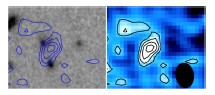
Here is a composite of HST and ALMA images for one of the objects discussed in the paper (MACS0416-JD):

I know it looks a bit blobby but it’s not easy to resolve things at such huge distances! Also, it’s quite small because it’s far away. In any case the spectroscopy is really the important thing, not the images, as that is what determines the redshift. The Universe has expanded by a factor 10 since light set out towards us from an object at redshift 9. I’m old enough to remember when “high redshift” meant z~0.1!

At the end of my talk on Wednesday Floyd Stecker asked me about what the James Webb Space Telescope (due for launch later this year) would do for cosmology and I replied that it would probably do a lot more for galaxy formation and evolution than cosmology per se. I think this is a good illustration of what I meant. Because of its infrared capability JWST will allow astronomers to push back even further and learn even more about how the first stars formed, but it won’t tell us much directly about dark matter and dark energy.

EDGES and Foregrounds

Posted in Astrohype, The Universe and Stuff with tags , , , on September 3, 2018 by telescoper

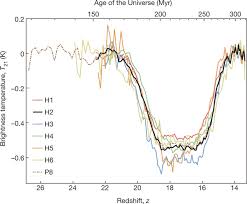
Earlier this year I wrote a brief post about paper by Bowman et al. from the EDGES experiment that had just come out in Nature reportining the detection of a flattened absorption profile in the sky-averaged radio spectrum, centred at a frequency of 78 megahertz, largely consistent with expectations for the 21-centimetre signal induced by early stars. It caused a lot of excitement at the time; see, e.g., here.
The key plot from the paper is this:

At the time I said that I wasn’t entirely convinced. Although the paper is very good at describing the EDGES experiment, it is far less convincing that all necessary foregrounds and systematics have been properly accounted for. There are many artefacts that could mimic the signal shown in the diagram.

I went on to say

If true, the signal is quite a lot larger than amplitude than standard models predict. That doesn’t mean that it must be wrong – I’ve never gone along with the saying `never trust an experimental result until it is confirmed by theory’ – but it’s way too early to claim that it proves that some new exotic physics is involved. The real explanation may be far more mundane.

There’s been a lot of media hype about this result – reminiscent of the BICEP bubble – and, while I agree that if it is true it is an extremely exciting result – I think it’s far too early to be certain of what it really represents. To my mind there’s a significant chance this could be a false cosmic dawn.

I gather the EDGES team is going to release its data publicly. That will be good, as independent checks of the data analysis would be very valuable.

Well, there’s a follow-up paper that I missed when it appeared on the arXiv in May the abstract of which reads:

We have re-analyzed the data in which Bowman et al. (2018) identified a feature that could be due to cosmological 21-cm line absorption in the intergalactic medium at redshift z~17. If we use exactly their procedures then we find almost identical results, but the fits imply either non-physical properties for the ionosphere or unexpected structure in the spectrum of foreground emission (or both). Furthermore we find that making reasonable changes to the analysis process, e.g., altering the description of the foregrounds or changing the range of frequencies included in the analysis, gives markedly different results for the properties of the absorption profile. We can in fact get what appears to be a satisfactory fit to the data without any absorption feature if there is a periodic feature with an amplitude of ~0.05 K present in the data. We believe that this calls into question the interpretation of these data as an unambiguous detection of the cosmological 21-cm absorption signature.

You can read the full paper here (PDF). I haven’t kept up with this particular story, so further comments/updates/references are welcome through the box below!