Archive for Cosmology

Finding the Lost Baryons

Posted in Astrohype, The Universe and Stuff with tags , , , , , on June 3, 2020 by telescoper

Taking a break from examination marking I thought I’d post a comment on a recent paper in Nature which you can find on the arXiv here; see also a report here.

The paper, entitled A census of baryons in the Universe from localized fast radio bursts, is an important one which does seem to resolve a longstanding question often called the missing baryon problem. In a nutshell, the problem is that the density of baryons suggested by cosmological considerations – specifically the element abundances produced by Big Bang nucleosynthesis and the cosmic microwave background (CMB) – was, until recently, rather higher than that which has been observed by astrophysical measurements; by `baryonic material’ I mean basically protons and neutrons (whether or not they are in atomic nuclei).

In the framework of the standard cosmological model, The density of baryonic matter (denoted `Ordinary Matter’ in the following figure) contributes only around 5% of the overall mass-energy budget of the Universe:
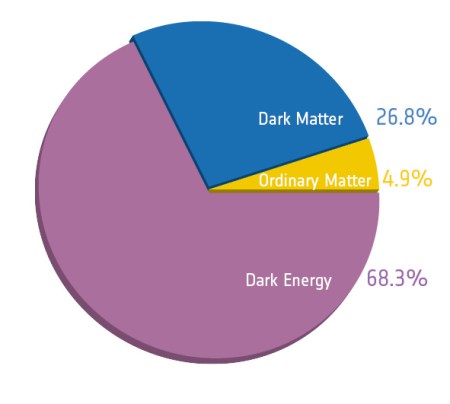
The first thing to stress is that this paper says nothing about the `Dark Matter’ which, according to the standard model, makes up about 27% of the pie and which cannot be in the form of baryons if the CMB and nucleosynthesis measurements are correct. If it were baryonic it would participate in nuclear reactions and mess up the light element abundances and also interact with photons in such a way as to change the fluctuation spectrum of the cosmic microwave background. Having said that, `dark’ is better adjective to use for hidden baryons than it is for non-baryonic matter, as baryons can absorb light. Non-baryonic matter isn’t really dark, it’s transparent because it doesn’t interact at all with electromagnetic radiation. We are however in the dark about it.

Note that the total density of dark + ordinary matter is about 32%, just what George Ellis and I concluded way back in 1994.

We can be much more certain about baryons actually existing than we can about dark matter because. For one thing, we are made of them. It has, however, been known for ages that the total density of directly visible baryons (ie those associated with stars and galaxies) is much lower than this figure, leading to the conclusion that some of the baryons predicted by cosmologists must be in some invisible form(s). Some, for example, is found by X-ray emissions in dense galaxy clusters, but this component is still inadequate to account for all the missing matter.

It has been suspected for some time that the hidden baryons probably inhabit a diffuse Warm-Hot Component of the Intergalactic Medium which, according to simulations of structure formation, traces its own form of the cosmic web we see in the distribution of galaxies:

The diffuse state and inhomogeneous nature of this intergalactic medium makes it difficult to detect, as explained in the abstract of the paper, but adding a relatively new technique involving fast radio bursts to probe the distribution of matter along the line of sight to the observer, it seems that it has now brought out into the open:

Now the inventory of observed baryons matches the 5% figure we cosmologists always knew it would be, and all is well with the world!

P. S. I was informed on Twitter after posting this that there was a paper on this topic in Nature a couple of years ago the last sentence of the abstract of which reads:

We conclude that the missing baryons have been found.
Cosmology Talks – Colin Hill on Early Dark Energy

Posted in The Universe and Stuff with tags , , , , , on June 2, 2020 by telescoper

Here is another one of those Cosmology Talks curated on YouTube by Shaun Hotchkiss.

In the talk, Colin Hill explains how even though early dark energy can alleviate the Hubble tension, it does so at the expense of increasing other tension. Early dark energy can raise the predicted expansion rate inferred from the cosmic microwave background (CMB), by changing the sound horizon at the last scattering surface. However, the early dark energy also suppresses the growth of perturbations that are within the horizon while it is active. This mean that, in order to fit the CMB power spectrum the matter density must increase (and the spectral index becomes more blue tilted) and the amplitude of the matter power spectrum should get bigger. In their paper, Colin and his coauthors show that this affects the weak lensing measurements by DES, KiDS and HSC, so that including those experiments in a full data analysis makes things discordant again. The Hubble parameter is pulled back down, restoring most of the tension between local and CMB measurements of H0, and the tension in S_8 gets magnified by the increased mismatch in the predicted and measured matter power spectrum.

The overall moral of this story is the current cosmological models are so heavily constrained by the data that a relatively simple fix in one one part of the model space tends to cause problems elsewhere. It’s a bit like one of those puzzles in which you have to arrange all the pieces in a magic square but every time you move one bit you mess up the others.

The paper that accompanies this talk can be found here.

And here’s my long-running poll about the Hubble tension:


Cosmology Talks – Deanna Hooper on CMB spectral distortions

Posted in The Universe and Stuff with tags , , , , on May 26, 2020 by telescoper

Here is another one of those Cosmology Talks curated on YouTube by Shaun Hotchkiss. This one was published over a month ago, but I missed it at the time.

In the talk, Deanna Hooper tells us about what we could learn from future measurements of the spectral distortions in the CMB, as well as how spectral distortions complement current and future measurements of CMB anisotropies. I’m particularly interested in this as I wrote a paper on it with John Barrow almost thirty years 30 ago and it’s fascinating to see how far the field has moved on from the theoretical point of view. Our paper was motivated by limits on spectral distortions imposed by the FIRAS instrument on COBE, and there hasn’t been anywhere near as much observational progress since then.

The paper that accompanies this talk can be found here.

Hubble Tension in Perspective

Posted in The Universe and Stuff with tags , , , on May 18, 2020 by telescoper

In my office today for the first time in a couple of months I stumbled across a folder containing the notes from the summer school for new Astronomy PhD students I attended in Durham in 1985. Yes, that’s thirty five years ago..

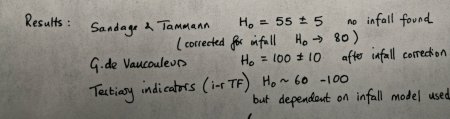
Among the lectures was a set given by Richard Ellis on Observational Cosmology from which I’ve taken this little snippet about the Hubble Constant:

It’s not only a trip down memory lane but also up the cosmological distance ladder! You will see that there were two main estimates, one low and one high. Both turned out to be about three sigma away from the currently-favoured value of around 70.

Plus ça change, plus c’est la même chose…

Does this change your mind about today’s tension between another pair of “low” (67) and “high” (73) values?

Cosmology Talks: Adam Riess on Cepheid Crowding and the Hubble Tension

Posted in The Universe and Stuff with tags , , , , , on May 15, 2020 by telescoper

Here’s another example from the series of cosmology talks being curated by Shaun Hotchkiss. In this one, esteemed astronomer and Nobel Prize winner Adam Riess talks about what he and collaborators considered to be the leading candidate for a systematic error in the SHOES measurement of the expansion rate of the Universe. This is “Cepheid crowding”, the possibility that background sources change our interpretation of Cepheid brightness, ruining one step in the SHOES distance ladder. Riess and collaborators devise a nice way to test whether the crowding is correctly accounted for and find that it is, so crowding cannot be the “explanation” of an error in the distance ladder measurement of H0. Riess also stresses that both the early and late universe measurements of H0 are now backed up by multiple different measurements. Accordingly, if the resolution isn’t fundamental physics, then no single systematic can entirely solve the tension.

P. S. The paper that accompanies this talk can be found on the arXiv here.

Gruber Prize 2020: Volker Springel & Lars Hernquist

Posted in Open Access, The Universe and Stuff with tags , , , , , on May 8, 2020 by telescoper

I’m delighted to be able to pass on the news released yesterday that the 2020 Gruber Prize for Cosmology has been awarded to Lars Hernquist (left) and Volker Springel (right) for their work on numerical simulations.

The citation reads:

The Gruber Foundation is pleased to present the 2020 Cosmology Prize to Lars Hernquist and Volker Springel for their transformative work on structure formation in the universe, and development of numerical algorithms and community codes further used by many other researchers to significantly advance the field. The contributions of Hernquist and Springel have led to profound insights spanning billions of years of cosmic evolution, including simulations of the growth of early density fluctuations through to present-day galaxies, the influence of galaxy mergers on star formation, and the close coevolution of supermassive black holes with their host galaxies.

I’ll just add that as well as being enormously influential in purely scientific terms both these scientists have contributed to the culture of open science through making codes (such as GADGET) freely available to the community.

Heartiest congratulations to Volker Springel and Lars Hernquist on their very well deserved award.

Cosmology Talks: Jurek Bauer on ‘Fuzzy’ Dark Matter

Posted in The Universe and Stuff with tags , , , , , on April 26, 2020 by telescoper

If you are missing your regular seminar experience because of the Coronavirus lockdown, Shaun Hotchkiss has set up a YouTube channel just for you!

The channel features technical talks rather than popular expositions so it won’t be everyone’s cup of tea but for those seriously interested in cosmology at a research level they should prove interesting.

Here’s another example from that series in which Jurek Bauer talks about ‘Fuzzy’ Dark Matter (ie matter in the form of a very light particle such as the axion) and the prospects for constraining its existence using the Square Kilometre Array.

P. S. The paper that accompanies this talk can be found on the arXiv here.

Cosmology Talks: Omar Darwish on Lensing Maps

Posted in The Universe and Stuff with tags , , , , , on April 17, 2020 by telescoper

If you are missing your regular seminar experience because of the Coronavirus lockdown, Shaun Hotchkiss has set up a YouTube channel just for you!

The channel features technical talks rather than popular expositions so it won’t be everyone’s cup of tea but for those seriously interested in cosmology at a research level they should prove interesting.

Here’s another example from that series in which Omar Darwish talks about CMB Lensing Maps and specifically about an extremely impressive example thereof which he made using data from the Atacama Cosmology Telescope.

Is the Expansion of the Universe Isotropic?

Posted in Astrohype, The Universe and Stuff with tags , , , , , on April 9, 2020 by telescoper

There’s a new paper out that has been making a few waves in cosmology. Here’s the title and abstract:

It’s published in Astronomy & Astrophysics but you can find it on the arXiv here.

Here’s a gratuitous pretty picture showing the distribution of the X-ray clusters used in the analysis.

The discussion in the paper focuses on two possibilities: (i) that the clusters are participating in a large-scale correlated motion; and (ii) that the Expansion of the Universe is not occurring isotropically. The latter option is the one that has attracted the most media attention (presumably because it has the most far-reaching implications). This seems to me to be a very unlikely explanation, however, because anisotropic expansion of the magnitude implied would leave a ~10% signal in the Cosmic Microwave Background which is not observed.

There is, however, a third possibility (admittedly duller than the other two) which is that there is some unknown systematic error in the observations…

Cosmology Talks: Julien Lesgourgues on Neutrino Masses

Posted in The Universe and Stuff with tags , , , on April 3, 2020 by telescoper

If you are missing your regular seminar experience because of the Coronavirus lockdown, Shaun Hotchkiss has set up a YouTube channel just for you!

The channel features technical talks rather than popular expositions so it won’t be everyone’s cup of tea but for those seriously interested in cosmology at a research level they should prove interesting.

Here’s an example in which Julien Lesgourgues talks about (not measuring neutrino masses with cosmological data.