Archive for Cosmology

Counting String Theory Standard Models

Posted in The Universe and Stuff with tags , on October 22, 2018 by telescoper

I saw a paper on the arXiv and couldn’t resist a (snarky) comment. Here is the abstract:

We derive an approximate analytic relation between the number of consistent heterotic Calabi-Yau compactifications of string theory with the exact charged matter content of the standard model of particle physics and the topological data of the internal manifold: the former scaling exponentially with the number of Kahler parameters. This is done by an estimate of the number of solutions to a set of Diophantine equations representing constraints satisfied by any consistent heterotic string vacuum with three chiral massless families, and has been computationally checked to hold for complete intersection Calabi-Yau threefolds (CICYs) with up to seven Kahler parameters. When extrapolated to the entire CICY list, the relation gives about 1023 string theory standard models; for the class of Calabi-Yau hypersurfaces in toric varieties, it gives about 10723 standard models.

Isn’t  10723 also the number of angels that can dance on the head of a pin? That number of models for the price of one theory looks like a bargain to me!

But, seriously, people often complain that string theory isn’t really scientific because it isn’t predictive. That clearly isn’t true. String theory is the most predictive theory ever: it can predict anything you want!


The Big Bang Exploded?

Posted in Biographical, The Universe and Stuff with tags , , , on October 15, 2018 by telescoper

I suspect that I’m not the only physicist who receives unsolicited correspondence from people with wacky views on Life, the Universe and Everything. Being a cosmologist, I probably get more of this stuff than those working in less speculative branches of physics. Because I’ve written a few things that appeared in the public domain, I probably even get more than most cosmologists (except the really famous ones of course).

Many “alternative” cosmologists have now discovered email, and indeed the comments box on this blog, but there are still a lot who send their ideas through regular post. Whenever I get a envelope with an address on it that has been typed by an old-fashioned typewriter it’s a dead giveaway that it’s going to be one of those. Sometimes they are just letters (typed or handwritten), but sometimes they are complete manuscripts often with wonderfully batty illustrations. I remember one called Dark Matter, The Great Pyramid and the Theory of Crystal Healing. I used to have an entire filing cabinet filled with things like his, but I took the opportunity of moving from Cardiff some time ago to throw most of them out.

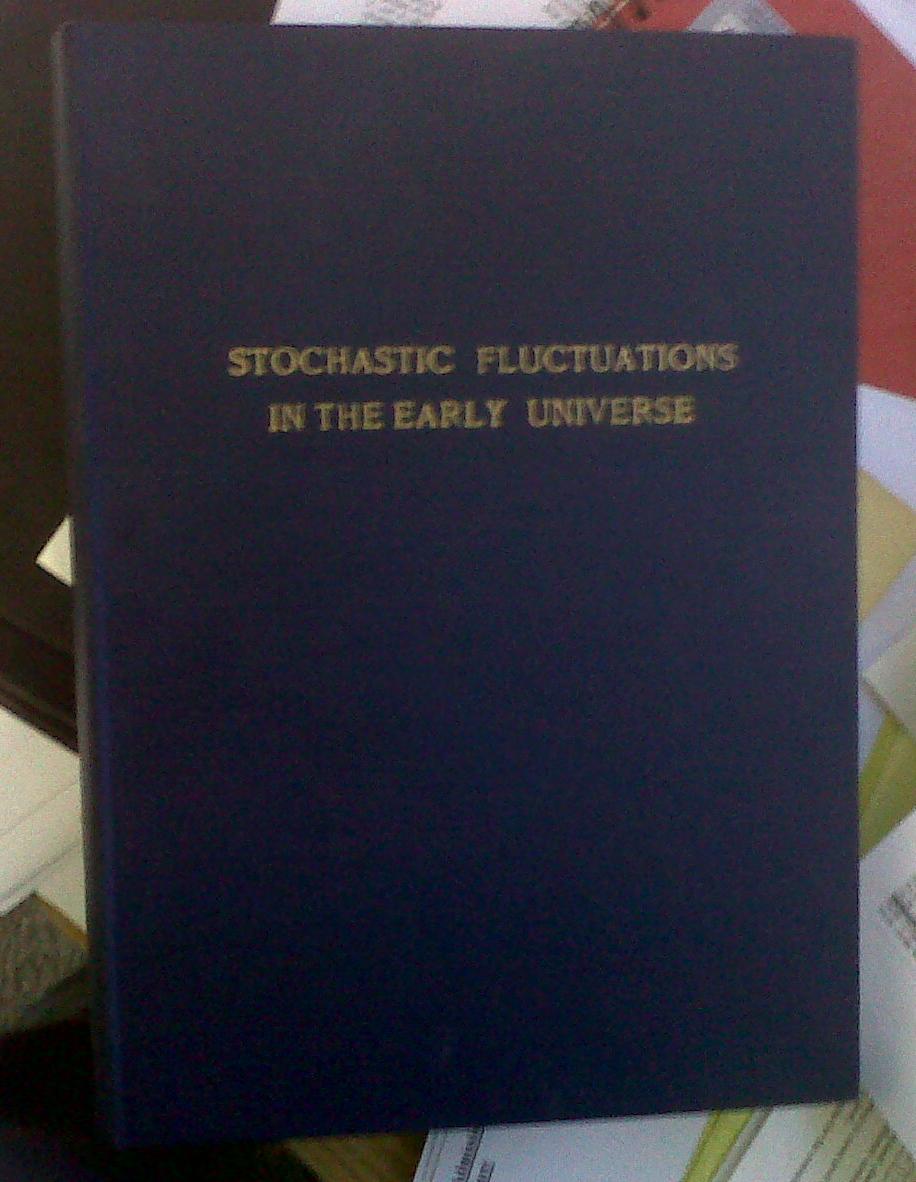
One particular correspondent started writing to me after the publication of my little book, Cosmology: A Very Short Introduction. This chap sent a terse letter to me pointing out that the Big Bang theory was obviously completely wrong. The reason was obvious to anyone who understood thermodynamics. He had spent a lifetime designing high-quality refrigeration equipment and therefore knew what he was talking about (or so he said). He even sent me this booklet about his ideas, which for some reason I have neglected to send for recycling:

His point was that, according to the Big Bang theory, the Universe cools as it expands. Its current temperature is about 3 Kelvin (-270 Celsius or thereabouts) but it is now expanding and cooling. Turning the clock back gives a Universe that was hotter when it was younger. He thought this was all wrong.

The argument is false, my correspondent asserted, because the Universe – by definition – hasn’t got any surroundings and therefore isn’t expanding into anything. Since it isn’t pushing against anything it can’t do any work. The internal energy of the gas must therefore remain constant and since the internal energy of an ideal gas is only a function of its temperature, the expansion of the Universe must therefore be at a constant temperature (i.e. isothermal, rather than adiabatic). He backed up his argument with bona fide experimental results on the free expansion of gases.

I didn’t reply and filed the letter away. Another came, and I did likewise. Increasingly overcome by some form of apoplexy his letters got ruder and ruder, eventually blaming me for the decline of the British education system and demanding that I be fired from my job. Finally, he wrote to the President of the Royal Society demanding that I be “struck off” and forbidden (on grounds of incompetence) ever to teach thermodynamics in a University. The copies of the letters he sent me are still will the pamphlet.

I don’t agree with him that the Big Bang is wrong, but I’ve never had the energy to reply to his rather belligerent letters. However, I think it might be fun to turn this into a little competition, so here’s a challenge for you: provide the clearest and most succint explanation of why the temperature of the expanding Universe does fall with time, despite what my correspondent thought.

Answers via the comment box please!

EDGES and Foregrounds

Posted in Astrohype, The Universe and Stuff with tags , , , on September 3, 2018 by telescoper

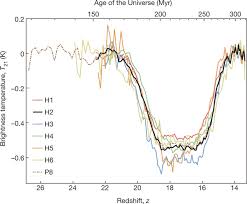
Earlier this year I wrote a brief post about paper by Bowman et al. from the EDGES experiment that had just come out in Nature reportining the detection of a flattened absorption profile in the sky-averaged radio spectrum, centred at a frequency of 78 megahertz, largely consistent with expectations for the 21-centimetre signal induced by early stars. It caused a lot of excitement at the time; see, e.g., here.
The key plot from the paper is this:

At the time I said that I wasn’t entirely convinced. Although the paper is very good at describing the EDGES experiment, it is far less convincing that all necessary foregrounds and systematics have been properly accounted for. There are many artefacts that could mimic the signal shown in the diagram.

I went on to say

If true, the signal is quite a lot larger than amplitude than standard models predict. That doesn’t mean that it must be wrong – I’ve never gone along with the saying `never trust an experimental result until it is confirmed by theory’ – but it’s way too early to claim that it proves that some new exotic physics is involved. The real explanation may be far more mundane.

There’s been a lot of media hype about this result – reminiscent of the BICEP bubble – and, while I agree that if it is true it is an extremely exciting result – I think it’s far too early to be certain of what it really represents. To my mind there’s a significant chance this could be a false cosmic dawn.

I gather the EDGES team is going to release its data publicly. That will be good, as independent checks of the data analysis would be very valuable.

Well, there’s a follow-up paper that I missed when it appeared on the arXiv in May the abstract of which reads:

We have re-analyzed the data in which Bowman et al. (2018) identified a feature that could be due to cosmological 21-cm line absorption in the intergalactic medium at redshift z~17. If we use exactly their procedures then we find almost identical results, but the fits imply either non-physical properties for the ionosphere or unexpected structure in the spectrum of foreground emission (or both). Furthermore we find that making reasonable changes to the analysis process, e.g., altering the description of the foregrounds or changing the range of frequencies included in the analysis, gives markedly different results for the properties of the absorption profile. We can in fact get what appears to be a satisfactory fit to the data without any absorption feature if there is a periodic feature with an amplitude of ~0.05 K present in the data. We believe that this calls into question the interpretation of these data as an unambiguous detection of the cosmological 21-cm absorption signature.

You can read the full paper here (PDF). I haven’t kept up with this particular story, so further comments/updates/references are welcome through the box below!

The Simons Observatory: Science Goals and Forecasts

Posted in The Universe and Stuff with tags , , on August 27, 2018 by telescoper

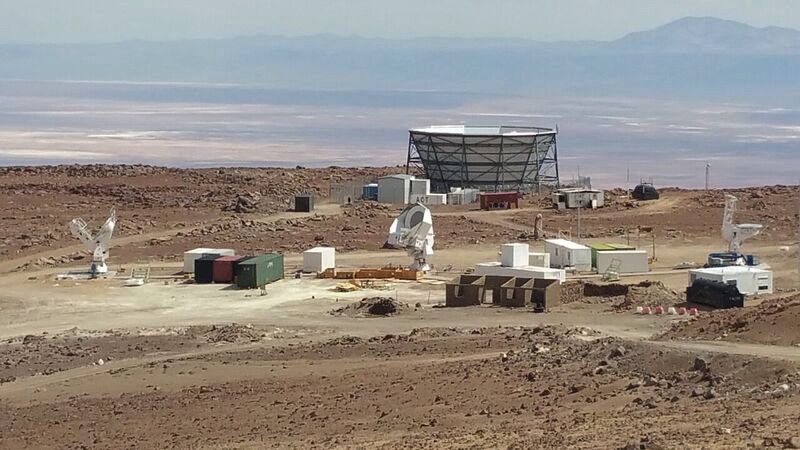
I haven’t been involved in this project, but several of my former colleagues at Cardiff have beenm and still are, so I know how much work has gone into this (especially by the amazing Erminia Calabrese), so I am happy to share this impressive work here. This long (54 pages) paper, which appeared on the arXiv last week, describes the latest step forward in ground-based cosmology using the cosmic microwave background. It shows just how rapid the onward march of instrumental technology continues to be.

The Simons Observatory Site, in Chile

It is likely that the Simons Observatory (based on a single 6m dish) will form part of the next generation CMB experiment known currently as CMB-S4.

You can download the paper in full from the arXiv here.

The Simons Observatory (SO) is a new cosmic microwave background experiment being built on Cerro Toco in Chile, due to begin observations in the early 2020s. We describe the scientific goals of the experiment, motivate the design, and forecast its performance. SO will measure the temperature and polarization anisotropy of the cosmic microwave background in six frequency bands: 27, 39, 93, 145, 225 and 280 GHz. The initial configuration of SO will have three small-aperture 0.5-m telescopes (SATs) and one large-aperture 6-m telescope (LAT), with a total of 60,000 cryogenic bolometers. Our key science goals are to characterize the primordial perturbations, measure the number of relativistic species and the mass of neutrinos, test for deviations from a cosmological constant, improve our understanding of galaxy evolution, and constrain the duration of reionization. The SATs will target the largest angular scales observable from Chile, mapping ~10% of the sky to a white noise level of 2 μK-arcmin in combined 93 and 145 GHz bands, to measure the primordial tensor-to-scalar ratio, r, at a target level of σ(r)=0.003. The LAT will map ~40% of the sky at arcminute angular resolution to an expected white noise level of 6 μK-arcmin in combined 93 and 145 GHz bands, overlapping with the majority of the LSST sky region and partially with DESI. With up to an order of magnitude lower polarization noise than maps from the Planck satellite, the high-resolution sky maps will constrain cosmological parameters derived from the damping tail, gravitational lensing of the microwave background, the primordial bispectrum, and the thermal and kinematic Sunyaev-Zel’dovich effects, and will aid in delensing the large-angle polarization signal to measure the tensor-to-scalar ratio. The survey will also provide a legacy catalog of 16,000 galaxy clusters and more than 20,000 extragalactic sources.

Cosmology Big Brother

Posted in Television, The Universe and Stuff with tags , , on August 17, 2018 by telescoper

I saw on Twitter today that the new series of Celebrity Big Brother has just started, though looking at the list of inmates housemates, I’m not sure whether the producers of this show understand the meaning of the word `celebrity’. At any rate, I’ve never heard of most of them.

I get the feeling that the Big Brother franchise may be getting a little tired, so I thought I’d pitch a new variant in order to boost the flagging ratings.

In Cosmology Big Brother a group of wannabe cosmologists live together in a specially-constructed house (with lots of whiteboards) isolated from the outside world (i.e. the arXiv). As the series progresses the furniture and rooms are gradually moved further apart, the temperature of the central heating is turned down, and the contents of the house become progressively more disordered.

Housemates are regularly voted out, at which point they have to enter the `real world’ (i.e. get a job in data science). Eventually only one person remains and whoever that is is awarded a research grant. They can then spend the rest of their life combining their study of cosmology with the usual activities of a Big Brother winner, e.g. opening supermarkets.

Nature After Planck…

Posted in Maynooth, The Universe and Stuff with tags , , , , , , on July 24, 2018 by telescoper

After last week’s short update about the last tranche of papers from the European Space Agency’s Planck Mission it’s time for another short update about a piece in Nature (by David Castelvecchi) that explains how researchers are moving to smaller projects studying different aspects of the cosmic microwave background.

In the spirit of gratuitous self-promotion I should also mention that there’s a little quote from me in that piece. My comment was hardly profound, but at least it gets Maynooth University a name check…

Much of Davide’s piece echoes discussions that were going on at the meeting I attended in India  last October, but things have moved on quite a bit since then at least as far as space experiments are concerned. In particular, the proposed Japanese mission Litebird has been shortlisted for consideration, though we will have to wait until next year (2019) at the earliest to see if it will be selected. An Indian mission, CMB-Bharat, has also emerged as a contender.

While the end of Planck closes one chapter on CMB research, several others will open. These are likely to focus on polarization, gravitational lensing and on cosmic reionization rather than refining the basic cosmological parameters still further.

Ongoing Hubble Constant Poll

Posted in The Universe and Stuff with tags , , , , on July 18, 2018 by telescoper

Here are two interesting plots that I got via Renée Hložek on Twitter from the recent swathe of papers from Planck The first shows the `tension’ between Planck’s parameter estimates `direct’ measurements of the Hubble Constant (as exemplified by Riess et al. 2018); see my recent post for a discussion of the latter. Planck actually produces joint estimates for a set of half-a-dozen basic parameters from which estimates of others, including the Hubble constant, can be derived. The plot  below shows the two-dimensional region that is allowed by Planck if both the Hubble constant (H0) and the matter density parameter (ΩM) are allowed to vary within the limits allowed by various observations. The tightest contours come from Planck but other cosmological probes provide useful constraints that are looser but consistent; `BAO’ refers to `Baryon Acoustic Oscillations‘, and `Pantheon’ is a sample of Type Ia supernovae.

You can see that the Planck measurements (blue) mean that a high value of the Hubble constant requires a low matter density but the allowed contour does not really overlap with the grey shaded horizontal regions. For those of you who like such things, the discrepancy is about 3.5σ..

Another plot you might find interesting is this one:

The solid line shows how the Hubble `constant’ varies with redshift in the standard cosmological model; H0 is the present value of a redshift-dependent parameter H(z) that measures the rate at which the Universe is expanding. You will see that the Hubble parameter is larger at high redshift, but decreases as the expansion of the Universe slows down, until a redshift of around 0.5 and then it increases, indicating that the expansion of the Universe is accelerating.  Direct determinations of the expansion rate at high redshift are difficult, hence the large error bars, but the important feature is the gap between the direct determination at z=0 and what the standard model predicts. If the Riess et al. 2018 measurements are right, the expansion of the Universe seems to have been accelerating more rapidly than the standard model predicts.

So after that little update here’s a little poll I’ve been running for a while on whether people think this apparent discrepancy is serious or not. I’m interested to see whether these latest findings change the voting!

Planck’s Last Papers

Posted in The Universe and Stuff with tags , , , , on July 17, 2018 by telescoper

Well, they’ve been a little while coming but just today I heard that the final set of a dozen papers from the European Space Agency’s Planck mission are now available. You can find the latest ones, along with the all the others, here.

This final `Legacy’ set of papers is sure to be a vital resource for many years to come and I can hear in my mind’s ear the sound of cosmologists all around the globe scurrying to download them!

I’m not sure when I’ll get time to read these papers, so if anyone finds any interesting nuggets therein please feel free to comment below!

Georges Lemaître: Google Doodle Poll

Posted in History, The Universe and Stuff with tags , , , , on July 17, 2018 by telescoper


I noticed this morning that today’s Google Doodle (above) features none other than Georges Lemaître. That reminded me that a while ago I stumbled across a post on the Physics World Blog concerning a radio broadcast about Georges Lemaître.

Here’s a description of said programme:

Few theories could claim to have a more fundamental status than Big Bang Theory. This is now humanity’s best attempt at explaining how we got here: A Theory of Everything. This much is widely known and Big Bang Theory is now one of the most recognisable scientific brands in the world. What’s less well known is that the man who first proposed the theory was not only an accomplished physicist, he was also a Catholic priest. Father Georges Lemaître wore his clerical collar while teaching physics, and not at Oxford, Cambridge or MIT but at the Catholic University of Leuven in Belgium. It was this unassuming Catholic priest in an academic backwater who has changed the way we look at the origins of the universe. His story also challenges the assumption that science and religion are always in conflict. William Crawley introduces us to the “Father” of the Big Bang.

The question is whether the word “Father” in the last sentence should be taken as anything more than a play on the title he’d be given as a Catholic priest?

Lemaître’s work was indeed highly original and it undoubtedly played an important role in the development of the Big Bang theory, especially in Western Europe and in the United States. However, a far stronger claim to the title of progenitor of this theory belongs to Alexander Alexandrovich Friedman, who obtained the cosmological solutions of Einstein’s general theory of relativity, on which the Big Bang model is based, independently of and shortly before Lemaître did. Unfortunately the Russian Friedman died in 1925 and it was many years before his work became widely known in the West. At least in my book, he’s the real “father” of the Big Bang, but I’m well aware that this is the source of a great deal of argument at cosmology conferences (especially when Russian cosmologists are present), which makes it an apt topic for a quick poll:

P.S. I prefer to spell Friedman with one “n” rather than two. His name in his own language is Алекса́ндр Алекса́ндрович Фри́дман and the spelling “Friedmann” only arose because of later translations into German.

Why the Universe is extremely overrated.

Posted in Television, The Universe and Stuff with tags , , , , , , on June 19, 2018 by telescoper

A few weeks I read an article in Physics Today which prompted me to revise and resubmit an old post I cobbled together in response to the BBC television series Wonders of the Universe in which I argued that the title of that programme suggests that the Universe is wonder-ful, or even, in a word which has cropped up in the series a few times, `awesome’.  When you think about it the Universe is not really `awesome at all’. In fact it’s extremely overrated.

Take this thing, for example:


This is an example of a galaxy (the Andromeda Nebula, M31, to be precise). We live in a similar object. Of course it looks quite pretty on the surface but, when you look at it with a physicist’s eye, such a galaxy is really not as great as it’s cracked up to be, as I shall now explain.

We live in a relatively crowded part of our galaxy on a small planet orbiting a fairly insignificant star called the Sun. Now you’ve got me started on the Sun. I know it supplies the Earth with all its energy, but it does the job pretty badly, all things considered because the Sun only radiates a fraction of a milliwatt per kilogram. By comparison a human being radiates more than one watt per kilogram. Pound for pound, that’s more than a thousand times as much energy as a star.

So,  in reality, stars are bloated, wasteful, inefficient and not even slightly awesome. They’re only noticeable because they’re big. And we all know that size shouldn’t really matter. In short, stars are extremely overrated.

But even in what purports to be an interesting neighbourhood of our Galaxy, the nearest star is 4.5 light years from the Sun. To get that in perspective, imagine the Sun is the size of a golfball. On the same scale, where is the nearest star?

The answer to that will probably surprise you, as it does my students when I give this example in lectures. The answer is, in fact, on the order of a thousand kilometres away. That’s the distance from Cardiff to, say, Munich. What a dull landscape our Galaxy possesses. In between one little golf ball in Wales and another one in Germany there’s nothing of any interest at all, just a featureless incomprehensible void not worthy of the most perfunctory second thought.

So galaxies aren’t dazzlingly beautiful jewels of the heavens. They’re flimsy, insubstantial things more like the cheap tat you can find on QVC. What’s worse is that they’re also full of a grubby mixture of soot and dust. Indeed, some are so filthy that you can hardly see any stars at all. Somebody needs to give the Universe a good clean. I suppose you just can’t get the help these days.

And then to the Physics Today piece I mentioned at the start of this article. I quote:

Star formation is stupendously inefficient. Take the Milky Way. Our galaxy contains about a billion solar masses of fresh gas available to form stars—and yet it produces only one solar mass of new stars a year.

Hopeless! What a waste of space a galaxy is! As well as being oversized, vacuous and rather dirty, one is also pretty useless at making the very things it is supposed to be good at! What galaxies clearly need is some sort of a productivity drive or perhaps a complete redesign using more efficient technology.

So stars are overrated and galaxies are overrated, but surely the Universe as a whole is impressive?

No. Think about the Big Bang. Well, I don’t need to go on about that because I’ve already posted about it. Suffice to say that the Big Bang wasn’t anywhere near as Big as you’ve been led to believe: the volume was between about 115 and 120 decibels. Quite loud, to be sure, but many rock concerts are louder. To be honest it’s a bit of an anti-climax. If I’d been in charge (and given sufficient funding) I would have put on something much more spectacular.

In any case the Big Bang happened a very long time ago. Since then the Universe has been expanding, the space between galaxies getting emptier and emptier so there’s now less than one atom per cubic metre, and cooling down to the point where its temperature is lower than three degrees above absolute zero.

The Universe is a cold, desolate and very empty place, lit by a few feeble stars and warmed only by the fading glow of the heat left over from when it was all so much younger and more exciting. Here and there amid the cosmic void a few galaxies are dotted about, like cheap and rather tatty ornaments. It’s as if we inhabit a shabby downmarket retirement home, warmed only by the feeble radiation given off by a puny electric fire as we occupy ourselves as best we can until Armageddon comes.

In my opinion the Universe would have worked out better had it been entirely empty, instead of being contaminated with such detritus. I agree with Tennessee Williams:

BRICK: “Well, they say nature hates a vacuum, Big Daddy.
BIG DADDY: “That’s what they say, but sometimes I think that a vacuum is a hell of a lot better than some of the stuff that nature replaces it with.”

So no, the Universe isn’t wonderful. Not at all. In fact, it’s basically a bit rubbish. Again, it’s only superficially impressive because it’s quite large, and it doesn’t do to be impressed by things just because they are large. That would be vulgar.

Digression: I just remembered a story about a loudmouthed Texan who owned a big ranch and who was visiting the English countryside on holiday. Chatting to locals in the village pub he boasted that it took him several days to drive around his ranch. A farmer replied “Yes. I used to have a car like that.”

Ultimately, however, the fact is that whatever we think about the Universe and how badly constructed it it, we’re stuck with it. Just like the trains, the government and the weather. There’s nothing we can do about it, so we might as grin and bear it.

It’s being so cheerful that helps keep me going.