Archive for Cosmology

Illustris, Cosmology, and Simulation…

Posted in The Universe and Stuff with tags , , , , , , on May 8, 2014 by telescoper

There’s been quite a lot of news coverage over the last day or two emanating from a paper just out in the journal Nature by Vogelsberger et al. which describes a set of cosmological simulations called Illustris; see for example here and here.

The excitement revolves around the fact that Illustris represents a bit of a landmark, in that it’s the first hydrodynamical simulation with sufficient dynamical range that it is able to fully resolve the formation and evolution of  individual galaxies within the cosmic web of large-scale structure.

The simulations obviously represent a tremendous piece or work; they were run on supercomputers in France, Germany, and the USA; the largest of them was run on no less than 8,192 computer cores and took 19 million CPU hours. A single state-of-the-art desktop computer would require more than 2000 years to perform this calculation!

There’s even a video to accompany it (shame about the music):

The use of the word “simulation” always makes me smile. Being a crossword nut I spend far too much time looking in dictionaries but one often finds quite amusing things there. This is how the Oxford English Dictionary defines SIMULATION:

1.

a. The action or practice of simulating, with intent to deceive; false pretence, deceitful profession.

b. Tendency to assume a form resembling that of something else; unconscious imitation.

2. A false assumption or display, a surface resemblance or imitation, of something.

3. The technique of imitating the behaviour of some situation or process (whether economic, military, mechanical, etc.) by means of a suitably analogous situation or apparatus, esp. for the purpose of study or personnel training.

So it’s only the third entry that gives the meaning intended to be conveyed by the usage in the context of cosmological simulations. This is worth bearing in mind if you prefer old-fashioned analytical theory and want to wind up a simulationist! In football, of course, you can even get sent off for simulation…

Reproducing a reasonable likeness of something in a computer is not the same as understanding it, but that is not to say that these simulations aren’t incredibly useful and powerful, not just for making lovely pictures and videos but for helping to plan large scale survey programmes that can go and map cosmological structures on the same scale. Simulations of this scale are needed to help design observational and data analysis strategies for, e.g., the  forthcoming Euclid mission.

Planck versus BICEP2: Round One!

Posted in The Universe and Stuff with tags , , , , , , , on May 6, 2014 by telescoper

You may recall my scepticism about the recent announcement from the BICEP2 experiment about evidence from polarized microwave emission for the existence of primordial gravitational waves generated during a period of cosmic inflation.

Well, in between a couple of meetings this morning, I realised that there’s a paper just out onto the arXiv from the Planck Collaboration. Here’s the abstract:

This paper presents the large-scale polarized sky as seen by Planck HFI at 353 GHz, which is the most sensitive Planck channel for dust polarization. We construct and analyse large-scale maps of dust polarization fraction and polarization direction, while taking account of noise bias and possible systematic effects. We find that the maximum observed dust polarization fraction is high (pmax > 18%), in particular in some of the intermediate dust column density (AV < 1mag) regions. There is a systematic decrease in the dust polarization fraction with increasing dust column density, and we interpret the features of this correlation in light of both radiative grain alignment predictions and fluctuations in the magnetic field orientation. We also characterize the spatial structure of the polarization angle using the angle dispersion function and find that, in nearby fields at intermediate latitudes, the polarization angle is ordered over extended areas that are separated by filamentary structures, which appear as interfaces where the magnetic field sky projection rotates abruptly without apparent variations in the dust column density. The polarization fraction is found to be anti-correlated with the dispersion of the polarization angle, implying that the variations are likely due to fluctuations in the 3D magnetic field orientation along the line of sight sampling the diffuse interstellar medium. We also compare the dust emission with the polarized synchrotron emission measured with the Planck LFI, with low-frequency radio data, and with Faraday rotation measurements of extragalactic sources. The two polarized components are globally similar in structure along the plane and notably in the Fan and North Polar Spur regions. A detailed comparison of these three tracers shows, however, that dust and cosmic rays generally sample different parts of the line of sight and confirms that much of the variation observed in the Planck data is due to the 3D structure of the magnetic field.

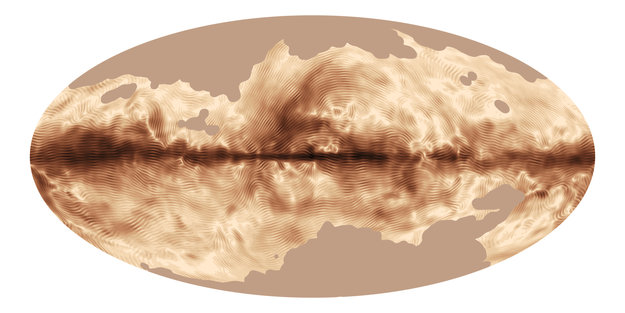
There’s also a press release from the European Space Agency which includes this nice picture:

Milky_Way_s_magnetic_fingerprint_large

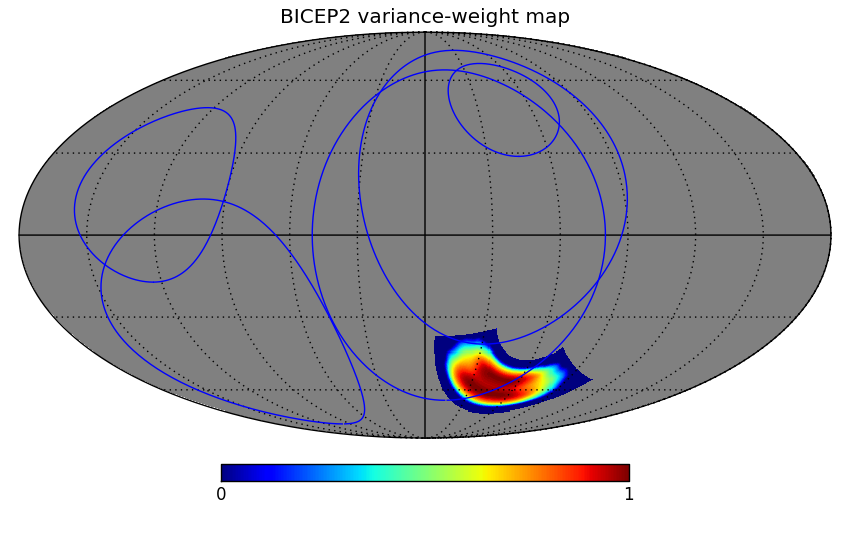
This study is at 353 GHz, compared to the 150 GHz of the BICEP2 measurements. Galactic dust emission increases with frequency so one would expect more of an effect in this Planck map than in BICEP2, but the fact that polarized foreground emission is so strong at these frequencies does give one pause for thought. The Planck data actually cover the whole sky, so the above map has clearly been censored; below you can see the actual region of the sky covered by BICEP2, so there is little or no direct overlap with what’s been released by Planck:

bicep2_loops

We’ll have to wait until later this year to see what’s going on in the masked regions (i.e. far above and below the Galactic Plane, where the dust emission is presumably weaker) and indeed at the 7 other frequencies measured by Planck. It’s all a bit of a tease so far!

Here’s what the press release says about BICEP2

In March 2014, scientists from the BICEP2 collaboration claimed the first detection of such a signal in data collected using a ground-based telescope observing a patch of the sky at a single microwave frequency. Critically, the claim relies on the assumption that foreground polarised emissions are almost negligible in this region.

Later this year, scientists from the Planck collaboration will release data based on Planck’s observations of polarised light covering the entire sky at seven different frequencies. The multiple frequency data should allow astronomers to separate with great confidence any possible foreground contamination from the tenuous primordial polarised signal.

P.S.  It’s gratifying to see the Planck Collaboration have used extragalactic Faraday Rotation measures to probe the Galactic Magnetic field as I suggested on this blog not long ago. The article that first advocated doing this with CMB maps can be found here.


Galactic Loops as Sources of Polarized Emission

Posted in The Universe and Stuff with tags , , , , , on April 8, 2014 by telescoper

Since I seem to have established myself as an arch-sceptic concerning the cosmological interpretation of the the BICEP2 measurement of the polarization of the cosmic microwave background (CMB), I couldn’t resist posting a link to an interesting paper by Liu et al. that has just appeared on the arXiv.

The abstract is:

We investigate possible imprints of galactic foreground structures such as the `radio loops’ in the derived maps of the cosmic microwave background. Surprisingly there is evidence for these not only at radio frequencies through their synchrotron radiation, but also at microwave frequencies where emission by dust dominates. This suggests the mechanism is magnetic dipole radiation from dust grains enriched by metallic iron, or ferrimagnetic molecules. This new foreground we have identified is present at high galactic latitudes, and potentially dominates over the expected B-mode polarisation signal due to primordial gravitational waves from inflation.

The authors argue that foreground emission from our own Galaxy has not been fully subtracted from maps of the cosmic microwave background. This emission could result in significant contamination of the CMB polarization if it is associated with dust grains aligned with the Galaxy’s magnetic field.

I’m grateful to one of the authors of the paper, Philip Mertsch, for sending me this map of the Galactic Loops with the BICEP2 region superimposed on it, demonstrating that there is potential for a contribution…

bicep2_loops


This paper is likely to provoke quite a discussion, so I thought I’d suggest one possible way of testing it, namely by updating the analysis presented by myself and Patrick Dineen in 2003 with new data. Here’s the abstract of our old paper:

We present a diagnostic test of possible Galactic contamination of cosmic microwave background sky maps designed to provide an independent check on the methods used to compile these maps. The method involves a non-parametric measurement of cross-correlation between the Faraday rotation measure (RM) of extragalactic sources and the measured microwave signal at the same angular position. We argue that statistical properties of the observed distribution of rotation measures are consistent with a Galactic origin, an argument reinforced by a direct measurement of cross-correlation between dust, free-free and synchrotron foreground maps and RM values with the strongest correlation being for dust and free-free. We do not find any statistically compelling evidence for correlations between the RM values and the COBE DMR maps at any frequency, so there is no evidence of residual contamination in these CMB maps. On the other hand, there is a statistically significant correlation of RM with the preliminary WMAP individual frequency maps which remains significant in the Tegmark et al. Wiener-filtered map but not in the Internal Linear Combination map produced by the WMAP team.

The idea is that cross-correlating the CMB pattern with Faraday rotation measures should provide an independent diagnostic of the effect of magnetic fields. Our analysis was based on old CMB data, so there’s an interesting project to be done updating it with, e.g., Planck CMB data and a larger set of rotation measures. See the comment below for a reference to more recent work along these lines, but still not including Planck.

Anyway, this all goes to show that there’s one question you can always ask about an astrophysics result: have you considered the possible role of magnetic fields?

BICEP2: Is the Signal Cosmological?

Posted in The Universe and Stuff with tags , , , , , on March 19, 2014 by telescoper

I have a short gap in my schedule today so I thought I would use it to post a short note about the BICEP2 results announced to great excitement on Monday.

There has been a great deal of coverage in the popular media about a “Spectacular Cosmic Discovery” and this is mirrored by excitement at a more technical level about the theoretical implications of the BICEP2 results. Having taken a bit of time out last night to go through the discovery paper, I think I should say that I think all this excitement is very premature. In that respect I agree with the result of my straw poll.

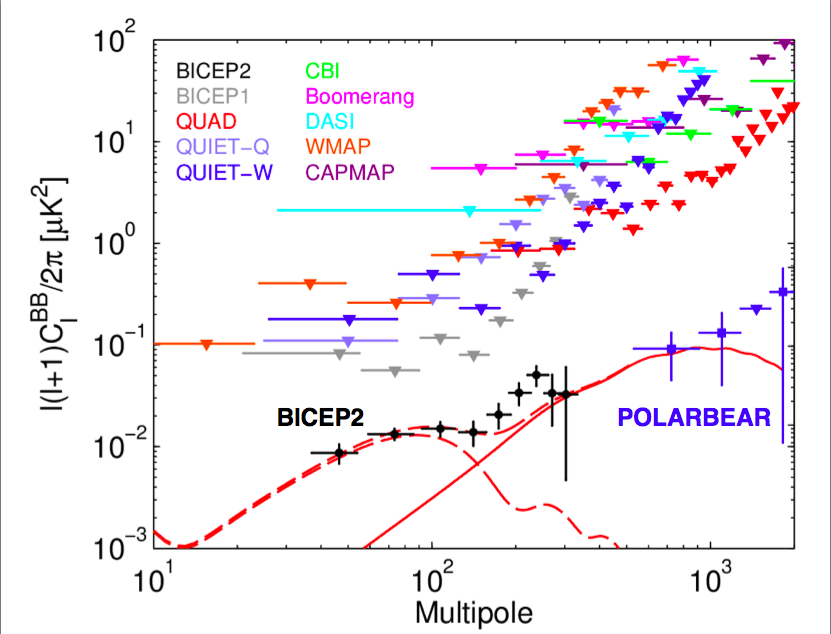
First of all let me make it clear that the BICEP2 experiment is absolutely superb. It was designed and built by top-class scientists and has clearly functioned brilliantly to improve its sensitivity so much that it has gone so far ahead of so many rivals:
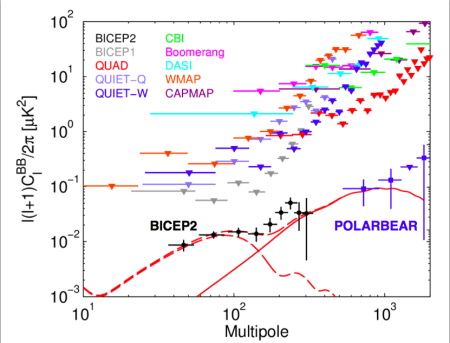
Polarization detections

Notice that the only other detection of the elusive B-mode signal is by POLARBEAR, but that is actually accounted for by gravitational lensing effects rather than being evidence of a primordial gravitational wave contribution.

The B-mode signal is so weak that it is to mind absolutely amazing that an experiment can get anywhere near measuring it. There’s no denying the fact that BICEP2 team have done heroic work.

But – and it’s a big “but” – we have to ask the question “How confident can we be that the signal detected by BICEP2 is, in fact, the imprint of primordial gravitational waves on the cosmic microwave background that cosmologists were hoping for?”

The answer to this question will depend on the individual, but I would say that to convince me the absolute minimum would be a detection of the signal in more than one frequency band. A primordial signal should not vary as a function of frequency, whereas foreground emission (likely to be from dust) would be frequency dependent.

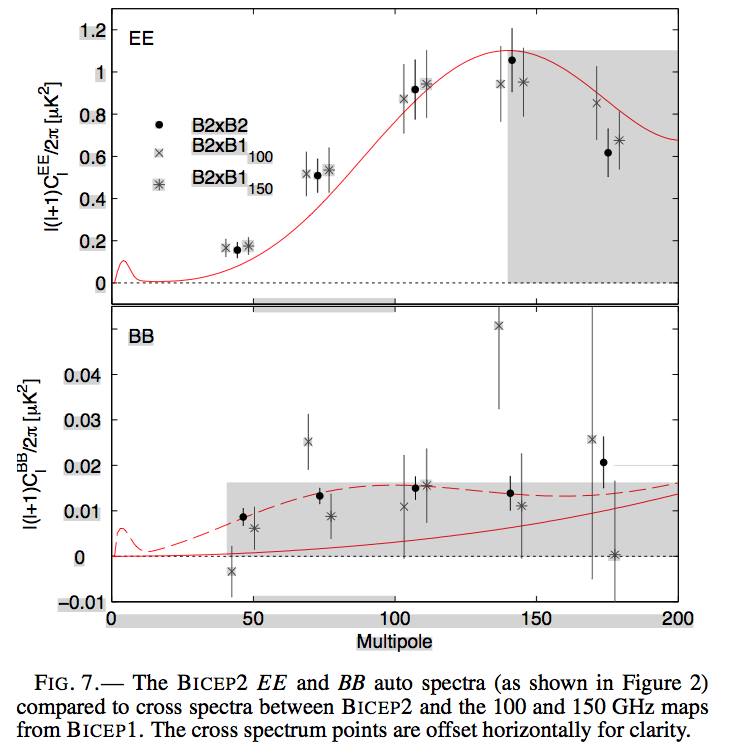
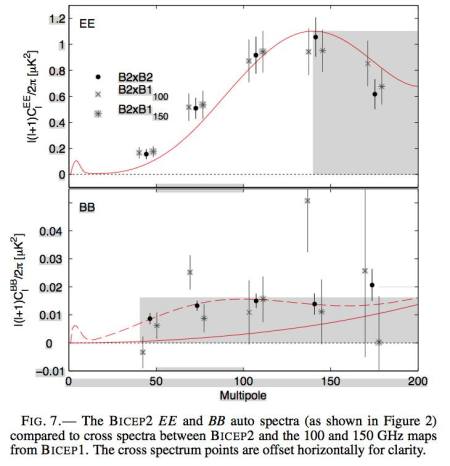
Now BICEP2 only operates at one frequency, 150GHz, so the experiment on its own can’t satisfy this criterion but it could through cross-correlation with the original BICEP1 instrument which worked at 100 GHz and 150 GHz. In the discovery paper we find the

Additionally, cross-correlating BICEP2 against 100GHz maps from the BICEP1 experiment, the excess signal is confirmed with 3sigma significance and its spectral index is found to be consistent with that of the CMB.

Here is the relevant plot, Figure 7 from the paper,
Xcor_BICEP

Well, the correct though the statement in the paper might be,  it is clear from this (rather ratty) cross-correlation that there is actually no firm detection of the B-modes at all at 100GHz. In other words, the 100 GHz BICEP1 data may be consistent with BICEP2 but they are also consistent with zero. (NOTE ADDED: I am ready to rescind this statement when I see a full analysis of these cross-correlations; at face value the scatter looks strange and certainly consistent with a null detection). In any case a positive cross-correlation does not exclude the possibility that the signal in common across the two channels is dust. If we only have a detection at one frequency we have no compelling evidence at all that the signal is cosmological.

When asked on Tuesday about this by Physics World I stated that I wasn’t convinced:

It seems to me though that there’s a significant possibility of some of the polarization signal in E and B [modes] not being cosmological. This is a very interesting result, but I’d prefer to reserve judgement until it is confirmed by other experiments. If it is genuine, then the spectrum is a bit strange and may indicate something added to the normal inflationary recipe.

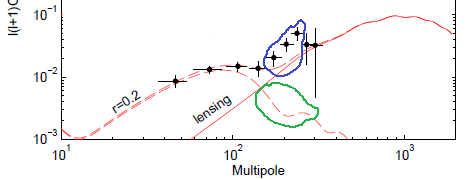
My scepticism was then derived primarily from the distribution of the points around l=200 in the first figure: they look too high compared to the expected gravitational lensing contribution (which seems to have been pinned down by the POLARBEAR measurements to the right of the plot):
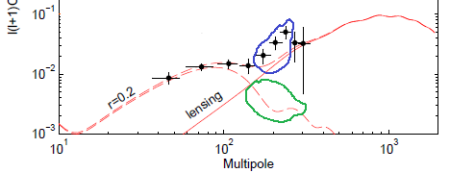
My concern: the three data points circles in blue are all higher than they should be, by about 0.01, which is the same height as the points to their left.  But the prediction of gravitational waves from inflation, circles in green, is that there should be very little contribution here --- which is why these points should lie closer to the solid red "lensing" prediction.  So the model of lensing for the right-hand part of the data + gravitational waves from inflation for the left-hand part of the data does not seem to be a very convincing fit.

I’ve taken this plot from the post I reblogged yesterday. The errors in the measurements ringed in blue are probably correlated so the fact that all three lie well above the red curve may not be as significant as it first seems, but note that the vertical scale is logarithmic. If some sort of systematic error has indeed bumped these points up then the amount of power involved could easily account for all the signal in the points to the left; the fit to the primordial B-mode (red dashed) part of the curve could then be fortuitous.

One possible systematic, apart from foreground contamination by dust, is leakage between E and B modes in the spherical harmonic decomposition. This arises because the spherical harmonic modes are only orthogonal over a complete sphere; BICEP2 does not map the whole sky, so the modes get mixed and separating them becomes extremely messy. Since the E-mode signal is so much larger, the worry is that some of it might leak into the B-mode.

UPDATE: 20/3/2014

I noticed a post on the BICEP2 Facebook Page from Hans Kristian Eriksen pointing another oddity:
PTE

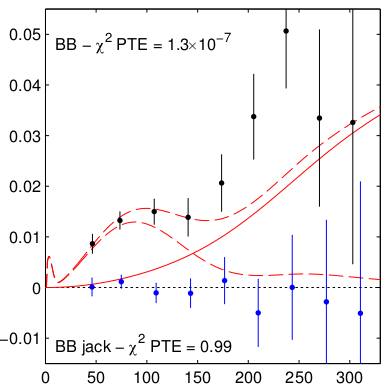
The above plot is one of many showing jackknife estimates relating to various aspects of the polarization signal. What is strange is that all the blue dots lie so close to zero. Statistically speaking this is extremely unlikely and it may suggest that the noise levels have been over-estimated underestimated; roughly one in three data points should be further away than one sigma from zero if sigma is estimated correctly.

Taking all this together I have to say that I stick to the point of view I took when I first saw the results. They are very  interesting, but it is far too earlier to even claim that they are cosmological, let alone to start talking about providing evidence for or against particular models of the early Universe. No doubt I’ll be criticized for trying to put a wet blanket over the whole affair, but this is a measurement of such potential importance that I think we have to set the bar very high indeed when it comes to evidence. If I were running a book on this, I would put it at no better than even money that this is a cosmological signal.

Of course the rush to embrace these results as “definitive proof” of something is a product of human nature and the general level of excitement this amazing experiment has generated. That’s entirely understandable and basically a very good thing. It reminds those of us working in cosmology how lucky we are that we work in a field in which such momentous discoveries do actually happen. This is no doubt why so many budding scientists are drawn into cosmology in the first place. Let’s not forget, however, that there is a thing called the scientific method and often after years of hard work there remain more questions than answers. For the time being, that’s where we are with gravitational waves.

BICEP2DAY

Posted in Astrohype, The Universe and Stuff with tags , , , , on March 17, 2014 by telescoper

Well, it’s official that this afternoon’s announcement of a “major discovery” is going to be from the BICEP team, and it specifically concerns the BICEP2 CMB telescope experiment. I’ve just got back to Sussex (after a weekend in Cardiff) and will be following the events in among other things I have to do before going off to give a lecture at 5pm GMT.

The schedule of events is as follows: there will be a special webcast presenting the first results from the BICEP2 CMB telescope. The webcast will begin with a presentation for scientists 10:45-11:30 EDT, followed by a news conference 12:00-1:00 EDT.

You can join the webcast from the link at http://www.cfa.harvard.edu/news/news_conferences.html

Papers and data products will be available at 10:45 EDT from http://bicepkeck.org/

EDT is four hours behind Greenwich Mean Time so the webcast will begin at 14:45 GMT, i.e. in about half an hour.

In the mean time, for those of you wondering what these BICEPS are all about, here is a useful graphic in which a Harvard astrophysicist demonstrates the possibilities:

biceps

LIVE BLOG:

14:36 The press conference server has gone down. There’s no truth in the rumour that ex-members of the Clover collaboration have sabotaged it.

14:42 There’s a grave danger that this press conference will run into tea time.

14:45 The BICEP2 papers are now live at http://bicepkeck.org/

14:48 Straight to the headline: R=0.2 (+0.07, -0.05) with R=0 rejected at about 7 sigma, if you like things stated in such terms…

14:53 Here’s the crucial graph. Results a bit higher than the expected  signal at l in range 200-300?

Bi7-IpDCEAA7frU

15:06 The news avalanche has started, e.g. here at the BBC, but there is some concern about the shape of the spectrum.

15:10 I’m not getting anything from the press conference, so may have missed important details. It seems to me though that there’s a significant possibility of some of the polarization signal in E and B not being cosmological. This is a very interesting result, but I’d prefer to reserve judgement until it is confirmed by other experiments.

15:35 Despite the press hype there’s still some scepticism among cosmologists arising from the strange-looking shape of the spectrum. I’m not convinced myself. Anyway, I have to sign off now in order to prepare a lecture..

16:20 Back-of-the-envelope time: if the result is correct then the inflationary energy scale is about 2×10¹⁶ GeV. That’s just two orders of magnitude below the Planck scale…

18:19 Returned from my 5pm Theoretical Physics lecture. Couldn’t resist spending 30 minutes talking about BICEP2, though I did tell them it’s not in the examination.

18:25 Main points of controversy:

  1. there seems to be evidence of leakage of temperature into polarization (lines in Fig. 5);
  2. there’s an excess in the B-B spectrum at l~250 shown above;
  3. there’s an excess at low l in the E-E spectrum
  4. there’s a deficit at low l in the cross-correlation with Keck

There may be a connection between 1. and 2.-4. If 2.-4 are real then they may be evidence of something interesting that requires more than a straightforward modification of inflation (such as might include just a running of the spectral index).

18:35 Other controversy: why has this result been announced before the paper has been published or even peer-reviewed?

Some B-Mode Background

Posted in Astrohype, Science Politics, The Universe and Stuff with tags , , , , , , , , , , , on March 15, 2014 by telescoper

Well, in case you hadn’t noticed, the cosmology rumour mill has gone into overdrive this weekend primarily concerning the possibility that an experiment known as BICEP (an acronym formed from Background Imaging of Cosmic Extragalactic Polarization). These rumours have been circulating since it was announced last week that the Harvard-Smithsonian Center for Astrophysics (CfA) will host a press conference  on Monday, March 17th, to announce “a major discovery”. The grapevine is full of possibilities, but it seems fairly clear that the “major discovery” is related to one of the most exciting challenges facing the current generation of cosmologists, namely to locate in the pattern of fluctuations in the cosmic microwave background evidence for the primordial gravitational waves predicted by models of the Universe that involve inflation.

Anyway, I thought I’d add a bit of background on here to help those interested make sense of whatever is announced on Monday evening.

Looking only at the temperature variation across the sky, it is not possible to distinguish between tensor  (gravitational wave) and scalar (density wave) contributions  (both of which are predicted to be excited during the inflationary epoch).  However, scattering of photons off electrons is expected to leave the radiation slightly polarized (at the level of a few percent). This gives us additional information in the form of the  polarization angle at each point on the sky and this extra clue should, in principle, enable us to disentangle the tensor and scalar components.

The polarization signal can be decomposed into two basic types depending on whether the pattern has  odd or even parity, as shown in the nice diagram (from a paper by James Bartlett)

The top row shows the E-mode (which look the same when reflected in a mirror and can be produced by either scalar or tensor modes) and the bottom shows the B-mode (which have a definite handedness that changes when mirror-reflected and which can’t be generated by scalar modes because they can’t have odd parity).

The B-mode is therefore (at least in principle)  a clean diagnostic of the presence of gravitational waves in the early Universe. Unfortunately, however, the B-mode is predicted to be very small, about 100 times smaller than the E-mode, and foreground contamination is likely to be a very serious issue for any experiment trying to detect it. To be convinced that what is being measured is cosmological rather than some sort of contaminant one would have to see the signal repeated across a range of different wavelengths.

Moreover, primordial gravitational waves are not the only way that a cosmological B-mode signal could be generated. Less than a year ago, a paper appeared on the arXiv by Hanson et al. from SPTpol, an experiment which aims to measure the polarization of the cosmic microwave background using the South Pole Telescope. The principal result of this paper was to demonstrate a convincing detection of the so-called “B-mode” of polarization from gravitational lensing of the microwave background photons as they pass through the gravitational field generated by the matter distributed through the Universe. Gravitational lensing can produce the same kind of shearing effect that gravitational waves generate, so it’s important to separate this “line-of-sight” effect from truly primordial signals.

So we wait with bated breath to see exactly what is announced on Monday. In particular, it will be extremely interesting to see whether the new results from BICEP are consistent with the recently published conclusions from Planck. Although Planck has not yet released the analysis of its own polarization data, analysis of the temperature fluctuations yields a (somewhat model-dependent) conclusion that the ratio of tensor to scalar contributions to the CMB pattern is no more than about 11 per cent, usually phrased in the terms, i.e. R<0.11. A quick (and possibly inaccurate) back-of-the-envelope calculation using the published expected sensitivity of BICEP suggests that if they have made a detection it might be above that limit. That would be really interesting because it might indicate that something is going on which is not consistent with the standard framework. The limits on R arising from temperature studies alone assume that both scalar and tensor perturbations are generated by a relatively simple inflationary model belonging to a class in which there is a direct relationship between the relative amplitudes of the two modes (and the shape of the perturbation spectrum). So far everything we have learned from CMB analysis is broadly consistent with this simplifying assumption being correct. Are we about to see evidence that the early Universe was more complex than we thought? We'll just have to wait and see…

Incidentally, once upon a time there was a British experiment called Clover (involving the Universities of  Cardiff, Oxford, Cambridge and Manchester) which was designed to detect the primordial B-mode signal from its vantage point in Chile. I won’t describe it in more detail here, for reasons which will become obvious.

The chance to get involved in a high-profile cosmological experiment was one of the reasons I moved to Cardiff in 2007, and I was looking forward to seeing the data arriving for analysis. Although I’m primarily a theorist, I have some experience in advanced statistical methods that might have been useful in analysing the output.  Unfortunately, however, none of that actually happened. Because of its budget crisis, and despite the fact that it had spent a large amount (£4.5M) on it already,  STFC decided to withdraw the funding needed to complete it (£2.5M)  and cancelled the Clover experiment. Had it gone ahead it would probably have had two years’ data in the bag by now.

It wasn’t clear that Clover would have won the race to detect the B-mode cosmological polarization, but it’s a real shame it was withdrawn as a non-starter. C’est la vie.

Fly through of the GAMA Galaxy Catalogue

Posted in The Universe and Stuff with tags , , , , , , , , on March 13, 2014 by telescoper

When I’m struggling to find time to do a proper blog post I’m always grateful that I work in cosmology because nearly every day there’s something interest to post. I’m indebted to Andy Lawrence for bring the following wonderful video to my attention. It comes from the Galaxy And Mass Assembly Survey (or GAMA Survey for short), a spectroscopic survey of around 300,000 galaxies in a region of the sky comprising about 300 square degrees;  the measured redshifts of the galaxies enable their three-dimensional positions to be plotted. The video shows the shape of the survey volume before showing what the distribution of galaxies in space looks like as you fly through. Note that the galaxy distances are to scale, but the image of each galaxy is magnified to make it easier to see; the real Universe is quite a lot emptier than this in that the separation between galaxies is larger relative to their size.

Is Inflation Testable?

Posted in The Universe and Stuff with tags , , , , , , , , on March 4, 2014 by telescoper

It seems the little poll about cosmic inflation I posted last week with humorous intent has ruffled a few feathers, but at least it gives me the excuse to wheel out an updated and edited version of an old piece I wrote on the subject.

Just over thirty  years ago a young physicist came up with what seemed at first to be an absurd idea: that, for a brief moment in the very distant past, just after the Big Bang, something weird happened to gravity that made it push rather than pull.  During this time the Universe went through an ultra-short episode of ultra-fast expansion. The physicist in question, Alan Guth, couldn’t prove that this “inflation” had happened nor could he suggest a compelling physical reason why it should, but the idea seemed nevertheless to solve several major problems in cosmology.

Three decades later, Guth is a professor at MIT and inflation is now well established as an essential component of the standard model of cosmology. But should it be? After all, we still don’t know what caused it and there is little direct evidence that it actually took place. Data from probes of the cosmic microwave background seem to be consistent with the idea that inflation happened, but how confident can we be that it is really a part of the Universe’s history?

According to the Big Bang theory, the Universe was born in a dense fireball which has been expanding and cooling for about 14 billion years. The basic elements of this theory have been in place for over eighty years, but it is only in the last decade or so that a detailed model has been constructed which fits most of the available observations with reasonable precision. The problem is that the Big Bang model is seriously incomplete. The fact that we do not understand the nature of the dark matter and dark energy that appears to fill the Universe is a serious shortcoming. Even worse, we have no way at all of describing the very beginning of the Universe, which appears in the equations used by cosmologists as a “singularity”- a point of infinite density that defies any sensible theoretical calculation. We have no way to define a priori the initial conditions that determine the subsequent evolution of the Big Bang, so we have to try to infer from observations, rather than deduce by theory, the parameters that govern it.

The establishment of the new standard model (known in the trade as the “concordance” cosmology) is now allowing astrophysicists to turn back the clock in order to understand the very early stages of the Universe’s history and hopefully to understand the answer to the ultimate question of what happened at the Big Bang itself and thus answer the question “How did the Universe Begin?”

Paradoxically, it is observations on the largest scales accessible to technology that provide the best clues about the earliest stages of cosmic evolution. In effect, the Universe acts like a microscope: primordial structures smaller than atoms are blown up to astronomical scales by the expansion of the Universe. This also allows particle physicists to use cosmological observations to probe structures too small to be resolved in laboratory experiments.

Our ability to reconstruct the history of our Universe, or at least to attempt this feat, depends on the fact that light travels with a finite speed. The further away we see a light source, the further back in time its light was emitted. We can now observe light from stars in distant galaxies emitted when the Universe was less than one-sixth of its current size. In fact we can see even further back than this using microwave radiation rather than optical light. Our Universe is bathed in a faint glow of microwaves produced when it was about one-thousandth of its current size and had a temperature of thousands of degrees, rather than the chilly three degrees above absolute zero that characterizes the present-day Universe. The existence of this cosmic background radiation is one of the key pieces of evidence in favour of the Big Bang model; it was first detected in 1964 by Arno Penzias and Robert Wilson who subsequently won the Nobel Prize for their discovery.

The process by which the standard cosmological model was assembled has been a gradual one, but the latest step was taken by the European Space Agency’s Planck mission . I’ve blogged about the implications of the Planck results for cosmic inflation in more technical detail here. In a nutshell, for several years this satellite mapped  the properties of the cosmic microwave background and how it varies across the sky. Small variations in the temperature of the sky result from sound waves excited in the hot plasma of the primordial fireball. These have characteristic properties that allow us to probe the early Universe in much the same way that solar astronomers use observations of the surface of the Sun to understand its inner structure,  a technique known as helioseismology. The detection of the primaeval sound waves is one of the triumphs of modern cosmology, not least because their amplitude tells us precisely how loud the Big Bang really was.

The pattern of fluctuations in the cosmic radiation also allows us to probe one of the exciting predictions of Einstein’s general theory of relativity: that space should be curved by the presence of matter or energy. Measurements from Planck and its predecessor WMAP reveal that our Universe is very special: it has very little curvature, and so has a very finely balanced energy budget: the positive energy of the expansion almost exactly cancels the negative energy relating of gravitational attraction. The Universe is (very nearly) flat.

The observed geometry of the Universe provides a strong piece of evidence that there is an mysterious and overwhelming preponderance of dark stuff in our Universe. We can’t see this dark matter and dark energy directly, but we know it must be there because we know the overall budget is balanced. If only economics were as simple as physics.

Computer Simulation of the Cosmic Web

The concordance cosmology has been constructed not only from observations of the cosmic microwave background, but also using hints supplied by observations of distant supernovae and by the so-called “cosmic web” – the pattern seen in the large-scale distribution of galaxies which appears to match the properties calculated from computer simulations like the one shown above, courtesy of Volker Springel. The picture that has emerged to account for these disparate clues is consistent with the idea that the Universe is dominated by a blend of dark energy and dark matter, and in which the early stages of cosmic evolution involved an episode of accelerated expansion called inflation.

A quarter of a century ago, our understanding of the state of the Universe was much less precise than today’s concordance cosmology. In those days it was a domain in which theoretical speculation dominated over measurement and observation. Available technology simply wasn’t up to the task of performing large-scale galaxy surveys or detecting slight ripples in the cosmic microwave background. The lack of stringent experimental constraints made cosmology a theorists’ paradise in which many imaginative and esoteric ideas blossomed. Not all of these survived to be included in the concordance model, but inflation proved to be one of the hardiest (and indeed most beautiful) flowers in the cosmological garden.

Although some of the concepts involved had been formulated in the 1970s by Alexei Starobinsky, it was Alan Guth who in 1981 produced the paper in which the inflationary Universe picture first crystallized. At this time cosmologists didn’t know that the Universe was as flat as we now think it to be, but it was still a puzzle to understand why it was even anywhere near flat. There was no particular reason why the Universe should not be extremely curved. After all, the great theoretical breakthrough of Einstein’s general theory of relativity was the realization that space could be curved. Wasn’t it a bit strange that after all the effort needed to establish the connection between energy and curvature, our Universe decided to be flat? Of all the possible initial conditions for the Universe, isn’t this very improbable? As well as being nearly flat, our Universe is also astonishingly smooth. Although it contains galaxies that cluster into immense chains over a hundred million light years long, on scales of billions of light years it is almost featureless. This also seems surprising. Why is the celestial tablecloth so immaculately ironed?

Guth grappled with these questions and realized that they could be resolved rather elegantly if only the force of gravity could be persuaded to change its sign for a very short time just after the Big Bang. If gravity could push rather than pull, then the expansion of the Universe could speed up rather than slow down. Then the Universe could inflate by an enormous factor (1060 or more) in next to no time and, even if it were initially curved and wrinkled, all memory of this messy starting configuration would be lost. Our present-day Universe would be very flat and very smooth no matter how it had started out.

But how could this bizarre period of anti-gravity be realized? Guth hit upon a simple physical mechanism by which inflation might just work in practice. It relied on the fact that in the extreme conditions pertaining just after the Big Bang, matter does not behave according to the classical laws describing gases and liquids but instead must be described by quantum field theory. The simplest type of quantum field is called a scalar field; such objects are associated with particles that have no spin. Modern particle theory involves many scalar fields which are not observed in low-energy interactions, but which may well dominate affairs at the extreme energies of the primordial fireball.

Classical fluids can undergo what is called a phase transition if they are heated or cooled. Water for example, exists in the form of steam at high temperature but it condenses into a liquid as it cools. A similar thing happens with scalar fields: their configuration is expected to change as the Universe expands and cools. Phase transitions do not happen instantaneously, however, and sometimes the substance involved gets trapped in an uncomfortable state in between where it was and where it wants to be. Guth realized that if a scalar field got stuck in such a “false” state, energy – in a form known as vacuum energy – could become available to drive the Universe into accelerated expansion.We don’t know which scalar field of the many that may exist theoretically is responsible for generating inflation, but whatever it is, it is now dubbed the inflaton.

This mechanism is an echo of a much earlier idea introduced to the world of cosmology by Albert Einstein in 1916. He didn’t use the term vacuum energy; he called it a cosmological constant. He also didn’t imagine that it arose from quantum fields but considered it to be a modification of the law of gravity. Nevertheless, Einstein’s cosmological constant idea was incorporated by Willem de Sitter into a theoretical model of an accelerating Universe. This is essentially the same mathematics that is used in modern inflationary cosmology.  The connection between scalar fields and the cosmological constant may also eventually explain why our Universe seems to be accelerating now, but that would require a scalar field with a much lower effective energy scale than that required to drive inflation. Perhaps dark energy is some kind of shadow of the inflaton

Guth wasn’t the sole creator of inflation. Andy Albrecht and Paul Steinhardt, Andrei Linde, Alexei Starobinsky, and many others, produced different and, in some cases, more compelling variations on the basic theme. It was almost as if it was an idea whose time had come. Suddenly inflation was an indispensable part of cosmological theory. Literally hundreds of versions of it appeared in the leading scientific journals: old inflation, new inflation, chaotic inflation, extended inflation, and so on. Out of this activity came the realization that a phase transition as such wasn’t really necessary, all that mattered was that the field should find itself in a configuration where the vacuum energy dominated. It was also realized that other theories not involving scalar fields could behave as if they did. Modified gravity theories or theories with extra space-time dimensions provide ways of mimicking scalar fields with rather different physics. And if inflation could work with one scalar field, why not have inflation with two or more? The only problem was that there wasn’t a shred of evidence that inflation had actually happened.

This episode provides a fascinating glimpse into the historical and sociological development of cosmology in the eighties and nineties. Inflation is undoubtedly a beautiful idea. But the problems it solves were theoretical problems, not observational ones. For example, the apparent fine-tuning of the flatness of the Universe can be traced back to the absence of a theory of initial conditions for the Universe. Inflation turns an initially curved universe into a flat one, but the fact that the Universe appears to be flat doesn’t prove that inflation happened. There are initial conditions that lead to present-day flatness even without the intervention of an inflationary epoch. One might argue that these are special and therefore “improbable”, and consequently that it is more probable that inflation happened than that it didn’t. But on the other hand, without a proper theory of the initial conditions, how can we say which are more probable? Based on this kind of argument alone, we would probably never really know whether we live in an inflationary Universe or not.

But there is another thread in the story of inflation that makes it much more compelling as a scientific theory because it makes direct contact with observations. Although it was not the original motivation for the idea, Guth and others realized very early on that if a scalar field were responsible for inflation then it should be governed by the usual rules governing quantum fields. One of the things that quantum physics tells us is that nothing evolves entirely smoothly. Heisenberg’s famous Uncertainty Principle imposes a degree of unpredictability of the behaviour of the inflaton. The most important ramification of this is that although inflation smooths away any primordial wrinkles in the fabric of space-time, in the process it lays down others of its own. The inflationary wrinkles are really ripples, and are caused by wave-like fluctuations in the density of matter travelling through the Universe like sound waves travelling through air. Without these fluctuations the cosmos would be smooth and featureless, containing no variations in density or pressure and therefore no sound waves. Even if it began in a fireball, such a Universe would be silent. Inflation puts the Bang in Big Bang.

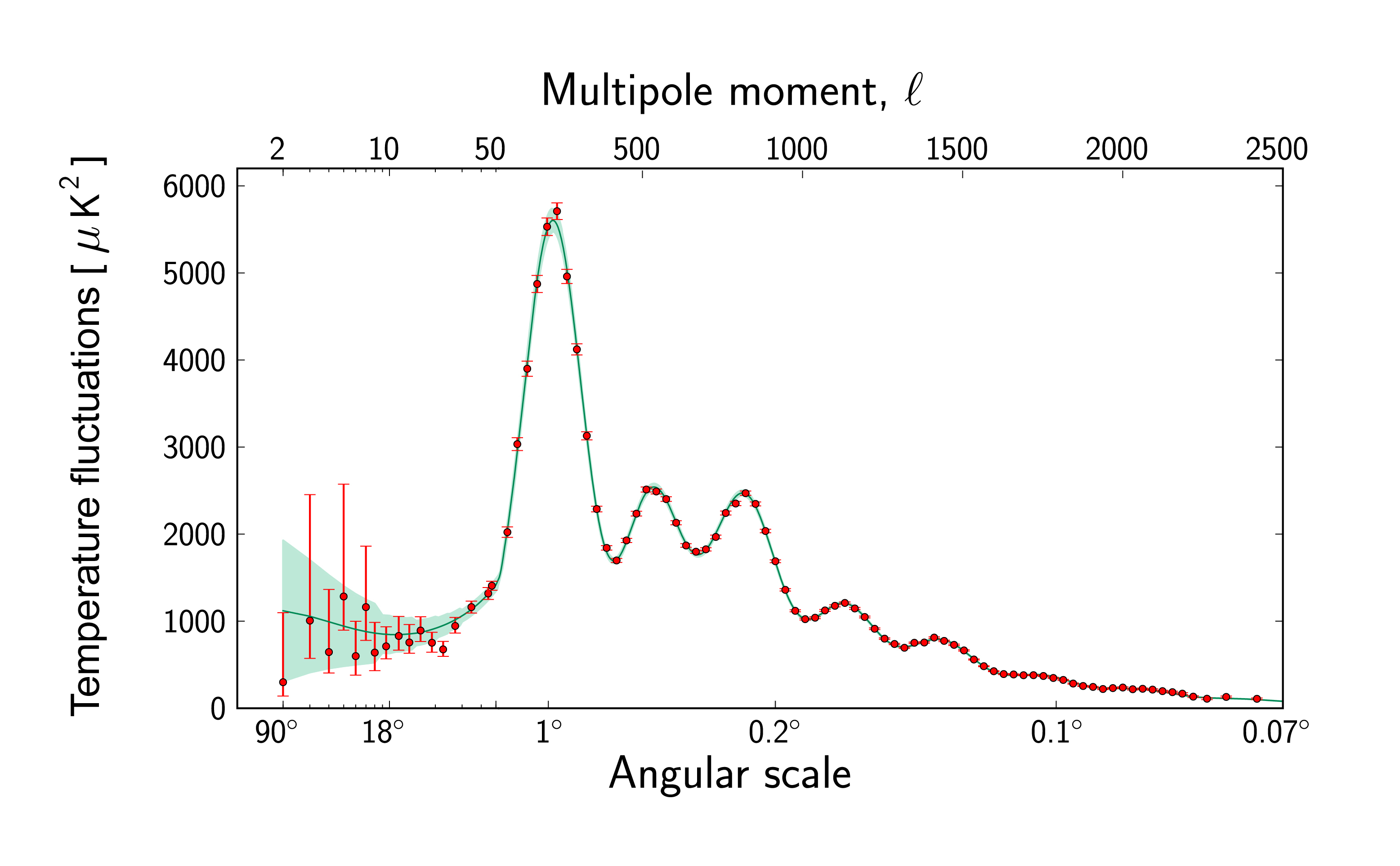
The acoustic oscillations generated by inflation have a broad spectrum (they comprise oscillations with a wide range of wavelengths), they are of small amplitude (about one hundred thousandth of the background); they are spatially random and have Gaussian statistics (like waves on the surface of the sea; this is the most disordered state); they are adiabatic (matter and radiation fluctuate together) and they are formed coherently.  This last point is perhaps the most important. Because inflation happens so rapidly all of the acoustic “modes” are excited at the same time. Hitting a metal pipe with a hammer generates a wide range of sound frequencies, but all the different modes of the start their oscillations at the same time. The result is not just random noise but something moderately tuneful. The Big Bang wasn’t exactly melodic, but there is a discernible relic of the coherent nature of the sound waves in the pattern of cosmic microwave temperature fluctuations seen in the Cosmic Microwave Background. The acoustic peaks seen in the  Planck  angular spectrum  provide compelling evidence that whatever generated the pattern did so coherently.

Planck_power_spectrum_orig
There are very few alternative theories on the table that are capable of reproducing these results, but does this mean that inflation really happened? Do they “prove” inflation is correct? More generally, is the idea of inflation even testable?

So did inflation really happen? Does Planck prove it? Will we ever know?

It is difficult to talk sensibly about scientific proof of phenomena that are so far removed from everyday experience. At what level can we prove anything in astronomy, even on the relatively small scale of the Solar System? We all accept that the Earth goes around the Sun, but do we really even know for sure that the Universe is expanding? I would say that the latter hypothesis has survived so many tests and is consistent with so many other aspects of cosmology that it has become, for pragmatic reasons, an indispensable part our world view. I would hesitate, though, to say that it was proven beyond all reasonable doubt. The same goes for inflation. It is a beautiful idea that fits snugly within the standard cosmological and binds many parts of it together. But that doesn’t necessarily make it true. Many theories are beautiful, but that is not sufficient to prove them right.

When generating theoretical ideas scientists should be fearlessly radical, but when it comes to interpreting evidence we should all be unflinchingly conservative. The Planck measurements have also provided a tantalizing glimpse into the future of cosmology, and yet more stringent tests of the standard framework that currently underpins it. Primordial fluctuations produce not only a pattern of temperature variations over the sky, but also a corresponding pattern of polarization. This is fiendishly difficult to measure, partly because it is such a weak signal (only a few percent of the temperature signal) and partly because the primordial microwaves are heavily polluted by polarized radiation from our own Galaxy. Polarization data from Planck are yet to be released; the fiendish data analysis challenge involved is the reason for the delay.  But there is a crucial target that justifies these endeavours. Inflation does not just produce acoustic waves, it also generates different modes of fluctuation, called gravitational waves, that involve twisting deformations of space-time. Inflationary models connect the properties of acoustic and gravitational fluctuations so if the latter can be detected the implications for the theory are profound. Gravitational waves produce very particular form of polarization pattern (called the B-mode) which can’t be generated by acoustic waves so this seems a promising way to test inflation. Unfortunately the B-mode signal is expected to be very weak and the experience of WMAP suggests it might be swamped by foregrounds. But it is definitely worth a go, because it would add considerably to the evidence in favour of inflation as an element of physical reality.

But would even detection of primordial gravitational waves really test inflation? Not really. The problem with inflation is that it is a name given to a very general idea, and there are many (perhaps infinitely many) different ways of implementing the details, so one can devise versions of the inflationary scenario that produce a wide range of outcomes. It is therefore unlikely that there will be a magic bullet that will kill inflation dead. What is more likely is a gradual process of reducing the theoretical slack as much as possible with observational data, such as is happening in particle physics. For example, we have not yet identified the inflaton field (nor indeed any reasonable candidate for it) but we are gradually improving constraints on the allowed parameter space. Progress in this mode of science is evolutionary not revolutionary.

Many critics of inflation argue that it is not a scientific theory because it is not falsifiable. I don’t think falsifiability is a useful concept in this context; see my many posts relating to Karl Popper. Testability is a more appropriate criterion. What matters is that we have a systematic way of deciding which of a set of competing models is the best when it comes to confrontation with data. In the case of inflation we simply don’t have a compelling model to test it against. For the time being therefore, like it or not, cosmic inflation is clearly the best model we have. Maybe someday a worthy challenger will enter the arena, but this has not happened yet.

Most working cosmologists are as aware of the difficulty of testing inflation as they are of its elegance. There are also those  who talk as if inflation were an absolute truth, and those who assert that it is not a proper scientific theory (because it isn’t falsifiable). I can’t agree with either of these factions. The truth is that we don’t know how the Universe really began; we just work on the best ideas available and try to reduce our level of ignorance in any way we can. We can hardly expect  the secrets of the Universe to be so easily accessible to our little monkey brains.

Inflationary Opinion Poll

Posted in The Universe and Stuff with tags , , , , , on February 28, 2014 by telescoper

Compare and contrast this abstract of a paper on the arXiv from Guth et al. from last year:

Models of cosmic inflation posit an early phase of accelerated expansion of the universe, driven by the dynamics of one or more scalar fields in curved spacetime. Though detailed assumptions about fields and couplings vary across models, inflation makes specific, quantitative predictions for several observable quantities, such as the flatness parameter (Ωk=1−Ω) and the spectral tilt of primordial curvature perturbations (ns−1=dlnPR/dlnk), among others—predictions that match the latest observations from the Planck satellite to very good precision. In the light of data from Planck  as well as recent theoretical developments in the study of eternal inflation and the multiverse, we address recent criticisms of inflation by Ijjas, Steinhardt, and Loeb. We argue that their conclusions rest on several problematic assumptions, and we conclude that cosmic inflation is on a stronger footing than ever before.

and this one, just out,  by Ijjas et al.:

Classic inflation, the theory described in textbooks, is based on the idea that, beginning from typical initial conditions and assuming a simple inflaton potential with a minimum of fine-tuning, inflation can create exponentially large volumes of space that are generically homogeneous, isotropic and flat, with nearly scale-invariant spectra of density and gravitational wave fluctuations that are adiabatic, Gaussian and have generic predictable properties. In a recent paper, we showed that, in addition to having certain conceptual problems known for decades, classic inflation is for the first time also disfavored by data, specifically the most recent data from WMAP, ACT and Planck2013. Guth, Kaiser and Nomura and Linde have each recently published critiques of our paper, but, as made clear here, we all agree about one thing: the problematic state of classic inflation. Instead, they describe an alternative inflationary paradigm that revises the assumptions and goals of inflation, and perhaps of science generally.

I’m not sure how much of a “schism” (to use Ijjas et al.’s word) there actually is, but it seems like an appropriate subject for a totally unscientific Friday lunchtime opinion poll:

The super-compressible Cosmic Microwave Background

Posted in The Universe and Stuff with tags , , on February 3, 2014 by telescoper

I just came across this blog post, one of a series on cosmology from the African Institute for Mathematical Sciences, which is in Muizenberg near Cape Town, South Africa. I thought I’d reblog it, partly because it’s on a topic I often discuss in talks and partly because I wanted to draw your attention the site and the other interesting posts on it.

In this article Bruce Bassett explains just how much of the information we get from measurements of the Cosmic Microwave Background can be squeezed into precise estimates of just a few parameters. The only point I would add is that this does assume at the outset that all relevant information is contained within the angular power spectrum; that’s not necessarily the case, but we don’t have any compelling evidence that it’s a wrong assumption for the CMB; see here for a previous discussion of this.

Bruce Bassett's avatarCosmology at AIMS

One of the most striking features about the Cosmic Microwave Background (CMB) is that it is incredibly compressible from an information content point of view. The Planck satellite produced maps with of order a billion pixels whose information could be compressed almost perfectly into a power spectrum of order one thousand real numbers.

This already is a massive compression. But in addition, most of this information can be compressed further into just six of the parameters of the standard model, yielding a total compression of about one billion to one. This is both remarkable and annoying because we want to be surprised and find things that we can’t explain. And if there are things we can’t explain we want to have clear signals data about them, not just vague hints of their existence.

Anyway, to illustrate just how efficient the compression is, I took the binned WMAP 9 TT power spectrum…

View original post 520 more words