Archive for Cosmology

First Light from Planck!

Posted in The Universe and Stuff with tags , , , on September 17, 2009 by telescoper

Credit to Andrew Jaffe for alerting me to the fact that ESA’s first press release concerning Planck has now been, well, released…

I last blogged about Planck when it had reached its orbit around L2 and cooled down to its working temperature of 100 milliKelvin. Over the ensuing weeks it has been tested and calibrated, prodded and poked (electronically of course) and generally tuned up. More recently it has completed a “mini-survey” to check that it’s all working as planned.

The way Planck scans means that it takes about six months to cover the whole sky, which is much longer than the two-week period allowed for the mini-survey. This explains the fact that a relatively narrow slice of the celestial sphere has been mapped. However, you can see the foreground emission from the Galactic plane quite clearly. Here is the region shown in the box split into the nine separate frequency channels that Planck observes:

The High Frequency Instrument (HFI) is more sensitive to dust, while the Low Frequency Instrument (LFI) detects more radio emission. It all seems to be working as expected!

And finally here’s a blow up of the smaller square above the Galactic plane shown as seen by  LFI and HFI:

This region is much less prone to foreground emission. The fact that similar structures are seen in the two completely independent receivers shows that the structure is not just instrument noise. In other words, Planck is seeing the cosmic microwave background!

Now Planck will carry out its full survey, scanning the sky for another year or so. There will then be an intense period of data analysis for about another year after which the key science results will be published. Exciting times.

Lessening Anomalies

Posted in Cosmic Anomalies, The Universe and Stuff with tags , , , , , on September 15, 2009 by telescoper

An interesting paper caught my eye on today’s ArXiv and I thought I’d post something here because it relates to an ongoing theme on this blog about the possibility that there might be anomalies in the observed pattern of temperature fluctuations in the cosmic microwave background (CMB). See my other posts here, here, here, here and here for related discussions.

One of the authors of the new paper, John Peacock, is an occasional commenter on this blog. He was also the Chief Inquisitor at my PhD (or rather DPhil) examination, which took place 21 years ago. The four-and-a-half hours of grilling I went through that afternoon reduced me to a gibbering wreck but the examiners obviously felt sorry for me and let me pass anyway. I’m not one to hold a grudge so I’ll resist the temptation to be churlish towards my erstwhile tormentor.

The most recent paper is about the possible  contribution of  the integrated Sachs-Wolfe (ISW) effect to these anomalies. The ISW mechanism generates temperature variations in the CMB because photons travel along a line of sight through a time-varying gravitational potential between the last-scattering surface and the observer. The integrated effect is zero if the potential does not evolve because the energy shift falling into a well exactly balances that involved in climbing out of one. If in transit the well gets a bit deeper, however, there is a net contribution.

The specific thing about the ISW effect that makes it measurable is that the temperature variations it induces should correlate with the pattern of structure in the galaxy distribution, as it is these that generate the potential fluctuations through which CMB photons travel. Francis & Peacock try to assess the ISW contribution using data from the 2MASS all-sky survey of galaxies. This in itself contains important cosmological clues but in the context of this particular question it is a nuisance, like any other foreground contamination, so they subtract it off the maps obtained from the Wilkinson Microwave Anisotropy Probe (WMAP) in an attempt to get a cleaner map of the primordial CMB sky.

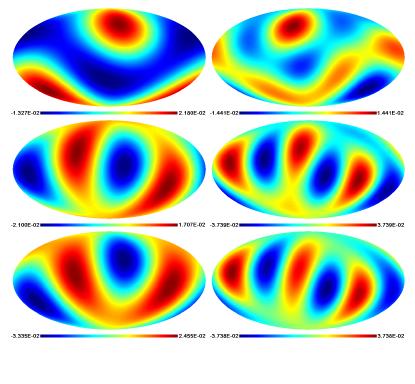
The results are shown in the picture below which presents  the lowest order spherical harmonic modes, the quadrupole (left) and octopole (right) for the  ISW component (top) , WMAP data (middle) and at the bottom we have the cleaned CMB sky (i.e. the middle minus the top). The ISW subtraction doesn’t make a huge difference to the visual appearance of the CMB maps but it is enough to substantially reduce to the statistical significance of at least some of the reported anomalies I mentioned above. This reinforces how careful we have to be in analysing the data before jumping to cosmological conclusions.

peacock

There should also be a further contribution from fluctuations beyond the depth of the 2MASS survey (about 0.3 in redshift).  The actual ISW effect could therefore  be significantly larger than this estimate.

Back Early…

Posted in The Universe and Stuff with tags , , , , , on September 11, 2009 by telescoper

As a very quick postscript to my previous post about the amazing performance of Hubble’s spanking new camera, let me just draw attention to a fresh paper on the ArXiv by Rychard Bouwens and collaborators, which discusses the detection of galaxies with redshifts around 8 in the Hubble Ultra Deep Field (shown below in an earlier image) using WFC3/IR observations that reveal galaxies fainter than the previous detection limits.

Amazing. I remember the days when a redshift z=0.5 was a big deal!

To put this in context and to give some idea of its importance, remember that the redshift z is defined in such a way that 1+z is the factor by which the wavelength of light is stretched out by the expansion of the Universe. Thus, a photon from a galaxy at redshift 8 started out on its journey towards us (or, rather, the Hubble Space Telescope) when the Universe was compressed in all directions relative to its present size by a factor of 9. The average density of stuff then was a factor 93=729 larger, so the Universe was a much more crowded place then compared to what it’s like now.

Translating the redshift into a time is trickier because it requires us to know how the expansion rate of the Universe varies with cosmic epoch. The requires solving the equations of a cosmological model or, more realistically for a Friday afternoon, plugging the numbers into Ned Wright’s famous cosmology calculator.

Using the best-estimate parameters for the current concordance cosmology reveals that at redshift 8, the Universe was only about 0.65 billion years old (i.e. light from the distant galaxies seen by HST set out only 650 million years after the Big Bang). Since the current age of the Universe is about 13.7 billion years (according to the same model), this means that the light Hubble detected set out on its journey towards us an astonishing 13 billion years ago.

More importantly for theories of galaxy formation and evolution, this means that at least some galaxies must have formed very early on, relatively speaking, in the first 5% of the time the Universe has been around for until now.

These observations are by no means certain as the redshifts have been determined only approximately using photometric techniques rather than the more accurate spectroscopic methods, but if they’re correct they could be extremely important.

At the very least they provide even stronger motivation for getting on with the next-generation space telescope, JWST.

Atlantes

Posted in Science Politics, The Universe and Stuff with tags , , , , , , on September 10, 2009 by telescoper

I’ve just noticed a  post on another blog about the  meeting of the Herschel ATLAS consortium that’s  going on in Cardiff at the moment, so I thought I’d do a quickie here too. Actually I’ve only just been accepted into the Consortium so quite a lot of the goings-on are quite new to me.

The Herschel ATLAS (or H-ATLAS for short) is the largest open-time key project involving Herschel. It has been awarded 600 hours of observing time  to survey 550 square degrees of sky in 5 wavelenth bands: 110, 170, 250, 350, & 500 microns. It is hoped to detect approximately 250,000 galaxies,  most of them in the nearby Universe, but some will undoubtedly turn out to be very distant, with redshifts of 3 to 4; these are likely to be very interesting for  studies of galaxy evolution.

Herschel is currently in its performance verification (PV) phase, following which there will be a period of science validation (SV). During the latter the ATLAS team will have access to some observational data to have a quick look to see that it’s  behaving as anticipated. It is planned to publish a special issue of the journal Astronomy & Astrophysics next year that will contain key results from the SV phase, although in the case of ATLAS many of these will probably be quite preliminary because only a small part of the survey area will be sampled during the SV time.

Herschel seems to be doing fine, with the possible exception of the HIFI instrument which is currently switched off owing to a fault in its power supply. There is a backup, but the ESA boffins don’t want to switch it back on and risk further complications until they know why it failed in the first place. The problem with HIFI has led to some rejigging of the schedule for calibrating and testing the other two instruments (SPIRE and PACS) but both of these are otherwise doing well.

The data for H-ATLAS proper hasn’t started arriving yet so the meeting here in Cardiff was intended to sort out the preparations, plan who’s going to do what, and sort out some organisational issues. With well over a hundred members, this project has to think seriously about quite a lot of administrative and logistical matters.

One of the things that struck me as particular difficult is the issue of authorship of science papers. In observational astronomy and cosmology we’re now getting used to the situation that has prevailed in experimental particle physics for some time, namely that even short papers have author lists running into the hundreds. Theorists like me usually work in teams too, but our author lists are, generally speaking, much shorter. In fact I don’t have any publications  yet with more than six or seven authors; mine are often just by me and a PhD student or postdoc.

In a big consortium, the big issue is not so much who to include, but how to give appropriate credit to the different levels of contribution. Those senior scientists who organized and managed the survey are clearly key to its success, but so also are those who work at the coalface and are probably much more junior. In between there are individuals who supply bits and pieces of specialist software or extra comparison data. Nobody can pretend that everyone in a list of 100 authors has made an identical contribution, but how can you measure the differences and how can you indicate them on a publication? Or  shouldn’t you try?

Some suggest that author lists should always be alphabetical, which is fine if you’re “Aarseth” but not if you’re “Zel’dovich”. This policy would, however, benefit “al”, a prolific collaborator who never seems to make it as first author..

When astronomers write grant applications for STFC one of the pieces of information they have to include is a table summarising their publication statistics. The total number of papers written has  to be given, as well as the number in which the applicant  is  the first author on the list,  the implicit assumption being that first authors did more work than the others or that first authors were “leading” the work in some sense.

Since I have a permanent job and  students and postdocs don’t, I always make junior collaborators  first author by default and only vary that policy if there is a specific reason not to. In most cases they have done the lion’s share of the actual work anyway, but even if this is not the case it is  important for them to have first author papers given the widespread presumption that this is a good thing to have on a CV.

With more than 100 authors, and a large number of  collaborators vying for position, the chances are that junior people will just get buried somewhere down the author list unless there is an active policy to protect their interests.

Of course everyone making a significant contribution to a discovery has to be credited, and the metric that has been used for many years to measure scientific productivity is the numbered of authored publications, but it does seem to me that this system must have reached breaking point when author lists run to several pages!

It was all a lot easier in the good old days when there was no data…

PS. Atlas was a titan who was forced to hold the sky  on his shoulders for all eternity. I hope this isn’t expected of members of the ATLAS consortium, none of who are titans anyway (as far as I can tell). The plural of Atlas is Atlantes, by the way.

Cosmic Haiku

Posted in Poetry, The Universe and Stuff with tags , , , on September 6, 2009 by telescoper

I haven’t had much time to post today and will probably be too busy next week for anything too substantial, so I thought I’d resort to a bit of audience participation. How about a few Haiku on themes connected to astronomy, cosmology or physics?

Don’t be worried about making the style of your contributions too authentic, just make sure they are 17 syllables in total, and split into three lines of 5, 7 and 5 syllables respectively.

Here’s a few of my own to give you an idea!

Quantum Gravity:
The troublesome double-act
Of Little and Large

Gravity’s waves are
Traceless; which does not mean they
Can never be found

The Big Bang wasn’t
So big, at least not when you
Think in decibels.

Cosmological
Constant and Dark Energy
Are vacuous names

Microwave Background
Photons remember a time
When they were hotter

Isotropic and
Homogeneous metric?
Robertson-Walker

Galaxies evolve
In a complicated way
We don’t understand

Acceleration:
Type Ia Supernovae
Gave us the first clue

Cosmic Inflation
Could have stretched the Universe
And made it flatter

Astrophysicist
Is what I’m told is my Job
Title. Whatever.

Contributions welcome via the comments box. The best one gets a chance to win Bully’s star prize.

Audio Video Disco

Posted in Biographical, The Universe and Stuff with tags , , on August 26, 2009 by telescoper

2656852604_d321d54df1

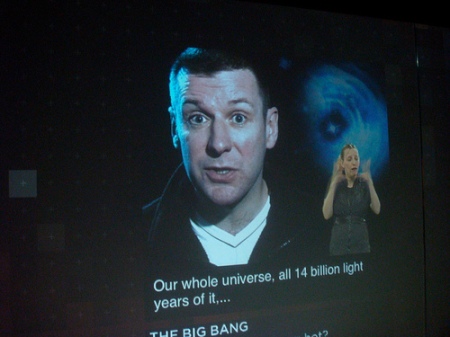
This scary picture is taken from an interactive exhibit in the Weller Galleries of the Royal Observatory at Greenwich, which opened in 2007. The exhibit, I mean, not the Royal Observatory. I remember going down there to record the video segments, but had forgotten all about it until somebody found this image on the net and drew my attention to it.

The exhibit consists of a series of display screens with various astronomical and cosmological concepts and questions on them, along with appropriate images. Visitors touch the screens to bring up the video segments in which distinguished astronomers (or me) attempt to provide explanations.

The lady to the bottom right is probably providing a sign language translation of my contribution. Or she could simply be screaming and waving her hands in terror. Wouldn’t you?

PS. If you want an explanation of the title of this blog post, I’ll translate Audio Video Disco from the latin for you. It means “I hear, I see, I learn”. Since they have to touch the screen, I might have added “I touch” which would be Tango….

Much Ado About a Null Result

Posted in Science Politics, The Universe and Stuff with tags , , , on August 20, 2009 by telescoper

In today’s Nature there’s an article outlining the current upper limits on the existence of a stochastic cosmological background of gravitational waves. The basis of the analysis presented in the paper is a combination of data from two larger international collaborations, called VIRGO and LIGO. Cardiff University is a member of the latter, so I suppose I should be careful about what I say…

These experiments have achieved incredible sensitivity – they can measure distortions that are a tiny fraction of an atomic nucleus in scale – but because gravity is such a very weak force they still haven’t managed to find direct evidence of gravitational waves. The next generation of these laser interferometers – Advanced LIGO – should get within hailing distance of a detection but in the meantime we have to do with upper limits. Since the sensitivity of the instruments is so well calibrated, the lack of a signal can yield interesting information. The Nature paper is quite interesting in that it summarizes the constraints that can be placed in such a way on some models of the early Universe. Mostly, though, these are “exotic” models that have already been excluded by other means. If I’ve got my sums right the stochastic gravitational wave background expected to be produced within the standard “concordance” cosmology, in which gravitational wave modes are excited by cosmic inflation, is at least three orders of magnitude lower than current experimental sensitivity.

I can’t resist including the following excerpts from a press release, produced by the Media Relations Department at Caltech whose spin doctors have apparently been hard at work.

Pasadena, Calif.—An investigation by the LIGO (Laser Interferometer Gravitational-Wave Observatory) Scientific Collaboration and the Virgo Collaboration has significantly advanced our understanding the early evolution of the universe.

Analysis of data taken over a two-year period, from 2005 to 2007, has set the most stringent limits yet on the amount of gravitational waves that could have come from the Big Bang in the gravitational wave frequency band where LIGO can observe. In doing so, the gravitational-wave scientists have put new constraints on the details of how the universe looked in its earliest moments.

Much like it produced the cosmic microwave background, the Big Bang is believed to have created a flood of gravitational waves—ripples in the fabric of space and time—that still fill the universe and carry information about the universe as it was immediately after the Big Bang. These waves would be observed as the “stochastic background,” analogous to a superposition of many waves of different sizes and directions on the surface of a pond. The amplitude of this background is directly related to the parameters that govern the behavior of the universe during the first minute after the Big Bang.

and

“Since we have not observed the stochastic background, some of these early-universe models that predict a relatively large stochastic background have been ruled out,” says Vuk Mandic, assistant professor at the University of Minnesota.

“We now know a bit more about parameters that describe the evolution of the universe when it was less than one minute old,” Mandic adds. “We also know that if cosmic strings or superstrings exist, their properties must conform with the measurements we made—that is, their properties, such as string tension, are more constrained than before.”

This is interesting, he says, “because such strings could also be so-called fundamental strings, appearing in string-theory models. So our measurement also offers a way of probing string-theory models, which is very rare today.”

“This result was one of the long-lasting milestones that LIGO was designed to achieve,” Mandic says. Once it goes online in 2014, Advanced LIGO, which will utilize the infrastructure of the LIGO observatories and be 10 times more sensitive than the current instrument, will allow scientists to detect cataclysmic events such as black-hole and neutron-star collisions at 10-times-greater distances.

“Advanced LIGO will go a long way in probing early universe models, cosmic-string models, and other models of the stochastic background. We can think of the current result as a hint of what is to come,” he adds.

“With Advanced LIGO, a major upgrade to our instruments, we will be sensitive to sources of extragalactic gravitational waves in a volume of the universe 1,000 times larger than we can see at the present time. This will mean that our sensitivity to gravitational waves from the Big Bang will be improved by orders of magnitude,” says Jay Marx of the California Institute of Technology, LIGO’s executive director.

“Gravitational waves are the only way to directly probe the universe at the moment of its birth; they’re absolutely unique in that regard. We simply can’t get this information from any other type of astronomy. This is what makes this result in particular, and gravitational-wave astronomy in general, so exciting,” says David Reitze, a professor of physics at the University of Florida and spokesperson for the LIGO Scientific Collaboration.

If hyperbole is what you’re looking for, go no further. There’s nothing wrong with presenting even null results in a positive light but, I don’t think this paints a very balanced picture of the field. For examples, early Universe models involving cosmic strings were already severely constrained before these results, so we know that they don’t have a significant effect on the evolution of cosmic structure anyway.

Clearly the political intention was to flag the importance of Advanced LIGO, although even that will probably be unable to detect the cosmological gravitational-wave background.  Overstatements contained in press releases of this type usually prove counterproductive in the long run.

The Cold Spot

Posted in Cosmic Anomalies, The Universe and Stuff with tags , , , , on August 16, 2009 by telescoper

Musing yesterday about the rapidly approaching restart of the academic year reminded me that I really ought to get on and finish the bunch of papers sitting on my desk and on various computers. I’ve also got a book to finish before October so I’d better get cracking with that too.

More importantly, however, it reminded me to congratulate my PhD student Rockhee Sung who has just had her first paper published (in the journal Classical and Quantum Gravity). The paper is available online here and it’s free to download for a month even if you don’t have a personal or institutional subscription to the journal.

The idea of this paper came a while ago but it has taken us a long time to get everything in place to start writing it up. In the meantime other papers have been written on the subject, but Rockhee and I have done this our own way – or rather she has, as she put most of the hard work into actually doing the calculations.

About four years ago, during the course of careful statistical analysis of data from the Wilkinson Microwave Anisotropy Probe (WMAP), a group based in Santander (Spain) published a paper drawing attention to the existence of an anomalous “Cold Spot” in the data. This phenomenon has now acquired its own Wikipedia entry (here), so I won’t repeat all the details except to say that it is about 5° across and that it is colder than one would expect if the temperature fluctuations are Gaussian, as is predicted in the simplest models of the early Universe involving cosmological inflation. The spot is to the bottom right, and is marked with an arrow on the picture below.

It’s worth digressing a little here to explain that a fluctuating field of course contains both hot spots and cold spots. Because there CMB temperature fluctuations comprise a wide range of wavelengths there are also spots on different scales. Assessing the statistical significance of a single isolated feature like the cold spot is not particularly easy. Based on the brute force method of simulating skies according to the Gaussian hypothesis and then repeating the approach that led to the original discovery, the result is that around 1% of Gaussian CMB skies have a cold spot as cold as that observed in the real data. Before the non-Bayesians among you get too excited, I’ll remind you that this means that the probability of a Cold spot given the standard model is about 1%, i.e. P(Cold Spot | Standard Model)=0.01. This is NOT the same as saying that the probability of the standard model being correct is 0.01…

A probability of 1% is an in-between kind of level: not too small to be decisive, and not too large to be instantly dismissed as just being a chance fluctuation. My personal opinion is that the Cold Spot is an interesting feature that deserves to be investigated further, but is not something that in itself should cause anyone to doubt the standard model. I include it among the list of cosmological anomalies that I’ve blogged about before (for example, here, here and here). I find them interesting but don’t lose sleep worrying that the standard model is about to fall to pieces. Not yet, anyway.

Not all theorists are as level-headed as me, however, and within weeks of the discovery of the cold spot suggestions were already being put forward as to how it could be “explained” theoretically. Some of these are described in the Wikipedia entry, so I won’t rehash the list. However, one suggestion not included there was the idea that the anomalous cold spot might be there because the Universe were not isotropic, i.e. if the Cosmological Principle were violated.

Way back when I was a lad doing my own PhD, my supervisor John Barrow had been interested in globally anisotropic (but nevertheless homogeneous) cosmologies. These are models in which any observer sees different things in different directions, but the pattern seen by observers in different places is always the same. I never worked on these at the time – they seemed a bit too esoteric even for me – but I remembered bits and pieces about them from conversations.

A complete classification of all the space-times  possessing this property was completed over a hundred years ago (before General Relativity was invented) by the Italian mathematician Luigi Bianchi, and cosmological models based on them are called the Bianchi models.

This isn’t the place to go into detail about the Bianchi models: the classification is based on the mathematical properties of Lie groups, which would take me ages to explain. However, it is worth pointing out that only five Bianchi types actually contain the cosmologically principled Friedmann-Lemaître-Robertson-Walker universe as a special case: I, V, VII0 ,VIIh and IX. If you really want to know what the classes are you’ll have to look them up! Since we know our Universe is very close to being homogeneous and isotropic, it seems reasonable to look at those models capable of describing small departures from that case so the above list provides a useful subset of the models to explore.

Rockhee’s PhD project was to explore  the patterns of cosmic microwave background  fluctuations that can arise in that set of Bianchi cosmologies, not just in the temperature (which had been done before) but also in polarization (which hadn’t). I’ve already posted some of the temperature patterns Rockhee computed here.

The reason for extending wanting to extend this work to include polarization was the following. The microwave background radiation is partly linearly polarized because of the way radiation is scattered by electrons. If an electron is immersed in a radiation bath which is isotropic there is no net polarization, but if the radiation field is anisotrpic – in particular if it varies on an angular scale of 90º (i.e. a quadrupole) – then the scattered radiation will be partly polarized. In the standard cosmology the variations in the radiation field are random fluctuations so each electron “sees” a different quadupole. The net polarization field is therefore produced incoherently, by adding stochastic contributions. In  a  Bianchi model the situation is different. Each electron in this case sees the same quadupole. The polarization pattern produced is therefore coherent. Not only do anisotropic universes produce characteristic radiation patterns, they also produce a corresponding pattern in polarization.

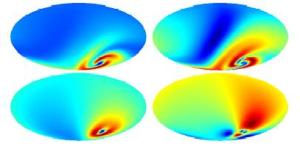
So what does this all have to do with the Cold Spot? Well, in anisotropic spaces that are also curved, it is possible for light rays to get focussed in such a way that the entire pattern of flucuations present at least-scattering winds up concentrated in a small patch of the sky as seen by a late-time observer. for this to happen the space has to be negatively curved. Only two of the Bianchi types can do this, as there are only two that are both near-FLRW and negatively curved: V and VIIh. Both of these models could, in principle, therefore produce a cold spot by geometrical, rather than stochastic means. In the little figure below, taken from our paper, you can see examples of Bianchi VIIh (top) and Bianchi V (bottom) showing the temperature (left) and polarization (right) in each case. We’ve oriented the model to put the cold spot in approximately the right location as the observed one.
 

cold


The point is that there is a pretty heavy price to be paid for producing the cold spot in this way: an enormous, coherent signal in the polarized radiation field.

As often happens in such situations, somebody else had the idea to investigate these models and we were scooped to a large extent by Andrew Pontzen and Anthony Challinor from Cambridge, who recently published a paper showing that the polarization produced in these models is already excluded by experimental upper limits. They concentrated on the Bianchi VIIh case, as this appears to have a more general structure than V and it was the model first advocated as an explanation of the cold spot. In this model the combined effect of vorticity and shear introduces a swirly pattern into the radiation field that you can see clearly in the top two panels of the figure as well as focussing it into a small patch. Bianchi V doesn’t produce the same kind of pattern either in temperature or polarization: it looks more like a simple quadrupole squeezed into a small part of the sky. A particularly interesting aspect of this is that the Bianchi VIIh case clearly has a definite “handedness” while the Bianchi V one doesn’t.

The moral of all this is that the polarization of the cosmic microwave background provides key additional information that could prove decisive in eliminating (or perhaps even confirming) models of the Universe more exotic than the standard one. That’s one of the areas in which  we expect Planck to produce the goods!

In the meantime Rockhee and I will be submitting a couple of much larger papers in due course, one containing a wider discussion of the possible pattern morphologies that can be produced in these models, and another about their detailed statistical properties.

The Axle of Elvis

Posted in Cosmic Anomalies, The Universe and Stuff with tags , , , , , , on August 6, 2009 by telescoper

An interesting paper on the arXiv yesterday gave me a prod to expand a little on one of the cosmic anomalies I’ve blogged about before.

Before explaining what this is all about, let me just briefly introduce a bit of lingo. The pattern of variations fluctuations in the temperature of the cosmic microwave background (CMB) across the sky, such as is revealed by the Wilkinson Microwave Anisotropy Probe (WMAP), is usually presented in terms of the behaviour of its spherical harmonic components. The temperature as a function of position is represented as a superposition of spherical harmonic modes labelled by two numbers, the degree l and the order m. The degree basically sets the characteristic angular scale of the mode (large  scales have low l, and small scales have high l). For example the dipole mode has l=1 and it corresponds to variation across the sky on a scale of 180 degrees; the quadrupole (l=2) has a scale of 90 degrees, and so on. For a fixed l the order m runs from -l to +l and each order represents a particular pattern with that given scale.

The spherical harmonic coefficients that tell you how much of each mode is present in the signal are generally  complex numbers having real and imaginary parts or, equivalently, an amplitude and a phase.  The exception to this are the modes with m=0, the zonal modes, which have no azimuthal variation: they vary only with latitude, not longitude. These have no imaginary part so don’t really have a phase. For the other modes, the phase controls the variation with azimuthal angle around the axis of the chosen coordinate system, which in the case of the CMB is usually taken to be the Galactic one.

In the simplest versions of cosmic inflation, each of the spherical harmonic modes should be statistically independent and randomly distributed in both amplitude and phase. What this really means is that the harmonic modes are in a state of maximum statistical disorder or entropy. This property also guarantees that the temperature fluctuations over the sky should be described by  a Gaussian distribution.

That was perhaps a bit technical but the key idea is that if you decompose the overall pattern of fluctuations into its spherical harmonic components the individual mode patterns should look completely different. The quadrupole and octopole, for example, shouldn’t line up in any particular way.

Evidence that this wasn’t the case started to emerge when WMAP released its first set of data in 2003 with indications of an alignment between the modes of low degree. In their  analysis, Kate Land and Joao Magueijo dubbed this feature The Axis of Evil; the name has stuck.They concluded that there was a statistically significant alignment (at 99.9% confidence) between the multipoles of low degree (l=2 and 3), meaning that the measured alignment is only expected to arise by chance in one in a thousand simulated skies. More recently, further investigation of this effect using subsequent releases of data from the WMAP experiment and a more detailed treatment of the analysis (including its stability with respect to Galactic cuts) suggested that the result is not quite as robust as had originally been claimed. .

Here are the low-l modes of the WMAP data so you see what we’re talking about. The top row of the picture contains the modes for l=2 (quadrupole) and l=3 (octopole) and the bottom shows l=4 and l=5.


The two small red blobs mark the two ends of the preferred axis of each mode. The orientation of this axis is consistent across all the modes shown but the statistical significance is much stronger for the ones with lower l.

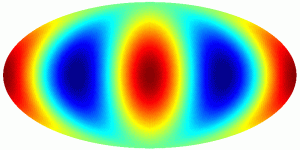
It’s probably worth mentioning a couple of neglected aspects of this phenomenon. One is that the observed quadrupole and octopole appear not only to be aligned with each other but also appear to be dominated by sectoral orders, i.e those with m=l. These are the modes which are, in a sense, opposite to the zonal modes in that they vary only with longitude and not with latitude. Here’s what the sectoral mode of the quadrupole looks like:

map22

Changing the phase of this mode would result in the pattern moving to the left or right, i.e. changing its origin, but wouldn’t change the orientation. Which brings me to the other remarkable thing, namely that the two lowest modes also have  correlated phases. The blue patch to the right of Galactic centre is in the same place for both these modes. You can see the same feature in the full-resolution map (which involves modes up to l~700 or so):

I don’t know whether there is really anything anomalous about the low degree multipoles, but I hope this is a question that Planck (with its extra sensitivity, better frequency coverage and different experimental strategy) will hopefully shed some light on. It could be some sort of artifact of the measurement process or it could be an indication of something beyond the standard cosmology. It could also just be a fluke. Or even the result of an over-active imagination, like seeing Elvis in your local Tesco.

On its own I don’t think this is going to overthrow the standard model of cosmology. Introducing extra parameters to a model in order to explain a result with a likelihood that is only marginally low in a simpler model does not make sense, at least not to a proper Bayesian who knows about model selection…

However, it is worth mentioning that the Axis of Evil isn’t the only cosmic anomaly to have been reported. If an explanation is found with relatively few parameters that can account for all of these curiosities in one fell swoop then it would stand a good chance of convincing us all that there is more to the Universe than we thought. And that would be fun.

Return of the Clerihews!

Posted in Poetry, The Universe and Stuff with tags , , on August 2, 2009 by telescoper

As a result of an after-dinner discussion at the meeting I attended last week, I’ve decided to put a revised cosmological clerihew collection back online. I’ve removed or edited those that caused the greatest offence, and added a few new ones.

Bernard Carr
Has gone a bit far:
His Anthropic Principle
Makes theories invincible

Sean Carroll
Has me over a barrel
Because the only plausible rhyme
Plugs his new book on Time

The mind of John Barrow
Is not very narrow:
He’s more open than me
To a variable c

Stephen Hawking
Lets a machine do the talking
But even  he can’t vocalize in-
side a black hole horizon.

Joe Silk
Is one of that ilk
Who writes far more articles
Than there are elementary particles

Matt Griffin
Has healthy salad for tiffin
But he’d probably expire
If something went wrong with SPIRE.

Peter Ade
Would never be afraid
To enter his name
In the citation game

Andy Lawrence
Would shed tears in torrents
If they finally got rid
Of the Astrogrid

Steve Maddox
Never eats haddocks
But he’s quite a dab hand
In the optical band

Ofer Lahav
Is awfully suave
But must be getting nervy
About the cancellation of funding for the Dark Energy Survey

Joao Magueijo
Was on the Today Show
Talking some shite
About travelling faster than light

Keith Mason
Said to Lord Drayson
“Can we have some more money?”
He replied “Don’t try to be funny…”

Andrei Linde
Felt rather windy
A peculiar sensation:
The result of internal inflation?

To rhyme Carlos Frenck
I’ve drawn a complete blenk
But I found in the lexicon
A good one for Mexican

When Andrew Jaffe
Plots a new graph he
Thinks fits his theory he’ll
Tell everyone at Imperial

Paul Steinhardt
Said “Lust not after beauty in thine heart”
But why he did so
I really don’t know

Feel free to offer your own through the comments box, after consulting the rules, although I remind you I don’t accept anonymous comments, even if they’re funny.