Archive for Cosmology

Who put the Bang in Big Bang?

Posted in The Universe and Stuff with tags , , , , , on December 29, 2008 by telescoper

Back from the frozen North, having had a very nice time over Christmas, I thought it was time to reactivate my blog and to redress the rather shameful lack of science on what is supposed to be a science blog. Rather than writing a brand new post, though, I’m going to cheat like a TV Chef by sticking up something that I did earlier. I’ve  had the following piece floating around on my laptop for a while so I thought I’d rehash it and post it on here. It is based on an article that was published in a heavily revised and shortened form in New Scientist in 2007, where it attracted some splenetic responses despite there not being anything particular controversial in it! It’s not particularly topical, but there you go. The television is full of repeats these days too.

Around twenty-five years ago a young physicist came up with what seemed at first to be an absurd idea: that, for a brief moment in the very distant past, just after the Big Bang, something weird happened to gravity that made it push rather than pull.  During this time the Universe went through an ultra-short episode of ultra-fast expansion. The physicist in question, Alan Guth, couldn’t prove that this “inflation” had happened nor could he suggest a compelling physical reason why it should, but the idea seemed nevertheless to solve several major problems in cosmology.

Twenty five years later on, Guth is a professor at MIT and inflation is now well established as an essential component of the standard model of cosmology. But should it be? After all, we still don’t know what caused it and there is little direct evidence that it actually took place. Data from probes of the cosmic microwave background seem to be consistent with the idea that inflation happened, but how confident can we be that it is really a part of the Universe’s history?

According to the Big Bang theory, the Universe was born in a dense fireball which has been expanding and cooling for about 14 billion years. The basic elements of this theory have been in place for over eighty years, but it is only in the last decade or so that a detailed model has been constructed which fits most of the available observations with reasonable precision. The problem is that the Big Bang model is seriously incomplete. The fact that we do not understand the nature of the dark matter and dark energy that appears to fill the Universe is a serious shortcoming. Even worse, we have no way at all of describing the very beginning of the Universe, which appears in the equations used by cosmologists as a “singularity”- a point of infinite density that defies any sensible theoretical calculation. We have no way to define a priori the initial conditions that determine the subsequent evolution of the Big Bang, so we have to try to infer from observations, rather than deduce by theory, the parameters that govern it.

The establishment of the new standard model (known in the trade as the “concordance” cosmology) is now allowing astrophysicists to turn back the clock in order to understand the very early stages of the Universe’s history and hopefully to understand the answer to the ultimate question of what happened at the Big Bang itself and thus answer the question “How did the Universe Begin?”

Paradoxically, it is observations on the largest scales accessible to technology that provide the best clues about the earliest stages of cosmic evolution. In effect, the Universe acts like a microscope: primordial structures smaller than atoms are blown up to astronomical scales by the expansion of the Universe. This also allows particle physicists to use cosmological observations to probe structures too small to be resolved in laboratory experiments.

Our ability to reconstruct the history of our Universe, or at least to attempt this feat, depends on the fact that light travels with a finite speed. The further away we see a light source, the further back in time its light was emitted. We can now observe light from stars in distant galaxies emitted when the Universe was less than one-sixth of its current size. In fact we can see even further back than this using microwave radiation rather than optical light. Our Universe is bathed in a faint glow of microwaves produced when it was about one-thousandth of its current size and had a temperature of thousands of degrees, rather than the chilly three degrees above absolute zero that characterizes the present-day Universe. The existence of this cosmic background radiation is one of the key pieces of evidence in favour of the Big Bang model; it was first detected in 1964 by Arno Penzias and Robert Wilson who subsequently won the Nobel Prize for their discovery.

The process by which the standard cosmological model was assembled has been a gradual one, but it culminated with recent results from the Wilkinson Microwave Anisotropy Probe (WMAP). For several years this satellite has been mapping the properties of the cosmic microwave background and how it varies across the sky. Small variations in the temperature of the sky result from sound waves excited in the hot plasma of the primordial fireball. These have characteristic properties that allow us to probe the early Universe in much the same way that solar astronomers use observations of the surface of the Sun to understand its inner structure,  a technique known as helioseismology. The detection of the primaeval sound waves is one of the triumphs of modern cosmology, not least because their amplitude tells us precisely how loud the Big Bang really was.

The pattern of fluctuations in the cosmic radiation also allows us to probe one of the exciting predictions of Einstein’s general theory of relativity: that space should be curved by the presence of matter or energy. Measurements from WMAP reveal that our Universe is very special: it has very little curvature, and so has a very finely balanced energy budget: the positive energy of the expansion almost exactly cancels the negative energy relating of gravitational attraction. The Universe is (very nearly) flat.

The observed geometry of the Universe provides a strong piece of evidence that there is an mysterious and overwhelming preponderance of dark stuff in our Universe. We can’t see this dark matter and dark energy directly, but we know it must be there because we know the overall budget is balanced. If only economics were as simple as physics.

Computer Simulation of the Cosmic Web

The concordance cosmology has been constructed not only from observations of the cosmic microwave background, but also using hints supplied by observations of distant supernovae and by the so-called “cosmic web” – the pattern seen in the large-scale distribution of galaxies which appears to match the properties calculated from computer simulations like the one shown above, courtesy of Volker Springel. The picture that has emerged to account for these disparate clues is consistent with the idea that the Universe is dominated by a blend of dark energy and dark matter, and in which the early stages of cosmic evolution involved an episode of accelerated expansion called inflation.

A quarter of a century ago, our understanding of the state of the Universe was much less precise than today’s concordance cosmology. In those days it was a domain in which theoretical speculation dominated over measurement and observation. Available technology simply wasn’t up to the task of performing large-scale galaxy surveys or detecting slight ripples in the cosmic microwave background. The lack of stringent experimental constraints made cosmology a theorists’ paradise in which many imaginative and esoteric ideas blossomed. Not all of these survived to be included in the concordance model, but inflation proved to be one of the hardiest (and indeed most beautiful) flowers in the cosmological garden.

Although some of the concepts involved had been formulated in the 1970s by Alexei Starobinsky, it was Alan Guth who in 1981 produced the paper in which the inflationary Universe picture first crystallized. At this time cosmologists didn’t know that the Universe was as flat as we now think it to be, but it was still a puzzle to understand why it was even anywhere near flat. There was no particular reason why the Universe should not be extremely curved. After all, the great theoretical breakthrough of Einstein’s general theory of relativity was the realization that space could be curved. Wasn’t it a bit strange that after all the effort needed to establish the connection between energy and curvature, our Universe decided to be flat? Of all the possible initial conditions for the Universe, isn’t this very improbable? As well as being nearly flat, our Universe is also astonishingly smooth. Although it contains galaxies that cluster into immense chains over a hundred million light years long, on scales of billions of light years it is almost featureless. This also seems surprising. Why is the celestial tablecloth so immaculately ironed?

Guth grappled with these questions and realized that they could be resolved rather elegantly if only the force of gravity could be persuaded to change its sign for a very short time just after the Big Bang. If gravity could push rather than pull, then the expansion of the Universe could speed up rather than slow down. Then the Universe could inflate by an enormous factor (1060 or more) in next to no time and, even if it were initially curved and wrinkled, all memory of this messy starting configuration would be lost. Our present-day Universe would be very flat and very smooth no matter how it had started out.

But how could this bizarre period of anti-gravity be realized? Guth hit upon a simple physical mechanism by which inflation might just work in practice. It relied on the fact that in the extreme conditions pertaining just after the Big Bang, matter does not behave according to the classical laws describing gases and liquids but instead must be described by quantum field theory. The simplest type of quantum field is called a scalar field; such objects are associated with particles that have no spin. Modern particle theory involves many scalar fields which are not observed in low-energy interactions, but which may well dominate affairs at the extreme energies of the primordial fireball.

Classical fluids can undergo what is called a phase transition if they are heated or cooled. Water for example, exists in the form of steam at high temperature but it condenses into a liquid as it cools. A similar thing happens with scalar fields: their configuration is expected to change as the Universe expands and cools. Phase transitions do not happen instantaneously, however, and sometimes the substance involved gets trapped in an uncomfortable state in between where it was and where it wants to be. Guth realized that if a scalar field got stuck in such a “false” state, energy – in a form known as vacuum energy – could become available to drive the Universe into accelerated expansion.We don’t know which scalar field of the many that may exist theoretically is responsible for generating inflation, but whatever it is, it is now dubbed the inflaton.

This mechanism is an echo of a much earlier idea introduced to the world of cosmology by Albert Einstein in 1916. He didn’t use the term vacuum energy; he called it a cosmological constant. He also didn’t imagine that it arose from quantum fields but considered it to be a modification of the law of gravity. Nevertheless, Einstein’s cosmological constant idea was incorporated by Willem de Sitter into a theoretical model of an accelerating Universe. This is essentially the same mathematics that is used in modern inflationary cosmology.  The connection between scalar fields and the cosmological constant may also eventually explain why our Universe seems to be accelerating now, but that would require a scalar field with a much lower effective energy scale than that required to drive inflation. Perhaps dark energy is some kind of shadow of the inflaton

Guth wasn’t the sole creator of inflation. Andy Albrecht and Paul Steinhardt, Andrei Linde, Alexei Starobinsky, and many others, produced different and, in some cases, more compelling variations on the basic theme. It was almost as if it was an idea whose time had come. Suddenly inflation was an indispensable part of cosmological theory. Literally hundreds of versions of it appeared in the leading scientific journals: old inflation, new inflation, chaotic inflation, extended inflation, and so on. Out of this activity came the realization that a phase transition as such wasn’t really necessary, all that mattered was that the field should find itself in a configuration where the vacuum energy dominated. It was also realized that other theories not involving scalar fields could behave as if they did. Modified gravity theories or theories with extra space-time dimensions provide ways of mimicking scalar fields with rather different physics. And if inflation could work with one scalar field, why not have inflation with two or more? The only problem was that there wasn’t a shred of evidence that inflation had actually happened.

This episode provides a fascinating glimpse into the historical and sociological development of cosmology in the eighties and nineties. Inflation is undoubtedly a beautiful idea. But the problems it solves were theoretical problems, not observational ones. For example, the apparent fine-tuning of the flatness of the Universe can be traced back to the absence of a theory of initial conditions for the Universe. Inflation turns an initially curved universe into a flat one, but the fact that the Universe appears to be flat doesn’t prove that inflation happened. There are initial conditions that lead to present-day flatness even without the intervention of an inflationary epoch. One might argue that these are special and therefore “improbable”, and consequently that it is more probable that inflation happened than that it didn’t. But on the other hand, without a proper theory of the initial conditions, how can we say which are more probable? Based on this kind of argument alone, we would probably never really know whether we live in an inflationary Universe or not.

But there is another thread in the story of inflation that makes it much more compelling as a scientific theory because it makes direct contact with observations. Although it was not the original motivation for the idea, Guth and others realized very early on that if a scalar field were responsible for inflation then it should be governed by the usual rules governing quantum fields. One of the things that quantum physics tells us is that nothing evolves entirely smoothly. Heisenberg’s famous Uncertainty Principle imposes a degree of unpredictability of the behaviour of the inflaton. The most important ramification of this is that although inflation smooths away any primordial wrinkles in the fabric of space-time, in the process it lays down others of its own. The inflationary wrinkles are really ripples, and are caused by wave-like fluctuations in the density of matter travelling through the Universe like sound waves travelling through air. Without these fluctuations the cosmos would be smooth and featureless, containing no variations in density or pressure and therefore no sound waves. Even if it began in a fireball, such a Universe would be silent. Inflation puts the Bang in Big Bang.

The acoustic oscillations generated by inflation have a broad spectrum (they comprise oscillations with a wide range of wavelengths), they are of small amplitude (about one hundred thousandth of the background); they are spatially random and have Gaussian statistics (like waves on the surface of the sea; this is the most disordered state); they are adiabatic (matter and radiation fluctuate together) and they are formed coherently.  This last point is perhaps the most important. Because inflation happens so rapidly all of the acoustic “modes” are excited at the same time. Hitting a metal pipe with a hammer generates a wide range of sound frequencies, but all the different modes of the start their oscillations at the same time. The result is not just random noise but something moderately tuneful. The Big Bang wasn’t exactly melodic, but there is a discernible relic of the coherent nature of the sound waves in the pattern of cosmic microwave temperature fluctuations seen by WMAP. The acoustic peaks seen in the WMAP angular spectrum  provide compelling evidence that whatever generated the pattern did so coherently.
 

There are very few alternative theories on the table that are capable of reproducing the WMAP results. Some interesting possibilities have emerged recently from string theory. Since this theory requires more space-time dimensions than the four we are used to, something has to be done with the extra ones we don’t observe. They could be wrapped up so small we can’t perceive them. Or, as is assumed in braneworld cosmologies our four-dimensional universe exists as a subspace (called a “brane”) embedded within a larger dimensional space; we don’t see the extra dimensions because we are confined on the subspace. These ideas may one day lead to a viable alternative to inflationary orthodoxy. But it is early days and not all the calculations needed to establish this theory have yet been done. In any case, not every cosmologist feels the urge to make cosmology consistent with string theory, which has even less evidence in favour of it than inflation. Some of the wilder outpourings of string-inspired cosmology seem to me to be the physics equivalent of nausea-induced vomiting.

So did inflation really happen? Does WMAP prove it? Will we ever know?

It is difficult to talk sensibly about scientific proof of phenomena that are so far removed from everyday experience. At what level can we prove anything in astronomy, even on the relatively small scale of the Solar System? We all accept that the Earth goes around the Sun, but do we really even know for sure that the Universe is expanding? I would say that the latter hypothesis has survived so many tests and is consistent with so many other aspects of cosmology that it has become, for pragmatic reasons, an indispensable part our world view. I would hesitate, though, to say that it was proven beyond all reasonable doubt. The same goes for inflation. It is a beautiful idea that fits snugly within the standard cosmological and binds many parts of it together. But that doesn’t necessarily make it true. Many theories are beautiful, but that is not sufficient to prove them right. When generating theoretical ideas scientists should be fearlessly radical, but when it comes to interpreting evidence we should all be unflinchingly conservative. WMAP has also provided a tantalizing glimpse into the future of cosmology, and yet more stringent tests of the standard framework that currently underpins it. Primordial fluctuations produce not only a pattern of temperature variations over the sky, but also a corresponding pattern of polarization. This is fiendishly difficult to measure, partly because it is such a weak signal (only a few percent of the temperature signal) and partly because the primordial microwaves are heavily polluted by polarized radiation from our own Galaxy. Although WMAP achieved the detection of this polarization, the published map is heavily corrupted by foregrounds.

Future generations of experiments, such as the Planck Surveyor (due for launch in 2009), will have to grapple with the thorny issue of foreground subtraction if substantial progress is to be made. But there is a crucial target that justifies these endeavours. Inflation does not just produce acoustic waves, it also generates different modes of fluctuation, called gravitational waves, that involve twisting deformations of space-time. Inflationary models connect the properties of acoustic and gravitational fluctuations so if the latter can be detected the implications for the theory are profound. Gravitational waves produce very particular form of polarization pattern (called the B-mode) which can’t be generated by acoustic waves so this seems a promising way to test inflation. Unfortunately the B-mode signal is very weak and the experience of WMAP suggests it might be swamped by foregrounds. But it is definitely worth a go, because it would add considerably to the evidence in favour of inflation as an element of physical reality

Besides providing strong evidence for the concordance cosmology, the WMAP satellite has also furnished some tantalizing evidence that there may be something missing. Not all the properties of the microwave sky seem consistent with the model. For example, the temperature pattern should be structureless, mirroring the random Gaussian fluctuations of the primordial density perturbations. In reality the data contains tentative evidence of strange alignments, such as the so-called “Axis of Evil” discovered by Kate Land and Joao Magueijo. These anomalies could be systematic errors in the data, or perhaps residual problems with the foreground that have to be subtracted, but they could also indicate the presence of things that can’t be described within the standard model. Cosmology is now a mature and (perhaps) respectable science: the coming together of theory and observation in the standard concordance model is a great advance in our understanding of the Universe and how it works. But it should be remembered that there are still many gaps in our knowledge. We don’t know the form of the dark matter. We don’t have any real understanding of dark energy.  We don’t know for sure if inflation happened and we are certainly a long way from being able to identify the inflaton. In a way we are as confused as we ever were about how the Universe began. But now, perhaps, we are confused on a higher level and for better reasons…
Physics Noir

Posted in The Universe and Stuff with tags , , on December 2, 2008 by telescoper

Last week, while I was indisposed with the ‘flu and faced with the imminent danger of having to watch daytime TV, I suddenly remembered that I had bought a boxed set of classic Film Noir on DVD and had only watched one or two of the films. I took the opportunity to watch the whole lot, and very enjoyable it was too. I’ve always been a big fan of this type of film, starting with the glorious Maltese Falcon (which has featured in a previous post of mine) and the classic Double Indemnity. There are probably hundreds of films belonging to this genre and, if the selection I watched last week is anything to go by then they are decidedly variable in quality. Among them, though, was one I had never seen before – Out of the Past – which I think is a masterpiece, containing all the quintessential elements of film noir and many unique features of its own.

It’s difficult to define exactly what turns a film noir, but there are some common characteristics. First the male lead protagonist is far from the dashing romantic character portrayed in mainstream Hollywood fare. Often a troubled and dysfunctional character, cynical and hard-bitten, distrustful and alienated, the classic noir anti-hero is often a private investigator or in any case a loner who lives in a moral vacuum. To counterpoint this, the female lead is usually a femme fatale, glamorous but duplicitous, sexy and dangerous, manipulative and assertive. There are definitely shades of Macbeth in that the female lead is usually a more compelling and impressive personality than the supposed hero. The inversion of stereotypical roles also serves to hold a “dark mirror” up to society, an effect which other elements of these films also strive to achieve.

The plots usually deal with the seedy side of human life: crime, betrayal, jealousy and revenge, much of it sexually motivated. Narrative strategies involve repeated use of flashbacks, first-person voiceovers, dream-like sequences, and unresolved episodes that emphasize the overall lack of moral direction. The photography is dominated by high contrast lights surrounding the protagonists with dark, threatening shadows while odd angles and unbalanced framing produce unstable, disorienting images. The chiaroscuro lighting makes even mundane encounters seem charged with danger or erotic suspense.

di6

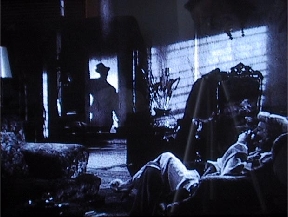
This is a still from Double Indemnity which shows a number of trademark features. The shadows cast by venetian blinds on the wall, the cigarette being smoked by Barbara Stanwyck and the curious construction of the mise en scene are all very characteristic of the style. What is even more wonderful about this particular shot however is the way the shadow of Fred McMurray’s character enters the scene before he does. The Barbara Stanwyck character is just about to shoot him with a pearl-handled revolver so this image suggests that he is already on his way to the underworld.

Noir settings are almost exclusively urban: the resulting iconography consists of images of dark night-time cities with rain-soaked streets reflecting dazzling neon lights that intrude into the picture and fracture the composition. Interiors are almost always cramped and claustrophobic: dingy hotel rooms, night clubs or even the backs of taxi cabs. The dark outside world presses in on the characters and is full of danger. Soundtracks often include jazz in the bebop style from the late 1940s or early 1950s, with its jagged melodic lines and stuttering rythms, emphasizing the psychological instability displayed by the characters and settings.

The protagonists are trapped, perhaps just by mischance, in an alienating lonely world, usually a night-time city, where they are constantly in danger for their lives. The chaotic, random violence of this world gives rise to feelings of persecution and paranoia and a sense that life is absurd, meaningless, without order or purpose, and governed by contingency rather than design.

Much has been written about the origins of Film Noir, but it does seem clear to me that, although it is essentially an American style, it owes many of its roots to European existentialism, a point further reinforced by the fact that many great movie directors of the noir period (including the great Billy Wilder, who directed Double Indemnity) were in fact European emigres.

Anyway, I digress. What I wanted to say really was that during the course of watching all these wonderful films from a bygone age it struck me how much the language and iconography of modern cosmology shares this existentialist heritage. Our new standard cosmological model is full of references to the “dark” sector (dark matter and dark energy) which dominates the energy budget of the Universe, but which not just invisible but also unfathomable. The cosmos is lit by garish starlight from small islands of luminosity embedded in this sea of darkness. Long chains of bright galaxies stretch across space like rows of streetlights whose glare fractures and disturbs the celestial dark. We cling to a precarious existence on a tiny rock that is surrounded by danger. Even the stuff from which our atoms are made is completely overshadowed by alien matter. The universe is oblivious to us and we are irrelevant to it.

But it’s not only the surface imagery of cosmology that resembles that of a noir movie. The exisentialist trend runs deep. Cosmology seems to be abandoning the idea that there is a design behind it all. The idea that there is a single explanatory principle “a theory of everything” that accounts for why our Universe is the way it is and why life is possible within it, is losing ground to the idea that there is a multiverse in which all possible laws of nature are realised; we just live in a place where life happens to be possible. I’m not at all convinced that it is a good route for science to follow, but many cosmologists seem to be accepting this kind of thing as the best we will ever do to explain the Universe.

But if the idea of a world without meaning fills you with existential angst, then don’t worry about it. At least there are plenty of good films to watch.

What about magnetic fields?

Posted in The Universe and Stuff with tags , , on November 20, 2008 by telescoper

If you’re stuck for a question to ask at the end of an astronomy seminar and don’t want to reveal the fact that you were asleep for most of it, there are some general questions that you can nearly always ask regardless of the topic of the talk without appearing foolish. A few years ago, “how would the presence of dust affect your conclusions?” was quite a good one, but the danger these days is that with the development of far-infrared and submillimetre instrumentation and the proliferation of people using it, this could actually have been the topic of the talk you just dozed through. However, no technological advances have threatened the viability of another old stalwart: “What about magnetic fields?”.

These thoughts came into my mind when I was listening to an excellent talk by Richard Ellis at the Royal Astronomical Society last Friday about the current state of play in the (very complicated) field of galaxy formation. I hasten to add that nobody there was sleeping. Well, not many.

In theory, galaxies condense out of the Big Bang as lumps of dark matter. Seeded by primordial density fluctuations and amplified by the action of gravity these are supposed to grow in a hierarchical, bottom-up fashion with little blobs forming first and then merging into larger objects. The physics of this process is relatively simple (at least if the dark matter is cold) as it involves only gravity.

But, by definition, the dark matter can’t be seen. At least not directly, though its presence can be inferred indirectly by dynamical measurements and gravitational lensing. What astronomers generally see is starlight, although it often arrives at the telescope in an unfamiliar part of the spectrum owing to the redshifting effect of the expansion of the Universe. The stars in galaxies sit inside the blobs of dark matter, which are usually called “haloes” although blobs is a better name. In art the whole purpose of a halo is that you can see it.

How stars form is a very complicated question to answer even when you’re asking about nearby stellar nurseries like the Orion Nebula. The basic idea is that a gas cloud cools and contracts, radiating away energy until it gets sufficiently hot that nuclear burning switches on and pressure is generated that can oppose further collapse. The early stages of this processs, though, involve very many imponderables. Star formation doesn’t just involve gravity but lots of other processes, including additional volumes of Landau & Lifshitz, such as hydrodynamics, radiative transfer and, yes, magnetic fields. Naively, despite the complicated physics, it might still be imagined that stars form in the little blobs of dark matter first and then gradually get incorporated in larger objects.

Unfortunately, as Richard Ellis pointed out, this naive picture doesn’t seem to work. Deep surveys of galaxies suggest that the most massive galaxies formed their stars quite early in the Big Bang and have been relatively quiescent since then, while smaller objects contain younger stars. In other words, pretty much the opposite of what one might have thought. This phenomenon (known appropriately in the time of the Credit Crunch as “downsizing”) suggests that something inhibits star formation early on in all but the largest of the largest haloes. It could be that powerful feedback from activity in the nuclear regions associated with a central black hole might do this, or it could be something a little less exotic such as stellar winds. Or it could be that the whole scheme is wrong in a more fundamental way. I personally wouldn’t go so far as to throw out the whole framework, as it has scored many successes, but it is definitely an open question what is going on.

Then I was reminded by a posting on the arxiv about an interesting paper that appeared in Nature last month by Art Wolfe and collaborators which revealed the presence of an enormously strong magnetic field in a galaxy at the relatively high redshift of 0.692. Actually it’s about 84 microGauss. OK, so this is just one object but the magnetic field in it is remarkably strong. It could be a freak occurence resulting from some kind of shock or bubble, but it does seem to fit in a pattern in which young galaxies generally seem to have much higher magnetic fields than previously expected. Obviously we need to know how many more such magnetic monsters are lurking out there.

So why are these results so surprising? Didn’t we already know galaxies have magnetic fields in them?

Well, yes we did. The Milky Way has a magnetic field with a strength of about 10 microGauss, much lower than that discovered by Wolfe et al. But the point is that if we understand them properly, galactic magnetic fields are supposed to be have been much lower in the past than they are now. The standard theoretical picture is that a (tiny) initial seed field is amplified by a kind of dynamo operating by virtue of the strong differential rotation in disk galaxies. This makes the field grow exponentially with time so that only a few rotations of the galaxy are needed to make a large field out of a small one. Eventually this dynamo probably quenches when the field has an energy density comparable to the gas in the galaxy (which is roughly the situation we find in our own Galaxy).

Hopefully you now see the problem. If the field is being wound up quickly then younger galaxies (those whose light comes to us from a long way away) should have much smaller magnetic fields than nearby ones. But they don’t seem to behave in this way. A few years ago, I wrote a paper about a model in which the galactic fields weren’t produced by a dynamo but were primordial in origin and large from the start. I might dust it off and look it again…

The mystery of the origin of galactic magnetic fields remains unsolved largely because, although we know magnetism exists, it is notoriously difficult to understand its behaviour when it is coupled to all the other messy things we have to deal with in astrophysics. It’s a kind of polar opposite of dark matter, which we don’t know (for sure) exists but which only acts through gravity so its behaviour is easier to model. This is the main reason why cosmological theorists prefer to think about dark matter rather than magnetic fields. I’d hazard a guess that this is one problem that won’t be resolved soon either. Things are complicated enough already!

It is also worth considering the possibility that magnetic fields might play a role in moderating the processes by which gas turns into stars within protogalaxies. At the very least, a magnetic field generates stresses that influence the onset of collapse. Although it is by no means obvious that they provide the required missing link between dark matter haloes and stars, we now have less excuse for continuing to ignore them.

Science and Stamp Collecting

Posted in Books, Talks and Reviews, The Universe and Stuff with tags , , on November 18, 2008 by telescoper

Musing over the comments posted on my (slightly ironic) blog item about exoplanetary ennui, I remembered a piece I wrote for the Times Literary Supplement last summer so I dusted it off, chopped it up, and updated it for presentation here because it expands a bit on the earlier contribution.

If the Sun were the size of a golf ball, then the Earth would be a speck of dust a few metres from it and the nearest star would be hundreds of kilometres away. And this is what it is like in the relatively crowded environment of the Milky Way. The unimaginable scale of our Universe means that astronomy has never really become an experimental science, but has largely remained an observational one, having more in common with, say, archaeology than chemistry or other laboratory-based disciplines. Consequently, even though it is perhaps the oldest science, it is also in some respects the least mature. The absence of the traditional interplay between theory and experiment, the inability to perform repeated experiments under slightly different conditions, and the sheer difficulty of measuring anything at all have stunted its development compared to younger fields. For this reason, one often finds in astronomy certain tendencies that other subjects have largely grown out of, such as an unhealthy mania for classification and nomenclature.

Taxonomy has its place within the scientific method: modern chemistry owes much to Dmitri Mendeleev‘s periodic table; botany could not have progressed without Linnaeus; and the theory of evolution was founded on Charles Darwin‘s painstaking studies on the Galapagos Islands. But arranging things in groups and giving them names does not in itself constitute scientific progress, no matter how systematically it is done. The great experimental physicist Ernest (Lord) Rutherford dismissed this kind of activity as not science but “stamp collecting”.

This brings us to the grand debate that took place in Prague in the summer of 2006 under the auspices of the International Astronomical Union. One of the problems before the IAU’s 26th General Assembly was what to do about the fact that recent investigations have revealed the presence of a number of objects orbiting the Sun that are ostensibly at least as worthy of the name “planet” as Pluto, which in our current textbooks is the ninth one out. Obviously, which objects should be called planets depends on how you define what a planet is. The solar system contains objects of all shapes and sizes, from tiny asteroids to immense gas giants such as Jupiter and Saturn. Where should one draw the line? The original proposal was to increase the number of planets to twelve by admitting some lowly new members to the club, but in the end the IAU decided to demote Pluto to the status of a “dwarf” planet thus restricting the number of true planets to eight. This was a controversial decision, at least in the United States, because the vital vote was taken on the last day of the meeting when most of the US delegates had to take flights home. Pluto was discovered by an American, Clyde Tombaugh, in 1930, so the decision deprived the nation of its only planet-discoverer.

The “no” decision hinged on the adoption of three criteria: that the object be round, i.e. have a shape determined by internal gravitational forces; that it should have cleared its own orbit of debris; and that it should be orbiting our own star, the Sun. None of these has any special scientific value; the resulting decision was therefore pretty arbitrary. Moreover, deep-space observations have led to the discovery of literally hundreds of planetlike objects orbiting other stars. These exoplanets offer much greater prospects for scientific progress into the general theory of planet formation than the few objects that happen to have formed in our particular vicinity, so why are they excluded from the definition? In any case, what have we learned scientifically from the new nomenclature? Pluto is still the same object that it was before August 2006, and astronomers still don’t understand what one can infer from its own particular properties about the general process of planet formation.

So is Pluto a planet?

Who cares? In this case there really is nothing in a name. When I was asked this question on the telephone by a reporter I gave precisely that answer and he was shocked. I’m sure he thought that all that astronomers do is look at things and give them names. There are some that do that, of course, but most of us prefer doing proper science.

In the field of exoplanet research we are seeing real signs of maturity, although current studies are still firmly rooted in the “discovery” and “classificatuion” stage. Witness last weeks press interest in the first directly imaged exoplanets. I am well aware of the immense potential that those pictures have for stimulating interest in science, but there is still a long way to go before this field reaches its prime. That probably makes it an excellent area for young scientists to work in. But ultimately this youthful exuberance should give way to something a bit more serious, which is to go beyond what these discoveries are in themselves and ask what deeper questions they might answer.

One can see many other parallels in the history of astronomy, such as the discovery of quasars in the late 1950s. The first few of these must have generated a huge amount of excitement because they were not at all understood. Within a few years hundreds had been detected by radio observations but their nature remained unknown. The subsequent identification of redshifted hydrogen emission lines in the spectra of these objects led to them eventually being identified as very distant extragalactic sources of immense intrinsic power. By the 1980s quasars were identified as a particular type of active galaxy and placed within a general classification scheme that also involved blazars, Seyfert galaxies, and so on. Nowadays we have samples of tens of thousands of quasar spectra and the interest evolves around how the activity in their nucleus relates to the process of galaxy formation in an expanding Universe and how we can use these objects to map out the large-scale distribution of matter. To an outsider these tasks may seem less glamorous that the early days of quasar research, but that’s what science is like.

At the extreme end of the distance scale of astronomical investigation lies my own field of cosmology, the scientific study of the Universe as a whole. The scale of the solar system is challenging enough, but the cosmos is really big. Until recently, cosmology was so lacking in reliable observational input that it was thought of as a flaky offshoot of astronomy, more a branch of metaphysics than a proper scientific discipline, a paradise for theoreticians whose wildest speculations stood no chance of ever being tested with real measurements. Over the past twenty years or so, however, staggering advances in astronomical instrumentation have allowed astronomers to probe the darkest depths of space, capturing light that has travelled for almost 14 billion years on its way towards us. Theories are now so tightly constrained by these observations that there is very little room for manoeuvre. From this interplay between conjecture and refutation has emerged a cosmological framework that accounts, at least in a broad-brush sense, for how the Universe is constructed and how it is evolving.

There are some important gaps, including some puzzling anomalies, and the precise nature of many of its constituents is yet to be understood, but the establishment of the “concordance model” is a sign that cosmology really has come of age.

A Lop-sided Universe?

Posted in Bad Statistics, Cosmic Anomalies, The Universe and Stuff with tags , on November 9, 2008 by telescoper

Over on cosmic variance, I found an old post concerning the issue of whether there might be large-scale anomalies in the cosmic microwave background sky. I blogged about this some time ago, under the title of Is there an Elephant in the Room?, so it’s interesting to see a different take on it. Interest in this issue has been highlighted by a recent paper by Groeneboom & Eriksen that claims to have detected asymmetry in the distribution of fluctuations in the data from the Wilkinson Microwave Anisotropy Probe (WMAP) inconsistent with the predictions of the standard cosmological model. If this feature is truly of primordial origin then it is an extremely important discovery as it will (probably) require the introduction of new physics into our understanding of cosmology, and that will be exciting.

It is the job of theorists to invent new theories, and it is not at all a problem that these bits of evidence have generated a number of speculative ideas. Who knows? One of them may be right. I think it is the job of theoreticians to think as radically as possible about things like this. On the other hand, it is the observational evidence that counts in the end and we should be very conservative in how we treat that. This is what bothers me about this particular issue.

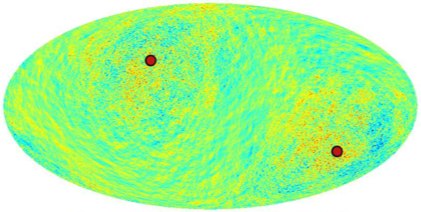
elongatedThe picture on the left shows a processed version of the WMAP fluctuation pattern designed to reveal the asymmetry, with the apparent preferred direction shown in red. This map shows the variation of the across the whole sky, and the claimed result is that the fluctuations are a bit larger around the red dots (which are 180 degrees apart) than in the regions at right angles to them.

It’s a slight effect, but everything in the picture is a slight effect as the CMB is extremely smooth to start with, the fluctuations in temperature being only about one part in a hundred thousand. The statistical analysis looks to me to be reasonably solid, so lets suppose that the claim is correct.scan

The picture on the right (courtesy of NASA/WMAP Science Team) shows the scan strategy followed by the WMAP satellite on the same projection of the sky. The experiment maps the whole sky by spinning its detectors in such a way that they point at all possible positions. The axis of this spin is chosen in a particular way so that it is aligned with the ecliptic poles (out of the plane of the solar system). It is in the nature of this procedure that it visits some places more than others (those at the ecliptic poles are scanned more often than those at the equator), hence the variation in signal-to-noise shown in the map. You can see that effect graphically in the picture: the regions near the North and South ecliptic poles have better signal to noise than the others.

The axis found by Groeneboom & Eriksen is not perfectly aligned with the ecliptic plane but it is pretty close. It seems a reasonable (if conservative) interpretation of this that the detected CMB anomaly could be due to an unknown systematic that has something to do either with the solar system (such as an unknown source of radiation, like cold dust) or the way the satellite scans. The WMAP team have worked immensely hard to isolate any such systematics so if this is such an effect then it must be very subtle to have escaped their powerful scrutiny. They’re all clever people and it’s a fabulous experiment, but that doesn’t mean that it is impossible that they have missed something.

Many of the comments that have been posted on cosmic variance relating to this question the statistical nature of the result. Of course we have only one sky available, so given the “randomness” of the fluctuations it is possible that freakish configurations occur by chance. This misses the essentially probabilistic nature of all science which I tried to describe in my book on probability From Cosmos to Chaos. We are always limited by noise and incompleteness but that doesn’t invalidate the scientific method. In cosmology these problems are writ large because of the nature of the subject, but there is no qualitative difference in the interplay between science and theory in cosmology compared with other sciences. It’s just less easy to get the evidence.

So the issue here, which is addressed only partially by Groeneboom % Eriksen, is whether a lop-sided universe is more probable than an isotropic one given the WMAP measurements. They use a properly consistent Bayesian argument to tackle this issue and form a reasonably strong conclusion that the answer is yes. As far as it goes, I think this is (probably) reasonable.

However, now imagine I don’t believe in anistropic cosmologies but instead have an idea that this is caused by an unknown systematic relating in some way to the ecliptic plane. Following the usual Bayesian logic I think it is clear that, although both can account for the data, my hypothesis must be even more probable than a lop-sided universe. There is no reason why a primordial effect should align so closely with the ecliptic plane, so there is one unexplained coincidence in the lop-sided-universe model, whereas my model neatly accounts for that fact without any freedom to adjust free parameters. Ockham’s razor is on my side.

So what can we do about this? The answer might be not very much. It is true that, soon, the Planck Surveyor will be launched and it will map the CMB sky againat higher resolution and sensitivity. On the other hand, it will not solve the problem that we only have one sky. The fact that it is a different experiment may yield clues to any residual systematics in the WMAP results, but if it has a similar scan strategy to WMAP, even Planck might not provide definitive answers.

I think this one may run and run!

Companion Piece

Posted in Books, Talks and Reviews with tags on October 1, 2008 by telescoper

I’ve just heard that my review of The Oxford Companion to Cosmology, by Andrew Liddle and Jon Loveday (both from the University of Sussex) has just been published in the journal Classical and Quantum Gravity. If you don’t have access to CQG then you can still get the review as long as you’re quick as it is available here free of charge for 30 days.

Cosmology Explained

Posted in Biographical, The Universe and Stuff with tags , , on September 29, 2008 by telescoper

I’ve always avoided describing myself as an astronomer, because most people seem to think that involves star signs and horoscopes. Anyone can tell I’m not an astrologer anyway, because I’m not rich. Astrophysicist sounds more impressive, but perhaps a bit too scary. That’s why I settled on “Cosmologist”. Grandiose, but at the same time somehow cuddly.

I had an inkling that this choice was going to be a mistake at the start of my first ever visit to the United States, which was to attend a conference in memory of the great physicist Yacov Borisovich Zel’dovich, who died in 1989. The meeting was held in Lawrence, Kansas, home of the University of Kansas, in May 1990. This event was notable for many reasons, including the fact that the effective ban on Russian physicists visiting the USA had been lifted after the arrival of glasnost to the Soviet Union. Many prominent scientists from there were going to be attending. I had also been invited to give a talk, the only connection with Zel’dovich that I could figure out was that the very first paper I wrote was cited in the very last paper to be written by the great man.

I think I flew in to Detroit from London and had to clear customs there in order to transfer to an internal flight to Kansas. On arriving at the customs area in the airport, the guy at the desk peered at my passport and asked me what was the purpose of my visit. I said “I’m attending a Conference”. He eyed me suspiciously and asked me my line of work. “Cosmologist,” I proudly announced. He frowned and asked me to open my bags. He looked in my suitcase, and his frown deepened. He looked at me accusingly and said “Where are your samples?”

I thought about pointing out that there was indeed a sample of the Universe in my bag but that it was way too small to be regarded as representative. Fortunately, I thought better of it. Eventually I realised he thought cosmologist was something to do with cosmetics, and was expecting me to be carrying little bottles of shampoo or make-up to a sales conference or something like that. I explained that I was a scientist, and showed him the poster for the conference I was going to attend. He seemed satisfied. As I gathered up my possessions thinking the formalities were over, he carried on looking through my passport. As I moved off he suddenly spoke again. “Is this your first visit to the States, son?”. My passport had no other entry stamps to the USA in it. “Yes,” I said. He was incredulous. “And you’re going to Kansas?”

This little confrontation turned out to be a forerunner of a more dramatic incident involving the same lexicographical confusion. One evening during the Zel’dovich meeting there was a reception held by the University of Kansas, to which the conference participants, local celebrities (including the famous writer William Burroughs, who lived nearby) and various (small) TV companies were invited. Clearly this meeting was big news for Lawrence. It was all organized by the University of Kansas and there was a charming lady called Eunice largely running the show. I got talking to her near the end of the party. As we chatted, the proceedings were clearly winding down and she suggested we go into Kansas to go dancing. I’ve always been up for a boogie, Lawrence didn’t seem to be offering much in the way of nightlife, and my attempts to talk to William Burroughs were repelled by the bevy of handsome young men who formed his entourage, so off we went in her car.

It takes over an hour to drive into Kansas City from Lawrence but we got there safely enough. We went to several fun places and had a good time until well after midnight. We were about to drive back when Eunice suddenly remembered there was another nightclub she had heard of that had just opened. However, she didn’t really know where it was and we spent quite a while looking for it. We ended up on the State Line, a freeway that separates Kansas City Kansas from Kansas City Missouri, the main downtown area of Kansas City actually being for some reason in the state of Missouri. After only a few moments on the freeway a police car appeared behind us with its lights blazing and siren screeching, and ushered us off the road into a kind of parking lot.

Eunice stopped the car and we waited while a young cop got out of his car and approached us. I was surprised to see he was on his own. I always thought the police always went around in pairs, like low comedians. He asked for Eunice’s driver’s license, which she gave him. He then asked for mine. I don’t drive and don’t have a driver’s license, and explained this to the policeman. He found it difficult to comprehend. I then realised I hadn’t brought my passport along, so I had no ID at all.

I forgot to mention that Eunice was black and that her car had Alabama license plates.

I don’t know what particular thing caused this young cop to panic, but he dashed back to his car and got onto his radio to call for backup. Soon, another squad car arrived, drove part way into the entrance of the parking lot and stopped there, presumably so as to block any attempted escape. The doors of the second car opened and two policemen got out, kneeled down and and aimed pump-action shotguns at us as they hid behind the car doors which partly shielded them from view and presumably from gunfire. The rookie who had stopped us did the same thing from his car, but he only had a handgun.

“Put your hands on your heads. Get out of the car. Slowly. No sudden movements.” This was just like the movies.

We did as we were told. Eventually we both ended up with our hands on the roof of Eunice’s car being frisked by a large cop sporting an impressive walrus moustache. He reminded me of one of the Village People, although his uniform was not made of leather. I thought it unwise to point out the resemblance to him. Declaring us “clean”, he signalled to the other policemen to put their guns away. They had been covering him as he searched us.

I suddenly realised how terrified I was. It’s not nice having guns pointed at you.

Mr Walrus had found a packet of French cigarettes (Gauloises) in my coat pocket. I clearly looked scared so he handed them to me and suggested I have a smoke. I lit up, and offered him one (which he declined). Meanwhile the first cop was running the details of Eunice’s car through the vehicle check system, clearly thinking it must have been stolen. As he did this, the moustachioed policeman, who was by now very relaxed about the situation, started a conversation which I’ll never forget.

Policeman: “You’re not from around these parts, are you?” (Honestly, that’s exactly what he said.)

Me: “No, I’m from England.”

Policeman: “I see. What are you doing in Kansas?”

Me: “I’m attending a conference, in Lawrence..”

Policeman: “Oh yes? What kind of Conference?”

Me: “It’s about cosmology”

At this point, Mr Walrus nodded and walked slowly to the first car where the much younger cop was still fiddling with the computer.

“Son,” he said, “there’s no need to call for backup when all you got to deal with is a limey hairdresser.”

Is there an Elephant in the Room?

Posted in Cosmic Anomalies, The Universe and Stuff with tags , on September 26, 2008 by telescoper

A couple of weeks ago I was in Cambridge giving a talk at a nice cosmology meeting housed in the splendid Centre for Mathematical Sciences. How the other half lives. The building is not only palatial, it is also very well designed for informal interactions and discussions. When I was a student at Cambridge this building didn’t exist and the Department of Applied Mathematics and Theoretical Physics was housed in rather ramshackle but characterful buildings in Silver Street, right in the city centre. I don’t know what department is there now.

I gave a talk with the title “Fishing for Elephants in the CMB”. I always think it’s a good idea not to give too much away in the title, although perhaps in this case I went a bit too far. Quite apart from the mixed metaphor, it doesn’t really give any clue at all as to what I was talking about. Mind you, I’m not sure at the end of the talk the audience was any the wiser either.

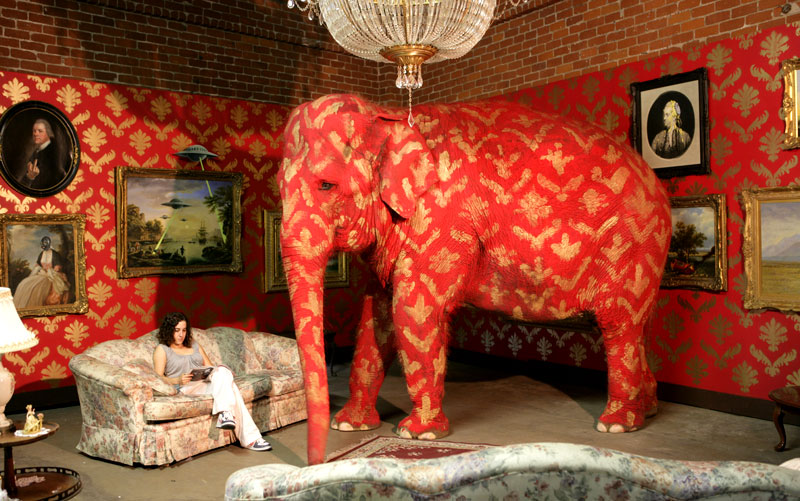
The idea for the title came from the phrase “There’s an Elephant in the Room”, a curious expression that even has its own wikipedia entry, as well as being the title of the picture shown here made by the artist Banksy. It refers to something that is large and obvious, but is being ignored for some reason, usually because it is considered impolite to draw attention to it. My talk of course wasn’t about real elephants but the possibility that there may be a metaphorical one in the field of cosmology, something that is consciously ignored by most of the community.

In yesterday’s post, I referred to the importance of the cosmic microwave background in establishing the so-called “concordance model” of cosmology. But as well as providing compelling evidence in support of this theory, the CMB has also thrown up a few bits of evidence that are quite difficult to reconcile with the standard description of the Universe.

Perhaps the most famous of these anomalies is the so-called “Axis of Evil“, which is an unexplained alignment of features in the pattern of temperature fluctuations observed across the sky by the Wilkinson Microwave Anisotropy Probe (WMAP) satellite. In the concordance picture, the fluctuations are basically random so there shouldn’t be coherent alignments like this.

But the Axle of Elvis isn’t the only curiosity in the cosmology shop. There is also a significant asymmetry between North and South on the sky (with respect to the ecliptic plane) when the two celestial hemispheres should be statistically indistinguishable if the standard model is correct.

There also exists a peculiar cold spot. Of course a fluctuating temperature pattern must contain places colder than average and places hotter than average. However, the standard model assumes these are drawn from a Gaussian (or “normal“) distribution, in which large fluctuations are extremely rare. The cold spot we see in the WMAP is colder than the coldest cold spot expected if the standard model is right, with odds of greater than 1000:1 against.

And there’s more. Statistical measures of the fluctuation pattern, such as the correlation function, pixel variance and quadupole moment, all give results for the real sky that are discordant with theory, although admittedly some are more significant than others. There are others too but I have no time to go into them, except to say that they may be related to the ones I’ve already mentioned, or at least share a common cause.

So what’s going on? The most conservative view is that there is nothing in the data that can’t be explained by the standard model and what we are seeing is a consequence of over-interpreting one or two chance coincidences. In the words of Fred Menger

If tortured sufficiently, data will confess to anything.

There may indeed be some truth to this, but serious attempts have been made to assess the statistical significance of the various results and my personal reaction is that, while coincidences do happen, it is unwise to dismiss 1000:1 results as mere flukes. On the other hand, these assessments are difficult and the significance may have been miscalculated.

More likely is the presence of some slight unidentified systematic artefact in the data. Not being an experimentalist it’s unfair to cast doubts on the brilliant work of the WMAP team, but one should keep an open mind about this possibility.

But as a theorist I have to admit that the most exciting possibility is that, lurking out there somewhere, are clues to a radical departure from orthodox theory. Many suggestions have been made, and no doubt most of them will be shown to be wrong. But the most dramatic thing that can happen in science is when the only game in town is “none of the above” and we are forced to think outside the box altogether.

I’m certainly not going to argue that we need to ditch the standard model or that cosmologists should all become obsessed with these tantalising conundrums. But in focussing exclusively on questions related to the standard model and its parameters, we may be throwing away a great deal of potentially exciting information. Every now and again, it’s worth checking your waste basket in case there’s something in it that you really shouldn’t have binned.

I realise that there are probably too many mixed metaphors in this piece. They’re a habit of mine and when you get to my age it’s difficult to change. After all, you can’t teach an old leopard to change its spots in midstream.


Mesmeric Universes

Posted in The Universe and Stuff with tags , , on September 25, 2008 by telescoper

It’s probably going to be difficult to describe what these images really are without going into enormous amounts of technical detail, but I think they are fun so I thought I’d put the pictures up with only a brief description. The remind me a little bit of the sort of hypnotic swirl sometimes used to put people under, although there’s a bit more to them than that.

According to our the standard “Big Bang” model, our Universe satisfies the Cosmological Principle which is that it is both homogeneous and isotropic, i.e. that it is the same in every location and looks the same in all directions. Of course we know our Universe isn’t exactly like that because it contains lumps of stuff called galaxies that correspond to variations in its density, but if look at sufficiently large scales it begins to look smooth. Sand is lumpy if you look close at it, but if you look at it from a long way away it looks smooth. The universe is supposed to be similarly smooth if you take a coarse-grained view.

The primary reason for incorporating the Cosmological Principle into models of the Universe is to make the mathematics simple. Einstein’s General Theory of Relativity is such a difficult theory that there are very few situations where the equations can actually be solved. One case where exact solution is relatively easy to achieve is that of homogeneous and isotropic space, which is such a symmetric state of affairs that much of the complexity of the Einstein equations disappears. Cosmological models based on this solution are generally called the Friedman models, after Alexander Friedman who first derived the solutions in the 1920s.

Despite their simplicity, the Friedman models turned out to be surprisingly accurate at describing our actual Universe which we now know to be very close to homogeneous and isotropic. Evidence for this comes from the Cosmic Microwave Background (CMB) which is astonishingly smooth across the sky. Variations in the sky temperature of the CMB are about one part in a hundred thousand of the mean temperature, which is smoother than the surface of a billiard ball.

However, it remains possible that our Universe may be slightly asymmetric and it is interesting to know what the CMB would look like if this were the case. Unfortunately there is no general cosmological solution available, so we have to tread slowly. One approach is to look at Universes which are homogeneous (the same in every place) but not isotropic (they look different in different directions). This might be describe the situation if the Universe were expanding more quickly in one direction that the others, or if it were rotating.

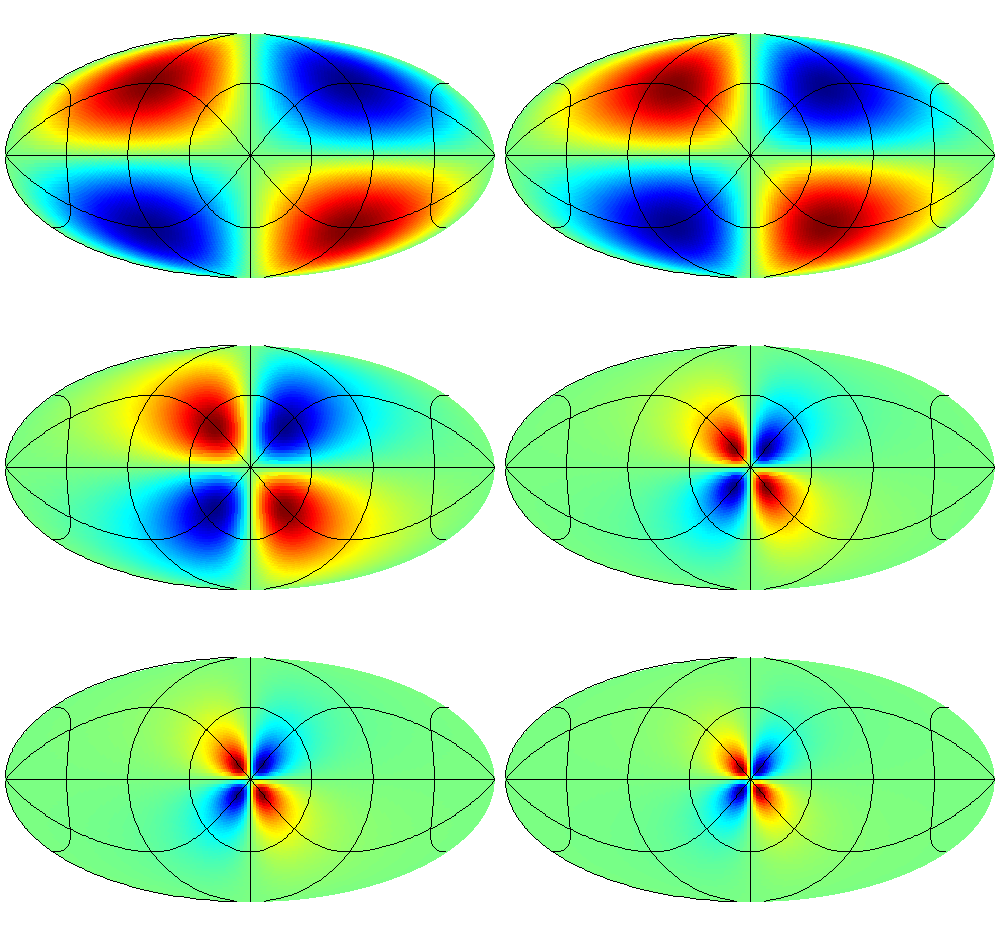
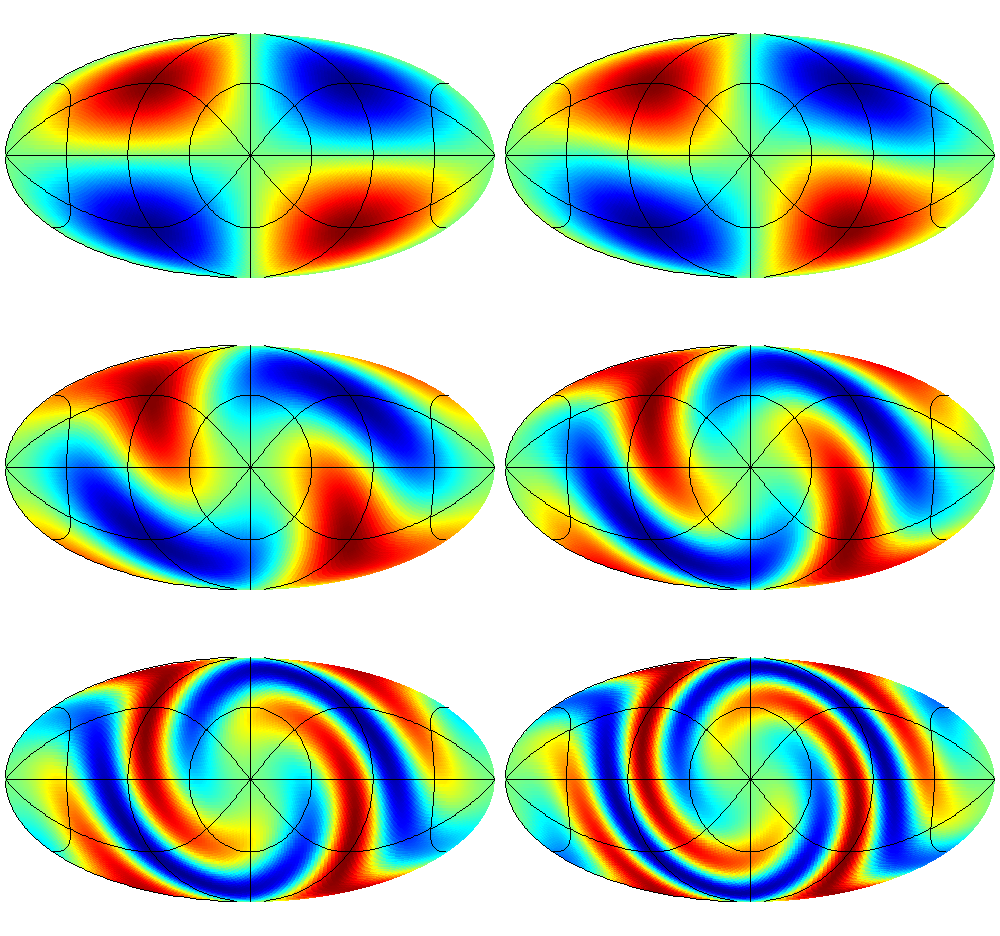
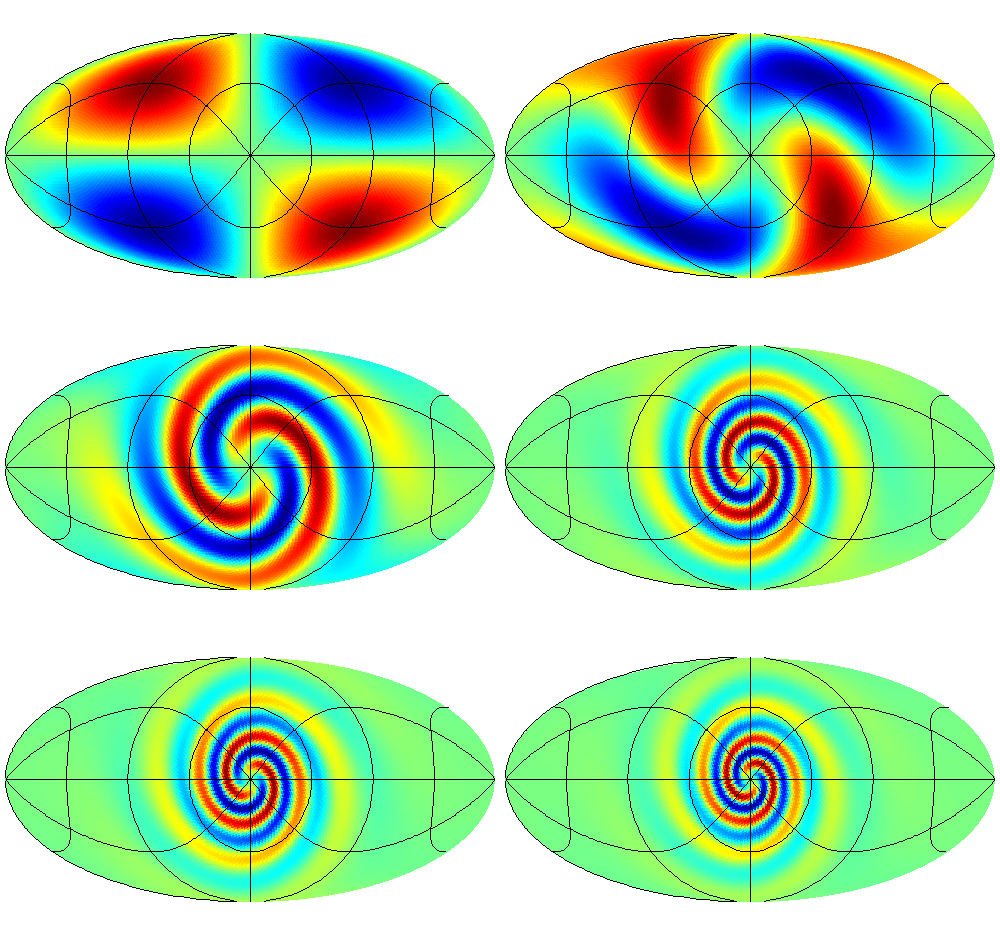
Actually the theory of homogeneous anisotropic universe models is quite well established and there is a full classification of all the possibilities, into the nine so-called Bianchi types. This is mathematically very complicated, so I won’t give details. However, my PhD student Rockhee has been calculating what the CMB pattern would look like in these models and the results are very pretty so I’ve included a few examples here. The little animated gifs show what the sky looks like as the Universe evolves in such cases. In all cases it starts as a pure quadrupole, i.e. a 90 degree variation across the sky. You might have to click on the image to see the animation.

The first one is Bianchi Type V. This is an example of a model in which the space is curved, so that as time goes on the initial quadrupole is focussed by gravitational effects into a smaller and smaller region of the sky. The preferred direction in this (and the other models) is picked to be in the centre of the image and the projection shows the whole sky. Hot spots are blue and cold spots are red, which is the way a physicist should plot temperature.

The next example is Bianchi Type VII_0 which is a flat Universe with rotation. What happens is that the initial quadrupole in this case gets twisted by the rotating space-time into a sort of spiral pattern. Late on in the evolution of such a Universe, an observer would see an interesting swirly structure in the cosmic microwave background.

The final example is my favourite, Bianchi Type VII_h. This one is a sort of combination of the two above examples. It has both rotation and curvature, so there is a swirly pattern which also gets focussed into a small bit of the sky. An observer living in such a Universe would see a prominent spot on the sky lying in the direction of the axis, which in this case is chosen to be in the centre of the diagram.

We’ve also been working out what the sky would look like in polarized light for these, but that’s even more complicated. If you’re really interested, I’ll post a link to the paper when it’s done…

The MacGuffin Factor

Posted in Science Politics, The Universe and Stuff with tags , , , on September 22, 2008 by telescoper

Unpick the plot of any thriller or suspense movie and the chances are that somewhere within it you will find lurking at least one MacGuffin. This might be a tangible thing, such the eponymous sculpture of a Falcon in the archetypal noir classic The Maltese Falcon or it may be rather nebulous, like the “top secret plans” in Hitchcock’s The Thirty Nine Steps. Its true character may be never fully revealed, such as in the case of the glowing contents of the briefcase in Pulp Fiction , which is a classic example of the “undisclosed object” type of MacGuffin. Or it may be scarily obvious, like a doomsday machine or some other “Big Dumb Object” you might find in a science fiction thriller. It may even not be a real thing at all. It could be an event or an idea or even something that doesn’t exist in any real sense at all, such the fictitious decoy character George Kaplan in North by Northwest.

Whatever it is or is not, the MacGuffin is responsible for kick-starting the plot. It makes the characters embark upon the course of action they take as the tale begins to unfold. This plot device was particularly beloved by Alfred Hitchcock (who was responsible for introducing the word to the film industry). Hitchcock was however always at pains to ensure that the MacGuffin never played as an important a role in the mind of the audience as it did for the protagonists. As the plot twists and turns – as it usually does in such films – and its own momentum carries the story forward, the importance of the MacGuffin tends to fade, and by the end we have often forgotten all about it. Hitchcock’s movies rarely bother to explain their MacGuffin(s) in much detail and they often confuse the issue even further by mixing genuine MacGuffins with mere red herrings.

North by North West is a fine example of a multi-MacGuffin movie. The centre of its convoluted plot involves espionage and the smuggling of what is only cursorily described as “government secrets”. But although this is behind the whole story, it is the emerging romance, accidental betrayal and frantic rescue involving the lead characters played by Cary Grant and Eve Marie Saint that really engages the characters and the audience as the film gathers pace. The MacGuffin is a trigger, but it soon fades into the background as other factors take over.

There’s nothing particular new about the idea of a MacGuffin. I suppose the ultimate example is the Holy Grail in the tales of King Arthur and the Knights of the Round Table and, much more recently, the Da Vinci Code. The original Grail itself is basically a peg on which to hang a series of otherwise disconnected stories. It is barely mentioned once each individual story has started and, of course, is never found.

Physicists are fond of describing things as “The Holy Grail” of their subject, such as the Higgs Boson or gravitational waves. This always seemed to me to be an unfortunate description, as the Grail quest consumed a huge amount of resources in a predictably fruitless hunt for something whose significance could be seen to be dubious at the outset.The MacGuffin Effect nevertheless continues to reveal itself in science, although in different forms to those found in Hollywood.

The Large Hadron Collider (LHC), switched on to the accompaniment of great fanfares last week, provides a nice example of how the MacGuffin actually works pretty much backwards in the world of Big Science. To the public, the LHC was built to detect the Higgs Boson, a hypothetical beastie introduced to account for the masses of other particles. If it exists the high-energy collisions engineered by LHC should reveal its presence. The Higgs Boson is thus the LHC’s own MacGuffin. Or at least it would be if it were really the reason why LHC has been built. In fact there are dozens of experiments at CERN and many of them have very different motivations from the quest for the Higgs.

Particle physicists are not daft, however, and they have realised that the public and, perhaps more importantly government funding agencies, need to have a really big hook to hang such a big bag of money on. Hence the emergence of the Higgs as a sort of master MacGuffin, concocted specifically for public consumption, which is much more effective politically than the plethora of mini-MacGuffins which, to be honest, would be a fairer description of the real state of affairs.

Even this MacGuffin has its problems, though. The Higgs mechanism is notoriously difficult to explain to the public, so some have resorted to a less specific but more misleading version: “The Big Bang”. As I’ve already griped, the LHC will never generate energies anything like the Big Bang did, so I don’t have any time for the language of the “Big Bang Machine”, even as a MacGuffin.

While particle physicists might pretend to be doing cosmology, we astrophysicists have to contend with MacGuffins of our own. One of the most important discoveries we have made about the Universe in the last decade is that its expansion seems to be accelerating. Since gravity usually tugs on things and makes them slow down, the only explanation that we’ve thought of for this perverse situation is that there is something out there in empty space that pushes rather than pulls. This has various possible names, but Dark Energy is probably the most popular, adding an appropriately noirish edge to this particular MacGuffin. It has even taken over in prominence from its much older relative, Dark Matter, although that one is still very much around.

We have very little idea what Dark Energy is, where it comes from, or how it relates to other forms of energy we are more familiar with, so observational astronomers have jumped in with various grandiose strategies to find out more about it. This has spawned a booming industry in survey of the distant Universe (such as the Dark Energy Survey) all aimed ostensibly at unravelling the mystery of the Dark Energy. It seems that to get any funding at all for cosmology these days you have to sprinkle the phrase “Dark Energy” liberally throughout your grant applications.

The old-fashioned “observational” way of doing astronomy – by looking at things hard enough until something exciting appears (which it does with surprising regularity) – has been replaced by a more “experimental” approach, more like that of the LHC. We can no longer do deep surveys of galaxies to find out what’s out there. We have to do it “to constrain models of Dark Energy”. This is just one example of the not necessarily positive influence that particle physics has had on astronomy in recent times and it has been criticised very forcefully by Simon White.

Whatever the motivation for doing these projects now, they will undoubtedly lead to new discoveries. But my own view is that there will never be a solution of the Dark Energy problem until it is understood much better at a conceptual level, and that will probably mean major revisions of our theories of both gravity and matter. I venture to speculate that in twenty years or so people will look back on the obsession with Dark Energy with some amusement, as our theoretical language will have moved on sufficiently to make it seem irrelevant.

But that’s how it goes with MacGuffins. Even the Maltese Falcon turned out to be a fake in the end.

p.s. I heard on Saturday that the LHC is having some problems with its magnets and will actually be off-line for a few months. Last week I heard a particle physicist describing the great switch-on as like “Christmas”. This turns out to have been truer than he can have imagined. Only a week has passed and his most expensive toy is already broken…