Archive for Dark Energy Spectroscopic Instrument

Two New Publications at the Open Journal of Astrophysics

Posted in OJAp Papers, Open Access, The Universe and Stuff with tags , , , , , , , , on October 20, 2023 by telescoper

It’s Friday so it’s a good time to catch up with the week’s action at the Open Journal of Astrophysics, where there have been two new publications so far this week. These papers take us up to a total of 40  in Volume 6 (2023) and 105 in total since we started publishing.

The title of the first paper is “Halo Properties from Observable Measures of Environment: I. Halo and Subhalo Masses” and its primary classification is Astrophysics of Galaxies. it is an exploration using neural networks of how the peak masses of dark matter halos and subhaloes correlate with observationally-accessible measures of their dependence on environment.

The authors based in the United States of America: Haley Bowden and Peter Behroozi of the University of Arizona, and Andrew Hearin of the Argonne National Laboratory

Here is a screen grab of the overlay which includes the abstract:
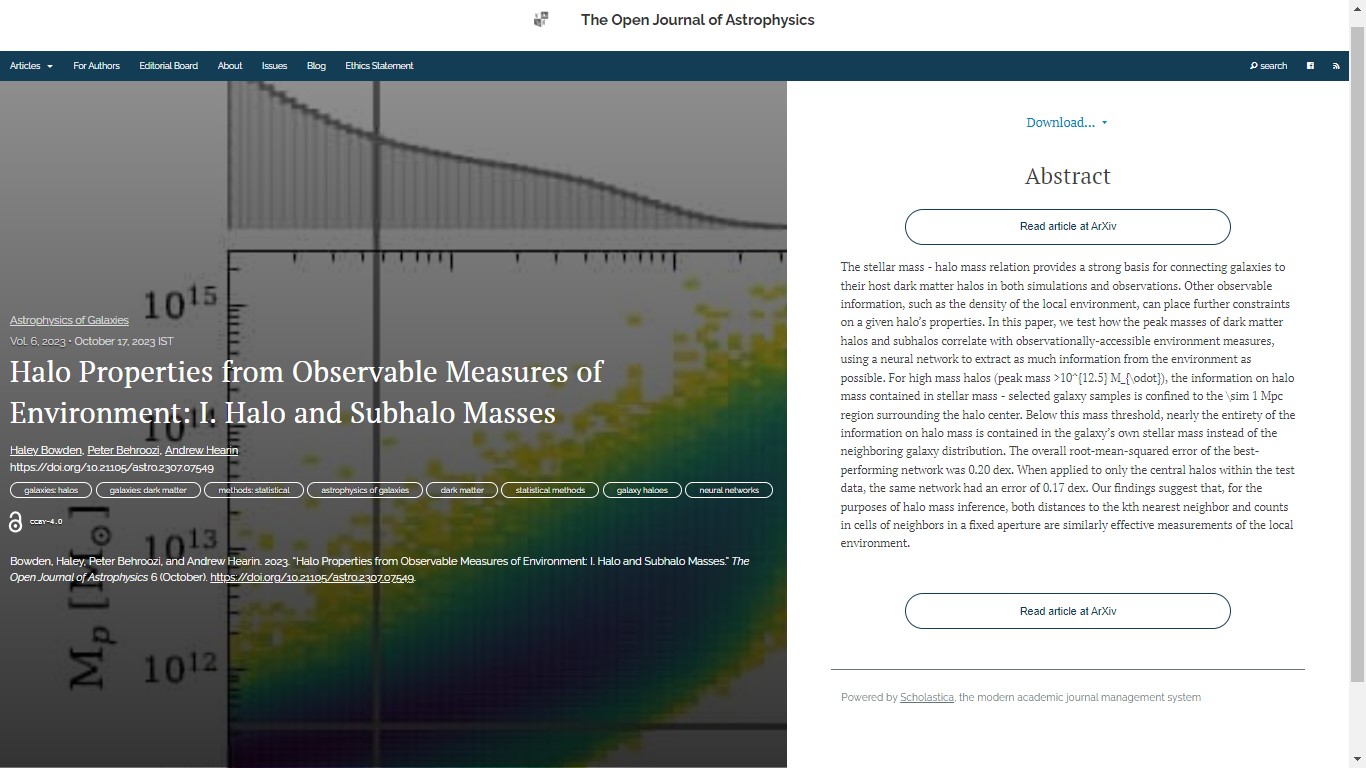
 

You can click on the image of the overlay to make it larger should you wish to do so. You can find the officially accepted version of the paper on the arXiv here.

The second paper was published on 18th October 2023.  The primary classification for this one is Cosmology and Nongalactic Astrophysics and is “Mitigating the noise of DESI mocks using analytic control variates”. For those of you not up with the lingo, DESI stands for the Dark Energy Spectroscopic Instrument and you can read more about it here.

The lead author for this one is Boryana Hadzhiyska of the Lawrence Berkeley Laboratory and the University of California, Berkeley (USA) and there are 32 other authors. This paper presents a method for reducing the effects of sample variance on cosmological simulations using analytical approximations and tests it using DESI data.

Here is a screen grab of the overlay which includes the abstract:
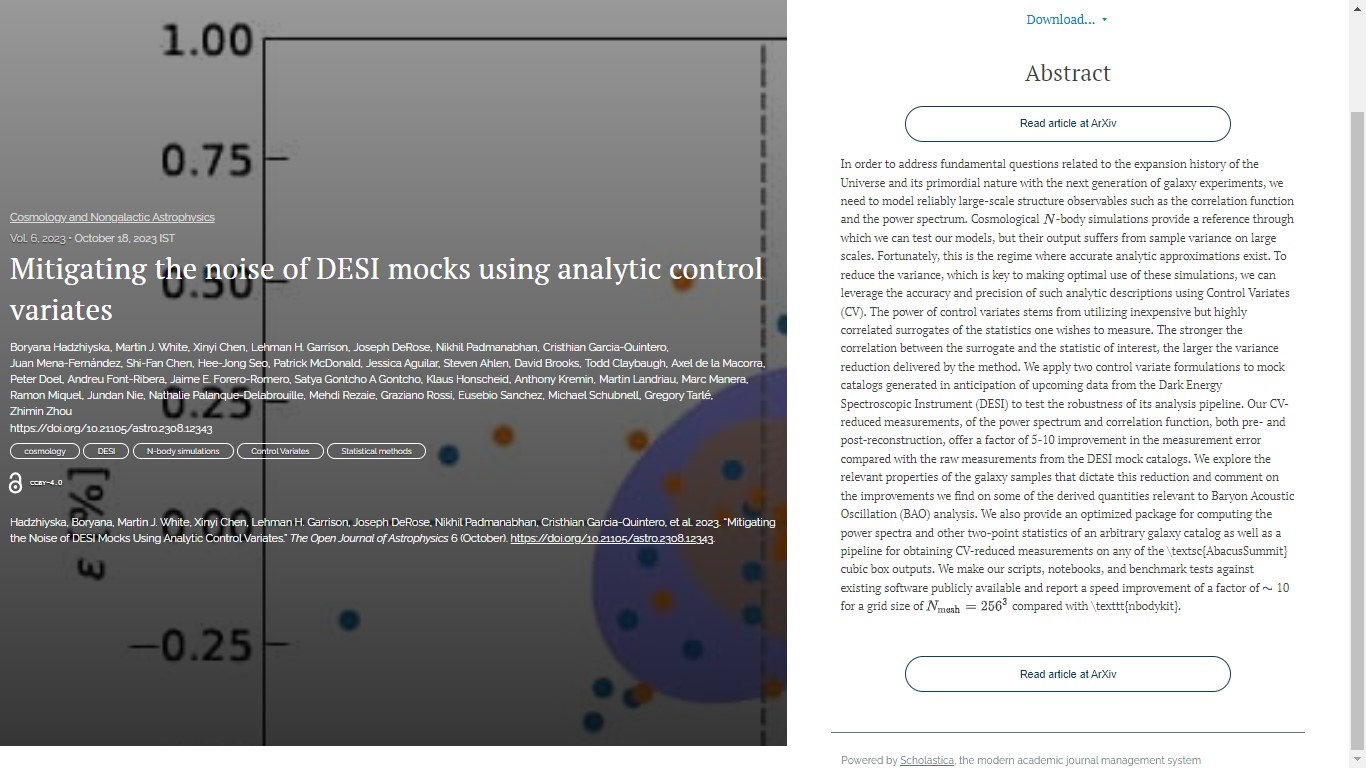


You can click on the image of the overlay to make it larger should you wish to do so. You can find the officially accepted version of the paper on the arXiv here.
Cosmology Talks: DESI detects BAOs!

Posted in The Universe and Stuff with tags , , , , on May 15, 2023 by telescoper

It’s been too long since I last posted one of the cosmology talks curated on YouTube by Sean Hotchkiss so I will endeavour to put that right by posting one today.

In this video, Jeongin Moon, David Valcin and Christoph Saulder talk about the first cosmologically relevant results from DESI (the Dark Energy Spectroscopic Instrument), including the first detection of the BAOs (Baryon Acoustic Oscillations) therefrom. It’s pretty impressive for a first detection with only two months worth of data, so the final result with the full data set should be spectacular!

You can of course read the paper related to these results (by Moon et al.) on the arXiv here.

The Largest Map of the Universe

Posted in The Universe and Stuff with tags , , , on January 14, 2022 by telescoper

Now I’m going to have to update the bit of my popular talks (e.g this one) about `Mapping the Universe’!

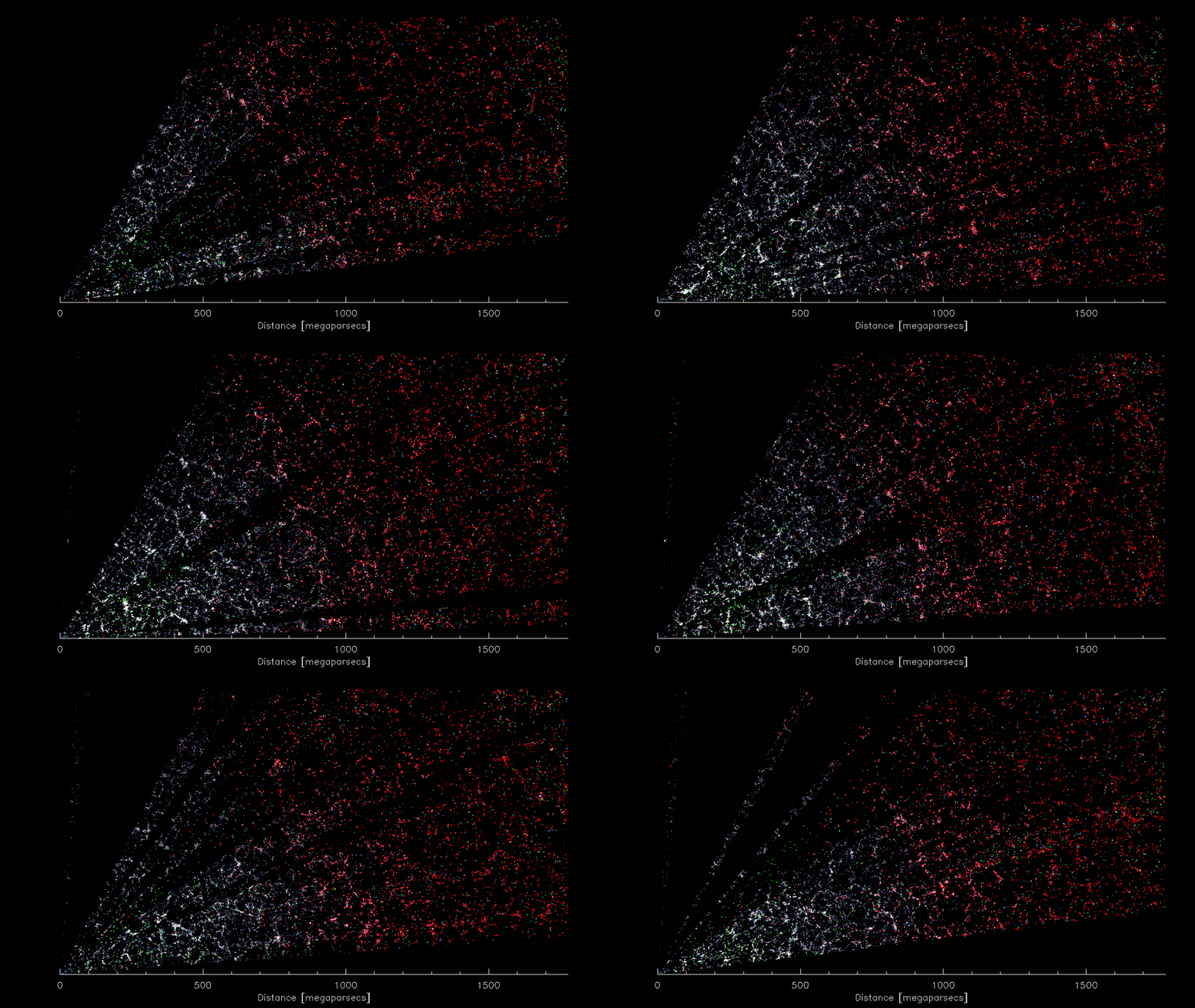
After just seven months of operations of the Dark Energy Spectroscopic Instrument (DESI) we now have the largest galaxy redshift survey – and it’s only about 10% of the way through its 5-year programme. Currently mapping the positions of about 7.5 million galaxies, the map will contain over 35 million by the time the survey is complete. Even now it is larger than all previous spectroscopic galaxy redshift surveys put together. The speed of DESI is accounted for by its use of 5000 robotically-positioned fibre-optic cables that can generate spectra of thousands of galaxy from a single pointing of the 4-m telescope on which it is mounted.

You can read more about the latest results from DESI here. I’ll just whet your appetite with this groovy animated picture:

DESI’s three-dimensional “CT scan” of the Universe. We are at in the lower left, looking out over 5 billion light years in the direction of the constellation Virgo. As the video progresses, the perspective sweeps toward the constellation Bootes. Each colored point represents a galaxy; gravity has pulled the galaxies into a “cosmic web” of dense clusters, filaments and voids. (Credit: D. Schlegel/Berkeley Lab using data from DESI)

The twinkling effect arises from the fact that you are viewing different thin slices through the 3D distribution. The dark sections that appear and disappear from time to time are just bits not yet included in the survey.

For those of you not familiar with astronomical distance measurements, 1500 megaparsecs = 1.5 Gigaparsecs = 4.5 billion light years (approximately), so this map is not only mapping the spatial distribution of galaxies but also how this distribution has evolved with cosmic time over billions of years.

First Light at the Dark Energy Spectroscopic Instrument

Posted in The Universe and Stuff with tags , , , , , , on November 4, 2019 by telescoper

While I was away last week there was quite a lot of press coverage (e.g. here) about the new Dark Energy Spectroscopic Instrument, which has just seen first light. I didn’t have time to mention this until now, and in any case  I have little to add to the coverage that has already appeared, but it does give me the excuse to post this nice video – which features quite a few people I actually know! – to describe  the huge galaxy survey that DESI will perform. It’s hard to believe that when I started in the field in 1985 the largest such survey, which took several years to compile, had only a few thousand galaxies in it. The DESI instrument will be able to determine spectra of more sources than that in a single pointing of the telescope that lasts about 20 minutes. Overall it should determine redshifts of over 35 million galaxies! Vorsprung durch Technik.