Archive for deep-learning

Weekly Update from the Open Journal of Astrophysics – 15/02/2025

Posted in OJAp Papers, Open Access, The Universe and Stuff with tags , , , , , , , , , , on February 15, 2025 by telescoper

Time for another quick update of papers published at the Open Journal of Astrophysics. Since the last update we have published two new papers, which brings the number in Volume 8 (2025) up to 14 and the total so far published by OJAp up to 249.

Here are quick descriptions of the two papers concerned; you can click on the images of the overlays to make them larger should you wish to do so.

First one up is “AI-assisted super-resolution cosmological simulations IV: An emulator for deterministic realizations” by Xiaowen Zhang & Patrick Lachance (Carnegie Mellon), Ankita Dasgupta (Penn State), Rupert A. C. Croft & Tiziana Di Matteo (Carnegie Mellon), Yueying Ni (Harvard), Simeon Bird (UC Riverside) and Yin Li (Shenzhen University, China).  It presents a method of achieving super-resolution to rapidly enhance low-resolution runs with statistically correct fine details to generate accurate simulations and mock observations for large galaxy surveys and was published on Monday 10th February 2025 in the folder marked Cosmology and NonGalactic Astrophysics.


You can find the officially accepted version of this paper on arXiv here.

The second paper, published on Friday 14th February 2025 in the folder Instrumentation and Methods for Astrophysics is “The Blending ToolKit: A simulation framework for evaluation of galaxy detection and deblending” which describes a modular suite of Python software for exploring and analyzing systematic effects related to blended galaxy images in cosmological surveys. It was written by Ismael Mendoza (U. Michigan, Ann Arbor, USA) and 19 others, on behalf of the LSST Dark Energy Science Collaboration. I don’t have time to list all the authors here but you can find them on the overlay here:
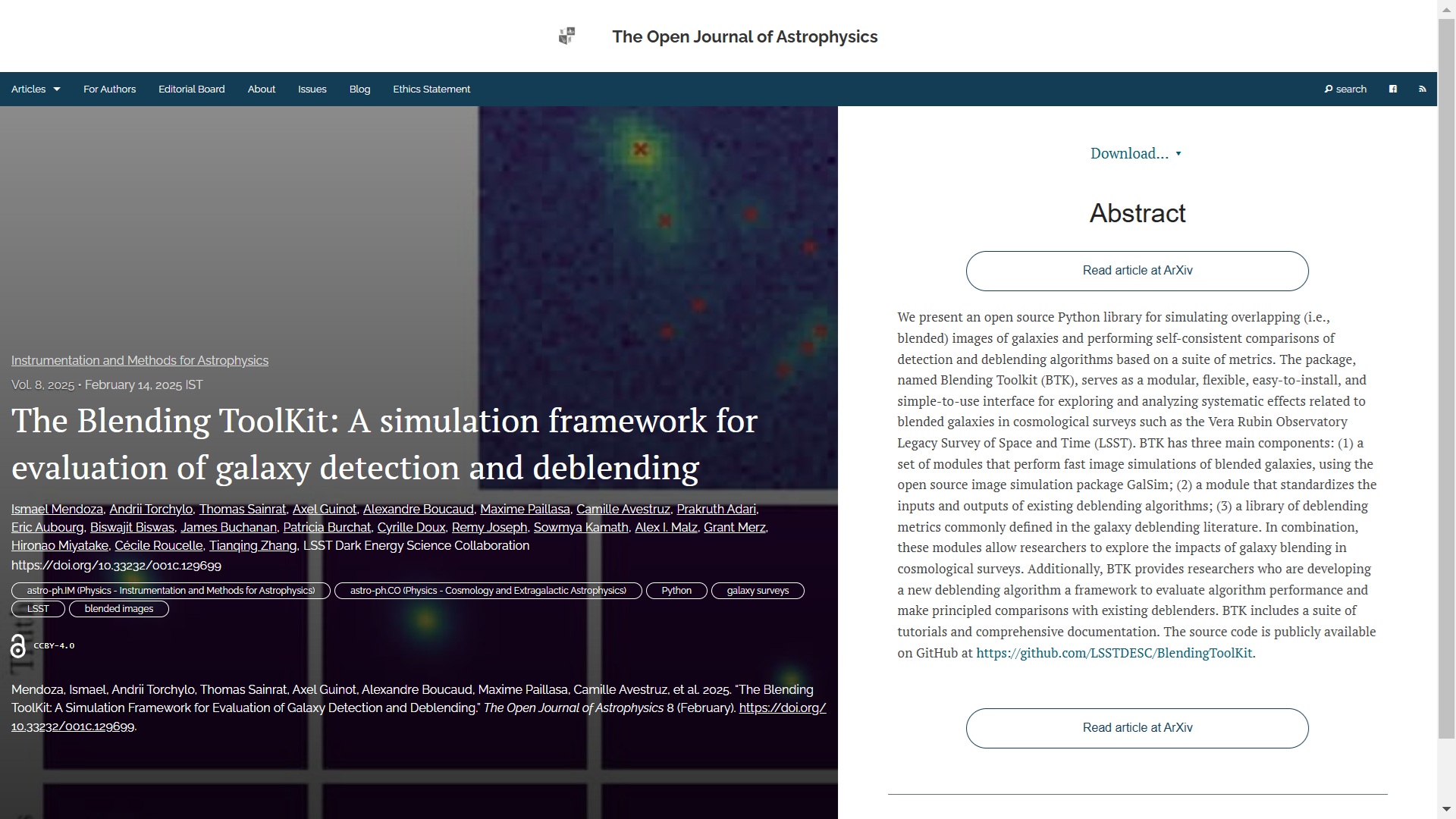


The accepted version of this paper can be found on the arXiv here.

That’s all for this week. I’ll do another update next week, when I expect to be able to report that we have passed the 250 publication mark.

Is machine learning good or bad for the natural sciences?

Posted in The Universe and Stuff with tags , , , , , , , on May 30, 2024 by telescoper

Before I head off on a trip to various parts of not-Barcelona, I thought I’d share a somewhat provocative paper by David Hogg and Soledad Villar. In my capacity as journal editor over the past few years I’ve noticed that there has been a phenomenal increase in astrophysics papers discussing applications of various forms of Machine Leaning (ML). This paper looks into issues around the use of ML not just in astrophysics but elsewhere in the natural sciences.

The abstract reads:

Machine learning (ML) methods are having a huge impact across all of the sciences. However, ML has a strong ontology – in which only the data exist – and a strong epistemology – in which a model is considered good if it performs well on held-out training data. These philosophies are in strong conflict with both standard practices and key philosophies in the natural sciences. Here, we identify some locations for ML in the natural sciences at which the ontology and epistemology are valuable. For example, when an expressive machine learning model is used in a causal inference to represent the effects of confounders, such as foregrounds, backgrounds, or instrument calibration parameters, the model capacity and loose philosophy of ML can make the results more trustworthy. We also show that there are contexts in which the introduction of ML introduces strong, unwanted statistical biases. For one, when ML models are used to emulate physical (or first-principles) simulations, they introduce strong confirmation biases. For another, when expressive regressions are used to label datasets, those labels cannot be used in downstream joint or ensemble analyses without taking on uncontrolled biases. The question in the title is being asked of all of the natural sciences; that is, we are calling on the scientific communities to take a step back and consider the role and value of ML in their fields; the (partial) answers we give here come from the particular perspective of physics

arXiv:2405.18095

P.S. The answer to the question posed in the title is probably “yes”.