Back in the 1940s, early in his career, trumpeter Dizzy Gillespie incorporated the theme from a tune called Be-Bop, or sometimes Dizzy’s Fingers, into a swirling big band arrangement and called the resulting piece Things to Come. It was a wild, gyrating score usually played at breakneck speed (often around 300bpm) that invariably proved a handful to perform. The Things Are Here is the eventual sequel to that composition that the Dizzy Gillespie Reunion Big Band played in the 1960s. Many concert performances of this are very long indeed, but this one (recorded in Berlin in 1968) lasts only about 8 minutes. I have this on vinyl but haven’t get got around to transferring it to digital. Here you hear the stunning power and virtuosity of this thrilling band; there must have been a tough entrance examination to get a place in it!
As you’d expect there’s a lot of solo space in this performance for Gillespie himself, but also room for solos and duets from the other musicians, including James Moody and Paul Jeffrey on tenor saxophone, Sahib Shihab on alto saxophone, Cecil Payne on baritone sax, Curtis Fuller on trombone and, right at the end, Otis Finch brings the house down with a drum solo.
It’s a wild, white-knuckle ride, so strap yourself in!
I’ve just caught up with the news of the death last week of composer, arranger and pianist Lalo Schifrin. He was 93. Most of the media coverage of his passing concentrates on his many excellent TV and movie scores, such as Mission Impossible*, Dirty Harry and Bullitt, but he was first and foremost a Jazz musician so I thought I’d pay tribute by posting a relatively early work by him.
Lalo Schifrin was a huge fan of trumpeter Dizzy Gillespie whom he met when Gillespie toured Schifrin’s home country of Argentina in 1956. This long piece, Gillespiana was written for Gillespie’s big band in 1958. You can here in it many of the musical ideas that Schifrin was later to include in his film scores. In 1960, Lalo Schifrin moved to York and joined Gillespie’s band as a pianist after the departure of Junior Mance. He only stayed with the band for a couple of years but together they made some great records, especially Dizzy on the French Riviera (which I have blogged about here).
Anyway, Gillespiana is suite in five movements (Prelude, Blues, Panamerica, Africana, and Toccata) that takes up an entire album that was released in 1960. It’s not so well known nowadays but I think it’s great. It gives ample opportunity not only to listen to Dizzy’s trumpet and Lalo Schifrin’s piano – as well as the enormously underrated alto saxophonist and flautist Leo Wright – but also to enjoy the wonderful arrangements.
*The original theme for Mission Impossible is written in 5/4 time. Not a lot of people know that the resulting rhythmic pattern (dash dash dot dot) is Morse code for the letters M I…
I was very sad to hear of the death yesterday (12th November) at the age of 99 of legendary jazz drummer Roy Haynes, one of the last survivors of the bebop era of the 1940s. Roy Haynes had a career that was not only exceptionally long but also exceptionally prolific: just look at the discography on his Wikipedia page! If I can add a personal note, he features on the first ever Charlie Parker LP I bought when I was about 15 and which I still have. I bought it on impulse, not really knowing who Charlie Parker was, was this record that turned me onto his music and I’ve never turned off.
No information is provided on Youtube, but the sleeve note reveals that the track was recorded from a radio broadcast live from Birdland in New York City on March 31st 1951 using a primitive disc recording machine by an amateur recording buff called Boris Rose. The sound quality isn’t great, but he deserves much greater recognition for capturing this and so many other classic performances and preserving them for posterity.
The personnel consists of Charlie Parker (alto saxophone), Dizzy Gillespie (trumpet), Bud Powell (piano), Tommy Potter (bass) and Roy Haynes (drums).
Here’s what the sleevenote (written by Gary Giddens) says about this track:
“Anthropology is an “I Got Rhythm” variation which originally appeared, in a slightly different form, as “Thriving on a Riff” on Parker’s first session as leader. The tempo is insanely fast; the performance is stunning. Bird has plenty of ideas in his first chorus, but he builds the second and third around a succession of quotations: “Tenderly”, “High Society”, “Temptation.” Gillespie’s second chorus is especially fine – only Fats Navarro had comparable control among the trumpeters who worked with Bird. His blazing high notes tend to set his lyrical phrases in bold relief. Bud, the ultimate bop pianist (and much more), jumps in for two note-gobbling choruses: no quotes, though, it’s all Powell. The four bar exchanges that follow demonstrate Haynes’s precision.
It’s a very exciting track not least because of the contributions of Roy Haynes, not only in the chase sequence mentioned in that quote but throughout the track where he demonstrates tremendous energy and imagination as well as control at such a high tempo.
Rest in peace, Roy Haynes (1925-2024), one of the greatest of all jazz drummers.
I couldn’t resist sharing this piece I found on YouTube a while ago and have listened to many times. It’s amazing how many of my favourite jazz performances date from 1958, and here’s another. It’s the Dizzy Gillespie Quintet of that year featuring the great Sonny Stitt on tenor saxophone, given plenty of space by leader Dizzy Gillespie who takes the second solo on trumpet. The tune is called Blues Walk, although it is sometimes known by the alternative title Loose Walk and as such appeared on the classic film Jazz on a Summer’s Day which also featured Stitt on tenor, though with a quite different band. Note the presence of the great Ray Brown on bass and Lou Levy on piano. The drummer, Gus Johnson, is much less well known but plays very well on this.
If anyone could claim to be a direct musical descendant of Charlie Parker then it was Sonny Stitt, who demonstrates his amazing drive and technical ability in a tremendous solo on this tune, the last number performed at a concert in Belgium. Listen to the chorus that starts about 1:30. Wow! They don’t call this style “hard bop” for nothing!
Today’s high temperatures provide me with an excuse to post my favourite hot-weather music, the 1962 album Dizzy on the French Riviera. Can this really have been recorded 60 years ago?
Anyway, the album features the great Dizzy Gillespie Quintet of that time which was heavily influenced by Latin American sounds and had Argentinian Lalo Schifrin on piano, a man best known as a prolific composer of film and TV scores. The band also featured Leo Wright, a very under-rated saxophonist and flautist, and is augmented on some of the tracks by various percussionists. I have lost track of the number of times I’ve listened to the happy seaside sounds of children playing leading into to the opening track No More Blues…
One of the things I did during my recent visit to Wales was to pack up my old vinyl LPs for removal to Ireland. I have quite a lot of them on digital formats now but that’s not true of all of them so I’m looking forward to listening to the others very soon.
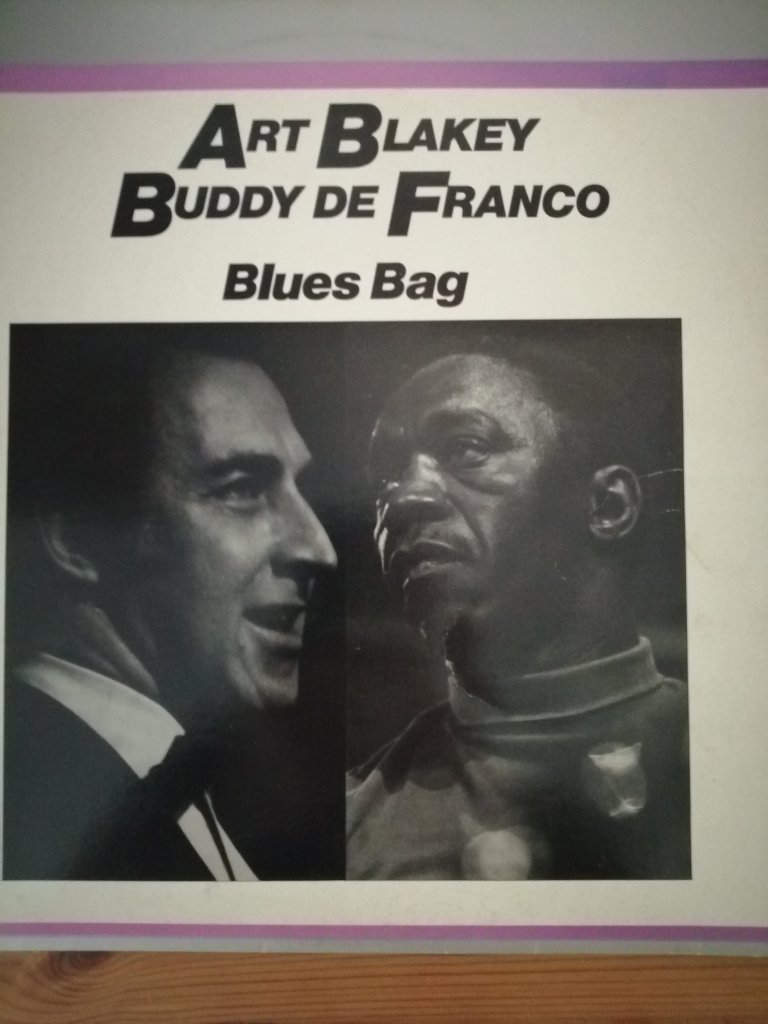
I bought this particular album Blues Bag as a curiosity as it features the unlikely combination of Buddy De Franco on clarinet (bass clarinet on several tracks, including the one below) and Art Blakey on drums.
Whatever I thought the combination of the smooth style and impeccable technical virtuosity of Buddy De Franco with the powerful and aggressive drum foundryman Art Blakey would be like before I bought the LP, when I first heard it the thing that struck me was how superbly they complemented each other.
Anyway, I thought I would post a track so you can decide what you think. This is Dizzy Gillespie tune called Kush. I think this version is great, with very fine work on the drums by Blakey.
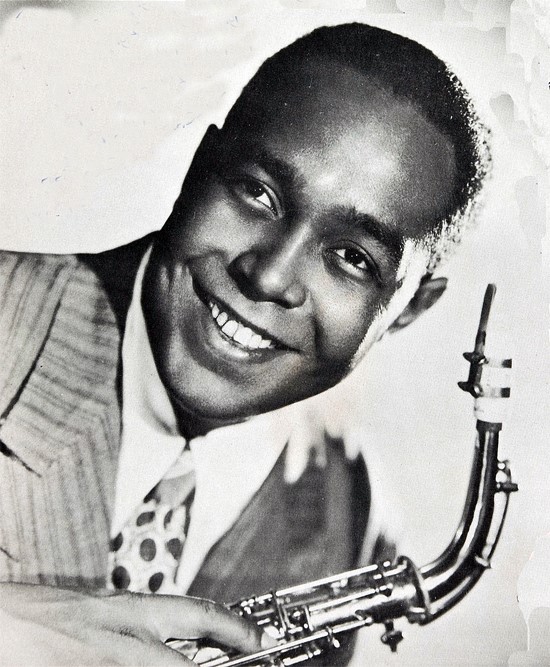
Here is another bit of music to celebrate the 100th anniversary of the birth of the great saxophonist Charlie Parker (“Bird”) on 29th August 1920.
I’ve written quite a few posts relating to Charlie Parker over the years but today has provided a good excuse to spend my lunchtime writing another one, this time featuring one of my favourite tracks from one of my favourite albums. First released in 1952 but in fact recorded in two separate sessions in 1949 and 1950, the album Bird and Diz was actually the last studio album made under the joint leadership of Charlie Parker and Dizzy Gillespie, the two main architects of the bebop revolution; the track I’ve picked has the added advantage of featuring another great musical genius on piano, Thelonious Monk.
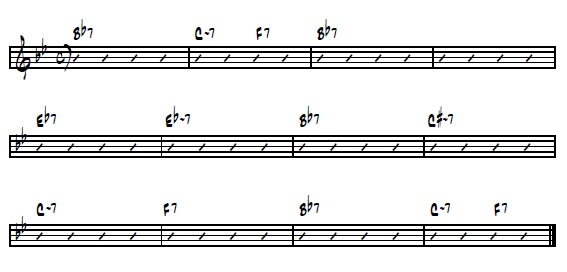
The Charlie Parker composition Bloomdido is yet another of his variations on the blues, though this one is a bit less intricate than some of the others he wrote. Here are the chords for Bloomdido:
You can see that the progression is based around the standard three chords of a blues in B♭. The foundation is a “tonic” chord (T) based on the root note of whatever key it’s played in, in this case B♭. This sometimes a basic triad consisting of the first, third and five notes of a major scale starting on that note or, as in this example, including the dominant 7th so it’s B♭7. The next chord is the subdominant chord (S), shifting things up by a perfect fourth relative to the tonic, in this case an E♭7 and then finally we have the dominant (D) which brings us up by a fifth from the original root note, in this case F7.
The basic blues sequence in B♭ would be four bars of B♭7 (T), two of E♭7 (S), back to B♭7 (T) for two, then the characteristic bluesy cadence returning to two bars of B♭7 (T) via one bar each of F7 (D) and E♭7 (S). The sequence for Bloomdido has a few alterations, including a characteristic turnaround at the end, but is otherwise fairly recognizable. I guess the first part of the title is a play on the blues origin too, though I wonder if the second part suggests that some of the alterations are inspired by the A-section of the Juan Tizol standard Perdido?
Some people tell me they find Charlie Parker’s music “too technical” and that somehow if music “needs to be explained” it’s not good music. I don’t understand that attitude at all. I find this music so fascinating and exciting to listen to that I want to try to dig a little bit into it and find out what’s going underneath the surface. It’s particularly striking what a difference a few substitutions and passing chords can make to the overall harmonic “feel” of a piece like this compared to a standard blues sequence, for example. But you don’t need to study the chords to appreciate the sheer beauty of the music that Charlie Parker built on these harmonic foundations; his solo on this track, as on so many others he recorded in his short life, is just sublime even if you don’t realise how hard it is to play! I guess it all depends whether your way of enjoying a thing is to sit back and let it wash over you, or for it to inspire you to find out more. Many of the physicists I know are deeply interested in music. Perhaps that’s because they’re the sort of people who don’t just think “wow that’s beautiful”, they tend to think “wow that’s beautiful – how does it work?”.
Charlie Parker and Albert Einstein died in the same year, just over a month apart, the former in March 1955 and the latter in April. They were two very different geniuses but it’s as difficult to imagine physics without Einstein as jazz without Bird.
For my next piece in celebration of the centenary of the birth of Charlie Parker I thought I’d pick a classic live performance from May 15th 1953 at Massey Hall in Toronto. Originally released as a vinyl LP with only 6 tracks on it, and called The Quintet of the Year, but subsequently re-released in various versions on CD, with various titles including Jazz at Massey Hall. The whole concert is available on Youtube here:
This concert was planned to unite the greatest stars of the bebop era who had performed together earlier in their careers but had gradually evolved different styles over the intervening years. The line-up is Charlie Parker on alto, Dizzy Gillespie on trumpet, Bud Powell on piano, Charles Mingus on bass and the great Max Roach on drums which is stellar by any criterion!
Gatherings of star jazz players have often turned out to be disappointing, largely because very great musicians can sometimes interfere negatively rather than positively with each other, not necessarily consciously but because they can have ideas incompatible with one another. This evening, however, was a glorious exception to this rule, doubtless because all the musicians had worked together in the past, and their subsequent individual development had not taken them too far beyond their shared musical background. It is true that the ensemble passages are slight, but that doesn’t matter much because the solos are of such a remarkable and consistently high standard. Charlie Parker turns in some of the very best of his later recorded work, giving the lie to those who argue that his musical abilities were in decline at this time. He might not play as elegantly as he did on the classic Dial and Savoy sessions, but he is significantly more adventurous, with startling melodic contrasts in much of his work. At times this is a bit of a problem in that he seems to full of ideas that what comes out is a sequence of breathtaking fragments rather than a cohesive solo. This happens on A Night in Tunisia, for example, which never quite fulfills the promise of its magnificent opening break. On other tracks, though, especially Hot House his improvisations are just brilliant. It’s hard to imagine listening to this that in less than two years he would be dead.
Dizzy Gillespie matches Parker in superb fashion, betraying none of the offhandedness that often afflicted his later recorded performances, and the pyrotechnical quality of his playing is as exhilarating as it is instantly recognizable. Gillespie was an extrovert on stage and his frequent dancing around on the stage results in him going on and off mike from time to time, but it doesn’t detract from the performance once you realize why he’s fading in and out. It is, after all, a live performance and if you shut your eyes you can imagine Dizzy Gillespie the showman without any difficulty at all!
Most Jazz reviewers confine their comments on the rhythm section to a few kind words, but in this case that would be a travesty. The limitations of live recording technology in 1953 result in a rather unbalanced mix, but the flip side of that is that you can hear particularly well the pivotal importance of the bass playing of Charles Mingus. Between them Mingus and Max Roach lay down a relentlessly propulsive beat as well as taking gripping solos; the drum workouts in Wee and Salt Peanuts are astonishing in their interplay of rhythm and texture. Trumping even them, however, is the genius of Bud Powell who plays at a level consistently high even by his own standards.
Bud Powell is a fascinating musician for many reasons. Much less of a formalist than many Jazz pianists he nevertheless seems to generate a real sense of unity, more through the emotional drive underpinning his phrases than by imposing any set structure on his improvisations. His solo on Wee offers a fine example of this: moving inexorably towards a shattering climax as the right hand figures vary ceaselessly in their length and the chords punched out by the left hand grow more frequent and more percussive.
This album is another must-have for any serious collector of post-War jazz. The individual parts are all superb, but the whole is even greater than their sum.
PS. I had the pleasure of attending a concert at Massey Hall myself, when I was on sabbatical in Toronto in 2005/6.
Today marks the 100th anniversary of the birth of the great Charlie Parker, who was known to his friends as “Bird”. I’ve posted more than a few examples of Charlie Parker’s music over the years so I thought I’d celebrate the centenary with a bit of a flood.
I thought I’d start with this clip (inevitably without video I’m afraid) is in fact taken from the first ever Charlie Parker LP I bought when I was about 15 and which I still have. I bought it on impulse, not really knowing who Charlie Parker was, was this record that turned me onto his music and I’ve never turned off.
No information is provided on Youtube, but referring to the sleeve note reveals that the track was recorded from a radio broadcast live from Birdland in New York City on March 31st 1951 using a primitive disc recording machine by an amateur recording buff called Boris Rose. The sound quality isn’t great, but he deserves much greater recognition for capturing this and so many other classic performances and preserving them for posterity.
The personnels consist of Charlie Parker (alto saxophone), Dizzy Gillespie (trumpet), Bud Powell (piano), Tommy Potter (bass) and Roy Haynes (drums).
Here’s what the sleevenote (written by Gary Giddens) says about this track:
“Anthropology is an “I Got Rhythm” variation which originally appeared, in a slightly different form, as “Thriving on a Riff” on Parker’s first session as leader. The tempo is insanely fast; the performance is stunning. Bird has plenty of ideas in his first chorus, but he builds the second and third around a succession of quotations: “Tenderly”, “High Society”, “Temptation.” Gillespie’s second chorus is especially fine – only Fats Navarro had comparable control among the trumpeters who worked with Bird. His blazing high notes tend to set his lyrical phrases in bold relief. Bud, the ultimate bop pianist (and much more), jumps in for two note-gobbling choruses: no quotes, though, it’s all Powell. The four bar exchanges that follow demonstrate Hayne’s precision.
Spot on, but words aren’t really enough to describe this scintillating music, so listen!
It behoves me to spend most of this evening at a postgraduate Open Evening here at Maynooth University so I thought I’d take a little tea break and post a bit of Jazz.
This recording, made in 1954, is from one of the famous `All-Star’ jam sessions organized by impresario Norman Granz. These are fascinating for jazz fans because they provide a rare opportunity to hear extended solos from great musicians, not confined to the usual three-minute 78rpm records of the period. This one is almost half an hour long altogether, and was originally issued in two parts (on either side of an LP record) so there’s a rather clumsy edit half way through. There are also a few jumps on the record, but I don’t think they spoil this classic too much.
Norman Granz liked to select contrasting musicians for these spontaneous recordings and this line-up was clearly intended to juxtapose modernist trumpeter Dizzy Gillespie with his boyhood inspiration Roy Eldridge. It is indeed fascinating to hear them play one after the other, but the star of this show for me is the great clarinettist Buddy De Franco whose solo is absolutely superb – few Jazz clarinettists are able to match his control in the upper register. The other musicians clearly enjoy his solo too; I’m pretty sure that it’s Dizzy Gillespie you can hear delivering the encouraging shouts as De Franco gets into full flood.
The soloists (in order) are: Flip Phillips (tenor sax); Bill Harris (trombone); Buddy De Franco (clarinet); Oscar Peterson (piano); Herb Ellis (guitar); Dizzy Gillespie (trumpet); and Roy Eldridge (trumpet). The other musicians providing rhythm accompaniment are Ray Brown (bass) and Louie Bellson (drums). That’s not a bad band is it?
The tune played here is the swing era standard Stomping at the Savoy which is a good choice for this kind of jam session because (a) everyone knows it (b) the melody is quite simple, and (c) it has interesting chords for the musicians to improvise over. It is in standard 32-bar AABA format with a relatively simple A section (Db6, Ab9, Db6, Ddim, Ebm7, Ab7, Db, Db) but has a B section (bridge) with considerable chromatic embellishment (Gb9/G9, Gb9, B13/F#m6, B13, E9/F9, E9, A13, Ab9b); these are assuming that it is played in Db. It’s fascinating to hear how each of the soloists navigates the middle eight on this record.
Stomping at the Savoy is usually played a bit faster than it is here, but I like this beautifully relaxed and comfortably swinging tempo.
UPDATE: By an amazing coincidence*, Part 1 of this session was played by Bernard Clarke last night on The Blue of the Night (at about 10.30).
*It’s not a complete coincidence, as we had an exchange on Twitter about it a while ago and he said he would try to play it sometime – it was nevertheless a surprise that he played it on exactly the same day as I posted this!
The views presented here are personal and not necessarily those of my employer (or anyone else for that matter).
Feel free to comment on any of the posts on this blog but comments may be moderated; anonymous comments and any considered by me to be vexatious and/or abusive and/or defamatory will not be accepted. I do not necessarily endorse, support, sanction, encourage, verify or agree with the opinions or statements of any information or other content in the comments on this site and do not in any way guarantee their accuracy or reliability.


 In the Dark