Archive for downsizing

Weekly Update from the Open Journal of Astrophysics – 15/11/2025

Posted in OJAp Papers, Open Access, The Universe and Stuff with tags , , , , , , , , , , , , , , , , , , , , , , , , , , , , , on November 15, 2025 by telescoper

It’s Saturday again, so it’s time for the usual update of the week’s new papers at the Open Journal of Astrophysics. It has been quite a busy week. Since the last update we have published another seven papers, which brings the number in Volume 8 (2025) up to 175, and the total so far published by OJAp up to 410.

First on the menu for this week is “Dynamical friction and measurements of the splashback radius in galaxy clusters” by Talia M. O’Shea (U. Wisconsin-Madison, USA), Josh Borrow & Stephanie O’Neil (U. Pennsylvania, USA) and Mark Vogelsberger (MIT, USA). Published on Tuesday 11th November in the folder Cosmology and NonGalactic Astrophysics, this one presents a study suggesting that dynamical friction does not play a major role in reducing the radius of the splashback feature in real data compared to numerical simulations.

The overlay is here:
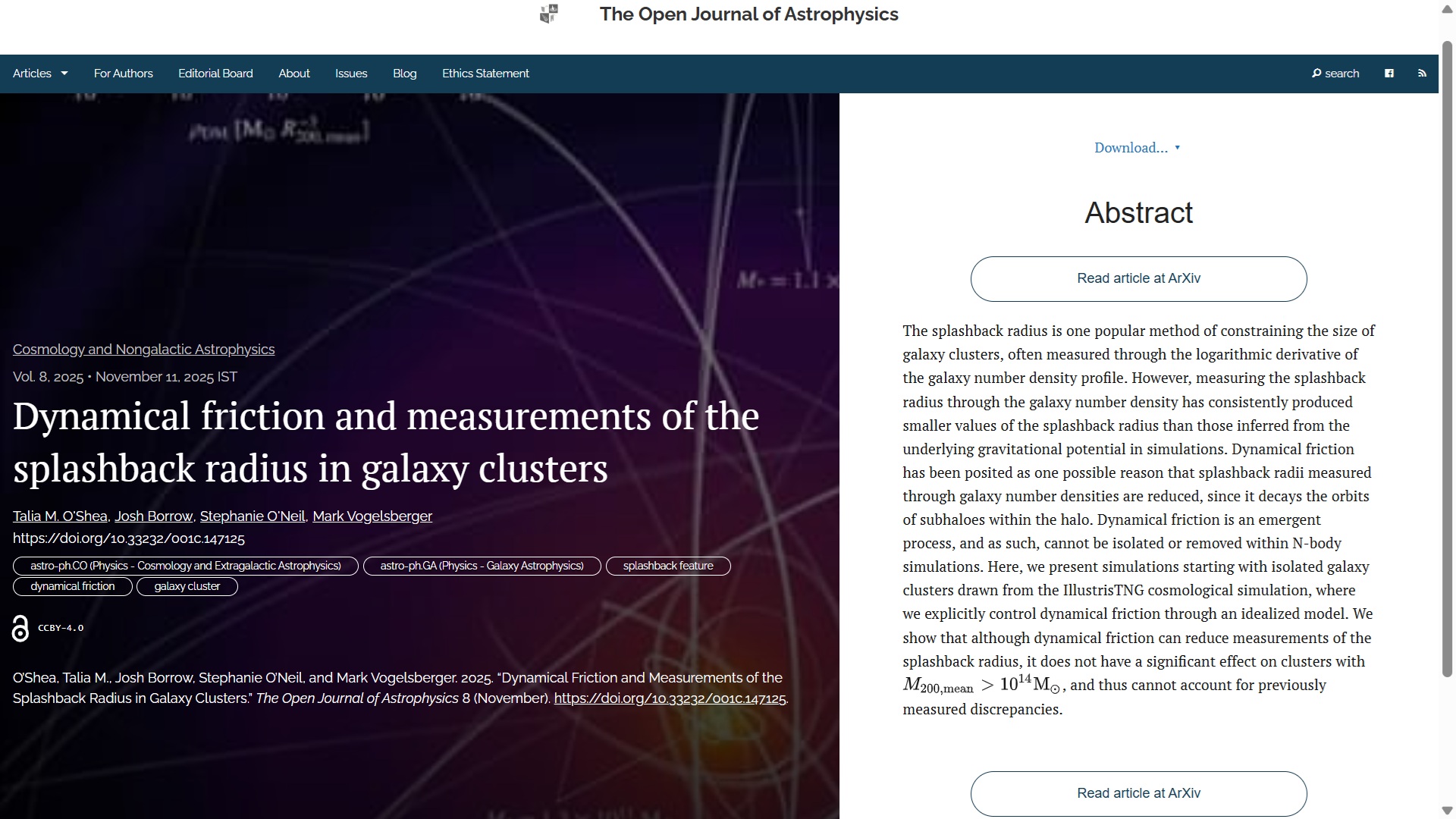
You can find the officially accepted version on arXiv here.

The Fediverse announcement is here:

Open Journal of Astrophysics

New Publication at the Open Journal of Astrophysics: "Dynamical friction and measurements of the splashback radius in galaxy clusters" by Talia M. O'Shea (U. Wisconsin-Madison, USA), Josh Borrow & Stephanie O'Neil (U. Pennsylvania, USA) and Mark Vogelsberger (MIT, USA)

doi.org/10.33232/001c.147125

November 11, 2025, 8:36 am 3 boosts 1 favorites


The second paper of the week is “Microlensing of lensed supernovae Zwicky & iPTF16geu: constraints on the lens galaxy mass slope and dark compact object fraction” by Nikki Arendse (Stockholm University, Sweden) and and international cast of 11 others based in Sweden, UK and France. This one was published on 11th November 2025 in the folder Astrophysics of Galaxies. It is about combining observations of two supernovae, iPTF16geu and SN Zwicky, with microlensing magnification maps to probe the properties of the lens galaxy.

The overlay is here:
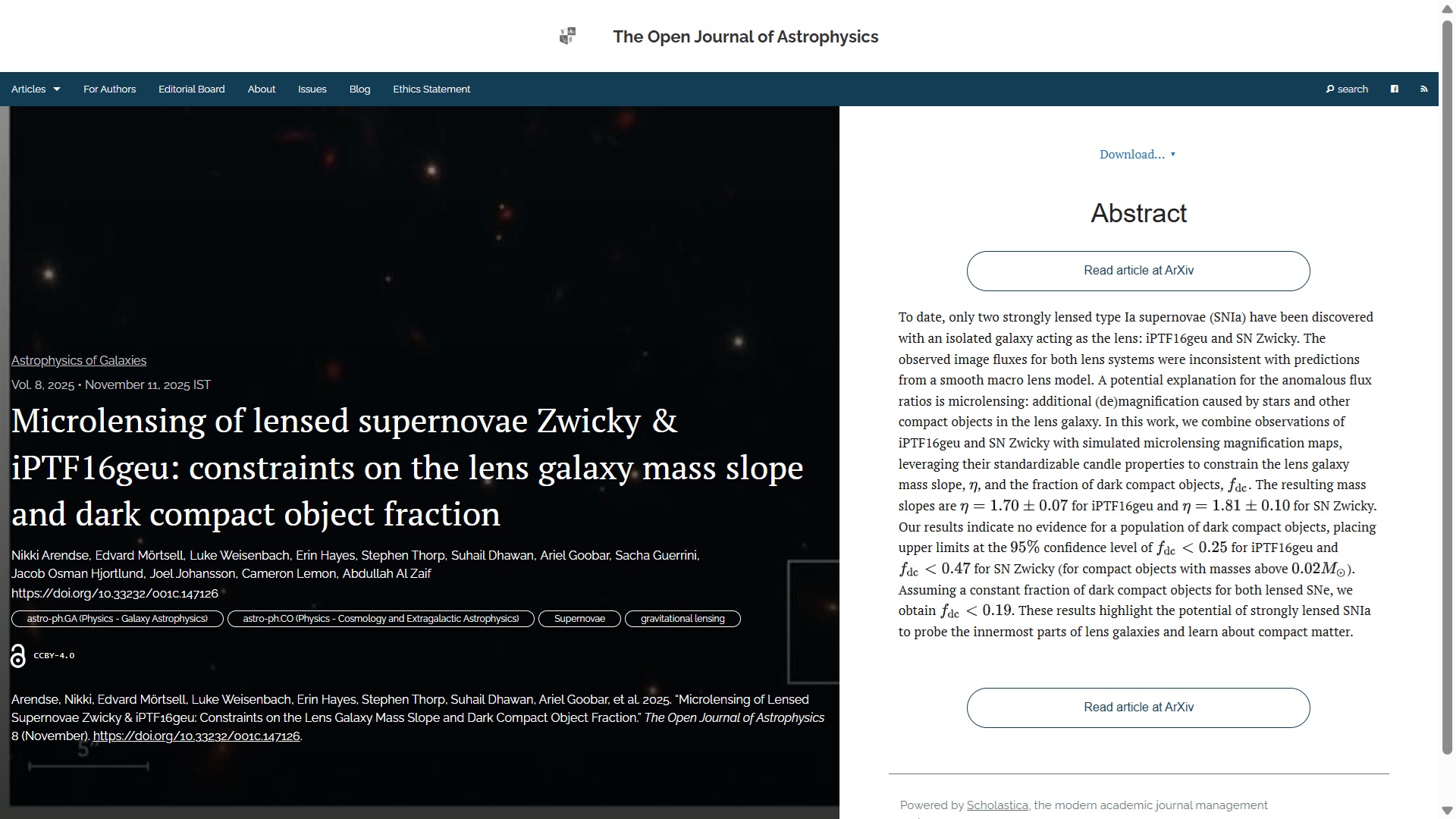
 

You can find the official version of this one on arXiv here. The federated announcement on Mastodon is here:

Open Journal of Astrophysics

New Publication at the Open Journal of Astrophysics: "Microlensing of lensed supernovae Zwicky & iPTF16geu: constraints on the lens galaxy mass slope and dark compact object fraction" by Nikki Arendse (Stockholm University, Sweden) and 11 others based in Sweden, UK and France

doi.org/10.33232/001c.147126

November 11, 2025, 8:53 am 1 boosts 1 favorites


Next one up is “Neutrino Constraints on Black Hole Formation in M31” by Yudai Sawa (U. Tokyo, Japan) and 11 others all based in Japan. This was published on Tuesday 11th November in the folder High-Energy Astrophysical Phenomena. It presents a calculation of the neutrino emission expected from the collapse of massive stars and its use in constraining black hole formation using neutrino detectors.


The overlay is here:
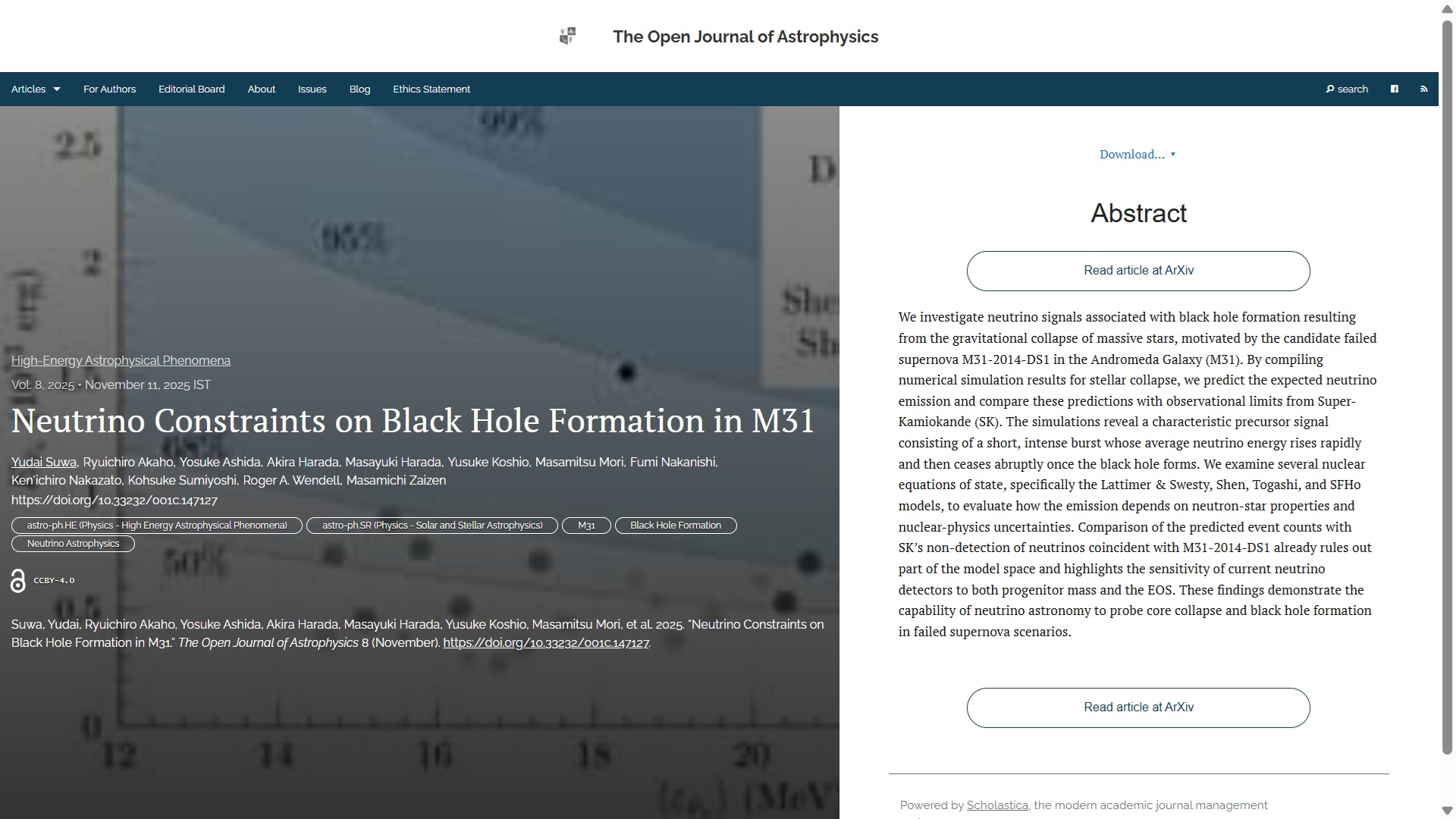
You can find the official accepted version on arXiv here. The fediverse announcement is here:

Open Journal of Astrophysics

New Publication at the Open Journal of Astrophysics: "Neutrino Constraints on Black Hole Formation in M31" by Yudai Sawa (U. Tokyo, Japan) and 11 others all based in Japan

doi.org/10.33232/001c.147127

November 11, 2025, 9:04 am 0 boosts 1 favorites

The fourth paper this week is “Redshift Drift in Relativistic N-Body Simulations” by Alexander Oestreicher (U. Southern Denmark, DK), Chris Clarkson (QMUL, UK), Julian Adamek (U. Zürich, CH) and Sofie Marie Koksbang (U. Southern Denmark, DK). This one was published on Wednesday 12th November in the folder marked Cosmology and NonGalactic Astrophysics. It presents numerical calculations of the cosmological redshift drift effect for comparison with future surveys.

The overlay is here:
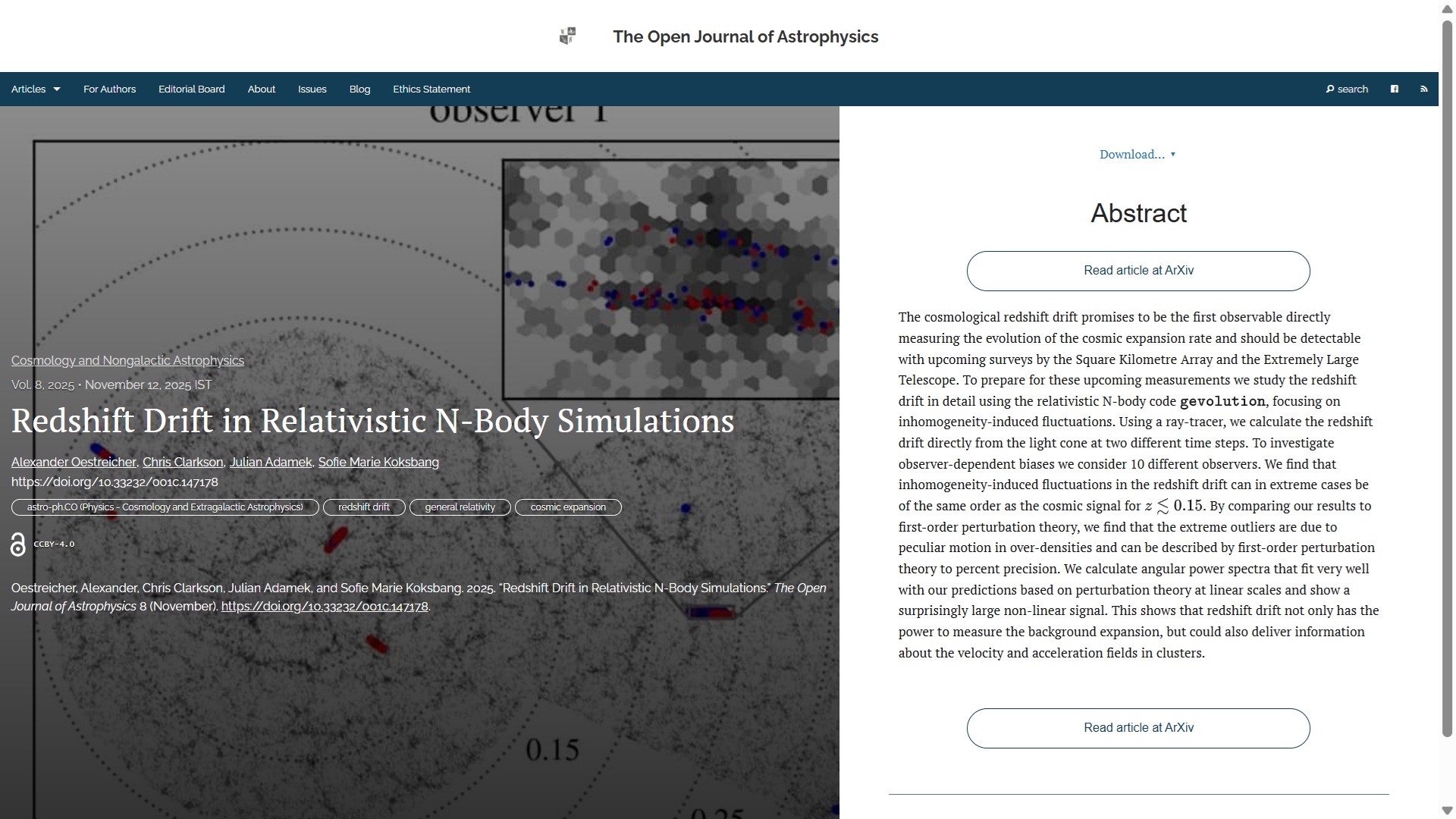


You can find the official published version on arXiv here. The Fediverse announcement follows:

Open Journal of Astrophysics

New Publication at the Open Journal of Astrophysics: "Redshift Drift in Relativistic N-Body Simulations" by Alexander Oestreicher (U. Southern Denmark, DK), Chris Clarkson (QMUL, UK), Julian Adamek (U. Zürich, CH) and Sofie Marie Koksbang (U. Southern Denmark, DK)

doi.org/10.33232/001c.147178

November 12, 2025, 8:35 am 1 boosts 0 favorites


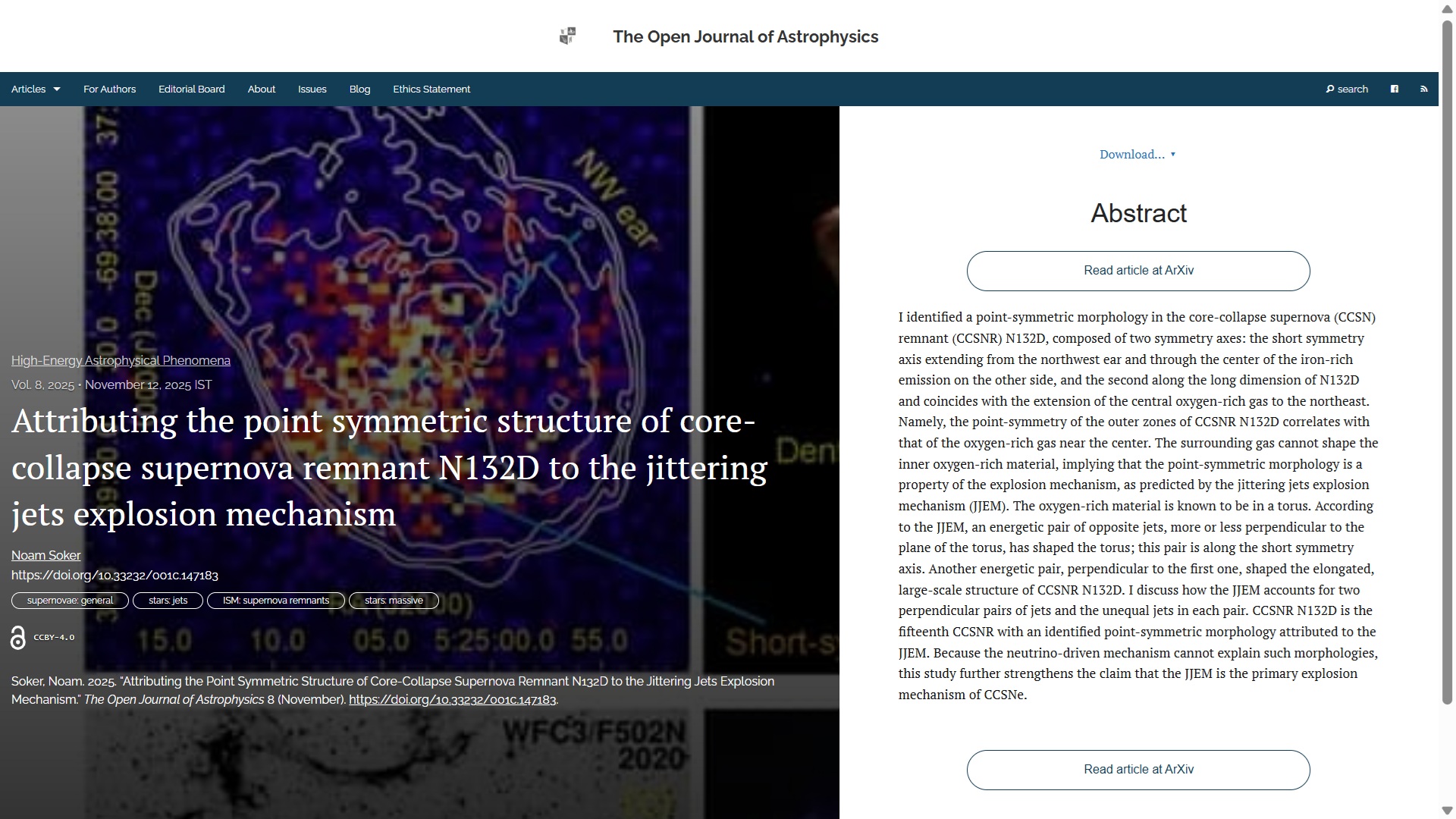
The fifth paper for this week is “Attributing the point symmetric structure of core-collapse supernova remnant N132D to the jittering jets explosion mechanism” by Noam Soker (Technion, Haifa, Israel). This one, published on Wednesday November 12th in the folder High-Energy Astrophysical Phenomena, presents a discussion of the morphology of a supernova remnant and possible explanation for it in terms of the explosion mechanism.

The overlay is here:
 

The officially accepted version can be found on arXiv here. The Fediverse announcement is here:

Open Journal of Astrophysics

New Publication at the Open Journal of Astrophysics: "Attributing the point symmetric structure of core-collapse supernova remnant N132D to the jittering jets explosion mechanism" by Noam Soker (Technion, Haifa, Israel)

doi.org/10.33232/001c.147183

November 12, 2025, 8:46 am 1 boosts 0 favorites

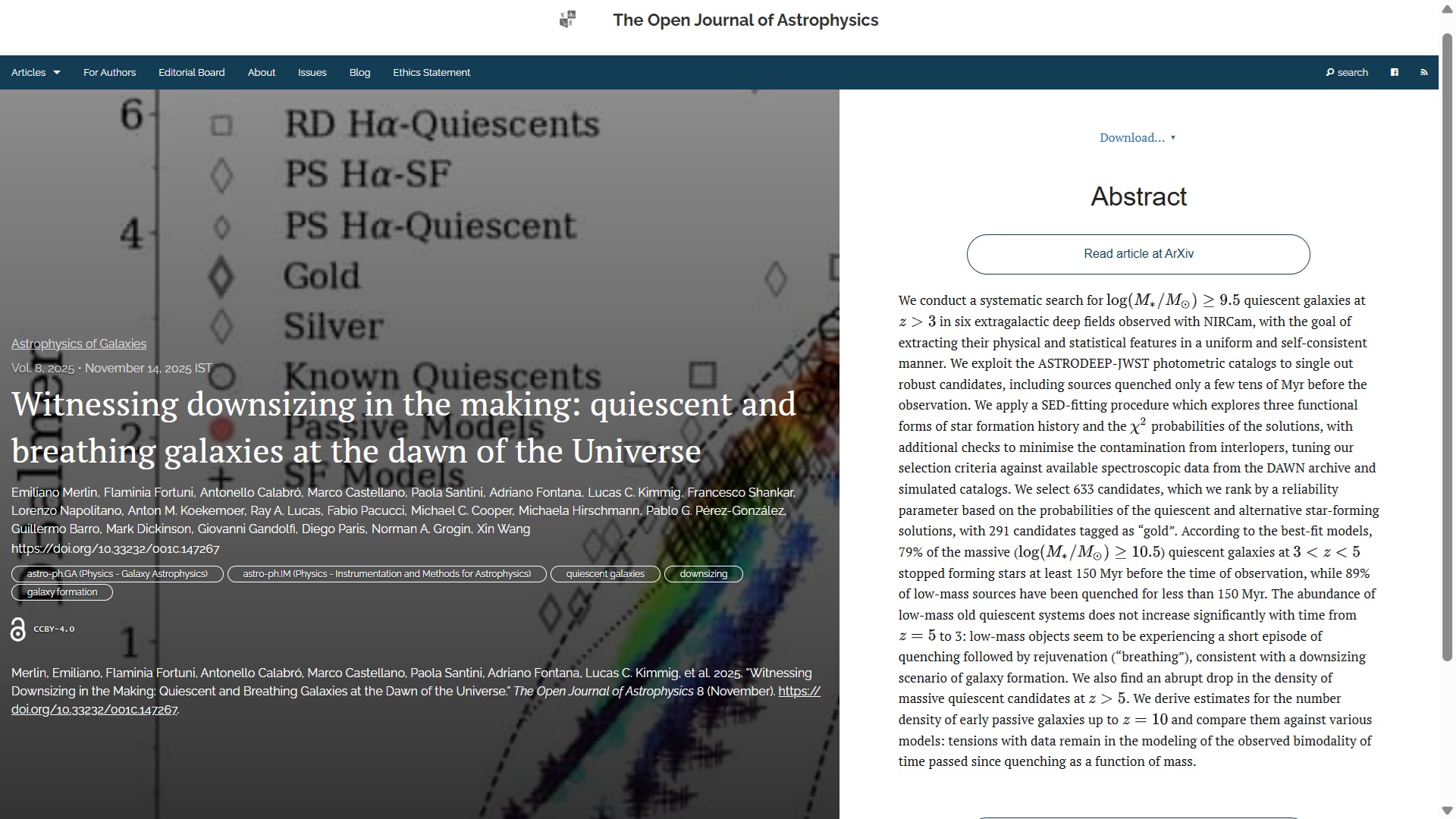
The sixth paper to report this week is “Witnessing downsizing in the making: quiescent and breathing galaxies at the dawn of the Universe” by Emiliano Merlin (Osservatorio Astronomico di Roma, Italy) and an international cast of 20 others based in Italy, Germany, UK, USA, Switzerland, Spain and China. This one was published on Friday November 14th in the folder Astrophysics of Galaxies.
You can find the officially-accepted version on arXiv here. The fediverse announcement is here:

Open Journal of Astrophysics

New Publication at the Open Journal of Astrophysics: "Witnessing downsizing in the making: quiescent and breathing galaxies at the dawn of the Universe" by Emiliano Merlin (Osservatorio Astronomico di Roma, Italy) and 20 others based in Italy, Germany, UK, USA, Switzerland, Spain and China

doi.org/10.33232/001c.147267

November 14, 2025, 8:38 am 1 boosts 1 favorites

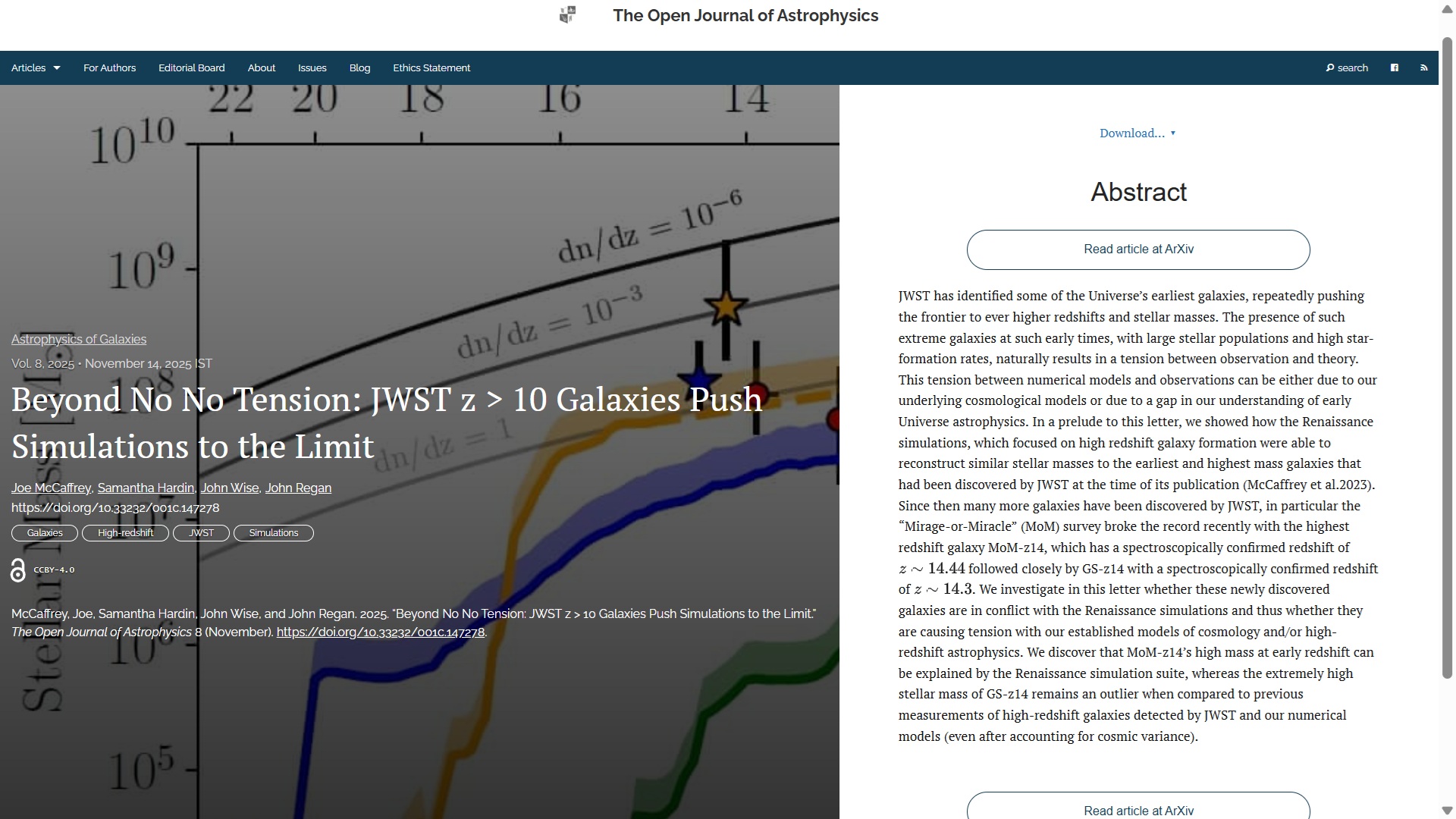
And finally (for this week) we have “Beyond No No Tension: JWST z > 10 Galaxies Push Simulations to the Limit” by Joe McCaffrey (NUI Maynooth, Ireland), Samantha Hardin & John Wise (Georgia Institute of Technology, USA) and John Regan (Maynooth). This one was also published on Friday 14th November, in the folder marked Astrophysics of Galaxies. It asks the question whether newly-discovered high redshift galaxies are consistent with simulations of galaxy formation. The overlay is here:
You can find the officially acceopted version on arXiv here. The fediverse announcement is here:

Open Journal of Astrophysics

New Publication at the Open Journal of Astrophysics: "Beyond No No Tension: JWST z > 10 Galaxies Push Simulations to the Limit" by Joe McCaffrey (NUI Maynooth, Ireland), Samantha Hardin & John Wise (Georgia Institute of Technology, USA) and John Regan (Maynooth)

doi.org/10.33232/001c.147278

November 14, 2025, 9:02 am 2 boosts 0 favorites

And that concludes the update for this week. There will be another next Saturday.

What about magnetic fields?

Posted in The Universe and Stuff with tags , , on November 20, 2008 by telescoper

If you’re stuck for a question to ask at the end of an astronomy seminar and don’t want to reveal the fact that you were asleep for most of it, there are some general questions that you can nearly always ask regardless of the topic of the talk without appearing foolish. A few years ago, “how would the presence of dust affect your conclusions?” was quite a good one, but the danger these days is that with the development of far-infrared and submillimetre instrumentation and the proliferation of people using it, this could actually have been the topic of the talk you just dozed through. However, no technological advances have threatened the viability of another old stalwart: “What about magnetic fields?”.

These thoughts came into my mind when I was listening to an excellent talk by Richard Ellis at the Royal Astronomical Society last Friday about the current state of play in the (very complicated) field of galaxy formation. I hasten to add that nobody there was sleeping. Well, not many.

In theory, galaxies condense out of the Big Bang as lumps of dark matter. Seeded by primordial density fluctuations and amplified by the action of gravity these are supposed to grow in a hierarchical, bottom-up fashion with little blobs forming first and then merging into larger objects. The physics of this process is relatively simple (at least if the dark matter is cold) as it involves only gravity.

But, by definition, the dark matter can’t be seen. At least not directly, though its presence can be inferred indirectly by dynamical measurements and gravitational lensing. What astronomers generally see is starlight, although it often arrives at the telescope in an unfamiliar part of the spectrum owing to the redshifting effect of the expansion of the Universe. The stars in galaxies sit inside the blobs of dark matter, which are usually called “haloes” although blobs is a better name. In art the whole purpose of a halo is that you can see it.

How stars form is a very complicated question to answer even when you’re asking about nearby stellar nurseries like the Orion Nebula. The basic idea is that a gas cloud cools and contracts, radiating away energy until it gets sufficiently hot that nuclear burning switches on and pressure is generated that can oppose further collapse. The early stages of this processs, though, involve very many imponderables. Star formation doesn’t just involve gravity but lots of other processes, including additional volumes of Landau & Lifshitz, such as hydrodynamics, radiative transfer and, yes, magnetic fields. Naively, despite the complicated physics, it might still be imagined that stars form in the little blobs of dark matter first and then gradually get incorporated in larger objects.

Unfortunately, as Richard Ellis pointed out, this naive picture doesn’t seem to work. Deep surveys of galaxies suggest that the most massive galaxies formed their stars quite early in the Big Bang and have been relatively quiescent since then, while smaller objects contain younger stars. In other words, pretty much the opposite of what one might have thought. This phenomenon (known appropriately in the time of the Credit Crunch as “downsizing”) suggests that something inhibits star formation early on in all but the largest of the largest haloes. It could be that powerful feedback from activity in the nuclear regions associated with a central black hole might do this, or it could be something a little less exotic such as stellar winds. Or it could be that the whole scheme is wrong in a more fundamental way. I personally wouldn’t go so far as to throw out the whole framework, as it has scored many successes, but it is definitely an open question what is going on.

Then I was reminded by a posting on the arxiv about an interesting paper that appeared in Nature last month by Art Wolfe and collaborators which revealed the presence of an enormously strong magnetic field in a galaxy at the relatively high redshift of 0.692. Actually it’s about 84 microGauss. OK, so this is just one object but the magnetic field in it is remarkably strong. It could be a freak occurence resulting from some kind of shock or bubble, but it does seem to fit in a pattern in which young galaxies generally seem to have much higher magnetic fields than previously expected. Obviously we need to know how many more such magnetic monsters are lurking out there.

So why are these results so surprising? Didn’t we already know galaxies have magnetic fields in them?

Well, yes we did. The Milky Way has a magnetic field with a strength of about 10 microGauss, much lower than that discovered by Wolfe et al. But the point is that if we understand them properly, galactic magnetic fields are supposed to be have been much lower in the past than they are now. The standard theoretical picture is that a (tiny) initial seed field is amplified by a kind of dynamo operating by virtue of the strong differential rotation in disk galaxies. This makes the field grow exponentially with time so that only a few rotations of the galaxy are needed to make a large field out of a small one. Eventually this dynamo probably quenches when the field has an energy density comparable to the gas in the galaxy (which is roughly the situation we find in our own Galaxy).

Hopefully you now see the problem. If the field is being wound up quickly then younger galaxies (those whose light comes to us from a long way away) should have much smaller magnetic fields than nearby ones. But they don’t seem to behave in this way. A few years ago, I wrote a paper about a model in which the galactic fields weren’t produced by a dynamo but were primordial in origin and large from the start. I might dust it off and look it again…

The mystery of the origin of galactic magnetic fields remains unsolved largely because, although we know magnetism exists, it is notoriously difficult to understand its behaviour when it is coupled to all the other messy things we have to deal with in astrophysics. It’s a kind of polar opposite of dark matter, which we don’t know (for sure) exists but which only acts through gravity so its behaviour is easier to model. This is the main reason why cosmological theorists prefer to think about dark matter rather than magnetic fields. I’d hazard a guess that this is one problem that won’t be resolved soon either. Things are complicated enough already!

It is also worth considering the possibility that magnetic fields might play a role in moderating the processes by which gas turns into stars within protogalaxies. At the very least, a magnetic field generates stresses that influence the onset of collapse. Although it is by no means obvious that they provide the required missing link between dark matter haloes and stars, we now have less excuse for continuing to ignore them.