Archive for dust

Planck versus BICEP2: Round One!

Posted in The Universe and Stuff with tags , , , , , , , on May 6, 2014 by telescoper

You may recall my scepticism about the recent announcement from the BICEP2 experiment about evidence from polarized microwave emission for the existence of primordial gravitational waves generated during a period of cosmic inflation.

Well, in between a couple of meetings this morning, I realised that there’s a paper just out onto the arXiv from the Planck Collaboration. Here’s the abstract:

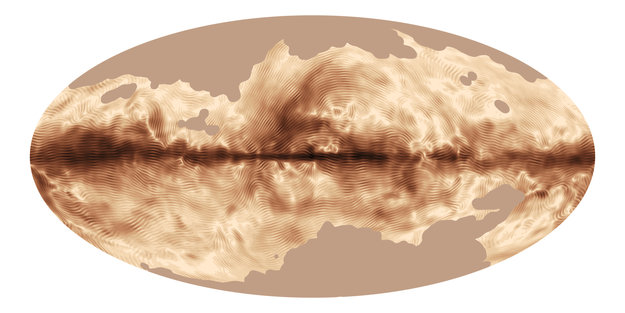
This paper presents the large-scale polarized sky as seen by Planck HFI at 353 GHz, which is the most sensitive Planck channel for dust polarization. We construct and analyse large-scale maps of dust polarization fraction and polarization direction, while taking account of noise bias and possible systematic effects. We find that the maximum observed dust polarization fraction is high (pmax > 18%), in particular in some of the intermediate dust column density (AV < 1mag) regions. There is a systematic decrease in the dust polarization fraction with increasing dust column density, and we interpret the features of this correlation in light of both radiative grain alignment predictions and fluctuations in the magnetic field orientation. We also characterize the spatial structure of the polarization angle using the angle dispersion function and find that, in nearby fields at intermediate latitudes, the polarization angle is ordered over extended areas that are separated by filamentary structures, which appear as interfaces where the magnetic field sky projection rotates abruptly without apparent variations in the dust column density. The polarization fraction is found to be anti-correlated with the dispersion of the polarization angle, implying that the variations are likely due to fluctuations in the 3D magnetic field orientation along the line of sight sampling the diffuse interstellar medium. We also compare the dust emission with the polarized synchrotron emission measured with the Planck LFI, with low-frequency radio data, and with Faraday rotation measurements of extragalactic sources. The two polarized components are globally similar in structure along the plane and notably in the Fan and North Polar Spur regions. A detailed comparison of these three tracers shows, however, that dust and cosmic rays generally sample different parts of the line of sight and confirms that much of the variation observed in the Planck data is due to the 3D structure of the magnetic field.

There’s also a press release from the European Space Agency which includes this nice picture:
Milky_Way_s_magnetic_fingerprint_large

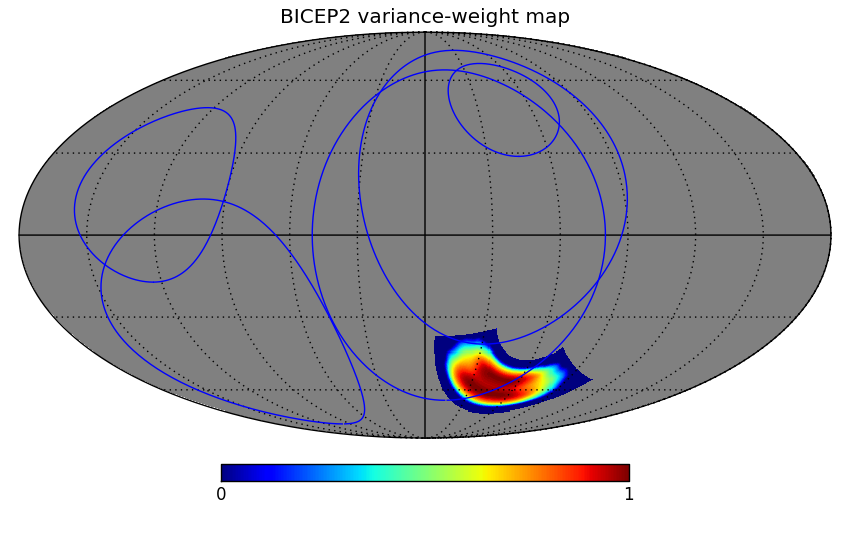
This study is at 353 GHz, compared to the 150 GHz of the BICEP2 measurements. Galactic dust emission increases with frequency so one would expect more of an effect in this Planck map than in BICEP2, but the fact that polarized foreground emission is so strong at these frequencies does give one pause for thought. The Planck data actually cover the whole sky, so the above map has clearly been censored; below you can see the actual region of the sky covered by BICEP2, so there is little or no direct overlap with what’s been released by Planck:
bicep2_loops

We’ll have to wait until later this year to see what’s going on in the masked regions (i.e. far above and below the Galactic Plane, where the dust emission is presumably weaker) and indeed at the 7 other frequencies measured by Planck. It’s all a bit of a tease so far!

Here’s what the press release says about BICEP2

In March 2014, scientists from the BICEP2 collaboration claimed the first detection of such a signal in data collected using a ground-based telescope observing a patch of the sky at a single microwave frequency. Critically, the claim relies on the assumption that foreground polarised emissions are almost negligible in this region.

Later this year, scientists from the Planck collaboration will release data based on Planck’s observations of polarised light covering the entire sky at seven different frequencies. The multiple frequency data should allow astronomers to separate with great confidence any possible foreground contamination from the tenuous primordial polarised signal.

P.S.  It’s gratifying to see the Planck Collaboration have used extragalactic Faraday Rotation measures to probe the Galactic Magnetic field as I suggested on this blog not long ago. The article that first advocated doing this with CMB maps can be found here.


Galactic Loops as Sources of Polarized Emission

Posted in The Universe and Stuff with tags , , , , , on April 8, 2014 by telescoper

Since I seem to have established myself as an arch-sceptic concerning the cosmological interpretation of the the BICEP2 measurement of the polarization of the cosmic microwave background (CMB), I couldn’t resist posting a link to an interesting paper by Liu et al. that has just appeared on the arXiv.

The abstract is:

We investigate possible imprints of galactic foreground structures such as the `radio loops’ in the derived maps of the cosmic microwave background. Surprisingly there is evidence for these not only at radio frequencies through their synchrotron radiation, but also at microwave frequencies where emission by dust dominates. This suggests the mechanism is magnetic dipole radiation from dust grains enriched by metallic iron, or ferrimagnetic molecules. This new foreground we have identified is present at high galactic latitudes, and potentially dominates over the expected B-mode polarisation signal due to primordial gravitational waves from inflation.

The authors argue that foreground emission from our own Galaxy has not been fully subtracted from maps of the cosmic microwave background. This emission could result in significant contamination of the CMB polarization if it is associated with dust grains aligned with the Galaxy’s magnetic field.

I’m grateful to one of the authors of the paper, Philip Mertsch, for sending me this map of the Galactic Loops with the BICEP2 region superimposed on it, demonstrating that there is potential for a contribution…

bicep2_loops


This paper is likely to provoke quite a discussion, so I thought I’d suggest one possible way of testing it, namely by updating the analysis presented by myself and Patrick Dineen in 2003 with new data. Here’s the abstract of our old paper:

We present a diagnostic test of possible Galactic contamination of cosmic microwave background sky maps designed to provide an independent check on the methods used to compile these maps. The method involves a non-parametric measurement of cross-correlation between the Faraday rotation measure (RM) of extragalactic sources and the measured microwave signal at the same angular position. We argue that statistical properties of the observed distribution of rotation measures are consistent with a Galactic origin, an argument reinforced by a direct measurement of cross-correlation between dust, free-free and synchrotron foreground maps and RM values with the strongest correlation being for dust and free-free. We do not find any statistically compelling evidence for correlations between the RM values and the COBE DMR maps at any frequency, so there is no evidence of residual contamination in these CMB maps. On the other hand, there is a statistically significant correlation of RM with the preliminary WMAP individual frequency maps which remains significant in the Tegmark et al. Wiener-filtered map but not in the Internal Linear Combination map produced by the WMAP team.

The idea is that cross-correlating the CMB pattern with Faraday rotation measures should provide an independent diagnostic of the effect of magnetic fields. Our analysis was based on old CMB data, so there’s an interesting project to be done updating it with, e.g., Planck CMB data and a larger set of rotation measures. See the comment below for a reference to more recent work along these lines, but still not including Planck.

Anyway, this all goes to show that there’s one question you can always ask about an astrophysics result: have you considered the possible role of magnetic fields?

The Heat Death of Herschel

Posted in The Universe and Stuff with tags , , , , on March 13, 2013 by telescoper

Most of the astronomers who read this blog will have heard the news that the Herschel Space Observatory is running out of the Helium that it has been using to keep it cool enough (~1.4K) to be sensitive to the far-infra-red radiation emitted by very distant objects.

There’s a gallery of wonderful images obtained by Herschel since it was launched in 2009 at the news item linked to above, but my favourite is one of the least photogenic:

_66205134_goodsn_3colour_cropped

Many of these fuzzy blobs correspond to immensely distant galaxies; what we see is starlight from very young stars absorbed by vast amounts of cosmic dust and then re-radiated in the infra-red. Understanding these sources is decidedly non-trivial and it will take many years to get all the information out that is hidden in images like this.

Anyway, one thing worth pointing out here is that what is going on now with Herschel is not some kind of failure. Quite the contrary, in fact. The original mission lifetime was planned to be three years, and Herschel has now been operating for nine months longer than that. The supply of Helium was always going to be the limiting factor as the spacecraft operates at the second Lagrange point of the Earth-Sun system, which is almost a million miles away and thus too far to be replenished. When the Helium does run out, Herschel will rapidly heat up to the point where its detectors are swamped. It will then be blind.

I was at this point going to make a cheap joke to the effect that after years on its own in the dark preoccupied with images of heavenly bodies, it was entirely predictable that Herschel would go blind. But I decided not to. I’ll save that kind of off-colour remark for Twitter…

ps. Coincidentally, on this day (March 13th) in 1781,  William Herschel  discovered the planet Uranus. The telescope is named in Herschel’s honour because he was also the first person to demonstrate the existence of infra-red radiation.

Dust

Posted in Poetry, The Universe and Stuff with tags , , , on July 4, 2010 by telescoper

I was reading through a collection of poems by Rupert Brooke this lazy sunday afternoon and found this. I haven’t posted much poetry recently so thought I’d add it here. I’m sure my many friends who work on astrophysical dust will enjoy it, especially those involved with the European Space Agency’s  Herschel Space Observatory. Apparently they’re all “passionate about dust”. If that’s true I wonder if one of them might want to write a wikipedia entry on the subject, because for some reason there isn’t one…

When the white flame in us is gone,
And we that lost the world’s delight
Stiffen in darkness, left alone
To crumble in our separate night;

When your swift hair is quiet in death,
And through the lips corruption thrust
Has still’d the labour of my breath –
When we are dust, when we are dust !

Not dead, not undesirous yet,
Still sentient, still unsatisfied,
We’ll ride the air, and shine, and flit,
Around the places where we died,

And dance as dust before the sun,
And light of foot and unconfined,
Hurry from road to road, and run
About the errands of the wind.

And every mote, on earth or air,
Will speed and gleam, down later days,
And like a secret pilgrim fare
By eager and invisible ways,

Nor ever rest, nor ever lie,
Till, beyond thinking, out of view,
One mote of all the dust that’s I
Shall meet one atom that was you.

Then in some garden hush’d from wind,
Warm in a sunset’s afterglow,
The lovers in the flowers will find
A sweet and strange unquiet grow

Upon the peace; and, past desiring,
So high a beauty in the air,
And such a light, and such a quiring,
And such a radiant ecstasy there,

They’ll know not if it’s fire, or dew,
Or out of earth, or in the height,
Singing, or flame, or scent, or hue,
Or two that pass, in light, to light,

Out of the garden, higher, higher. . . .
But in that instant they shall learn
The shattering ecstasy of our fire,
And the weak passionless hearts will burn

And faint in that amazing glow,
Until the darkness close above;
And they will know – poor fools, they’ll know!
One moment, what it is to love.

Planck and the Cold Galaxy

Posted in The Universe and Stuff with tags , , , , , , on March 17, 2010 by telescoper

Just a quick post to show a cool result from Planck which has just been released by the European Space Agency (ESA). It will be a while before any real cosmological results are available, but in the meantime here are a couple of glimpses into the stuff we cosmologists think of as foreground contamination but which are of course of great interest in themselves to other kinds of astronomers.

The beautiful image above (courtesy of ESA and the HFI Consortium) covers a portion of the sky about 55 degrees across. It is a three-colour combination constructed from Planck’s two shortest wavelength channels (540 and 350 micrometres, corresponding to frequencies of 545 and 857 GHz respectively), and an image at 100 micrometres obtained with the Infrared Astronomical Satellite (IRAS). This combination effectively traces the dust temperature: reddish tones correspond to temperatures as cold as 12 degrees above absolute zero, and whitish tones to significantly warmer ones (a few tens of degrees above absolute zero) in regions where massive stars are currently forming. Overall, the image shows local dust structures within 500 light years of the Sun.

Our top man in the HFI Consortium,  Professor Peter Ade, is quoted as saying

..the HFI is living up to our most optimistic pre-flight expectations.  The wealth of the data is seen in these beautiful multicolour images exposing previously unseen detail in the cold dust components of our galaxy.  There is much to be learned from detailed interpretation of the data which will significantly enhance our understanding of the star formation processes and galactic morphology.

This Planck image was obtained during the first Planck all-sky survey which began in mid-August 2009. By mid-March 2010 more than 98% of the sky has been observed by Planck. Because of the way Planck scans the sky 100% sky coverage for the first survey will take until late-May 2010.

Other new results and a more detailed discussion of this one can be found here and here.