Archive for Ecology

Cat Crainn

Posted in Irish Language, Maynooth with tags , , , , , on May 21, 2026 by telescoper

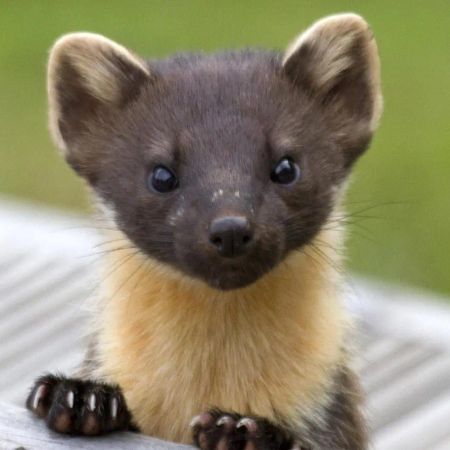
In Irish, a pine marten – such as the one shown on the left – is cat crainn which means literally “cat of the tree” or, less clumsily, “tree cat”. The word for “tree” in the nominative case is crann and the genitive meaning “of the tree” is crainn. They are about the size of a domestic cat.

I mention the pine marten partly because a while ago it came up on Bitesize Irish, which is a way I’m trying to add to my meagre vocabulary of Irish words and phrases, and partly because the story of these animals is quite fascinating. Pine martens have existed in Ireland for thousands of years alongside native red squirrels whose habitat is similar. More recently the invasive grey squirrels arrived and bullied their smaller red cousins into decline. Pine martens were also in serious decline because of hunting and deforestation and were critically endangered until recently, when legal protections were introduced. Now the population is growing and they are spreading into new areas.

Pine martens are fierce predators who eat all kinds of small mammals including rats and voles as well as squirrels. Having coexisted with them for ages, red squirrels have learnt to avoid pine martens quite effectively. Pine martens will try to catch them but don’t find them easy prey. Grey squirrels are a different matter, though, so there has been a big difference in the rate of predation with the grey squirrels being forced out of many areas. This differential effect has been excellent news for the red squirrels, whose population is recovering strongly.

I’m told that there are pine martens on the campus at Maynooth, though I have never actually seen one in the flesh and am not sure where they live. This is not surprising – they are secretive and good at hiding. There are grey squirrels on Maynooth campus too. I have seen many. I’ve never seen any red squirrels though. If the pine martens thrive, perhaps that will change?

Although undeniably cute, with their chocolate-coloured coat and creamy yellow bib, pine martens are wild animals and will bite if you give them cause. The word for “bite” in Irish is greim.

Open Access in Ecology

Posted in Open Access with tags , , , , on May 6, 2024 by telescoper

My attention was drawn yesterday to the following blog post about Open Access in the field of ecology. I recommend you read it (and the comments, some of which are excellent).

I will add a few comments of my own here.

First, whenever I read an article like this from a discipline different from my own it makes me not only feel grateful that we have arXiv but also wonder why so many fields don’t have the equivalent. On the other hand, there is EarthArxiv, but it doesn’t seem to have very many papers on it.

Second, I agree with the author of the post that far too many papers are being published. That is driven by the absurdity of a system that no longer regards the journal article as a means of disseminating scientific results but instead as a kind of epaulette to give status to the author. I also agree that scientists have largely got themselves to blame for this ridiculous situation.

Third, I disagree most strongly with this statement:

First, pipe dreaming academics who believed in the mirage of “Diamond OA” (nobody pays and it is free to publish). Guess what – publishing a paper costs money – $500-$2000 depending on how much it is subsidized by volunteer scientists. 

This is nonsense. It does not cost anything like $500-$2000 dollars to publish a paper. Of course it does cost something, but the true amount is trivial – tens of dollars, rather than hundreds or thousands – and can easily be absorbed. The entire annual running costs of OJAp are less than the typical Article Processing Charge for a single paper in a “prestigious” journal. Most money being paid in the form of APC goes directly into profit for the publishers, and the rest is largely wasted on administrative overhead. The Open Journal of Astrophysics is a Diamond Open Access journal, not a mirage. It may be a no-frills service, but it’s a reality. Why doesn’t someone set up an overlay journal on EarthArXiv?

The author of this blog post also spectacularly misses the point with “depending on how much it is subsidized by volunteer scientists”. Volunteer scientists are already subsidizing the profits of profit-making publishers! One of the commenters on the blog post has it right:

On Diamond OA and who pays; we’re already paying the big publishers with both our time and our money to publish in / review for / edit for their journals. Perhaps if we redirected that time to Diamond OA titles things would be somewhat different.

A final comment, only tangentially related to this post, is that I have been (pleasantly) surprised by the extent to which early career researchers have embraced the concept of the Open Journal of Astrophysics when you might have thought that they had more to lose by not publishing in mainstream journals rather than us oldies who don’t care any more. The explanation seems to be that younger people seem to see the absurdity and obvious unsustainability of the current publishing environment more easily than those who have put up with it for decades already.