Archive for education

Midpoint at Maynooth

Posted in Biographical, Education, mathematics, Maynooth with tags , , , , on November 11, 2024 by telescoper

Amid all the excitement last week I forgot that it was the sixth teaching week of the Semester. That means that we’re now past the halfway point. Among other things that meant that examination papers were due in on Friday (8th November). That means two papers for each module I’m teaching, one to be sat in January and another for the repeat opportunity in August, so that’s four altogether.

I always find setting examination questions very difficult. In theoretical physics we want to stretch the stronger candidates at the same time as allowing the weaker ones to show what they can do. It’s a perennial problem how to make the questions neither too easy nor too difficult, but it is compounded this time by the fact that I’m teaching two modules for the very first time so judging the right level is tricky.

Another issue is that I’m once again in a situation in which I have to set examination papers without having taught all the material. At least I’ve covered the first half of the content so I have some idea of what the students found difficult, but that’s not the case for the second half. It should be a bit easier next year once I’ve experience of covering the whole syllabus. Assuming, of course, that I’m teaching the same modules again next year, which is by no means guaranteed…

I’m teaching a module on Differential Equations and Complex Analysis for 4th year students and just about ready to switch to the part that comes after the and. I taught a bit of Complex Analysis when I was at Sussex and I’m quite looking forward to it, although it does pose a particular challenge. Some of the class are doing a Double Major in Theoretical Physics and Mathematics, and have done quite a lot of Complex Analysis before, while others are doing a Single Major in Theoretical Physics and haven’t really done any. I have to somehow find a way to satisfy these two different groups. The only way I can think of to do that is to teach the subject as a physicist rather than a pure mathematician, with an emphasis on examples and real-world applications rather than in the abstract. We’ll see how this works out over the next few weeks.

P.S. On the subject of Complex Analysis, I just remembered this post from a few years ago.

Steps to Improve

Posted in Education, Maynooth with tags , , , , , on October 18, 2024 by telescoper

Along with all academic staff at Maynooth University I received an email this afternoon from the Vice-President for Research and Innovation, which contained the following request:

Well, I certainly won’t be providing any such lists at any time for this or any similar purpose, let alone by next Wednesday! I will be boycotting the QS World University Rankings and I urge any of my “peers” who are contacted about it to do likewise.

I assume that request this is a panicky reaction to the fact that Maynooth is so low in the current current QS league tables and falling in most others. This decline is a direct result of policies implemented by the Management Team at Maynooth, pushing up a student-staff ratio that is already the highest in Ireland, and starving core activities of resources while squandering millions on management salaries and perks – latest example of which is  €500,000 on a luxury taxi service for “priority staff members”; you can guess who that means. ..

I would prefer that the people in charge of Maynooth University made some attempt to improve teaching and research – you know, the things that a university is suppose to do – rather than try to game these ridiculous league tables. Such an approach, however, seems to be out of the question. Maynooth’s race to the bottom is bound to continue unless and until attitudes change at the top.

Mental Health and Graduate Studies

Posted in Biographical, Mental Health with tags , , , , , , , , on October 3, 2024 by telescoper

There has been a lot of comment on social media about a recent article in Nature about the mental health of graduate students and the numbers looking for treatment. There are many sources of stress that can have a negative effect on mental health, including financial pressures and poor accommodation to name but two. These aren’t really specific to graduate studies. One that is is the pressure to produce results. That actually continues throughout an academic career – burnout is a very real phenomenon – but it’s probably worse during the “apprenticeship” phase when one is inexperienced and still learning the trade.

“Productivity” is indeed important but should not be interpreted as having to work ridiculously long hours. I remember many years ago commenting on an article that claimed 80-100 hours a week was not unusual. There are people who can sit at their desks for 12 hours a day without producing anything very much at all. It’s not the hours that matter, but what you do with them. In no way will indulging your outside interests (sporting, cultural, political, or “other”…),  or simply relaxing, detract from your ability to do research. As a matter of fact, I think such diversions actually improve your work, as well as (of course) your general well-being.

I think it is fair to say that you have to work hard to do a PhD. I worked hard on mine back in the day. But don’t think that means it has to be a grim slog. I can only speak for myself, but I greatly enjoyed my time as a graduate student. I think this was at least in part because when I was doing my PhD I had plenty of outside interests (including music, sport and (ahem) “nightlife”)  and took time out regularly to indulge them. I did experience mental health problems later during my PhD, but these were not caused by being a research student.

I can think of many times during my graduate studies when I was completely stuck on a problem – to the extent that it was seriously bothering me. On such occasions I learned to take a break. I often found that going for a walk, doing a crossword, or just trying to think about something else for a while, allowed me to return to the problem fresher and with new ideas. I think the brain gets into a rut if you try to make it work in one mode all the time.

There were indeed many times during my time as a research student – and have been since – that I worked extremely long hours – all night sometimes. I wouldn’t say exactly that was because I “enjoyed” it, but that I wanted to know an answer and couldn’t get the problem out of my head.  I’ve stayed up into the early hours of the morning trying to finish a crossword too. Not because I had to, but because I couldn’t put it down unfinished. I know that makes me a saddo in many minds, but I think that’s the sort of obsessiveness and tenacity a researcher needs: becoming so absorbed by the task in hand that you don’t notice the passage of time.

I don’t think anyone should try to infer too much from these personal reflections, but I do think there’s one important point that I try to point to every graduate student I advise and that is to look after your mental health. Perhaps the Nature article has a positive side, in that at least graduate students are seeking help. Recognizing that you might have a problem is a very important first step.

Back to Teaching

Posted in Education, mathematics, Maynooth with tags , , on September 24, 2024 by telescoper

So, after an absence from teaching of over a year, this afternoon I returned to the lecture theatre to give a double session on the module EE206 Differential Equations and Transform Methods. I was a bit apprehensive about having a two-hour slot and it is fair to say that I felt a bit knackered after it, but `then I am getting on a bit. I did have time for a ten-minute break in the middle during which the students could relax and stretch their legs a little. Some of them even came back afterwards.

This module is meant for students on two courses, Electronic Engineering and Robotics and Intelligent Devices, so I will have to think of relevant examples. I’ve got the RLC circuit, of course, but I’ll have to more than that!

If you’re interested you can find an old summary of the module here to see what topics are covered.

The good news from my point of view is that I have a decent room to teach in – complete with chalk boards – and the students seemed pleasant and engaged. I always like to get some interaction going in my classes so it was good to find a reasonable number of people willing to offer answers to questions I asked and indeed willing to ask me questions or request clarification. Overall, I was quite pleased with how it went. You will have to ask the students to see if they agree. At any rate I did manage to get through everything I planned to cover. The class size is about 55, incidentally.

Anyway, today I just warmed up for the module with some revision of basic calculus. I had pessimistically imagined that the students would have forgotten what they did in the first year about this, but in fact quite a few of them remembered quite a lot. I have my second session with this group on Thursday, though that should be a bit easier as it is only one hour instead of two. I will start differential equations proper then.

My remaining teaching sessions this week are all in the Arts Building. I have been quite worried that the rooms I am supposed to use would not be ready in time, but I took a walk around yesterday morning and they are ready (although construction work is going on elsewhere in the block). I was thinking I might have to give these lectures via a remote connection from home as in the old days of the pandemic, but that fortunately is not the case.

Flying Visit(s)

Posted in Biographical, Education, The Universe and Stuff with tags , , , , , , , on June 2, 2024 by telescoper

So here I am, not in Barcelona. On Thursday night I flew to the fine city of Newcastle upon Tyne to act as external examiner for a PhD candidate. Since I knew I would be arriving quite late I stayed in a hotel near Newcastle Airport. It was just as well I did so because, it being Ryanair, I arrived even later than expected. On Friday morning I took the Metro from the Airport to Haymarket and spent the morning in the School of Mathematics, Statistics and Physics at Newcastle University ahead of the viva voce examination.

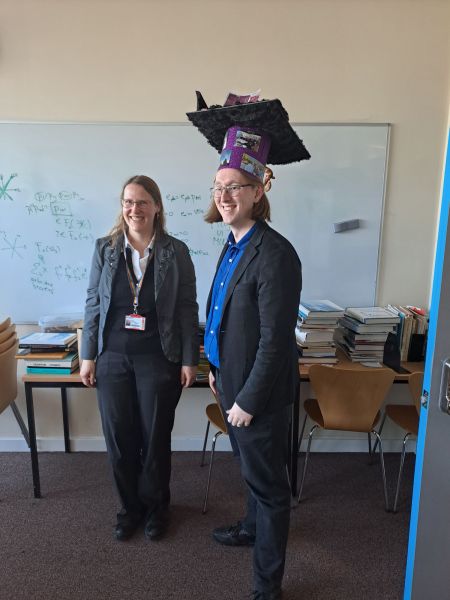
The PhD candidate was Alex Gough (pictured right, after the examination, with supervisor Cora Uhlemann). Cora being German we were treated to the tradition of successful PhD candidates having to wear a elaborate hat, after the examination (fortunately not during it). Some champagne was consumed, followed by dinner at a nice Indian restaurant on Clayton Street.

For those of you not familiar with how the PhD system works in the UK, it involves doing research into a particular topic and then writing up what you’ve done in a thesis. The thesis is a substantial piece of work, often in the region of 100,000 words (200 pages or so), which is then assessed by two examiners (one internal to the university at which the research was done, and one external). They read copies of the thesis and then the candidate has to defend it in an oral examination, which was what happened on Friday, after which they make a recommendation to the university about whether the degree should be awarded.

There aren’t many rules for how a viva voce examination should be conducted or how long it should last, but the can be as short as, say, 2 hours and can be as long as 5 hours or more. The examiners usually ask a mixture of questions, some about the details of the work presented and some about the general background. The unpredictable content of a viva voce examination makes it very difficult to prepare for, and it can be difficult and stressful for the candidate (as well as just tiring, as it can drag on for a long time). However, call me old-fashioned but I think if you’re going to get to call youself Doctor of Philosophy you should expect to have to work for it. Some might disagree.

Obviously I can’t give details of what went on in the examination except that it was quite long primarily because the thesis was very interesting and gave us lots to discuss. At the end internal examiner Danielle Leonard and I agreed to recommend the award of a PhD. In Newcastle as in other UK universities, the examiners simply make a recommendation to a higher authority (e.g. Board of Graduate Studies) to formally award the degree, but they almost always endorse the recommendation. I’ve never been sure exactly when a successful candidate is allowed to call themselves “Doctor”, actually, but congratulations to Dr Gough!

Anyway, the celebratory dinner ended just after Women’s International football match between England and France (which France won) had finished at St James’ Park and the Metro was consequently crammed full, but I got back to the hotel at a reasonable hour. Thank you to everyone in the group, especially Cora and Ian Moss, for being so friendly and making me feel so welcome during this brief visit.

Tomorrow I shall be heading to the part of not-Barcelona known as Oxford, where I believe there is a University of some sort, to give a lecture about which I’ll post more tomorrow.

General Science at Maynooth

Posted in Education, Maynooth with tags , , , , , , , on May 27, 2024 by telescoper

Following on – sort of – from yesterday’s post – here is a little promotional video about the ‘Omnibus’ Bachelor of Science undergraduate course (codename MH201). I have blogged about this course before (e.g. here) but this gives me an opportunity to repeat the salient points.

Currently, most students doing Science subjects here in Maynooth enter on the General Science programme a four-year Omnibus BSc course that involves doing four subjects in the first year, but becoming increasingly specialized thereafter. That’s not unlike the Natural Sciences course I did at Cambridge, except that students at Maynooth can do both Mathematical Physics and Experimental Physics in the first year as separate choices. I’d recommend anyone who wants to do Physics in the long run to do both of these, as they do complement each other. Other possibilities include Chemistry, Computer Science, Biology, etc.

In Year 1 students do four subjects (one of which has to be Mathematics). That is narrowed down to three in Year 2 and two in Year 3. In their final year, students can stick with two subjects for a Joint Honours (Double Major) degree, or specialise in one, for Single Honours.

I like this programme very much because it does not force the students to choose a specialism before they have had a taste of the subject, and that it is flexible enough to accommodate Joint Honours qualifications in, e.g., Theoretical Physics and Mathematics. It also allows us to enrol students onto Physics degrees who have not done Physics or Applied Mathematics as part of the Leaving Certificate.

Anyway, this video features Oisín Davey, who took Mathematical Physics, Experimental Physics, Chemistry and Mathematics in his first year. As a matter of fact I taught him in Year 1 (Mechanics & Special Relativity) and Year 2 (Vector Calculus and Fourier Series) but, despite that, as he explains, he has decided to persist with Mathematical Physics. He will be in the final year next academic year, after he returns from his summer in CERN, and I’ll be back from sabbatical.

Free Atkins!

Posted in Biographical, Education, The Universe and Stuff with tags , , , , , , on May 26, 2024 by telescoper

I took my first degree in the Natural Sciences Tripos at the University of Cambridge. This involved doing a very general first year comprising four different elements that could be chosen flexibly. I quickly settled on Physics, Chemistry and  Mathematics for Natural Sciences to reflect my A-level results but was struggling for the fourth. In the end I picked the one that seemed most like Physics, a course called Crystalline Materials. I didn’t like that at all, and wish I’d done some Biology instead – Biology of Cells and Biology of Organisms were both options – or even Geology, but I stuck with it for the first year.

Having to do such a wide range of subjects was very challenging. The timetable was densely packed and the pace was considerable. In the second year, however, I was able to focus on Mathematics and Physics and although it was still intense it was a bit more focussed. I ended up doing Theoretical Physics in my final year, including a theory project.

My best teacher at School, Dr Geoeff Swinden,  was a chemist (he had a doctorate in organic chemistry from Oxford University) and when I went to Cambridge I fully expected to specialisze in Chemistry rather than Physics. I loved the curly arrows and all that. But two things changed. One was that I found the Physics content of the first year far more interesting – and the lecturers and tutors far more inspiring – than Chemistry, and the other was that my considerable ineptitude at practical work made me doubt that I had a future in a chemistry laboratory. And so it came to pass that I switched allegiance to Physics, a decision I am very glad I made.

(It was only towards the end of my degree that I started to take Astrophysics seriously as a possible specialism, but that’s another story…)

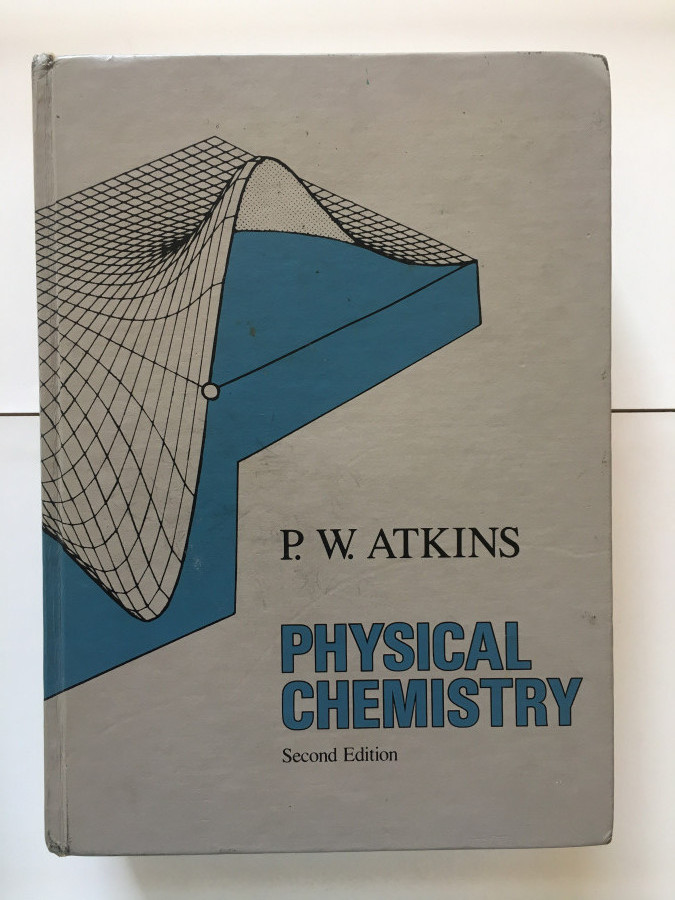
Anyway, when I turned up at Cambridge over 40 years ago to begin my course, and having Chemistry as a probable end point, I bought all the recommended text books, one of which was Physical Chemistry by P.W. Atkins. I found a picture (above) of the 1982 edition which may well be the one I bought (although I vaguely remember the one I had being in paperback). I thought it was a very good book, and it has gone into many subsequent editions. I also found the Physical part of Chemistry quite straightforward because it is basically Physics. I even got higher marks in Chemistry in the first year than I did in Physics but that didn’t alter my decision to drop Chemistry after the first year. When I did so, I followed tradition and sold my copy to a new undergraduate along with the other books relating to courses that I dropped.

Yesterday I found out that Peter Atkins has decided to make one of his books available to download. The book concerned is however not the compendious tome I bought, but a shorter summary called Concepts in Physical Chemistry, which was published in 1995. This is no doubt a very useful text for beginning Chemistry students so I thought I’d pass on this information. You can download it here, although you have to do it chapter by chapter in PDF files.

P.S. Chemistry in Spanish is ‘Química’. Since Physics and Chemistry share the same building in the University of Barcelona, where I am currently working, I frequently walk past rooms with doors marked ‘Quim’ (but I have never taken the opportunity to enter one).

My First Maynooth PhD!

Posted in Maynooth, The Universe and Stuff with tags , , , , , , on March 14, 2024 by telescoper

Today saw the viva voce examination of the first PhD student at Maynooth to have completed their degree under my supervision, although in this case the student started his postgraduate degree under another supervisor and I only took over responsibility when that person retired, a few years ago.

Anyway, I delayed my return to Barcelona so I could be present today. It’s not normal practice for the supervisor of a PhD to be present at the examination of the candidate. The rules allow for it – usually at the request of the student – but the supervisor must remain silent unless and until invited to comment by the examiners. I think it’s a very bad idea for both student and supervisor, and the one example that I can recall of a supervisor attending the PhD examination of his student was a very uncomfortable experience. My presence today was limited to supplying a couple of anticipatory bottles of champagne and then waiting nervously for the examination to finish.

I always feel nervous when a student of mine is having their viva voce examination, probably because I’m a bit protective and such an occasion always brings back painful memories of the similar ordeal I went through thirty-odd years ago. However, this is something a PhD candidate has to go through on their own, a sort of rite of passage during which the supervisor has to stand aside and let them stand up for their own work.

The examination turned out to be quite a long one – about three and a half hours – but ended happily. Unfortunately, I had to leave the celebrations early in order to do yet another Euclid-related Zoom call but when that was over I was able to find the pub to which everyone had adjourned and had a pint there with them. I have a feeling the celebrants might make a night of it tonight, but I’m a bit too tired after recent exertions to join them.

The student’s name, by the way, is Aonghus Hunter-McCabe and the title of the thesis is Differential geometric and general relativistic techniques in non-relativistic laboratory systems. If you’re looking for a postdoc to work in related areas then Aonghus might just be the person you want!

P.S. About a decade ago I did a post on the occasion of the PhD examination of another student of mine, Ian Harrison. I found out recently that Ian now has a permanent position at Cardiff University. Congratulations to him!

The Age Thing

Posted in Biographical, Education with tags , , , , , on January 2, 2024 by telescoper

When I was younger, so much younger than today, I thought I would hate getting old. Now that I’m sixty though I have to say in all honesty that it’s not too bad at all. I could do without the arthritis, of course, but that’s more of an inconvenience than anything else. I am also fortunate to be comfortably off and in a secure job, with the prospect of a decent pension. When I was younger I was frequently under stress, with bouts of insomnia and other issues. Although I am subjected to a bit of aggravation now and then, I seem to have learnt to deal with it better.

I think part of this is that as I’ve got older I’ve become more resistant to peer pressure. Nowadays I go out only when I really want to, and do only what I want to do. Gone are the days when friends used to drag me out to places I didn’t really want to go to. I used to go because I thought people would label me as ‘boring’ if I didn’t. Nowadays, I don’t mind being called boring. I may be boring to you but I am rarely ever bored. I always find plenty to occupy myself.

Another thing that helps is working in a University, which is a good way of being surrounded by interesting young people. So many people of my age seem to resent the young, to the extent of criticizing virtually everything they do. I find the vast majority students friendly, hard-working and engaged, although they have to put up with much more than I had to when I was in their situation.

Teaching physics is interesting because the current generation of undergraduates has to learn a lot of what I had to when I was a student. Every year therefore provides a reminder of the time when I was the age of the new intake, as many of their educational and social experiences are similar. Of course not all. When I was an undergraduate we had no internet or anything like that. There were no social media, either. 

Students these days seem to like using Instagram. I do have an account on Instagram but it is very quiet, probably because I’m not very good at it. Some students follow me there, but I have been told that it would be “inappropriate” to follow them back. That’s probably fair, but I do worry that I appear rude for not following back. It’s not that I’m snobbish or anything. I just feel that I would be intruding, in much the same way as if I wandered into a bar full of students I know. It’s not that I don’t like them, just that I find it awkward (as I’m sure they do). Not having had Instagram when I was young, I suppose I just don’t really understand the etiquette.

One of the things about Instagram is that people do sometimes share quite personal things, and sometimes things that might be quite compromising in a work context, e.g. pictures of themselves in a  state of inebriation. I suppose that’s why it’s a rather contentious issue whether a member of academic staff in a University should or not be “friends” with their undergraduate students on social media. Indeed, this is the official advice given by some institutions to staff. Most wouldn’t have a problem with having social media interactions with their graduate students, though. The nature of the relationship between a PhD student and supervisor is different from that between an undergraduate and a lecturer.

There is a point on social media where professionalism might be compromised just as there is in other social interactions. The trouble is knowing precisely where that boundary lies, which is easy to misjudge. I’ve never felt that it was in any way improper to be friendly to students. Indeed I think that could well improve the students’ experience of education. If the relationship with staff is too distant students may not  feel comfortable asking for help with their work, or advice about wider things. Why should being “professional” mean not treating students as human beings? One can take friendliness too far, however. There have to be some boundaries, and intrusive or demanding behaviour that makes students uncomfortable should be avoided.

I realize I have digressed into social media. Aside from that, though, I’m sure much of student was similar in my day. I’m pretty sure that neither the subject of physics nor students of physics have changed that much over the years. The only difference from my perspective is that every year they look younger! That’s the other side of the coin: the students remind you of your younger self, but not in such a way as to delude you into thinking that you’re still the same person! I think that’s the one thing I’ll miss when I retire, hopefully in the not-too-distant future.

All of this is a roundabout way of saying that I don’t mind getting old. In fact, I feel that my whole life so far has been practice for this.

Spanish Practices

Posted in Barcelona, Education, History, Maynooth with tags , , , , , on October 20, 2023 by telescoper

When I was a lad, during the 1970s, the term Spanish Practices was used pejoratively in a union-bashing sense to describe restrictive practices in the workplace. Until recently I thought it was a modern invention that relied on a stereotypical view of Spanish people as being lazy. In fact it seems the term dates back to Tudor times and is religious in origin, referring to Roman Catholic rites, in contrast to the simpler Protestant forms of worship. Anyway, none of that is what this post is about. I just used the title as clickbait.

I’ve been here in Barcelona, and working in the University of Barcelona, for four weeks now and I thought I’d share a few observations about differences in practice here and in the Ireland (and the UK).

The other night I went out for dinner with colleagues from the Department. The restaurant was much closer to the University than to my flat so instead of going home first I stayed in my office and walked straight there. My route out of the building takes me past a number of teaching rooms. During this warm weather, most of the rooms have the doors open so it’s easy to have a quick look at what’s going on inside. On my way out at about 7.30pm I was surprised to see a number of classes still going on, and they weren’t sparsely attended either.

In Maynooth the latest regular lectures finish at 6pm. Even during the 5pm to 6pm lectures, many students have to leave before the end to catch the one and only bus back to their place of residence. Here the public transport system is so good that isn’t really an issue even for those who don’t live near the campus. As far as I know lectures start at 9am, so students potentially have a very long day. They work hard.

I have to say that I wouldn’t like to have teach late in the evening. I used to do that on Fridays at Queen Mary for the MSc course and didn’t enjoy it. I don’t mind doing 9am lectures, though, but I don’t think students agree – partly because of the difficulty of getting to campus at that time.

In the Faculty of Physics, all the lecture halls, classrooms and laboratories are in one building rather than spread around the campus like they are in Maynooth (and many places in the UK). Fortunately, the building has been designed with students in mind and there is plenty of space for students to use socially or for private study between teaching sessions.

In this picture you can see the inner courtyard of the building occupied by the Faculties of Chemistry and Physics. It’s a big open space, with teaching rooms, etc, on either side. In the far right-hand corner there is a café/bar where one can buy lunch, a coffee, or even a beer, to be consumed either inside or in the seating area in the courtyard. Many students seem to prefer bring their own lunch and eat it in this space., although the food available is pretty good and cheap compared to back home.

As well as being able to eat and drink here, there is plenty of room for students simply to hang out or to study, either alone or in groups. If they don’t feel like that they can use the tram, bus or Metro to go home, and come back later if they have a long gap between classes. None of this is possible at Maynooth.

This particular kind of open space would not work so well in Ireland or the UK because of the weather, though you can probably see in the picture that there had been a bit of rain before I took the photograph, but I hope I’ve made the point that having social spaces makes a huge amount of difference to the student experience, not least because it feels that the University has thought about them. In the neoliberal system that dominates in the UK and Ireland, students are simply a commodity, a source of revenue, to be crammed into every available space and processed as cheaply as possible. In Maynooth students have been, and are being, forced to pay an extra levy for a notional student centre that will probably never be built.

The contrast is very disheartening.

Getting back to educational matters, another thing I’ve noticed walking past classrooms is that it’s not unusual to see a student standing at the blackboard in front of the class going through a problem. I’ve seen that a number of times with quite large classes. Sometimes we ask students to do that sort of thing in tutorials, but I’ve never done so in a full lecture. I think our students would be shocked if we asked, but it’s clearly not unexpected here. That’s a Spanish Practice I’d be quite happy to try.