Archive for Elections

Kildare North Candidates

Posted in Politics with tags , , , , , , , , , , , , , on November 23, 2024 by telescoper

The arrival of my polling card yesterday indicates that the general election in Ireland on Friday 29th November is approaching rapidly, so I thought I’d give a rundown of the 16 candidates who will appear on the ballot paper for my constituency, Kildare North.

Kildare North will return 5 TDs (Teachta Dála, or Deputies), one more than last time because of the population growth in the area. The current TDs are Réada Cronin (SF; Sinn Féin), Bernard Durkan (FG; Fine Gael), James Lawless (FF; Fianna Fáil) and Catherine Murphy (SD; Social Democrats). The latter is retiring so will not be standing at this election. The current government is a coalition of FG, FF and Green Party TDs.

The Single Transferable Vote system is used, meaning that voters have a single ballot paper on which they rank the candidates in order of preference. The candidate with the lowest number of first-preference votes is eliminated and their second preference votes redistributed. Candidates are thus progressively eliminated until the requisite number of TDs is selected.

There are three FG candidates: Bernard Durkan, Joe Neville and Evie Sammon). They are based in Maynooth, Leixlip and Celbridge respectively so are presumably hoping that local voting will work out in their favour. The idea presumably is that Bernard Durkan would be first choice in Maynooth, etc. However, I’ve already had canvassers arguing that I should put Joe Neville first. I won’t be voting for any of the candidates anyway, but I would be very amused if their decision to put three candidates forward backfired. Incidentally, Bernard Durkan is 79 and has been a TD since 1982. The leaflet I got from him promised “New Energy” for Kildare North. Yeah, right…

There are two FF candidates, James Lawless and Naoise Ó Cearúil; the latter was elected to the County Council this summer. I find FF indistinguishable from FG. Together or separately these two parties have governed the Republic since its creation and a change is long overdue.

The two Sinn Féin candidates are the incumbent Réada Cronin and Caroline Hogan. I haven’t seen any posters for Réada Cronin up in Maynooth, so I assume the campaign team is saving their resources for elsewhere. Maynooth is not traditionally an SF stronghold.

With Catherine Murphy not standing, the Social Democrats ran a process to select a replacement candidate, which was won by Aidan Farrelly (who actually works at Maynooth University) who is the official SD candidate. That doesn’t end the story, however. Former SD member Bill Clear is standing as an Independent because he didn’t get selected. Adding to the fact that Catherine Murphy had a considerable personal following, this looks like a bit of a mess for the Social Democrats whose vote will probaboly be reduced and split. It may be in order to capitalize on this that SF added a candidate; they only fielded one last time round.

Now we’re into the (probable) also-rans. Angela Feeney is standing for Labour. She is an active member of the Council, representing Maynooth, but it’s not clear whether she has reach over the rest of the constituency. Vincent Martin represents the Greens who haven’t previously been strong here. The Green Party in Ireland is nowhere near as left-wing as corresponding parties in the UK and elsewere. It often seems like the bicycle division of Fine Gael. Leah Whelan is standing for People Before Profit – Solidarity, the only really left-wing party standing in Kildare North.

Then we have we have a number of generally disagreeable (to me) fringe party candidates: Una O’Connor is standing for Aontú, a reactionary splinter group of people previously in Sinn Féin and Sean Gill for the Centre Party of Ireland, an ironic name for what is far-right splinter group of FG previously known as Renua. Gerry Waters is standing from the Irish Freedom Party. He was struck off the medical register for refusing to administer vaccines and has unsupportable far-right opinions on other issues. Last and by all means least is Avril Corcoran who is candidate for The Irish People, a far-right nationalist party which is part of the National Alliance of like-minded bigots.

It’s probably obvious which 11 candidates I’m not going to be voting for, but I’ll leave you to guess in what order I will rank the other 5!

P.S. LinkedIn didn’t like this post:

Opinion Polls, Exit Polls and Election Results

Posted in Politics with tags , , , , , , , , , on July 8, 2024 by telescoper

It has been quite an eventful week for voters either side of the English channel. In the United Kingdom, Keir Starmer’s Labour Party were victorious in the General Election, turfing out the Tories after 14 years of misrule, while in France a left-wing coalition managed against the odds to beat Marine Le Pen’s fascist National Rally into third place in their runoff election. In both elections tactical voting clear played a big role. In France many third-placed candidates of the centre or left stood aside to help defeat the Far Right. What happens now with regard to forming a government is anyone’s guess, even for people who know far more about French politics than me.

In the runup up to the UK general election, opinion polls had Labour much further ahead in terms of popular vote. As it turned out, however, Labour won 411 seats on a share of the vote of just 33.7% compared to the Conservatives 23.7% and a smaller number of votes than in 2019 when they won just 202 seats. The UK system is not proportional – and doesn’t pretend to be – so this kind of outcome is not surprising. Pundits have rightly pointed to the fact that the far-right Reform party got 14.3% of the vote which undoubtedly took seats from the Tories, but only managed 5 seats and that Labour profited greatly from the collapse of the SNP vote in Scotland.

There are other factors, however. One is that the turnout was 59.9%, well down on 2019 (67.35). That may well be partly due to voters generally not being enthused. But there may be more to it than that. The last time the turnout was below 60% in a UK general election was in 2001. In that year, Labour were miles ahead in the opinion polls so I suppose many Labour voters thought the result was a foregone conclusion and didn’t bother to turn out. It seems likely to me that there was a similar effect on the Labour vote this time. Rather than merely predicting the final result, opinion polls often influence it.

Another factor is that there may have been higher levels of tactical voting, especially with Labour voters switching to the Liberal Democrats to remove the Tory. That might account for why the LibDems did so well. Opinion polls play a role in this too. Yet another is that Labour lost several seats to Independents, standing against the stance on Gaza, and former Labour leader Jeremy Corbyn won his seat standing as an Independent.

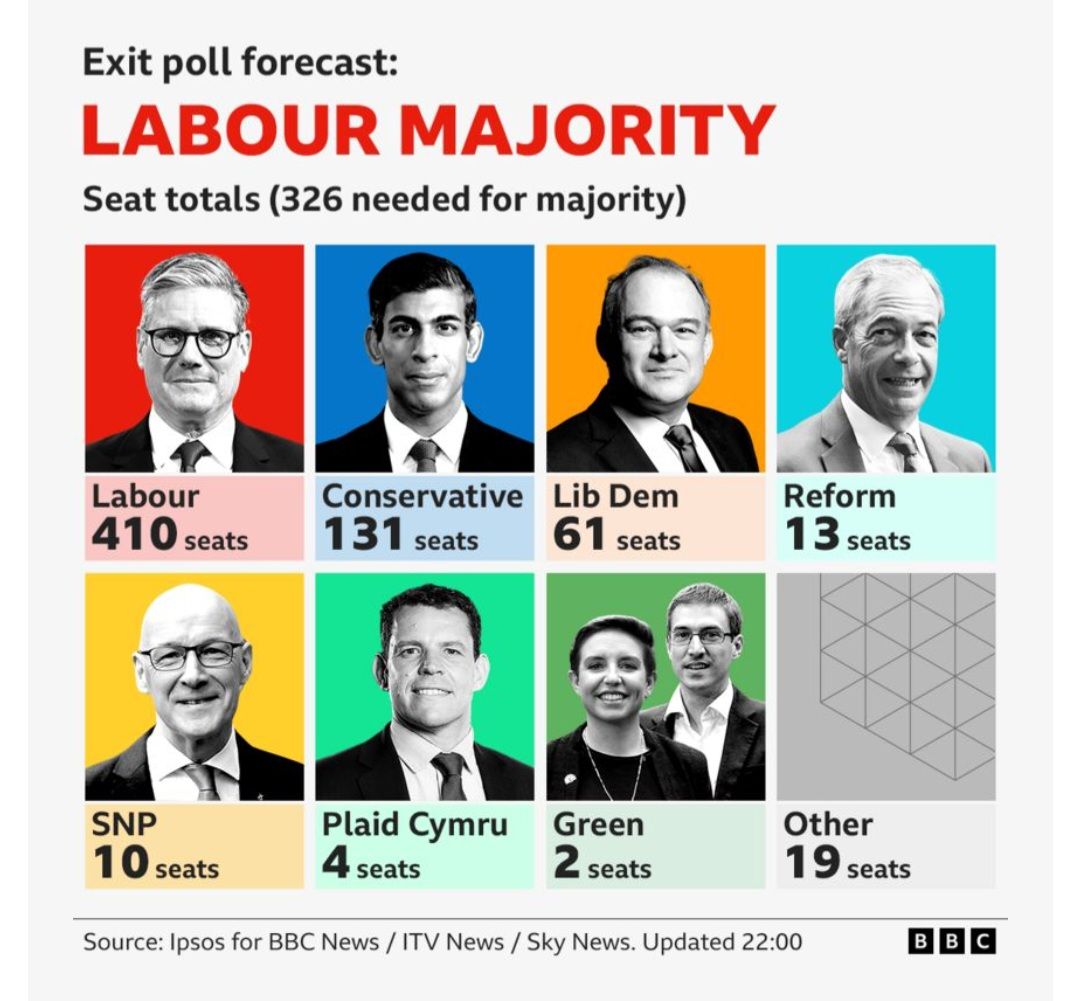
That brings me to the exit polls in the UK and France. Here the projections, the first released at 10pm on Thursday and the second at 9pm on Sunday:

Both are pretty accurate, but I’ve always been annoyed by the way the UK exit poll projection (left) is presented as a point estimate without any indication of the uncertainty (which must be considerable, especially for the smaller parties). The final results were Labour 411, Conservative 121, Lib Dem 72, Reform 5, SNP 9, Plaid Cymru 4, Green 4.

The French method of presenting the results (right) is much better in my opinion. In this case the results were 182, 168 and 143 respectively – all within the range presented.

I have to say that I greatly prefer the voting system used here in Ireland to those deployed in either France or the United Kingdom. Elections here are held under Proportional Representation (Single Transferable Vote) which seems to me a very sensible system. One ranks the candidates in order of preference; you can rank all the candidates or just some. In the system employed here in Ireland, votes are progressively reallocated in various rounds until one ends up with the top n candidates to fill the available seats. The STV system involves a quota for automatic election which is N/(m+1) + 1 votes, where N is the number of valid ballots cast and m is the number of seats in the constituency.  To see why this is the case consider a four-seat constituency, where the quota would be 20% of the votes cast plus one. No more than four candidates can reach this level so anyone managing to get that many votes is automatically elected. Surplus votes from candidates exceeding quota, as well as those of eliminated candidates, are reallocated to lower-preference candidates in this process. This system returns representatives with a local constituency connection but is also (approximately) proportional.

One problem with the First Past The Post system deployed in the UK is that if a Reactionary party (Reform) gets 5 seats while a Progressive party (Green) gets only 4, the former gets all the press coverage and the latter gets none..

P.S. I didn’t vote in the UK general election, but the four constituencies in which I lived before moving to Ireland (Cardiff West, Brighton Kemptown, Broxtowe, and Bethnal Green & Stepney) all voted in Labour MPs.

Local Election Result

Posted in Maynooth, Politics with tags , , , , , , , , , , on June 9, 2024 by telescoper

Following Friday’s vote, counting in Ireland’s local elections began Saturday morning. As it happened, Maynooth was one of the first LEAs to start counting and, the electorate being fairly small, was completed last night.

In the system employed in these elections, votes are progressively reallocated in various rounds until one ends up with the top n candidates to fill the available seats. The STV system involves a quota for automatic election which is N/(m+1) + 1 votes, where N is the number of valid ballots cast and m is the number of seats in the constituency.  To see why this is the case consider a four-seat constituency, where the quota would be 20% of the votes cast plus one. No more than four candidates can reach this level so anyone managing to get that many vote is automatically elected. Surplus votes from candidates exceeding quota, as well as those of eliminated candidates, are reallocated to lower-preference candidates in this process.

I thought it might be interesting to show how it went. Here is the state of the poll after the initial count of first preference votes:

Incumbent Councillor Naoise Ó Cearúil (Fianna Fáil) led the first preference votes, exceeding the quota of 1566, and was therefore immediately elected. When his surplus votes were reallocated to second-preference candidates they did not result in anyone else exceeding quota, so Peter Hamilton (who finished last) was eliminated and his votes reallocated, etc. And so it came to pass that Tim Durkan (Fine Gael) was elected on the third count, Angela Feeney (Lab) and Peter Melrose (Social Democrats) on the 6th Count, and Paul Ward (FF) on the 7th Count. Durkan, by the way, is the son of sitting Fine Gael TD Bernard Durkan. For those outside Ireland I should mention that the Irish Social Democrats are quite progressive – in contrast to some parties with the same name in other countries – and they have a TD in the form of Caroline Murphy who has strong local support.

The turnout in Maynooth, by the way, was 45.3%. That’s quite high by the standards of local elections in the UK, but I always find it disappointing when people can’t be bothered to vote.

Anyway, of the five councillors elected (2 FF, 1 FG, 1 Lab & 1 SD) four are incumbent. The only change was sitting Green candidate Hamilton was replaced by newbie Peter Melrose for the Social Democrats. It was a disappointing result for Sinn Féin, similar to what happened five years ago in this LEA. The losing candidate then, however, Réada Cronin, went on to win a seat as TD for North Kildare in the General Election of 2020.

As I write, under a quarter of LEAs have completed their counts but it is fairly clear that it has been a disappointing election for Sinn Féin who, despite riding high in the opinion polls a few months ago, have not really recovered significantly from their poor showing in the 2019 Local Elections. Of course the question asked in opinion polls is about a General Election, which is quite a different kettle of fish compared to a Local election. Lots of pundits are trying to interpret these local results as a kind of opinion poll on the General Election which must happen before next year. They do this in the UK too. I don’t think that is wise. I think most people vote in the Local Elections on the local and rather mundane issues which are actually what the County Councils can actually deal with. Councils have very little power in Ireland and candidates who have grandiose plans far beyond the scope of what a councillor can actually achieve are not likely to do well. There is also a definite advantage on being an incumbent who has done a good job for the past five years. A problem for Sinn Féin is that it had to put up new faces in many LEAs to replace those lost five years ago, and few have been successful.

Anyway, it seems the status quo parties have done better than expected, and a variety of Independents have done well. Fianna Fáil and Fine Gael – to me, indistinguishable conservative neoliberal parties – are currently governing Ireland in coalition with the Greens. It surprises me that there is so much support for establishment parties that have presided over a housing shortage, ever-increasing homelessness and steadily deteriorating public services, but there you go.

We’ll have to wait a considerable time for the European Election count to finish, as it hasn’t even started yet, but it seems likely that Sinn Fein will struggle and that Independent will do well.

What Nigel Farage did not say on beards

Posted in Beards, Politics with tags , , , on May 26, 2014 by telescoper

In the aftermath of yesterday’s European election results, the great political question of the day is where precisely does UKIP stand on facial hair?

kmflett's avatarKmflett's Blog

What Nigel Farage did not say on beards

UKIP leader Nigel Farage who is perpetually clean shaven is very probably a pogonophobe although as the equally perpetually hirsute Michael Rosen has pointed out to me, UKIP has some supporters with beards.

Accuracy on matters UKIP is not easy to achieve. The party itself is an unreliable guide and the BBC guided by the follicly challenged Nick Robinson isn’t much better.

However at the end of the week which saw a supposed quote from Farage about Muslims and beards to the effect that either the beard went or the wearer did and that beards should be no more than two inches in length achieve wide currency, a small attempt at accuracy can surely do no harm.

There is no absolute proof that Farage did not make these remarks. He has not denied them despite opportunities to do so

It is however…

View original post 198 more words

Local Politics

Posted in Politics with tags , , , , , on May 6, 2012 by telescoper

By way of reminding myself for future reference I thought I’d do a quick post about the results of Thursday’s local elections.

I live in the Riverside ward within the area administered by Cardiff City Council. When I moved here in 2008 there were three Plaid Cymru (Welsh Nationalist) councillors. That was just after an election in which the Welsh Labour party had done badly, and also to some extent reflected the particular nature of the Pontcanna area which is within Riverside ward, in that it has a sizeable Welsh-speaking population many of whom work for the  media, especially the BBC.

Last year we had a by-election, won by Iona Gordon for Labour, so going into this year’s elections there were two Plaid councillors and one Labour. The result of the 2012 vote was very bad for Plaid, who lost their two remaining candidates to Labour. So in four years I’ve gone from living in a Plaid Cymru stronghold to a Labour stronghold.

The pattern in Riverside ward was repeated across Cardiff, so that Labour achieved a sizeable overall majority, with the Conservatives, Liberal Democrats and Plaid Cymru all losing seats:

Before the elections the Council was run by a LibDem/Plaid Coalition and such was the swing against these parties that Council Leader Rodney Berman lost his seat, although in apparent desperation to cling onto his salary he demanded two recounts before giving up. Afterwards he spoke to the press claiming that the result in Cardiff was down to Westminster politics rather than local issues.

I don’t think so.

I certainly voted on local issues and so did many of the people I talked to. The former administration of the Council was awful in many respects, including proven maladministration over the decision to build a waste incinerator. I’m not the only person to have remarked on the plethora of pointless roadworks going on in the city, including narrowing the busiest thoroughfares, and of course the ongoing over-development of Bute Park.

No, Mr Berman. You were voted out because you did a lousy job.

There’s no guarantee, of course, that Labour will do any better but I very much doubt they can do any worse. I hope I’m not proved wrong.

Returning

Posted in Biographical, Politics with tags , , , , on May 7, 2011 by telescoper

Well chaps and chapesses, I’m back to base after a very enjoyable break in foreign climes. I won’t bore you with interminable holiday snaps and the like, however. Suffice to say that, although it was good to get away from it all for a bit, it’s also nice to be back to Blighty. I’ve got quite a few things to catch up with on at home, at work, and on the blog, and I’ll try to return to fairly frequent postings now that I’m home.

I thought I’d start with one of the big events that happened while I was away. Not the Royal Wedding, which I successfully avoided completely although I only narrowly escaped seeing some of it on an outdoor  big screen (which I had assumed would be showing some form of sporting contest). Not the killing of Osama Bin Laden, either. Nor even the AV referendum, which went the way I expected. No, I think the first thing I should comment on is the result of the elections to the National  Assembly for Wales which I followed, as best I could, by Twitter and on the net via my Blackberry while I was away. I wasn’t helped by the fact that North Wales decided not even to start counting votes until the morning after Polling Day, thus holding up the final results by half a day. Perhaps that’s because the count was done in Llandudnno, where people generally go to bed about 10pm?

This was the first Senedd election I have had the opportunity to vote in, even though I had to do it postally. For the Welsh Assembly elections, each voter gets two votes. One is cast just as in a General Election, i.e. by picking one candidate for one’s own consituency – in my case Cardiff West. This is a safe Labour seat, previously held by former First Minister Rhodri Morgan, and it was no surprise to see the Labour candidate romp home with an increased majority. Of the 60 members of the Welsh Assembly, 40 are elected directly through constituency votes like this.

Incidentally, one of the other candidates in this constituency was Neil McEvoy, standing for Plaid Cymru. McEvoy is currently deputy leader of Cardiff City Council (which is run by a coalition of LibDems and Plaid Cymru councillors) and is an enthusiastic champion of the building of a major road into Bute Park for use by heavy lorries. It might have been better for the people of Cardiff – especially those who appreciate its wonderful green spaces – had Councillor McEvoy been elevated to the Senedd, because that would prevent him doing further damage on behalf of the Council. In the end, though, he trailed in third place in the Welsh Assembly poll so will presumably remain on the Council.

Meanwhile, back at the polls. Voters in the Welsh Assembly elections get another regional vote in addition to their constituency vote, which they can cast for a  closed party list. There are 5 regions in Wales, each of which elects 4 members to the Assembly taking its full complement to 60. The so-called Additional Member system uses the d’Hondt divisor formula to allocate regional AMs in accordance with the following algorithm:

  1. Party list votes are totalled from each of the constituencies making up the region.
  2. These totals are then divided by the number of constituency seats each party has won – plus one.
  3. The party with the highest resulting total elects one Additional Member.
  4. That party’s divisor is then increased by one (because of its victory)
  5.  Step 2 is repeated with the updated number of seats.; again, the highest resulting total wins a seat.
  6. The process is then repeated until all Additional Members are elected.

The aim of the system is to compensate parties which pile up lots votes in constituencies but fail to win many seats there. Under the d’Hondt system, they are much more likely to gain additional regional members. Conversely, parties which do well in constituency elections will do less well in the top-up seats. The idea is that the final outcome is much more proportional than it would be based on constituency votes alone. It’s not perfect, of course. Welsh Labour won precisely 50% of the seats in the Senedd, but with considerably less than 50% of the popular vote.

This system probably sounds quite complicated – especially considering the difficulty many people seem to have had understanding the Alternative Vote, which is much simpler! – but it is actually fairly straightforward to operate. It does, however produce a few unexpected consequences.

In the 2011 Welsh Assembly elections the constituency vote held up very well for the Conservative Party. This was probably helped by a relatively low turnout of just over 40%, because ensuring the core Tory voters turned out for the poll was probably all the campaign strategists needed to do. However, the unexpected success of the Conservatives in the constituency vote led to one notable casualty when the additional members were calculated. The Conservative leader in the Welsh Assembly, a regional member, Nick Bourne, found himself a victim of the party’s own success: he lost his seat, and the Tories now need a new leader.

In summary, Welsh Labour did pretty well, returning 30 out of the total of 60 Assembly Members, up 4 on the last election. The Conservatives, somewhat surprisingly, were up 2 on 14. It was a bad night for Plaid Cymru, who lost four members to end on 11. The Liberal Democrats did poorly in the constituency vote, losing all but one of their seats, but picked up 4 regional members courtesy of d’Hondt. No other parties won any seats.

What happens next? Labour could try to form a minority administration on their own, but it seems more likely that they will try to find a coalition partner. The previous administration involved a combination of Labour and Plaid Cymru, but the latter did so badly in these elections that they may decide that they don’t want to play anymore. That would make the LibDems favourites, although they might be considered a bit toxic after their poor showing elsewhere in the UK. We’ll just have to wait and see what emerges from the discussions (which have presumably already started). I’ll be following it all with particular interest because, amongst other things, there might be important implications for Higher Education in Wales if Labour go it alone or the LibDems replace Plaid in the governing coalition.

There were, of course, elections going on last week throughout the United Kingdom. I haven’t got time to comment on all the results, but fortunately I found this interesting and informative summary of the situation Nationwide

Share/Bookmark

Day of Days

Posted in Biographical with tags , on June 4, 2009 by telescoper

Well, here we are then.

Another birthday.

Actually, this one has been great (so far) and I’m looking forward to the rest of the day. Although it coulded over yesterday evening leading me to think our sunny spell was over, today I awoke to bright sunshine again and it’s stayed the same all morning. The garden looks unkempt but is at least full of flowers and smells, and I had my breakfast outside again before toddling off down to the polling station in St Catharine’s Church Hall to cast my vote in the Elections for the European parliament.

We won’t get the results of that election until Sunday because different European countries are voting on different days and the results are only announced when all polls are closed. I’ll be in Copenhagen on Sunday so will have to catch up on the news from there. Other parts of the United Kingdom are also voting for their local Councils too, and those results will be out tomorrow.

I’m not an expert political analyst but it seems to me these elections could go one of two ways: either the major political parties get a complete drubbing or the population is so disgusted with the political establishment that they don’t turn out at all. When I went to my polling station it was completely deserted apart from the two ladies keeping track of the ballot papers. On the basis of that observation, it could be that apathy will carry the day.

Incidentally, I’m very old-fashioned about voting. I don’t agree at all with the trend of encouraging on-line or postal voting. I think it’s part of one’s civic duty to cast a vote and that means getting off your arse and putting a cross on a bit of paper. It gives a sense of participation to vote in person and most excuses for not doing so just amount to  laziness. There are polling stations all over the place, they open from the early morning until late at night, and it only takes a minute or so to vote.  So get out there and do your bit.

Now I have time to do mark a few more examinations before having a shower and getting ready to get on the train to London. As a birthday treat, organized by Joao Magueijo, a bunch of us are off to the posh seats at Covent Garden to see the opening night of the Royal Opera‘s new production of Alban Berg‘s Lulu, which I’ll review when I get back tomorrow.

ps. A package arrived in the post on Tuesday from my Mum with my usual birthday gift. It turned out to be a raincoat – usually a useful thing for someone living in Wales – but on a sweltering day it seemed a bit comical. No doubt I’ll get a chance to wear it before too long…