Archive for Elsevier

Yet Another Elsevier Scandal

Posted in Open Access with tags , , , on December 3, 2025 by telescoper

I wish to draw your attention to an article in the Spanish newspaper El Pais. I encourage you to read the full article, which in English here, and the headline is this:

The article is about a very dodgy journal called Science of the Total Environment published by Elsevier. As far as I can tell, despite the scandal, this journal is still listed in Scopus which is meant to mean that it is a quality journal. One shouldn’t be surprised however, because Scopus is itself owned by Elsevier. Why anyone would trust Scopus for anything is completely beyond me.

As well as the huge revenues and profit margins revealed in the article, it also mentions that Erik Engstrom, CEO of RELX (the multinational that owns Elsevier), earned more than €15 million ($17.4 million) in 2024 between his salary and other compensation. Nice work if you can get it…

Here’s a quote:

The scandal exposes the windfall profits of scientific publishers, who in recent years have amassed billions of dollars in earnings from public funds earmarked for science.

Quite so. I’ve been saying as much for years, in fact, and it is the major reason for setting up the Open Journal of Astrophysics. In my opinion, however, the scandalous behaviour of publishers is only half the problem: equally to blame are the institutions that go along with it.

Working for Elsevier…

Posted in Open Access with tags , on August 29, 2025 by telescoper

I found this on Mastodon and, for obvious reasons, couldn’t resist sharing it here:

ResearchFish Again

Posted in Biographical, Science Politics with tags , , , , , , on April 1, 2025 by telescoper

One of the things I definitely don’t miss about working in the UK university system is the dreaded Researchfish. If you’ve never heard of this bit of software, it’s intended to collect data relating to the outputs of research grants funded by the various Research Councils. That’s not an unreasonable thing to want to do, of course, but the interface is – or at least was when I last used it several years ago – extremely clunky and user-unfriendly. That meant that, once a year, along with other academics with research grants (in my case from STFC) I had to waste hours uploading bibliometric and other data by hand. A sensible system would have harvested this automatically as it is mostly available online at various locations or allowed users simply to upload their own publication list as a file; most of us keep an up-to-date list of publications for various reasons (including vanity!) anyway. Institutions also keep track of all this stuff independently. All this duplication seemed utterly pointless.

I always wondered what happened to the information I uploaded every year, which seemed to disappear without trace into the bowels of RCUK. I assume it was used for something, but mere researchers were never told to what purpose. I guess it was used to assess the performance of researchers in some way.

When I left the UK in 2018 to work full-time in Ireland, I took great pleasure in ignoring the multiple emails demanding that I do yet another Researchfish upload. The automated reminders turned into individual emails threatening that I would never again be eligible for funding if I didn’t do it, to which I eventually replied that I wouldn’t be applying for UK research grants anymore anyway. So there. Eventually the emails stopped.

Then, about three years ago, ResearchFish went from being merely pointless to downright sinister as a scandal erupted about the company that operates it (called Infotech), involving the abuse of data and the bullying of academics. I wrote about this here. It then transpired that UKRI, the umbrella organization governing the UK’s research council had been actively conniving with Infotech to target critics. An inquiry was promised but I don’t know what became of that.

Anyway, all that was a while ago and I neither longer live nor work in the UK so why mention ResearchFish again, now?

The reason is something that shocked me when I found out about it a few days ago. Researchfish is now operated by commercial publishing house Elsevier.

Words fail. I can’t be the only person to see a gigantic conflict of interest. How can a government agency allow the assessment of its research outputs to be outsourced to a company that profits hugely by the publication of those outputs? There’s a phrase in British English which I think is in fairly common usage: marking your own homework. This relates to individuals or organizations who have been given the responsibility for regulating their own products. Is very apt here.

The acquisition of Researchfish isn’t the only example of Elsevier getting its talons stuck into academia life. Elsevier also “runs” the bibliometric service Scopus which it markets as a sort of quality indicator for academic articles. I put “runs” in inverted commas because Scopus is hopelessly inaccurate and unreliable. I can certainly speak from experience on that. Nevertheless, Elsevier has managed to dupe research managers – clearly not the brightest people in the world – into thinking that Scopus is a quality product. I suppose the more you pay for something the less inclined you are to doubt its worth, because if you do find you have paid worthless junk you look like an idiot.

A few days ago I posted a piece that include this excerpt from an article in Wired:

Every industry has certain problems universally acknowledged as broken: insurance in health care, licensing in music, standardized testing in education, tipping in the restaurant business. In academia, it’s publishing. Academic publishing is dominated by for-profit giants like Elsevier and Springer. Calling their practice a form of thuggery isn’t so much an insult as an economic observation. 

With the steady encroachment of the likes of Elsevier into research assessment, it is clear that as well as raking in huge profits, the thugs are now also assuming the role of the police. The academic publishing industry is a monstrous juggernaut that is doing untold damage to research and is set to do more. It has to stop.

Publisherballs

Posted in Uncategorized with tags , , , , , on January 26, 2025 by telescoper

Private Eye has a regular feature called “Commentatorballs” which contains various verbal gaffes perpetrated by sports commentators, usually sent in by members of the public. It used to be called “Colemanballs” after David Coleman, but the name was changed after he passed away in 2013. Years ago, I had a couple of my own contributions published, actually.

Anyway, I’m seriously thinking about running a similar feature on this blog devoted to outrageous blunders made by academic publishers.

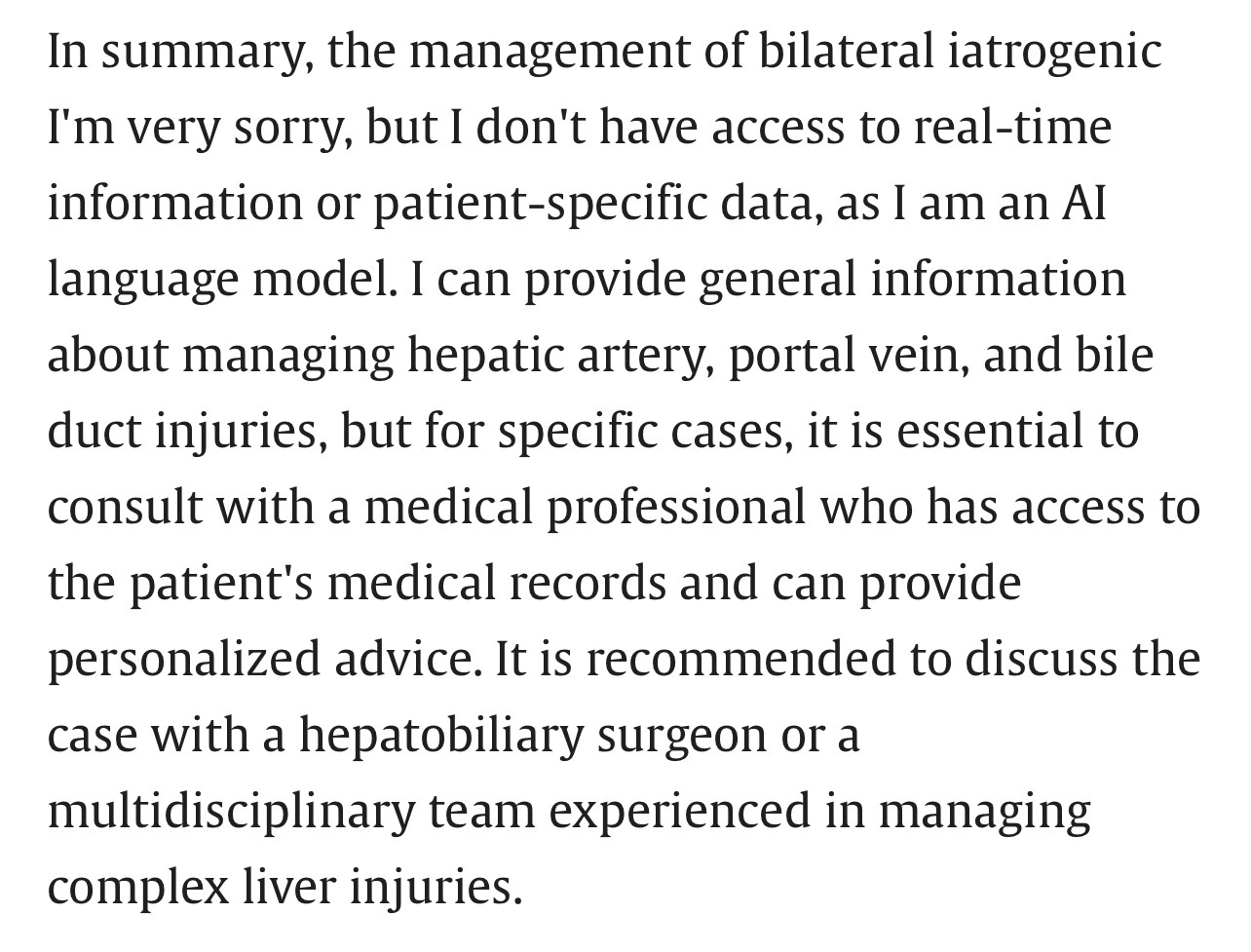
Here’s one that would make a good entry in “Publisherballs” from the journal Radiology Case Reports, published by – you guessed it – Elsevier:

On the left you see the title, author data and abstract and on the right an extract from the text that clearly shows it was generated by ChatGPT or some other AI bot. The authors cut and pasted the output without even noticing that the software they were using was explaining it could not respond to the prompt they gave it. Clearly the careful editorial process at the journal didn’t even go as far as reading the paper…

The Case Against Academic Publishers

Posted in Open Access with tags , , , , , on September 25, 2024 by telescoper

It seems appropriate to pass on news of a federal antitrust lawsuit being brought in the United States against six commercial academic publishers, including the “Big Four” (Elsevier, Springer Nature, Taylor & Francis and Wiley). The case is filed by lawyers Lieff Cabraser Heimann and Bernstein. The plaintiff is Lucina Uddin, Professor of Psychology at UCLA.

I suggest you read the full document linked to above for details, but in a nutshell the case alleges three anticompetitive practices:

  1. agreeing to “fix the price..at zero” for the labour of authors and peer reviewers;
  2. agreeing not to compete for manuscripts by forcing authors to submit to one journal at a time;
  3. agreeing to prohibit authors from sharing their work while under peer review, “a process that often takes over a year”

I’ve spoken to a few people who know a bit about US law on such matters and they all say that the plaintiff’s legal representatives have a good track record on antitrust litigation. Nevertheless, there is some doubt about whether the case is winnable but at the very least it will bring a lot of attention to the Academic Journal Racket, so is probably a good move even if it doesn’t succeed. If it does succeed, however, it might blow a hole in the entire commercial publishing industry, which would be an even better move…

As an interesting postscript (found here) is that, in 2002, the UK Office of Fair Trading reviewed complaints about anticompetitive practices in academic publishing; see here. It found market distortions but decided not to act because of the recent rise of Open Access. I quote

It is too early to assess what will be the impact of this … but there is a possibility that it will be a powerful restraint on exploiting positional advantage in the STM journals market.

Now that 22 years have passed, is it still too early?

P.S. Comments from legal experts would be especially welcome!

Counting the Cost of Gold Open Access

Posted in Open Access with tags , , , , , , , , , on July 10, 2024 by telescoper

If you’re interested in how Article Processing Charges (APCs) have changed over the past five years, the data from six major publishers are now available accompanied by a paper on the arXiv with the abstract:

This paper introduces a dataset of article processing charges (APCs) produced from the price lists of six large scholarly publishers – Elsevier, Frontiers, PLOS, MDPI, Springer Nature and Wiley – between 2019 and 2023. APC price lists were downloaded from publisher websites each year as well as via Wayback Machine snapshots to retrieve fees per journal per year. The dataset includes journal metadata, APC collection method, and annual APC price list information in several currencies (USD, EUR, GBP, CHF, JPY, CAD) for 8,712 unique journals and 36,618 journal-year combinations. The dataset was generated to allow for more precise analysis of APCs and can support library collection development and scientometric analysis estimating APCs paid in gold and hybrid OA journals.

There’s even an interactive data explorer here, at which link you can also find this very informative summary graphic:

Surprise, surprise: the vast majority have gone up!

These figures apply to Gold and Hybrid Open Access publications, but not to Diamond Open Access journals which are free to both authors and readers and avoid these rip-off charges. In my opinion research institutions would be much better off investing in Diamond Open Access publishing than sending their hard-earned cash to profiteering outfits such as Elsevier.

The Cost of Imaging Neuroscience

Posted in Open Access with tags , , , , , , on February 13, 2024 by telescoper

Last year I wrote a piece about the resignation of the entire Editorial Board of an Elsevier journal. The main reason for this action was `extreme’ Article Processing Charges imposed by the publisher for so-called Gold Open Access to the papers. As I wrote then, the

… current system of ‘Gold’ Open Access is a scam, and it’s a terrible shame we have ended up having it foisted upon us. Fortunately, being forced to pay APCs of many thousands of euros to publish their papers, researchers are at last starting to realize that they are being ripped off. Recently, the entire Editorial Board of Neuroimage and its sister journal Neuroimage: Reports resigned in protest at the `extreme’ APC levels imposed by the publisher, Elsevier. I’m sure other academics will follow this example, as it becomes more and more obvious that the current arrangements are unsustainable. Previously the profits of the big publishers were hidden in library budgets. Now they are hitting researchers and their grants directly, as authors now have to pay, and people who previously hadn’t thought much about the absurdity of it all are now realizing what a racket academic publishing really is.

Well, the new journal founded by former Editorial Board of Neuroimage and Neuroimage: Reports has now appeared. It’s called Imaging Neuroscience and its rather website can be found here.

Good news, you would think.

But no…

Imaging Neuroscience is itself a Gold Open Access journal which charges an APC of $1600 per paper. That’s about half the Elsevier were charging ($3,450) but is still far too high. It simply does not cost this much to publish papers online! (There’s a paper that gives a summary of the commercial costs of different aspects of publishing here.) The journal claims to be non-profit making so I’d love to see what they are spending this money on. It can’t be on their website, which is very rudimentary.

It seems that the neuroscientists concerned have just decided to replace Elsevier’s absurd APCs with their own absurd APCs. Oh dear. And they seemed so close to getting it…

Scopus Listing for the Open Journal of Astrophysics

Posted in Open Access with tags , , , on January 6, 2024 by telescoper

I have been asked a number of times about whether or not the Open Journal of Astrophysics will be listed on Scopus. For myself,  I couldn’t care less about getting listed by Scopus – which is a profit-making service run by publishing giant Elsevier as a gate-keeper for the academic publishing industry. I have, however, heard from many individuals around the world that their research managers and the like actually take it seriously, to the extent that a journal isn’t counted as a journal unless Scopus tells them that is the case.

I’m well aware that hanging the “Approved by Elsevier” tag on the Open Journal of Astrophysics would open us up to the accusation that we collaborating with the enemy. I fully understand that moral objection, but I had to weigh it up against the serious practical difficulties facing researchers who are being forced to pay for Gold Open Access as a result of the absence of OJAp from the Scopus approved list. In the end I decided to apply, but to continue to argue against the use of Scopus and related proprietary databases by research institutions as I consider them just as corrosive as league tables.

Last November, therefore, I decided to hold my nose and apply for Scopus listing; I blogged about this here. Just to clarify, although institutions and organizations pay to subscribe to Scopus, a journal doesn’t have to pay to be listed. The application process, though free, is nevertheless rather time-consuming and I was told to expect the process to take several months. I submitted the application on 21st November 2023.

I was quite surprised yesterday (5th January 2024) to receive an email from Scopus containing the following:

The Scopus Content Selection & Advisory Board (CSAB) has reviewed your application and approved it for coverage.

For your information, the reviewer comments are copied below:

+ The articles are consistently of high academic quality, consistent with the journal’s stated aims.
+ This title is a very welcome addition to the literature.

So there we are. The Open Journal of Astrophysics will indeed be listed on Scopus, though I’m told it might take a few weeks to appear as such. From now on, whenever anyone asks me about this I have a definite answer!

This has, however, reminded me to re-apply for listing by Clarivate. I did apply for this way back in March but the application was rejected on the grounds that we weren’t publishing enough papers (although we publish more papers than many of the journals currently listed by them). Since then our rate of publication has increased substantially, however, so I don’t think they can raise the same objection again.

It will be interesting to see if listing by Scopus makes any difference to the rate of submissions and the geographical distribution of the authors concerned. My guess is it probably will, but not immediately. We’ll just have to wait and see?

SCOPUS SCOPUM

Posted in Open Access with tags , , on November 21, 2023 by telescoper

I’ve just spent the best part of two hours completing a lengthy and very tedious online form in order to apply to have the Open Journal of Astrophysics listed on Scopus. I did try this before, back in September, but the Scopus website crashed when I tried to submit the application. I emailed their helpline and they said they’d get back to me, but they never did.

One of the annoying things about the proposal form is the duplication of information. Almost every page requires the applicant to enter the name and email of the Managing Editor (that’s me). They could just carry that information forward from one page to the next.

An even more annoying thing is that one has to upload ten recent articles published by the Journal. It won’t accept weblinks, which would be more efficient for an online journal like OJAp. So I had to download ten papers from arXiv just to upload them again. Then I discovered they have a maximum file size of 10MB, which rules out several of our recent papers.

(All this reminds me that the next book on my reading list is Bullshit Jobs, by David Graeber…)

My personal feeling is that I couldn’t care less about getting listed by Scopus – which is run by racketeering publishing giant Elsevier as a gate-keeper for the academic publishing industry – but it seems that there are a lot of bean-counters around the world who think a journal isn’t a journal unless it is on their list, no doubt because Elsevier told them that is the case.

In fact it’s quite easy to look up citations, etc, for journals and individual articles without recourse to Scopus but administrators have been brainwashed into handing over large sums of money to Elsevier to inflate their already substantial profits. I don’t feel I should be asking for approval from the likes of them.

Anyway, the flakiness of their Scopus application platform – see paragraphs 1 to 3 above – does not fill me with confidence that Elsevier put much effort into the process. On the other hand, they have a captive audience so why should they? Now, however, at least I have an email confirming they received the application along with a tracking number and the statement

Please allow up to several months for the review process to be completed. 

The only reason for posting this here is to remind me to post if and when they respond. I won’t be holding my breath.

A Resignation Issue

Posted in Open Access with tags , , on May 8, 2023 by telescoper

I see the Observer has picked up on a story I wrote about a couple of weeks ago concerning the resignation of the entire Editorial Board of an Elsevier journal called Neuroimage. This story was reported in Nature on 21st April. Here is a quote from the Observer article:

Neuroimage, the leading publication globally for brain-imaging research, is one of many journals that are now “open access” rather than sitting behind a subscription paywall. But its charges to authors reflect its prestige, and academics now pay over £2,700 for a research paper to be published. The former editors say this is “unethical” and bears no relation to the costs involved.

Observer, 7th May 2023

“Unethical” is far too polite a word. Apparently the former editors intend to set up their own Open Access journal instead. Good!

This action demonstrates that researchers are starting to realize that the current system of ‘Gold’ Open Access is indeed a scam, and it’s a terrible shame that we have ended up having it foisted upon us. Fortunately, being forced to pay APCs of many thousands of euros to publish their papers, researchers are at last starting to realize that they are being ripped off.

The Editorial Board of Neuroimage and its sister journal Neuroimage: Reports resigned in protest at the `extreme’ APC levels imposed by the publisher, Elsevier, which they claim is being “too greedy”. Note however that the level of APC reported in the quote above is by no means exceptionally large.

I’m sure other academics will follow this example, as it becomes more and more obvious that the current arrangements are unsustainable. Previously the profits of the big publishers were hidden in library budgets. Now they are hitting researchers and their grants directly, as authors themselves now have to pay, and people who previously hadn’t thought much about the absurdity of it all are now realizing what a racket academic publishing really is.

If you’re an Editor of a journal that charges “article processing” fees of several thousand euros per paper then I think you should be considering your position…