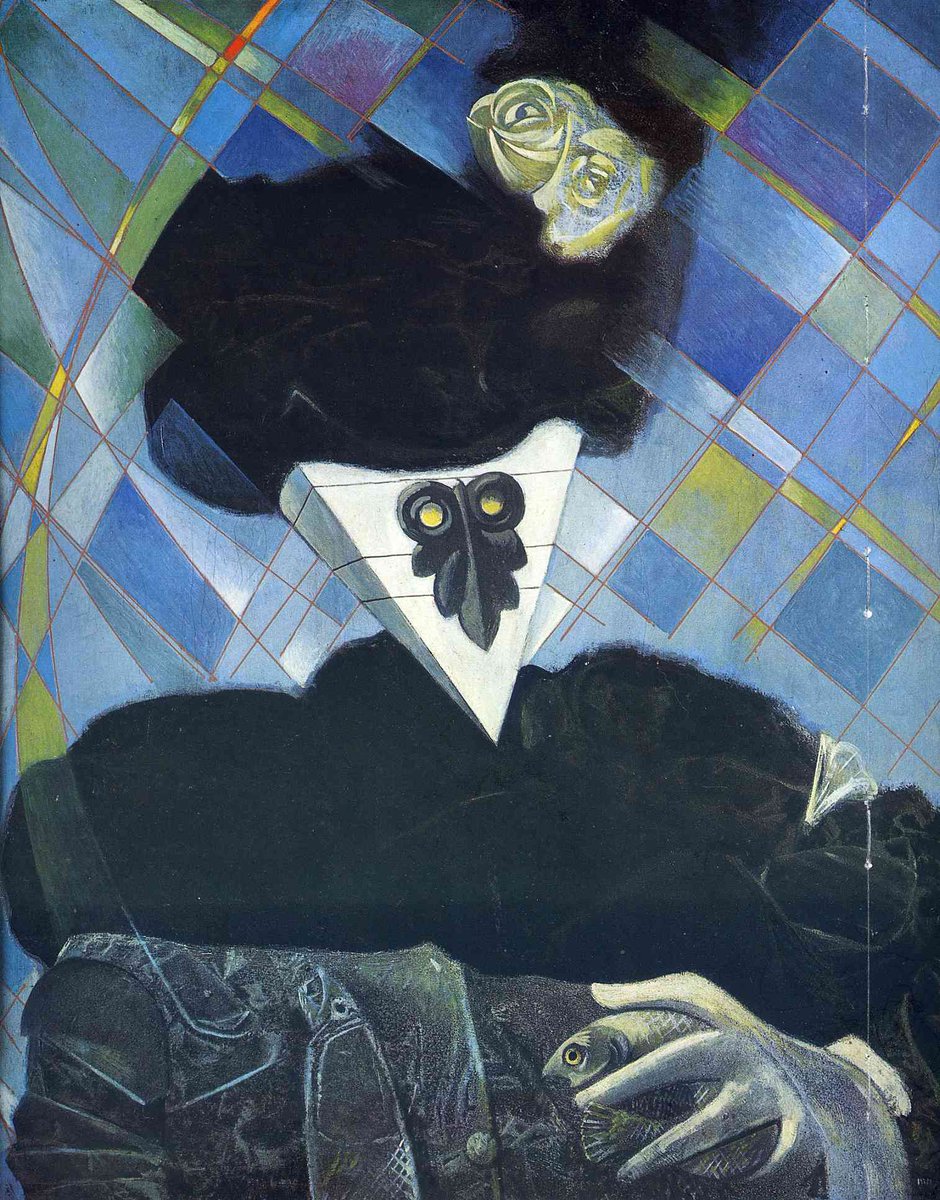
by Max Ernst (1891-1976) , painted in 1945 (oil on canvas, 65 x 57.5 cm).
Follow @telescoper
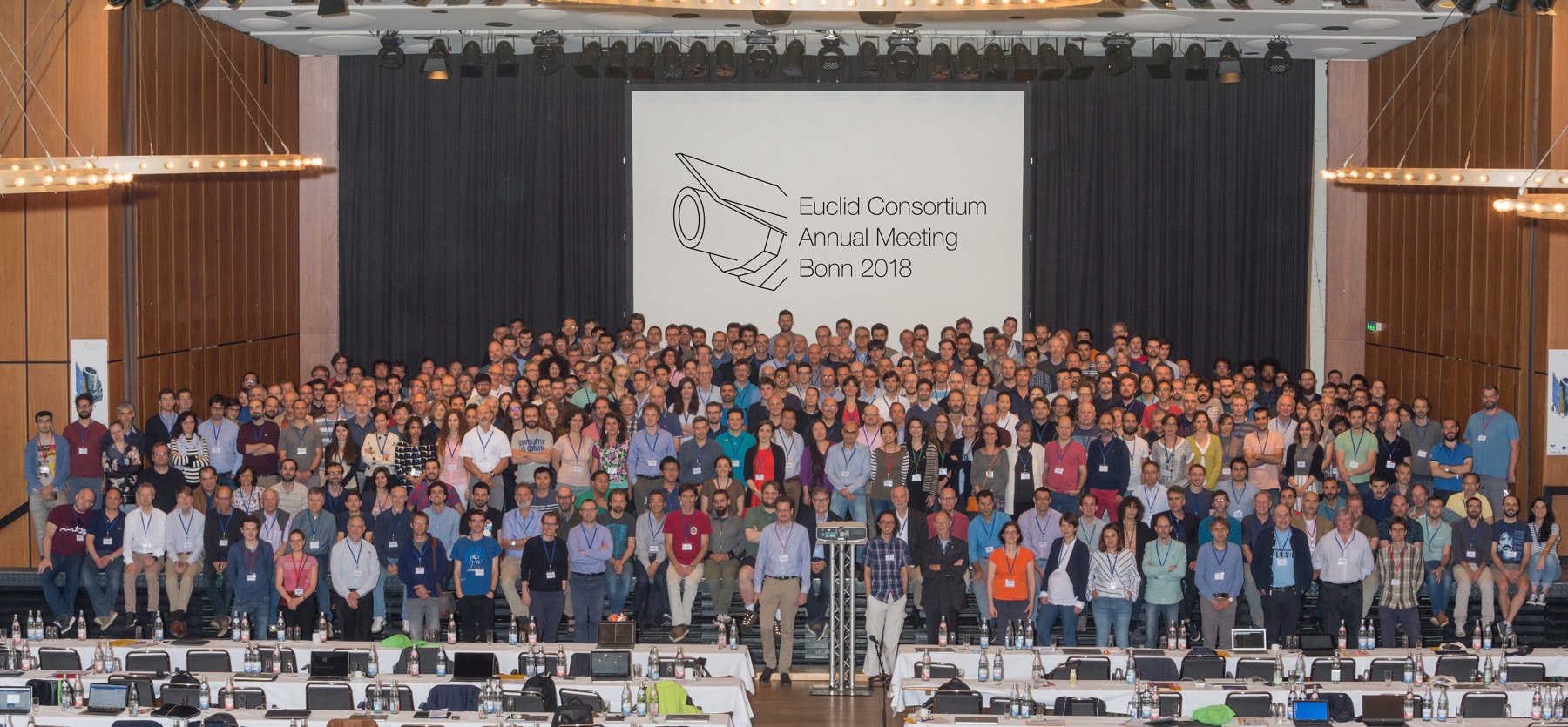
It’s the morning after the conference dinner the night before, so as Day 4 of the Euclid Consortium meeting gets under way I’ve just got the time and bandwidth to do a brief post about the events of yesterday. First of all, the conference photo arrived and is shown above. You’d be hard pressed to spot me in it, as there are a lot of people in it (and bear in mind that only about a quarter of the membership of the Euclid Consortium are actually present here in Bonn).
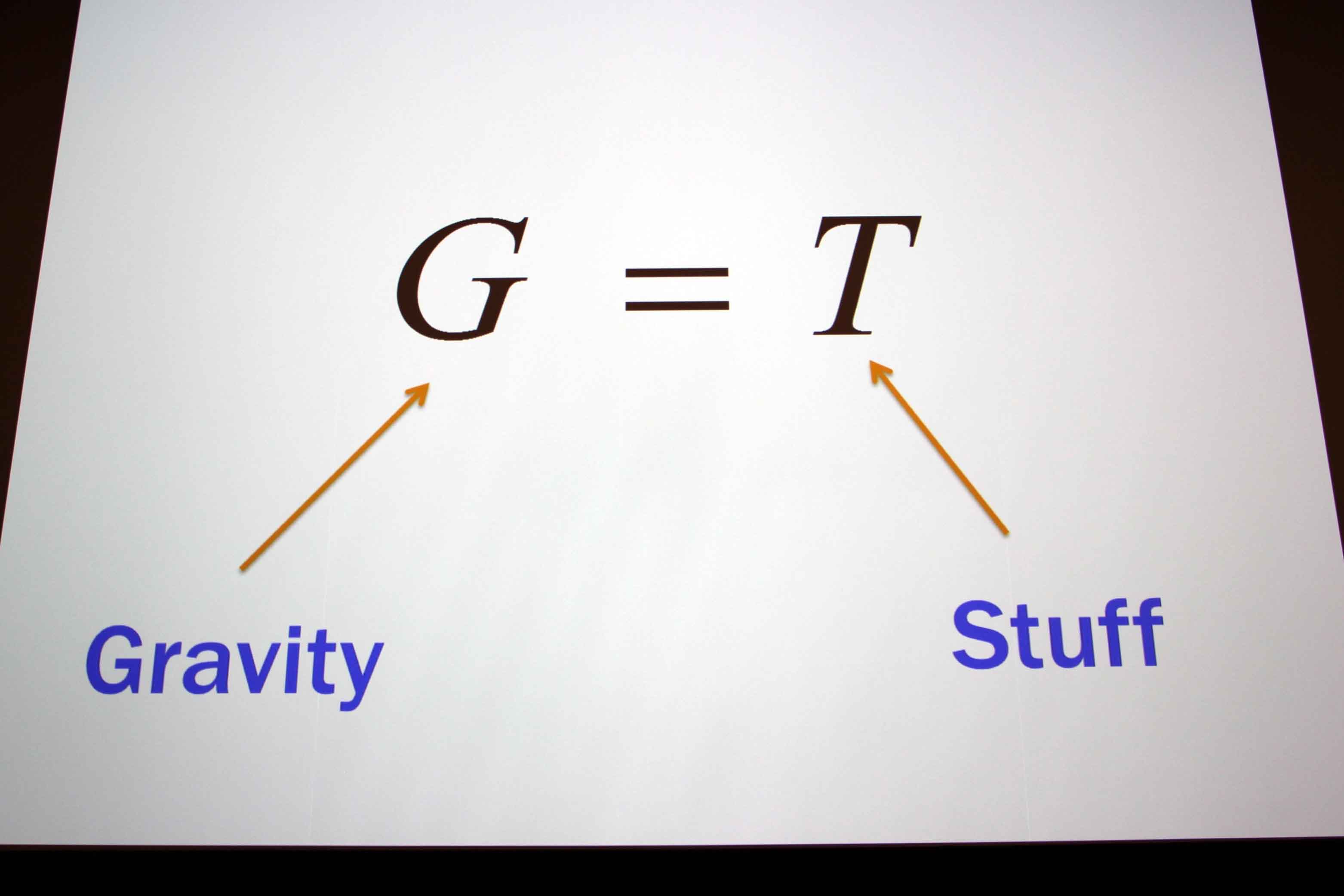
Yesterday I went to splinter meetings related to the working groups on cross-correlating Euclid with cosmic microwave background data (morning) and clusters of galaxies (afternoon). The latter session produced the following diagram, which makes everything clear:

After the day’s work was done I took a walk down to the western bank of the Rhine (just about 15 minutes’ walk from my hotel), on the way to the conference dinner at the . Sadly, I didn’t see any Rhine Maidens or find any gold to make into a ring.

Anyway, the dinner was at the splendid Rhein Hotel Dreesen and I had the good fortune to sit with some Italian friends from way back – by which I mean over 20 years!

Fortunately I didn’t have far to go to get back to my hotel after the festivities!
Follow @telescoperI’ve just had my breakfast so I thought I’d do a quick post before the start of play at Day 3 of the 2018 Euclid Consortium Meeting in Bonn.
Day 2 was largely devoted to updates from the various Science Working Groups, but there was also an important presentation from Jason Rhodes about WFIRST, which is in some ways a rival to Euclid, or perhaps a complementary mission depending on how you look at it.
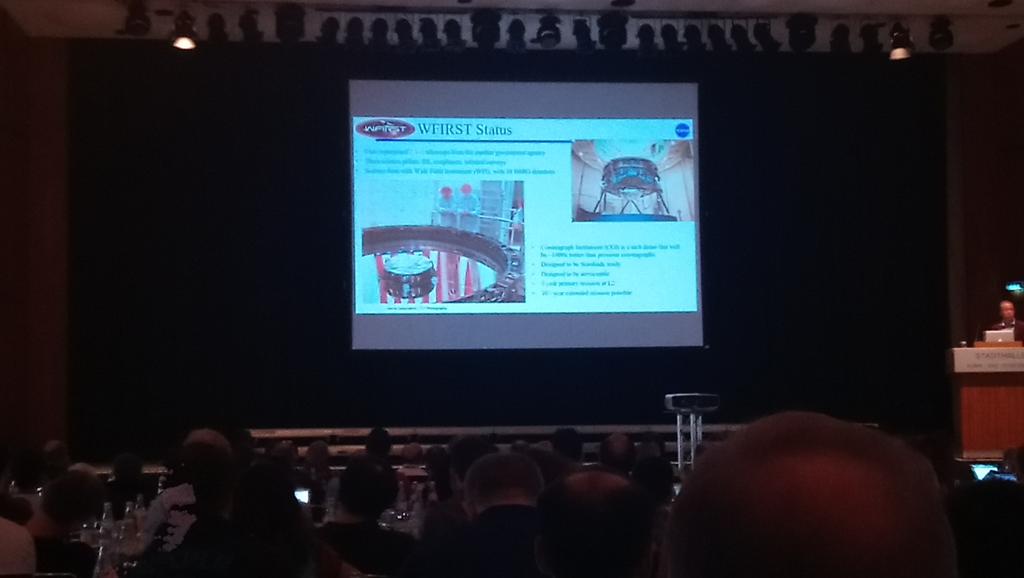
There was dismay in the global astronomy community last year when Donald Trump proposed taking the axe to WFIRST but it was good to hear that Congress not only reversed his decision but granted it additional funds over and above the original request.
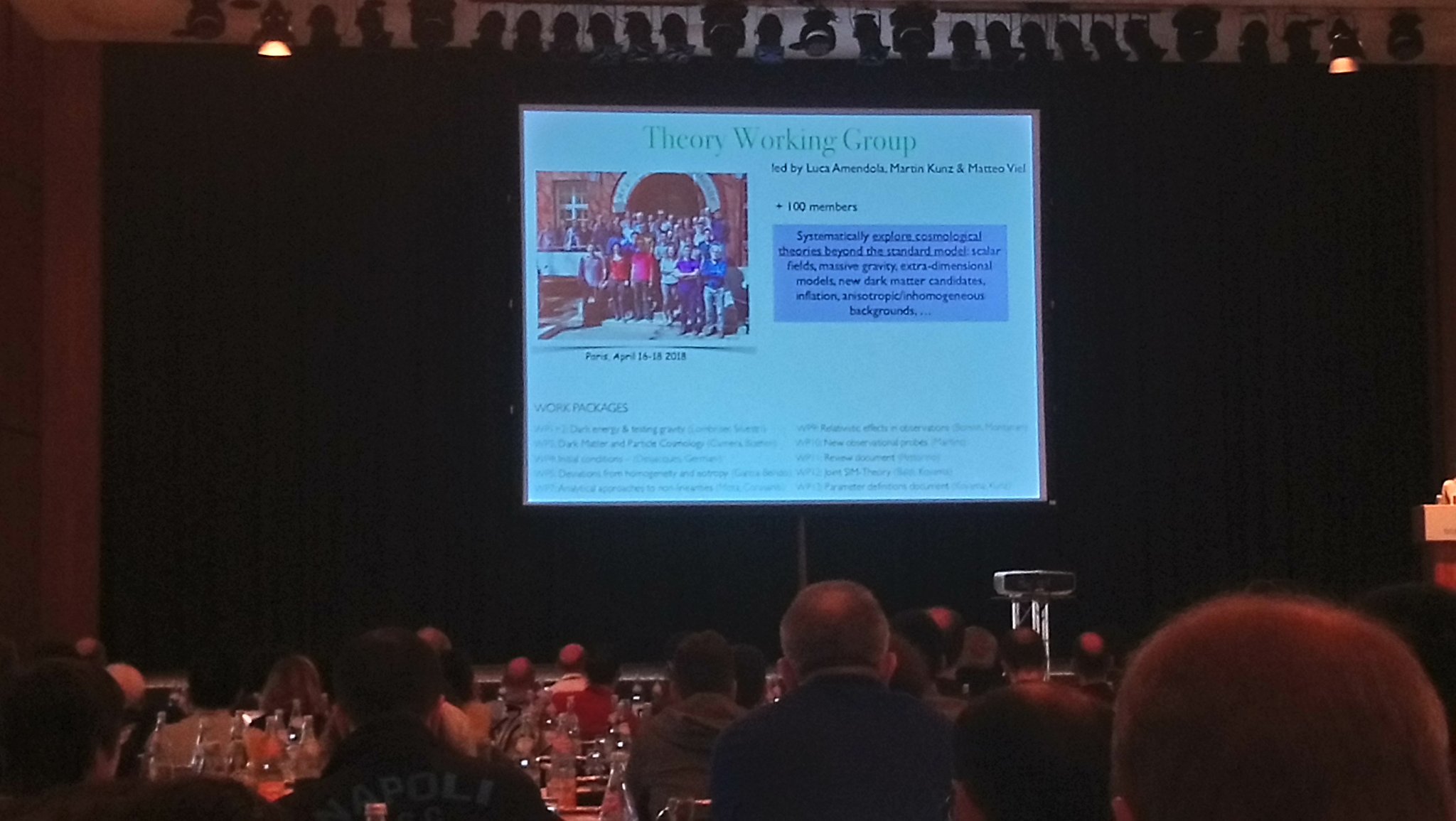
Among the SWG updates was one by Alessandra Silvestri from the Theory Working Group concentrating on how Euclid could be used to test cosmology beyond the standard model. She focussed quite a lot on Horndeski Gravity, which is the most general four-dimensional scalar-tensor theory that leads to equations of motion that have the form of second-order differential equations.
Towards the end of the day there was a session devoted to the award of the Euclid Star Prizes.

The individual awards went to Micaela Bagley, Carmelita Carbone, Teake Nutma, Bertrand Morin, and Stefanie Wachter; more details on the winners and the awards they won will be posted here. The team award was given to the Flagship simulation team. Coincidentally, I posted about the Flagship simulations last year. Much of the preparation for Euclid would be impossible without these simulations, and the award of a prize to the team is very well justified.
The day finished with short talks from each of the prizewinners. That brought to the end two days of plenary sessions in the big hall of the Stadthalle. The next two days will be the `Splinter sessions’ which are held in parallel.
Oh, and one other thing: the 2019 Euclid Consortium Meeting will be held in Helsinki from June 4-7. Looks like I’ll be spending my birthday in Finland next year!
P.S. Previous Euclid Consortium meetings were: Bologna (2011); Copenhagen (2012); Leiden (2013); Marseille (2014); Lausanne (2015); Lisbon (2016); and London (2017).
Follow @telescoper 
Credit: J. Carretero/P. Tallada/S. Serrano for ICE/PIC/U.Zurich and the Euclid Consortium Cosmological Simulations Science Working Group.
The above image is taken from the world’s largest simulated galaxy catalogue, which has been constructed to help prepare for the forthcoming Euclid space mission. The image actually shows only a small part of the full Euclid Flagship mock galaxy catalogue, which contains more than 2 thousand million galaxies distributed over the 3-dimension cosmological volume that Euclid will survey. Synthetic galaxies in this simulation mimic with great detail the complex properties that real sources display: ranging from their shapes, colours, luminosities, and emission lines in their spectra, to the gravitational lensing distortions that affect the light emitted by distant galaxies as it travels to us. The simulation is large enough to allow full `light-cone’ effects to be taken into account, as the look-back time to the edge of the Euclid survey volume is long enough for significant evolution to have occurred; according to the standard cosmological model, the time taken for light to travel from redshift z=2.3 to now is about 10.8 billion years, a significant fraction of the age of the Universe.
`Mock’ catalogues like this are needed to plan large observational programmes, whether using space missions or ground-based facilities, and to help prepare the data analysis strategies and tools needed to deal with the real data when it arrives. They can also be used to make excellent images for PR and outreach purposes.
The use of the word `simulation’ always makes me smile. Being a crossword nut I spend far too much time looking in dictionaries but one often finds quite amusing things there. This is how the Oxford English Dictionary defines SIMULATION:
1.
a. The action or practice of simulating, with intent to deceive; false pretence, deceitful profession.
b. Tendency to assume a form resembling that of something else; unconscious imitation.
2. A false assumption or display, a surface resemblance or imitation, of something.
3. The technique of imitating the behaviour of some situation or process (whether economic, military, mechanical, etc.) by means of a suitably analogous situation or apparatus, esp. for the purpose of study or personnel training.
So it’s only the third entry that gives the meaning intended to be conveyed by the usage in the context of cosmological simulations. This is worth bearing in mind if you prefer old-fashioned analytical theory and want to wind up a simulationist!
In football, of course, you can even get sent off for simulation…
Follow @telescoperYesterday was a very busy day: up early to check out of my hotel and head to the third day of the Euclid Consortium meeting for the morning session, then across to the Institute of Physics for a Diversity and Inclusion Panel meeting, then back to the Euclid Consortium meeting for the last session of the day, then introducing the two speakers at the evening event, then to Paddington for the 7.15 train back to Cardiff. I was not inconsiderably tired when I got home.
I had to bale out of the evening session to get the train I was booked on, but it seemed to be going well. Before I left, Ofer Lahav asked for an informal show of hands about a few possibilities relating to the nature of Dark Energy. Since today is polling day for the 2017 General Election, I thought it might be a good idea to distract people from politics for a bit by running a similar poll on here.
There are lots of possibilities for what dark energy may turn out to be, but I’ve decided to allow only six broad classes into which most candidate explanations can be grouped:
Well, there are the six candidates. Make your choice:
Follow @telescoperI didn’t expect to be doing anything other than listening to the talks and getting updated on the progress of the Euclid project at this meeting in London, but this morning I was roped in to introduce a public event tomorrow evening, called Cosmology beyond the Centenary of Λ:
This will take the form of a dialogue/discussion/debate between two leading cosmologists taking a `big picture’ view of the state of cosmology now and likely future developments. I’m sure it will be very friendly so I won’t use any form of language that suggests confrontation but it features, in the red corner, George Efstathiou of the University of Cambridge and, in the blue corner, Ofer Lahav of University College London.
Incidentally, I posted some months ago about the fact that this is the centenary year of Einstein’s introduction of the cosmological constant into the field equations of general relativity in this paper:

I recommend anyone attending this Euclid meeting and indeed anyone with a passing interest in cosmology to read that paper – it’s very different from what you might probably imagine it to be!
Follow @telescoper“It was the best of times, it was the worst of times..”
As planned on Saturday evening I stayed at home, cooked myself dinner, opened a bottle of wine, and watched an old film on DVD. Self-indulgent, I know, but a good way to have a pleasant evening while avoiding the crowds at the UEFA Champions League final.
Some time after 10pm I checked Twitter to see what the score was (4-1 to Real Madrid), and just to check that nothing untoward had happened before or during the match.
It hadn’t, but that was exactly when news was coming in of another terrorist attack in London, this time on London Bridge and in the area of Borough Market. Stories were initially very confused, and I went to bed before a clear picture emerged.
I checked the news feeds again when I woke up and felt the saddest I’ve ever been on a birthday, but still determined to go to Der Rosenkavalier. The best way for us all to beat terrorism is to carry on regardless.
Likewise I didn’t think twice about coming to London today for the Euclid meeting this week. That said, I did arrive very late. Torrential rain overnight in Cardiff, combined with a blocked gutter, led to a flood in my kitchen. I had to call a useful person to fix it the problem, which delayed me by a few hours. Fortunately it was only rainwater in the leak, not nasty stuff backed up from the drain.
Now I’m in London where it is also tipping down, but at least I’m in a pleasant hotel and looking to get a good night’s sleep. The sound of rain can be restful, at least when it’s not flooding your kitchen.
I made my way to the hotel, which is in Bayswater, after a wine and nibbles reception at the workshop. I have never stayed here before and it took a while to find. I was a bit nervous too, as the place is remarkably cheap by London standards. Before correctly locating the hotel I wandered into another establishment on the same street with a similar name. It was quite obviously a brothel, and they politely directed me to the correct address. The hotel turned out to be fine, though obviously without any of the ‘extras’ that would have been available at the other place.
I can’t stay the whole week here as I have to get back to Cardiff to vote on Thursday, but it’s been nice to catch up with news of the Euclid mission and to meet some old friends. There are about 400 cosmologists here in London for this meeting, some of them familiar some of them less so. The mission won’t be launched until 2021 at the earliest, and it’s unlikely I’ll be involved very much, but it’s still exciting to see it all taking shape.
Follow @telescoperThis morning I flew from London Gatwick to Edinburgh to attend the UK Euclid meeting at the Royal Observatory, which lasts today and tomorrow. It turns out there were two other astronomers on the plane: Alan Heavens from Imperial and Jon Loveday from my own institution, the University of Sussex.
The meeting is very useful for me as it involves a number of updates on the European Space Agency’s Euclid mission. For those of you who don’t know about Euclid here’s what it says on the tin:
Euclid is an ESA mission to map the geometry of the dark Universe. The mission will investigate the distance-redshift relationship and the evolution of cosmic structures by measuring shapes and redshifts of galaxies and clusters of galaxies out to redshifts ~2, or equivalently to a look-back time of 10 billion years. In this way, Euclid will cover the entire period over which dark energy played a significant role in accelerating the expansion
Here’s an artist’s impression of the satellite:
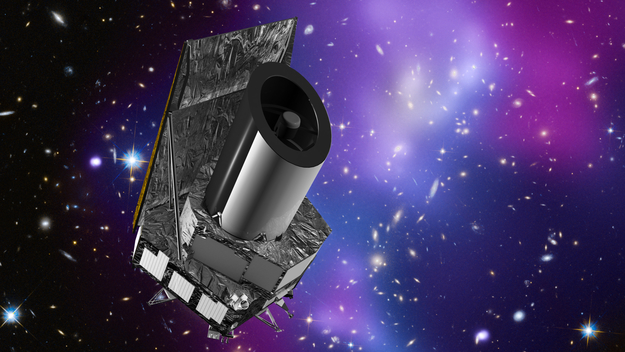
Do give you an idea of what an ambitious mission this is, it basically involves repeated imaging of a large fraction of the sky (~15,000 square degrees) over a period of about six years. Each image is so large that it would take 300 HD TV screens to display it at full resolution. The data challenge is considerable, and the signals Euclid is trying to measure are so small that observational systematics have to be controlled with exquisite precision. The requirements are extremely stringent, and there are many challenges to confront, but it’s going well so far. Oh, and there are about 1,200 people working on it!
Coincidentally, this very morning ESA issued a press release announcing that Euclid has passed its PDR (Preliminary Design Review) and is on track for launch in December 2020. I wouldn’t bet against that date slipping, however, as there is a great deal of work still to do and a number of things that could go wrong and cause delays. Nevertheless, so far so good!
Follow @telescoper
Following hard on the heels of the announcement of a Nobel Prize for cosmology earlier this morning, the European Space Agency has this afternoon officially announced the two candidates which have been chosen for its next M-class missions from a shortlist of three.
One of the successful candidates, EUCLID, is directly relevant to the topic covered by the Nobel Prize announced this morning. “Euclid will address key questions relevant to fundamental physics and cosmology, namely the nature of the mysterious dark energy and dark matter. Astronomers are now convinced that these substances dominate ordinary matter. Euclid would map the distribution of galaxies to reveal the underlying ‘dark’ architecture of the Universe.”
Now that it’s definitely been selected, I hope to devote time in due course for a longer post about EUCLID’s capabilities and intentions, but in the meantime I’ll just say that it’s been a very good day for Dark Energy.
P.S. The other successful candidate is called Solar Orbiter. Commiserations to advocates of the third mission on the shortlist of three, PLATO. Close, but no cigar…
Follow @telescoper

