
The Euclid Consortium is celebrating the first year of the journey of the European Space Agency’s Euclid Mission into space! Over the past 52 weeks, Euclid has been scanning the cosmos, uncovering new insights into dark matter, dark energy, and the structure of the universe. The Euclid Consortium has produced a slideshow, showcasing the key moments and discoveries from the first year in space.
The slideshow can be seen on YouTube here:
Here is a poster:
This can also found in interactive form here where you can click on each of the 52 images to see what it’s about.
P.S. The subtitle of the poster is “first year of a big journey to new physics”. There’s no guarantee that Euclid will find any new physics, rather than confirming our existing ideas, but it might.
I haven’t posted anything about the European Space Agency’s Euclid mission recently but I can remedy that today by sharing a new video that describes one of the methods that Euclid will use to map the dark Universe. Here’s the video:
ESA’s Euclid mission is surveying the sky to explore the composition and evolution of the dark Universe. But how can Euclid see the invisible? Watch this video to learn about the light-bending effect that enables scientists to trace how dark matter is distributed in the Universe.
By making use of Euclid’s flagship simulation, the video illustrates how dark-matter filaments subtly alter the shape of galaxies. Light travelling to us from vastly distant galaxies is bent and distorted by concentrations of matter along its way. The effect is called gravitational lensing because matter (both ‘normal’ and dark matter) acts as a kind of magnifying glass.
Scientists distinguish between strong and weak gravitational lensing. In strong gravitational lensing distortions of background galaxies or other light sources are very apparent, resulting in arcs, multiple images or so-called Einstein rings. In weak lensing, background sources appear only mildly stretched or displaced. This means we can only detect this effect by analysing large numbers of sources in a statistical way.
The further we look, the more prominent the distortions from weak gravitational lensing are, because there are more dark-matter structures acting as lenses between us and the light sources.
Euclid will measure the distorted shapes of billions of galaxies over 10 billion years of cosmic history, providing a 3D view of the dark matter distribution in our Universe. This will shed light on the nature of this mysterious component.
The map of the distribution of galaxies over cosmic time will also teach us about dark energy, which affects how quickly the Universe expands. By charting the Universe’s large-scale structure in unprecedented detail, Euclid will enable scientists to trace how the expansion has changed over time.
I usually only do updates at weekends about papers published in the Open Journal of Astrophysics but I’m making an exception today because a paper we published yesterday is making some waves that I think are worth propagating. The paper is called “A population of neutron star candidates in wide orbits from Gaia astrometry” and the first author is Kareem El-Badry of Caltech (USA); his institution have put out a press release to go with the paper which you an read for more details. They key point is that these are main sequence stars with (probably) neutron star companions and nobody really knows how such systems formed. The paper is also yet another illustration of the amazingly rich source of discovery data that is the European Space Agency’s Gaia mission.
The press release also contains some snazzy graphics, such as this:
The press release explains
The new study, which includes a team of co-authors from around the world, was published in The Open Journal for Astrophysics. Data from several ground-based telescopes, including the W. M. Keck Observatory on Maunakea, Hawai‘i; La Silla Observatory in Chile; and the Whipple Observatory in Arizona, were used to follow up the Gaia observations and learn more about the masses and orbits of the hidden neutron stars.
It is very gratifying to see one of our papers gaining such traction. It also exemplifies something that has struck me recently. Obviously, when we started the Open Journal of Astrophysics I really had no idea how it would go, but one thing that has surprised me (in a pleasant way) is how many articles we are getting from authors based in high-profile US institutions, such as Caltech, Harvard, Princeton and Berkeley (among others). I always assumed that such institutions were rich enough not to be worried by the cost of Article Processing Charges and, being based in America, the authors would in any case be used to paying page charges for the Astrophysical Journal which has been standard practice for ages. Whatever the reason, it sends a great message to the community to see these leading institutions going via the Diamond Open Access route. I hope this provides even more evidence to persuade even more authors that OJAp is a serious journal!
Update: it all seemed to go very well, but the timing of the launch was badly planned by the EuropeanSpaceAgency, as it clashed with the semi-final between Spain and France in the European Championship.
Together with the five images released last November that makes a total of ten Early Release Observations from the pre-survey phase of Euclid. It’s not all about the pictures, however. Today also saw the release of ten scientific papers to go with these images, as well as five reference papers for the main survey. You can find them all, with accompanying information here. They will be announced on arXiv tomorrow.
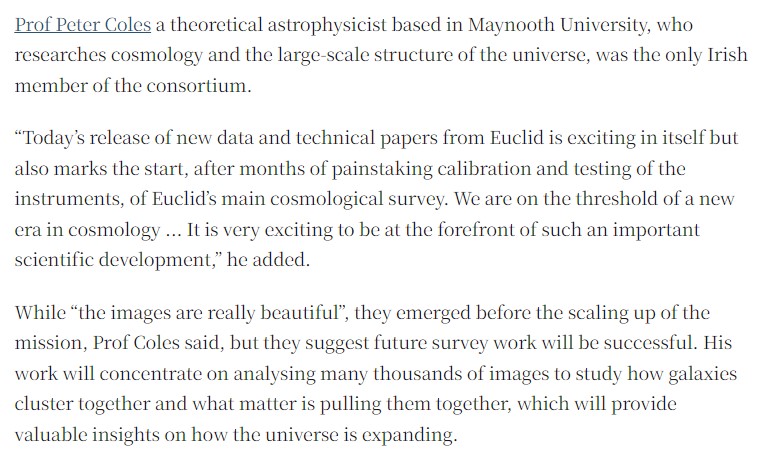
You might also be interested to read my Euclid piece on RTÉ Brainstorm which has just appeared. This is not just about the new images, but gives an update on what Euclid has been up to since launch, and what we can expect in the future. There’s also a version adapted for Maynooth University PR purposes here. It includes this quote:
Today’s release of new data and technical papers from Euclid is exciting in itself but also marks the start, after months of painstaking calibration and testing of the instruments, of Euclid’s main cosmological survey. We are on the threshold of a new era in cosmology. Maynooth is the only University in Ireland to be involved in this mission and it is very exciting to be at the forefront of such an important scientific development.
I’m also quoted in a piece in the Irish Times. You’ll probably find the article blocked by a paywall but my bit is:
It’s a hectic time ahead of a Big Event on Thursday 23rd May, which will include the publication of five new Early Release Observations (EROs). I’m not at liberty to say what they are until after 12 noon (CEST) on Thursday except that they’re very pretty. You can watch the live stream here:
Thursday will also see the release of ten scientific papers related to the EROs; they will appear on arXiv on Friday 24th May. These will be the first science results from the Euclid mission.
But that’s not all! Thursday will also see the publication of five papers from the Euclid Consortium (of which I am the sole member based in Ireland). These will be the principal technical reference papers aimed at the astronomical community about the Euclid mission, covering the instruments, cosmology and other astronomy science possibilities, as well as the cosmological simulations used to assist the analysis of the mission. One of these, the main overview paper for the mission, has over a thousand authors (one of whom is your truly).
Thursday’s announcements are likely to significant level of press interest. That’s not only due to the European Space Agency’s own social media feeds and the like, but also local activities in Ireland. For example, there’s this from Science Foundation Ireland using this, from the Little Book of Irish Research:
I have also written a piece for RTÉ Brainstorm, as a kind of update on the one I wrote last year on the occasion of the launch; this will go live after the embargo is lifted on Thursday.
Today is a public holiday in Spain, as it is in much of Europe (including France, Germany, The Netherlands and Denmark). The occasion for the day off is Pentecost (or Whitsuntide as it is known in the UK) which, if I understand correctly, is when the Holy Spirit went down on the Apostles. Actually Pentecost (Whit Sunday) was yesterday, exactly 7 weeks after Easter Sunday, which was quite early this year which is why Pentecost Monday (20th May) is earlier than the fixed Bank Holidays used to mark it in the UK (the last Monday in May, 27th, next Monday) and Ireland (the first Monday of June, 3rd, in two weeks’ time). Could I perhaps take all three off?
Today’s holiday notwithstanding, this is going to be a busy week. On Wednesday and Thursday there is to be an event at the European Space Agency coincident with which, on Thursday 23rd May, there will be a significant press event relating to Euclid. I’m not at liberty to say any more at this point, as everything is strictly embargoed until 12 noon CEST on that day, but I have been writing a piece for RTÉ Brainstorm to come out as soon as the embargo is lifted. Hopefully the Communications team at Maynooth University will get involved in the press activity. Watch this space.
Remarkably for me, I filed the RTÉ Brainstorm piece ahead of the deadline but it’s no time to rest on my laurels because I have another paper to finish this week by a different deadline.
And next week will be busy too. I have to make a short trip to not-Barcelona to do a PhD examination in Newcastle upon Tyne and give a lecture in Oxford, where (so I’m told) there is a University of some sort. Then I have to pass through Maynooth to vote in the Local and European Elections before returning to Barcelona. Having another two Whit Monday holidays is looking like a good plan…
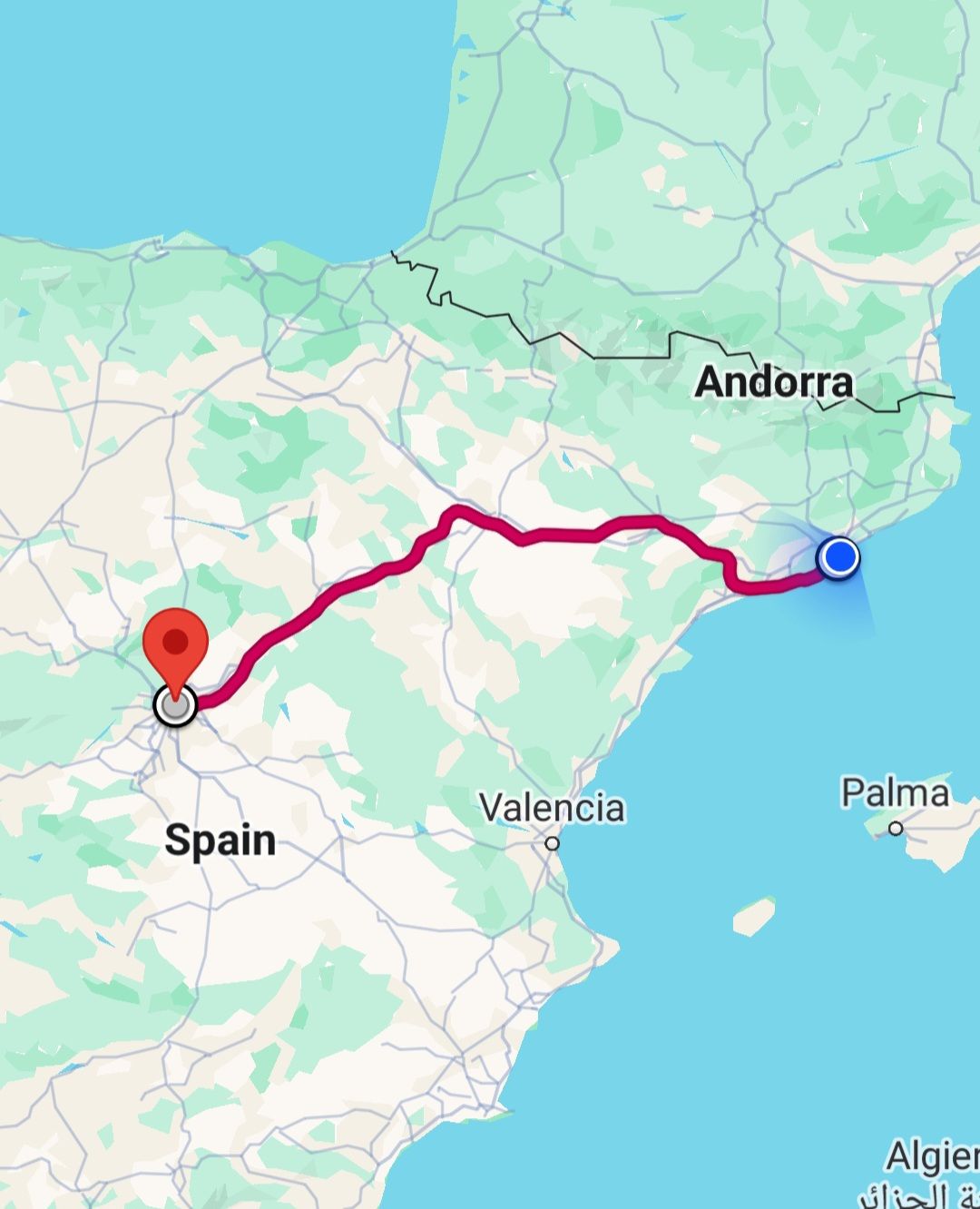
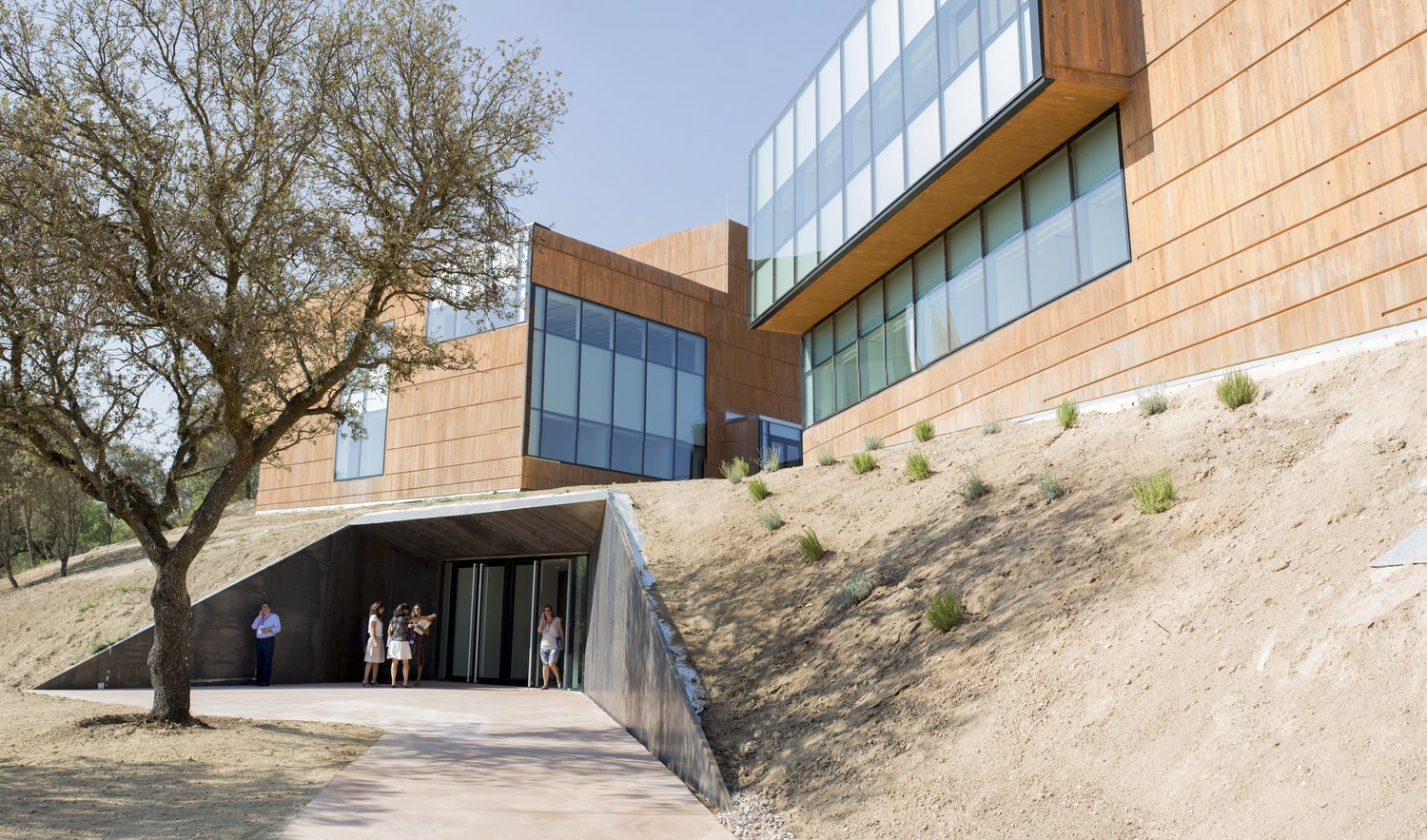
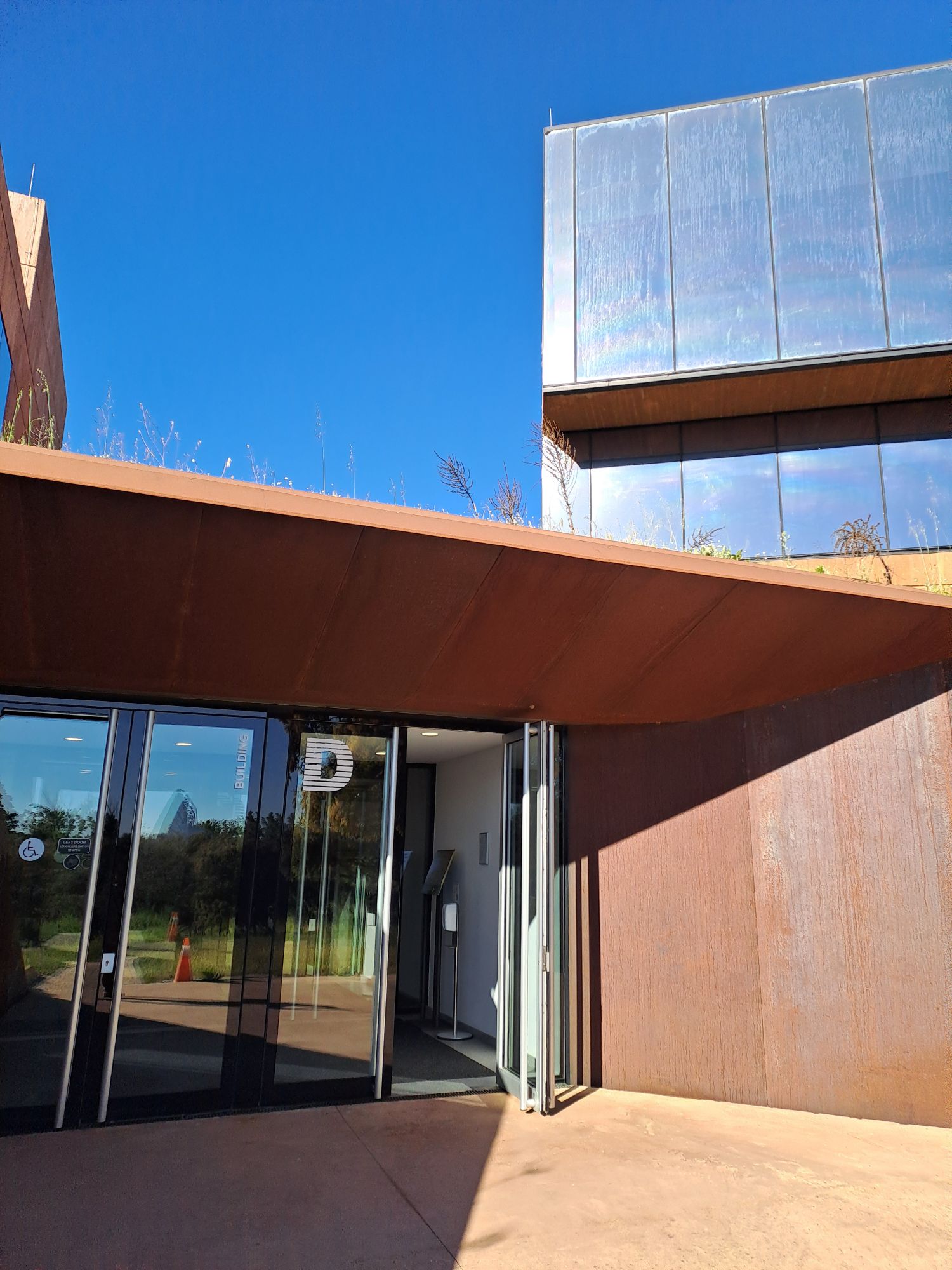
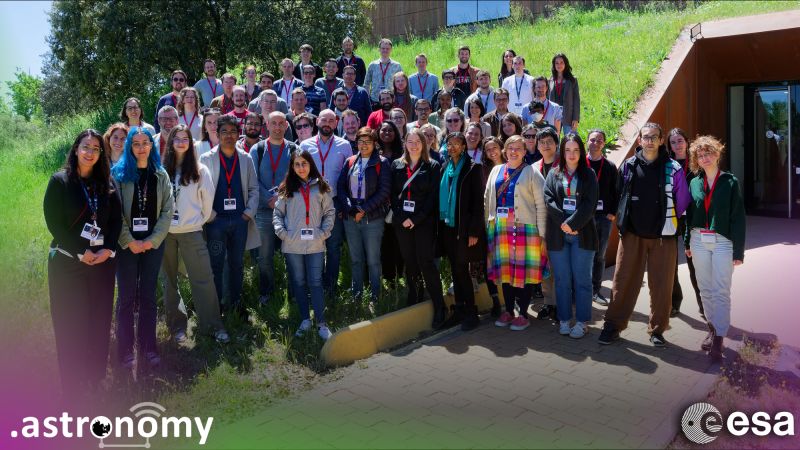
So here I am at the European Space Astronomy Centre (ESAC) just outside Madrid for a conference called .Astronomy 13. It is (obviously) the thirteenth such conference but the first that I have attended. I’m giving a plenary talk in half-an-hour or so. I travelled from Barcelona by train yesterday evening, which was a comfortable and uneventful trip, the (approximately) 504 km from Barcelona to Madrid Atocha station taking about 2 hours and 30 minutes that cost about 30 euros. I stayed overnight in Madrid and took a shuttle bus from to ESAC. The only glitch in my travels so far was that I got on the Metro Line 6 (the equivalent of the Circle Line), but chose the wrong platform and went the long way round. I still got there in time to get the shuttle.
Incidentally, ESAC hosts the Euclid Science Operations Centre (SOC) which plays a central role in the processing of data from Euclid and is also responsible for the development and operations of the Euclid Archive from which data will be distributed to the global astronomical community.
UPDATE: Back in Barcelona. The return by train was just as smooth an uneventful as the outbound journey, and in fact arrived back about five minutes ahead of schedule. Thanks to the organizers for inviting me – I’m sorry I couldn’t stay for longer as I like the idea of the .Astronomy meetings. Perhaps we should have one in Ireland sometime?
I thought it would be appropriate to add a little update about the European Space Agency’s Euclid mission. I’ll keep it brief here because you can read the full story on the official website here.
You may have seen in the news that the Euclid telescope has been having an issue with ice forming on surfaces in its optical systems, especially the VIS instrument. This is a common problem with telescopes in space, but the extent of it is not something that can be predicted very accurately in advance so a detailed strategy for dealing with it had to be developed on the go.
The layers of ice that form are very thin – just tens of nanometres thick – but that is enough to blur the images and also reduce the throughput of the instruments. Given that the objects we want Euclid to see are faint, and we need very sharp images then this is an issue that must be dealt with.
Soon after launch, the telescope was heated up for a while in order to evaporate as much ice as possible, but it was not known how quickly the ice would return and to what parts of the optical system. After months in the cold of space the instrument scientists now understand the behaviour of the pesky ice a lot better, and have devised a strategy for dealing with it.
The approach is fairly simple in principle: heat the affected instruments up every now and again, and then let them cool down again so they operate; repeat as necessary as ice forms again. This involves an interruption in observations, it is known to work pretty well, but exactly how frequently this de-icing cycle should be implemented and what parts of the optical system require this treatment are questions that need to be answered in practical experimentation. The hope is that after a number of operations of this kind, the amount of ice returning each time will gradually reduce. I am not an expert in these things but I gather from colleagues that the signs are encouraging.
Since it’s been a couple of weeks since Euclid commenced its routine survey operations, I thought I would share this little video from the European Space Agency that shows how the surveying will proceed over the next six years with explanatory text adapted from here:
This animation shows the location of the fields on the sky that will be covered by Euclid’s wide (blue) and deep (yellow) surveys. The sky is shown in the Galactic coordinate system, with the bright horizontal band corresponding to the plane of our Milky Way.
The wide survey will cover more than one third of the sky as shown in blue. Other regions are avoided because they are dominated by Milky Way stars and interstellar matter, or by diffuse dust in the Solar System – the so-called zodiacal light. The wide survey is complemented by a deep survey, taking about 10% of the total observing time and repeatedly observing just three patches of the sky called the Euclid Deep Fields, highlighted in yellow.
The Euclid Deep Field North – towards the top left – has an area of 20 square degrees and is located very close to the Northern Ecliptic Pole. The proximity to the ecliptic pole ensures maximum coverage throughout the year; the exact position was chosen to obtain maximum overlap with one of the deep fields surveyed by NASA’s Spitzer Space Telescope.
The Euclid Deep Field Fornax – in the lower right of the image – spans 10 square degrees and is located in the southern constellation Fornax, the furnace. It encompasses the much smaller Chandra Deep Field South, a 0.11 square degree region of the sky that has been extensively surveyed in the past couple of decades with the Chandra and XMM-Newton X-ray observatories, as well as the Hubble Space Telescope and major ground-based telescopes.
The third and largest of the fields is the Euclid Deep Field South – between the Large Magellanic Cloud and the Euclid Deep Field Fornax. It covers 20 square degrees in the southern constellation of Horologium, the pendulum clock. This field has not been covered to date by any deep sky survey and so has a huge potential for new, exciting discoveries. It has been planned to be observed from the ground by the Vera C. Rubin Observatory.
P.S. According to my latest calculations, I shall have retired by the time the Wide survey is completed.
The views presented here are personal and not necessarily those of my employer (or anyone else for that matter).
Feel free to comment on any of the posts on this blog but comments may be moderated; anonymous comments and any considered by me to be vexatious and/or abusive and/or defamatory will not be accepted. I do not necessarily endorse, support, sanction, encourage, verify or agree with the opinions or statements of any information or other content in the comments on this site and do not in any way guarantee their accuracy or reliability.





 In the Dark