Archive for Examinations

Marking Progress

Posted in Biographical, Education, mathematics, Maynooth with tags , on January 14, 2025 by telescoper

I’ve been at home marking examinations almost all day and have decided to knock off until tomorrow when hopefully I can finish the job. I say almost all day because I took a break this afternoon to back to campus to collect some papers that I didn’t get yesterday because they were from students sitting the examination for various reasons in alternative venues on campus rather than the main examination room.

What I do with examination scripts is mark one question at a time rather than one script at a time. What I mean by that is that I go through every script marking all the attempts at Question 1, then I start again and do all the Questions 2, etc. I find that this is much quicker and more efficient than marking all the questions in each script then moving onto the next script. The reason for this is that I can upload into my mind the model answer for Question 1 so that it stays there while I mark dozens of attempts at it so I don’t have to keep referring to the marking scheme. Other advantages are that it’s easier to be consistent in giving partial credit when you’re doing the same question over and over again, and that also you spot what the common mistakes are more easily.

It’s a fairly monotonous job and I find my concentration starts to wander if I try to do too many in one go. Fortunately the exam papers are organized in batches (separated by elastic bands as in the photograph) so I usuallly take a break – as a sort of self-reward- after each batch to break things up. Each batch usually takes a couple of hours or so, so the breaks often end up as times to have lunch and tea. In terms of the timing it’s rather like a game of cricket, actually.

Today I corrected Question 1 in two batches before lunch, then another between lunch and tea. At that point I took a walk into town to do a few errands and then collected the remaining scripts from campus, which I have now just finished correcting. Some people will accuse me of being lazy, taking breaks like this, but I think it’s more efficient to do it this way. Trying to mark examinations for hours on end inevitably leads to more errors, so in the long run it takes longer to complete the job. Slow and steady does it.

I remember using a similar approach when I wrote my thesis many years ago. That’s a much bigger job, of course, but I found what worked for me was to plan out each chapter in terms of sections of roughly equal length, write each in turn and take a break when I’d finished it. Writing a thesis of around 200 pages may seem a daunting task, but if you split it into 1000-word chunks spread over three months or so it’s quite manageable – and you can plan to take time out for relaxtion along the way to avoid getting too burned out by the process.

Anyway, I’ve now finished all the attempts at Question 1 in this examination, including those in the extra scripts I picked up today. Question 1 consists of a set of short problems and is altogether worth 50% of the examination mark, so I’m actually abouty halfway through the marking. There three questions left, each longer than the pieces of Question 1 and worth 25% of the overall mark. Students are supposed to answer two. I’ll start on Question 2 in the morning and hopefully by this time tomorrow evening I will have marked all three, and that will be that. Until the next one…

Marking Time Again

Posted in Education, mathematics, Maynooth with tags , on January 13, 2025 by telescoper

Lecturers at Maynooth University are supposed to be available on the telephone to deal with queries from students concerning their examinations. This morning I was “on call” for the first time in 2025 and indeed the first time since 2023. Since I live in Maynooth I decided to come into campus in case of a query so I could go to the examination hall to deal with it if required. In the event, however, the examination passed off without incident and nobody called.

I wasn’t twiddling my thumbs all morning though. It seemed a good opportunity to go through the accumulated coursework for this module applying various exemptions for medical or other reasons so that when I’ve marked the scripts I can immediately combine the results with the CA component.

So here I am again, with a stack of an examination scripts to mark. The picture shows about 50 papers, part of the collection from my module on Differential Equations and Transform Methods. I want to get them out of the way as quickly as possible as I have another paper coming up next week and have a lot of other things to do before term starts at the beginning of February. I plan to spend the next couple of days correcting these, adding up the marks, combining those with the coursework, and preparing everything for upload to the system. I want to get this task out of the way as quickly as possible as I have another paper coming up next week and have a lot of other things to do before term starts at the beginning of February.

Exam Time Again

Posted in Education, Maynooth with tags , , , on January 9, 2025 by telescoper

The January examination period starts tomorrow (10th January), so I thought I’d do a quick post on the topic of examinations. First of all let me wish the very best of luck everyone at Maynooth or elsewhere taking examinations in the next few weeks. I hope at least that the exam halls are nice and warm!

As the first examination for which I have responsibility is not until Monday 13th – unlucky for some! –  I’ll have to wait to find out how any of my students have done but let me take this opportunity to pass on a few quick tips.

  1. Try to get a good night’s sleep before the examination and arrive in plenty of time before the start. This is especially important when there’s bad weather that may disrupt travel. It is your responsibility to get to the examination on time!
  2. Read the entire paper before starting to answer any questions. In particular, make sure you are aware of any supplementary information, formulae, etc, given in the rubric or at the end.
  3. Start off by tackling the question you are most confident about answering, even if it’s not Question 1. This will help settle any nerves.
  4. Don’t rush! Students often lose marks by making careless errors. Check all your numerical results on your calculator at least twice and – PLEASE – remember to put the units!
  5. Don’t panic! You’re not expected to answer everything perfectly. A first-class mark is anything over 70%, so don’t worry if there are bits you can’t do. If you get stuck on a part of a question, don’t waste too much time on it (especially if it’s just a few marks). Just leave it and move on. You can always come back to it later.

Readers of this blog are welcome to add other tips through the comments box below!

Approaching Examinations

Posted in Education, Maynooth with tags , , , , , , , , on November 27, 2024 by telescoper

We’re in Week 9 of teaching in the Autumn Semester at Maynooth University, which means we’ve got one eye on the forthcoming Examination Period, which starts on 10th January 2025. Examination papers have already been prepared in draft form, and are now being checked ahead of printing. A draft examination timetable has also been released to staff, but not yet to students in case it has to be revised because of clashes.

I’m still on schedule with both my modules to finish the actual content in time to do use the last week for revision classes, going through past examination papers and generally helping the students prepare for the ordeals of January. There is a continuously-assessed component of both my modules, which counts 20% of the overall grade. One purpose of these assignments is to give the students some practice at the sort of problems they might encounter in the examinations: if they can do the assignments, they shouldn’t be too fazed by the examination questions. The purpose of the coursework is not just about passing examinations, however. I think the only way really to learn about mathematical physics is by doing it; the coursework is at least as important as the lectures and tutorials in terms of actually learning the subject. I think that modern higher education involves drastic over-assessment. Too much emphasis on grades and scores can be detrimental to real learning, but assessment that is formative can be extremely beneficial. Continuous assessment provides a way to give feedback to students on how they are doing, and to lecturers on how well the message is getting across; giving grades to such coursework is really just an incentive to the students to do it. It’s not primarily intended to be summative.

Anyway, back to examinations. One big difference between our examinations in Theoretical Physics in Maynooth and those at other institutions at which I’ve taught (in the UK) is that most of the papers here offer no choice of questions to be answered. Elsewhere it is quite common to find a choice of two or three questions from four or five on the paper. In my module on Differential Equations and Complex Analysis, for example, there are four questions on the examination paper and students have to do all of them for full marks.

One  advantage of our system is that it makes it much harder for students to question-spot in the hope that they can get a good grade by only revising a fraction of the syllabus. If they’re well designed, a few longish questions can cover most of the syllabus for a module, which they have to in order to test all the learning outcomes. To accomplish this, questions can be split into parts that may be linked to each other to a greater or lesser extent in order to explore the connections between different ideas, but also sufficiently separate that a student who can’t do one part can still have a go at others. With such a paper, however, it is a  dangerous strategy for a student to focus only on selected parts of the material in order to pass.

As an examiner, the Maynooth style of examination also has the advantage that you don’t have to worry too much if one question turns out to be harder than the others. That can matter if different students attempt different questions, as students might be penalized if they chose a particularly hard one, but not if everyone has to do everything.

But it’s not just the number of questions that’s important, it’s the duration. I’ve never felt that it was even remotely sensible for undergraduate physics examinations to be speed tests, which was often the case when I was a student. Why the need for time pressure? It’s better to be correct than to be fast, I think. I always try to set examination questions that could be done inside two hours by a student who knew the material, including plenty of time for checking so that even a student who made a mistake would have time to correct it and get the right answer. If a student does poorly in this style of examination it will be because they haven’t prepared well enough rather than because they weren’t fast enough.

Midpoint at Maynooth

Posted in Biographical, Education, mathematics, Maynooth with tags , , , , on November 11, 2024 by telescoper

Amid all the excitement last week I forgot that it was the sixth teaching week of the Semester. That means that we’re now past the halfway point. Among other things that meant that examination papers were due in on Friday (8th November). That means two papers for each module I’m teaching, one to be sat in January and another for the repeat opportunity in August, so that’s four altogether.

I always find setting examination questions very difficult. In theoretical physics we want to stretch the stronger candidates at the same time as allowing the weaker ones to show what they can do. It’s a perennial problem how to make the questions neither too easy nor too difficult, but it is compounded this time by the fact that I’m teaching two modules for the very first time so judging the right level is tricky.

Another issue is that I’m once again in a situation in which I have to set examination papers without having taught all the material. At least I’ve covered the first half of the content so I have some idea of what the students found difficult, but that’s not the case for the second half. It should be a bit easier next year once I’ve experience of covering the whole syllabus. Assuming, of course, that I’m teaching the same modules again next year, which is by no means guaranteed…

I’m teaching a module on Differential Equations and Complex Analysis for 4th year students and just about ready to switch to the part that comes after the and. I taught a bit of Complex Analysis when I was at Sussex and I’m quite looking forward to it, although it does pose a particular challenge. Some of the class are doing a Double Major in Theoretical Physics and Mathematics, and have done quite a lot of Complex Analysis before, while others are doing a Single Major in Theoretical Physics and haven’t really done any. I have to somehow find a way to satisfy these two different groups. The only way I can think of to do that is to teach the subject as a physicist rather than a pure mathematician, with an emphasis on examples and real-world applications rather than in the abstract. We’ll see how this works out over the next few weeks.

P.S. On the subject of Complex Analysis, I just remembered this post from a few years ago.

The English Premier League – Classification of Honours

Posted in Football with tags , , , on May 20, 2024 by telescoper

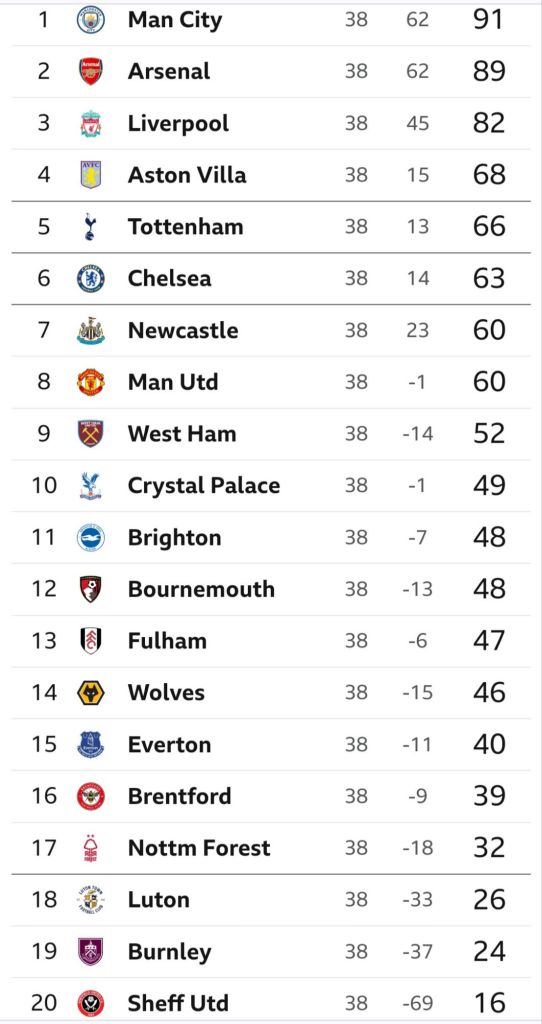
Now all the final results are in and validated, the Board can now proceed to the classification of Honours for the 2023/24 Premier League.

As Chair, I will remind you of the regulations as we go through. Fortunately, as was the case last year, matters are relatively straightforward.

FINAL TABLE

Three candidates (Manchester City, Arsenal, and Liverpool) have a final score greater than or equal to 70 and will therefore be awarded First Class Honours. All three can look forward to further study abroad in Europe next year. Manchester City win this year’s prize for getting the top marks as well as a special award for getting away with so many financial irregularities.

The next five candidates all have scores in the range 60-69 so they are all in the Upper Second Class, i.e. II.1, category though in the case of Newcastle United and Manchester United, only just. Aston Villa will be disappointed to have missed out on a First, but their mark of 68 is nevertheless enough to ensure they will be heading abroad next year along with the top three.

Tottenham and Chelsea (and perhaps Newcastle United) will also get to study abroad next year. Manchester Utd are taking an extra exam on Saturday and if they pass that will get to study abroad, in place of Newcastle.

Only one candidate is in the Lower Second Class (II.2) this year (West Ham), while the next six candidates all get clear Thirds, having marks in the range 40-49. The Board discussed whether to offer Crystal Palace a viva but in the end decided it couldn’t be bothered. Everton only just passed, with a mark of 40, after having points deducted for disciplinary reasons.

Brentford technically failed with a mark of 39 but can pass by compensation.  Nottingham Forest only just scraped through by compensation last year, and did even worse this year including having marks deducted for cheating but, having considered the extenuating circumstances, the Board has decided to allow them yet another go, although they do not qualify for Honours and must be content with being classified as “Ordinary”.

That leaves the three candidates at the bottom of the table – Luton Town, Burnley, and Sheffield United  – who are all “hard fails” . They  will have to terminate the course and consider their options. The Chair has agreed to meet with the Admissions Team to understand how Sheffield United was admitted to the course when they were so clearly under-qualified. Perhaps some form  of administrative error occurred?

Examination Time in Maynooth

Posted in Barcelona, Education, Maynooth, The Universe and Stuff with tags , , on May 17, 2024 by telescoper

Today ( Friday 17th May) is the first day of the Summer Examination Period in Maynooth. Although I’m not there right now I thought I’d take the opportunity to wish all students the best for their examinations:

You shouldn’t really be relying on luck of course, so here are some tips for the examination period (especially for physics students, but applicable elsewhere).

  1. Try to get a good night’s sleep before the examination and arrive in plenty of time before the start. Spending all night cramming is unlikely to help you do well.
  2. Prepare well in advance so you’re relaxed when the time comes.
  3. Read the entire paper before starting to answer any questions. In particular, make sure you are aware of any supplementary information, formulae, etc, given in the rubric or at the end.
  4. Start off by tackling the question you are most confident about answering, even if it’s not Question 1. This will help settle any nerves. You’re under no obligation to answer the questions in the order they are asked.
  5. Don’t rush! Students often lose marks by making careless errors. In particular, check all your numerical results on your calculator at least twice
  6. Please remember the units!
  7. Don’t panic! You’re not expected to answer everything perfectly. A first-class mark is anything over 70%, so don’t worry if there are bits you can’t do. If you get stuck on a part of a question, don’t waste too much time on it (especially if it’s just a few marks). Just leave it and move on. You can always come back to it later if you have time.

Meanwhile, in Barcelona, Monday is a public holiday (Pentecost) so I am faced with the prospect of having to endure a long weekend break. Such is life…

Marking Scheme

Posted in mathematics with tags , , , on December 8, 2023 by telescoper

With Christmas looming and the January examination period getting closer, I thought I’d help (?) those involved in such assessments by sharing this model of an elegant marking scheme from a Mathematics examination.

What could be simpler?

Winding Up

Posted in Biographical, Education, Maynooth with tags , , , on August 16, 2023 by telescoper

This morning, we held the last meeting this academic year of the Departmental Examination Board to look over the results of the recent repeat examinations ahead of the final upload this afternoon. That having been satisfactorily completed, I have now finished my teaching-related duties for this academic year. I start a year’s sabbatical on 1st September, so I won’t be attending more Exam Boards for a while!

Another loose end to be dealt with was the Departmental Twitter account, which I have been running. Twitter is really terrible these days and I have decided to deactivate my own personal account entirely on 31st August. The departmental account probably should stay open, so this afternoon I transferred its controls to our Departmental Adminstrator. Just before doing so, I realised that the password was a bit rude, so I quickly changed it to something more presentable before handing it over to avoid embarrassment.

If you want to follow that account, by the way, you can!

All I have left to do now is remove a few personal things from my office for whoever uses it next academic year. I’ve got plenty of time to do that, although I will be away for part of next week (way down South, in Cork).

Tonight, however, although it’s a school night, I think I’ll celebrate by having a little drink and watching the Super Cup Final between Man City and Sevilla the telly box. Cheers!

Examinations, Past and Future

Posted in Biographical, Education, mathematics, Maynooth with tags , , , , , on June 7, 2023 by telescoper

No sooner is yesterday’s departmental Examination Board done and dusted (after just two and a half hours) when attention switches to school examinations. The Junior Certificate and Leaving Certificate examinations both start today, so the first thing I need to do is wish everyone taking examinations the very best of luck!

Among other things, the results of the leaving certificate examinations are important for next year’s University admissions. As we gradually dispense with the restrictions imposed during the pandemic, it seems this year we just might have the results before the start of teaching at the end of September. That will make a nice change!

In the system operating in England and Wales the standard qualification for entry is the GCE A-level. Most students take A-levels in three subjects, which gives them a relatively narrow focus although the range of subjects to choose from is rather large. In Ireland the standard qualification is the Leaving Certificate, which comprises a minimum of six subjects, giving students a broader range of knowledge at the sacrifice (perhaps) of a certain amount of depth; it has been decreed for entry into this system that an Irish Leaving Certificate subject counts as about 2/3 of an A-level subject for admissions purposes, so Irish students do the equivalent of at least four A-levels, and many do more than this. It’s also worth noting that all students have to take Mathematics at Leaving Certificate level.

Overall I prefer the Leaving Certificate over the UK system of A-levels, as the former gives the students a broader range of subjects than the latter (as does the International Baccalaureate). I would have liked to have been allowed to take at least one arts subject past O-level, for example.

For University admissions points are awarded for each paper according to the marks obtained and then aggregated into a total CAO points, CAO being the Central Applications Office, the equivalent of the UK’s UCAS. This means, for example, that our main Science pathway at Maynooth allows students to study Physics without having done it at Leaving Certificate level. This obviously means that the first year has to be taught at a fairly elementary level, but it has the enormous benefit of allowing us to recruit students whose schools do not offer Physics.

As much as I like the Leaving Certificate, I have concerns about using a simple CAO points count for determining entry into third-level courses. My main concern about is with Mathematics. Since the pandemic struck, students have been able to choose to questions from just six out of ten sections. That means that students can get very high grades despite knowing nothing about 40% of the syllabus. That matters most for subjects that require students to have certain skills and knowledge for entry into University, such as Physics.

I’ve been teaching the first year Mathematical Physics course in Maynooth for about 5 years. At the start of the module I put up a questionnaire asking the students about various mathematical concepts and asking them how comfortable they feel with them. It’s been noticeable how the fraction that are comfortable with basic differentiation and integration has been falling. That’s not a reflection on the ability of the students, just on the way they have been taught. As well as making adjustments during the pandemic for online teaching, etc, I have changed various things about the teaching, in particular adjusting the way I have introduced calculus into the module. Another problem is that we have been forced to start teaching first-years a week late because of delays to the CAO process caused by the pandemic.

I’ll be on sabbatical next academic year so I won’t be teaching the first-years (or anyone else) in September. It’s time to hand these challenges on to someone else!